
Every department says it uses AI agents. Almost none of them let an agent finish anything on its own.
That gap is the story of enterprise AI in 2026. Wharton Human-AI Research and GBK Collective published their fourth annual adoption study on October 13, and the numbers describe a market that paid for autonomy and then quietly kept the hand brake on.
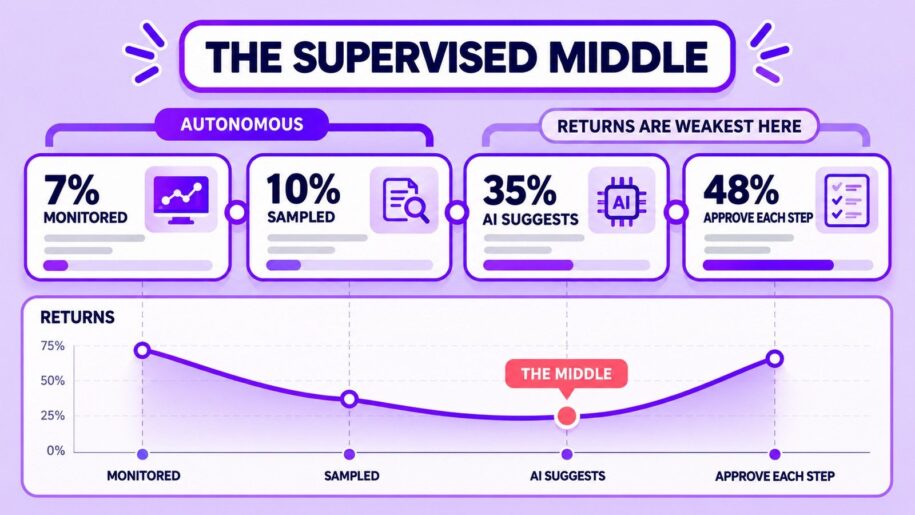
Two thirds of departments, 67%, report using AI agents in some form. Only 17% let an agent complete a task without a person approving each step. The largest single group is the most revealing: 48% say the AI performs the work and a person reviews it before anything happens. Another 35% use AI to suggest or draft while a person makes every final call.
Add those two groups together and you get 83%. Eighty three percent of departments keep a person in the loop on every action.
GBK’s Brian Smith named the pattern in the announcement: “Most companies are sitting in a supervised middle, paying for autonomy and then reviewing every action, and that is where returns are weakest.”
The operative word is paying. Companies are funding agentic capability and running it at human-approval speed, which is the most expensive way to use the technology on the market. That is not a technology failure. It is a trust failure, and it has a specific cause.
What the 2026 study actually measured
The Wharton and GBK research report defines workflow transformation as three conditions held at once: workflows have changed significantly, AI is embedded in core business processes, and agents are in use in some form. Only one in five organizations meet all three. Only 7% succeed across every marker the study tracks.
The payoff for closing that gap is not marginal. Among departments that meet the transformation definition, 67% report strongly positive ROI, against 19% of those that do not. Across the whole sample, 80% of managers and above report some positive return on AI, but only 28% call it strongly positive. Wide adoption, thin results.
The measurement question turns out to matter as much as the technology. Among departments tracking at least one growth measure, such as net-new revenue or sales conversion, 35% report strongly positive returns. Among those measuring efficiency alone, 13%. Time saved is a real outcome, and it is a narrow one. Organizations that only count hours are counting the smallest part of the return.
What an agent needs before you can hand over authority
An AI agent needs three things before it can own a task: a current record of what is actually happening, definitions that mean the same thing in every system it reads, and a monitoring layer that catches errors without a human watching every step. Remove any one of the three and autonomy stops being an operating decision and becomes a risk decision instead.
That definition matters because it reframes the entire vendor conversation. The question stops being which agent is smarter and becomes whether the record underneath it can be defended. We wrote about why AI adoption keeps turning into a trust problem for the same reason.
The autonomy ladder, and where the returns actually sit
The study lays out an autonomy ladder, and the distribution across it is lopsided.
At the top, 7% of departments use real-time monitoring and systematic guardrails instead of human review. Just below them, 10% review a sample of the agent’s output after the fact. That is 17% operating with genuine autonomy in any form.
Below that, 35% of departments let AI suggest or draft, with a person making every final call. At the bottom rung, where most of the volume sits, 48% let the AI perform the work and require a person to review and approve it before anything happens.
The correlation between authority and results is hard to miss. Where agents may take actions that touch customers, 25% of departments have transformed their workflows, against 12% of those that do not. Where agents may take irreversible financial or legal actions, the figure is 29% against 13%. Departments that monitor agents automatically have transformed at 24%, against 9% that do not.
There is a genuinely counterintuitive finding buried in the same data. Thirty one percent of departments using agentic AI to its fullest capacity achieve transformational success. So do 25% of departments where AI only advises and no agents run at all. Both ends of the spectrum outperform the middle. Partial automation, the place where 83% of departments live, is the worst position in the study.
Agents on a defensible record versus agents on a fragmented one
The difference between the two ends is not the model. It is the condition of the source.
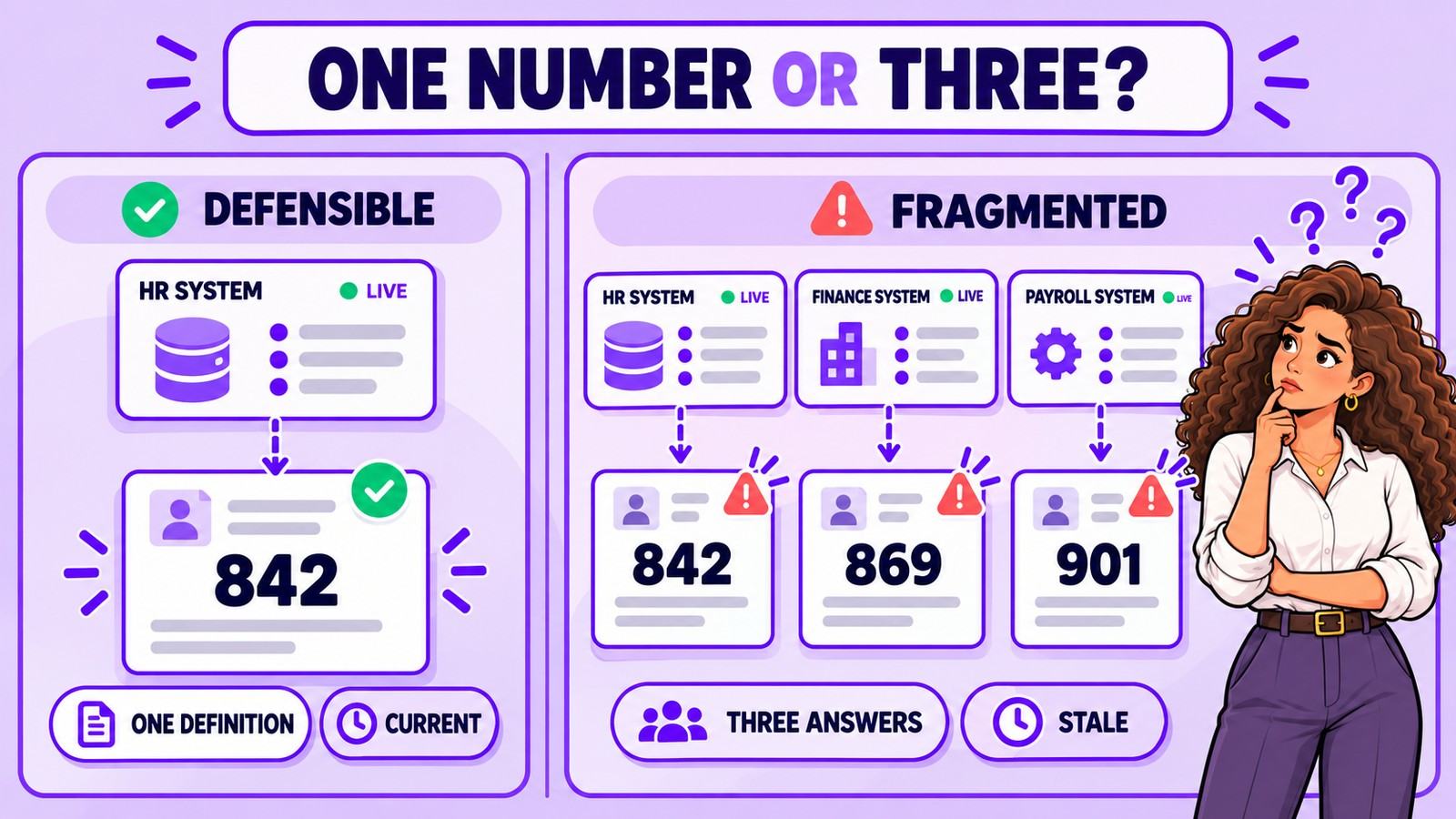
| Dimension | Agent on a defensible record | Agent on a fragmented record |
|---|---|---|
| The core number | One agreed definition, used everywhere | Three systems, three different answers |
| Freshness | Current inside the reporting cadence | Stale by a quarter or more |
| Error handling | Automated monitoring catches drift | A human approves every step, so errors queue up |
| Agent’s role | Owns the task inside written limits | Drafts the work, then a person redoes it |
| Cost structure | Capability at machine speed | Capability at human-approval speed |
| Failure mode | Bounded, traceable, correctable | Confident, repeated, and expensive |
Read the left column again. Nothing in it is exotic. Every item is a governance decision about definitions, ownership, and freshness, and every item is cheap compared to the cost of running agents in the right column for another year. Freshness is the one teams underestimate most, and it comes with its own cadence problem.
Where agents genuinely help
None of this is an argument against agents. The case for them is already settled in the areas where the record is clean and the stakes are bounded.
Agents are excellent at reconnaissance. They can read across systems that no human has time to reconcile, surface the contradictions, and hand a short list to the person who owns the decision. That work used to consume an analyst’s week.
They are strong at drafting and first-pass synthesis, particularly where a human will refine the output. The 35% of departments using AI to suggest and draft are getting real value, even though they sit outside the transformation marker.
They are also the most reliable way to find out whether your definitions hold. Point an agent at your people data and it will surface every place where two systems disagree about what a headcount is. That is unpleasant and it is exactly the audit most organizations keep postponing. We made the same observation when agents started outrunning how well organizations understand their own culture.
The pattern holds across all three: agents earn their keep fastest where the work is bounded and the record is defensible. Extend their authority past that line and you are buying speed on top of uncertainty.
Why management structure matters more than headcount
The study is blunt about what separates the winners. It is not staff reductions.
Sixty four percent of departments reporting strongly positive ROI have changed their management structure because of AI, against 47% of those that have not. Crucially, they report no more staff reductions or hiring freezes than anyone else. The redesign is about how work is managed, not how many people are left.
Ownership shows up the same way. Fifty eight percent of organizations with a newly designated Chief AI Officer report strongly positive ROI, against 8% where no such role exists and none is planned. Workforce data needs that kind of ownership because it deserves the same discipline financial data already gets. Standardization tells the same story: 50% strongly positive among organizations standardized on a single approved AI platform, against 9% among those still experimenting without a defined approach.
The training gap is the uncomfortable one. Seventy eight percent of leaders believe employees receive adequate AI training, against 56% of employees who say the same. When you ask the two groups about the same program, they describe different companies.
There is one more number worth sitting with. Seventy two percent of managers and above say their focus has shifted from creating outputs to managing AI-generated outputs. Among vice presidents and above, it reaches 82%. Verification has quietly become the core of the job, which is precisely why verifying every single step does not scale. If human review is your only control, your organization’s ceiling is the number of things your managers can read in a day.
What to ask a vendor before you grant autonomy
- Where does this agent’s data come from, and how fresh is it at the moment it acts?
- Show me how you define our two most important metrics. Do your definitions match ours, and where do they diverge?
- What monitoring runs while the agent works, and what happens automatically when it drifts?
- Which actions can the agent take without a human, and which are permanently gated?
- What is the audit trail for a decision the agent made six months ago?
- What happens to individual-level data in the pipeline, and who inside our company can see it?
- If we turn this off, what are we left holding?
Question six is the one most vendors would rather skip. It is also the one that decides whether the other six answers hold up, because measurement your employees do not trust produces signal you cannot defend. That is true of agents and it was true before agents existed.
Frequently Asked Questions
What is the “supervised middle” in the Wharton study?
It is the group of departments that use AI agents but require human approval at every step. In the 2026 Wharton and GBK study that is 83% of departments: 48% where a person reviews the work before it happens, plus 35% where a person makes every final call. The study identifies it as the position with the weakest returns.
What is the difference between an AI agent and a chatbot?
A chatbot answers questions and produces text for a person to use. An agent takes action toward a goal, often across multiple systems, without being prompted at each step. The study found 81% of managers report chatbot use in their department, against 67% reporting agent use, which is why the two are frequently conflated in vendor decks.
Why do companies say they use agents but still approve every action?
Because approving every step is a risk control, not a technology limitation. It exists because leadership cannot defend the record the agent acts on. The study links higher agent authority to better outcomes, but strictly on the basis that some control layer is doing the work: 24% of departments that monitor agents automatically have transformed their workflows, against 9% that do not.
How do you know if your people data is good enough for agent autonomy?
Run one test. Take your most important workforce metric and ask three departments to define it. If the definitions match and the underlying rows are current, the record can carry authority. If three answers come back, an agent will inherit all three and choose one without telling you.
Why does measurement matter more than model quality here?
Because the study separates returns by what organizations track. Thirty five percent of departments measuring at least one growth outcome report strongly positive returns, against 13% measuring efficiency alone. What you measure decides which improvements you can see and fund, regardless of which model is running.
Why is data privacy part of an autonomy conversation?
Because trust and data quality are the same problem seen from two directions. Teams that believe they are being watched as individuals produce cautious, edited signal. Signal collected anonymously at the source and aggregated at team level stays usable, which is what makes the record defensible enough to hand an agent real authority.
Do we need a Chief AI Officer to get these results?
The data says ownership matters more than the title. Fifty eight percent of organizations with a newly designated CAIO report strongly positive ROI, against 8% with no such role and none planned. The mechanism is clear: someone has to own which work an agent may do, how it gets monitored, and what happens when it drifts.
The next decision is about authority, not models
The 2026 Wharton and GBK study describes a market that has finished adopting and has not finished redesigning. Agents are in two thirds of departments. Almost none of them are trusted with the final step.
Closing that gap is not a matter of waiting for better models. The organizations reporting the strongest returns changed how work is managed, assigned clear ownership, standardized their platforms, and put automated monitoring in place so that step-by-step human approval stopped being the only control. Every one of those moves is available today, and none of them require a bigger budget than the agents already cost.
Start with the record your agents would act on. If you cannot defend it in front of your leadership, no amount of agent capability will fix that, and every step of human approval you add is a signal that the foundation is not ready.
Wurkn exists for that exact problem. We read the signal your teams already produce where the work already happens, anonymize it at the collection layer before it touches anything else, and aggregate at team level with hashed identifiers. No individual scorecards, no activity monitoring, and no ambiguity about what the number means or where it came from.
If your organization is sitting in the supervised middle and you want to find out why, a benchmark against organizations of your size is the fastest way to see where your record actually stands. That conversation starts at wurkn.com.