
A floating holiday is a paid day off that isn't attached to a specific public holiday like Thanksgiving or Canada Day. Think of it as a flexible ‘wild card’ day an employee can play whenever it holds personal, cultural, or religious meaning for them. It’s a genuinely powerful tool for recognizing and celebrating the diverse backgrounds that make up your team.
Unlocking Flexibility with Floating Holidays

As workplaces across the United States and Canada become more diverse, a standard holiday calendar that only marks statutory holidays can unintentionally leave people out. A floating holiday policy tackles this gap head-on, giving employees real choice and autonomy over their time.
This benefit allows individuals to shape their work calendar to better fit their lives. For example, an employee could use a floating holiday to:
- Observe a religious holiday like Diwali, Yom Kippur, or Eid al-Fitr.
- Celebrate a cultural event such as Lunar New Year or Juneteenth.
- Mark a personal milestone like their birthday or a child's graduation.
- Take a mental wellness day to recharge and head off burnout.
When you offer this kind of flexibility, you send a clear message: we see you, and what's important to you is important to us. This isn't just a perk; it's a foundational piece of an inclusive culture and a key factor in achieving work-life balance.
Beyond a Simple Perk
A floating holiday is much more than another day off—it's a strategic cultural lever. While standard HR surveys might tell you if people are satisfied, a business intelligence platform like Wurkn can show you the real-world ripple effect of policies like this.
Wurkn digs into aggregated, anonymous sentiment data to reveal how benefits like floating holidays directly influence employee engagement, belonging, and overall morale. This shifts the conversation from just tracking time off to understanding its true cultural ROI, providing insights far beyond what a traditional employee engagement platform can offer.
Ultimately, knowing what a floating holiday is means seeing its potential to build a more supportive, adaptable, and loyal workforce. It shows a commitment to employee well-being that goes far beyond a one-size-fits-all approach to benefits.
Floating Holidays vs PTO and Personal Days
It’s easy to lump all time off into one big bucket, but understanding the real differences between leave types is critical. For employees, it means knowing how to use their benefits effectively. For employers in the US and Canada, it’s about crafting a policy that’s not just generous, but also smart and inclusive.
Think of your time-off policies as a toolkit. Each tool has a specific job. Statutory holidays like Canada Day or the Fourth of July are fixed dates set by the government for nearly everyone. A floating holiday, however, is different. It’s a tool for personal choice, designed specifically to empower your team to observe days that hold personal meaning.
This distinction is what transforms a good benefits package into a great one. A standard PTO bank is perfect for general rest and relaxation, but floating holidays acknowledge that a one-size-fits-all calendar doesn't reflect the diverse cultural and personal lives of a modern workforce.
Clarifying the Key Differences
Let’s get practical and break down how these leave types actually work. Each one fills a unique need in an employee’s life, and when offered together, they create a much more comprehensive and supportive system.
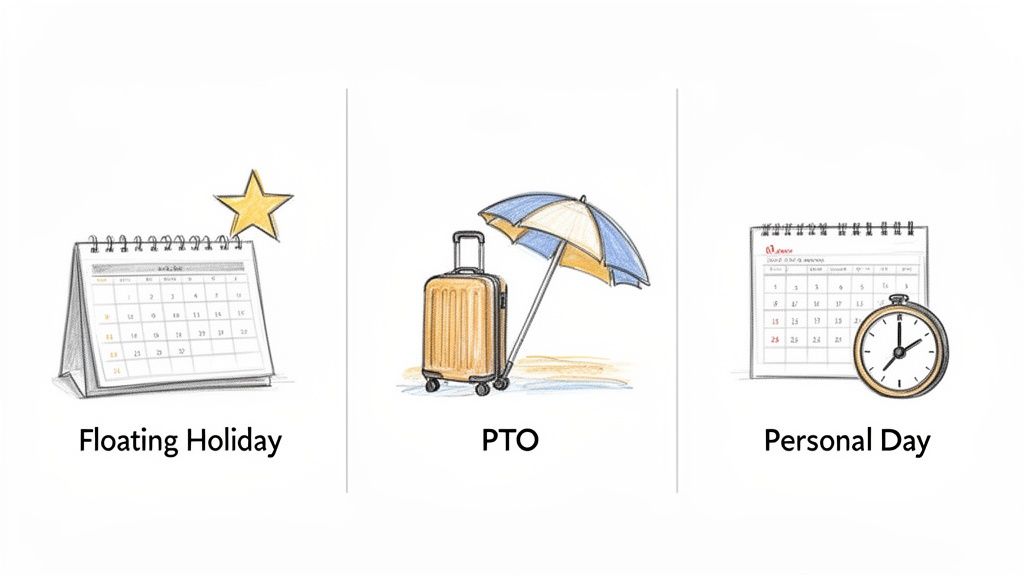
- Paid Time Off (PTO) or Vacation: This is the big one. It's a bank of accrued hours or days meant for planned, longer stretches of rest. Think of the employee in the US using a week of PTO for a family road trip to a national park.
- Personal Days: These are your go-to for urgent, often unforeseen personal matters. A Canadian employee might use a personal day to deal with a sudden household repair or attend a last-minute parent-teacher conference.
- Floating Holidays: This leave is explicitly for observance and celebration. It gives an employee the freedom to honour a day of personal, cultural, or religious significance that isn’t on the company’s official holiday calendar.
A floating holiday's real power is in the message it sends. It tells your team that you see and respect their individual identities. You're moving beyond a generic leave policy to one that actively champions diversity and inclusion.
Real-World Scenarios in Action
Let’s see how this plays out for an employee in Toronto who wants to observe Diwali in October. Her company offers standard public holidays, but Diwali isn’t on that list. Instead of burning a generic vacation day, she uses her floating holiday. The specific designation validates her cultural celebration—it’s not just another day off.
Later that month, she has a scheduled dentist appointment. She uses a personal day for that short, necessary absence. Finally, for a week-long getaway in December, she taps into her accrued PTO. Each type of leave serves its intended purpose, giving her flexibility without having to make compromises.
By differentiating these benefits, companies get much clearer insight into what their employees actually need. But tracking usage is just the start. This is where a business intelligence tool like Wurkn goes deeper. It can analyze aggregated sentiment data to show how policies like floating holidays genuinely impact feelings of belonging and morale. It connects the dots between your benefits strategy and the tangible health of your culture—proving a value that a traditional HR survey could never capture.
Why a Floating Holiday Policy Is More Than Just a Perk
Rolling out a floating holiday policy isn't just about adding another line item to your benefits package; it's a powerful strategic move. The most immediate payoff is the boost to employee morale and the feeling of genuine inclusion. When people can take a paid day off for a cultural, religious, or personal event that truly matters to them, it sends a clear message: we see you, and we value who you are outside of these walls.
In a tight job market across the US and Canada, that kind of recognition makes a real difference. When top talent has choices, a benefits package that proves you’re committed to diversity and well-being can easily become the deciding factor.
It's About Building a Culture of Appreciation
A floating holiday is one of the simplest, most direct ways to show your team you trust and respect them. You're giving them autonomy over their own time, which is a massive contributor to a healthier work-life balance and a great way to push back against burnout. This small gesture is a key ingredient in building a loyal, engaged workforce.
It's also a practical solution for supporting a diverse team without creating an impossibly long list of company-wide holidays. Instead of guessing which celebrations matter most, you empower each person to make that choice for themselves. For more on creating this kind of positive environment, check out our guide on effective employee appreciation ideas.
Balancing the Benefits with the Admin
Of course, offering this kind of flexibility requires a bit of planning on the back end. Scheduling conflicts are a valid concern, especially for smaller teams or during peak business seasons. And without a crystal-clear policy, you can run into legal risks, particularly around how unused days are handled when an employee moves on.
But these challenges are completely manageable with the right approach. The key is to build a straightforward request-and-approval process and lay out the rules clearly from day one. In reality, countless organizations have found the payoff is well worth the administrative effort.
The trend toward this kind of flexibility is clear. In a 2021 survey by the American Society of Employers, nearly half of participating US employers offered floating holidays. (ASE, "floating holiday trends and their benefits").
This data shows that floating holidays are shifting from a niche perk to a mainstream strategy for building an inclusive and attractive workplace. The return on investment—in the form of higher morale, better retention, and a stronger culture—far outweighs the administrative tasks needed to manage the policy well.
Navigating the Legal and Payroll Landscape
Rolling out a floating holiday policy isn't as simple as just adding a day to the calendar. You have to get the legal and payroll details right, or what seems like a simple perk can quickly turn into a compliance nightmare. The rules for time off are notoriously complex, with major differences between jurisdictions in Canada and the United States.
The biggest legal tripwire is whether a floating holiday is treated as earned wages. If it is, that day often can't be forfeited and must be paid out when an employee leaves. Suddenly, your flexible benefit has become a significant financial liability you didn't see coming.
The California Complication
Nowhere is this issue thornier than in California. The state has a habit of viewing floating holidays as just another form of vacation pay, especially when they're offered with no strings attached. When that happens, the California Division of Labor Standards Enforcement (DLSE) considers the leave a vested wage. This means any unused floating holidays have to be included in an employee’s final paycheque. As noted by CalChamber, this interpretation kills any chance of a simple "use-it-or-lose-it" policy for unrestricted floating holidays (California's policy determines payout rules).
To sidestep this risk, many employers in places like California build specific conditions into their policies. These small tweaks can make a huge difference:
- Link it to an event: Tie the floating holiday to something specific, like an employee's birthday or work anniversary.
- Give it an expiry date: Require the holiday to be used within a specific pay period or quarter (where legally allowed).
- Make it a substitute: Frame the day as a replacement for another company-wide holiday, like the day after Thanksgiving.
These small but strategic details can help classify the benefit as something other than accrued vacation, dialing down your financial risk.
Payroll and Administrative Best Practices
Beyond the legal maze, your payroll administration has to be rock-solid for a floating holiday program to work. Your system needs to be set up to handle this unique leave type separately from standard PTO, sick leave, or public holidays.
The real administrative headache is ensuring you're tracking and reporting everything accurately. If you misclassify a floating holiday in your payroll system, you're looking at incorrect accrual calculations, improper payouts at termination, and a whole lot of compliance trouble.
The first step is creating a distinct time-off code just for floating holidays. This makes sure every hour is tracked correctly from the moment it’s granted to when it’s used. That level of detail is non-negotiable for both financial audits and proving you’re following the law.
But just tracking usage numbers only gives you part of the picture. This is where a business intelligence platform like Wurkn goes beyond simple metrics. While a basic HR survey might ask employees if they like the new policy, Wurkn analyzes aggregated, anonymous sentiment data to show you how the policy is actually landing in your workplace culture. It connects the dots between your benefits strategy and real outcomes like employee morale and retention, giving you a much deeper understanding of your policy's true impact.
How to Build Your Floating Holiday Policy
Okay, let's get down to brass tacks. Crafting a floating holiday policy that actually works is the difference between a great idea and a management headache. This isn't just about writing down some rules; it's about building a benefit that your team understands, values, and can use without causing confusion.
A solid policy acts as your single source of truth. It prevents misunderstandings and ensures everyone, from new hires to senior leaders across Canada and the United States, is on the same page. The goal here is crystal clarity—ambiguity is the enemy of a good policy.
Defining Your Policy's Core Rules
A strong policy leaves zero room for interpretation. You need to nail down the fundamentals from the get-go. Think of these as the pillars holding up your entire program.
Start by answering these core questions:
- Eligibility: Who gets this perk? Is it just for full-time employees, or are part-timers included? Be specific about any waiting periods for new hires.
- Number of Days: How many floating holidays are you offering? Most companies land on one or two days per year. Keep it simple and fair.
- Request Process: How does someone actually book their day? Define your notice period (e.g., two weeks in advance) and the approval workflow. This is crucial for managing schedules and keeping operations smooth.
- Carryover Rules: Do the days expire? A "use-it-or-lose-it" approach is pretty common, where days must be taken within the calendar or fiscal year. Just be sure to check local laws on this, as some jurisdictions have specific rules.
Getting the back-end process right is just as important. This flow shows how time off moves through the payroll system, from the initial setup to the final payout.
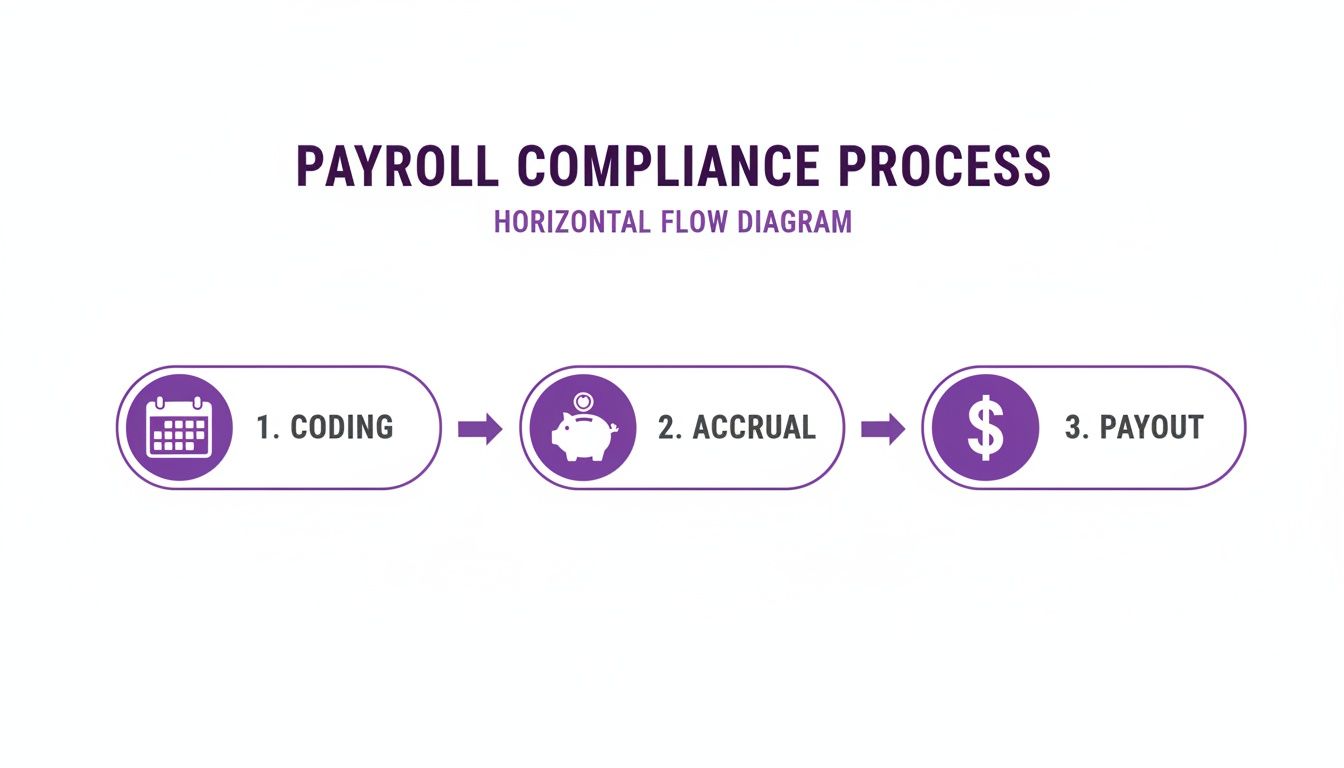
As you can see, proper coding and accrual practices are essential. Mess this up, and you're in for a world of compliance pain and inaccurate paycheques.
Communicating Your New Benefit
How you roll out the policy is just as critical as the policy itself. A sloppy launch can undermine the whole thing. Frame the announcement around the why—this is about your commitment to flexibility, inclusivity, and work-life balance.
Don't just email a dry policy document and call it a day. Explain the value.
A quick legal aside: the regulatory environment has pushed companies to get these policies in writing. As legal experts at Ogletree Deakins point out, if leave is offered without clear conditions, it can be treated like vested vacation time—meaning you have to pay it out when an employee leaves (employment law interpretations impact time-off flexibility).
By having a clear, written policy and a payroll system that can handle it properly, you sidestep that risk.
Ultimately, a successful rollout gives every employee the confidence and knowledge to use this benefit. That’s how a policy document transforms into a genuine cultural asset that people actually appreciate.
Measure the True Impact of Your Policies
So, you’ve rolled out a floating holiday policy. Great. But if all you’re doing is counting the number of days people take off, you're missing the entire point.
Traditional HR platforms are decent at tracking absence, but they’re completely blind to the why. They can’t tell you if your new benefit is actually making your workplace better, or if it's just another box to check. This is precisely where a business intelligence platform like Wurkn changes the game, moving beyond the limits of typical HR survey tools.
Wurkn plugs into the anonymous, aggregated communication happening in places like Slack and Microsoft Teams. This gives you a real-time pulse on how a policy like a floating holiday is genuinely landing with your teams across Canada and the United States.
Beyond Simple Metrics
Wurkn isn’t about counting days off; it's about connecting your policy to the business outcomes that actually matter. Are conversations around work-life balance becoming more positive since you launched the benefit? Is there a measurable uptick in team engagement scores after a long weekend filled with cultural celebrations that your employees could finally attend?
This is the kind of insight that turns your benefits strategy from a cost centre into a culture driver. It gives leaders concrete, data-backed proof that their investments in people are paying off.
Instead of just hoping a policy has an impact, Wurkn gives you the business intelligence to prove it. You can see, in black and white, how a benefit designed for inclusion actually makes employees feel seen and valued—which is a powerful engine for retention and loyalty.
Turning Sentiment into Strategy
Imagine logging in and discovering that since implementing floating holidays, voluntary turnover in your most diverse teams has dropped by 5%. Or seeing hard data that directly links the new policy to higher scores on your latest employee satisfaction survey. This is the actionable intelligence Wurkn is built to deliver.
By connecting the dots between qualitative employee sentiment and hard KPIs like productivity and retention, Wurkn transforms a simple perk into a measurable business asset. You stop just offering benefits and start making strategic investments in your people, with the data to back up every single decision.
Your Top Questions About Floating Holidays, Answered
As floating holidays become a staple in modern benefits packages across North America, a lot of good questions pop up. Whether you're an HR leader designing a policy or an employee trying to figure out how it all works, you're not alone. Let's clear up some of the most common questions.
Are Floating Holidays Required by Law?
Nope, not at all. Floating holidays aren't legally required in either Canada or the United States. Think of them as an optional, employer-provided benefit—a strategic tool companies use to build a more competitive compensation package and a genuinely inclusive culture. The choice to offer them is entirely up to the company.
Do Floating Holidays Expire?
This is a classic "it depends" situation, and it hinges on your company's policy and sometimes, local laws. Many companies have a "use-it-or-lose-it" rule, meaning you have to take the day within a certain timeframe, like the calendar year.
But be careful—in some places, like California, an unrestricted floating holiday can be treated like vested wages. That means it can't expire and would have to be paid out if an employee leaves the company. It's a crucial detail to get right.
Can a Manager Deny a Floating Holiday Request?
Yes, an employer can deny a request based on real business needs. A solid floating holiday policy should spell out the request and approval process clearly, including how much notice an employee needs to give.
The key is to handle denials fairly and consistently to avoid any hint of discrimination. For instance, it's perfectly reasonable to deny a request from an employee in Vancouver during a critical project deadline or if half the team in a small Dallas office has already booked the same day off.
How Many Floating Holidays Should We Offer?
There's no magic number here, but the most common approach is to offer one to two floating holidays per year. The right amount for your company will depend on your overall benefits strategy, what your operations can handle, and the specific cultural goals you're trying to hit with the policy.
Tracking who takes what day off is just scratching the surface. To really understand the cultural return on your benefits investment, you need to go deeper. Wurkn is a business intelligence platform that looks beyond basic HR data. It analyzes aggregated, anonymous sentiment to show you exactly how policies like floating holidays are affecting morale, engagement, and retention. Discover the true impact of your culture with Wurkn.