
Think of a traditional personnel satisfaction survey like an old-fashioned family portrait taken once a year. It captures a single, posed moment but tells you almost nothing about the day-to-day life, the real ups and downs, that happened in between. For a long time, this was the standard, but that annual snapshot is dangerously out of sync with the fast-moving reality of today’s workplaces in Canada and the US.
Why Annual Surveys Leave You Flying Blind
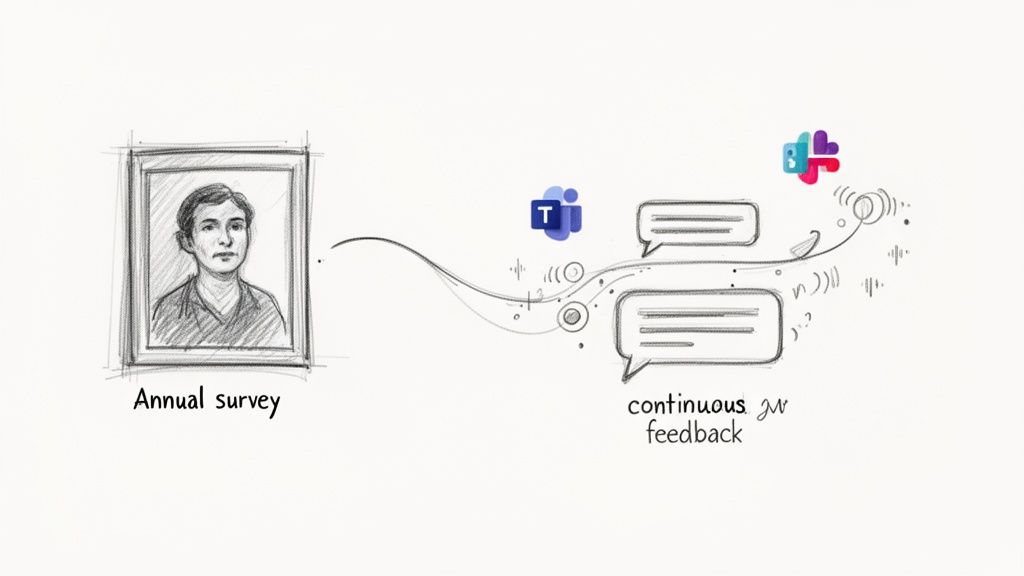
When you rely on a once-a-year survey, you're always playing catch-up. By the time you’ve collected the data, spent weeks analyzing it, and finally started planning your response, your company's culture has already moved on. A small frustration that bubbled up in January could easily boil over into a team-wide problem by July, long before your next survey even goes out.
This massive delay forces leaders into a reactive loop, constantly fixing yesterday's problems instead of proactively building a better future. It’s like trying to navigate a ship using a map that's a year old; you're steering based on where you were, not where you are right now.
The Problem With an Outdated Snapshot
The biggest flaw in the annual survey model is that it’s purely retrospective. It’s a history lesson, not a real-time dashboard. This creates several critical blind spots:
- Recency Bias: Employees naturally answer based on how they feel this week, not how they felt over the past 12 months. A single bad project or a recent success can skew the entire year's results.
- Action Lag: The gap between feedback and action can stretch for months. This delay sends a clear message to your team: "We hear you, but we're not in a hurry." Unsurprisingly, this breeds disengagement.
- The Incomplete Picture: A single data point completely misses the ebb and flow of morale. It won't show you the impact of a new product launch, a re-org, or a shift in team dynamics.
This outdated approach isn’t just inefficient; it's failing to capture a dangerously sharp decline in employee satisfaction. Recent data reveals a troubling trend: the percentage of employees satisfied with their job has plummeted from 80% to just 59% in only three years (Forbes, 2023). You can dig into the specifics by reviewing the full employee satisfaction survey report.
From Static Surveys to Live Intelligence
To manage culture effectively, you need to see what's happening as it happens. You need to upgrade from that single photograph to a live video stream. This is where a business intelligence tool like Wurkn delivers something a simple HR survey tool never can.
Wurkn isn't just a platform for asking questions; it's a business intelligence engine. It transforms continuous, anonymous feedback from platforms like Slack and Microsoft Teams into a live, operational dashboard that connects culture to performance.
This "always-on" approach provides the visibility needed to steer company culture with current data. Instead of reacting to last year’s problems, leaders can proactively spot declining morale, identify flight risks before they give notice, and draw a direct line between employee sentiment and your most important business KPIs.
Designing a Survey That Delivers Real Insights
An effective personnel satisfaction survey isn't just about throwing a long list of questions at your team. It’s about asking the right questions, the right way, to get past the polite yes/no answers and uncover what’s really going on in your company culture. This takes a bit of thought, with a design process centred on trust and clarity.
The entire foundation of a useful survey rests on one core principle: guaranteed anonymity. If your people even suspect their honest feedback could be traced back to them, you’ll get guarded, watered-down responses that are essentially useless.
This is exactly why a business intelligence tool like Wurkn is built with privacy at its core, ensuring every piece of feedback is fully anonymized. Without that trust, your data is compromised from the start. Think of it like a suggestion box where everyone knows the manager has a key and checks the handwriting—you're only going to get polite, surface-level comments, not the raw insights you actually need to hear.
Choosing the Right Question Types
To get a complete picture, you need to mix up your question formats. Each type has a specific job to do, and blending them helps you understand both the "what" and the "why" behind how your employees are feeling. A well-designed survey will always combine quantitative and qualitative questions to build a multi-dimensional view.
Here are the essential types to have in your toolkit:
-
Likert Scale Questions: These are the backbone of any quantitative analysis. You ask people to rate their agreement with a statement on a scale (e.g., from "Strongly Disagree" to "Strongly Agree"). This format is perfect for tracking sentiment trends over time on topics like leadership effectiveness or how people feel about their benefits.
-
Open-Ended Questions: They're a bit harder to analyze in large numbers, but these questions are pure gold. A simple prompt like, "What is one thing we could do to improve your team's workflow?" can uncover brilliant solutions and specific frustrations that a rating scale would completely miss.
-
Multiple-Choice Questions: These are great for gathering demographic data or understanding preferences between a few clear options, like which communication style works best or what kind of training formats people prefer.
A business intelligence platform like Wurkn doesn’t just collect these answers. Its AI-powered engine analyzes thousands of open-ended, anonymous comments to synthesize them into clear themes, turning messy qualitative feedback into a measurable asset that informs strategic decisions.
Pulse Surveys vs. Annual Reviews
Finally, you need to think about the rhythm of your feedback. The old-school annual review is quickly being replaced by a much more agile approach, especially for fast-moving organizations across Canada and the United States.
An annual survey is like a single census report—it’s a massive undertaking that's already outdated the moment it's published. In contrast, continuous feedback or frequent pulse surveys act like a real-time economic indicator, showing you subtle shifts as they happen.
For hybrid and remote teams where those informal "water cooler" chats just don't happen anymore, these continuous touchpoints are absolutely essential. They give you an ongoing channel to check morale, catch frustrations before they boil over, and make your people feel like they’re being heard all the time. This is the difference between reviewing a historical document and having live, operational intelligence.
Connecting Employee Feedback to Business KPIs
Getting data from a personnel satisfaction survey is the easy part. The real magic happens when you connect that raw, human feedback to tangible business outcomes, turning employee sentiment into the kind of strategic intelligence that shapes decisions.
This is exactly where most traditional HR survey tools miss the mark. They're great at giving you a satisfaction score, but they can't tell you why that score matters to your bottom line. A true business intelligence platform like Wurkn goes beyond percentages to expose the deep, often invisible, lines connecting your culture to your company's performance.
Instead of a generic report stating "engagement is down 5%," you get a specific, actionable insight. For example, Wurkn could show you precisely how a dip in sentiment around psychological safety on your engineering team correlates with a recent spike in their attrition rate. That’s not an HR problem; it’s a data-driven mandate to intervene before more top talent walks out the door.
From Cultural Signals to Measurable Outcomes
The goal is to translate what feels like soft, qualitative feedback into hard, quantitative proof of its impact. When you dig into survey data, you're not just reading comments; you're hunting for patterns that link cultural themes directly to your most critical key performance indicators (KPIs).
This isn't something you can do with a spreadsheet. It requires a system that can make sense of thousands of anonymous comments and sentiment data points, then display them on a dynamic dashboard. Wurkn’s AI pipeline does exactly that, giving leaders a real-time view of these connections as they happen.
For instance, you might suddenly discover:
- Poor Management Feedback: A recurring theme of poor communication from managers isn't just a morale issue. You can now see it's directly linked to a 15% drop in that team's productivity over the last quarter.
- Burnout Signals: A noticeable increase in comments about workload and stress isn't just chatter. It's a leading indicator that absenteeism is about to rise or that you're heading for a spike in turnover.
- Customer Satisfaction Link: In your customer-facing teams, you can see how a slide in employee morale reliably precedes a drop in your Net Promoter Score (NPS) or overall customer satisfaction ratings.
This is why getting the survey design right from the start is so critical. You need to capture the right data points to make these connections.
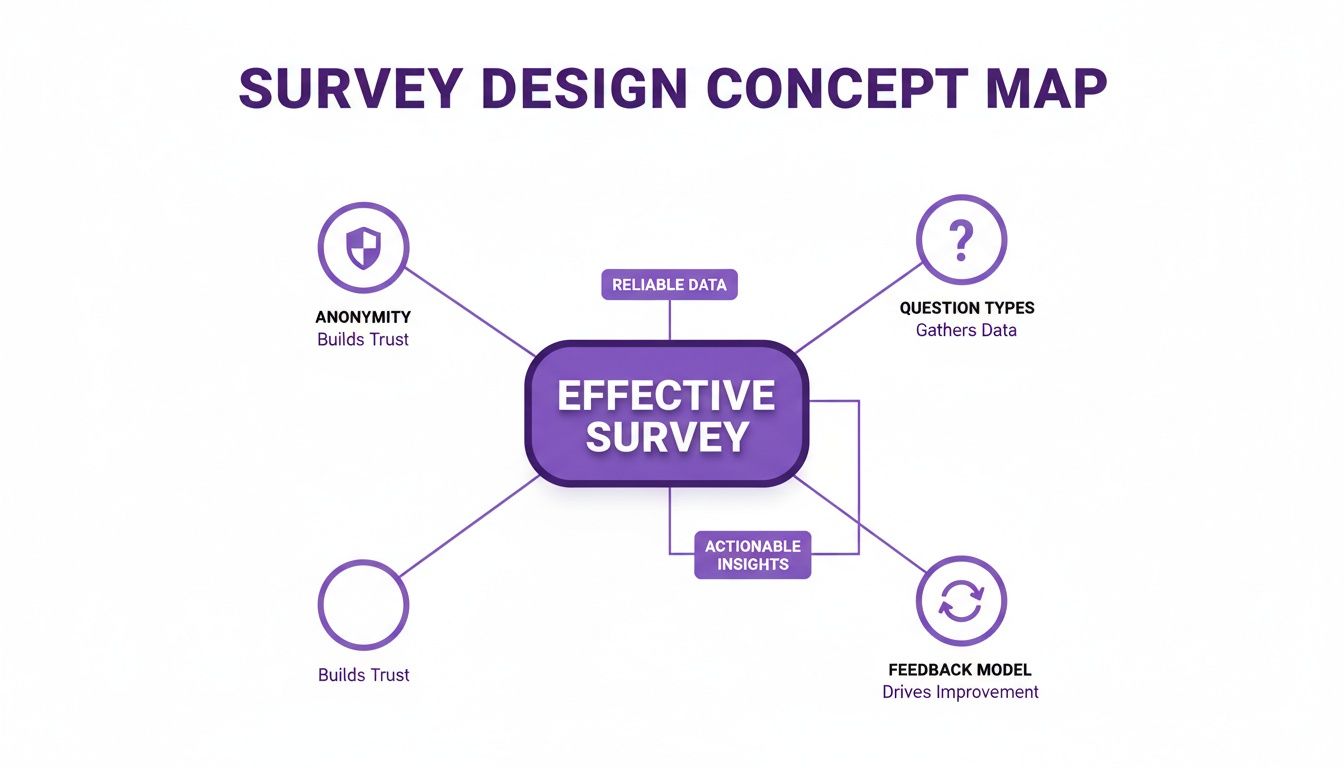
As the visualization shows, an effective survey is built on a foundation of anonymity, smart question design, and a consistent feedback loop.
Addressing Modern Workforce Risks
Understanding the forces shaping today's workforce is essential for interpreting your survey data correctly. A recent UC Irvine survey revealed a telling paradox: while 74% of workers report being satisfied, a massive 41% of in-person or hybrid employees would still leave for a fully remote role (UC Irvine, 2023).
This isn't just an interesting statistic; it's a huge retention risk for any company that isn't listening closely to what their people want from a modern work environment.
By linking sentiment data to business KPIs, you stop guessing what drives performance and start knowing. This proactive approach transforms HR from a cost centre into a strategic driver of growth and profitability.
Connecting Survey Feedback to Business KPIs
The table below shows how you can translate common themes from your survey feedback into measurable business impacts and the KPIs you should be watching. This is the core of turning cultural intelligence into a strategic asset.
| Survey Theme/Sentiment Driver | Potential Business Impact | Relevant KPI to Monitor |
|---|---|---|
| Low Psychological Safety | Reduced innovation, fear of failure, increased errors, higher turnover among top performers. | Employee Turnover Rate, Project Error Rate, Number of New Ideas Submitted |
| Poor Manager Communication | Decreased team productivity, project delays, lower engagement scores, misalignment on goals. | Team Productivity Metrics, Project Completion Rate, Employee Net Promoter Score (eNPS) |
| Concerns About Workload/Burnout | Increased absenteeism, higher healthcare costs, decline in work quality, spike in voluntary turnover. | Absenteeism Rate, Employee Retention Rate, Customer Satisfaction (CSAT) |
| Lack of Growth Opportunities | Loss of high-potential employees to competitors, difficulty filling senior roles internally. | Internal Promotion Rate, Time-to-Fill for Open Roles, Attrition Rate of High-Performers |
By building these connections, every piece of feedback becomes a potential indicator for a core business function, giving you a powerful early warning system.
This ability to connect feedback to tangible results is no longer optional for modern leadership. To go deeper on this, check out our guide on how COOs get actionable business insights from continuous employee feedback.
Essential Questions for Your Next Survey
Figuring out what to ask in a personnel satisfaction survey is where the rubber meets the road. If you ask the wrong questions, you get useless data. While you can find generic templates all over the internet, the best questions are always the ones that dig into what really makes your company culture in Canada or the United States tick.
The secret is to get a healthy mix of quantitative and qualitative questions. Think of it like a doctor's visit: you need the numbers from the blood pressure cuff (the "what"), but you also need to hear from the patient how they're feeling (the "why").
Quantitative questions—usually using a Likert scale like "Rate your agreement from 1 to 5"—are fantastic for setting a baseline and seeing how things change over time. But it's the open-ended, qualitative questions that provide the colour and context. This is where a business intelligence tool like Wurkn becomes invaluable, saving leaders hundreds of hours by automatically analyzing thousands of anonymous text responses to find the real themes.
Questions on Management and Leadership
Great managers are a force multiplier; bad ones are a bottleneck. These questions help you figure out if your leaders are empowering their people or just getting in the way.
- I receive regular, constructive feedback that helps me improve my performance. (Rate 1-5)
- My manager gives me the support and resources I need to do my job well. (Rate 1-5)
- What is one thing your manager could start doing to better support you and your team? (Open-ended)
Questions on Career Development
People don't leave companies, they leave dead-end jobs. If your employees can't see a future with you, they'll start looking for one somewhere else. These questions check the pulse on growth opportunities.
- I see a clear path for career advancement at this organisation. (Rate 1-5)
- The company provides good opportunities for professional development and training. (Rate 1-5)
- What skills would you like to develop to advance your career here? (Open-ended)
Questions on Inclusive Culture and Belonging
A sense of belonging isn't just a "nice-to-have"—it's a critical driver of psychological safety and high performance. Use these questions to find out if your workplace is truly as inclusive as you think it is.
- I feel respected and valued for my unique contributions. (Rate 1-5)
- I feel comfortable voicing my opinions, even when they differ from others. (Rate 1-5)
- What could our organisation do to create a more inclusive environment for everyone? (Open-ended)
For a deeper dive, including sharp questions on compensation and work-life balance, check out our complete employee opinion survey example for more ideas. By sorting your questions into these kinds of categories, you guarantee you're getting a complete picture of the employee experience, not just a snapshot.
From Static Reports to Always-On Intelligence
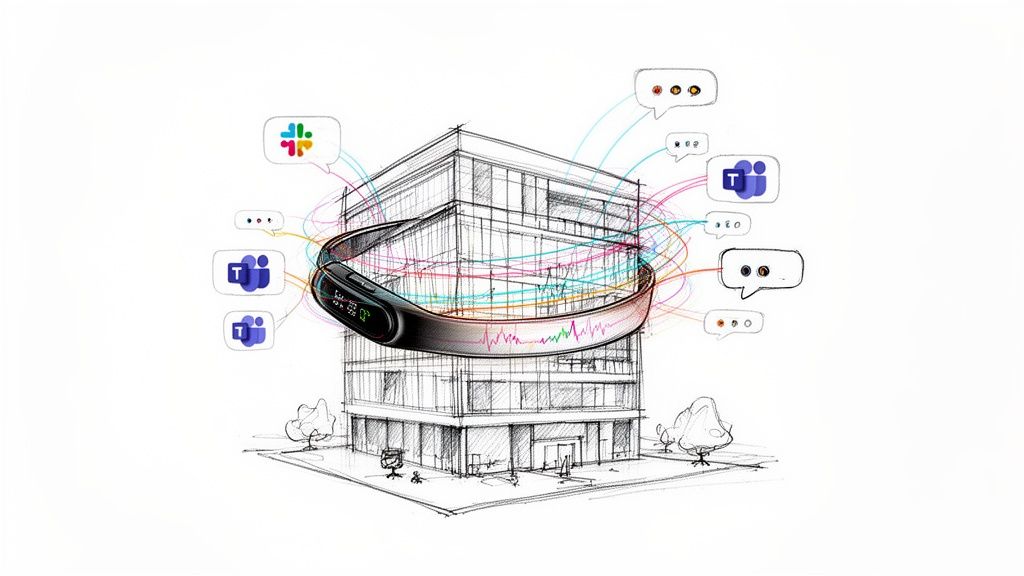
While a periodic personnel satisfaction survey has its place, the future of effective employee listening is continuous, always-on feedback. In today's fast-moving business world, relying only on a once-a-year snapshot is quickly becoming a major liability for organizations in Canada and across North America.
Think of it this way: an annual survey is like a yearly physical. It’s a decent check-up, but it completely misses the day-to-day health fluctuations. You could be perfectly fine on appointment day but struggling with a serious issue a month later that goes completely unnoticed until the next year.
An always-on business intelligence platform like Wurkn is much more like a wearable fitness tracker. It gives you a 24/7 stream of vital signs on your company’s cultural health, alerting you to problems the moment they pop up—not months after the damage is done.
Capturing Feedback in the Flow of Work
The secret to this modern approach is simple: meet your people where they already are. Instead of piling another task onto their already-full plates, a tool like Wurkn integrates right into the daily workflow tools they live in, like Slack and Microsoft Teams.
This allows the platform to capture unfiltered, anonymous sentiment without adding any friction to the employee's day. Someone can share a quick thought or a pressing concern in the moment, and that critical data point is captured and analyzed without ever interrupting their work.
This constant stream of information provides leaders with a living, breathing view of their company culture. It lets them connect emotional trends to business performance in real time, drawing a direct and undeniable line between how people feel and how the business performs.
This marks a critical shift in strategy—moving from reactive problem-solving where you’re always fighting yesterday's fires, to proactive culture optimization where you can anticipate challenges and shape a better future.
Turning High Engagement Into Continuous Intelligence
Even wildly successful traditional surveys show the limits of static data. For example, a large public university might achieve an incredible 62.2% response rate from over 14,500 participants. While that level of engagement is fantastic, it also highlights the monumental task of acting on a massive, singular dataset, as was the case for the UC Davis Employee Experience Survey (UC Davis Human Resources, 2023). You can read more about their survey results and next steps.
An always-on approach could have transformed that amazing participation into continuous intelligence, allowing leaders to address issues as they came up throughout the year.
Platforms like Wurkn solve this very problem by turning feedback from a periodic event into an ongoing operational asset. Instead of sifting through a historical report, leaders get a dynamic dashboard that visualizes cultural health as a core business metric—right alongside finance and sales data. It’s the difference between reading a history book and watching live news.
How to Turn Insights Into Meaningful Action
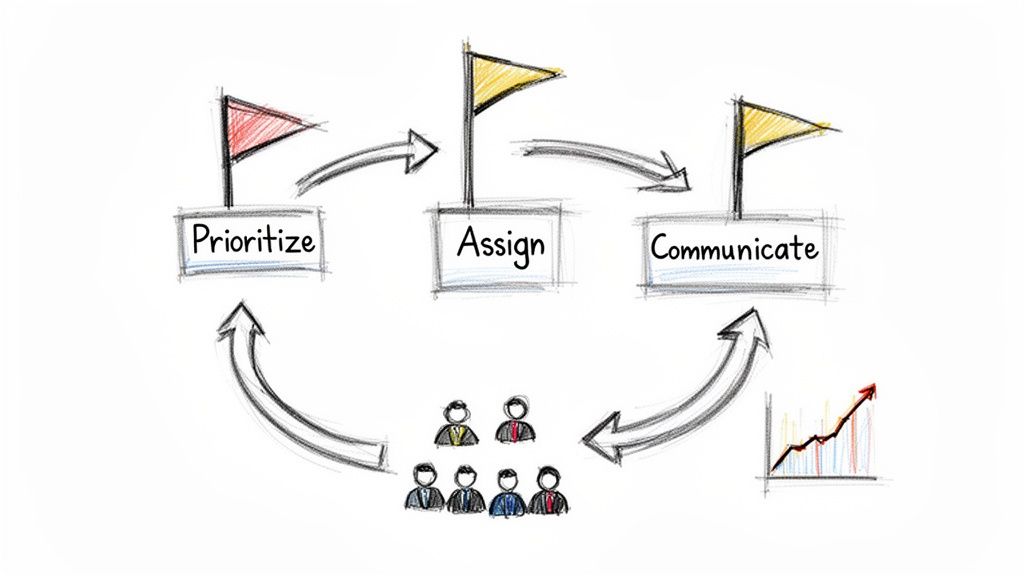
The single greatest mistake you can make with a personnel satisfaction survey has nothing to do with negative feedback—it’s doing nothing at all.
When you ask for opinions and then let the results gather dust, you're sending a loud, clear message: "We don't actually care." That silence is far more corrosive to morale than never asking in the first place. It breeds cynicism and erodes the trust you're trying to build.
To avoid this trap, you need a battle-tested plan for turning that raw data into tangible, visible improvements. It starts with triage. Not every piece of feedback carries the same weight. You have to zero in on the recurring themes, especially those impacting large groups of people or showing a direct line to business performance.
From Data to Delegation
Once your priorities are clear, the next step is assigning ownership. This is critical. A goal without a champion is just a wish. Every initiative, whether it's revamping manager training or clarifying career paths, needs a designated leader who is accountable for driving it forward.
This is where traditional employee engagement platforms fall flat. They give you a static report—a snapshot in time—but no clear way to manage the follow-through. A true business intelligence tool like Wurkn brings this process to life, offering a dynamic dashboard where leaders can track the real-world impact of their initiatives. You can actually see how a new communication protocol influences sentiment around leadership, proving its value in real-time.
Closing the Feedback Loop
Finally, and this is non-negotiable, you have to communicate everything back to your team. You must close the loop. This is the moment your employees see that their voices weren't just heard—they were valued and acted upon.
This isn't complicated, but it has to be deliberate. The process involves three key moves:
- Acknowledge and Share: Start by thanking everyone for their candour. Then, share the high-level themes you uncovered. Be transparent.
- Outline the Action Plan: Tell them exactly what you're going to do. Announce the specific initiatives you’re launching, who owns them, and what success will look like.
- Report on Progress: Keep them in the loop. Provide regular updates on how things are going, celebrating the wins and being honest about any roadblocks.
This level of transparency is a massive trust-builder. When people see their feedback directly lead to meaningful change, they become more engaged and invested in the company's success. This isn't just about running a survey; it's a fundamental part of learning how to improve company culture and creating a workplace that’s always getting better.
Common Questions from Operations Leaders
When COOs and PeopleOps leaders across Canada and the United States start thinking seriously about a modern feedback strategy, a few key questions always come up. Let's tackle them head-on.
How Often Should We Run These Surveys?
The old model of a massive, once-a-year survey is dead. While it might give you a deep snapshot, it also creates a massive blind spot for the other 11 months. The real value comes from a consistent rhythm of shorter, more frequent "pulse" surveys.
Think of it like this: an annual survey is like checking your oil once a year. A pulse survey is like having a real-time dashboard. Sending out brief questionnaires quarterly, or even monthly, helps you spot trends as they bubble up, not after they’ve already boiled over. You catch problems when they're small and manageable.
Can We Actually Guarantee Anonymity?
You can, and you absolutely must. Anonymity isn't a feature; it's the foundation of the entire system. Without it, you’re just collecting polite, filtered responses that tell you nothing about the real issues affecting productivity and retention.
A business intelligence platform like Wurkn is fundamentally different from a standard HR survey tool because it is built from the ground up with privacy at its core. It works by stripping out personally identifiable information and completely anonymizing every submission. This creates the psychological safety your team needs to give you the candid, valuable feedback that actually drives business improvements.
How Do We Get People to Actually Respond?
Great question. A high response rate isn't about incentives or top-down mandates; it's about building trust and proving that this isn't just another corporate exercise. People will gladly give you their time when they believe their feedback will actually lead to positive change.
Here’s how to build that trust:
- Explain the 'Why' Clearly: Don't just send a link. Communicate the purpose of the survey and exactly how the insights will be used to make their work lives better and the company more efficient.
- Make it Effortless: Your team is busy. Design short, sharp surveys that can be completed in just a few minutes, from any device. Respect their time.
- Close the Feedback Loop: This is the most critical step. After every survey, share a summary of the high-level findings and—most importantly—the action plan you’re putting in place. When your team sees their feedback directly leads to action, they'll be lining up to participate next time.
A Wurkn cultural intelligence platform goes way beyond static surveys, turning that continuous, anonymous feedback into a live dashboard. See for yourself how to connect the health of your culture directly to your business results at https://wurkn.com.