
In today’s competitive landscape, a strong organisational culture isn’t just a ‘nice-to-have’ – it’s a critical business driver. For leaders in Canada and the United States, understanding the link between culture and performance is paramount. Yet, many struggle to move beyond generic engagement surveys that offer lagging indicators and little actionable insight. They see culture as an abstract concept, disconnected from the hard metrics that define success: productivity, retention, and revenue.
This article moves beyond theory. We will dissect 10 powerful organisational culture example company case studies, revealing the specific, measurable strategies they use to build and maintain high-performance environments. You will learn the concrete practices, behavioural signals, and replicable methods behind the success of giants in technology, retail, and services.
More importantly, we’ll explore how modern business intelligence tools are revolutionising this space. Wurkn moves beyond static HR survey tools, capturing continuous, anonymous employee sentiment from the platforms where work actually happens, like Slack and Microsoft Teams. It transforms this qualitative data into a living dashboard of cultural intelligence. This gives COOs and People Ops leaders the real-time, actionable insights needed to connect cultural health directly to business outcomes, diagnosing issues before they impact the bottom line. This listicle provides a blueprint for turning your company’s culture into your most significant competitive advantage.
1. Google’s Innovation-Driven Culture with Psychological Safety
Google stands as a premier organisational culture example company by building its foundation on two interconnected pillars: radical innovation and psychological safety. The company operationalises a culture where employees are not only encouraged but expected to experiment, risk failure, and challenge the status quo. This is enabled by a deep-seated belief, validated by their internal research, that the highest-performing teams are those where members feel safe to take interpersonal risks without fear of negative consequences (as detailed in their Project Aristotle study).
The Strategy and Its Impact
Google’s culture isn’t just a mission statement; it’s a system of reinforcing behaviours and programs. The famous “20% Time” policy, which allowed engineers to dedicate a portion of their work week to passion projects, is a prime example. This initiative directly led to the creation of blockbuster products like Gmail and Google Maps, demonstrating a clear return on cultural investment.
This approach creates a powerful flywheel effect. By fostering psychological safety, Google empowers employees to innovate freely. This innovation leads to groundbreaking products, which in turn attract top-tier talent seeking an environment that values their creativity and autonomy. The cycle reinforces itself, cementing Google’s position as an industry leader. For a deeper analysis of this crucial cultural element, you can learn more about navigating psychological safety at Wurkn.com.
Actionable Takeaways for PeopleOps and COOs
Replicating Google’s success requires moving beyond abstract ideals to concrete, measurable actions.
- Implement Continuous Feedback Loops: Replace annual surveys with more frequent pulse checks. Using a business intelligence tool like Wurkn, you can gather real-time data on team dynamics and psychological safety, allowing for immediate intervention rather than waiting for yearly reviews. Wurkn offers a significant advantage over traditional HR survey tools by providing a continuous, rather than episodic, view of cultural health.
- Create and Track Safety Metrics: Develop specific key performance indicators (KPIs) for psychological safety. Track metrics such as ‘willingness to ask questions’ or ‘comfort in admitting mistakes’ through anonymised surveys. Display these on a real-time dashboard to give leaders visibility into the cultural health of their teams.
- Train for Cultural Leadership: Equip managers with the skills to foster psychological safety. Training should focus on active listening, constructive feedback, and recognising team members’ contributions, ensuring they can model and encourage the desired behaviours.
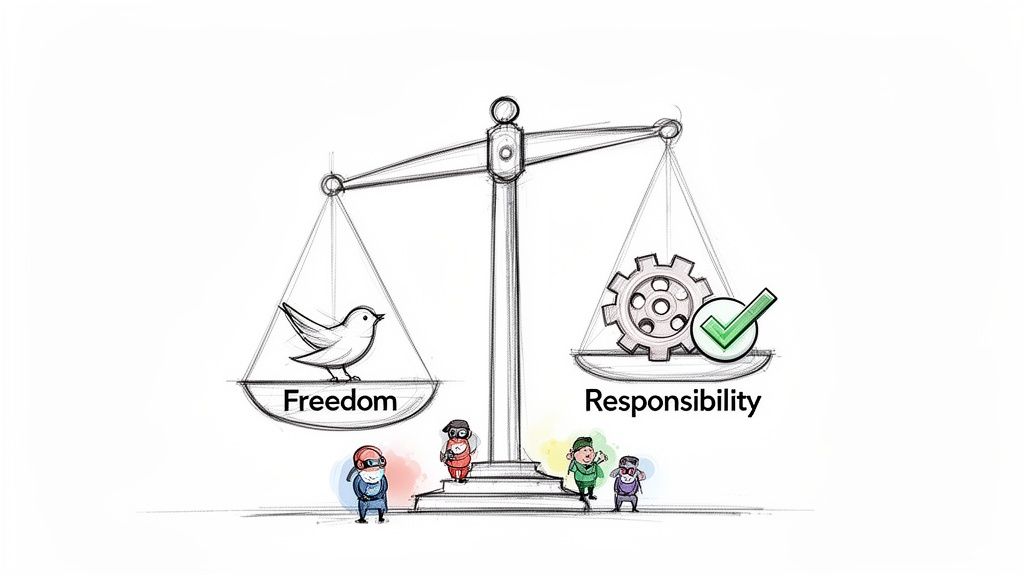
2. Netflix’s Freedom and Responsibility Culture
Netflix is a quintessential organisational culture example company that championed the philosophy of “freedom and responsibility.” This model operates on radical trust, deliberately minimising rules and hierarchical approvals. Instead, it empowers employees at all levels with significant autonomy, operating on the principle that responsible people thrive on freedom and are worthy of it. This culture, famously documented in their publicly shared Culture Deck, ties high performance directly to the latitude given to individuals to make impactful decisions.
The Strategy and Its Impact
Netflix’s culture is not just an abstract ideal; it’s an operational framework. For example, they famously eliminated formal vacation and expense policies, asking employees to simply “act in Netflix’s best interest.” This pushes decision-making to the lowest possible level, allowing small, autonomous teams to greenlight multi-million dollar content projects without extensive bureaucratic oversight. This trust accelerates decision-making and fosters a powerful sense of ownership.
This high-trust environment creates a self-selecting and reinforcing system. It attracts highly motivated, self-disciplined professionals who excel without hand-holding, while naturally filtering out those who require more rigid structures. The result is an agile organisation that can pivot quickly in the hyper-competitive streaming market. The strategy’s success is evident in Netflix’s ability to consistently produce globally acclaimed content and maintain subscriber growth.
Actionable Takeaways for PeopleOps and COOs
Implementing a culture of freedom and responsibility requires a foundation of transparent data and clear performance metrics.
- Establish and Visualise Clear KPIs: For freedom to work, responsibility must be measurable. Define clear, role-specific KPIs and make them transparent across the organisation. Use a business intelligence tool like Wurkn to create real-time dashboards that connect individual and team performance to overarching business outcomes, such as subscriber retention or content engagement.
- Implement Continuous Feedback Systems: Replace backward-looking annual reviews with continuous, forward-looking feedback mechanisms. This allows for immediate course correction and identifies cultural or performance gaps early, ensuring that trust is consistently validated by results. Wurkn’s ability to synthesise qualitative data from everyday work provides deeper insights than standard employee engagement platforms.
- Link Compensation to Cultural Behaviours: Ensure your compensation and recognition programs directly reward the behaviours you want to see. This means paying top of market to attract and retain high performers and making it clear that accountability, transparency, and decisive action are as valued as hitting numerical targets.
3. Zappos’ Core Values-Driven Customer Culture
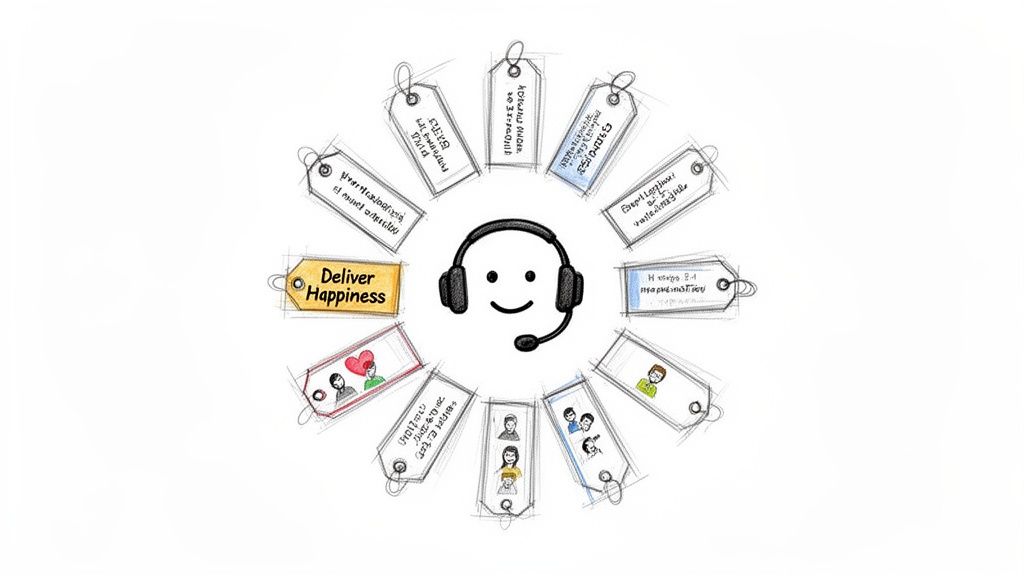
Zappos is a legendary organisational culture example company that architected its entire operating system around ten explicit core values, with “Deliver WOW Through Service” at its centre. This culture is not just a poster on the wall; it is a rigorous framework where every decision, from hiring and promotions to company strategy, is filtered through the lens of these values. The company proved that by prioritising a happy, value-aligned workforce, it could generate exceptional customer satisfaction and fierce loyalty.
The Strategy and Its Impact
Zappos’ strategy involves deeply embedding its values into every employee lifecycle process. For example, customer service representatives are famously empowered to spend unlimited time on calls to resolve issues, trusting them to embody the core values without restrictive scripts or time limits. The annual “Culture Book,” an unedited collection of employee thoughts on the company’s values and culture, serves as both a public declaration and an internal accountability mechanism.
This values-first approach creates a direct link between employee experience and customer outcomes. Empowered and engaged employees who feel a sense of purpose and community are intrinsically motivated to deliver superior service. This model demonstrates that a strong, lived-in culture is a powerful business driver, not just a “nice-to-have” HR initiative. For more foundational knowledge, you can explore this overview of what organisational culture is at Wurkn.com.
Actionable Takeaways for PeopleOps and COOs
Translating the Zappos model requires operationalising your organisation’s unique values.
- Embed Values into Performance Management: Move beyond competency-based reviews. Incorporate value alignment into hiring rubrics and promotion criteria, ensuring that “how” work gets done is as important as “what” gets done.
- Measure Value Alignment Continuously: Use a business intelligence tool like Wurkn to deploy pulse surveys that specifically measure how well teams and leaders are living the company values. Unlike traditional HR survey tools, Wurkn can also analyse ambient communication to see if values are being organically discussed and demonstrated.
- Link Culture Metrics to Business KPIs: Correlate employee sentiment data around core values with key business outcomes like Net Promoter Score (NPS) and customer retention. Create dashboards that visualise this connection, proving the ROI of your cultural investments to the executive team.
4. Microsoft’s Growth Mindset Transformation
Microsoft provides a compelling organisational culture example company by demonstrating how a legacy giant can pivot its core ethos. Under CEO Satya Nadella’s leadership, the company shifted from a rigid, competitive “know-it-all” culture to a dynamic “learn-it-all” growth mindset. This transformation, outlined in Nadella’s book Hit Refresh, prioritises continuous learning, curiosity, and collaboration over internal rivalry, revitalising the company’s innovation engine and market position.
The Strategy and Its Impact
Microsoft’s cultural overhaul was a deliberate, top-down strategy centred on changing fundamental behaviours. Nadella himself modelled the vulnerability and curiosity he wanted to see, openly admitting mistakes and emphasising empathy. This shift was operationalised by integrating ‘learning agility’ as a core performance competency and breaking down historic silos to foster cross-team collaboration. The company started rigorously tracking how teams worked together, linking these new collaboration metrics directly to project success rates and product innovation.
This strategy created a direct and measurable business impact. By moving away from a culture that penalised failure and towards one that embraces experimentation as a learning opportunity, Microsoft re-energised its workforce. The focus on learning and collaboration directly fuelled successes in cloud computing (Azure) and other emerging technologies, proving that cultural revitalisation can drive significant revenue growth and reclaim market leadership.
Actionable Takeaways for PeopleOps and COOs
Emulating Microsoft’s transformation requires a systematic commitment to measuring and nurturing a growth mindset.
- Establish Culture-to-Business Metrics: Don’t just talk about culture; quantify its impact. Create explicit KPIs that link cultural initiatives, such as participation in learning programs or cross-functional project involvement, to tangible business outcomes like product cycle times or revenue growth.
- Implement Continuous, Integrated Feedback: Move beyond static surveys by capturing sentiment where work happens. A business intelligence platform like Wurkn can analyse anonymised communications in tools like Slack and Teams to provide real-time insights into collaboration patterns and employee sentiment, offering a live view of cultural health.
- Model and Train for a Growth Mindset: Leadership behaviour is paramount. Train managers and executives to model ‘learn-it-all’ attitudes by rewarding curiosity, celebrating learned lessons from failures, and actively seeking diverse perspectives in decision-making processes.
5. Patagonia’s Purpose-Driven Environmental Culture
Patagonia is a quintessential organisational culture example company that has woven its environmental mission directly into its operational fabric. The company’s culture is not an add-on; it is the core strategic driver, built on the conviction that business can be a force for good. This purpose-driven model makes values-alignment a non-negotiable hiring criterion and measures success not just by profit, but by positive environmental and social impact.
The Strategy and Its Impact
Patagonia’s culture is a masterclass in authenticity, where stated values are backed by tangible actions. The company famously donates 1% of all sales to environmental organisations and provides employees with paid time off to volunteer for environmental causes, a commitment it has held since 1985. This is reinforced through transparent sustainability reports shared openly with all stakeholders, creating a culture of accountability.
This deeply integrated purpose creates a powerful bond with employees who are drawn to work for an organisation that reflects their personal values. The result is exceptionally high employee engagement, brand loyalty, and retention. Patagonia demonstrates that a clear, authentic purpose attracts and retains top talent who are motivated by more than just a paycheque, proving that a strong mission can be a formidable competitive advantage.
Actionable Takeaways for PeopleOps and COOs
Translating purpose into a lived cultural reality requires a systematic, data-driven approach.
- Define and Measure Purpose Metrics: Go beyond financial KPIs by establishing clear metrics for your organisation’s mission. Track indicators like volunteer hours, carbon footprint reduction, or community impact, and integrate them into your company’s performance dashboards.
- Create Transparent Impact Dashboards: Use a business intelligence tool like Wurkn to build and share dashboards that display purpose-driven metrics alongside traditional business results. This provides a holistic view of organisational performance and keeps the mission at the forefront for every team member.
- Assess Value Alignment Anonymously: Deploy regular pulse surveys to gauge how authentically employees feel the company is living its stated values. Anonymised feedback provides an honest measure of purpose-alignment sentiment, highlighting any gaps between your mission statement and the day-to-day employee experience. Wurkn can identify trends in this sentiment before they become retention issues.
6. HubSpot’s Transparent, Data-Driven Culture
HubSpot is a leading organisational culture example company that has masterfully built its environment on radical transparency and data-driven decision-making. Their philosophy, famously codified in their public “Culture Code” slide deck, treats culture as a product to be iterated upon, measured, and improved. This means all employees have visibility into key company metrics, strategic plans, and even the cultural indicators that drive business performance.
The Strategy and Its Impact
HubSpot’s culture is not merely about being open; it’s a strategic system where transparency fuels autonomy and performance. For instance, weekly company meetings openly display business metrics alongside cultural data, directly linking employee sentiment to outcomes like customer retention and revenue. This practice makes it clear to everyone how their work and the health of the culture impact the bottom line.
This data-centric approach creates a culture of accountability and trust. When employees see the same data as leadership, they feel empowered to make smarter, more autonomous decisions aligned with company goals. It demystifies leadership choices and fosters a shared sense of ownership, attracting talent who thrive on clarity and impact. This strategy has been a cornerstone of HubSpot’s growth, proving that a transparent culture can be a powerful competitive advantage.
Actionable Takeaways for PeopleOps and COOs
Translating HubSpot’s data-first culture into your own organisation requires a commitment to both technology and process.
- Integrate Cultural and Business Dashboards: Move beyond siloed data. Use a business intelligence platform like Wurkn to create unified, role-based dashboards that display cultural KPIs (like engagement scores from pulse surveys) next to relevant business metrics (like team productivity or customer satisfaction scores).
- Implement Continuous Feedback Systems: Replace infrequent annual surveys with a more agile approach. Regular pulse surveys and continuous feedback channels provide real-time sentiment data. You can learn more about effective survey design by reviewing these employee opinion survey examples at Wurkn.com.
- Train Managers on Data Interpretation: Data is only useful if managers know how to act on it. Provide specific training on how to interpret cultural data signals, discuss findings constructively with their teams, and develop targeted action plans to address challenges before they escalate.
7. Amazon’s Customer Obsession with Leadership Principles
Amazon provides a powerful organisational culture example company by building its entire operational framework around a set of explicit Leadership Principles. This culture is relentlessly driven by core tenets like “Customer Obsession,” “Ownership,” and “Think Big,” which are not just inspirational posters but are deeply embedded into every facet of the employee lifecycle. The company’s success demonstrates how a principle-driven culture can be methodically scaled across a massive, global organisation.
The Strategy and Its Impact
Amazon’s culture is a rigorously engineered system designed to guide behaviour and decision-making at every level. The Leadership Principles are the central code that dictates hiring, promotions, project evaluations, and daily operations. For instance, the “Bar Raiser” program ensures that every new hire is evaluated not just on skill but on their alignment with these principles, with a designated interviewer having veto power to maintain cultural consistency.
This systematic approach creates a high-performance, high-accountability environment. Annual reviews and feedback processes explicitly measure employees against both performance goals and their demonstration of the Leadership Principles. This direct link between cultural adherence and career progression ensures that the principles are lived, not just memorised. The result is a highly aligned workforce that can make autonomous decisions consistent with Amazon’s core values, enabling rapid innovation and scale.
Actionable Takeaways for PeopleOps and COOs
Implementing a principle-driven culture requires a commitment to embedding these values into tangible organisational processes.
- Define and Codify Core Principles: Establish 5-10 core, non-negotiable principles that guide all major business decisions. These should be clear, actionable, and reflect your unique strategic vision.
- Integrate Principles into Talent Management: Build principle evaluation directly into your performance management and hiring systems. Use a business intelligence tool like Wurkn to track how consistently managers and teams are demonstrating these principles through continuous, anonymised feedback loops.
- Create Consequences for Misalignment: Establish clear and consistent consequences for actions that violate core principles, regardless of an individual’s performance metrics. This reinforces that cultural fit is as critical as hitting targets.
8. Salesforce’s Stakeholder Culture with Equality Focus
Salesforce provides a leading organisational culture example company by building its ethos on stakeholder capitalism and a deep, measurable commitment to equality. This framework treats employees, customers, partners, and the community with the same level of importance as shareholders. Salesforce operationalises this culture by embedding equality into its core business strategy, proving that prioritising human values and corporate values are not mutually exclusive but are, in fact, mutually beneficial.
The Strategy and Its Impact
Salesforce’s commitment is not just declarative; it is backed by significant, transparent action. The company has invested millions of dollars over multiple years to close gender and race-based pay gaps, conducting regular audits to maintain pay equity. This isn’t a one-time fix but an ongoing process. Furthermore, Salesforce publicly releases its diversity data annually, holding itself accountable and setting a benchmark for the industry.
This data-driven approach to equality creates a powerful cycle of trust and performance. By transparently addressing inequities and actively fostering a sense of belonging through well-supported Employee Resource Groups (ERGs), Salesforce attracts diverse talent that feels valued and secure. This inclusive environment fuels innovation and strengthens customer relationships, as employees who feel respected are better equipped to serve a diverse customer base, ultimately driving business success.
Actionable Takeaways for PeopleOps and COOs
To build a culture of genuine equality, organisations must move from performative gestures to integrated, data-backed strategies.
- Establish and Link DEI Metrics: Define clear DEI key performance indicators (KPIs) that go beyond simple diversity counts. Measure metrics like promotion velocity for underrepresented groups, inclusion sentiment scores, and supplier diversity spend. Crucially, tie these metrics directly to executive compensation and departmental goals to ensure accountability.
- Implement Continuous and Transparent Reporting: Use a business intelligence platform like Wurkn to conduct regular pulse surveys focused on belonging and inclusion. Instead of waiting for an annual report, create real-time dashboards that visualise progress on DEI goals, making this data accessible to leaders and employees to foster transparency and trust.
- Resource and Empower ERGs: Move Employee Resource Groups from social clubs to strategic business partners. Provide them with executive sponsorship, dedicated budgets, and a formal feedback channel to influence policy and business decisions, ensuring diverse voices are heard at the highest levels.
9. Southwest Airlines’ Employee-First Culture
Southwest Airlines has long been a benchmark organisational culture example company, built on a deceptively simple yet powerful principle: put employees first. The airline operates on the strategic belief that happy, engaged employees will naturally create happy, loyal customers, which in turn drives profitability. This isn’t a vague ideal; it’s a core business strategy that treats employee satisfaction as a primary driver of success, not a byproduct of it.
The Strategy and Its Impact
Southwest’s culture is a system designed to treat employees like valued stakeholders. This is evident in its long-standing profit-sharing program, which directly aligns the financial interests of employees with those of shareholders. The company meticulously hires for attitude and cultural fit, prioritising a sense of humour and teamwork over pure technical skill, knowing that skills can be taught while attitude is ingrained.
This “employee-first” philosophy creates a virtuous cycle. When employees feel valued and empowered, their service is genuinely friendly and efficient, leading to industry-leading customer satisfaction scores (as reported by sources like the American Customer Satisfaction Index). This superior service builds a loyal customer base, which drives consistent profitability and allows the company to reinvest in its employees through better pay, benefits, and job security. The culture becomes a self-sustaining competitive advantage that is difficult for rivals to replicate.
Actionable Takeaways for PeopleOps and COOs
Translating Southwest’s model into your organisation requires a fundamental shift in how employee well-being is measured and managed.
- Elevate Engagement to a Core KPI: Treat employee engagement metrics with the same seriousness as financial results. Use a business intelligence platform like Wurkn to track real-time employee sentiment and display these cultural KPIs alongside operational and financial data on executive dashboards.
- Establish Transparent Feedback Loops: Create systems for continuous, anonymous feedback that capture the true pulse of the organisation. This goes beyond annual surveys to include weekly or bi-weekly pulse checks, ensuring leaders have a constant and honest view of morale.
- Train Leaders on Cultural Accountability: Equip managers with the skills to not only read cultural data but to act on it decisively. Training should focus on connecting feedback to specific operational changes and demonstrating to employees that their voice directly influences business decisions. Wurkn provides the real-time insights managers need to have these data-driven conversations.
10. Atlassian’s Distributed, Async-First Culture
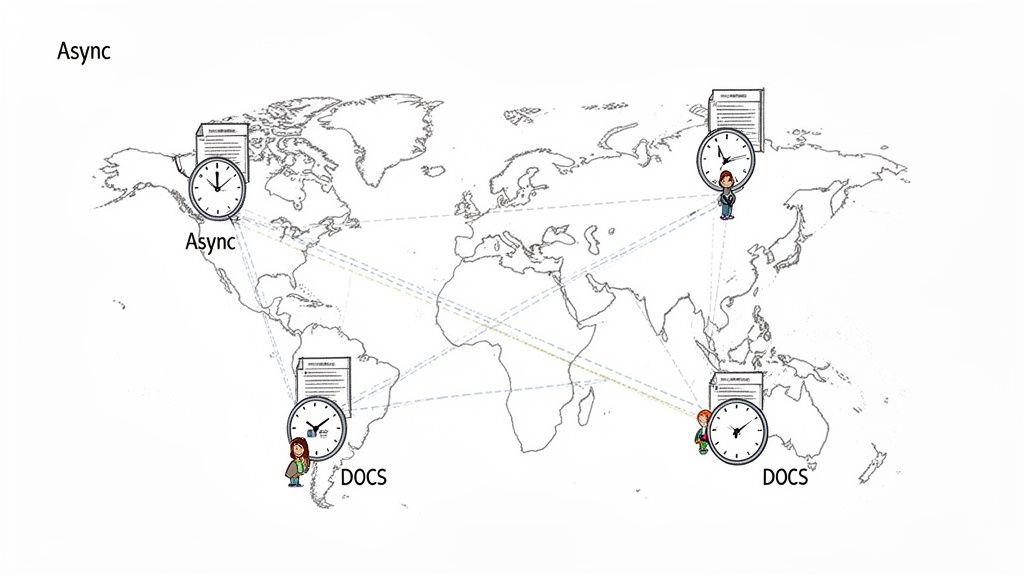
Atlassian serves as a forward-thinking organisational culture example company by pioneering a “Team Anywhere” policy built on a distributed, asynchronous-first foundation. The company recognised early that remote work isn’t just about location; it demands a fundamental rewiring of communication, collaboration, and cultural rituals. Atlassian’s culture is intentionally designed for a global workforce, prioritising outcomes and documented clarity over synchronous presence and in-person meetings.
The Strategy and Its Impact
Atlassian’s culture thrives on explicit communication and radical transparency, operationalised through its own products like Confluence and Trello. Key decisions, project updates, and team discussions are documented and shared, creating a single source of truth accessible to employees across all time zones. This async-first model decouples productivity from a traditional 9-to-5 schedule, empowering employees with genuine flexibility.
This approach directly enhances talent acquisition and retention by removing geographical barriers and appealing to professionals who value autonomy. By codifying processes and communication norms, Atlassian ensures team cohesion and productivity are maintained, even when colleagues rarely share the same working hours. This strategy has proven essential for scaling a consistent culture across a rapidly growing, globally distributed organisation.
Actionable Takeaways for PeopleOps and COOs
Building a successful distributed culture requires deliberate, tool-supported processes, not just remote work policies.
- Implement Digital-First Feedback Systems: Measure cultural health where work actually happens. Use a business intelligence tool like Wurkn to integrate with platforms like Slack and Teams, capturing real-time employee sentiment through continuous pulse surveys and conversation analysis directly within their workflow.
- Establish Asynchronous KPIs: Develop metrics that track collaboration quality in a distributed setting. Monitor things like documentation clarity, response times on asynchronous channels, and inclusivity in decision-making processes, ensuring no time zone is disadvantaged.
- Train for Asynchronous Leadership: Equip managers with the skills to lead remote teams effectively. Training should focus on written communication clarity, outcome-based performance management, and creating virtual spaces for connection that are inclusive of all time zones, such as pre-recorded all-hands meetings with Q&A forums.
10-Company Organisational Culture Comparison
| Culture Model | Implementation Complexity 🔄 | Resource & Cost ⚡ | Expected Outcomes 📊 | Ideal Use Cases 💡 | Key Advantages ⭐ |
|---|---|---|---|---|---|
| Google’s Innovation-Driven Culture with Psychological Safety | High — continuous people analytics and manager training 🔄 | High — analytics teams, surveys, training, labs ⚡ | High innovation output, strong retention, measurable culture→business 📊 | R&D-heavy orgs or large tech companies aiming to scale innovation 💡 | Psychological safety + data-driven insights for rapid innovation ⭐ |
| Netflix’s Freedom and Responsibility Culture | Medium‑High — performance systems and radical transparency 🔄 | Medium — real-time feedback infrastructure, high talent cost ⚡ | Faster decisions, rapid innovation, higher turnover risk 📊 | Fast-moving product/content teams needing speed and autonomy 💡 | Autonomy with clear accountability speeds decision cycles ⭐ |
| Zappos’ Core Values‑Driven Customer Culture | Medium — embed values in hiring, promotion, and processes 🔄 | Medium — hiring/practice changes, development programs ⚡ | Strong customer satisfaction, high engagement, lower turnover 📊 | Customer-service and consumer brands prioritizing culture-fit hires 💡 | Values-driven clarity aligns employees to customer outcomes ⭐ |
| Microsoft’s Growth Mindset Transformation | Very High — org-wide change, leadership modeling, long timeline 🔄 | Very High — leadership time, change programs, analytics at scale ⚡ | Improved collaboration, innovation velocity, measurable engagement gains 📊 | Large enterprises transforming competitive cultures to collaborative ones 💡 | Scalable cultural shift with measurable business linkage ⭐ |
| Patagonia’s Purpose‑Driven Environmental Culture | Medium — integrate purpose into hiring and metrics 🔄 | Medium — sustainability programs, reporting, volunteer time ⚡ | Strong retention, brand loyalty, purpose-aligned hiring benefits 📊 | Purpose-driven companies prioritizing environmental/social impact 💡 | Authentic purpose alignment that differentiates employer brand ⭐ |
| HubSpot’s Transparent, Data‑Driven Culture | High — requires dashboards, governance, continuous measurement 🔄 | High — analytics platform, dashboards, privacy controls ⚡ | Clear linkage of culture to KPIs, early issue detection, reduced politics 📊 | Scaling startups and firms that value transparency and measurable culture 💡 | Transparency + analytics converts culture into actionable signals ⭐ |
| Amazon’s Leadership Principles Culture | High — codify principles into hiring, feedback, and development 🔄 | High — performance systems, interview programs, leadership training ⚡ | Consistent decision-making, scalable culture, potential rigidity risks 📊 | Rapidly growing orgs needing a clear, consistent decision framework 💡 | Explicit principles that scale alignment across large teams ⭐ |
| Salesforce’s Stakeholder/Equality Culture | High — DEI programs, public reporting, sustained accountability 🔄 | High — pay equity investments, DEI analytics, public reporting ⚡ | Improved diversity, inclusion, brand trust, measurable DEI outcomes 📊 | Organizations committed to stakeholder capitalism and public accountability 💡 | Data-backed equality commitments that improve outcomes and trust ⭐ |
| Southwest Airlines’ Employee‑First Culture | Medium — engagement programs, profit-sharing, continuous surveys 🔄 | Medium — engagement investment, profit-sharing, training ⚡ | High customer satisfaction, lower turnover, strong brand ambassadors 📊 | Service industries where employee experience drives customer outcomes 💡 | Employee-first focus that directly supports customer and financial metrics ⭐ |
| Atlassian’s Distributed, Async‑First Culture | Medium‑High — async processes, documentation standards, tooling 🔄 | Medium — collaboration tools, documentation, timezone-inclusive design ⚡ | Enables distributed talent, improved knowledge sharing, some slower urgent decisions 📊 | Remote/hybrid organizations seeking async efficiency and inclusivity 💡 | Async-first design that scales collaboration across timezones ⭐ |
From Examples to Execution: Building Your Actionable Culture Strategy
Throughout this detailed exploration of leading organisational culture example companies, a powerful, unifying thread emerges: culture is not an accident. It is a deliberate, strategic, and measurable discipline. From Google’s calculated pursuit of psychological safety to foster innovation, to Microsoft’s systematic overhaul towards a growth mindset, these giants treat culture with the same rigour they apply to their product roadmaps and financial forecasting.
They have moved beyond vague mission statements and annual engagement surveys. Instead, they build systems, rituals, and feedback loops that translate abstract values into tangible, everyday behaviours. Patagonia doesn’t just talk about environmentalism; it builds activism directly into its operational model. Netflix doesn’t hope for high performance; it designs a culture of “freedom and responsibility” that actively selects for it. The critical lesson is that an exceptional culture is an engineered culture.
Distilling the Blueprint for Cultural Excellence
So, what is the common blueprint we can extract from these diverse and successful models? It boils down to a few core principles that any organisation in Canada or the United States can adapt, regardless of size or industry.
- Principle 1: Values Must Be Verbs. Zappos’ core values aren’t just posters on a wall; they are the active criteria used in hiring, firing, and performance reviews. For your organisation, this means translating your values into a clear set of expected behaviours. What does “collaboration” actually look like in a meeting? How is “customer obsession” demonstrated in a support ticket? Define it, model it, and measure it.
- Principle 2: Leadership is the Thermostat. As seen in Microsoft’s transformation under Satya Nadella, leadership behaviour sets the cultural tone. Leaders must not only champion the desired culture but consistently embody it. Their actions, decisions, and communication are the most powerful signals of what is truly valued within the organisation.
- Principle 3: Systems Reinforce Behaviours. Culture is shaped by the environment. Atlassian’s “Team Anywhere” policy is a system designed to reinforce its async-first, distributed culture. Your performance management, compensation structures, and daily workflows must be aligned to encourage the behaviours you want to see, not inadvertently reward those you don’t.
From Lagging Indicators to Real-Time Intelligence
The most significant takeaway, however, is the shift from reactive measurement to proactive cultural intelligence. Historically, People Ops leaders have been forced to rely on lagging indicators like annual surveys and exit interviews. These tools tell you about a problem long after the damage has been done.
The modern organisational culture example company operates differently. They seek to understand the subtle, day-to-day signals that define the employee experience. They are tuning into the real-time conversations, the sentiment shifts, and the emerging themes that reveal the true health of their culture. This is where traditional HR survey tools and employee engagement platforms fall short; they provide a static snapshot, not a continuous stream of insight.
This is precisely the gap that business intelligence tools are designed to fill. By moving beyond simple polling, platforms like Wurkn provide a living dashboard of your culture. By anonymously analysing sentiment and thematic patterns from the daily flow of work in tools like Slack and Teams, Wurkn’s AI-powered platform gives leaders a continuous, qualitative understanding of their organisation. It doesn’t just tell you that engagement is dropping; it synthesises the underlying conversations to show you why. This allows you to move from guessing to knowing, enabling you to identify cultural risks, pinpoint drivers of high performance, and make data-backed decisions that turn your organisational culture into your most powerful and measurable competitive advantage.
Ready to move from observing great cultures to building one with precision? See how Wurkn provides the continuous cultural intelligence you need to translate strategy into reality. Discover the patterns, sentiments, and drivers shaping your employee experience by visiting Wurkn today.