
A work satisfaction survey is much more than a simple questionnaire. Think of it as a diagnostic tool, designed to get a real read on how content and fulfilled your people are in their roles. It digs deeper than surface-level happiness to uncover how your team really feels about company culture, leadership, their career path, and work-life balance.
Why Traditional Work Satisfaction Surveys Are Failing You
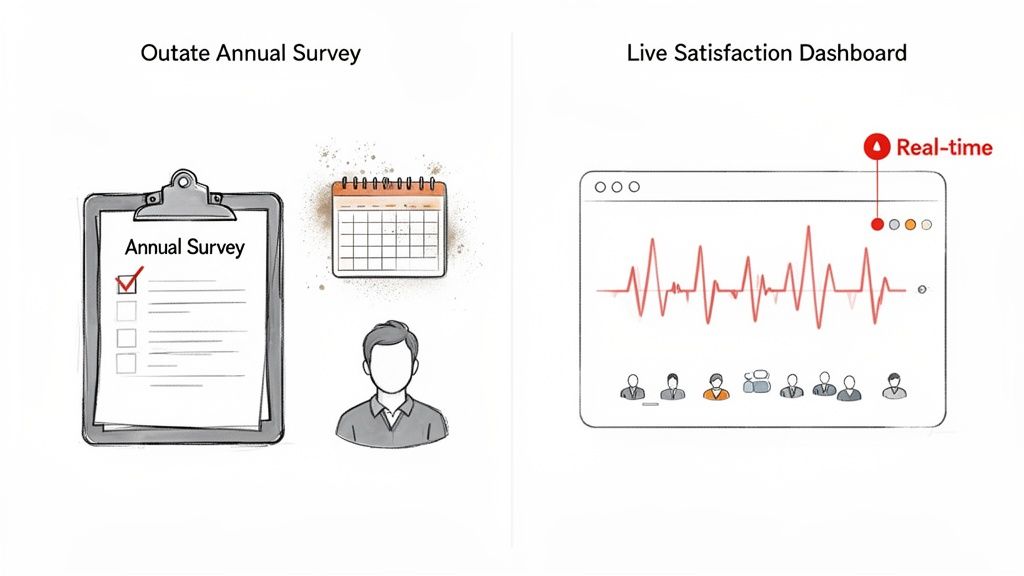
Let's be honest: the annual survey often feels like a checkbox exercise for everyone involved. It shows up once a year, people fill it out, and by the time the results are compiled, they're too stale to drive any real change. This old-school approach treats employee sentiment like a yearly report card when it’s actually a live, pulsing indicator of your business’s health.
True work satisfaction isn't a "soft" metric; it's a leading indicator for critical business outcomes. It has a direct and measurable influence on:
- Productivity and Performance: Engaged, satisfied employees are simply more motivated and productive.
- Customer Loyalty: Happy employees create happy customers, which is the surest path to retention.
- Talent Retention: A positive and supportive work environment is your best defence against costly turnover.
The Problem With a Single Snapshot
Relying on a traditional survey is like checking your car’s oil once a year and just hoping for the best. By the time you spot a problem, the damage is likely already done. This static, rearview-mirror approach gives you a dangerously incomplete picture of your organization's health.
For example, a recent study highlighted a critical risk that basic satisfaction scores can hide. While a high percentage of workers may report being satisfied overall, a significant portion—nearly half of those not working fully remotely—were willing to quit for a company that offered a hybrid schedule (Statista, 2022). This is a perfect example of how a high-level satisfaction score can mask underlying issues that an annual survey will completely miss.
A single, high-level satisfaction score can easily create a false sense of security. It tells you what employees feel, but offers no insight into the crucial why behind that sentiment, leaving you vulnerable to unforeseen challenges.
Moving Beyond Simple Scores to Business Intelligence
The old way of thinking about employee feedback is fundamentally broken. The shift from a once-a-year survey to a continuous business intelligence approach is not just an upgrade; it's a complete change in how you manage your most valuable asset: your people.
Here's a look at how these two approaches stack up.
Traditional Survey vs Modern Business Intelligence
| Attribute | Traditional Survey Approach | Business Intelligence Approach |
|---|---|---|
| Frequency | Annual or bi-annual | Continuous, real-time |
| Data Type | Static, point-in-time snapshot | Live, dynamic trend data |
| Insight Lag | 3-6 months | Instantaneous |
| Focus | Measuring past satisfaction | Predicting future outcomes |
| Management Style | Reactive (problem-fixing) | Proactive (opportunity-seeking) |
| Business Impact | A lagging indicator of culture | A leading indicator of performance |
This is where a business intelligence tool like Wurkn offers a distinct advantage over standard HR survey platforms. It moves beyond simplistic "happiness scores" or basic metrics. Instead, it provides a continuous, live dashboard of your company culture, connecting employee sentiment directly to core business KPIs.
For leaders in Canada and the United States who need to understand not just morale but its direct impact on the bottom line, this approach is mission-critical. By analyzing real-time feedback, you can spot issues before they escalate, turning your work satisfaction survey process from a reactive chore into a proactive strategic tool. If you want to dive deeper, you can learn more about why just measuring employee Net Promoter Score isn't enough to accurately gauge company culture.
Choosing Your Feedback Model: Annual Static vs. Always-On
Picking the right way to gather feedback on work satisfaction isn't a small decision—it directly shapes the quality and timeliness of your insights. For years, organizations have leaned on a few standard models, but for today's fast-moving workforces across Canada and the United States, the old ways are showing their age.
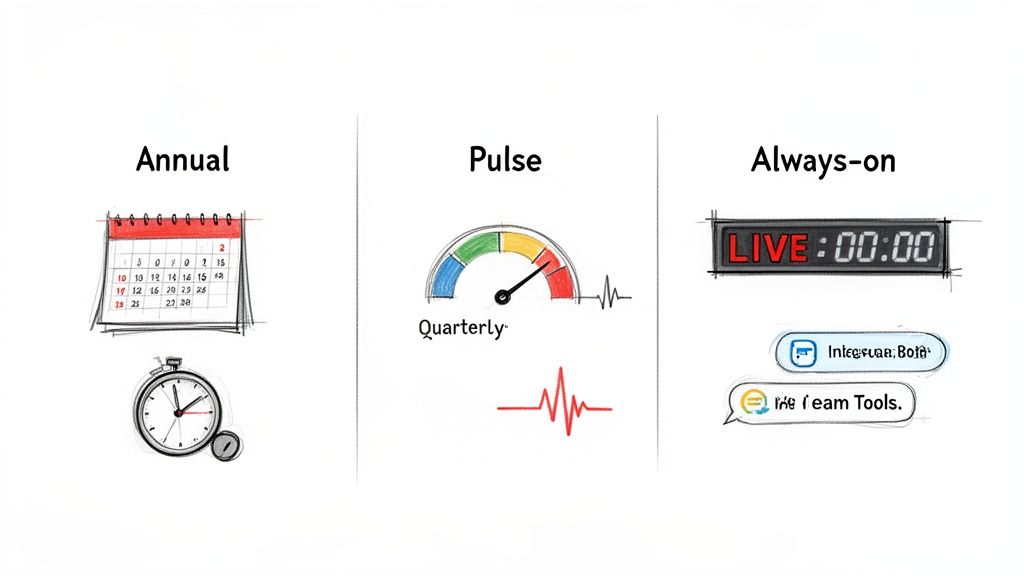
The most traditional approach is the annual survey. Think of it as a year-end organizational census. It’s often a deep dive, covering a huge range of topics in painstaking detail. But its biggest flaw is its speed. The moment you collect the data, it starts to get stale, quickly becoming a historical document rather than a current diagnostic tool.
The Problem With Infrequent Snapshots
A slightly more modern take is the pulse survey. These are shorter, more frequent check-ins, usually sent out quarterly or monthly. A pulse survey is like a quarterly financial report for your company culture; it gives you a more regular snapshot than an annual review and helps you spot short-term trends.
But even this is an improvement that still runs on a delay. It can flag a problem that started weeks or even months ago, but it’s not designed to catch the subtle, day-to-day shifts in team morale or identify roadblocks the moment they appear. Both annual and pulse surveys also force employees to stop their work, switch contexts, and fill out a form, which fuels the dreaded "survey fatigue."
Waiting for a quarterly survey to discover a critical team issue is like waiting for a smoke alarm to go off when you could have had a system that detects heat changes in real-time. By the time you get the signal, significant damage may have already occurred.
The Shift to a Continuous Feedback Loop
The most advanced model, and the one that's perfectly suited for today's hybrid and remote work environments, is the always-on feedback approach. This isn't just another survey; it's a continuous stream of operational health data. Imagine it as a live stock ticker for your organizational culture, giving you constant, real-time insight into the health of your teams.
This model is the engine behind a true business intelligence platform like Wurkn. Instead of periodically pushing out questionnaires, it captures anonymous, in-the-moment sentiment right from the tools your employees already use every day, like Slack or Microsoft Teams. This completely eliminates the disruption of traditional surveys.
By weaving itself into daily workflows, an always-on model gathers authentic feedback without adding another task to your team's to-do list. An employee might share a frustration about a process or celebrate a team win in a Slack channel, and Wurkn can anonymously synthesize that sentiment into a broader, actionable theme for leadership.
Comparing Feedback Models at a Glance
| Feedback Model | Analogy | Pros | Cons |
|---|---|---|---|
| Annual Survey | A year-end census | Comprehensive, deep data dive | Instantly outdated, high survey fatigue, reactive |
| Pulse Survey | A quarterly report | More frequent, tracks trends | Still delayed, disruptive, surface-level insights |
| Always-On | A live stock ticker | Real-time, continuous data, non-disruptive, authentic | Requires a privacy-first platform to ensure trust |
This continuous flow completely changes how leaders operate. You're no longer reacting to old news from a static report. Instead, you have a living dashboard that connects cultural signals directly to business outcomes, allowing for proactive adjustments that can stop small issues from turning into major problems. For leaders looking for a competitive edge, understanding how to get actionable business insights from continuous employee feedback is no longer a nice-to-have—it's essential for building a resilient, high-performing organization.
Designing a Survey That Delivers Real Insights
So, we've covered the 'why.' Now, let's get into the 'how.' Building a work satisfaction survey that actually gives you something useful takes real thought. Let’s be honest, a poorly designed survey doesn't just give you junk data; it can actually make employees trust you less. The goal is to create something that feels less like a corporate interrogation and more like a real conversation.
It all starts with tying every single question back to a specific, measurable business objective. Before you even think about writing a question, you have to know what decision the answer will help you make. For instance, asking about team collaboration is only useful if you’re actually prepared to invest in better project management tools or communication training based on what you learn.
People are more than happy to give feedback when they believe it will lead to real change. A prime example is the U.S. Federal Employee Viewpoint Survey, which in 2022 achieved a 35% response rate across over 1.5 million federal employees by focusing on key drivers like leadership and engagement (OPM.gov, 2022). This proves the power of asking targeted, meaningful questions about the things that truly define a culture.
Crafting High-Impact Survey Questions
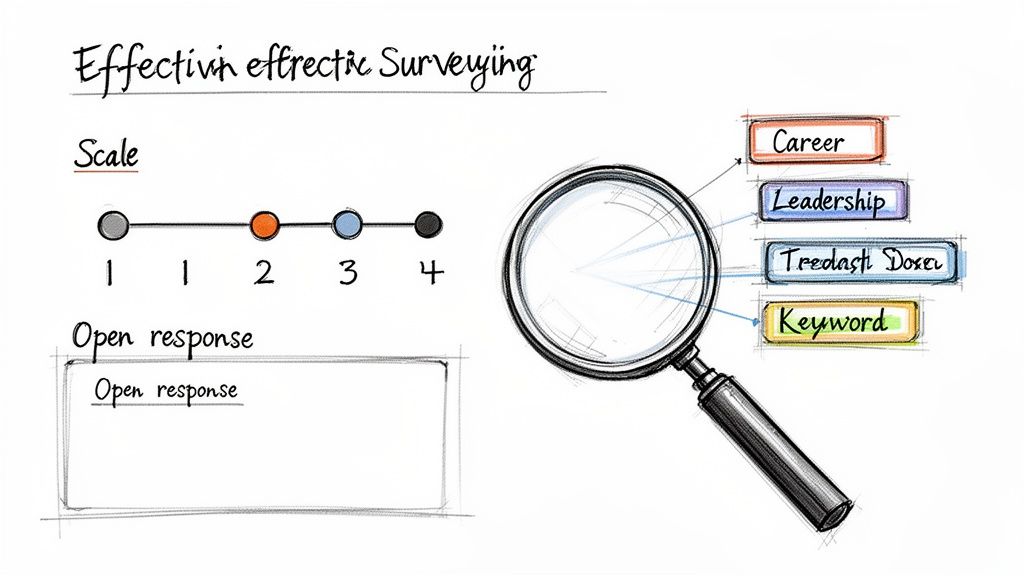
The quality of your insights hangs entirely on the quality of your questions. The best surveys strike a careful balance between two types of questions to get the full picture.
-
Quantitative Questions: These are your rating-scale questions (think Likert scales from 1 to 5). They’re fantastic for generating clean, measurable data that you can use to track trends over time and see if you’re making progress.
- Example: "On a scale of 1-5, how supported do you feel by your direct manager?"
-
Qualitative Questions: These are the open-ended ones that invite people to tell a story. They uncover the all-important 'why' behind the numbers, giving you the context that raw data just can’t provide.
- Example: "What is one thing your direct manager could do to better support your professional growth?"
You absolutely need a mix of both. The quantitative data tells you what is happening, and the qualitative data tells you why. For more inspiration, you can check out some excellent employee opinion survey examples to see how it's done.
A Template for Foundational Questions
To help you get started, we've put together a template of high-impact questions organized by the key drivers of satisfaction. Whether you're a Canadian or American organization, you can adapt these to fit your unique culture.
High-Impact Work Satisfaction Survey Questions
| Category | Sample Question (Quantitative) | Sample Question (Qualitative) |
|---|---|---|
| Leadership Effectiveness | On a scale of 1-5, how effectively does leadership communicate company strategy and goals? | What is one thing leadership could start or stop doing to improve transparency? |
| Career Pathing & Growth | I see a clear path for advancement for myself at this company. (Agree/Disagree) | What skills or opportunities would you need to feel more confident about your career growth here? |
| Work-Life Integration | My workload is manageable, and I am able to disconnect after work hours. (Agree/Disagree) | What is the biggest barrier to achieving a healthy work-life balance in your role? |
| Recognition & Value | I feel my contributions are recognized and valued by the organization. (Agree/Disagree) | What forms of recognition are most meaningful to you? |
These questions provide a solid foundation for understanding the core elements of the employee experience.
Beyond the Survey: The Business Intelligence Advantage
Here's the thing about even the most well-designed survey: it can only answer the questions you think to ask. This is where a true business intelligence tool like Wurkn offers a depth of insight that traditional HR survey platforms just can't touch.
Traditional surveys help you find answers to known questions. Business intelligence tools help you discover the 'unknown unknowns'—the critical issues you weren't even aware of.
Instead of waiting for a formal survey, Wurkn taps into the unsolicited, organic feedback happening every day in places like Slack and Microsoft Teams. It listens for the unfiltered conversations, the quiet frustrations, and the small wins that contain the most honest and timely insights into your company's health.
This unstructured data is an absolute goldmine. An employee might not bother to mention a recurring IT issue that’s killing their productivity in an annual survey, but you can bet they’ll vent about it in their team channel. Wurkn’s AI synthesizes these thousands of unstructured data points into clear, actionable themes. It can spot rising frustration around a new software rollout or growing excitement about a new company benefit, giving leaders a real-time, unprompted view of what truly matters to their teams—long before they would ever think to ask about it on a formal work satisfaction survey.
Building the Foundation of Trust with Anonymity
Let's be blunt: without trust, your work satisfaction survey is dead on arrival.
If your people fear that honest feedback could come back to haunt them, they’ll give you polite fictions instead of the ground-truth insights you need to run the business. This fear doesn't just skew the data a little; it poisons the entire well, making the results completely useless for any real decision-making.
This is why true anonymity isn’t just a nice-to-have feature—it's the non-negotiable bedrock of a successful feedback program. When employees are 100% confident their identity is protected, they gain the psychological safety needed to be candid. This is how you move the conversation from surface-level satisfaction scores to the specific, thorny issues that are actually dragging down performance and morale.
The Psychology of Anonymous Feedback
Put yourself in an employee's shoes. Maybe a manager's communication style is creating serious friction for their team. In a typical, non-anonymous survey, would an employee risk providing specific, constructive criticism? It’s highly unlikely. Instead, you'll get a vague, neutral answer that tells you absolutely nothing.
This creates a dangerous blind spot for leadership. You might see a satisfactory team engagement score on a spreadsheet while, behind the scenes, productivity is quietly tanking and your top performers are polishing their CVs. Honest feedback is a gift, but it’s a gift that will only be offered in an environment of absolute trust.
When employees know their responses are truly anonymous, they're far more likely to share the kind of feedback that drives real improvement—calling out confusing processes, admitting they don't understand a new company initiative, or suggesting changes they might otherwise keep to themselves.
How a Privacy-First Architecture Builds Trust
This is where a business intelligence tool like Wurkn provides value that traditional HR survey tools simply can't match. Wurkn is built on a privacy-first architecture, which is the gold standard for protecting employee identity. This goes much deeper than just a promise of confidentiality; it's baked directly into the technology with multiple, overlapping safeguards.
These technical protections are designed to make it impossible to trace feedback back to an individual:
- Complete Anonymization: Submissions are stripped of all personally identifiable information (PII) the instant they are captured. There's no "deanonymize" button.
- Automated Data Redaction: The platform automatically finds and scrubs names, titles, or other sensitive details from comments to protect both the person giving feedback and anyone they mention.
- Secure Data Handling: All feedback is managed within a secure, end-to-end system designed to prevent any unauthorized access.
Let’s make this real. Imagine an employee in your Toronto office is getting frustrated with a new project management tool. They might vent to a colleague on Slack, saying, "This new system is making my projects take twice as long." With a standard survey, that valuable insight is lost forever.
With Wurkn's always-on model, that comment is captured, completely anonymized, and then grouped with similar feedback. Leadership doesn't see who said it; they see a rising, quantified theme of 'process friction' tied directly to the new software. This transforms a private complaint into an actionable business insight, allowing you to fix the root cause systemically—without ever asking a single person to risk putting their name on their feedback.
Turning Raw Data into Strategic Decisions
Collecting honest feedback is a fantastic first step, but it’s only half the battle. The real magic happens when you turn that raw, unfiltered data into intelligent, strategic action. For too many leaders, this is exactly where the process grinds to a halt. They find themselves drowning in spreadsheets and qualitative comments, completely unsure of where to even begin.
This is where a business intelligence platform like Wurkn automates the heavy lifting. Instead of your People Ops team spending weeks manually sifting through thousands of comments, our AI synthesizes themes, identifies sentiment, and pinpoints root causes in real-time. It transforms a mountain of data into a clear, actionable dashboard.
From Sentiment to Strategy
Traditional analysis often stops at identifying high-level themes like "communication" or "workload." That's interesting, but you can't really do much with it. A true business intelligence tool connects these cultural insights directly to tangible business outcomes. It helps you answer not just what people are saying, but why it matters to the business.
For instance, your dashboard could reveal a clear correlation between a dip in sentiment around 'work-life balance' in your engineering team and a subsequent rise in voluntary turnover three months later. All of a sudden, a "soft" cultural metric becomes a powerful, predictive tool for making proactive decisions.
By connecting cultural data to operational KPIs like retention, productivity, and even customer satisfaction, you transform your survey from a rearview mirror into a forward-looking guidance system. You can start anticipating problems instead of just reacting to them.
This flow shows exactly how trustworthy feedback becomes a strategic asset—moving from confidential input to anonymized data and, finally, to insights you can act on.
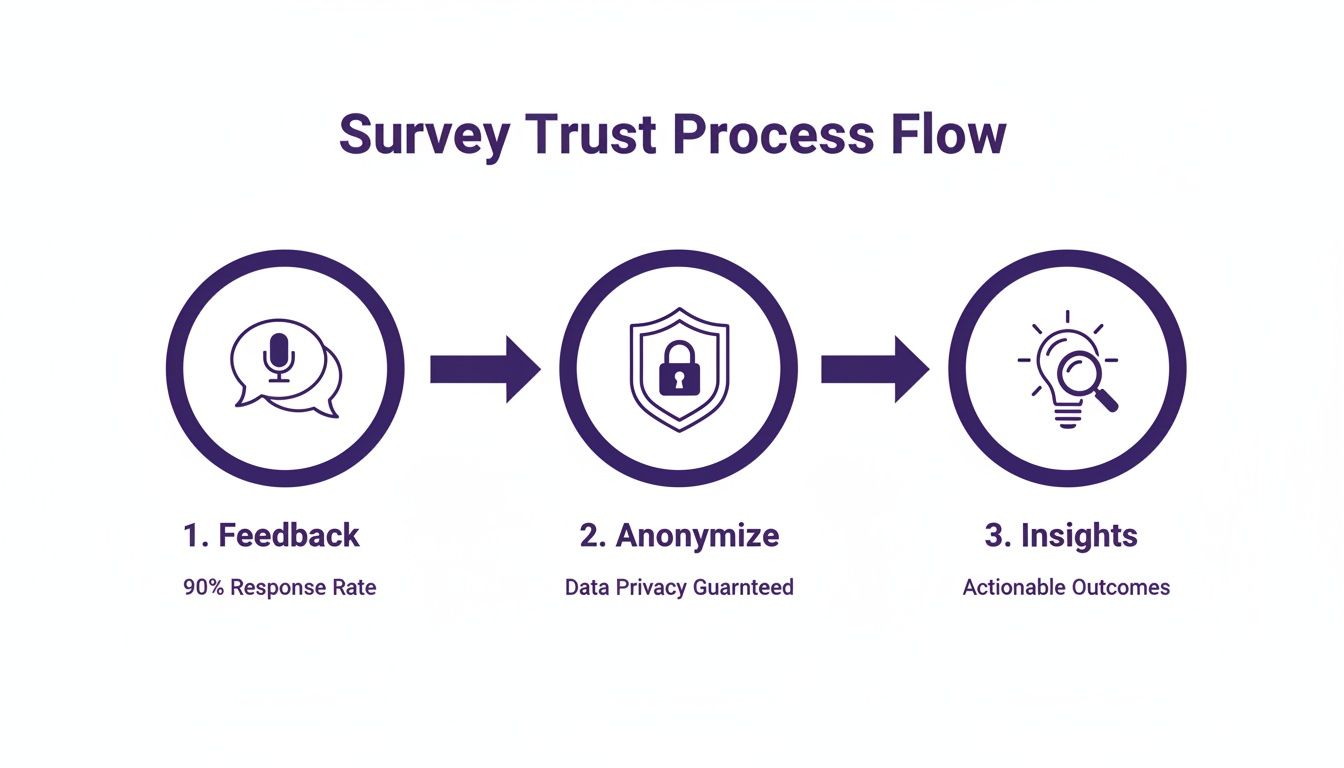
This process makes it clear that the integrity of the system, especially robust anonymization, is what allows you to generate insights that leadership can confidently use to make decisions.
Uncovering the Nuances in Your Data
Overall satisfaction scores can be dangerously misleading. A company-wide score of 80% satisfaction might look great on the surface, but it could be masking critical issues brewing within specific departments, roles, or demographics. To get ahead of real problems, you have to dig deeper.
A recent report on employee satisfaction highlighted this exact challenge. The survey revealed a significant decline in overall satisfaction among professionals in California to just 59%, a steep drop from 80% two years prior. But the analysis didn't stop there. It identified that the 45-54 age group showed the lowest satisfaction at 48% and pinpointed "limited career opportunities" as a key driver. You can discover more about these satisfaction trends. This is precisely the kind of granular insight needed to take targeted, effective action.
A platform like Wurkn makes this level of analysis effortless. It can automatically segment feedback to reveal hidden patterns, such as:
- Is dissatisfaction with management concentrated in a specific region, like your Canadian offices?
- Are junior employees in the United States expressing more concern about career pathing than senior staff?
- Does sentiment around benefits differ significantly between your sales and product teams?
This capability moves way beyond the limitations of standard HR survey tools. It gives you a multi-dimensional view of your organization's health, equipping leaders with the cultural intelligence needed to make precise, data-backed decisions. Instead of launching a generic, company-wide initiative, you can address the specific pain points of the teams that need it most, ensuring your efforts are both efficient and impactful.
Common Questions About Work Satisfaction Surveys
Here are the answers to the questions we hear most often from leaders across Canada and the United States who are ready to build a smarter feedback strategy.
How Often Should We Run a Survey?
The old model of the annual or biannual survey is just too slow for the speed of modern business. By the time you get the results, the problems have already changed.
The best practice today is a continuous, “always-on” approach. This doesn’t mean spamming your team with daily forms—that’s a fast track to survey fatigue. Instead, it’s about using a business intelligence tool like Wurkn to passively collect anonymized feedback from the places where work already happens. By tapping into communications in tools like Slack and Teams, you get a real-time pulse of your organization’s health without ever interrupting someone’s workflow. This lets you act on issues as they pop up, not months after the fact.
What Is the Biggest Mistake to Avoid with Survey Results?
The absolute biggest mistake you can make is doing nothing. Collecting a mountain of feedback and letting it gather dust is worse than not asking in the first place. It sends a loud and clear message to your team that their opinions don't actually matter, and you can guarantee they won't bother participating next time.
The second critical error is getting fixated on the overall score. The real gold is in the qualitative comments—the "why" behind the numbers. A cultural business intelligence platform helps you sidestep both of these traps. It makes it simple to analyze what people are really saying, track the actions you take in response, and communicate that progress back to the team, which is how you truly close the feedback loop.
How Can We Increase Our Survey Participation Rate?
Getting high participation boils down to three things: trust, communication, and simplicity.
First, you have to guarantee and repeatedly communicate that all feedback is 100% anonymous. People need to feel psychologically safe to be honest without fear of backlash. Second, you have to prove that their feedback leads to real change. Share concrete examples of how past results have directly shaped company policy or fixed a frustrating process.
Finally, make it ridiculously easy to participate. Don't send people to another website they have to log into. Meet them where they already are. Platforms like Wurkn integrate feedback channels directly into tools like Slack or Microsoft Teams, removing all friction and capturing more authentic, in-the-moment sentiment.
Transform your employee feedback from a static report into a strategic advantage. Wurkn provides the cultural business intelligence you need to connect satisfaction directly to performance. Discover how Wurkn can give you a real-time view of your organization's health.