
The debate over KPI vs. OKR often misses the point. It’s not an either/or decision. The simplest way I’ve found to explain it is this: KPIs (Key Performance Indicators) are your car’s dashboard. They’re the essential, always-on dials—fuel level, engine temperature, speed—that tell you if you’re operating safely.
In contrast, OKRs (Objectives and Key Results) are your GPS. You plug in an ambitious destination, and the GPS maps out the specific turns you need to make to get there. You wouldn’t drive a long distance by staring only at your fuel gauge, nor would you follow a GPS without keeping an eye on your speed. You need both to get where you’re going effectively.
Understanding the KPI vs OKR Frameworks
For Chief Operating Officers and People Ops leaders across Canada and the United States, mastering both frameworks is non-negotiable. It’s the key to balancing the day-to-day operational stability with the forward-looking strategic growth that keeps you competitive.
Think of KPIs as your business-as-usual health metrics. These are the numbers you track continuously to make sure the core functions of the business are running smoothly—things like employee retention rate, customer satisfaction scores, or monthly recurring revenue. They tell you if you're on solid ground.
OKRs, on the other hand, are built to get you off that solid ground and onto higher terrain. They’re a framework for tackling ambitious, game-changing goals. An OKR always starts with an inspirational Objective (the "what") and is measured by a handful of specific, quantifiable Key Results (the "how"). This structure is perfect for driving major change, like launching a new product line or fundamentally shifting your company culture.
This visual breaks down the core difference: KPIs monitor the health of the engine, while OKRs plot the course to a new destination.
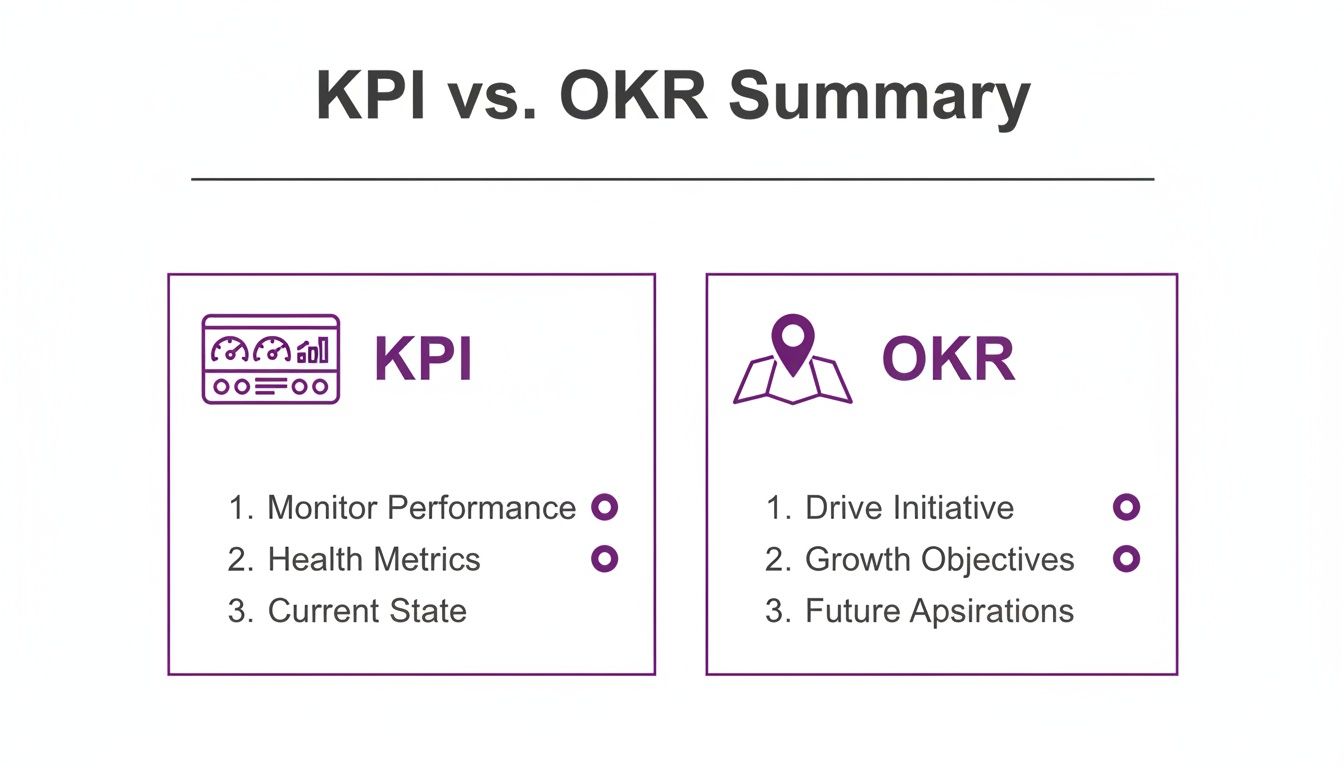
As you can see, it positions KPIs as the steady hand monitoring performance, while OKRs are the strategic lever pulling the organization toward ambitious new goals.
Why Both Frameworks Matter
Relying only on KPIs is a recipe for stagnation. You end up optimizing the status quo, getting really good at doing the same things over and over. But chasing ambitious OKRs without watching your core KPIs is just as dangerous—it's like flooring it on a road trip without ever checking if you have oil in the engine. The best operators use them in tandem.
This dual approach is proving its worth, particularly in the Canadian business landscape. According to one report, organizations embracing OKRs achieved their strategic goals at a higher rate than those stuck using only traditional KPIs. This was especially true for HR-driven initiatives in remote and hybrid teams, highlighting how OKRs can push ambitious, culture-focused goals forward in Canada’s evolving work environment. You can dig deeper into how Canadian companies are making this work at HR Reporter.
The magic happens when an underperforming KPI inspires a new, ambitious OKR. This is where you shift from simply monitoring a problem to actively solving it with a focused, strategic initiative.
But the numbers alone won't give you the full picture. A business intelligence tool like Wurkn provides the crucial cultural context behind your metrics. It goes beyond static HR survey tools by capturing continuous, anonymous sentiment. This shows you why a KPI might be dipping and helps you validate if an OKR is genuinely improving your team's experience, not just moving a number on a spreadsheet.
For a quick reference, this table breaks down the core differences between the two frameworks.
KPI vs OKR At a Glance
| Attribute | Key Performance Indicators (KPIs) | Objectives and Key Results (OKRs) |
|---|---|---|
| Purpose | To measure and monitor the ongoing health and performance of the business. | To set and achieve ambitious, strategic goals that drive significant change. |
| Analogy | A car's dashboard, showing vital signs like speed and fuel. | A GPS navigation system, setting a destination and mapping the route. |
| Nature | Typically ongoing, representing "business as usual." | Time-bound (usually quarterly) and aspirational, designed to be stretched. |
| Focus | Measures outcomes and efficiency of existing processes. | Drives change, innovation, and breakthrough growth. |
| Scope | Often tied to specific departments, teams, or operational functions. | Aligned across the organization, cascading from company-level strategy. |
Ultimately, understanding these distinctions allows leaders to use each tool for its intended purpose: KPIs to maintain a healthy, stable operation, and OKRs to push the boundaries of what's possible.
How KPIs Measure Your Operational Health
Think of your Key Performance Indicators (KPIs) as the vital signs monitor for your business. They aren't there to map out an ambitious cross-country road trip; their job is to be the dashboard that tells you if your engine is running smoothly, if you have enough fuel, and if your tire pressure is stable.
For COOs and People Ops leaders in Canada and the United States, KPIs provide that constant, reliable pulse on the health of your most critical functions. This steady stream of data is less about inspiration and more about stability—it’s how you monitor performance, spot troubling trends before they escalate, and ensure the company is running predictably.
KPIs in Action for COOs and People Ops
To bring this out of the theoretical, let's look at a few logical examples that are probably already on your radar:
- Employee Retention Rate: This is a direct measure of workforce stability. A consistent rate signals a healthy, functioning culture. A sudden dip? That's your engine light blinking—an immediate red flag that demands investigation.
- Operational Cost per Employee: A COO's bread and butter, this metric is all about efficiency. Keeping this KPI within a target range is fundamental to maintaining profitability and smart resource allocation.
- Time to Hire: A People Ops staple, this KPI tracks the health of your recruitment pipeline. If that number starts creeping up, it could point to bottlenecks that are preventing you from landing top talent.
These metrics aren't just figures on a spreadsheet; they tell a story about what’s working and, more critically, what’s not. For a closer look at the metrics that truly matter, you can explore a range of valuable work culture KPIs for enhanced business success.
A Key Performance Indicator is a quantitative measure that signals the progress being made in a specific area of the business. Its primary function is to monitor and report on the health of existing processes and outcomes.
Going Beyond the Numbers with Business Intelligence
Here’s where the conventional approach to KPIs often hits a wall. A declining 'Productivity per Employee' KPI is a symptom, not a diagnosis. Your standard HR survey tools might tell you that productivity is down, but they can't tell you why in real time. Is it widespread burnout? Are teams wrestling with a new software rollout? Is there a communication breakdown between departments?
This is where a business intelligence tool like Wurkn adds an absolutely essential layer of context. Instead of relying on disruptive, periodic surveys, Wurkn taps into the communication platforms your teams already live in—like Slack and Microsoft Teams—to capture continuous, anonymous feedback and sentiment. It effectively translates qualitative cultural data into actionable intelligence.
Suddenly, that dipping productivity KPI isn’t an isolated data point anymore. When you can correlate it with anonymized sentiment analysis from Wurkn showing a spike in chatter about "burnout" or "tool fatigue," it becomes a clear, undeniable signal of an underlying cultural issue. This empowers leaders to shift from reactive fire-fighting to proactive intervention, addressing the root cause before it poisons retention, morale, and the bottom line.
How OKRs Drive Ambitious Strategic Goals
If KPIs are your business’s health monitor, then Objectives and Key Results (OKRs) are your strategic rocket fuel. They’re the framework you use not just to track performance, but to propel your entire organization toward its most ambitious goals. While KPIs tell you how you’re doing today, OKRs define where you need to go tomorrow.
At its heart, the OKR framework is brilliantly simple. It’s made of two parts: the Objective, which is the ambitious, qualitative vision—the rallying cry that answers, “What do we really want to achieve?”
Then you have the Key Results. These are the cold, hard numbers—the measurable, quantitative milestones that prove you got there. They answer the crucial question, “How will we know we’ve actually won?” This structure forces you to connect a lofty aspiration to specific, verifiable outcomes.
Deconstructing the OKR Framework
Let's break this down with a logical, real-world example from a People Ops team in a growing Canadian or American tech company. Say the leadership team wants to make a massive leap in how they support their people.
- Objective: Become the industry benchmark for employee well-being and professional growth.
- Key Results:
- Boost the employee well-being score from 65 to 80 by the end of Q3.
- Hit a 90% participation rate in the new personal development program.
- Cut voluntary turnover linked to "lack of growth opportunities" by 25% in the next six months.
Notice how the Objective is big and inspiring. But the Key Results are sharp, specific, and time-bound. There's no grey area; you either hit the numbers or you don’t.
A core tenet of the OKR framework is its aspirational DNA. The point isn't always to hit 100% on every Key Result. In many high-performing cultures, nailing 70-80% of a tough OKR is a huge win, proving the team set a goal that genuinely stretched their limits.
This "stretch goal" philosophy is what pushes teams beyond making tiny, incremental improvements. It creates a space where it's safe to aim high and even fall a bit short, because the focus is on making a giant leap forward, not just ticking a box. Research on goal-setting repeatedly shows this is how you drive major change.
Connecting OKRs to Real-Time Cultural Intelligence
The real magic happens when you can measure an OKR's impact not just on business metrics, but on your company's actual culture. This is where most goal-setting falls apart. How do you know if your big strategic push is genuinely boosting morale and not just moving numbers on a spreadsheet?
This is exactly where a business intelligence tool like Wurkn gives you an edge that standard HR survey tools can’t. By continuously and anonymously capturing employee sentiment from tools like Slack and Microsoft Teams, Wurkn delivers real-time cultural intelligence. It becomes a leading indicator, giving you instant insight into how your big strategic bets are actually landing with your teams.
For instance, as you chase that well-being OKR, you can use Wurkn to track sentiment around keywords like "work-life balance," "management support," and "career development." A steady climb in positive sentiment validates that your initiatives are hitting the mark culturally. But if sentiment dips? You get an early warning signal, letting you pivot and fix the problem long before it shows up in lagging indicators like your turnover rate. This turns your OKR from a static quarterly plan into a living, breathing strategy informed by the real-time voice of your people.
Making KPIs and OKRs Work Together
The biggest mistake leaders make is pitting KPIs against OKRs, treating it as an either/or decision. But that’s a false choice. In reality, these frameworks aren’t rivals at all—they're partners designed to strike the perfect balance between keeping the lights on and shooting for the moon.
Think of it like this: your KPIs are the dashboard of your car, constantly monitoring vital signs like fuel level, engine temperature, and tire pressure. OKRs are your GPS, the strategic route you map out to reach an ambitious new destination. You need both to operate effectively.
The KPI to OKR Flywheel
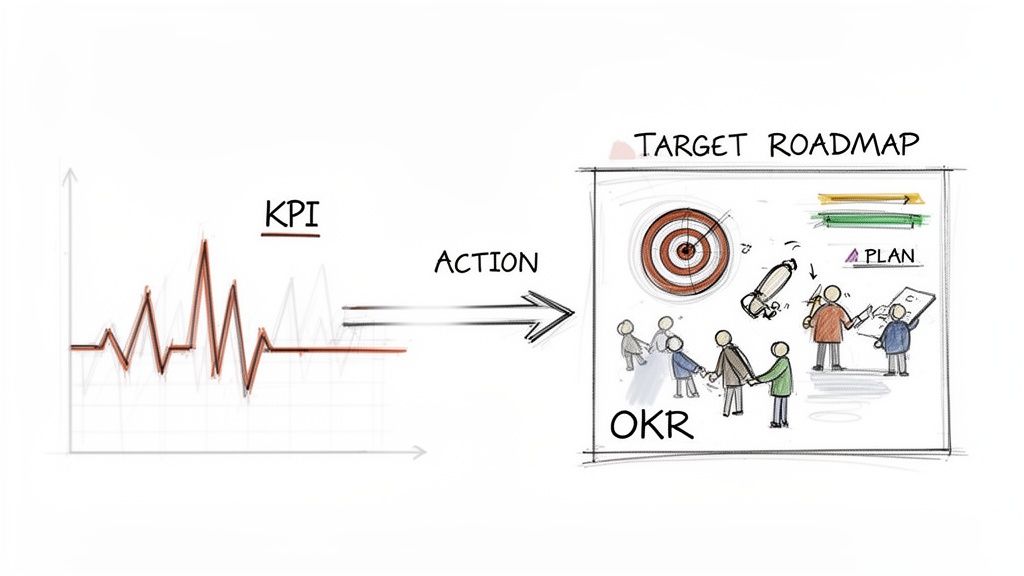
The real magic happens when you let a struggling KPI become the spark for a new OKR. When a KPI starts flashing red, it’s not just a problem; it’s a signal telling you precisely where to focus your strategic energy. The KPI tells you what's broken, and the OKR becomes your game plan for how you’re going to fix it.
This turns reactive firefighting into a proactive, strategic mission. You stop just watching a number dip and start launching a focused campaign to turn it around.
Let's walk through a logical, real-world scenario for a COO or a People Ops leader.
-
The KPI Signal: Your ‘Voluntary Employee Turnover’ KPI has been creeping up for two straight quarters, blowing past its target of less than 10% annually. The dashboard is flashing red. The KPI has done its job—it's flagged a critical problem with your operational health.
-
The OKR Response: Instead of launching a dozen scattered initiatives hoping something sticks, you craft a single, ambitious OKR to tackle the root cause.
- Objective: Build a magnetic work culture that our top performers won't want to leave.
- Key Results:
- Slash voluntary turnover in the engineering department by 20% before the end of Q4.
- Boost the employee satisfaction score for "career growth opportunities" from a 6.5 to an 8.0.
- Hit a 95% completion rate for our new manager training on how to run effective one-on-ones.
See the synergy? The KPI identified the illness (high turnover), and the OKR became the bold, measurable treatment plan. This direct link ensures your biggest strategic bets are always aimed at solving your most painful operational problems.
KPIs are the smoke detectors for your business, constantly scanning for trouble. OKRs are the specialized crew you send in—not just to put out the fire, but to rebuild that part of the house stronger than it was before.
Knowing When to Use Each Framework
Knowing which tool to pull out of the toolbox is what separates good leaders from great ones. While KPIs and OKRs work together, they have distinct jobs. KPIs are for monitoring and maintaining standards; OKRs are for making a big leap forward. To get even sharper on goal-setting, our guide on creating effective team charters and templates is a great place to start.
So, when do you reach for a KPI, and when is it time for an OKR? I find that breaking it down by common business scenarios really helps clarify the choice.
Operational Scenarios When to Use KPIs vs OKRs
| Business Scenario | Use KPI or OKR? | Example Application |
|---|---|---|
| Monitoring monthly server uptime | KPI | Measure: Maintain server uptime at 99.95% or higher. This is a baseline standard to uphold, not a moonshot goal. |
| Slashing customer support ticket resolution time | OKR | Objective: Deliver lightning-fast, world-class customer support. Key Result: Crush our average first-response time from 24 hours down to just 4 hours. |
| Tracking employee attendance | KPI | Measure: Keep unscheduled absenteeism below 3%. This is a routine operational health check, not a strategic initiative. |
| Breaking into a new international market | OKR | Objective: Successfully plant our flag and establish a strong market presence in Canada. Key Result: Acquire 1,000 new Canadian customers by the end of Q2. |
This table makes it clear: KPIs are for the steady hum of the engine, while OKRs are for hitting the accelerator.
The Bridge Between KPI and OKR
The missing link in this whole cycle is often the "why." A KPI can tell you turnover is high, but it can’t tell you if it’s because of burnout, bad managers, or lousy compensation. This is where a cultural business intelligence tool like Wurkn becomes your secret weapon.
By analyzing continuous, anonymous employee feedback, Wurkn surfaces the story behind the numbers. It might show a huge spike in conversations around "burnout" and "unrealistic deadlines" specifically within the engineering team, directly connecting the why to your failing turnover KPI. Armed with that insight, your OKR isn't a guess—it's a precision-guided strategy aimed squarely at the real problem.
Integrating Cultural Intelligence into Your Strategy
Modern leadership is about more than just hitting the numbers; it’s about understanding the story behind them. In the KPI vs. OKR debate, the most effective strategies are the ones that evolve beyond static metrics into dynamic, responsive systems. This is where real cultural intelligence becomes a massive operational advantage, adding a critical layer of human context to both frameworks.
Traditional methods like annual HR survey tools give you a single snapshot in time. They completely miss the day-to-day reality of your company culture, where the real story unfolds in the conversations happening every single day.
From Static Numbers to Actionable Insights
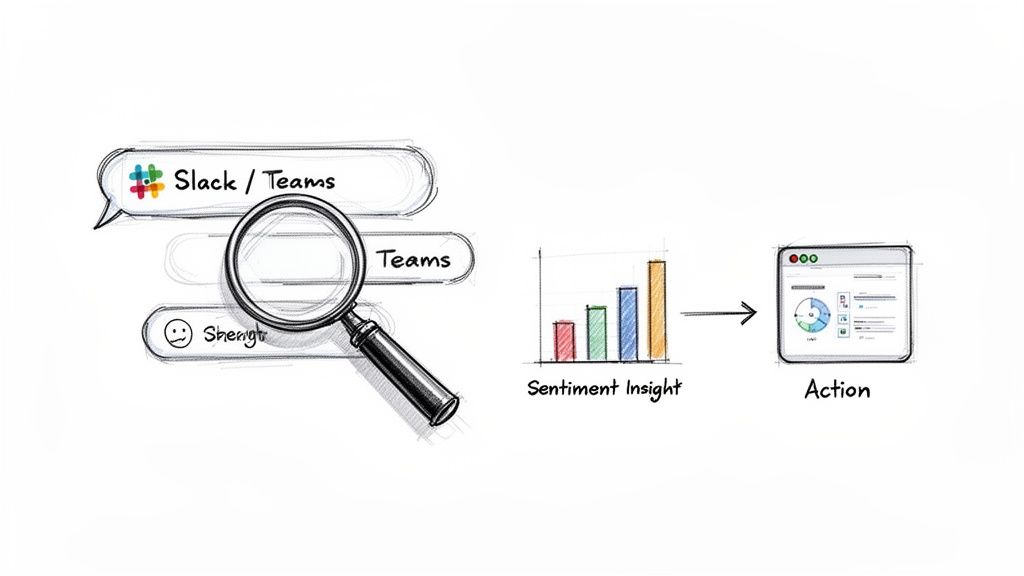
Business intelligence tools built for cultural analysis offer a fundamentally different path. Forget disruptive, low-response-rate surveys. Platforms like Wurkn tap into the communication channels your teams already live in, like Slack and Microsoft Teams.
By capturing continuous, anonymized feedback, Wurkn turns qualitative employee sentiment into measurable, actionable intelligence. Think of it as an "always-on" listening post that gives you a living, breathing view of your organizational health—all without interrupting workflows. This ensures the insights are both authentic and timely.
For leaders in both Canada and the United States, this represents a significant shift from reactive problem-solving to proactive strategy. You're no longer waiting for a quarterly report to tell you something is wrong; you're seeing the early warning signs in real-time.
This continuous stream of information is rocket fuel for both your KPI monitoring and your OKR execution, finally providing the "why" behind the "what."
Powering Your KPIs with the Human Story
For your Key Performance Indicators, cultural intelligence provides the essential narrative behind the data. A KPI can tell you that your 'Time to Hire' has shot up by 15%, but it can't tell you why.
Is your application process a clunky mess? Are hiring managers ghosting candidates? Is your employer brand taking a hit in the market?
With a tool like Wurkn, you can correlate that lagging KPI with anonymized sentiment data. You might suddenly discover a spike in negative conversations around the "interview process" or "recruiter communication." Just like that, an abstract number has a clear, human story attached to it, pointing you directly to the root cause. This lets you fix the actual problem, not just chase the symptoms.
Validating OKR Impact in Real-Time
When it comes to Objectives and Key Results, cultural intelligence offers a powerful validation loop. OKRs are designed to be ambitious and drive significant change, but how do you know if that change is having the right cultural impact?
Imagine a People Ops team sets a bold OKR:
- Objective: Foster a world-class culture of cross-departmental collaboration.
- Key Result: Increase the number of successfully completed cross-functional projects by 30% this quarter.
On paper, hitting that 30% target looks like a massive win. But what if the process to get there was a nightmare that created friction, burnout, and resentment between teams? You've hit your number, but you’ve inadvertently poisoned the very culture you aimed to improve. This is a classic failure point in many KPI vs. OKR implementations.
By analyzing sentiment data from Wurkn, you get a much richer, more accurate picture of success. An increase in positive sentiment around terms like "teamwork," "collaboration," and "support" from other departments provides real-time proof that your strategic initiative is landing well. Conversely, a spike in negative chatter is an immediate red flag, allowing you to course-correct before long-term damage is done.
To learn more, explore our resources on connecting people and culture to business outcomes. This approach transforms your OKR framework from a simple goal-setting tool into a responsive instrument for genuine cultural improvement.
Common Implementation Pitfalls and How to Avoid Them
Even the most buttoned-up strategies can fall apart in the real world. When it comes to KPIs and OKRs, I’ve seen companies across Canada and the US trip over the same hurdles time and time again. Knowing what these pitfalls are is the first step to building a goal-setting culture that actually drives results, not just creates more admin work.
One of the biggest mistakes with KPIs is getting seduced by vanity metrics. These are the numbers that look great in a slide deck but have zero connection to what moves the business forward. A COO might get excited about a jump in social media followers, but if that buzz isn't turning into sales or making customers stick around, it’s just noise.
Avoiding Common KPI Mistakes
The key to avoiding these traps is to anchor every single KPI to a strategic business outcome. Don't just track things because you can; make sure every metric is a true signal of your operational health.
-
Pitfall – Tracking too many KPIs: When you throw a dozen metrics at a team, you create confusion. Focus gets diluted, and nobody knows what really matters anymore.
-
Solution – Stick to 3-5 critical KPIs per team: This simple constraint forces you to get crystal clear. It ensures that every metric is a powerful indicator directly linked to that team's core purpose.
-
Pitfall – Setting KPIs in a silo: Nothing kills engagement faster than leadership handing down targets from on high without any context or input. Teams see them as arbitrary hoops to jump through.
-
Solution – Explicitly link KPIs to business goals: You have to connect the dots for people. Show them exactly how a KPI like 'Customer Churn Rate' directly impacts the company's bottom line and its biggest strategic goals.
Navigating OKR Implementation Challenges
OKRs have their own unique set of landmines, usually planted by misunderstanding their aspirational spirit. One of the worst mistakes is setting OKRs without involving the team. This top-down approach completely defeats the purpose, killing the very buy-in and motivation the framework is meant to spark.
Another classic error is punishing teams for not hitting 100% on a moonshot goal. OKRs are supposed to be a stretch. Hitting 70-80% of a truly ambitious Key Result is often a massive win that deserves celebration.
OKRs must be decoupled from performance reviews and compensation. Tying aspirational goals to an individual's salary creates a culture of fear, encouraging teams to set safe, easily achievable goals instead of pushing for breakthroughs. OKRs are a strategic tool for growth, not a yardstick for bonuses.
This isn't a minor point; it's fundamental. This separation keeps the framework focused on alignment and ambitious goals, not a source of anxiety and sandbagging.
Finally, while plenty of platforms can track your progress toward OKRs, they often miss the human side of the equation. This is where a cultural intelligence tool like Wurkn changes the game. It goes beyond just tracking percentages by continuously analyzing anonymous sentiment. It tells you if your strategic push is genuinely inspiring your team or just burning them out, giving you the context you need to adjust your approach and protect your culture while you chase those big goals.
Common Questions from the Field
Even with a solid grasp of the KPI vs. OKR debate, leaders are often left with practical questions about making them work in the real world. Here are some of the most common queries I hear from COOs and People Ops leaders across Canada and the US, with some straightforward advice.
Can a Small Business or Startup Really Benefit from Both KPIs and OKRs?
Absolutely, and I'd argue they have to. For a startup, survival is a balancing act between keeping the lights on today and chasing the ambitious growth that will secure tomorrow.
They should lean on KPIs to obsessively track the vital signs of the business—metrics like cash burn rate and customer acquisition cost. At the same time, OKRs provide the focused, ambitious push needed to win over investors and grab market share. An OKR like "Successfully launch in a new market" or "Secure Series A funding" creates the strategic discipline to make big leaps, not just tiny steps. The key is to keep both frameworks brutally simple and focused only on what's critical for survival and growth.
How Often Should We Be Looking at Our KPIs and OKRs?
They operate on totally different timelines because they do different jobs. KPIs are your business's pulse, so you need to check them often—weekly or monthly in operational meetings is typical. This rhythm allows your teams to spot trends and react before a small dip becomes a major problem.
OKRs are your quarterly strategic sprints. You set them for a specific period, usually a quarter, and progress should be a topic in weekly check-ins to clear roadblocks. The formal review and grading happen at the quarter's end, with those lessons feeding directly into the next goal-setting cycle.
A classic mistake is setting OKRs and then forgetting about them until the end of the quarter. Those weekly check-ins are non-negotiable; they build momentum and give you a chance to course-correct before it's too late.
How Is a Tool like Wurkn Different from a Standard Employee Survey?
This is a critical distinction that trips people up. Think of Wurkn as a business intelligence tool, not just another HR survey tool. It’s built to fight survey fatigue by meeting people where they’re already working, like in Slack or Microsoft Teams. Instead of disruptive, infrequent surveys that get low response rates, it captures continuous, anonymous feedback as part of the natural workflow.
This "always-on" approach gives you a real-time stream of cultural data without adding another task to an employee's to-do list. The result is information that's not only more current but also more honest, giving leaders a true pulse on the health of the organization.
Ready to connect your cultural health to your business results? Wurkn goes beyond traditional survey tools, providing the continuous, actionable intelligence you need to make smarter strategic decisions. See how you can get the full story behind your KPIs and OKRs at https://wurkn.com.