
Think of a Human Resource Information System (HRIS) as the digital nervous system for your people operations. It’s a single piece of software that acts as the central hub for managing all your employee data and automating the core HR tasks that keep your business running.
What Is An HRIS and Why Does It Matter Now
Imagine trying to run a modern business with scattered spreadsheets, overflowing filing cabinets, and a dozen different apps for every little HR function. It’s messy, wildly inefficient, and a recipe for costly mistakes. This is the exact problem an HRIS is built to solve.
At its heart, an HRIS is a database with a user-friendly front end, designed to bring all your employee information together in one secure, reliable place.
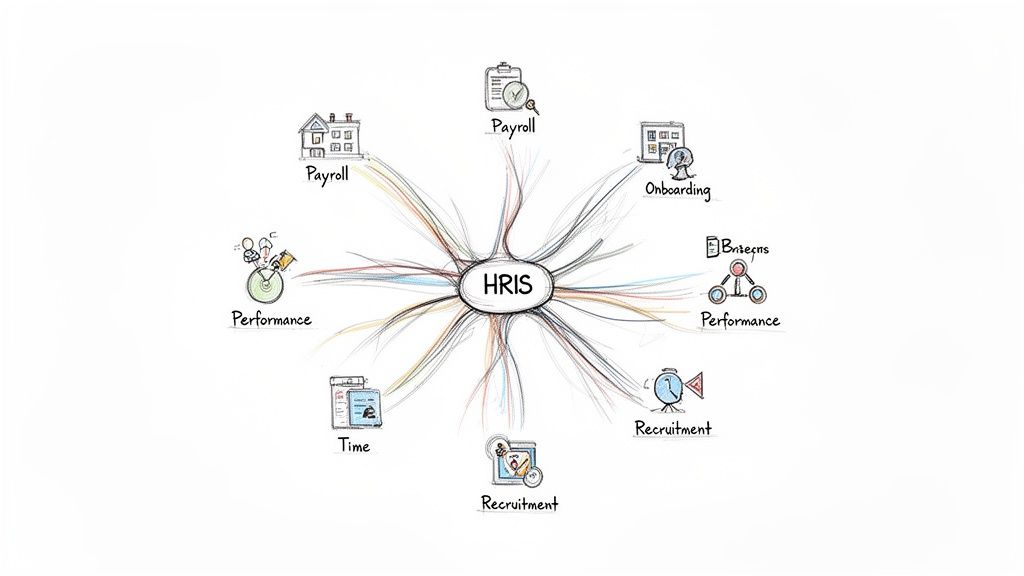
This system transforms siloed, chaotic data into an organized and accessible asset. But modern HRIS platforms have moved far beyond being just a digital filing cabinet. They are strategic tools that take routine administrative work off your plate, freeing up your HR team to focus on what really matters—like developing your talent and shaping company culture.
The Evolution From Record-Keeping To Strategic Asset
The earliest versions of these systems were little more than digital record-keepers. Today, they've become indispensable for businesses across Canada and the United States. Companies are grappling with complex challenges like managing hybrid workforces, staying on top of ever-changing labour laws, and fighting to attract the best talent.
A solid HRIS provides the data foundation needed to tackle these challenges head-on.
But its real power is unlocked when you see it as more than just a system of record. The data sitting inside your HRIS holds immense potential for deeper business intelligence.
An HRIS isn't just about administrative efficiency; it's about creating a single source of truth for your most valuable asset—your people. When this data is connected to other business systems, it unlocks predictive insights into organizational health.
This shift from a passive database to an active intelligence source is a game-changer. For example, a basic HRIS can tell you what your turnover rate is. But it can’t tell you why people are leaving. That’s where its role as a foundational data source becomes so critical for more advanced analytics.
The Modern Imperative For Canadian And US Businesses
For any organization in North America today, the need for a powerful, centralized system is undeniable. With the rise of remote and hybrid work, you need to deliver a seamless digital employee experience, whether you're onboarding a new hire in Vancouver or managing benefits for a team in Texas. An HRIS makes this possible.
More than that, as companies get serious about data-driven decision-making, the HRIS is where it all begins. The adoption of AI-powered HR tools is accelerating; 12.2% of Canadian businesses reported using AI technologies last year, a figure that nearly doubled from the year before, according to Statistics Canada's Survey of Digital Technology and Internet Use. This trend shows that leaders in both Canada and the US are embracing technology to get a competitive edge, turning their HRIS into a hub for cultural and operational intelligence. You can dig into more on AI adoption trends at HunterTech.
This is where a true business intelligence tool like Wurkn comes in. Unlike a simple employee survey tool, Wurkn builds on that HRIS foundation, integrating with your system to connect demographic and organizational data with real-time, anonymous employee sentiment. This elevates the HRIS from a simple system of record to a true business intelligence tool, giving you a direct line of sight into how your culture is impacting measurable outcomes like productivity and retention.
Exploring the Core Features of an HRIS
An HRIS isn't just a digital filing cabinet. Think of it more like a Swiss Army knife for your people operations. It's a collection of distinct, powerful tools that are all connected, working together to create a single, efficient system for managing your team. These core features are what make modern HR possible.
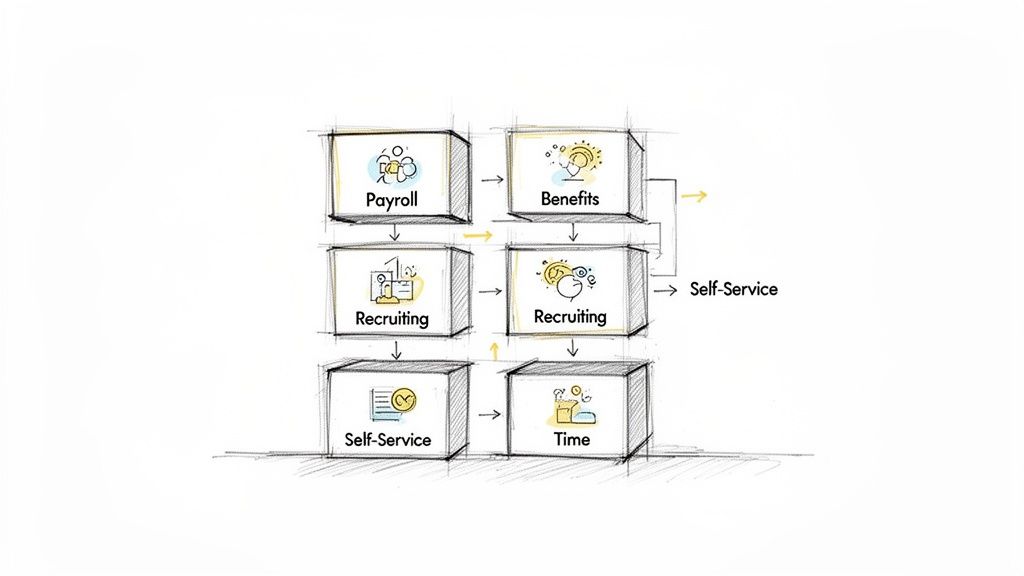
Understanding these components is the key to seeing the real value of an HRIS. It’s the difference between just storing employee files and actively managing the entire employee lifecycle with precision and ease.
Centralized Employee Database and Core HR Functions
At the very heart of any HRIS is the core HR database. This is the single source of truth for every piece of employee information—from personal details and job titles to salary history and emergency contacts. It’s what finally lets you ditch the scattered spreadsheets and overflowing filing cabinets, ensuring your data is accurate, secure, and easy to find.
This central hub is the engine that powers every other function in the system. When a manager in Texas needs to confirm an employee's start date for a performance review, the information is right there, instantly. This foundational module also handles your organizational structure, job descriptions, and critical compliance reporting.
Payroll and Compensation Management
One of the most powerful and time-saving features of an HRIS is its payroll processing module. It automates the entire payroll cycle, from calculating wages and withholdings to processing direct deposits and generating payslips. The system automatically pulls data on hours worked, time off, and benefits deductions from other modules, which makes the whole process incredibly accurate.
This automation slashes the risk of human error—mistakes that can be costly and seriously damage employee trust. Key payroll functions usually include:
- Automated Tax Calculations for federal and provincial/state requirements in Canada and the US.
- Direct Deposit Processing to ensure everyone gets paid on time, every time.
- Year-End Reporting to make generating tax forms a breeze for both the company and its employees.
Benefits Administration
Managing employee benefits—from health insurance to retirement plans—is a notoriously complex and administration-heavy job. An HRIS cuts through that complexity with a dedicated benefits administration module.
This feature allows HR teams to manage different benefit plans, track enrolment, and handle life event changes without the usual headaches. More importantly, it empowers employees through self-service portals where they can review their options and make their selections during open enrolment, all without filling out a single paper form. Imagine a new remote hire in Vancouver enrolling in their health plan from their home office on day one—that’s the kind of efficiency an HRIS delivers.
An HRIS transforms routine administrative tasks into strategic opportunities. By automating payroll and benefits, it frees up HR professionals to focus on higher-value initiatives like talent development and improving the employee experience.
Recruitment and Onboarding
The employee journey starts long before the first day on the job. That’s why an HRIS often includes an Applicant Tracking System (ATS) to manage the entire hiring process, from posting jobs and tracking candidates to scheduling interviews and sending out offer letters.
Once a candidate accepts an offer, the system smoothly transitions their data from applicant to employee. The onboarding module then takes over, automatically creating a new employee profile, assigning checklists for IT and HR, and giving new hires digital access to company policies and essential paperwork. This creates a structured, welcoming experience that sets people up for long-term success from the very beginning.
These features are fantastic for collecting foundational data, but that data becomes truly powerful when you analyze it. To learn more about making your HR systems more strategic, check out our guide on why your HR software should be data-driven and helpful. This is where a business intelligence tool like Wurkn adds another layer of value, turning the administrative data collected by your HRIS into deep, actionable insights about your organization's culture.
HRIS vs HRMS vs HCM: Demystifying the Acronyms
Trying to figure out HR technology can feel like wading through an alphabet soup of confusing acronyms. Leaders across Canada and the United States often hear HRIS, HRMS, and HCM used interchangeably, but they actually represent very different levels of capability.
Picking the right one isn’t just a technical decision; it’s a strategic one. Get it wrong, and you end up with a system that either can’t keep up with your growth or is bloated with features you’ll never use.
Think of it like building a house. Every single house needs a solid foundation before you can even think about putting up walls, running plumbing, or picking out furniture. In the world of HR software, the HRIS is that non-negotiable foundation.
HRIS: The Foundational Layer
A Human Resource Information System (HRIS) is where it all starts. Its main job is to be the single source of truth for all core employee data. This is your digital filing cabinet, the system of record for everything from an employee's home address and job title to their salary history and benefits choices.
An HRIS is built to automate the essential, administrative work that keeps an HR department from drowning in paperwork. Its core responsibilities are pretty straightforward:
- Core HR: Managing employee records, building org charts, and handling compliance reporting.
- Payroll Processing: Automating wage calculations, tax deductions, and direct deposits.
- Benefits Administration: Tracking who’s enrolled in what plan and managing the details.
At its heart, an HRIS is all about the "information." It’s designed to make sure your foundational people data is accurate, secure, and easy to find.
HRMS: Adding Talent Management
Step up a level and you get to the Human Resource Management System (HRMS). An HRMS does everything an HRIS can do, but it adds a crucial layer of features focused on managing and developing your people.
If the HRIS is the foundation of the house, the HRMS adds the framework—the walls, the wiring, the plumbing. It starts to connect the dots between pure administration and the actual employee lifecycle.
An HRMS takes the core data from an HRIS and puts it to work in processes that manage how your people contribute and grow. The focus shifts from just keeping records to actively managing your workforce.
On top of all the HRIS functions, an HRMS usually brings these tools to the table:
- Time and Labour Management: Tracking employee hours, attendance, and scheduling shifts.
- Recruiting and Onboarding: Managing your applicant pipeline and creating a structured welcome for new hires.
- Performance Management: Running performance reviews and tracking progress against goals.
HCM: The Strategic Suite
At the top of the pyramid is Human Capital Management (HCM). This is the most comprehensive and strategic of the three systems. An HCM suite includes all the features of an HRIS and an HRMS, then expands its view to cover the entire strategic employee experience. It’s the fully finished, furnished, and decorated house.
HCM software operates on a different philosophy. It sees employees not just as resources to manage, but as valuable capital to invest in. It incorporates advanced tools for things like strategic workforce planning and talent optimization, helping align your people strategy with broader business goals. You'll often find sophisticated analytics and even AI-driven insights to help leaders make smarter, data-backed decisions.
To help clear things up, here’s a quick breakdown of how these systems stack up against each other.
HRIS vs HRMS vs HCM Feature Comparison
| System Type | Primary Focus | Core Features Included | Strategic Scope |
|---|---|---|---|
| HRIS | Data Management | Core HR (employee records), Payroll, Benefits Administration | Administrative Efficiency: Centralizes data and automates core HR tasks. |
| HRMS | Talent & Process Management | All HRIS features + Time & Labour, Recruiting & Onboarding, Performance Management | Talent Optimisation: Manages the entire employee lifecycle from hire to retire. |
| HCM | Strategic Value Creation | All HRMS features + Workforce Planning, Compensation Management, Analytics, Employee Experience | Business Alignment: Treats employees as capital to be invested in and developed. |
Ultimately, the right choice really hinges on your company’s complexity and where you’re headed strategically.
But here’s the thing: while these systems are fantastic for collecting data, their real power is unlocked when that data is turned into actual business intelligence. By connecting any of these systems to a business intelligence platform like Wurkn, you elevate them from simple administrative tools into genuine strategic assets. Wurkn uses the anonymous demographic data from your system to add powerful context to real-time employee sentiment. This helps you understand why things are happening in your culture and links that insight directly to your business outcomes.
Unlocking Business Intelligence with Your HRIS
A Human Resource Information System is fantastic at what it was designed for: centralizing employee records, streamlining payroll, and managing benefits. It holds a massive amount of valuable data about your people—who they are, their role, how long they’ve been with the company, and where they sit in the org chart.
But for too many businesses in Canada and the United States, that’s where the story ends. The HRIS is treated like a digital filing cabinet. It’s an essential system of record, sure, but it remains a passive vault of information.
Leaving your HRIS as a standalone system is a huge missed opportunity. The real power of that data isn't just in having it; it's in what you do with it. When you connect that raw data to the right tools, your HRIS evolves from an administrative chore into a strategic asset that fuels smarter, faster business decisions.
From Administrative Data to Strategic Insight
Let’s get practical. Imagine you notice the sales department in your Calgary office has a turnover rate that's 25% higher than any other team. Your HRIS can absolutely tell you what is happening. It gives you the raw numbers on attrition, showing you the tenure of the employees leaving and their pay grades.
But it can’t tell you why they’re leaving.
Is it a problem with a specific manager? A flawed commission structure? A toxic team culture? An HRIS alone leaves you with educated guesses at best. This is the crucial gap between having data and having intelligence.
This is where the broader ecosystem of HR technology comes into play. An HRIS forms the foundational core, but it's just the starting point.
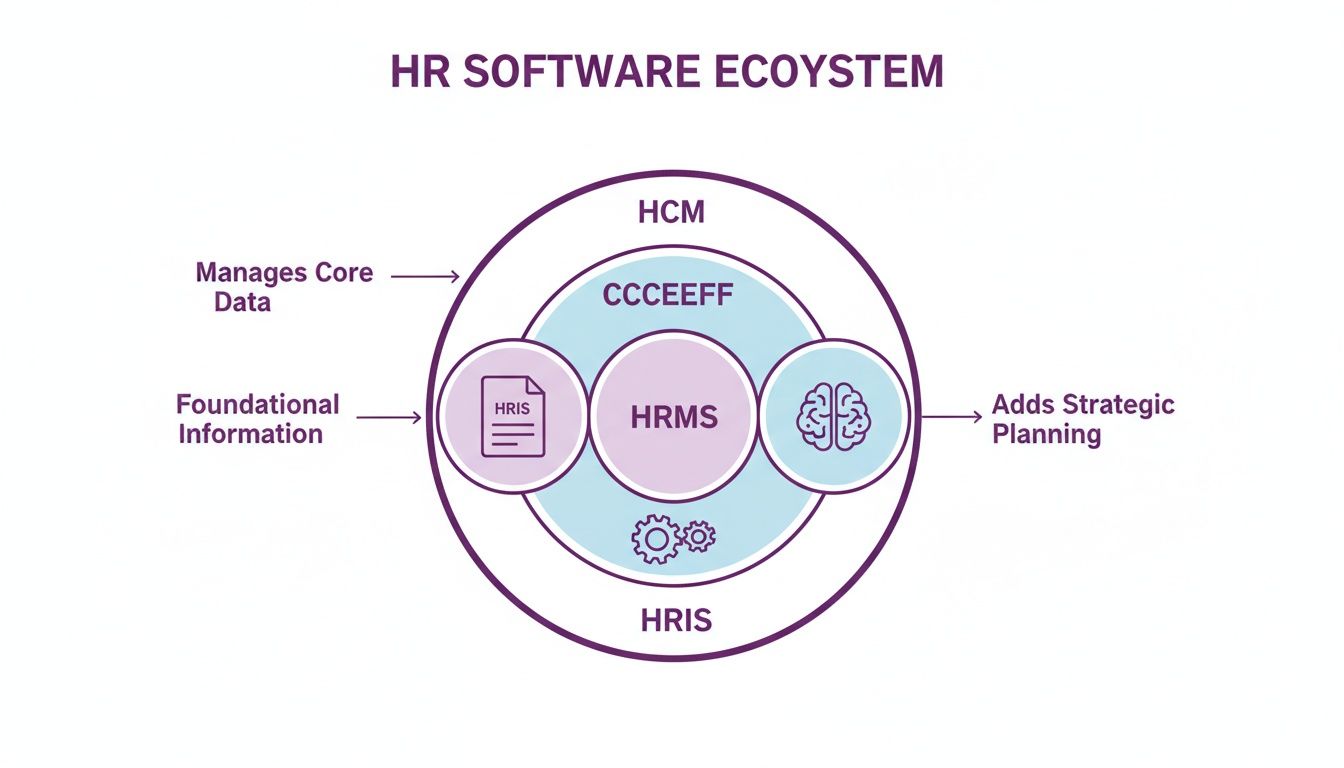
As you can see, the HRIS is the essential data layer. To get truly strategic, you need to build on top of it.
This is exactly where integrating your HRIS with a business intelligence tool like Wurkn changes the game. Wurkn is not just another HR survey or employee engagement tool; it’s a system designed to connect to your existing data and turn it into a predictive engine for your company’s health.
Connecting Data to Understand the 'Why'
Wurkn securely and anonymously integrates with your HRIS. It pulls key demographic and organizational data points—like department, tenure, location, and role—to add crucial context to real-time employee sentiment. This sentiment is gathered from the digital spaces where your people already collaborate, like Slack and Microsoft Teams, without adding yet another app or survey to their plate.
By layering anonymous, continuous feedback on top of your core HRIS data, you move beyond simply observing trends. You start understanding the root causes. This is the difference between reactive problem-solving and proactive strategy.
Let’s circle back to that turnover problem in the Calgary sales team. With a Wurkn integration, you could see things your HRIS would never be able to show you:
- Sentiment Analysis: Anonymous conversations from that team might reveal consistent frustration around a new commission structure that was rolled out last quarter.
- Thematic Trends: You might see recurring themes of burnout or a lack of recognition from leadership popping up again and again.
- Correlation: You could correlate this negative sentiment directly with the group of employees who have a tenure of less than one year, instantly pinpointing an issue with your onboarding or early-career support.
Suddenly, you’re not just staring at a high turnover number. You have a clear, data-backed story explaining what’s driving it. You finally see the 'why' behind the 'what.'
Elevating the HRIS to a Predictive Engine
This kind of integration elevates the HRIS from a simple system of record to a true business intelligence engine. For COOs and PeopleOps leaders, this is a game-changer. You no longer have to guess how culture impacts business outcomes; you can draw a direct line between them.
You can start asking—and actually answering—much more sophisticated questions:
- Which of our managers are fostering cultures that lead to the highest retention and productivity?
- How is our new return-to-office policy really affecting morale in our Toronto office versus our Texas office?
- Are employees in our engineering department showing early signs of burnout before a major project deadline hits?
By answering these questions with real data, you can take targeted, proactive steps to improve organizational health before small issues spiral into major problems. This allows you to connect culture directly to the business KPIs that matter, like revenue, productivity, and retention.
For a deeper dive, leaders can explore our COO's guide to leveraging workplace culture data for better decision-making. The data in your HRIS is the foundation, but unlocking its potential is what drives a real strategic advantage.
Choosing and Implementing the Right HRIS
Picking a Human Resource Information System is a huge decision, and it’s about way more than just buying software. This is an investment that will fundamentally shape your HR processes, define the employee experience, and build the data backbone for your company's future. Getting this wrong means ending up with a system that creates more headaches than it solves, leaving both your HR team and your employees frustrated.
A deliberate, thoughtful approach is the only way to ensure you land on a system that not only fits your business needs today—whether in Canada or the United States—but can also grow with you tomorrow.
Defining Your Core Needs
Before you even think about looking at demos, the first step is to look inward. You have to get crystal clear on what you actually need the HRIS to do.
This means sitting down and mapping out your current HR workflows, pinpointing every frustrating bottleneck, and talking to the people who live in these processes every day. Get payroll admins, department heads, and front-line managers in a room to understand their biggest pain points.
From there, create a brutally honest list of "must-haves" versus "nice-to-haves." For example, a "must-have" might be automated payroll that can handle the complexities of both Canadian provincial and US federal tax laws. A "nice-to-have" could be a sophisticated performance management module you plan to roll out next year. This clarity is your shield against getting distracted by flashy features you'll never use. It keeps everyone focused on solving your most critical operational problems first.
Key Factors for Evaluating Vendors
Once your requirements are locked down, you can start talking to vendors. But this isn't just about ticking boxes on a feature list. You need to dig deeper into a few critical areas.
- Scalability: Will this system grow with you? The perfect solution for 50 employees will likely fall apart at 500. You need to ask vendors pointed questions about how their platform—and their pricing—adapts when you double your headcount or expand into new regions.
- Integration Capabilities: A modern HRIS can't be a data silo. It’s essential that it connects smoothly with your existing tools, like your accounting software. Crucially, it must integrate with your business intelligence platforms. This is especially true for systems like Wurkn, which pull HRIS data to deliver deep, actionable insights into your company culture.
- Data Security and Compliance: This one is absolutely non-negotiable. Any vendor on your shortlist must be able to prove they have rock-solid security measures. They also need to demonstrate full compliance with regional privacy laws like Canada's Personal Information Protection and Electronic Documents Act (PIPEDA) or relevant US state regulations.
Planning a Seamless Implementation
Choosing the right system is maybe 40% of the battle. The other 60% is nailing the implementation. A smooth rollout is what actually determines whether you get any real value from your investment, and it requires a detailed project plan, constant communication, and a laser focus on your people.
A great HRIS implementation isn't a technical project—it's a change management initiative. The goal isn't just to launch new software; it's to get your employees to actually use it and, hopefully, love it.
Your implementation plan needs to cover a few key stages:
- Data Migration: This is almost always the trickiest part. You need a solid plan, developed with your vendor, for cleaning and moving all your existing employee data from old spreadsheets or legacy systems into the new HRIS. One mistake here can cause payroll nightmares for months.
- System Configuration: This is where you mould the HRIS to fit your company's DNA. You'll set up your specific payroll rules, benefits packages, and internal approval chains so the system works the way you do.
- Employee Training: Don't just show people where to click. Train them on how the new system makes their life easier. You'll need different sessions for different groups—what managers need to know is very different from what a general employee or an admin needs.
- Go-Live and Support: If you can, roll it out in phases. Most importantly, have a dedicated support team ready from day one to answer questions and squash bugs the moment they pop up.
Getting the human side of this right is what separates success from failure. For any organization navigating this shift, getting expert guidance on managing workplace transitions can make all the difference. Learning more about how structured change management facilitation programs can ensure your new HRIS is seen as a welcome upgrade, not a burden to be resisted.
Measuring the ROI of Your HRIS Investment
Putting a new Human Resource Information System in place is a serious commitment of both time and money. For any leader in Canada or the United States, the real question isn't about the bells and whistles—it’s about the return. How do you actually prove this shiny new system is making a difference to the business?
The answer is in tracking the right Key Performance Indicators (KPIs). To show the value of your HRIS, you have to look past simple cost savings and measure its ripple effect across three make-or-break areas: operational efficiency, employee experience, and strategic business outcomes. This is how you get the hard data to show exactly how your investment is paying off.
Key Metrics for Proving HRIS Value
If you want to build a compelling business case, you have to be able to quantify the improvements. A clear dashboard of metrics lets you tell a powerful story backed by numbers, showing a clear "before and after" picture.
You'll want to focus on a balanced set of KPIs:
-
Operational Efficiency: This is usually the easiest place to start. Track metrics like a reduction in time-to-hire, a decrease in payroll processing errors, or the hours saved per month on HR admin tasks. For example, proving a 40% reduction in manual data entry for benefits enrolment is a crystal-clear efficiency gain.
-
Employee Experience: A great HRIS doesn't just help HR; it empowers your people. The key numbers here are things like the employee self-service portal adoption rate or a drop in HR help desk tickets for basic questions. High adoption proves that employees find the system useful, which directly lifts their satisfaction and gives them more autonomy.
-
Strategic Impact: This is where an HRIS stops being a cost centre and starts driving real value. You're looking at high-level metrics like improved employee retention rates or a reduction in compliance-related fines. These KPIs show how a well-managed HRIS directly contributes to the financial health and stability of the entire organization.
From HR Data to Cultural Intelligence
While these metrics are solid, the real strategic ROI gets unlocked when you connect your HRIS data to deeper business intelligence. An HRIS is fantastic at telling you what is happening, but it often falls short when explaining why.
An HRIS provides the blueprint of your organization—your org chart, tenure data, and team structures. A business intelligence tool like Wurkn overlays that blueprint with real-time cultural data, revealing the hidden dynamics that are truly driving performance.
This is where Wurkn delivers value far beyond what traditional HR survey tools or basic employee engagement platforms can offer. By integrating with your HRIS, Wurkn securely and anonymously links organizational data (like department, tenure, or manager) with continuous employee sentiment. It transforms your static HR data into living, breathing cultural intelligence.
Instead of just tracking turnover, COOs and PeopleOps leaders can suddenly analyze high-value KPIs like employee retention by manager or productivity trends in hybrid teams, and correlate them with real-time feedback. This gives you the hard evidence to show that your HR tech investment isn't just making things more efficient—it's building a stronger, more resilient culture and a healthier bottom line.
Your HRIS Questions, Answered
Jumping into the world of Human Resource Information Systems usually sparks a few critical questions for leaders. Before you make a big investment for your Canadian or US-based business, you need clear, no-nonsense answers. Here’s what we hear most often from executives and PeopleOps teams.
How Secure Is Employee Data in a Cloud-Based HRIS?
This is, rightly, the first thing on everyone's mind. Top-tier cloud HRIS providers use enterprise-grade security that’s often more robust than what a company could build in-house. Think end-to-end data encryption, regular third-party security audits, and incredibly detailed access controls so only the right people see the right information.
When you're vetting vendors, you absolutely have to confirm their compliance with regional data privacy laws, like PIPEDA in Canada or specific state laws in the US. It's non-negotiable. And when you connect that system to a business intelligence tool like Wurkn, security is just as vital. All the data is anonymized, protecting employee confidentiality while still giving you the powerful, big-picture insights you need.
Can an HRIS Actually Improve Company Culture?
On its own, an HRIS is an administrative engine. It’s brilliant at creating efficiency and organizing data, which definitely cuts down on employee frustration. But it doesn't directly measure or build culture. The magic happens when you pair it with a business intelligence platform that provides a layer of insight traditional HR tools can't.
By linking your HRIS to Wurkn, you start to see the connections between anonymous, real-time employee feedback and hard data points like department, role, or location. Suddenly, your HRIS goes from a simple filing cabinet to a powerful diagnostic tool. You can stop guessing and start pinpointing the real sources of cultural friction on specific teams, letting you make targeted changes that actually work.
What Is a Typical Implementation Timeline for a New HRIS?
This really depends on your company's size, the system's complexity, and how clean your existing data is. There's no single answer.
A successful launch always hinges on a clear project plan, dedicated internal resources, and a strong, collaborative partnership with your chosen vendor. It's more of a change management project than a pure tech rollout.
For a small or mid-sized business, you’re likely looking at a timeline of two to four months. For larger companies with complex payroll, multiple integrations, and years of historical data to move over, the process could easily take six to twelve months. Breaking the rollout into phases often makes the whole transition smoother and helps get everyone on board faster.
An HRIS is the backbone of modern people operations, but its true power is unlocked when you turn its data into intelligence. Wurkn is the business intelligence layer that connects your HRIS data to the real-time, anonymous pulse of your workforce, giving you a clear view of how culture drives business results. Discover how to turn your HR data into a strategic advantage at https://wurkn.com.