
An HRIS, or Human Resources Information System, is the technology that pulls all your company's employee data into one organized place. Think of it less like a digital filing cabinet and more like the central command centre for your entire workforce, covering everything from the day they’re hired to the day they retire. It’s the software that automates core HR tasks, creating a single, reliable source of truth for all your people operations.
What Is An HRIS System
Imagine trying to run your business today using a patchwork of spreadsheets, paper files, and a handful of disconnected apps for payroll and time tracking. It’s chaotic, wildly inefficient, and a breeding ground for costly mistakes. This is precisely the headache an HRIS system is built to cure. At its heart, it’s a centralized platform that becomes the foundational operating system for your people.
But this technology doesn't just store information; it connects it. When an employee’s vacation request is approved in the time-tracking module, that data automatically flows to the payroll system. A new hire’s details, entered just once during onboarding, are instantly available for benefits enrolment. This integration kills the need for duplicate data entry, saving countless admin hours and slashing the risk of human error.
To give you a clearer picture, here’s a quick breakdown of what an HRIS really does and why it matters.
HRIS At A Glance Core Purpose And Benefits
| Core Purpose | Key Business Benefit |
|---|---|
| Centralize all employee data into a single, secure database. | Eliminates data silos and creates a single source of truth for reporting and decision-making. |
| Automate core, repeatable HR administrative tasks. | Frees up HR teams from manual work to focus on strategic initiatives like talent development and culture. |
| Connect different HR functions (e.g., payroll, benefits, time off). | Reduces manual errors, improves data accuracy, and ensures operational consistency. |
| Provide a self-service portal for employees and managers. | Empowers employees to manage their own information, reducing the administrative burden on HR. |
| Generate reports and analytics on workforce data. | Offers clear visibility into key metrics like headcount, turnover, and compensation for better planning. |
Ultimately, an HRIS brings order and efficiency to the complex world of people management.
The Conductor of Your People Operations
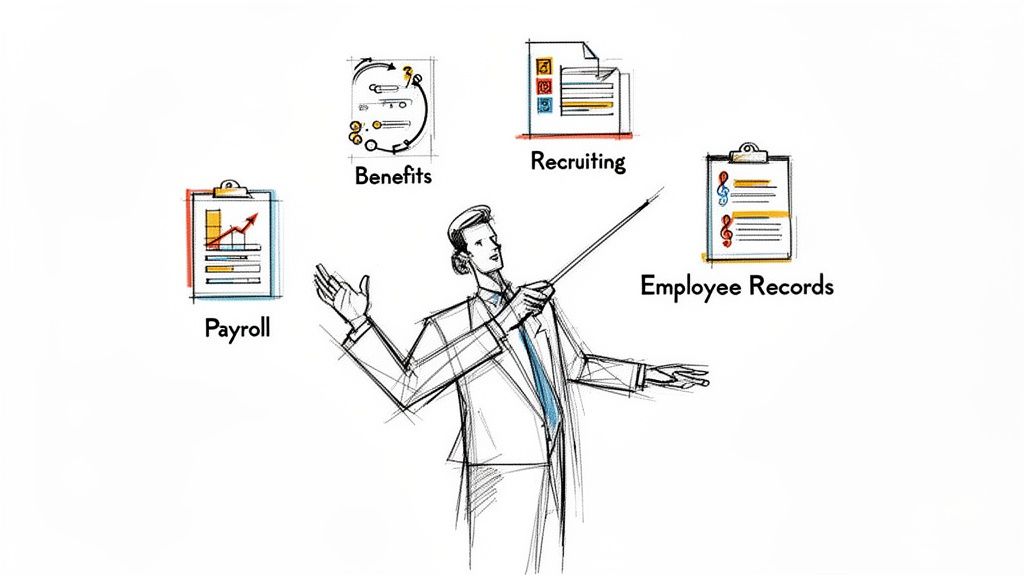
A great way to think about an HRIS is to picture your people operations as a busy orchestra. You have different sections—payroll, recruiting, benefits, performance—all playing their part. The HRIS is the conductor. It doesn't play an instrument itself, but it makes sure every section is working in perfect harmony, following the same sheet of music.
Without the conductor, each department might play at its own tempo, creating a disorganized mess. With an HRIS in place, every process is synchronized, leading to a cohesive and efficient operation.
The adoption of these systems is picking up steam across North America. In Canada, the Human Resources Information System (HRIS) software market is projected to grow at a compound annual growth rate of 3.7% in the coming years. This growth underscores how much Canadian businesses now rely on an HRIS to centralize employee data and automate routine tasks, which cuts down on errors and boosts efficiency. You can dive deeper into the HRIS software market growth via Cognitive Market Research.
Beyond Administration: A Foundation for Intelligence
While an HRIS is a master at automating administrative work, its real power lies in the data it organizes. It provides the clean, structured, quantitative data—the "what"—that is happening inside your company. At a glance, you can see turnover rates, compensation trends, and demographic breakdowns.
This is where its role as a foundational system becomes so critical. This data is the launchpad for much deeper business intelligence. Platforms like Wurkn are designed to connect to your HRIS, taking this quantitative data and layering it with real-time, qualitative cultural insights.
An HRIS tells you who left the company. A business intelligence tool like Wurkn helps you understand why they left by analyzing continuous, anonymous employee sentiment. This combination turns a simple record-keeping system into a powerful strategic tool for making proactive, data-driven decisions that impact retention and performance.
The Core Modules Of A Modern HRIS
An HRIS isn't one giant piece of software. It’s better to think of it as a collection of specialized tools—often called modules—that all talk to each other to manage the entire employee journey. Each module handles a specific piece of the HR puzzle, but the real magic happens when they share information seamlessly, creating one unified system.
Think of it like the apps on your smartphone. Your contacts, calendar, and email are all separate apps, but they work together. When you add a new contact, their email address is instantly available when you go to compose a new message.
This integration is what finally kills the mind-numbing, error-prone task of typing the same employee details into half a dozen different spreadsheets. Update something in one place, and it’s instantly correct everywhere else.
Core Administrative and Data Management
At the very heart of any HRIS are the modules that run the essential administrative machinery and act as the central hub for all employee data. This is the system's engine room, the single source of truth that feeds every other function.
The foundational modules here usually include:
- Employee Database Management: This is your digital filing cabinet. It’s the central, secure home for everything from an employee's contact info and job title to their employment history and emergency contacts.
- Payroll Management: This module puts payroll on autopilot. It calculates wages, handles tax and benefit deductions based on the latest federal and provincial rules in Canada (or state and federal laws in the US), processes direct deposits, and generates payslips.
- Benefits Administration: This takes the headache out of managing employee benefits. It keeps track of who is eligible for what, manages open enrolment periods, handles contributions, and ensures you’re staying compliant.
For example, when an employee in Ontario gets a raise, their manager just has to update the salary in the database. The payroll module automatically picks up that new number for the next paycheque, and the benefits module might adjust life insurance coverage accordingly. No manual double-entry needed.
Workforce and Talent Management
Beyond just keeping the lights on, a modern HRIS also has modules built to help you manage and grow your talent more strategically. These tools help you handle everything from finding and hiring great people to nurturing their careers and planning for the company's future.
These talent-focused modules often include:
- Applicant Tracking System (ATS): This runs your entire hiring process—posting jobs, screening résumés, scheduling interviews, and sending out offer letters. When it’s part of your HRIS, a new hire’s data flows smoothly from their application right into their employee file.
- Time and Attendance: This tracks employee hours, manages work schedules, and handles paid time off requests. This information feeds directly into the payroll module, ensuring everyone gets paid correctly and on time.
- Performance Management: This is where performance reviews, goal setting, and ongoing feedback happen. It helps managers and employees stay aligned on expectations and track progress against company objectives.
- Onboarding: This module automates the new hire experience, handling digital paperwork, kicking off IT equipment requests, and scheduling orientation. It makes for a much smoother, more welcoming start for new team members.
The real value of tying all these modules together is creating that single source of truth. Data moves logically from one part of the employee lifecycle to the next, giving you a complete picture that leads to smarter decisions and a more efficient operation.
Having all this data in one place is also critical for effective workforce planning. By looking at trends across these modules, leaders can spot patterns in performance, see what’s working in recruitment, and start building a solid pipeline for future leadership roles. To really see how this works, you can dig into how this organized data provides the foundation for a strong succession management definition. This HRIS data gives you the quantitative 'what' of your workforce. But when you pair it with a business intelligence tool like Wurkn—which adds the qualitative 'why' through continuous employee feedback—your HRIS transforms from a simple record-keeping system into a powerful tool for genuine strategic insight.
Untangling HRIS vs HRMS vs HCM
Jumping into the world of HR technology can feel like you’re swimming in alphabet soup. Vendors in Canada and the US often use terms like HRIS, HRMS, and HCM as if they mean the same thing, which only makes it harder to figure out what your business actually needs. While they all manage people data, they represent very different levels of complexity and strategic focus.
Getting this right is crucial. Think of it like building a house:
An HRIS (Human Resources Information System) is your foundation and framing. It’s the absolute core—the single source of truth for your employee records, payroll, and benefits administration. It handles the essential, administrative heavy lifting.
An HRMS (Human Resource Management System) builds on that foundation, adding the plumbing, electrical, and interior walls. It includes all the HRIS functions but expands into talent management territory, covering things like recruiting, onboarding, and performance tracking. It’s about managing the entire employee lifecycle more efficiently.
Finally, an HCM (Human Capital Management) system is the fully finished, landscaped property designed for long-term value. It bundles everything from HRIS and HRMS but adds high-level strategic tools like workforce planning, succession management, and complex compensation analysis. It’s a shift in mindset, treating your people not just as resources to manage but as valuable capital to invest in for business growth.
Comparing HRIS, HRMS, And HCM Functionality
To make it even clearer, each system is an evolution of the one before it, expanding from basic administrative tasks to a comprehensive talent strategy. The right choice isn't about which one is "best"—it's about what fits your company's current size, complexity, and future goals. A 50-person startup likely only needs a solid HRIS, whereas a 1,000-person enterprise will need the strategic foresight of an HCM.
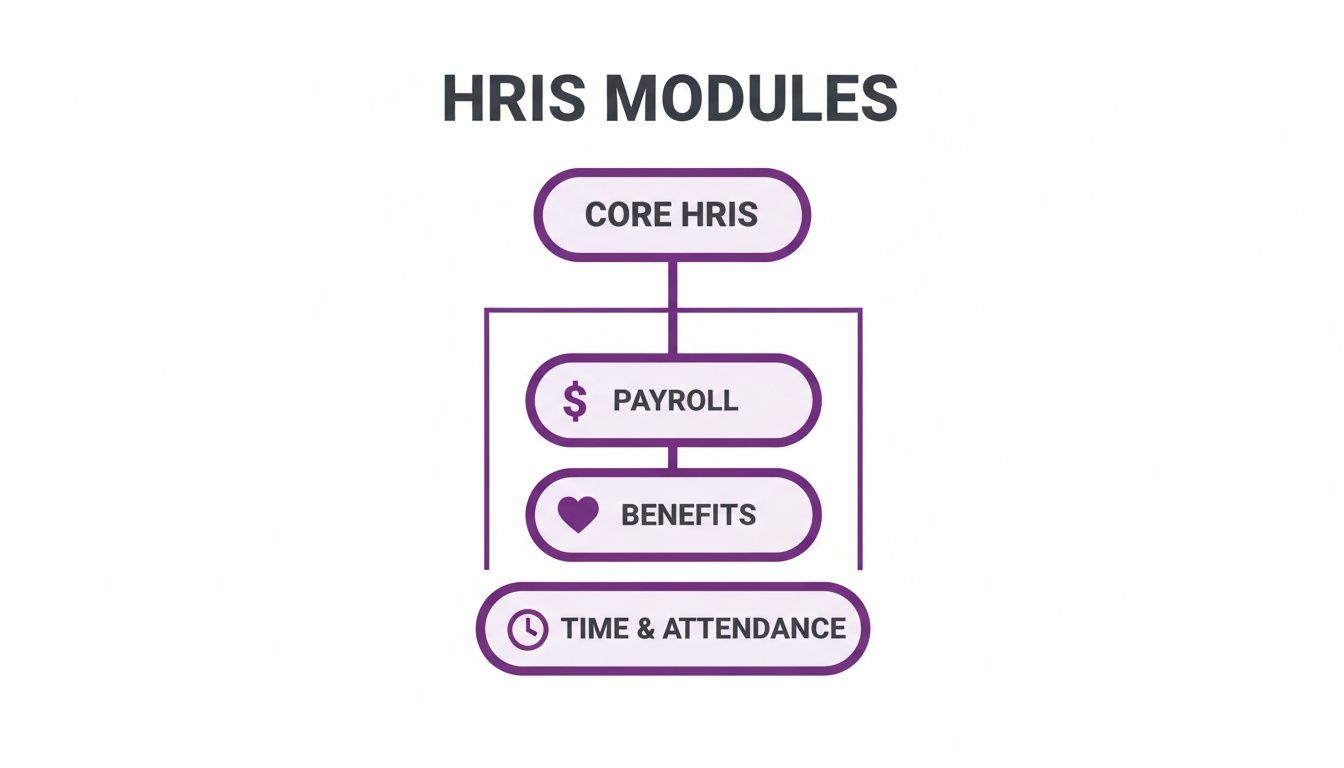
The diagram above shows those foundational pieces—Payroll, Benefits, Time & Attendance—that are the non-negotiable building blocks for any modern HR system.
Choosing the wrong system is a costly mistake. You could end up locked into a platform that’s too basic to grow with you or, conversely, pay for an overly complex system you don't fully use.
| System Type | Core Focus | Key Features | Strategic Scope |
|---|---|---|---|
| HRIS | Administration & Core Data | Payroll, benefits administration, employee records, time & attendance, compliance reporting. | Operational efficiency, accurate record-keeping, and process automation. |
| HRMS | Talent Management & Processes | All HRIS features, plus recruiting & applicant tracking, onboarding, performance management, learning & development. | Managing the entire employee lifecycle, from hiring to performance reviews. |
| HCM | Strategic Workforce Optimization | All HRIS & HRMS features, plus strategic workforce planning, succession planning, advanced compensation, global compliance. | Aligning human capital with long-term business goals and market trends. |
The key takeaway is that each system builds on the last. You can't have strategic HCM without solid HRIS data at its core. Your decision should align with where your business is today and where you plan to be in the next three to five years.
Beyond the Acronyms: What Really Matters
Ultimately, the labels—HRIS, HRMS, HCM—are less important than what the system does for you. These platforms are brilliant at providing the quantitative data, the "what" of your workforce. You can instantly see turnover rates, payroll expenses, and absenteeism trends. This data is the essential starting point.
But it’s only half the story.
This is where a business intelligence tool like Wurkn comes in. Wurkn integrates with your chosen system—whether it’s an HRIS, HRMS, or HCM—to connect that hard, quantitative data with the qualitative "why." It moves beyond outdated annual surveys by capturing continuous, anonymous employee sentiment.
This connection transforms your HR platform from a simple database into a powerful strategic tool. You don't just see that turnover is spiking in the engineering department; you get real-time intelligence on why it’s happening. This allows leaders to address the root cause—be it management, workload, or lack of growth opportunities—and turn your HR tech into a true driver of business performance, not just an administrative filing cabinet.
The Real Business Value Of An HRIS
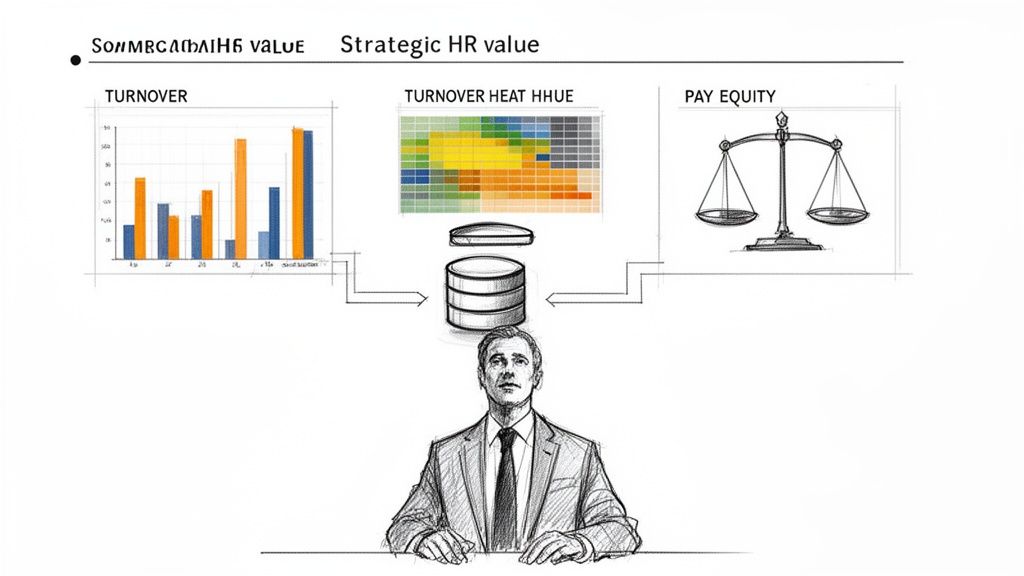
Sure, the efficiency an HRIS brings is a big win, but its true power goes way beyond just automating paperwork. The real magic happens when you stop seeing it as a filing cabinet and start using it as a business intelligence tool. It takes all that raw employee data and turns it into a serious strategic asset.
By putting all your people-related information in one place, an HRIS finally gives leaders a clear, reliable picture of the entire workforce. This isn't just about clean records; it's about making smarter, data-driven decisions that impact the bottom line.
Think about a Chief Operating Officer wrestling with a turnover problem that just won't go away. Without an HRIS, they're stuck with office rumours and a mess of disconnected spreadsheets. With an HRIS, they can instantly see turnover rates by department, manager, or even how long someone's been with the company, pinpointing exactly where the fire is.
That's how HR moves from being a reactive administrative function to a proactive partner in the business. It’s the difference between guessing what’s happening and knowing.
From Data Points To Strategic Insights
Once you have reliable, centralized HR data, you can finally tackle critical business challenges with precision. An HRIS gives you the hard numbers—the "what"—that you need to build any sound people strategy.
Here are a few real-world examples of how this plays out:
- Spotting Pay Inequity: A COO can run compensation reports to see how pay stacks up across different demographics, departments, and roles. This data quickly reveals any unintended biases or inconsistencies, letting the company fix pay equity issues before they become legal risks.
- Finding Turnover Hotspots: By tracking who is leaving and when, leaders can identify specific teams or managers with alarmingly high attrition rates. This allows them to step in with targeted training or support before more top talent walks out the door.
- Getting Labour Costs Under Control: An operations leader can dive into the overtime data from the time and attendance module to find scheduling holes. That visibility leads to smarter workforce planning, cutting unnecessary labour costs while making sure you still have the coverage you need.
Using technology this way is quickly becoming the norm. A recent Survey of Advanced Technology from Statistics Canada found that 62.1% of Canadian businesses have adopted advanced technologies, with HRIS platforms being a key piece of that puzzle (Statistics Canada, 2024). Adoption rates vary across the country—Ontario is at 66.2% while Quebec is at 58.3%—showing just how different the operational landscape can be. You can see the full scope of Canadian business technology adoption in their detailed report.
Beyond HR Data: The Leap To Business Intelligence
An HRIS is fantastic at telling you what is happening. It shows you the numbers: turnover is up 15%, or absenteeism in the sales department has doubled. But those numbers are only half the story. To make decisions that actually work, you have to understand the "why" behind the data.
This is where traditional employee surveys and engagement platforms fall short. Static, infrequent feedback can’t keep up with the speed of business, and the results are almost always disconnected from the hard operational numbers sitting in your HRIS.
A business intelligence tool like Wurkn is built to bridge this exact gap. By integrating directly with your HRIS, Wurkn connects the quantitative data (the 'what') with real-time, qualitative cultural insights (the 'why'). It goes beyond simple record-keeping to give you a complete picture of your organization's health.
For instance, your HRIS might flag that your top engineering team has a high turnover rate. A simple survey might not tell you much. But Wurkn could reveal, through continuous and anonymous sentiment analysis, that the real problem is burnout from a clunky project management process. That's the kind of insight that turns your HRIS from a data repository into a dynamic problem-solving machine, empowering you to fix issues before they truly hurt your business.
Choosing The Right HRIS For Your Company
Picking a Human Resources Information System is easily one of the most critical technology decisions your company will ever make. This isn't just about buying a piece of software; you're selecting the operational backbone for your entire people strategy. Get it right, and you’ll slash administrative drag, unlock critical data for smart planning, and genuinely improve the employee experience.
But a bad choice? That leads to years of painful workarounds, surprise costs, and the kind of operational friction that grinds growth to a halt. The real goal is to find a platform that doesn't just fix today's headaches but also serves as a solid foundation for where you're headed next. You need a system that can grow with you and play nicely with other powerful tools.
Assess Your Current and Future Needs
Before you even think about watching a demo, you have to look inward. The classic mistake is getting wowed by flashy features without first defining the actual problems you need to solve. Start by mapping your current HR processes and pinpointing exactly where the pain is.
- Where are the biggest administrative bottlenecks? Is your team drowning in manual payroll calculations or managing time-off requests through a chaotic mess of emails?
- What data is impossible to get your hands on? Are you flying blind when it comes to understanding turnover, compensation trends, or headcount across different locations in Canada and the US?
- What do your employees and managers actually need? A clunky system that’s a pain to use will crater adoption rates, creating more work for your HR team, not less.
Now, think bigger. Where will the company be in three to five years? If you’re planning to double your headcount, you need a system that can handle that scale. A platform that works fine for 50 employees might completely buckle under the load of 500. Your evaluation has to account for that future state.
Key Evaluation Criteria
Once you have a crystal-clear picture of your needs, you can start digging into potential HRIS vendors. Zero in on a few critical areas that will make or break the long-term success of your investment.
1. Scalability and Flexibility
Your business isn't static, and your HRIS shouldn't be either. The system absolutely must be able to handle more employees, new office locations, and evolving business rules. Directly ask vendors how their platform supports growth and how it can be tailored to fit your specific workflows, not the other way around.
2. Integration Capabilities
An HRIS doesn’t live on an island. It has to connect seamlessly with your other essential business systems—think accounting software, learning management systems, and especially advanced business intelligence platforms. This is where you unlock the real strategic value of your people data.
A well-integrated HRIS provides the clean, quantitative data—the "what"—that a business intelligence platform like Wurkn needs to thrive. Wurkn connects to your HRIS, layering that operational data with real-time, qualitative cultural insights. This gives you the crucial "why" behind the numbers, transforming your HR system from a simple database into a strategic powerhouse.
3. User Experience (UX)
It’s a simple truth: if the system is hard to use, people won’t use it. Test drive the interface from the perspective of an administrator, a manager, and a regular employee. Is requesting time off intuitive? Can a manager approve a timesheet without a user manual? A smooth user experience is non-negotiable for adoption.
4. Compliance and Security
Operating in both the United States and Canada means navigating a complex maze of labour laws and data privacy regulations. Your HRIS must be built to handle compliance on both sides of the border, from federal reporting in the US to provincial standards in Canada. And data security? That's table stakes. Make sure the vendor has bulletproof measures to protect sensitive employee information. For organizations aiming to streamline their People Ops, looking into a specialized People Ops SaaS solution can ensure these critical functions are managed effectively.
Ultimately, choosing the right HRIS is about finding a strategic partner. You're looking for a platform that not only automates today's tasks but also provides the data foundation you need to build a smarter, more efficient, and more engaged organization for years to come.
Integrating Your HRIS For Maximum Impact
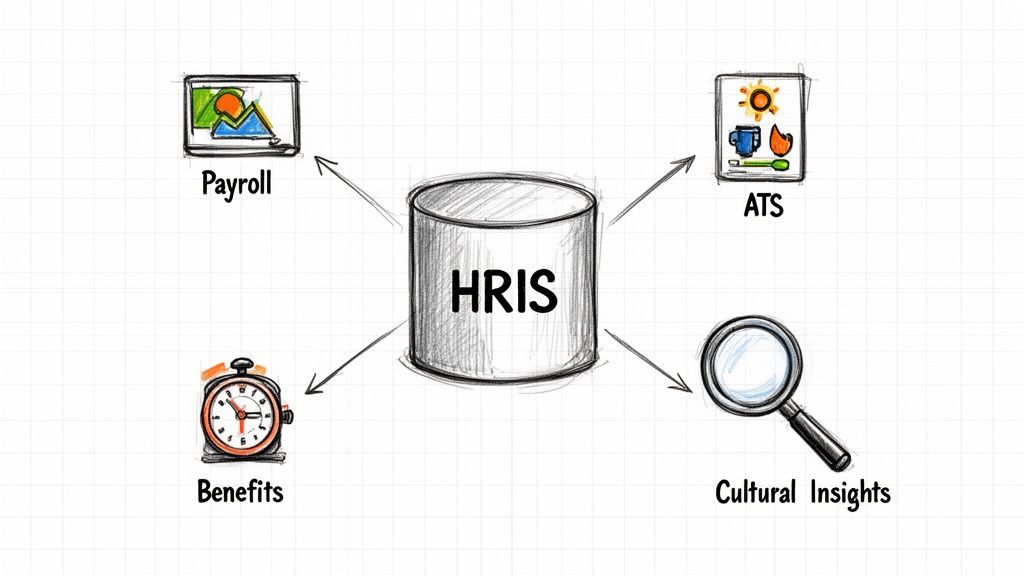
Think of your Human Resources Information System not just as a piece of software, but as the operational engine at the heart of your business. The real magic happens when it stops being a simple digital filing cabinet and starts talking to the other systems that run your company.
This integration transforms your HRIS from a silo of employee records into a central hub for strategic business intelligence.
Effective integration means plugging your HRIS into your broader tech stack—your accounting software, project management tools, and learning platforms. When these systems share data automatically, you kill off the soul-crushing, error-prone task of manual data entry. For example, a new hire added to the HRIS should instantly have accounts created across every other essential platform. No one should have to lift a finger.
This connectivity is the foundation, but the real prize is turning all that HR data into sharp insights that actually drive business forward.
Bridging HR Data with Business Intelligence
The true power of an integrated HRIS emerges when it starts feeding a business intelligence platform. Your HRIS gives you the clean, structured, quantitative data—the “what” of your workforce. It can tell you which departments have the highest turnover or the average tenure of your top performers. But that’s where it stops.
On its own, an HRIS can't tell you why those trends are happening.
This is the critical gap separating basic HR admin from genuine business strategy. Without understanding the 'why,' leaders are just guessing, reacting to problems instead of getting ahead of them.
By connecting your HRIS to a business intelligence platform like Wurkn, you close this gap for good. Wurkn pulls in your HRIS data, combining anonymized employee demographics with real-time cultural feedback. This integration hands leaders actionable intelligence, revealing the direct link between how their teams feel and how the business performs.
From Data Points to Actionable Strategy
This integrated approach turns static HR metrics into a dynamic dashboard for organizational health. It’s the difference between knowing your turnover rate and understanding the specific cultural drivers—like burnout or a lack of recognition—that are causing it.
Here’s how this integration delivers far more value than traditional employee engagement platforms or HR survey tools:
- Real-Time Insights: Instead of waiting for an annual survey, you get a continuous pulse on employee sentiment, directly tied to the demographic and departmental data sitting in your HRIS.
- Predictive Power: By correlating cultural data with business KPIs like productivity and retention, you can spot potential fires before you even smell the smoke.
- Targeted Interventions: Leaders can stop guessing with broad, company-wide initiatives and start taking targeted action. If the data shows one specific team is struggling, you can address the root cause directly and effectively.
A successful HRIS implementation is ultimately defined by how well it connects to your operational core. You can learn more about building the technical backbone for this kind of strategic advantage by exploring options for powerful and flexible API integration. This is how your HRIS evolves from an administrative chore into your company’s strategic nerve centre.
Your HRIS Questions, Answered
Navigating the world of HR technology can feel overwhelming, especially when you’re trying to find a system that works seamlessly across both your Canadian and U.S. operations. Let's cut through the noise and get to the practical answers COOs and HR leaders are looking for.
How Does An HRIS Actually Improve Data Security And Compliance?
Think of it as moving from a messy filing cabinet (or worse, a dozen scattered spreadsheets) to a secure digital vault. An HRIS centralises all your sensitive employee information into a single, access-controlled system. Modern platforms are built on role-based permissions, which is a fancy way of saying people only see what they absolutely need to see for their job. This simple step dramatically cuts down the risk of the wrong eyes seeing the wrong data.
On the compliance front, a good HRIS is your best friend. It automates the painful record-keeping and reporting required by Canadian regulations like the Personal Information Protection and Electronic Documents Act (PIPEDA), and U.S. rules like Equal Employment Opportunity Commission (EEOC) filings. This makes audits less of a fire drill and significantly lowers your company's legal exposure.
Is An HRIS Worth It For A Small Business In The US Or Canada?
Absolutely. In fact, small businesses often feel the biggest and most immediate impact. Gone are the days of clunky, expensive systems. Today’s cloud-based solutions are built to be scalable and affordable, designed specifically for small and medium-sized businesses.
An HRIS takes the repetitive, soul-crushing tasks like payroll and onboarding off your plate, freeing up a small team to focus on growth. More importantly, it builds a solid HR foundation from the start, preventing the operational chaos that almost always comes with rapid expansion.
What’s A Realistic Implementation Timeline For A New HRIS?
This isn't a one-size-fits-all answer. The timeline really depends on your company's size, how clean your existing data is, and how many other tools you need it to talk to.
Here are some general guidelines:
- For a small business with straightforward needs, you could be up and running in a few weeks.
- For a mid-sized company, the process usually takes somewhere between three to nine months.
This window covers all the crucial stages: the initial planning and setup, migrating your employee data (which is often the trickiest part), integrating the HRIS with your other software, and, finally, training your team so they actually use it effectively.
How Does Wurkn Enhance The Data From An HRIS?
This is a critical distinction to make. Your HRIS is fantastic at giving you the ‘what’—the hard, quantitative data. It tells you what your turnover rate is or which departments are seeing the most absenteeism. It's the scoreboard.
Wurkn delivers the ‘why.’ As a business intelligence platform, Wurkn plugs into your HRIS and connects that hard data with real-time, anonymous employee sentiment. It provides the story behind the numbers.
This transforms your static HR reports into a dynamic, predictive tool. Instead of just seeing that turnover is high, you can understand the root causes—like burnout, poor management, or a lack of recognition—and make proactive decisions that fix the real problem, improving both your culture and your bottom line.
Wurkn turns your HR data into a strategic advantage by revealing the cultural drivers behind your key business metrics. Move beyond static reports and gain the actionable intelligence you need to build a healthier, more productive organization. Discover how Wurkn can provide clarity on your company's culture today.