
A satisfaction at work survey is a classic tool companies use to get a read on how their employees are feeling about their jobs, the culture, and the whole work experience. For a long time, these were huge, once-a-year events that gave leadership a single snapshot of how the workforce was doing.
Rethinking the Annual Satisfaction at Work Survey
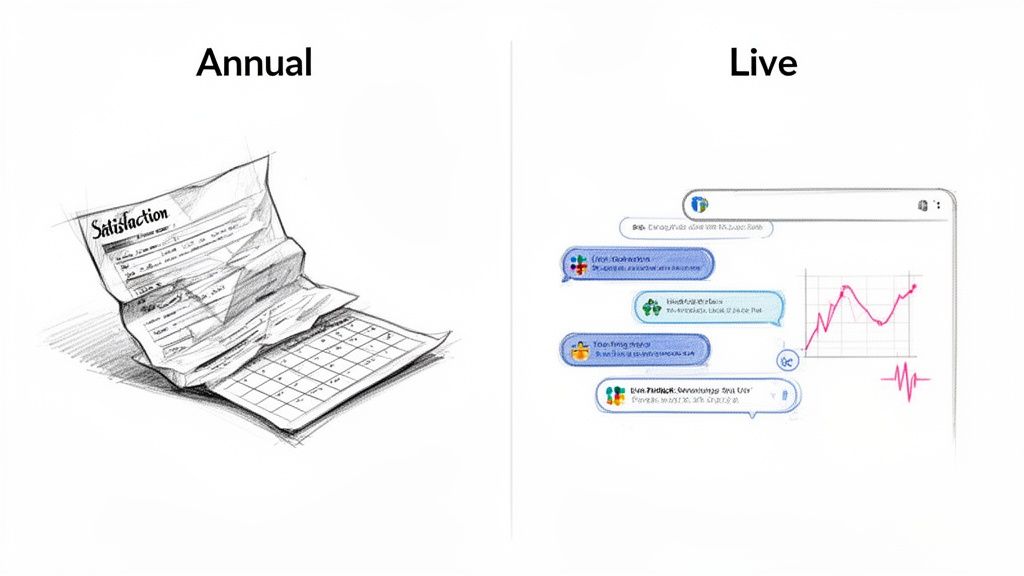
The classic annual satisfaction survey is quickly becoming a relic. For decades, it was the go-to method for gauging employee morale across Canada and the United States. Leaders would wait, sometimes for months after the survey closed, to finally see a picture of their organization's health. The problem? By the time they saw it, that picture was already out of date.
This once-a-year approach just doesn't work for today’s dynamic workplaces, especially with so many hybrid and remote teams. A single survey only gives you a delayed snapshot of an environment that’s constantly changing.
Think about it: feedback collected in October about a project from August is hardly actionable by the time it’s analyzed in January. It’s like trying to navigate a busy highway by only looking in the rearview mirror—you can see where you’ve been, but you have no idea what’s coming up ahead.
The Shift to Continuous Cultural Intelligence
A much better model is one that centres on continuous cultural intelligence. Instead of a massive yearly event that kills productivity and causes serious survey fatigue, imagine an 'always-on' feedback system that captures how people are feeling, as it happens. This is the fundamental difference between a traditional survey tool and a true business intelligence platform like Wurkn.
Rather than just sending out another form, Wurkn plugs directly into the digital channels where work already happens, like Slack and Microsoft Teams. It transforms the natural, daily conversations and interactions among your team members into a live, anonymized dashboard of your company’s cultural health.
This shift from a single, static data point to a continuous stream of information is a game-changer. It allows leaders to spot cultural trends as they emerge, turning reactive problem-solving into proactive strategy. You can actually see the real-time impact of a new policy or a big project kickoff.
Connecting Sentiment to Business Outcomes
The real power of this modern approach is its ability to directly connect employee satisfaction to your core business KPIs. A traditional survey might tell you that morale is low, but it rarely explains why or how that’s hitting your bottom line.
A business intelligence tool, on the other hand, can draw clear, undeniable lines between cultural signals and business performance. For example, a Canadian technology firm might use a tool like Wurkn to see how a dip in sentiment around work-life balance on their development team correlates with a drop in that team's quarterly code deployment velocity. Or, a US-based retail company could see how glowing feedback about a new store manager aligns with higher sales figures and better retention rates in their location.
This deeper level of analysis gives you some serious advantages:
- Early Warning System: You can spot potential issues like burnout or disengagement before they snowball into major problems that cost you revenue or top talent.
- Data-Driven Decisions: It allows you to make strategic choices based on real-time, qualitative insights instead of relying on outdated metrics or just a gut feeling.
- Demonstrable ROI: You can clearly show how investments in company culture are paying off in tangible business results, from reduced churn to increased efficiency.
By finally moving beyond the limitations of the annual survey, organizations across North America can get a clear, current, and actionable understanding of employee satisfaction—one that genuinely drives meaningful business growth.
Designing Surveys That Uncover Actionable Insights
Let's be blunt: a poorly designed satisfaction at work survey can do more harm than good. It creates confusing data, frustrates your team, and ultimately leads to inaction that erodes trust. To get clear, usable feedback, you need a thoughtful approach that goes far beyond generic templates.
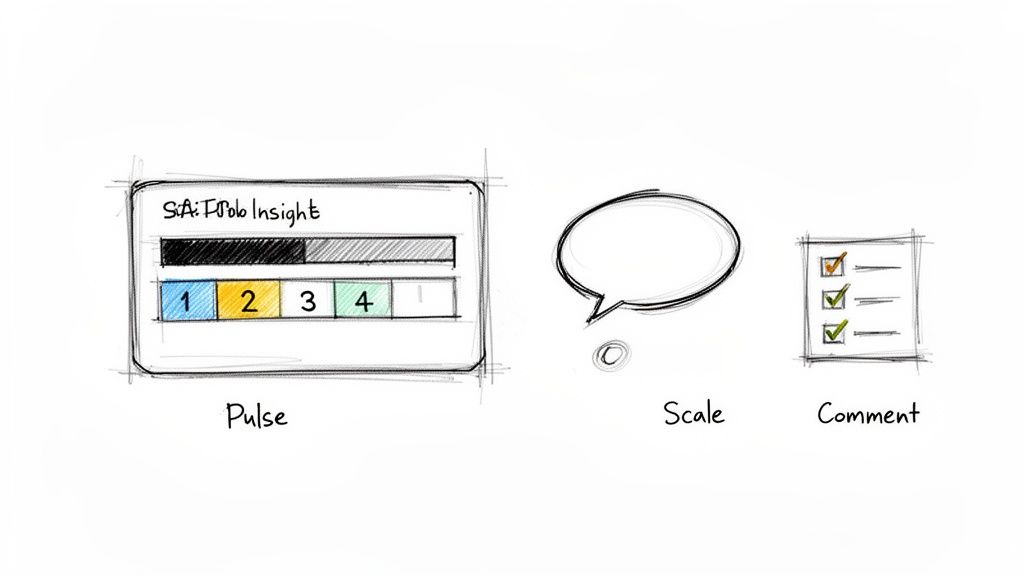
This means it's time to move on from those long, dreaded annual questionnaires. The modern, effective approach is all about shorter, more frequent 'pulse' questions. The real goal is to capture authentic feedback in the moment, without pulling people away from their actual work.
From Static Questions to Dynamic Prompts
The smartest companies are now embedding feedback opportunities directly into their team's daily workflows. A business intelligence tool like Wurkn is built for this, meeting people right where they already collaborate—inside platforms like Slack or Microsoft Teams.
Instead of emailing out yet another survey link that gets ignored, you can pose a quick, relevant question directly in a team channel. The result? Immediate, candid responses. This approach sidesteps survey fatigue because it feels like a natural part of the daily conversation, not some mandatory corporate chore. For PeopleOps leaders, this shift is a game-changer, turning feedback collection from a painful administrative task into a powerful strategic listening tool.
The key is to align every single question with a specific business objective. Don't ask questions just because you're curious; ask them because the answers will help you make smarter decisions about talent, productivity, and culture.
For example, if your company is trying to foster more innovation, your pulse questions should dig into psychological safety and how well teams are collaborating. If retention is the fire you're trying to put out, your prompts should focus on career growth opportunities and leadership support.
Crafting Questions That Yield Clear Answers
The way you ask a question matters just as much as what you ask. Different formats are better suited for different kinds of insights, and mixing them up keeps the process feeling fresh while gathering both hard numbers and the stories behind them.
- Likert Scales: These are your go-to for gauging sentiment on a spectrum (e.g., "On a scale of 1-5, how supported do you feel by your manager?"). They deliver quantitative data that's incredibly easy to analyze and track over time.
- Open-Ended Prompts: Questions like, "What is one thing we could do to improve our team meetings?" are where the gold is. They invite detailed, qualitative feedback that uncovers the 'why' behind the scores.
- Multiple Choice: Perfect for straightforward questions where the answers are finite, like "Which of these benefits do you value most?"
It is absolutely critical to write questions that are crystal clear, concise, and focused on a single topic. Ambiguous or loaded questions will always give you unreliable data. For a deeper dive, it's worth learning how to avoid common mistakes like the dreaded double-barrelled question that can tank your survey's effectiveness.
Evolving Your Survey Strategy
Thinking about how to get started? The table below shows just how easily traditional, static survey questions can be reimagined as dynamic, continuous feedback prompts. This evolution is central to building a more agile and responsive understanding of your workforce.
Traditional Survey Questions vs. Continuous Feedback Prompts
| Satisfaction Driver | Traditional Annual Survey Question | Modern Continuous Feedback Prompt (e.g., in Slack) |
|---|---|---|
| Work-Life Balance | "Rate your satisfaction with your work-life balance over the past year." | "How's your workload feeling this week? 🟢 manageable / 🟡 busy / 🔴 overwhelming" |
| Leadership | "Do you agree that management is transparent about company performance?" | "After our All-Hands today, how clear do you feel about our Q3 priorities? (1-5 scale)" |
| Career Growth | "Do you see a path for career advancement at this company?" | "What's one skill you'd love to develop in the next six months?" |
| Recognition | "Do you feel you are appropriately recognized for your contributions?" | "Who on the team deserves a shout-out this week for going above and beyond?" |
By making this shift, you collect insights that are not only more accurate but also infinitely more actionable in the moments that matter.
Building Trust Through Anonymity and Transparency
If you want honest feedback from your team, you have to make it safe for them to give it. It’s that simple. Without psychological safety, you won’t get the ground-truth data needed to make smart decisions; you’ll just get polite, vague answers that hide the real issues brewing under the surface. This isn’t about making people feel good—it’s a strategic imperative for effective leadership.
When employees even suspect their candid feedback could be traced back to them, they’ll naturally self-censor. And this fear is often justified. Common mistakes, like collecting unnecessary personal details or using feedback channels that feel monitored by management, can instantly destroy any trust you hope to build.
A common example is a company celebrating strong survey results while ignoring a high turnover rate in a specific department. The feedback system felt so transparent to employees that no one dared voice concerns about a toxic manager, leading to a silent exodus that seriously damaged the business.
Creating a Genuinely Anonymous Feedback Loop
True anonymity isn't negotiable. It’s not just a feature; it’s the entire foundation of a healthy feedback culture. This means designing a system where your team has absolute, unshakeable confidence that their identity is protected.
Modern business intelligence tools like Wurkn are built with this privacy-first principle at their core, moving far beyond what traditional HR survey tools can offer. The entire platform is engineered to shield individual identities using sophisticated data redaction and aggregation techniques.
Here’s what that looks like in practice:
- Data Redaction: Identifying details are automatically stripped from all feedback. This makes it impossible to trace comments back to an individual.
- Aggregation Rules: Data is only ever displayed in aggregate. Insights are only surfaced for groups large enough to prevent anyone from singling out a specific person's response.
- Minimal Data Collection: The system is designed to only collect the essential information needed for analysis, avoiding the over-collection of personal data that can feel invasive.
This robust approach to privacy encourages the kind of candid feedback that uncovers critical issues before they escalate into full-blown crises. It allows leaders to see rich, thematic insights without ever compromising employee confidentiality.
When you guarantee anonymity, you're not just collecting data; you're building a culture of trust. You’re sending a clear message that you value honest input over performative positivity, which is the only way to drive real change.
The Business Case for Trust
Building a trustworthy feedback mechanism isn't just an HR initiative; it's a powerful driver of business outcomes, especially in the competitive Canadian and American talent markets. When employees trust the process, they are far more likely to stay engaged and committed. And this connection is backed by hard data.
For instance, a 2025 survey of the California construction industry found that a lack of trust was a significant factor in turnover intentions (AGC of California, 2025). This directly links trustworthy feedback channels to tangible results like reduced employee churn—a critical metric for any business. You can learn more about the findings on trust and retention in their report.
Platforms like Wurkn provide the architectural integrity needed to build this trust from the ground up. By handling sensitive feedback with the utmost security, they empower PeopleOps leaders and COOs to focus on what matters most: using the insights to build a healthier, more productive, and more resilient organization. Ultimately, anonymity is the key that unlocks the honest conversations necessary for continuous improvement and sustainable growth.
Analyzing Feedback to Pinpoint Key Business Drivers
Collecting feedback is just the first step. The real value from any satisfaction at work survey comes out during the analysis, when you turn all that raw data into strategic insights that can actually move the business forward. This is the moment that separates interesting observations from impactful actions. It’s about getting beyond the spreadsheet and digging into the ‘why’ behind the numbers.
For leaders in Canada and the United States, that means blending quantitative scores with qualitative comments to find the real drivers of employee satisfaction—and dissatisfaction. Let's be honest, manually combing through thousands of open-ended comments is a nightmare. It's slow, biased, and you're almost guaranteed to miss the subtle trends or connected ideas hidden in the text.
Moving From Raw Data to Strategic Intelligence
This is exactly where a business intelligence tool like Wurkn completely outclasses traditional survey platforms. Instead of dumping a mountain of data on your desk, Wurkn’s AI-powered synthesis engine does the heavy lifting for you. It pulls out recurring themes, gauges the underlying sentiment, and links trends to specific departments or locations—all while keeping employee anonymity locked down.
This gives leaders immediate context. Imagine you see a small dip in your satisfaction scores. A basic tool tells you what happened. A platform like Wurkn can tell you why it happened, connecting that dip to growing themes like ‘meeting fatigue’ on your engineering team or ‘unclear strategic direction’ coming from new hires.
Getting to that level of detail is critical. It's the difference between treating symptoms and actually solving the root cause of a problem.
This is the ideal flow for turning that honest employee input into real business intelligence.
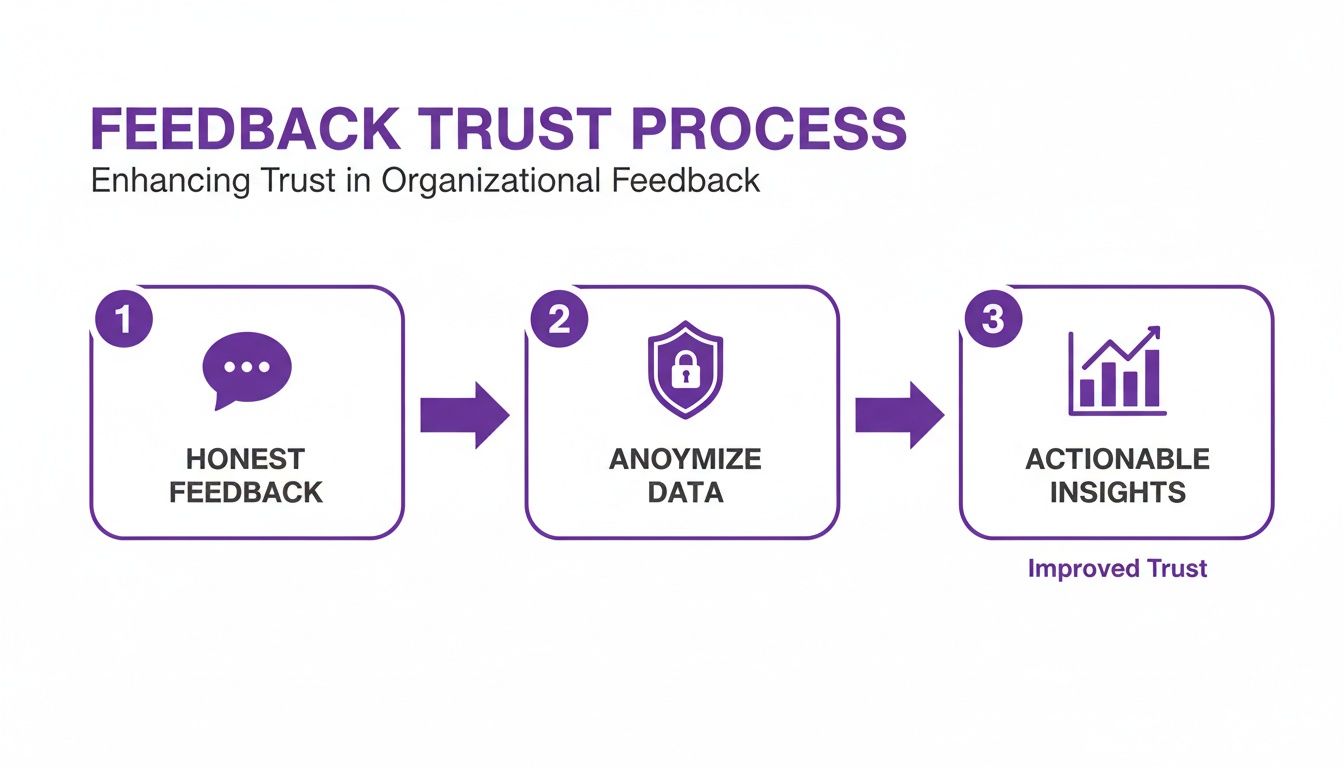
As you can see, actionable insights are only possible when they're built on a solid foundation of anonymized, honest feedback.
Uncovering Hidden Risks and Opportunities
A deep analysis often shines a light on critical risks that a high-level, positive satisfaction score can easily hide. A good top-line number doesn't tell you the whole story. The real gold is in the nuances—the details that point to brewing problems that could tank retention and productivity down the line.
For instance, a UC Irvine survey found that while 74% of workers reported being satisfied overall, a shocking 41% of in-person or hybrid workers would still quit for a fully remote job (UCI, 2025). This single data point reveals how a seemingly happy workforce can still be a massive retention risk if you don't understand their underlying preferences. You can discover more insights about the shifting work landscape to see just how crucial this deeper dive is.
Without the right tools, finding insights like these is next to impossible. You need a system that can slice and dice the data, cross-referencing different variables to uncover those hidden connections.
A business intelligence approach lets you ask much smarter questions of your data. You can explore how satisfaction drivers differ between tenured staff and new hires, or how feelings about work-life balance vary between your sales and operations teams.
Integrating Business Intelligence for Better Decisions
Ultimately, the whole point of analyzing feedback is to make better business decisions. A platform like Wurkn gives you a living dashboard that ties the health of your culture directly to operational outcomes. This allows COOs and PeopleOps leaders to see the clear, undeniable lines connecting employee sentiment to core business KPIs.
This capability transforms feedback analysis from a reactive, backward-looking chore into a proactive, strategic advantage. You can see the full potential of this approach by learning more about advanced analytics for HR. By investing in a system that delivers true business intelligence, you're empowering your organization to not just listen to its people, but to understand them on a level that drives real, sustainable growth.
Turning Insights Into High-Impact Business Actions
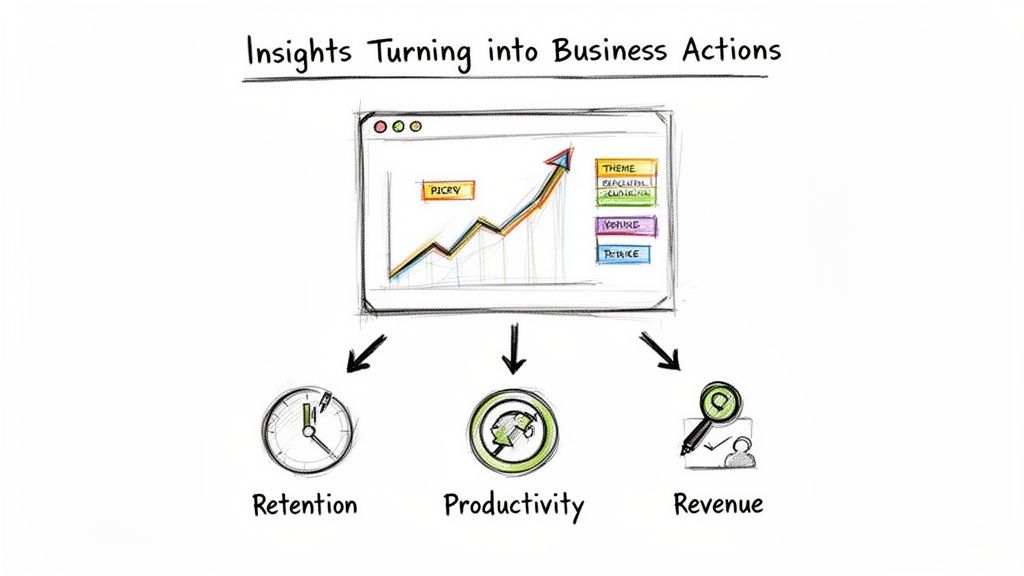
An unanswered satisfaction at work survey is a broken promise. After you’ve asked for and received honest, anonymous feedback, the most critical step is turning those insights into a real action plan that links directly to business outcomes. Just acknowledging the feedback isn’t enough—your team needs to see that their input genuinely leads to change.
Failing to act is one of the fastest ways to destroy trust and guarantee everyone ignores your next survey. This is all about closing the loop and showing that leadership isn’t just listening but is committed to building a better workplace. But you can't tackle everything at once. That’s a recipe for burnout and diluted impact. The real goal is strategic prioritization.
Prioritizing Actions for Maximum Impact
A powerful way to prioritize is to weigh each potential action against two things: its potential impact on key business KPIs (like revenue, productivity, and retention) and the effort required to get it done. This helps you spot the high-impact, low-effort wins that build momentum and show you’re serious.
Instead of getting bogged down by a long list of suggestions, use your data to zero in on the two or three initiatives that will move the needle most. For example, if your analysis shows burnout is a major theme driving down satisfaction and increasing turnover risk, then an initiative to improve work-life balance should jump to the top of your list.
The need to act on this kind of feedback is becoming more urgent. According to a 2025 survey report, overall job satisfaction has dropped to 59%, with dissatisfaction hitting its peak among those aged 45-54 (33%) (MBS, 2025). The data shows that ignoring these specific pain points creates a huge churn risk, driving home the need to translate survey insights into targeted actions that solve the most pressing issues. You can explore the full 2025 satisfaction report to get a better handle on these trends.
From Action Plan to Living Dashboard
This is where a cultural business intelligence tool like Wurkn delivers value that goes way beyond what traditional HR survey tools can offer. Once you've identified your priorities and launched an initiative, Wurkn gives you a living dashboard to track the results in near real-time. It turns your action plan from a static document into a dynamic, data-driven feedback loop.
Consider this logical example: a U.S.-based logistics company uses Wurkn's analysis and flags widespread meeting fatigue as a primary driver of burnout. In response, leadership implements a 'no-meeting Friday' policy.
With a traditional survey, you'd have to wait months—maybe even a full year—to see if the policy made any difference. With Wurkn, you can start monitoring sentiment around "work-life balance" and "productivity" almost immediately. The platform can surface anonymized comments and track shifts in tone, showing you the direct impact of your decision within weeks.
This allows for a much more agile and effective approach to the management of people and cultural initiatives. If sentiment improves, you have clear data to prove the policy’s success. If it doesn't, you can quickly pivot and refine your approach based on continuous feedback.
This creates a data-driven cycle where actions are measured, refined, and proven to deliver a clear return on your cultural investments. It shifts the conversation with executives from "we think this is a good idea" to "we can demonstrate the positive business impact of this action."
Demonstrating the ROI of Cultural Investment
By linking cultural initiatives directly to business outcomes, COOs and PeopleOps leaders can finally put a number on the value of their efforts. Wurkn makes this connection clear, showing how improvements in employee satisfaction translate into tangible benefits.
Here’s how this data-driven loop works:
- Identify the Problem: Wurkn’s analysis pinpoints a key driver of dissatisfaction, like a lack of career growth opportunities.
- Launch an Initiative: You roll out a new mentorship program and increase the budget for professional development.
- Measure the Impact: You use Wurkn to monitor sentiment specifically related to "career growth" and "development."
- Correlate with KPIs: Over the next two quarters, you see a positive trend in sentiment that correlates with a 5% decrease in voluntary turnover in a key department.
This closed-loop system provides the hard evidence needed to justify cultural investments and prove their strategic importance. It moves employee satisfaction from a vague HR metric to a core business driver that directly influences profitability, productivity, and your ability to retain top talent across Canada and the United States.
Common Questions from People Leaders
As PeopleOps leaders and COOs look to evolve their feedback strategy, a few questions always come up. Let's tackle the big ones that arise when shifting from a traditional satisfaction at work survey to a modern, continuous feedback program.
Can We Really Guarantee Anonymity?
This is the big one. And it’s the bedrock of getting honest, unfiltered feedback. Just saying feedback is anonymous isn't enough anymore—your team is too smart for that. The system itself has to be built for it.
Think about it this way: a true business intelligence tool like Wurkn is engineered differently from a standard HR survey tool from the ground up. It’s designed to automatically redact any personally identifiable information and only ever shows insights in aggregate. This makes it technically impossible for anyone, even an admin, to trace a comment back to a person. That's how you build the psychological safety needed for candid feedback.
The gold standard is a system where even the administrators cannot de-anonymize feedback. Once your team understands this, trust in the process skyrockets, and the quality of your data improves dramatically.
How Do We Get Insights Without Causing Survey Fatigue?
Survey fatigue is a very real problem, especially in fast-paced workplaces across Canada and the United States. But the answer isn't to stop asking for feedback; it's to fundamentally change how and when you ask. The days of the long, dreaded annual survey are over.
The key is to meet employees where they already are. Instead of another email getting buried in a crowded inbox, a platform like Wurkn embeds quick, one-question prompts right into Slack or Microsoft Teams. This feels less like a chore and more like a natural part of the daily workflow. You get much higher participation without ever disrupting momentum.
How Do We Prove the ROI of This to the C-Suite?
Executives need to see a clear line connecting culture initiatives to the bottom line. To prove the ROI, you have to move beyond "soft" metrics and show a direct, data-driven link between employee sentiment and core business KPIs. This is where a proper business intelligence tool really shines.
Imagine showing your leadership a chart where a negative sentiment trend around "work-life balance" directly correlates with a 5% increase in voluntary turnover in a specific department. Or even better, demonstrating how a new leadership program led to a measurable lift in that team's productivity scores the following quarter.
Suddenly, you're not just talking about satisfaction; you're managing a key driver of business performance. Wurkn gives you a living dashboard that makes these connections impossible to ignore, allowing you to prove the value of your cultural investments with hard, compelling data.
Ready to move beyond static surveys and unlock real business intelligence from your employee feedback? See how Wurkn transforms continuous sentiment into a powerful driver for retention, productivity, and growth. Discover Wurkn today.