
In today's competitive talent market across Canada and the United States, the 'Great Resignation' has evolved into a persistent 'Great Re-evaluation.' Employees are no longer just seeking a paycheque; they are critically assessing their roles, searching for purpose, growth, flexibility, and a workplace culture where they feel genuinely valued and heard. For many organisations, the real story behind employee sentiment remains hidden, surfacing only in exit interviews when it's too late.
Traditional annual engagement surveys often miss the crucial, day-to-day fluctuations in morale, capturing a single, outdated snapshot in time. By the time leadership reviews the aggregated data, your top performers may have already accepted offers elsewhere. The financial and cultural cost of this churn is immense, impacting productivity, team cohesion, and your bottom line. This is why a proactive, data-informed approach to retention strategies for employees is no longer a luxury, but a core business necessity.
This article moves beyond generic advice to provide ten actionable, data-driven retention strategies. We will explore how to not only keep your team intact but to transform your organisation into a place top talent actively chooses to stay. You'll learn how to shift from reactive measures to proactive, intelligence-led strategies, uncovering the 'why' behind turnover before it happens. Central to this modern approach is leveraging a cultural business intelligence tool like Wurkn to understand the real-time, nuanced sentiment of your workforce and link that crucial cultural data directly to tangible business outcomes, giving you the power to act decisively.
1. Continuous Feedback and Sentiment Monitoring
Among the most impactful retention strategies for employees is moving from static, annual surveys to a dynamic, continuous feedback model. This approach involves collecting real-time employee sentiment through always-on listening channels integrated into daily workflows, such as Slack, Microsoft Teams, or email. Instead of a once-a-year snapshot, you get a living pulse of your organisation's health, allowing you to identify and address cultural issues, engagement dips, or team friction before they escalate and lead to turnover.

Why It Works
Continuous feedback provides unfiltered, in-the-moment insights that traditional surveys often miss. When employees can share their thoughts as they arise, the feedback is more authentic and relevant. This proactive listening stance demonstrates that leadership values employee voices, which builds psychological safety and trust. By analyzing this unstructured data, organisations can uncover the root causes of disengagement and connect them to operational outcomes, transforming cultural health from a vague concept into a measurable business metric.
How to Implement It
- Integrate Listening Tools: Deploy platforms that integrate directly into communication tools your teams already use. This lowers the barrier to providing feedback.
- Guarantee Anonymity: Ensure your system offers complete anonymization. This is non-negotiable for encouraging candid feedback, especially on sensitive topics.
- Establish Clear Protocols: Communicate that the goal is organisational improvement, not individual performance evaluation. Train managers to interpret sentiment trends and respond constructively.
- Close the Feedback Loop: Regularly share high-level insights with the company and communicate the specific actions being taken as a result. For instance, if feedback highlights burnout, share plans for a workload re-evaluation. For more details, you can learn how COOs get actionable business insights from continuous employee feedback.
Key Insight: The true power of continuous feedback isn't just collecting data; it's about transforming that data into business intelligence. Unlike simple HR survey tools, Wurkn can correlate sentiment trends with performance KPIs like productivity and attrition, providing leaders with a clear line of sight between culture and operational success.
2. Career Development and Internal Mobility Programs
One of the most powerful retention strategies for employees is establishing structured pathways for internal growth. This involves creating clear opportunities for advancement through skills training, mentorship, and transparent internal mobility programs that allow talent to move into new roles within the organisation. Employees are far more likely to stay when they see a viable future and clear skill-advancement paths with their current employer, turning a job into a long-term career.
Why It Works
Investing in career development sends a clear message that you value your employees as long-term assets, not just temporary resources. It addresses a primary driver of turnover: the feeling of stagnation. Internal mobility programs also provide significant returns by retaining valuable institutional knowledge, reducing recruitment costs, and shortening the ramp-up time for critical roles. For example, a major North American telecommunications company successfully used a large-scale reskilling program to reduce external hiring for technical roles by 40%, demonstrating direct financial and operational benefits.
How to Implement It
- Create Transparent Career Paths: Develop and communicate clear promotion criteria, skill requirements, and expected timelines for different roles and levels.
- Build a Skills Inventory: Implement a system to map current employee skills and identify gaps. This data helps match internal talent with emerging opportunities and informs training priorities.
- Fund Continuous Learning: Offer to fund external certifications, advanced degrees, or specialized training that aligns with both the employee's aspirations and the company's future needs.
- Promote Internal Opportunities: Actively market internal job openings and encourage managers to support their team members in exploring new roles within the organisation. This is a core component of building a robust succession management plan.
Key Insight: To make career development truly effective, you must first understand what your employees want. A continuous listening tool like Wurkn provides business intelligence that goes beyond traditional engagement platforms, capturing anonymized feedback on career aspirations and frustrations. This allows you to align development programs with actual employee sentiment, ensuring your investment in training and mobility directly addresses the desires of your top talent and prevents their departure.
3. Competitive Compensation and Benefits Strategy
A foundational element among retention strategies for employees is a competitive and thoughtfully designed total rewards package. This goes beyond just salary to encompass a holistic view of compensation, including comprehensive benefits, performance-based incentives, and equity where appropriate. While high pay alone won't guarantee loyalty, falling short of market standards is a guaranteed way to lose top talent. A strong strategy signals that the organisation values its people and is invested in their long-term financial and personal well-being.
Why It Works
Fair and competitive compensation is a fundamental aspect of the employer-employee contract. When employees feel they are being paid their market worth, it removes a major source of dissatisfaction and a primary reason for job hunting. A well-rounded benefits package further deepens this connection by addressing key life needs, such as health, family, and future financial security. This approach creates a powerful value proposition, making it harder for others to lure away your key contributors with marginal salary increases alone.
How to Implement It
- Conduct Regular Audits: Perform annual compensation benchmarks using reliable market data to ensure your salary bands remain competitive for your industry and region.
- Embrace Transparency: Consider publishing salary ranges in job postings. This practice builds trust from the initial point of contact and helps attract candidates who are aligned with your compensation philosophy.
- Customise Benefits: Survey your employees to understand which benefits they value most. A flexible benefits plan can be more impactful than a one-size-fits-all approach, allowing employees to choose what matters to them.
- Align Incentives with Performance: Tie bonuses, commissions, or equity grants to clear, achievable performance metrics. This ensures that rewards are directly linked to value creation for the company. For example, some leading tech companies commit to a "pay top of market" philosophy to attract and retain the best talent in their field.
Key Insight: Compensation isn't just an expense; it's a strategic investment in talent. A business intelligence tool like Wurkn helps organisations correlate compensation adjustments with sentiment trends. For instance, you could analyze if a recent benefits enhancement directly impacts team morale or if discussions about pay equity are rising, giving you the intelligence to fine-tune your total rewards strategy for maximum impact on retention—capabilities that extend far beyond simple HR survey tools.
4. Manager Quality and Leadership Development
One of the most critical retention strategies for employees centres on investing in the people who lead them. This means moving beyond basic management and actively developing leaders who can coach, communicate effectively, and champion a positive organisational culture. The well-known adage, "people leave managers, not companies," is consistently proven by data; a direct manager has a disproportionate influence on an employee's daily experience, engagement level, and decision to stay.

Why It Works
Strong managers create environments of psychological safety where team members feel comfortable taking risks, sharing ideas, and admitting mistakes. They are skilled at connecting an individual's work to the company's broader mission, providing purpose and making work feel meaningful. Research from large-scale internal studies at major tech firms has identified manager quality as a top predictor of team performance and retention (Project Oxygen, 2008). When managers are trained as effective coaches, they foster growth, provide clear direction, and build trust, which are foundational elements of employee loyalty.
How to Implement It
- Assess Manager Effectiveness: Use anonymous 360-degree feedback tools to understand current manager strengths and weaknesses from the perspective of their direct reports, peers, and superiors.
- Make Training Continuous: Implement mandatory and ongoing leadership development programs. Focus on crucial skills like providing constructive feedback, active listening, conflict resolution, and fostering inclusivity.
- Link Compensation to Team Health: Tie a portion of manager bonuses or compensation to team-specific retention rates and engagement scores. This creates direct accountability for building a positive team environment.
- Encourage Peer Learning: Establish manager peer groups or "masterminds" where they can share challenges, best practices, and learn from one another in a confidential setting. You can discover more about leadership's impact on staff retention success here.
Key Insight: Continuous feedback tools provide an objective measure of a manager's impact. By using a business intelligence platform like Wurkn, organisations can analyse sentiment data at the team level, identifying specific managers who may need more coaching or recognizing those who excel at fostering engagement. This transforms manager evaluation from subjective observation into a data-driven process, directly linking leadership effectiveness to business outcomes like reduced team attrition.
5. Flexible Work Arrangements and Work-Life Balance
In the modern workplace, one of the most powerful retention strategies for employees is offering meaningful flexibility. This goes beyond simple remote work options; it encompasses policies that empower employees to manage their schedules, choose their work location, and maintain healthy boundaries between their professional and personal lives. Post-pandemic, flexibility has shifted from a perk to a core expectation, and organisations that fail to adapt risk losing top talent.
Why It Works
Flexible work arrangements are fundamentally built on trust, granting employees autonomy over their time and environment. This autonomy is a direct driver of job satisfaction, engagement, and loyalty. When people feel trusted to manage their own productivity, they are more likely to be motivated and committed. Moreover, this approach widens the talent pool significantly, allowing companies to hire the best person for the job, regardless of their geographical location in Canada or the United States. It demonstrates a commitment to employee well-being, which is a critical factor in long-term retention.
How to Implement It
- Establish Clear Guardrails: Define clear expectations for communication, availability, and performance in a hybrid or remote model. A policy might state core collaboration hours while allowing flexibility outside of them.
- Invest in Technology: Equip teams with the necessary collaboration tools (e.g., project management software, high-quality video conferencing) to ensure seamless communication and workflow, regardless of location.
- Focus on Outcomes, Not Hours: Shift performance management to be results-oriented. Trust your employees to deliver quality work rather than tracking their online status or hours clocked. Major automotive and tech companies have successfully adopted hybrid models that balance presence with performance.
- Create Intentional Connection: For remote and hybrid teams, proactively schedule virtual social events, team-building activities, and in-person meetups to foster connection and combat potential isolation.
Key Insight: Flexibility can create new cultural challenges, such as proximity bias or remote employee isolation. A business intelligence tool like Wurkn helps leaders monitor sentiment across different work arrangements. By correlating feedback with location or team structure, you can identify if remote employees feel disconnected or if in-office staff perceive unfair advantages, allowing you to fine-tune your policies for true equity and inclusion—a level of analysis traditional engagement platforms cannot provide.
6. Recognition and Appreciation Programs
Implementing systematic recognition and appreciation programs is a powerful retention strategy for employees that moves beyond sporadic praise to a structured approach for acknowledging contributions. This involves creating formal and informal channels for celebrating wins, big and small, to ensure employees consistently feel seen and valued. Effective programs can range from sophisticated peer-to-peer platforms to simple, manager-led rituals that reinforce desired behaviours and build a culture of gratitude, directly fuelling engagement and loyalty.
Why It Works
Recognition directly addresses a core human need to be valued for one's effort. When employees feel their contributions are noticed, it validates their work, boosts morale, and strengthens their connection to the organisation's mission. According to research from Gallup, businesses with a strong recognition culture experience significantly lower absenteeism and higher productivity (Harter & Adkins, 2016). This psychological impact often delivers a greater return on investment than purely monetary rewards, transforming a simple "thank you" into a key driver of organisational commitment.
How to Implement It
- Make It Timely and Specific: Acknowledge achievements as they happen. Instead of a generic "good job," say, "Thank you for staying late to finalise the report; your attention to detail saved us from a major client issue."
- Enable Peer-to-Peer Recognition: Empower employees to celebrate each other. This fosters stronger team bonds and ensures recognition isn't limited to top-down communication.
- Celebrate Diverse Contributions: Recognise not just major sales wins but also the "quiet heroes" who demonstrate company values, provide excellent support, or innovate behind the scenes.
- Link Recognition to Values: Tie acknowledgements back to specific company values. For example, "Your collaborative effort on the Q3 project perfectly embodies our 'One Team' value."
Key Insight: Recognition data is a goldmine of cultural intelligence. By analysing who is being recognised, for what, and by whom, you uncover your true cultural influencers and the behaviours driving success. A business intelligence tool like Wurkn can analyse this unstructured communication, revealing patterns that show whether recognition is inclusive and genuinely aligned with your stated values, transforming appreciation from a feel-good initiative into a measurable cultural metric.
7. Inclusive and Psychological Safe Culture
One of the most foundational retention strategies for employees is the intentional creation of an inclusive and psychologically safe culture. This involves building an environment where every employee feels they belong, can be their authentic self, and can voice ideas or concerns without fear of negative consequences. When psychological safety is high, people feel valued and respected, which is directly linked to higher engagement, better collaboration, and a stronger desire to stay with the organisation.
Why It Works
An inclusive culture acts as a powerful retention magnet for a diverse workforce. When employees see a genuine commitment to equity and belonging, they feel a deeper connection to the organisation's values and mission. Psychological safety, as defined by Harvard Business School professor Amy Edmondson, allows for the moderate risk-taking, speaking your mind, creativity, and sticking your neck out without fear of being embarrassed or punished (Edmondson, 1999). This combination prevents the kind of emotional burnout and disengagement that often precedes an employee's decision to leave. Many leading technology firms have demonstrated that a focus on inclusion directly correlates with improved retention, particularly among underrepresented groups.
How to Implement It
- Assess and Listen Anonymously: Use continuous listening tools to gauge the current state of psychological safety and inclusion. Ask direct questions about belonging, fairness, and the comfort level in speaking up.
- Train Leadership on Inclusive Behaviours: Equip managers with the skills to foster psychological safety. This includes training on active listening, managing unconscious bias, and responding constructively to feedback and failure.
- Establish Clear Anti-Harassment and Microaggression Policies: Create and enforce policies that address subtle and overt forms of non-inclusive behaviour. Education is key to helping employees recognise and stop microaggressions.
- Champion Employee Resource Groups (ERGs): Support the creation of ERGs with executive sponsorship and adequate budgets. These groups provide vital support networks and give a platform to diverse voices within the organisation.
Key Insight: Building an inclusive culture isn't just an HR initiative; it's a critical business strategy. A business intelligence platform like Wurkn helps quantify the impact of these efforts by correlating inclusion metrics from anonymous feedback with key performance indicators like voluntary turnover and productivity rates across different demographic groups. This provides clear evidence of how cultural health drives business outcomes.
8. Purpose-Driven Work and Mission Alignment
One of the most profound retention strategies for employees is to clearly articulate an organisational purpose and intentionally align individual roles to that meaningful mission. Today's workforce, especially younger generations across Canada and the United States, seeks more than just a paycheque; they want their work to contribute to something larger than themselves. When employees feel their daily tasks are connected to a compelling mission that aligns with their personal values, their loyalty and engagement skyrocket.
Why It Works
A strong, authentic purpose acts as a cultural magnet, attracting and retaining talent that is intrinsically motivated by the organisation's "why." This creates a powerful sense of belonging and shared identity, making employees feel like valued partners in a meaningful journey rather than just cogs in a machine. Companies that live their mission, such as outdoor apparel brands with environmental activism or consumer goods companies with a one-for-one giving model, build a workforce that is deeply committed and acts as passionate brand ambassadors. This alignment reduces turnover by fulfilling a core human need for meaning.
How to Implement It
- Connect Daily Tasks to the Mission: Regularly communicate how individual and team contributions directly advance the company's overarching purpose. Frame project goals within the context of the mission.
- Live Your Values: Ensure leadership decisions, resource allocation, and corporate policies consistently reflect the stated purpose. Gaps between words and actions quickly erode trust.
- Communicate Impact: Transparently share metrics and stories that demonstrate the organisation's positive impact. Show employees the tangible results of their collective effort.
- Hire for Alignment: During the recruitment process, assess candidates not only for skills but also for their alignment with the company's core values and mission.
Key Insight: A stated mission is meaningless if employees perceive a disconnect between purpose and practice. Continuous listening is crucial to identify these "purpose-action" gaps. A business intelligence tool like Wurkn can detect when employee sentiment reveals cynicism or a perceived lack of authenticity, allowing leaders to address these issues before they damage morale and drive away top talent.
9. Proactive Exit Interviews and Stay Interviews
While many organisations conduct exit interviews, one of the most underutilised retention strategies for employees involves pairing them with proactive "stay" interviews. This dual approach involves structured conversations not only with departing employees to understand why they are leaving but also with current high-performers to learn what keeps them engaged. While exit interviews provide lagging indicators of attrition root causes, stay interviews offer leading indicators, enabling you to intervene and address potential issues before top talent considers leaving.
Why It Works
This strategy provides rich, qualitative context that quantitative data alone often misses. An exit interview can reveal specific managerial friction or cultural breakdowns that led to a resignation, while a stay interview can highlight the unwritten cultural perks or leadership qualities that make an employee feel valued. By systematically collecting and analysing this feedback, you move from reactive problem-solving to a predictive retention model. For instance, a leading software company famously used aggregated exit interview data to identify and address systemic cultural issues, demonstrating the power of these conversations.
How to Implement It
- Schedule Strategically: Conduct exit interviews during the employee's final week, when they still feel connected but are more likely to be candid. Schedule stay interviews quarterly or semi-annually with key talent, framing them as forward-looking career conversations, not performance reviews.
- Use Neutral Third Parties: Whenever possible, have a neutral party, like an HR business partner, conduct the interviews instead of a direct manager to encourage more honest and unfiltered feedback.
- Standardise Questions: Develop a consistent set of open-ended questions for both interview types to ensure you can track trends over time. For stay interviews, ask questions like, "What do you look forward to when you come to work each day?" and "What might tempt you to leave?"
- Aggregate and Act on Insights: Do not let the feedback sit in a file. Aggregate the anonymous, high-level themes and share them with relevant leadership. If multiple departing employees cite a lack of growth opportunities, develop a plan to enhance your professional development programs and communicate it.
Key Insight: Combining interview data with continuous sentiment monitoring creates a powerful business intelligence loop. A platform like Wurkn helps identify at-risk teams by spotting negative sentiment trends, allowing you to prioritise stay interviews where they are most needed. This transforms exit and stay interviews from isolated HR activities into a data-driven component of your operational strategy, a clear advantage over basic survey tools.
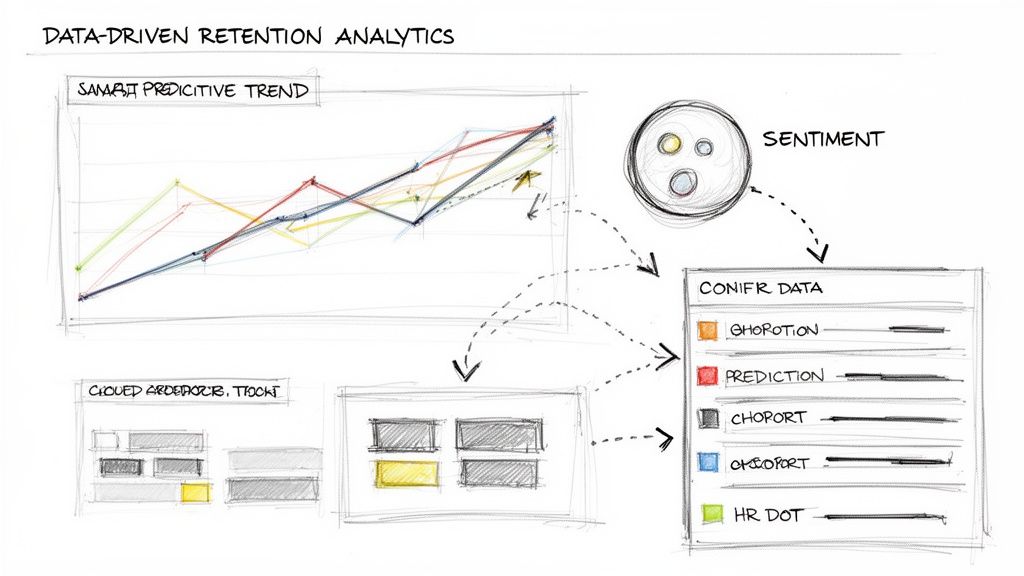
10. Data-Driven Retention Analytics and Predictive Modeling
One of the most powerful retention strategies for employees involves moving beyond reactive measures and adopting a proactive, data-driven approach. This means systematically using HR data from multiple sources to identify at-risk employees, understand the core drivers of turnover, and predict attrition before it happens. By combining quantitative metrics with qualitative cultural intelligence, organisations can build predictive models that offer a significant competitive advantage in talent management.
Why It Works
Predictive analytics transforms retention from a guessing game into a strategic function. It allows leaders to allocate resources effectively, focusing interventions on the specific teams or individuals with the highest flight risk. For instance, an influential study by a major tech company's People Analytics team identified that the number one predictor of team performance and retention was not individual talent, but the quality of the manager. This insight allowed them to channel resources into management training, directly impacting retention. This approach provides objective, evidence-based direction for HR initiatives.
How to Implement It
- Integrate Data Sources: Combine data from your HRIS (e.g., tenure, compensation, promotion history), performance reviews, and continuous sentiment feedback. A comprehensive dataset is the foundation of accurate modelling.
- Identify Key Predictors: Analyse historical data to identify variables that correlate with turnover. These might include commute time, a recent change in manager, declining sentiment scores, or a lack of recognition.
- Develop and Test Models: Use statistical or machine learning models to predict attrition risk. Start simple and refine your models as you gather more data and validate their accuracy against real-world outcomes.
- Build Actionable Dashboards: Create dashboards for leaders and managers that visualise attrition risk and highlight the underlying drivers. This empowers them to intervene with targeted support, like a development conversation or a workload adjustment.
- Maintain Transparency and Trust: Be transparent with employees about how data is used for organisational improvement. Ensure models are audited for bias to maintain fairness and credibility in algorithmic decisions.
Key Insight: Data-driven retention is most effective when it pairs quantitative data with qualitative cultural intelligence. A business intelligence tool like Wurkn connects the dots between sentiment trends (e.g., a drop in sentiment around workload) and business KPIs (like attrition risk), providing leaders with early warnings and the context needed to take meaningful, proactive action.
Top 10 Employee Retention Strategies Comparison
| Strategy | 🔄 Implementation Complexity | ⚡ Resource Requirements | ⭐ Expected Outcomes | 💡 Ideal Use Cases | 📊 Key Advantages |
|---|---|---|---|---|---|
| Continuous Feedback and Sentiment Monitoring | Medium (4–8 wks; platform & AI integration; leadership buy-in) | Medium (integration, NLP, analysts) | ⭐⭐⭐⭐ High — early issue detection; improved engagement | Real-time org health, distributed teams, rapid-change environments | Live sentiment trends; high response; rapid interventions |
| Career Development & Internal Mobility Programs | High (frameworks, LMS, mentorship, policies) | High (training budgets, L&D staff, platforms) | ⭐⭐⭐⭐ High — higher retention; faster internal fills | Succession planning, skill gaps, high-potential pipelines | Cuts external hire costs; builds bench strength; boosts loyalty |
| Competitive Compensation & Benefits Strategy | Medium (benchmarking, salary bands, governance) | High (ongoing budget, HR analytics) | ⭐⭐⭐⭐ High — removes pay as primary attrition driver | Tight labor markets, senior/technical roles, talent attraction | Market competitiveness; financial incentives; attracts talent |
| Manager Quality & Leadership Development | Medium–High (training, assessments, accountability) | Medium (coaches, training time, tools) | ⭐⭐⭐⭐⭐ Very High — strong impact on engagement & retention | Organizations with manager-related attrition; scaling teams | Improves engagement; reduces toxic culture; develops leaders |
| Flexible Work Arrangements & Work-Life Balance | Medium (policy, tech, manager practices) | Medium (digital tools, infra, manager training) | ⭐⭐⭐⭐ High — major retention factor; improves wellbeing | Remote-capable roles, distributed teams, post-pandemic models | Expands talent pool; reduces burnout; lowers real-estate costs |
| Recognition & Appreciation Programs | Low (platforms & behavioral adoption) | Low (platforms, small bonus budgets) | ⭐⭐⭐⭐ High — immediate morale and engagement lift | Teams needing morale boost; low-cost retention strategies | Low-cost, high-impact; reinforces culture; improves belonging |
| Inclusive & Psychological Safety Culture | High (ongoing training, policies, leadership commitment) | Medium–High (training, ERGs, accountability systems) | ⭐⭐⭐⭐⭐ Very High — improves retention for diverse groups | Diverse workforces; scaling orgs; innovation-focused teams | Sustained advantage; reduces turnover; enhances mental health |
| Purpose-Driven Work & Mission Alignment | Medium (communication, role alignment, authentic actions) | Low–Medium (communication, programs, impact reporting) | ⭐⭐⭐⭐ High — drives intrinsic motivation; attracts values-aligned talent | Mission-led orgs; younger workforce; CSR-focused companies | Increases pride & advocacy; differentiates employer brand |
| Proactive Exit & Stay Interviews | Medium (process design, trained interviewers, analysis) | Medium (HR time, third-party options) | ⭐⭐⭐ Moderate — qualitative insights; some prevention via stay interviews | High-turnover teams; retention troubleshooting; key talent | Reveals candid reasons; identifies patterns; informs actions |
| Data-Driven Retention Analytics & Predictive Modeling | High (data integration, modeling, governance) | High (data engineers, analysts, tools) | ⭐⭐⭐⭐ High — proactive risk ID; targeted interventions; ROI | Large orgs with HRIS data; high-volume hiring; strategic HR | Identifies at-risk employees; focuses resources; quantifies ROI |
From Retention Strategies to Cultural Intelligence
Navigating the landscape of employee retention can feel like assembling a complex puzzle. We've explored ten powerful strategies, moving from foundational elements like competitive compensation to sophisticated approaches such as predictive retention analytics. Each piece, whether it's fostering manager quality, championing flexible work, or building a psychologically safe culture, represents a critical component in creating an organisation where talented people choose to stay and thrive.
However, the most significant takeaway is not the list of strategies itself, but the underlying principle that connects them all: a deep, continuous, and authentic understanding of your workforce. Isolated tactics, no matter how well-intentioned, often fail to gain traction because they are implemented in a vacuum. A recognition program falls flat if employees are primarily concerned about career progression. A new flexibility policy misses the mark if the root cause of burnout is unmanageable workloads, not the location of work. These are the nuances that generic approaches overlook.
The Shift from Reactive Tactics to Proactive Intelligence
Effective retention strategies for employees are not static; they are dynamic and responsive. The true goal is to evolve beyond a reactive, checklist-driven HR model and embrace a proactive system of cultural business intelligence. This means moving away from annual engagement surveys and toward a real-time, data-driven dialogue with your organisation. It’s about capturing the subtle shifts in sentiment, understanding the "why" behind turnover trends, and identifying friction points before they escalate into resignations.
This is where the power of an always-on, anonymous feedback mechanism becomes indispensable. It provides the raw, unfiltered data needed to inform and refine every retention effort.
- For Career Development: Are employees aware of internal mobility opportunities? What skills do they want to develop? Continuous feedback tells you.
- For Manager Quality: Which teams are showing signs of declining morale? Which leaders are consistently praised for their support? Real-time sentiment analysis pinpoints these patterns.
- For Work-Life Balance: Is a specific department consistently logging late hours? Are employees feeling the strain of hybrid-work communication gaps? This data provides an early warning system.
By continuously listening, you transform your retention efforts from educated guesses into data-backed strategic initiatives. You stop simply reacting to turnover and start actively architecting a culture of loyalty and commitment.
Building a Resilient, Human-Centric Organisation
Ultimately, mastering employee retention is about building a more resilient, responsive, and human-centric organisation. The strategies detailed in this article provide a robust framework, but their true potential is only unlocked when they are guided by cultural intelligence. When you know what your employees truly value, need, and experience day-to-day, you can allocate resources more effectively, design programs with greater impact, and make leadership decisions that resonate on a human level.
This data-driven approach doesn't just benefit People Operations professionals; it provides COOs and operations executives with a direct line of sight into the health of their most valuable asset, their people. It connects cultural metrics to critical business outcomes like productivity, innovation, and profitability, transforming your culture from an abstract concept into your most significant competitive advantage. The future of retention isn't about more perks; it's about deeper understanding.
Ready to move from guessing to knowing? See how Wurkn transforms anonymous employee feedback into the actionable cultural intelligence you need to reduce turnover and build a thriving workplace. Discover the power of Wurkn today.