
Let's be honest, the term "constructive feedback" can make even the most seasoned professional’s palms sweat. Too often, it’s just a nice way of saying, "I'm about to tell you what you did wrong." But that’s a complete misunderstanding of what it’s actually for.
Real constructive feedback isn't about pointing out past mistakes. It's specific, forward-looking guidance designed purely to help someone get better. Think of it less as a report card and more as a roadmap for future success.
What Constructive Feedback Really Means
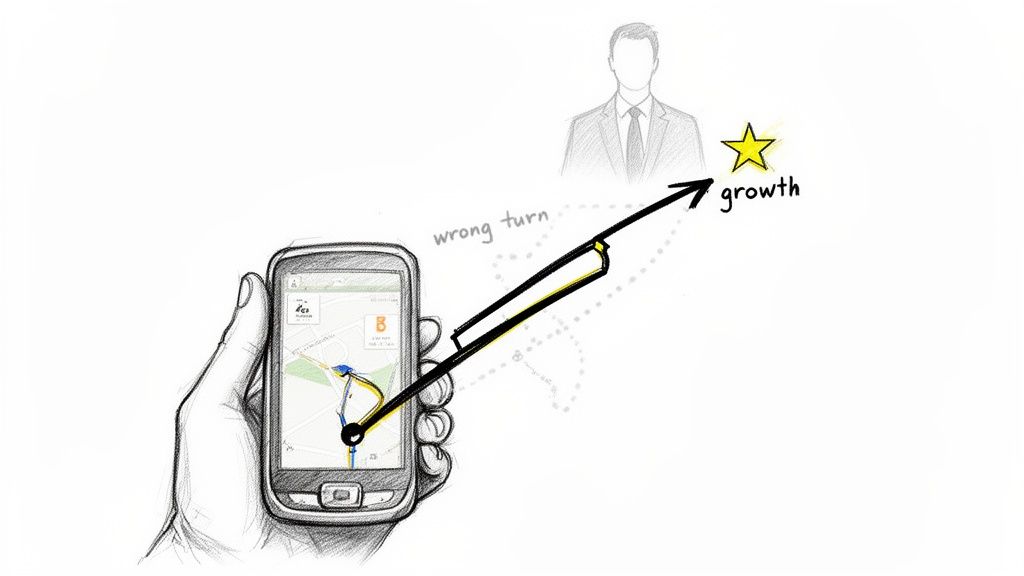
Forget the stiff, academic definitions. The best way to grasp the true meaning of constructive feedback is with an analogy: think of it as a professional GPS.
When you take a wrong turn, your GPS doesn't yell at you for being a bad driver. It doesn't dwell on the error. It simply and calmly says, "Rerouting," and shows you the best way forward from where you are right now. That’s constructive feedback in a nutshell. It separates the action from the person and focuses entirely on the path to the destination.
This approach immediately sets it apart from both empty praise ("Great job!") and harsh criticism ("You messed that up."). Its sole purpose is to build future capability, not to judge past performance. This subtle but critical distinction is what transforms a potentially anxious conversation into a powerful catalyst for growth. When your team sees feedback as helpful guidance, you build the psychological safety needed for real, continuous improvement to take root.
For business leaders in Canada and the United States, mastering this skill is the key to moving beyond outdated annual reviews and building genuinely high-performing teams.
The Goal of Constructive Dialogue
The ultimate objective is simple: empower individuals and teams, not find fault. A genuinely constructive conversation is always built on a foundation of mutual respect and a shared desire for success. The core principles are non-negotiable:
- Development-Focused: The entire conversation is about growth and skill enhancement.
- Forward-Looking: The focus is on what can be done differently next time.
- Collaborative: It feels like a partnership, with both people working together to find a solution.
This forward-looking approach is what people actually want. A study in the Harvard Business Review found that 57% of employees prefer corrective feedback over simple praise, as long as it’s delivered constructively (Zenger & Folkman, 2014). They see it as essential fuel for their career development.
This is where advanced tools make a critical difference. While traditional survey tools only capture a snapshot in time, a business intelligence platform like Wurkn turns daily interactions into actionable insights. Instead of waiting for a yearly survey, Wurkn surfaces real-time cultural trends from employee conversations, linking feedback directly to business outcomes.
This allows leaders to see the immediate impact of their communication on key metrics like productivity and retention. Suddenly, feedback isn’t just a conversation—it’s a strategic asset.
The Anatomy of Genuinely Helpful Feedback
What separates feedback that actually helps someone grow from criticism that just stings? The real difference is in a few key ingredients that can turn a tough conversation into a genuine opportunity for improvement.
Truly effective feedback isn’t about vague statements or personal jabs. It’s built on a foundation of clarity with a laser focus on what can be done differently next time. The core principle is simple but powerful: focus on the behaviour, not the person.
To truly understand the constructive feedback meaning, you need to know that every piece of guidance should be built on four essential pillars.
The Four Pillars of Effective Feedback
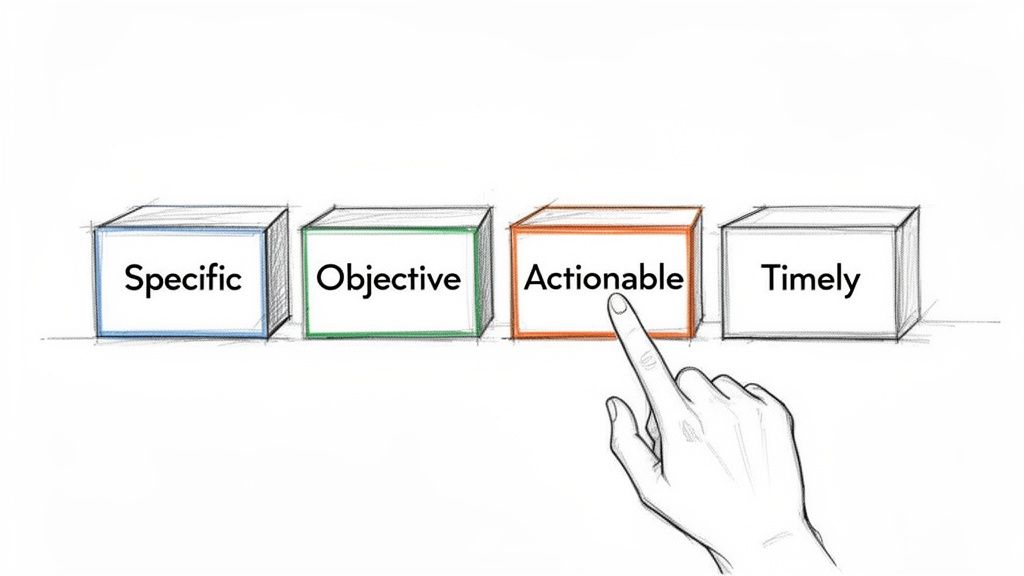
For feedback to land well and actually lead to change, it has to be S.O.A.T.—Specific, Objective, Actionable, and Timely. Think of them like the legs of a table; if one is missing, the whole thing wobbles and collapses.
- Specific: Feedback has to be crystal clear. Vague comments like "do better" leave people guessing and frustrated.
- Objective: Stick to what you actually saw or heard—the facts. This isn't the time for assumptions about their intentions or personal opinions.
- Actionable: The person hearing it must walk away knowing exactly what they can do next to improve. Give them a path forward.
- Timely: Feedback loses its punch the longer you wait. Deliver it while the situation is still fresh in everyone's mind.
Here’s a simple, logical example of how this plays out in a professional context:
Instead of this (Vague Criticism): "Your presentation was a bit weak."
Try this (Constructive Feedback): "During the client presentation, the data on slide 7 was compelling. To make it even stronger next time, I suggest adding a summary slide at the end to reinforce our key recommendations. That will help ensure our main points are what they remember."
See the difference? The second example is specific (slide 7, summary slide), objective (reinforcing key points), and actionable (add a summary slide). There’s no ambiguity.
Why Timing and Action Are Everything
Timing is a game-changer. Waiting for an annual performance review to bring up something that happened six months ago is useless. It’s like trying to coach a golfer on their swing a week after the tournament—the moment is long gone, and the advice feels irrelevant.
Frequent, in-the-moment feedback creates a rhythm of continuous improvement, which is absolutely critical in today's hybrid and remote work setups common across the United States and Canada. A Wiley Workplace Intelligence survey of 2,000 professionals found that an incredible 92% of employees who get constructive feedback weekly feel their manager creates a supportive environment. That number plummets to just 59% for those who only get it annually. You can read the full research on these powerful feedback findings here.
This proves that consistent, helpful dialogue isn't just a "nice-to-have"—it's a core driver of performance and a feeling of support. This is also where a business intelligence platform like Wurkn provides a strategic advantage over traditional HR survey tools. By analyzing daily communication trends, Wurkn lets leaders see the real-time cultural impact of their feedback, linking it directly to business results and ensuring their guidance is always relevant and effective.
Feedback vs Criticism vs Praise Explained
To really nail what constructive feedback is, you first have to understand what it isn’t. In any workplace, the way we communicate about performance tends to fall into three buckets: constructive feedback, criticism, and praise. They might feel related, but their goals, and more importantly, their impact on your team are worlds apart.
Getting this right is a game-changer for any leader in Canada or the US trying to build a resilient and motivated team. Choose the wrong approach, and you can accidentally kill an employee's drive. Choose the right one, and you can unlock potential they didn't even know they had.
Defining the Core Differences
When you get right down to it, the difference is all about your intent. Are you trying to build someone up for the future, just point out a flaw from the past, or give them a pat on the back for something they did today?
Criticism judges the past, praise acknowledges the present, but constructive feedback builds the future.
This is a powerful mental filter to use before you speak. Just ask yourself, "Is what I'm about to say focused on helping this person win tomorrow?" If the answer is no, you might be leaning toward criticism.
For example, a manager who’s just being critical might say, “This project proposal is full of holes.” It’s a dead-end statement—a judgment with no path forward.
A leader giving constructive feedback reframes it completely: “I’ve read through the proposal and have some ideas on how we can strengthen the budget section to get faster approval. Can we review it together?” This version identifies a specific area for improvement and offers a collaborative way to solve it. For more great examples, check out our guide on giving positive feedback that inspires action.
To make it even clearer, let's put these three styles side-by-side.
Feedback vs Criticism vs Praise: A Clear Comparison
This table breaks down the fundamental differences between constructive feedback, criticism, and praise to help leaders choose the right approach.
| Attribute | Constructive Feedback | Criticism | Praise |
|---|---|---|---|
| Ultimate Goal | Development & Growth | Judgment & Correction | Motivation & Recognition |
| Focus | Future Behaviour & Solutions | Past Mistakes & Faults | Present Accomplishments |
| Tone | Collaborative & Supportive | Authoritative & Negative | Encouraging & Positive |
| Impact on Recipient | Empowered & Clear on Next Steps | Defensive & Demoralised | Valued & Appreciated |
At the end of the day, praise definitely has its place for boosting morale, but it doesn't really drive growth. Criticism often shuts down growth entirely.
Only constructive feedback creates the right conditions for people to continuously improve. It helps build a culture where your team feels safe enough to learn, develop, and bring their best work to the table.
A Practical Framework for Giving Constructive Feedback
Knowing the theory behind constructive feedback is one thing. Actually delivering it—without making things awkward or defensive—is another challenge entirely. This is especially true for the hybrid and remote teams common across Canada and the US, where clear, structured communication is everything.
To get from knowing what to say to knowing how to say it, you need a simple, repeatable model. It needs to structure the conversation for clarity and impact, every single time.
One of the most battle-tested methods out there is the Situation-Behavior-Impact-Next Steps (SBIN) model. Think of it as a script that keeps the conversation focused on facts and collaborative solutions, stripping away emotional guesswork and personal judgment. It’s the key to making sure your feedback is heard, understood, and acted on.
Breaking Down the SBIN Model
The SBIN model works because it creates a logical, undeniable flow. You start with a specific context, describe a concrete action, explain the result of that action, and then—crucially—work together on what comes next. It turns a potential confrontation into a shared problem-solving session.
Here’s a look at how each piece fits together:
- Situation: First, ground the feedback in a specific time and place. This immediately provides context and stops you from using vague, unhelpful generalities like "you always…"
- Behavior: Next, describe the exact, observable action you witnessed. Stick purely to the facts. No assumptions, no interpretations.
- Impact: This is the most important part. Explain the tangible effect of that behaviour on the project, the team, or the business. This is where you connect the dots between the action and a meaningful outcome.
- Next Steps: Finally, shift the focus to the future. This part is collaborative. You work together to define a clear, actionable plan for what will happen differently.
The whole idea is to transform a potentially awkward critique into a structured, forward-looking discussion. By focusing on the impact of the behaviour, you depersonalize the feedback and make it about improving outcomes, not finding fault.
SBIN in Action: A Practical Script
Let’s put this framework into a real-world scenario. Imagine a team member consistently misses deadlines for their part of a project.
- Situation: "During our project sync this morning,"
- Behavior: "I noticed the analytics report wasn't submitted by the agreed-upon 10 a.m. deadline."
- Impact: "Because we didn't have those numbers, the marketing team had to delay the launch of the campaign, which could affect our quarterly targets."
- Next Steps: "Let's look at your workload together. What can we do to ensure you have the resources you need to hit the next deadline?"
This kind of structured approach is vital for teams everywhere. In the context of economic shifts affecting businesses across North America, absolute clarity is paramount. Research shows that employees who receive frequent, actionable feedback are significantly more engaged and productive (OECD, 2024).
This highlights a critical point for today's hybrid teams: frequency and structure aren't optional—they're essential for clear communication. You can explore more about these regional development dynamics and communication.
Using a framework like SBIN, especially in dedicated conversations, makes sure every piece of feedback lands constructively. These discussions are almost always best held in private, structured sessions. For more on this, check out our guide on how to run effective one-on-one meetings. By choosing the right setting and using a collaborative tone, you create a safe environment where your message can be received and acted upon, turning feedback into a genuine tool for growth.
Turning Daily Feedback into Business Intelligence
What if you could spot cultural issues months before they blow up in your quarterly turnover numbers? That’s the leap you make when you stop treating feedback as just an HR task and start seeing it for what it is: a core business intelligence function.
The old way—relying on that once-a-year survey—gives you a stale, outdated snapshot of a moment that’s long gone. It’s a fundamentally reactive approach. By the time you get the results, the damage is often done, and you’re left scrambling to play catch-up. To really get a pulse on your organization, you need a living, breathing view of your culture as it unfolds every single day.
This flowchart breaks down a simple but powerful process for giving feedback that actually works.
This model is all about turning a vague critique into a structured, forward-looking conversation by focusing on a specific situation, behaviour, its impact, and what to do next.
Moving Beyond Static Surveys
This is where a cultural business intelligence tool like Wurkn completely changes the game. Unlike standard HR survey platforms that only capture point-in-time data, Wurkn captures continuous, anonymous sentiment right from the tools your teams in Canada and the United States are already using—like Slack and Microsoft Teams. It meets employees where they are, ditching the friction of old-school surveys without breaking their workflow.
Wurkn’s AI then takes this raw, ongoing communication and transforms it into a dynamic dashboard for leaders. This isn't just another platform to measure engagement; it's a tool that draws a straight line from qualitative feedback to hard business numbers.
Imagine noticing a rising sentiment of 'burnout' among your sales team and being able to correlate it, in real-time, with a dip in your sales pipeline. That's the power of turning feedback into predictive intelligence.
This kind of proactive insight lets you step in and solve small issues before they snowball into major problems, protecting both your productivity and your best people.
Tying Feedback to Business KPIs
The real value unlocks when you connect the health of your culture to your financial performance. Data shows that the frequency of constructive feedback is a massive driver for business results and psychological safety. One study found that 92% of employees receiving weekly feedback feel supported by their managers, a stark contrast to just 59% of those getting it annually (Wiley, 2021). For remote and hybrid teams in the US and Canada, that's a crucial insight. This ties directly to performance, where negative productivity growth in some sectors highlights a desperate need for better, more actionable guidance.
Platforms like Wurkn make this connection crystal clear by linking these cultural signals directly to key business metrics, such as:
- Employee Retention: Spot flight risks by identifying themes of frustration or disengagement in specific departments long before anyone resigns.
- Productivity: Correlate communication patterns with project velocity and output to see what’s helping or hurting performance.
- Customer Satisfaction: Understand how the health of your internal teams is impacting your external client relationships.
By turning everyday conversations into a source of strategic insight, leaders can finally stop guessing and start making data-driven decisions that build a healthier, more resilient business. It’s an essential shift for any organization wanting to go beyond simply measuring happiness. You can learn more about how to develop a great satisfaction at work survey to get your baseline.
Common Questions About Constructive Feedback
Even with the best intentions, building a real feedback culture hits practical roadblocks. For leaders in Canada and the United States, how you handle these moments is what builds trust and drives results. Here are some straightforward answers to the questions that come up most often.
How Do I Encourage My Team to Actually Want Feedback?
It starts with you. You have to model the behaviour you want to see. The next time you get feedback, thank the person for it—in public, if appropriate—and then talk openly about what you plan to do with that insight.
This single act does more for psychological safety than a dozen emails ever could. It reframes feedback from a critique into a tool for getting better together. This is also where continuous feedback platforms like Wurkn can be a game-changer. By making feedback a daily, low-stakes conversation instead of a formal, high-stakes event, it just becomes part of the workflow.
What's the Best Way to Give Feedback to My Boss?
Giving feedback up the chain is all about tact and framing. Never just dive in. Start by asking for permission, which immediately makes it a collaborative conversation, not a complaint. Something as simple as, "Are you open to some thoughts on the new reporting process?" can set the right tone.
Keep your feedback focused on the impact on the team or on business goals, not on your boss as a person. Instead of saying, "You keep changing the requirements," try framing it as, "When project requirements change late in the day, it makes it tough for the team to hit our deadlines." Crucially, come prepared with a potential solution. This positions you as a proactive partner, not just a problem-spotter.
A classic but effective approach is the "feedback sandwich." Start with a genuine positive, deliver the constructive point, and wrap it up with another piece of encouragement. It helps ensure the core message lands without putting them on the defensive.
Can You Give Constructive Feedback in a Group Setting?
As a general rule: don't. Feedback aimed at a specific person's behaviour or performance should always, always be delivered in private. Public correction is just public shaming, and it absolutely kills trust and makes people defensive. The goal is improvement, not humiliation.
The only time group feedback works is when you're talking about a collective process or a team-wide effort, like during a project retrospective. Saying, "As a team, let's figure out a better way to communicate project dependencies," is productive. Pointing out that "John's part was late" in front of everyone is not.
How Can We Actually Measure the ROI of a Better Feedback Culture?
You measure the impact by connecting the "soft" cultural data to the "hard" business numbers. It's a two-part equation. First, you need the qualitative data. Business intelligence platforms like Wurkn are designed to track this, monitoring shifts in employee sentiment and spotting recurring themes in conversations to give you the 'why' behind what's happening.
Second, you correlate that cultural data with your core business KPIs. Are you seeing a connection between better communication scores and lower employee turnover? Does higher team engagement correlate with faster project cycle times or even higher revenue? When you can draw a straight line from a healthier feedback culture to a healthier bottom line, the ROI becomes undeniable.
Ready to stop treating feedback like an HR chore and start using it as a strategic advantage? See how Wurkn turns daily conversations into the business intelligence you need to drive real results. Learn more about Wurkn.