
A double-barrelled question is one of those sneaky survey mistakes that seems harmless but completely tanks your data quality. It’s when you accidentally cram two different ideas into a single question, making it impossible for someone to give you a straight, honest answer.
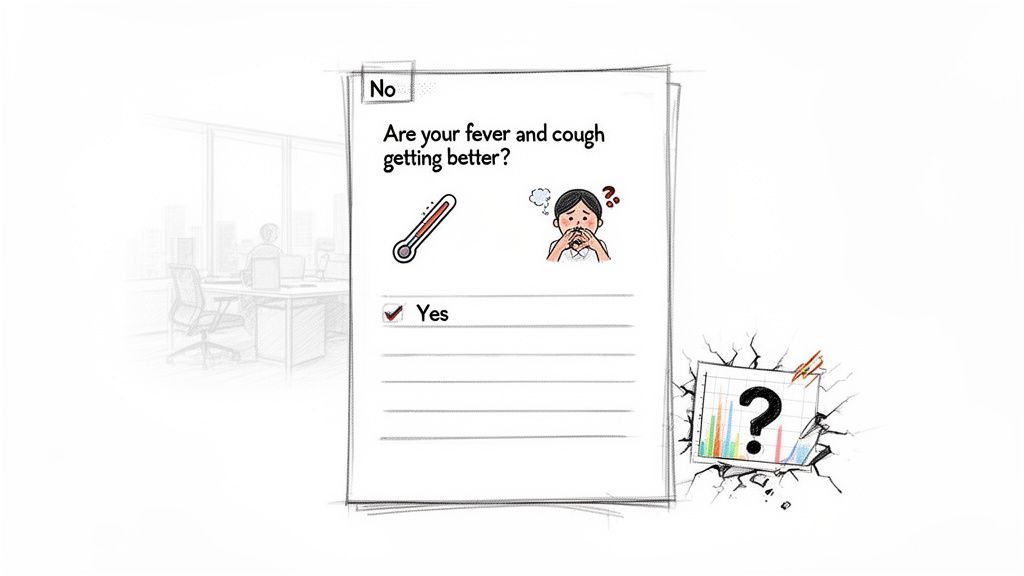
Think of it like a doctor in Toronto asking, “Are your fever and cough getting better?” A simple “yes” or “no” tells them nothing. Is the fever gone but the cough is worse? Are they both a little better? The answer is a guess, and guesswork leads to bad business decisions.
The Hidden Flaw in Your Employee Surveys
In the world of employee feedback, a simple survey question can either unlock powerful business intelligence or create a fog of useless data. Far too many organizations in Canada and the United States fall into the double-barrelled trap, bundling distinct ideas into one query. The result? Murky, misleading feedback that hides the real story.
This isn’t just a minor slip-up; it has a real business cost. When your data is flawed, you risk making misguided strategic decisions. Imagine investing thousands in a new benefits program because a survey suggested employees were unhappy, only to discover their real issue was with compensation—a completely separate topic you accidentally lumped in.
The Problem with Ambiguous Data
Bad questions create a ripple effect that damages more than just your analytics dashboard. The consequences often spiral into:
- Wasted Resources: Misreading feedback means you’re throwing budget and time at the wrong problems. That’s a costly mistake for any business, whether in Vancouver or Houston.
- Eroding Employee Trust: When people see their feedback leads to ineffective changes, they lose faith in the whole process. Soon enough, they stop giving honest opinions at all.
- Masking Critical Issues: A poorly worded question can easily hide serious problems like burnout or plummeting morale, stopping leaders from stepping in before it leads to a spike in turnover.
The core issue with a double-barrelled question is that you can’t tell which part of it your employee is actually answering. This ambiguity forces your team to operate on assumptions instead of insights, undermining the entire reason you’re collecting feedback in the first place.
This is exactly where traditional HR survey tools fall short. Their value depends entirely on someone crafting perfect questions every single time—a tall order for any busy People team. A smarter approach is needed, one that moves beyond static questionnaires to deliver genuine business intelligence.
Modern business intelligence platforms like Wurkn are built to bypass these survey pitfalls. Instead of relying on questions, Wurkn analyzes continuous, authentic sentiment from the workplace tools your teams already use, like Slack and Microsoft Teams. It transforms that messy, organic feedback into a reliable cultural dashboard, giving leaders the unvarnished truth without ever asking a single flawed question.
Why Double-Barrelled Questions Are Sabotaging Your Employee Feedback
Let's get straight to it. A double-barrelled question is a survey gremlin that tries to measure two completely different things at once. It forces your employees into a single, often confusing, response for multiple distinct ideas. For any PeopleOps team in North America serious about data quality, these questions are a nightmare.
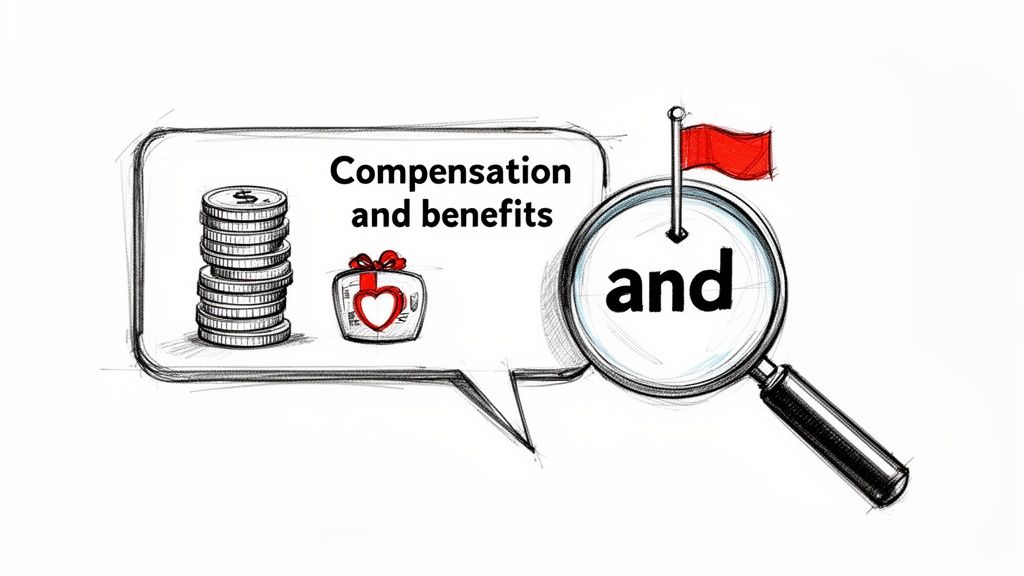
Think about this classic HR survey stumper: "How satisfied are you with your compensation and benefits?"
An employee could feel their pay is fantastic, but the benefits package is a total letdown. So how do they answer? They're stuck. They have to mentally average out their feelings, giving you a lukewarm, middle-of-the-road answer that completely masks a huge point of friction.
This isn't just a small hiccup; it poisons your data. The golden rule of good feedback is simple: one precise question equals one clear answer. Break that rule, and your analytics become unreliable, leading to misguided people strategies and wasted resources.
The Problem With Inaccurate Signals
The real danger here is the false sense of security these questions create. A "mostly positive" score on a flawed question might make leadership think everything’s fine, when in reality, a significant problem is simmering just below the surface.
This issue is pervasive. Research shows that double-barrelled questions are a common flaw in survey design that can significantly skew results. In fact, official bodies like Statistics Canada’s guidance on survey design explicitly warn against them because they force respondents to make a difficult choice, compromising data validity. Splitting these confusing queries—like one combining new hire training with ongoing retraining programs—is a fundamental best practice for achieving accurate results.
The core problem is that a double-barrelled question assumes two experiences are linked, when for the employee, they are often entirely separate. By forcing a combined answer, you lose all the nuance—the very thing you need to make smart, targeted improvements to your company culture.
This reveals a structural weakness in traditional HR survey tools. They are completely dependent on perfectly crafted questions to give you anything useful.
But a business intelligence platform like Wurkn flips the script. Instead of relying on rigid questions, it analyzes the organic, always-on feedback from the digital spaces where your employees already talk—like Slack and Teams. By tapping into this continuous stream of authentic sentiment, Wurkn delivers a genuine view of what people really think about separate topics like compensation, benefits, management, and workflow. It moves beyond the limitations of flawed questions to give you clear, actionable business intelligence, helping you understand the true drivers of your workplace culture.
The Real-World Cost of Asking Flawed Questions
Let’s move past the theory. Flawed questions have a very real, very direct impact on a company's bottom line. When organizations in Canada and the United States base their strategies on the skewed analytics from double-barrelled questions, they end up making poor business decisions that ripple through every single department. This isn't just about wasted time; it's a direct hit to the metrics that matter.
Imagine a typical scenario. A tech company, trying to do the right thing, sends out a pulse survey. One question reads: "Are you satisfied with our work-life balance and remote work policies?" The results look pretty good, and leadership chalks it up as a win.
But here’s the problem: a critical burnout signal is completely buried in that "positive" data. Employees might love the flexibility of working from home but feel absolutely crushed by an unsustainable workload. They had no way to separate the two issues, so their answer masked the rising stress. The result? Increased employee churn as your top performers quietly hand in their resignations. This happens all the time, and traditional feedback systems are blind to it.
From Bad Data to Business Impact
This isn't a rare mistake; it's a systemic problem. A Statistics Canada conference paper on survey applications highlights how the construction of a question directly impacts the quality of the data collected, with multi-subject questions being a primary source of error. This issue is just as common in PeopleOps, where lumping topics like 'job satisfaction and career growth' together completely distorts the insights you need for retention—a critical blind spot for businesses in competitive North American markets.
A flawed question doesn't just produce a bad data point; it creates a misleading narrative. This narrative informs budget allocation, leadership priorities, and strategic initiatives, all based on a fundamentally incorrect understanding of the employee experience.
This is exactly where old-school HR survey tools fall short and a business intelligence platform like Wurkn shines. Instead of getting stuck with static, error-prone questions, Wurkn gives you a strategic edge by avoiding these measurement errors from the start. It works by synthesizing continuous, anonymized feedback from the digital tools your teams already use every single day.
By analyzing authentic conversations, Wurkn provides COOs and PeopleOps leaders with a living dashboard of their company's cultural health. This real-time intelligence is completely free from the distortions of badly designed surveys. It uncovers the real drivers behind employee sentiment, connects them to hard metrics like productivity and retention, and helps you proactively fix issues before they escalate into the high cost of employee turnover. With Wurkn, you aren’t just fixing surveys; you’re building a more resilient and profitable organization on a foundation of trustworthy insights.
How to Spot and Fix Double Barrelled Questions
Getting your employee feedback right is a critical skill for any PeopleOps pro who cares about data integrity. The good news is, once you know what you’re looking for, spotting a flawed question becomes second nature. The most obvious red flag is a simple conjunction: the word “and”, or sometimes “or”, trying to glue two completely different ideas together.
When you see a question like, “Are our team meetings effective and inclusive?” you've almost certainly found a double-barrelled question. A meeting could easily be brilliant at making decisions (effective) but terrible at making everyone feel heard (not inclusive). Forcing a single yes/no answer to both concepts just gives you murky, useless data.
This simple decision tree is a great way to visualise how to evaluate your survey questions.
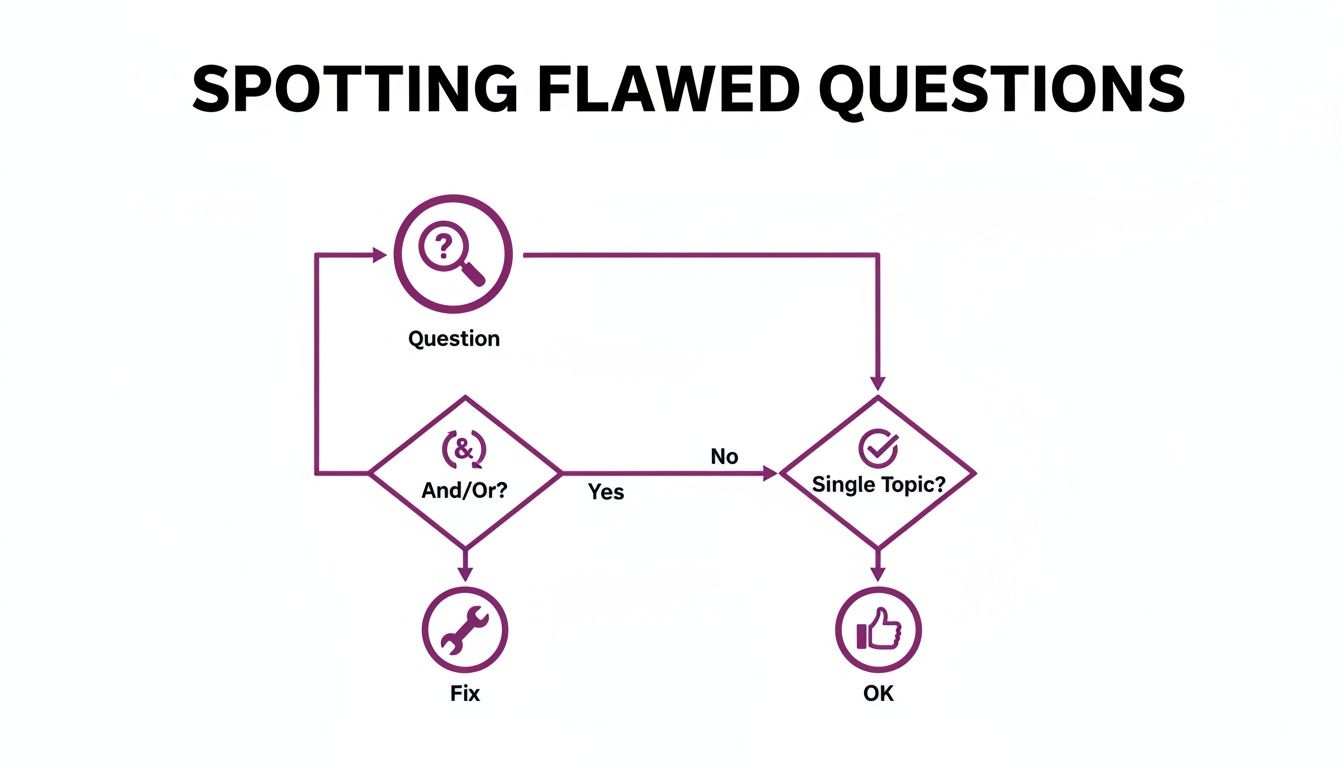
As the flowchart shows, it's a straightforward test: if your question has a word like 'and' or covers more than one topic, it's time for a rewrite.
Deconstructing and Rewriting Flawed Questions
To get the kind of clear, actionable insights you can actually use, you have to break these questions apart. This isn’t just a grammar exercise; it’s about making sure every single question measures one, and only one, specific thing.
Let's look at some real-world examples you might find in HR surveys across the US and Canada.
Fixing Common Double Barrelled Questions
Here's a quick reference table showing how to transform confusing questions into crisp, clear ones that deliver real insight.
| Flawed Question (Before) | Why It Fails | Improved Questions (After) |
|---|---|---|
| Are you satisfied with your compensation and benefits? | This jams two huge, distinct parts of total rewards into one. An employee could be thrilled with their salary but deeply unhappy with the health plan. | 1. How satisfied are you with your current compensation? 2. How satisfied are you with your current benefits package? |
| Do you feel our managers provide regular feedback and career development support? | This wrongly assumes feedback and career development are the same activity. A manager might give great daily feedback but completely ignore career pathing, masking a critical leadership gap. | 1. How satisfied are you with the frequency and quality of feedback from your manager? 2. Do you feel you receive adequate career development support from your manager? |
By splitting the questions, you get feedback that's precise and surgical. You can then confidently pinpoint exactly where to focus your efforts, whether that’s beefing up the benefits package or rolling out better career development programs for your managers.
Your Quick Checklist for Reviewing Questions
Before you hit 'send' on any poll or survey, give your questions a quick once-over with this simple checklist. It’s the fastest way to catch double-barrelled questions before they have a chance to mess up your data.
- Scan for Conjunctions: Look for “and” or “or” connecting two separate subjects or ideas. They're your biggest warning sign.
- Test for a Single Focus: Ask yourself, "Could someone honestly agree with one part of this question but disagree with the other?" If the answer is yes, you need to split it.
- Keep It Simple: Does the question cover one and only one topic? The best questions are always direct and impossible to misinterpret.
While mastering the art of question design is a valuable skill, it also shines a light on a fundamental flaw in traditional surveys. The entire system depends on you getting every single question perfect, every single time.
This is exactly why leading North American organizations are starting to move beyond static, periodic surveys. A business intelligence platform like Wurkn offers a much more natural and proactive way to understand your organization. By analyzing the continuous, organic communication already happening, Wurkn surfaces what employees are truly thinking and feeling—without ever interrupting their workflow with a survey. This approach delivers raw, unvarnished business intelligence, free from the kind of measurement errors that flawed questions create, and provides a richer, more accurate picture than even the most perfectly crafted satisfaction survey questions for employees ever could.
From Static Surveys to Continuous Business Intelligence
Fixing double-barrelled questions is a great start, but it also shines a light on a much bigger problem with how we usually ask for employee feedback. Even a perfectly written annual or quarterly survey is just a snapshot in time. It captures a single moment, but completely misses the continuous, living story of your company culture.
This gap between something happening and a survey finally asking about it creates a massive blind spot for leaders. By the time you get the results, the context has already changed, the issue might have gotten worse, or you've missed your chance to act when it mattered most. To make truly smart, strategic decisions, you have to move beyond these periodic check-ins.
The Limits of a Static Snapshot
Most traditional employee engagement platforms are built around this "snapshot" model. They're reactive by design, set up to measure how people feel after the fact. While that's better than nothing, this approach can't deliver the real-time business intelligence that modern organizations across Canada and the United States need to compete.
The hidden danger is that double-barrelled questions can inflate agreement rates, giving leaders a false sense of security. As detailed in the official survey design guidelines from Statistics Canada, question wording has a profound impact on response patterns. A poorly formed question that combines two different concepts is a primary source of measurement error, which can lead to invalid conclusions about the population being surveyed.
Imagine asking your hybrid team, "Are you happy with your team and workload?" You might get a 65% satisfaction rate. But when you split it, you could discover that while team happiness is great, workload dissatisfaction is at a critical 40%—a number closely tied to voluntary turnover in the North American tech sector. Avoiding this single error is a fundamental step toward reliable data.
From Measurement to Intelligence
This is where a true business intelligence platform like Wurkn takes a fundamentally different approach. Wurkn isn’t just another HR survey tool; it's a cultural intelligence engine designed to provide strategic business insights. It meets employees where they already are—in Slack, Microsoft Teams, and other systems—to capture anonymous, in-the-moment feedback without pulling them away from their work.
Wurkn moves beyond asking what employees think at one point in time to understanding why they feel that way, continuously. It's a shift from periodic measurement to always-on business intelligence.
Wurkn's advanced AI, guided by human oversight, makes sense of all this organic communication, pulling out key themes, emotional tones, and the real drivers behind them. This gives leaders a living, trustworthy dashboard of their cultural health. It doesn't just show you the surface-level issues; it reveals the complex connections between them, linking what people are saying directly to business results. This transforms the People function from a reactive survey administrator into a proactive, strategic partner. To see how this works, learn more about how to get actionable business insights from continuous employee feedback.
Your Action Plan for Better Employee Feedback
Moving to a smarter feedback model means you first have to clean up your current methods. For PeopleOps leaders in Canada and the US, this is your immediate action plan to kill double-barrelled questions and start gathering data you can actually trust.
Think of it as a quick audit for your existing surveys and polls.
- Hunt for Conjunctions: Your first pass is simple. Scan every single question for the words “and” or “or.” These are the biggest red flags that a question is trying to do two jobs at once.
- Confirm a Single Focus: For each question, ask yourself: “Could someone agree with one part but disagree with the other?” If the answer is yes, you have to split it. No exceptions.
- Pilot Test Before Launch: Never launch a survey cold. Always send it to a small, trusted group first. Ask them to call out anything that felt confusing, awkward, or just plain hard to answer honestly.
While these steps will absolutely improve your survey accuracy, they also point to a much bigger strategic opportunity. To build a truly agile and responsive organization, you have to move beyond periodic, static surveys.
A business intelligence platform like Wurkn delivers the continuous cultural intelligence that static surveys just can't capture. By analyzing real-time, anonymous feedback, Wurkn shifts your people function from a reactive department putting out fires to a proactive, strategic partner armed with data that’s actually trustworthy.
Got Questions? We’ve Got Answers.
Even after you get the hang of it, a few tricky situations can pop up when you're trying to stamp out double-barrelled questions. Let's clear up some of the most common questions PeopleOps and operations leaders run into.
What’s the Easiest Way to Spot a Double-Barrelled Question?
Look for the word “and.” That's your biggest red flag. Sometimes "or" plays the same role, but "and" is the main culprit, stitching two completely different ideas into a single query. When you see it, hit pause.
Take a question like, "Are our team meetings effective and inclusive?" It’s asking for a single verdict on two separate things. A meeting could be incredibly effective for making decisions, but if half the team feels like they can't get a word in, it's not inclusive at all. How can someone give a straight "yes" or "no" to that?
Here's a quick litmus test you can use on any question: Could someone honestly agree with one part of this and disagree with the other? If the answer is yes, you've found a double-barrelled question. Time to split it up.
Are These Questions Only a Problem in Big, Formal Surveys?
Absolutely not. They cause just as much damage in the quick, informal feedback channels we use every day. Think about Slack polls, pulse surveys, or even one-on-one check-ins with managers. Any place you’re gathering feedback, these questions muddy the waters and can lead to bad decisions across your organization, whether you're in Canada or the United States.
Imagine a manager asking, "Is your workload manageable, and is the project interesting?" An employee who loves the project might say "yes" just based on their interest, completely hiding the fact that their workload is pushing them toward burnout. This is exactly why a continuous analysis approach is so much more powerful—it uncovers what’s really going on without forcing people into these flawed response boxes.
Flawed questions create blind spots wherever feedback is gathered. A casual poll in a team channel can be just as misleading as a formal annual survey if it contains double-barrelled questions, leading to well-intentioned but misguided actions from team leaders.
How Does a Business Intelligence Tool Avoid This Problem?
This is where a platform like Wurkn changes the game entirely. As a business intelligence tool, it sidesteps the problem by moving away from a rigid Q&A model and toward continuous analysis. It doesn't need to push out structured surveys that might be loaded with flawed questions in the first place.
Instead, Wurkn taps into the anonymous, always-on feedback from conversations that are already happening in tools like Slack and Microsoft Teams. Its AI, which is validated by human oversight, analyzes all that organic data to pinpoint key themes, emotional tones, and the real drivers of your culture. You get an unprompted, authentic view of what people are actually talking about, free from the measurement errors that double-barrelled questions introduce. The result is true business intelligence—a much more accurate picture of your company culture that drives strategic decisions.
Ready to move beyond flawed surveys and get real business intelligence? See how Wurkn transforms continuous employee sentiment into your most valuable business asset. Get started at https://wurkn.com.