
A one-on-one meeting isn't just a calendar invite. It’s a dedicated, recurring conversation between a manager and their direct report, built to foster trust, tackle challenges head-on, and genuinely support professional growth. Think of it less as a meeting and more as a cornerstone of effective leadership—a space to move beyond status updates and forge a real connection.
Why Your One on One Meetings Feel Ineffective
Let's be real for a moment. Far too many one-on-ones are a total drag for everyone involved. For managers, they often feel like just another box to check on an endless to-do list. For employees, they can feel like a repetitive status report or, even worse, a monologue of one-sided criticism. This massive disconnect is exactly why these critical conversations so often fail to deliver any real value.
This isn't just a gut feeling; it’s a problem backed by hard data. A landmark 2022 study of the Canadian workplace uncovered a stark reality. While a whopping 94% of Canadian managers claim they schedule regular one-on-ones, believing they're building strong connections, their teams see it differently. Only 50% of employees say they actually have monthly one-on-ones, and a tiny 20% find them to be truly effective (KPMG, 2022). You can explore more about these findings on meeting impact for yourself.
Moving Beyond the HR Checkbox
The root of the problem? Most organizations treat the one-on-one like a procedural task instead of a strategic tool. When its purpose is fuzzy, the conversation defaults to the most superficial topics: project updates, immediate to-dos, and logistical hurdles. This completely misses the entire point.
A great one-on-one is a powerful lever for retention and performance. It's the dedicated space to:
- Build Psychological Safety: You need to create an environment where people feel safe enough to share their real concerns, admit mistakes, and offer honest feedback without worrying about the consequences.
- Align on Priorities and Growth: This is where you ensure you and your team member are perfectly aligned on what success looks like—not just for the current project, but for their long-term career path.
- Uncover Hidden Roadblocks: It’s your best chance to find the subtle issues that never show up in a project management tool, like friction within the team, a hidden resource gap, or the early signs of burnout.
From Anecdote to Intelligence
To truly transform these meetings, you have to shift your approach from relying on anecdotal updates to discussing data-driven insights. This is where a business intelligence tool like Wurkn gives you a serious edge over traditional employee engagement platforms. Instead of just asking a generic, "How are you doing?", you can walk into the conversation already understanding the underlying sentiment of your team.
Imagine Wurkn's real-time analytics flag a rising theme of "workload imbalance" across your reports. Suddenly, your one-on-one is no longer a generic check-in. It becomes a focused, strategic session to tackle a specific, validated problem. You're not just managing a task list; you're using real business intelligence to solve issues before they escalate, which is the very definition of proactive leadership.
Building the Framework for a Successful One on One
A great one-on-one needs more than good intentions; it demands a solid, repeatable framework. Without structure, these conversations inevitably drift into surface-level status updates, completely missing the mark on what truly drives employee engagement and performance. Nailing the practical mechanics from the start is non-negotiable.
So, where do you begin? Start with cadence and duration. A punchy, 30-minute weekly meeting might be perfect for a new hire in the US or Canada who needs consistent guidance. On the other hand, a more senior team member operating with greater autonomy might thrive with a deeper, 45-minute session every other week. The key is consistency, not rigidity.
Too often, a lack of structure creates a massive disconnect between what managers think they're hearing and what employees are actually trying to say.
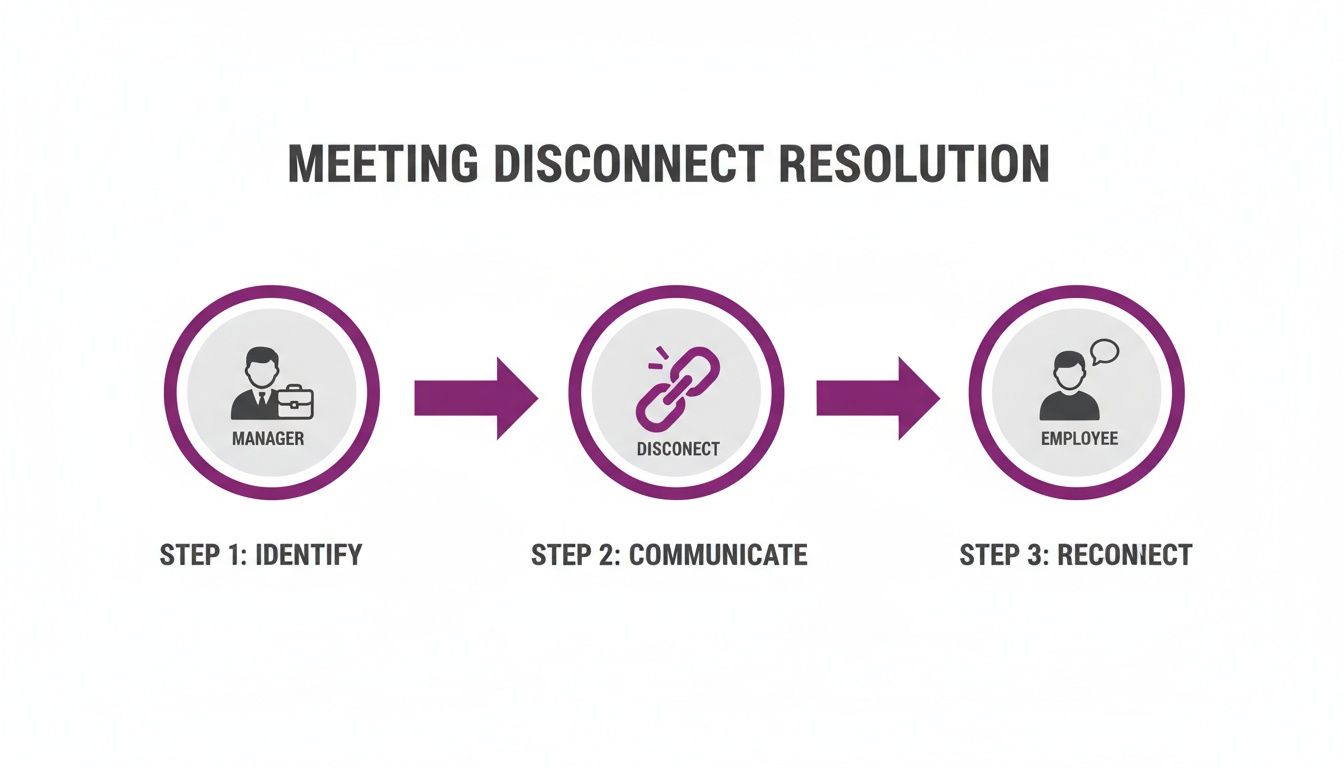
This visual is a stark reminder that without a shared framework for communication, crucial insights get lost in translation, and meaningful progress stalls out.
One on One Meeting Cadence Comparison
Choosing the right meeting frequency is less about a universal rule and more about tailoring it to your team's specific context, roles, and current projects. A new team tackling a complex launch will have very different needs than a stable, experienced team in a maintenance phase. Here’s a quick breakdown to help you decide.
| Cadence | Best For | Pros | Cons |
|---|---|---|---|
| Weekly | New hires, fast-paced projects, junior team members, or during periods of significant change. | Keeps momentum high, builds rapport quickly, and allows for rapid course correction. | Can feel like micromanagement if not employee-led; risk of becoming a simple status report. |
| Bi-Weekly | Experienced employees, stable project environments, and teams with a high degree of autonomy. | Allows more time for meaningful topics to develop; encourages greater employee ownership between sessions. | Can feel too infrequent if major roadblocks appear; requires more disciplined preparation from both sides. |
| Monthly | Highly autonomous senior leaders, long-term strategic roles, or very stable, low-volatility teams. | Focuses squarely on high-level strategy, career development, and long-term goals. | Too slow to address tactical issues; potential for small problems to escalate between meetings. |
Ultimately, the best cadence is the one you can stick to consistently. It's better to have a reliable bi-weekly meeting that always happens than a weekly one that gets cancelled half the time. Be open to adjusting the frequency based on feedback and changing team needs.
Designing a Collaborative Agenda
Here’s a game-changing shift in mindset: the most effective one-on-ones are employee-led. When you hand over the reins by using a collaborative agenda, you empower your team members to take ownership of the conversation. It instantly transforms the meeting's dynamic from an interrogation into a genuine partnership.
A flexible template is your best friend here. It should provide just enough structure to guide the discussion without putting it in a straitjacket.
- Well-being and Morale: Start with a simple, human check-in. How are they really doing, personally and professionally?
- Priorities and Roadblocks: This is the space to talk about current projects, celebrate recent wins, and—most importantly—identify any hurdles that are slowing them down.
- Growth and Development: Look to the future. This segment is all about career aspirations, skill-building, and long-term goals. This proactive approach aligns perfectly with the principles found in effective team charters and templates.
The biggest mistake leaders make is treating the one-on-one as "just another meeting." Since 2000, time spent in meetings has exploded by 8-10% annually across North America (Perlow, Hadley, & Eun, 2017, Harvard Business Review). With a significant portion of the workday in the US and Canada dedicated to meetings, making every single one count is mission-critical.
Elevating Agendas with Business Intelligence
This is where you move from good to truly great. Traditional employee engagement surveys give you a static, outdated snapshot of morale. A business intelligence tool like Wurkn delivers a dynamic advantage by capturing continuous, anonymous sentiment from your team in real time.
Imagine this: Wurkn’s analytics flag a subtle but growing concern around "recognition for effort" on your team. Instead of waiting for this to fester and surface as a formal complaint, you can get ahead of it. You can proactively add an item to the one-on-one agenda and ask, “I want to make sure we’re properly celebrating our wins. What’s a recent accomplishment you’re really proud of that maybe we haven’t talked about enough?”
This data-informed approach turns a routine chat into a strategic dialogue. You're no longer just reacting to problems as they appear. You're using business intelligence to anticipate needs, address underlying issues before they escalate, and prove that you’re actively listening to what isn't always being said out loud. This is how the one-on-one becomes one of your most powerful tools for building a resilient, high-performing team.
Asking Questions That Spark Real Conversation
The difference between a generic check-in and a breakthrough one-on-one often comes down to a single thing: the quality of your questions.
Getting past the automatic, “How’s it going?” is the first real step toward unlocking a more meaningful dialogue. The right questions create space for honesty, uncover hidden roadblocks, and show your team member you’re genuinely invested in their experience and growth.
This is where you shift from manager to coach. A well-posed question can reframe a challenge, inspire a new perspective, and build the psychological safety needed for real vulnerability. It's about asking things that can't be answered with a simple "yes" or "no."
Questions Tailored to the Situation
A one-size-fits-all list of questions will only get you so far. The most impactful conversations happen when you tailor your approach to the employee's specific context. Whether they're a new hire finding their footing or a senior employee navigating a complex project, your questions should reflect their unique journey.
For a New Hire (First 90 Days):
The goal here is to accelerate their integration and build a strong foundation. Your questions should centre on their learning curve, initial challenges, and sense of belonging.
- "What's one thing that has surprised you most since you joined?"
- "Who have you found most helpful in getting answers to your questions so far?"
- "What part of the role is still feeling a bit unclear?"
For Navigating Performance Hurdles:
When performance is a concern, the conversation has to be supportive, not accusatory. You need to focus on identifying root causes and collaborating on solutions.
- "Walk me through your process for [specific task]. What part feels most challenging?"
- "What resources or support do you feel are missing right now to help you succeed?"
- "When you picture success in this area, what does that look like to you?"
Connecting Questions to Cultural Intelligence
This is where you can turn a good conversation into a strategic one. Instead of guessing what might be on your team’s mind, a business intelligence tool like Wurkn provides the cultural context to ask targeted, empathetic questions. It moves you from reacting to problems to proactively addressing underlying themes.
For example, imagine Wurkn identifies that "workload balance" is a rising concern across your team. Now, your one-on-one becomes a powerful diagnostic tool.
Instead of asking a generic, "Are you feeling overworked?", which might put an employee on the defensive, you can use the insight to frame a more constructive inquiry.
You could try asking things like:
- "I'm thinking about how we're distributing work across the team. Which of your current projects feel the most energizing, and which ones feel like more of a grind?"
- "Looking at your priorities for the next few weeks, what's one thing we could potentially de-prioritize to create more focus?"
- "What does your ideal, productive week look like in terms of pace and workload?"
This approach shows you're paying attention to team-wide sentiment while still keeping the conversation personal and forward-looking. To dig deeper into structuring effective queries, you might find it useful to learn about avoiding the pitfalls of double-barrelled questions.
Questions for Career and Project Support
Beyond day-to-day tasks, your one-on-one is the primary venue for discussing long-term growth and providing real-time project support.
For Planning Career Paths:
These questions help you understand an employee’s aspirations and co-create a plan to get them there.
- "What skills are you most interested in developing over the next six months?"
- "If you look a year or two down the road, what kind of impact do you want to be making?"
- "What kind of projects would give you the opportunity to learn something new?"
For Providing Project Support:
This is about getting beyond a simple status update to uncover the real story behind a project's progress.
- "What's one decision on this project you're feeling uncertain about?"
- "Are there any cross-functional dependencies that are slowing you down?"
- "What's the biggest risk you see for this project right now that we haven't discussed?"
By asking specific, thoughtful, and data-informed questions, you transform the one-on-one from a simple update into a catalyst for performance, engagement, and trust.
Turning Your Conversations into Actionable Outcomes
A great conversation that goes nowhere is a missed opportunity. I’ve seen it happen countless times: a manager and a team member have a fantastic, insightful one-on-one, only for nothing to change. Without a simple way to capture what you discussed and who’s doing what, even the best intentions fade into the daily grind.
This isn't about creating bureaucratic meeting minutes. It's about building a shared record of accountability. This simple document becomes the living history of your conversations, decisions, and that employee's growth journey.
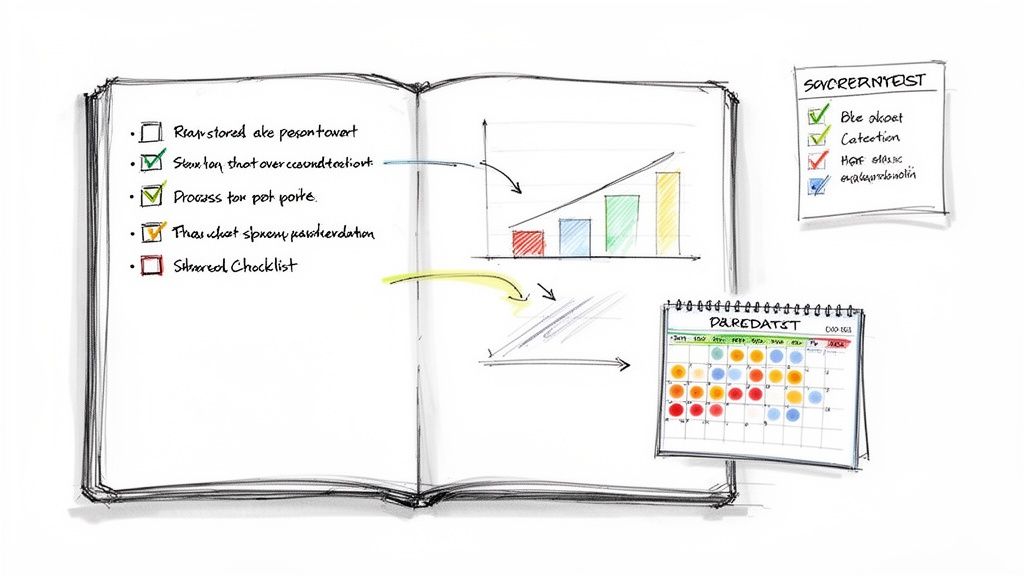
This process is what carries the momentum from your meeting into the actual work week. It's the bridge between talking and doing.
A Simple Method for Capturing Outcomes
Right after your meeting wraps up, take five minutes. That's all it takes. Pull up a shared document or your preferred collaboration tool and jot down a quick summary. Keep it focused on three things:
- Key Takeaways: What were the 2-3 most important insights from the chat? Think of these as the "aha!" moments.
- Decisions Made: Did you agree on a new priority or a change in process? Write it down plainly to kill any future confusion.
- Action Items: This is the most critical part. List the specific next steps and, crucially, assign an owner to each one.
For example, don't just write "Look into career development." That’s too vague. A truly actionable item is: "Sarah will research two online project management courses and share them by next Friday." See the difference? It's specific, measurable, and has a deadline. It makes follow-up easy.
Insight without a corresponding action is just trivia. Documenting next steps transforms your one-on-one from a pleasant chat into a powerful engine for growth and performance.
Connecting Individual Actions to the Bigger Picture
Now, here's where this gets really powerful. Every one-on-one meeting you have is a source of rich, individual-level data. When you pair this with a business intelligence platform like Wurkn, you can suddenly connect the dots between individual conversations and massive, company-wide patterns.
Imagine in a few separate one-on-ones, you create action items around clarifying project roles. At the same time, Wurkn flags a rising, anonymous sentiment trend around a lack of "role clarity" across the entire company. You've just validated a systemic issue.
This elevates your role from just putting out fires for one person to solving a problem for everyone. The feedback from your one-on-ones becomes a crucial data point that complements the hard numbers from Wurkn. You’re no longer just looking at the trees; you can see the entire forest. You’re spotting trends that can trigger meaningful improvements in company processes, communication, or resource allocation.
Your individual check-ins are no longer just meetings—they're a foundational piece of your organization's business intelligence strategy.
Measuring the Business Impact of Your One on Ones
For any leader, the real test is connecting the dots between team conversations and hard business results. A well-run one on one program isn't just a "nice-to-have" cultural perk; it's a strategic asset with a measurable return. The trick is to stop seeing these meetings as isolated chats and start treating them as a powerful source of business intelligence.
To really prove their value, you have to move past anecdotal stories and start tracking metrics that the business actually cares about. These aren't vanity numbers—they're real indicators of organizational health that have a direct line to your bottom line.
From Conversation to KPI
You can absolutely quantify the impact of your one on ones by tracking a few key performance indicators (KPIs). When you monitor these over time, you’ll start to see a clear, undeniable link between consistent, high-quality conversations and better business outcomes.
- Employee Engagement Scores: Are engagement scores on your team climbing after you put a more structured one on one process in place? High engagement is a direct predictor of better productivity and more innovation.
- Team Retention Rates: It’s a fact: organizations that prioritize regular coaching conversations have significantly lower turnover. Take a minute to calculate the real cost of replacing just one team member in the US or Canada—recruitment, onboarding, lost productivity—and you'll see the immediate ROI of keeping your people.
- Velocity of Action Items: How fast are the action items from your meetings actually getting done? This simple metric is a great way to track accountability and prove that your conversations are leading to real, tangible progress.
A common pitfall is treating one on ones as simple check-ins. Their real power is in providing the qualitative context you need to truly understand the quantitative business data.
Tying Business Intelligence to Business Results
This is exactly where traditional annual HR surveys completely miss the mark. They give you a static, outdated snapshot of how people feel. A true business intelligence tool like Wurkn, on the other hand, delivers a continuous, real-time feed of the cultural undercurrents affecting your team. This allows you to draw a direct line from the health of your culture to hard business metrics.
Let's walk through a real-world scenario.
Imagine your quarterly business review shows a key product team's project velocity has tanked by 15%. The usual analysis might point to process snags or technical debt. But Wurkn’s continuous sentiment analysis, which gathers anonymous feedback, reveals a growing theme of "ambiguous project ownership" and "decision fatigue" specifically bubbling up within that team.
Now you have the intel. You can use your upcoming one on ones to diagnose the root cause. Instead of asking generic questions, you get specific: "Where are you feeling the most friction when making decisions on this project?" or "Which part of the current workflow feels the least clear in terms of who owns what?"
The insights you gather confirm that a recent re-org has created a ton of confusion. You and your team member work together to create clear action items: clarify roles and document a new decision-making framework. Over the next month, you don't just see the "ambiguous ownership" sentiment fade in Wurkn; the team's project velocity recovers and even starts to surpass its old baseline.
You’ve just created a measurable feedback loop. You connected qualitative business intelligence (sentiment) to individual conversations (one on ones) and linked the actions you took to a critical business KPI (project velocity). This is how you demonstrate the undeniable ROI of your one on one program. To go deeper on this, you can learn more about using analytics for HR to drive strategic decisions.
Common Questions (and Real Answers) About One on Ones
Even with a solid game plan, one on ones can get tricky. People are complex, and real conversations don't always follow a script. Here are some of the most common hurdles managers run into, with practical advice for clearing them.
What if My Direct Report Barely Says Anything?
This is a classic. You ask, "How's it going?" and get a one-word answer. It's awkward, but it's also fixable.
The silence often isn't about them being difficult; it's usually about ownership or trust. First, make sure you're sending the agenda ahead of time and framing it as their meeting. This simple shift can make a world of difference.
If they're still quiet, you need to ditch the generic questions. Instead of "How's it going?", get more specific. Try questions like:
- "What was the most energizing part of your week?"
- "Walk me through the biggest roadblock you hit on the Miller project."
- "If you could wave a magic wand and fix one annoying thing in our workflow, what would it be?"
Sometimes, it's just a matter of building trust. Silence can be a sign that they're not yet sure if it's a safe space. Be patient. Show up consistently, listen intently when they do talk, and prove over time that this meeting is genuinely for them.
How Do I Give Tough Feedback Without Demoralizing Them?
Nobody enjoys delivering bad news, but avoiding it is far worse. The key is to take the judgment out of it and focus on collaboration. Frame the feedback around observable actions and their concrete impact, not on personality flaws.
A simple but powerful framework is: "When X happened, the impact was Y. What are your thoughts on how we can approach this differently next time?" This structure keeps the conversation focused on the problem and the solution, not the person.
This isn't an ambush. You should come prepared with specific, recent examples. Your role here isn't to be a judge handing down a verdict; it's to be a coach who wants to see them win. The goal is for them to walk out of the meeting feeling like you're in their corner, even when the conversation is tough.
Is it Okay to Cancel a One on One if We’re Both Swamped?
I'm going to be blunt: avoid this at all costs.
Cancelling a one on one meeting sends a loud and clear message: "Everything else is more important than you." It might not be what you intend, but it's how it's often received. Every cancelled meeting chips away at trust and makes it harder for your direct report to feel valued.
If an absolutely unavoidable, company-on-fire emergency comes up, don't just cancel—reschedule it on the spot. Explain why it has to move. Protecting this time is one of the highest-leverage things you can do. It's a direct investment in your relationship, their growth, and the overall health of your team.
Ready to turn your one on one meetings into a source of strategic advantage? Wurkn is the business intelligence platform that connects the dots between employee sentiment and business results, giving you the insights to lead proactively. See how it works.