
Company values should be a strategic compass, guiding every decision and behaviour in your organization. The problem is, most initiatives fail because the values are just abstract ideals plastered on a wall, completely disconnected from daily operations.
For COOs and PeopleOps leaders, the goal isn't just to define values—it's to operationalize them and prove the ROI of a strong, intentional culture.
Why Most Company Values Fail And How To Fix It
Let's be blunt: the traditional approach to creating company values is broken. Leaders hole up for weeks to craft perfect-sounding statements like "Integrity" or "Innovation," only to see them fade into the background noise of everyday business.
They become decorative, not functional.
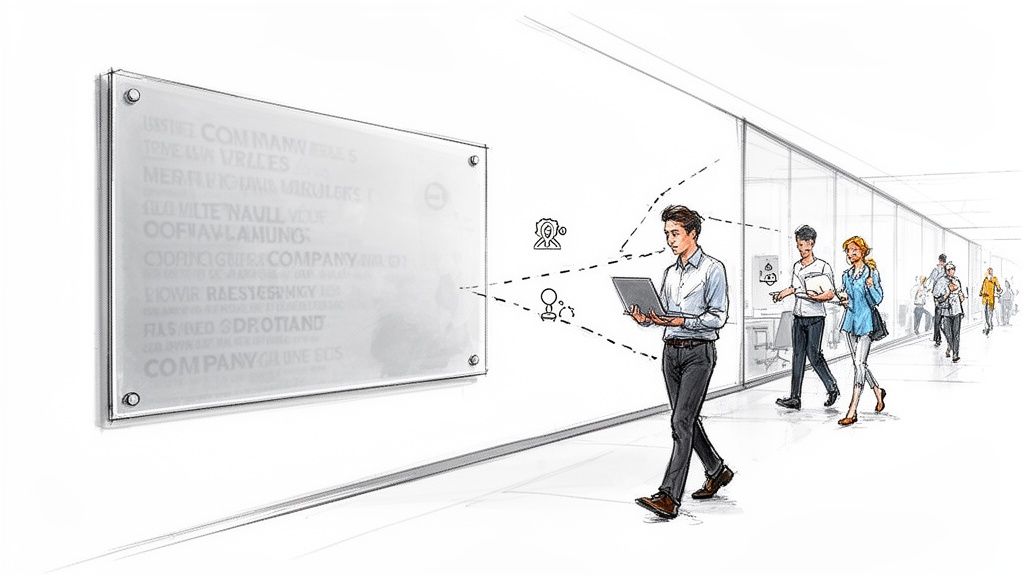
This disconnect is especially damaging in the hybrid work environments we see across the United States and Canada. When your team is distributed, a deeply embedded culture isn’t just a nice-to-have; it’s your best defence against churn and performance dips.
The Shift From Abstract Ideals To Actionable Behaviours
The root of the problem is that vague values offer zero direction. What does "Commitment to Excellence" actually look like for a software developer on a Tuesday afternoon? Or for a customer support agent in the US handling a tough call?
Without specific, observable behaviours tied to each value, they're impossible to measure, manage, or reinforce. This is where the whole paradigm needs to shift. Instead of focusing on what you value, you have to define how those values show up in action.
- From Vague to Specific: "Customer Obsession" becomes "Proactively seek customer feedback in every project and share insights with the team within 24 hours."
- From Passive to Active: "Teamwork" becomes "Actively solicit diverse perspectives before making a key decision, even when it challenges your own view."
- From Unmeasurable to Tangible: "Ownership" becomes "Take full responsibility for project outcomes, including communicating setbacks transparently and proposing solutions."
This table shows the shift in thinking: from passive statements to dynamic behaviours you can actually manage.
Traditional vs Actionable Company Values
| Traditional Value (The 'What') | Actionable Value (The 'How') | Business Impact |
|---|---|---|
| Integrity | Speak up when you disagree, even when it's uncomfortable. | Faster problem-solving, reduced groupthink, increased trust. |
| Innovation | Dedicate 10% of your time to projects outside your core role. | Increased idea generation, cross-functional collaboration, new revenue streams. |
| Customer-Centricity | Share one piece of direct customer feedback in team meetings each week. | Products are more aligned with user needs, higher customer retention rates. |
By defining the 'how,' you give your team a clear playbook for success and give yourself a clear way to measure if your culture is truly taking hold.
Connecting Culture to Business Outcomes
Ultimately, for COOs and PeopleOps leaders, this is all about proving the ROI of culture. In Canada's evolving workplace, a strong culture is now a major predictor of employee retention—even more than compensation. For instance, a study by The Globe and Mail and Howatt HR found that 86% of employees at top Canadian workplaces say leadership openness directly boosts their commitment to stay. You can discover more about what Canada's retention trends reveal and why culture is so critical.
The challenge isn't just defining values; it's measuring their adoption and impact. Traditional annual surveys are far too slow. They capture a single moment in time, missing the daily nuances that truly shape the employee experience.
This is where you need a business intelligence tool like Wurkn. Unlike HR survey tools that provide a static snapshot, Wurkn's platform offers continuous, real-time data to see if your values are genuinely shaping your organization. It moves beyond simple engagement scores, delivering deep business intelligence that reveals why certain behaviours are happening and how they connect directly to your KPIs. This is how you turn culture from a fluffy concept into a measurable driver of business results.
How To Uncover Your Company's Authentic Values
Your company's real values aren't cooked up in a boardroom meeting. They already exist. You can see them in the daily interactions, the tough decisions, and the quiet wins your team celebrates. The actual work isn't inventing values—it's uncovering them.
A discovery workshop is hands-down the best way to excavate these genuine principles. But its success hinges entirely on who you invite and how you run the session.
Forget the old top-down approach. You need a true cross-section of your organization in the room. That means individual contributors from different departments, mid-level managers who see the daily grind, and senior leaders. This mix ensures the values you unearth represent the entire company, not just what leadership thinks they are. Research from the Society for Human Resource Management (SHRM) found that when employees feel their voices are heard, they are 4.6 times more likely to feel empowered to do their best work.
Setting The Stage For Honest Feedback
Before a single calendar invite goes out, you need to set the stage. The goal is to get past the generic corporate buzzwords and into what actually drives your team. Traditional HR survey tools often give you surface-level data, but they completely miss the emotional context—the why behind the what.
This is where a business intelligence tool like Wurkn changes the game. By analyzing continuous, anonymous feedback from platforms your team already uses, Wurkn can spot existing themes and emotional drivers before the workshop even begins. This is a level of insight traditional engagement platforms cannot provide.
This pre-workshop analysis gives you a data-backed starting point. Instead of walking in with a blank whiteboard, you can kick things off with real insights like, "Our data suggests a strong sense of collaborative problem-solving is a major source of pride and motivation here. Let's talk about that." It immediately frames the conversation around what genuinely matters to your people.
Structuring Your Discovery Workshop
A great workshop guides people toward meaningful insights without feeling like a forced corporate exercise. The absolute key is creating psychological safety, where everyone feels comfortable sharing real stories and honest opinions. Ditch the sterile exercises and use prompts that tap into actual experiences.
Here are a few exercises that really work:
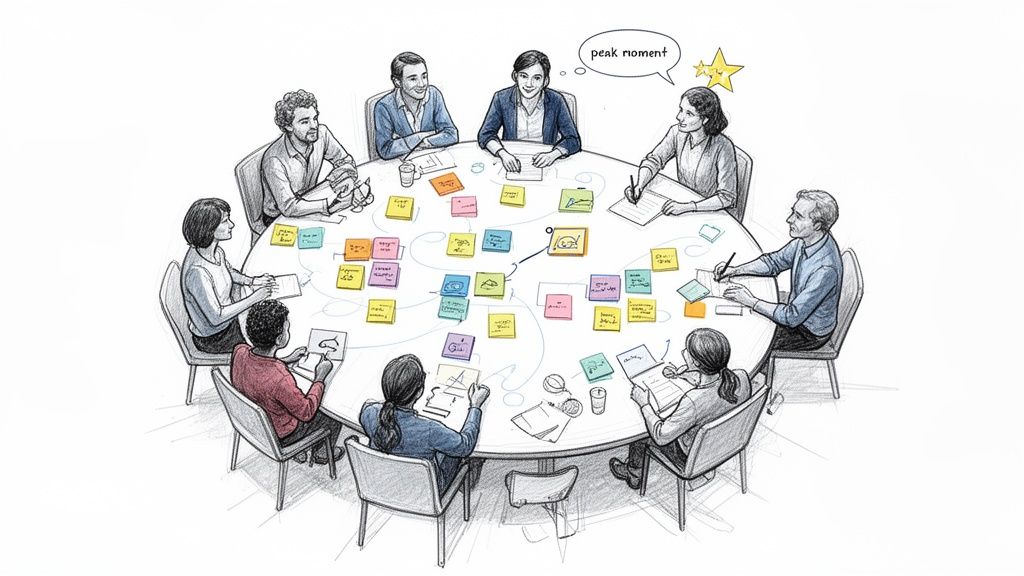
- Peak Moment Stories: Ask everyone to silently write down a time they felt proudest to work for the company. What was happening? Who was involved? What specific actions made it a "peak moment"?
- Narrative Prompts: Break into small groups and give them prompts like, "Tell a story about when a colleague went way above and beyond for you or a customer," or "Describe a decision we made that you totally agreed with, and explain why."
- Values Nomination: Give everyone sticky notes and have them write down 3-5 words or short phrases they believe describe the company at its best. Post these on a wall and then, as a group, start clustering similar themes.
These exercises are designed to pull out stories, not just single words. Your values are hidden in the behaviours described in those stories. If multiple people tell stories about proactive, transparent communication during a tough project, maybe a value like "Radical Candor" is starting to emerge. You can dive deeper into the principles of defining your culture by understanding the true corporate values meaning and its business impact.
The goal of a discovery workshop isn't to invent values from thin air. It's to hold up a mirror to the organization and articulate the principles that are already driving its most successful and admirable behaviours.
Asking The Right Questions
The quality of the values you uncover is a direct result of the quality of your questions. You have to avoid leading questions like, "Don't you think we value innovation?" Instead, ask open-ended questions that force people to reflect and share details.
Questions That Uncover Hidden Values
| Question Type | Example Prompt | What It Reveals |
|---|---|---|
| Behaviour-Focused | "Who do you admire most in the company, and what specific actions do they take that you respect?" | Pinpoints the concrete behaviours that are already seen as aspirational within the culture. |
| Decision-Making | "Think of a tough decision we had to make. What principles guided us to the right answer?" | Highlights the ethical or strategic guardrails that the organization naturally uses under pressure. |
| Future-Oriented | "If we were to hire someone new, what qualities would they need to thrive here, beyond their job skills?" | Uncovers the implicit cultural expectations for new team members, which is a powerful indicator of core values. |
By running a workshop focused on stories, specific behaviours, and smart questions, you gather the raw, authentic material needed to craft value statements that actually mean something. This process ensures the values for your company are not just aspirational words on a wall but a true reflection of your organization's DNA.
Crafting Value Statements That Actually Mean Something
You’ve just wrapped up your discovery workshops, and now you’re sitting on a goldmine of stories, candid quotes, and raw team insights. This isn’t fluff—it’s the authentic material you'll use to forge your company’s real cultural values. The next job is to distill all this rich, qualitative data into clear, compelling value statements that actually stick.
Think of this part of the process as synthesis, not invention. You’re not creating values out of thin air. Your role is to spot the patterns and group them into distinct themes. What behaviours kept coming up? Which beliefs were shared across different departments? What common language did people use?
Maybe you noticed a bunch of stories about "moving fast" or "experimenting without fear." That’s the seed of a value you might eventually call something like "Bias for Action."
Moving Beyond Generic Terms
Here's where so many companies go wrong. They land on generic, one-word values like "Integrity," "Respect," or "Innovation." While they sound nice, they’re basically meaningless on their own. They're table stakes, not true differentiators that define your unique culture.
The real power is in pairing the value with specific, observable behaviours. If "Integrity" is a core theme that surfaced, don't just write the word on a poster. Define what it actually looks like day-to-day in your company.
- Does it mean admitting mistakes openly, even when it’s tough?
- Does it mean giving direct, constructive feedback to a colleague, no matter their job title?
- Does it mean being upfront with customers about a product’s limitations?
A strong value statement is actionable. It gives everyone a clear guide for how to behave and make decisions. As noted in the Harvard Business School publication by Patrick Lencioni, well-defined principles help managers make smarter strategic calls—a concept that applies directly to the cultural assets you’re building.
Your goal isn't just to label a value; it's to describe it in motion. A great value statement answers the question, "What do people do here when they are living this value?"
Using a Value Statement Charter
To get this clarity down on paper, I recommend creating a "Value Statement Charter" for each potential value. It's a simple document that forces you to articulate the 'what,' the 'why,' and, most importantly, the 'how.' It’s what turns an abstract idea into a practical, everyday guide.
This charter ensures your values aren’t just words on a wall but are deeply understood and consistently applied, fuelling your company's growth.
Example Value Statement Charter
| Component | Description |
|---|---|
| Value Name | Own the Outcome |
| Why It Matters | We believe true progress comes from taking full responsibility for our work, start to finish. This empowers individuals, builds trust, and ensures we deliver exceptional results for our customers and each other. |
| Key Behaviours (The 'How') | 1. Proactively identify and solve problems without waiting to be asked. 2. Communicate setbacks early and honestly, always proposing a solution. 3. See projects through to completion, making sure all stakeholders are satisfied. 4. Celebrate team successes as a collective achievement. |
Building a charter like this for each theme lets you pressure-test its meaning and see how it holds up across the entire organization.
Prioritizing Your Core Values
As you sort through all the feedback, you might identify six, seven, or even ten potential values. That's perfectly normal. But you have to be ruthless about narrowing them down. A company with ten "core" values really has none—it’s just a list nobody can remember.
The sweet spot is three to five core values. That’s a number people can actually recall and apply in their daily work, allowing for deep alignment across the company.
To get there, bring your leadership team together and evaluate each potential value against your strategic goals. Ask this critical question: which of these principles, if lived out every single day, will have the biggest impact on hitting our business objectives over the next three to five years?
- If your goal is aggressive market expansion into the US, a value like "Seek Adventure" might be far more critical than "Maintain Stability."
- If you're laser-focused on product innovation for your Canadian user base, "Default to Curiosity" could be completely non-negotiable.
This is the step that connects your cultural DNA directly to your business strategy. It makes sure your values are more than a feel-good exercise—they become a core part of your operational playbook. This is how you build a culture that not only feels great but also performs at the highest level.
Connecting Company Values Directly To Business KPIs
Defining your company values is a great start, but for any COO or People Ops leader, the real work begins when you have to prove they actually move the needle. This is the critical step where culture shifts from a line item on the HR budget to a core driver of your entire business strategy. It’s all about creating a direct, measurable link between those aspirational principles and the hard metrics that define success.
This connection answers the one question every COO is asking: "What's the ROI on this culture initiative?" It reframes values for a company not as soft, feel-good ideals, but as powerful levers for performance.
Think about it this way. A value like "Radical Candor" isn't just about encouraging honest conversations. It can be directly tied to a Key Performance Indicator (KPI) like Time to Project Resolution. When your teams are genuinely empowered to give direct, constructive feedback, roadblocks get surfaced faster, decisions happen quicker, and projects get over the line sooner.
It’s the same with a value like "Deep Belonging." That isn't just a warm sentiment; it has a clear financial impact. You can link it directly to KPIs like retention rates among diverse employee groups or even new hire ramp-up time. When people feel they truly belong, they stay longer—slashing your turnover costs—and they become fully productive members of the team much faster.
The Blind Spot of Traditional Measurement
Trying to forge these connections with old-school methods like annual engagement surveys is a losing battle. A once-a-year survey gives you a static, outdated snapshot. It might tell you what people felt six months ago, but it completely misses the continuous, real-time context—the why behind their feelings.
Traditional surveys are like looking at a single photograph of a river and trying to understand its current. You see one moment in time, but you have no idea about the flow, the depth, or where it's headed.
This is exactly where most culture initiatives fall flat and fail to demonstrate their value. Without a way to correlate the qualitative, always-on feedback with your quantitative business data, the link between values and results remains purely theoretical.
Using Business Intelligence to Finally Prove ROI
This is precisely the problem a business intelligence platform like Wurkn was built to solve. It moves lightyears beyond static surveys by capturing continuous, anonymous sentiment from the tools your teams already use every single day. Wurkn provides that missing link, correlating the qualitative "why" with the quantitative "what."
Its dashboards are designed specifically to visualize how cultural health directly influences your most important business outcomes.
- Customer Satisfaction: Wurkn can surface clear correlations between teams that exhibit high psychological safety and their corresponding CSAT or Net Promoter Scores.
- Employee Churn: It can identify departments where sentiments around a value like "Work-Life Harmony" are starting to decline, flagging them as a high turnover risk long before people start handing in their notice.
- Revenue Growth: The platform helps you see how teams that strongly embody your value of "Customer Obsession" are also the ones driving higher sales figures or better customer lifetime value.
This capability completely changes the conversation around the values for a company. You're no longer just asking people if they feel engaged; you're analyzing how specific cultural behaviours are driving tangible, bottom-line results.
A Framework for Linking Values to KPIs
To start making these connections in your own organization, you need a straightforward framework. It’s a structured way to turn your cultural principles into measurable business outcomes.
Example Framework in Action
| Company Value | Observable Behaviours | Connected Business KPI | Potential Business Impact |
|---|---|---|---|
| Bias for Action | Teams launch small experiments without waiting for permission. Individuals make decisions quickly with 70% of the information. | Time to Market for New Features | Faster product iteration, increased competitive advantage, and higher revenue from new offerings. |
| Deep Collaboration | Cross-functional teams are formed proactively. Information is shared openly in public channels, not siloed in DMs. | Employee Productivity (e.g., projects completed on time) | Reduced redundant work, faster problem-solving, and more efficient use of resources. |
When you adopt this kind of approach, your company values transform from passive statements on a wall into an active management tool. With a business intelligence platform like Wurkn, you gain the ability to continuously monitor these connections, arming you with the data to prove the financial impact of your culture and make smarter, data-driven decisions. For a deeper dive, you can learn more about the relationship between company values and culture in our detailed guide.
Embedding Values Into Your Daily Operations
Defining your company values is a massive accomplishment, but let's be honest—that was the easy part. The real work starts now. The challenge is getting those values off the wall and into the daily rhythm of your business, making them the default setting for how everyone thinks, acts, and makes decisions.
This is where you weave your values into the very operating system of your company. When done right, they stop being abstract ideals and become the lived, day-to-day experience for every single person on your team. That's how you build a culture that isn't just authentic but is also a powerful driver of your business goals.
Integrating Values From Day One
The employee journey is your most powerful tool for making values stick. It begins the moment a candidate first interacts with your brand and continues through every single stage of their career with you. Every touchpoint is an opportunity to either reinforce your culture or let it fade into the background.
This isn't about adding a slide to your orientation deck. It's about tangible, practical tactics.
- Hiring and Interviewing: Ditch the generic, skill-based questions. Instead, engineer behavioural interview questions that directly probe for your values. If "Own the Outcome" is a core value, you should be asking things like, "Tell me about a time a project you were responsible for started to go off the rails. What specific steps did you take to get it back on track, and what was the ultimate result?"
- Onboarding: Your onboarding shouldn't just be about tools and processes; it should be a full immersion into your culture. Dedicate specific modules to each value, using real-world examples from your own teams to show what "good" looks like in practice. Better yet, pair new hires with a "values mentor" who can model the right behaviours from day one.
- Performance Management: This is critical. Weave your values directly into performance reviews and feedback conversations. This sends the unmistakable message that how the work gets done is just as important as what gets done. Make it a concrete part of career progression, not just a footnote.
Making Values Visible Through Recognition
Here’s a simple truth: what gets celebrated gets repeated. A strong recognition program is one of the fastest ways to make your values tangible and aspirational for everyone. When you publicly praise people for living the values, you’re not just rewarding one person; you’re showing the entire company what matters most.
This doesn't need to be a complex, top-down initiative. Often, the simplest actions have the greatest impact.
A dedicated team messaging channel for value-based shout-outs is incredibly effective. Encourage everyone to tag the specific value when they recognize a colleague. This creates a living, breathing archive of your culture in action.
Think about the difference. A generic "good job" is nice, but a message like, "Huge shout-out to Sarah for living our 'Default to Curiosity' value! She dove deep into the customer data and unearthed an insight that completely reshaped our project approach," is infinitely more powerful. It connects a specific action to a core principle.
Measuring Adoption in Real Time
So, how do you know if any of this is actually working? Let me be blunt: your annual engagement survey is useless for this. It’s a rear-view mirror, giving you a snapshot of problems that might have been festering for months. You wouldn't run your finances with a once-a-year report, so why would you manage your culture that way?
This is where you need something more dynamic, like a business intelligence platform. Tools like Wurkn are designed for this very purpose. By capturing continuous, anonymous feedback through the platforms your team already uses every day, you can monitor how your values are landing in real time. It shifts culture from a reactive, yearly HR exercise to a proactive, strategic function.
This simple flow shows the direct line from a defined value to its financial impact—a connection that's impossible to prove without continuous measurement.
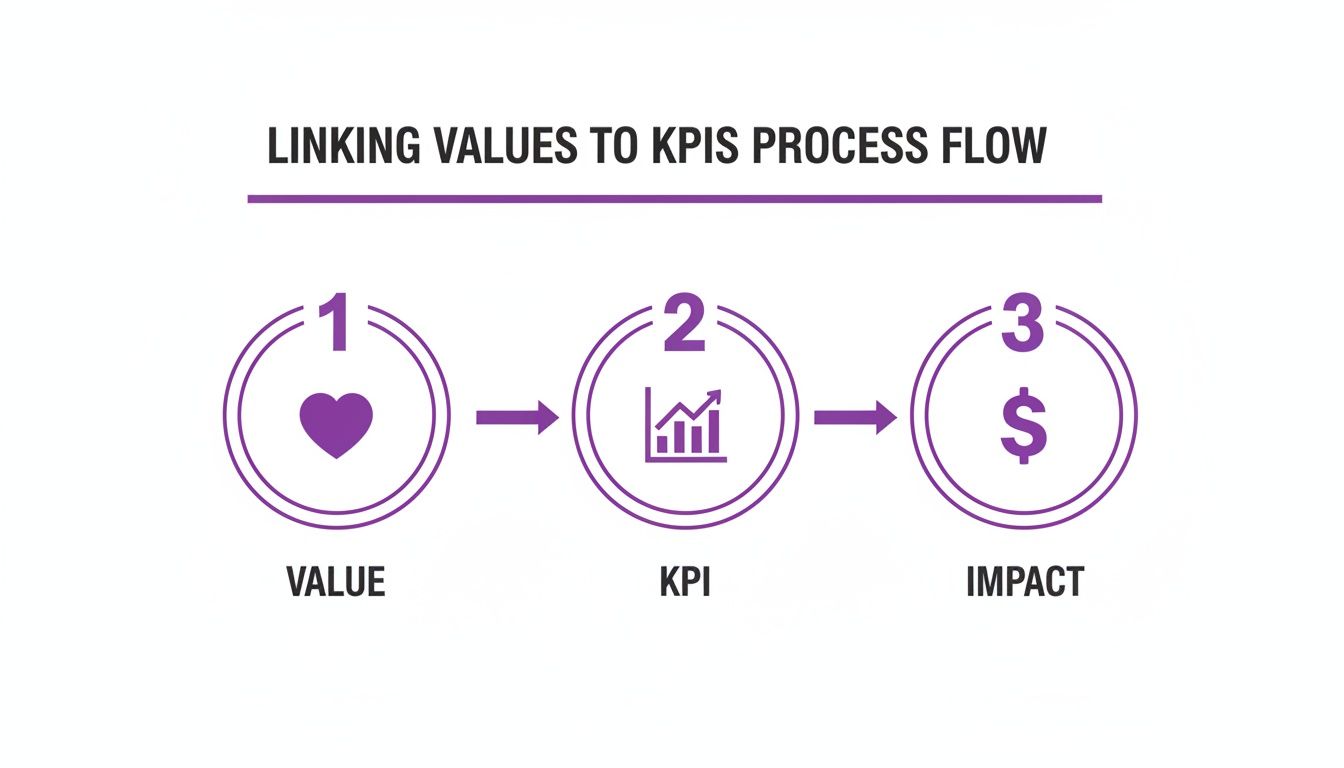
The graphic makes it clear: values only drive business outcomes when they are consistently tracked against the KPIs that matter.
With a real-time tool, you spot misalignment the moment it happens. If sentiment around your "Deep Belonging" value suddenly dips in one department, you can intervene immediately. You don't have to wait until next year's survey, long after your best people have already walked out the door. This is especially vital today. According to a 2023 Proof Strategies CanTrust Index, 51% of Canadians believe inclusion policies are good for society, but new workplace challenges can quickly erode trust if you're not paying close attention.
By weaving your values into every part of the employee experience and using a business intelligence platform like Wurkn to measure adoption, you create a powerful feedback loop. You can finally nurture a culture that not only feels good but actively drives performance, giving you the data to prove its undeniable ROI. To dig deeper into this, check out our guide on the foundational role of values in companies.
Your Company Values Questions, Answered
Defining and embedding company values that actually stick is a tough process. It’s full of nuances and potential pitfalls. Here are some straight answers to the questions I hear most often from COOs and PeopleOps leaders across Canada and the United States.
How Many Company Values Should We Have?
Stick to three to five core values. That's the sweet spot.
Any more than that and you're just creating a laundry list nobody can remember. When people can't recall the values off the top of their head, they can't use them to make decisions. The goal isn't a checklist; it's a true cultural guide that shapes behaviour when no one is looking. A tight, focused list ensures each value carries real weight.
How Often Should We Revisit Our Values?
You should formally review your values every 18 to 24 months. But that's just the scheduled check-in.
The real answer is: revisit them anytime something big changes. A major pivot in strategy, a period of hyper-growth, or a merger are all critical moments to pause and ask, "Do these still represent who we are and where we're going?" The aim isn't constant change, but ensuring your values evolve alongside the business instead of becoming relics on a wall.
What's the Difference Between a Mission and Our Values?
This one trips a lot of people up, but it's pretty simple when you break it down:
- Your Mission is your destination. It’s the 'what' and the 'why'—the ultimate purpose your company exists to achieve in the world.
- Your Values are your compass. They're the 'how'—the guiding principles and behaviours that steer your culture and every decision you make on the journey to that mission.
You can't reach the destination without a reliable compass to guide you through the day-to-day choices.
How Can We Actually Measure if Our Values Are Being Adopted?
This is the million-dollar question. The short answer is you need a mix of qualitative and quantitative data, but annual surveys are way too slow to be useful. They can’t capture the daily reality of your workplace culture.
The most effective approach is to treat culture like any other part of your business: with real-time intelligence. Traditional engagement tools might give you a surface-level score, but they can't connect what's happening in your culture to actual business outcomes.
This is where a business intelligence platform like Wurkn comes in. It provides the continuous, anonymous feedback you need to track how values are being lived out in real-time. It moves beyond simple surveys by correlating cultural sentiment with hard business metrics. This is the crucial difference between a simple HR survey tool and a true business intelligence platform.
You can also weave values into your operational fabric: build value-based criteria into performance reviews, analyze promotion data for alignment, and track the specific KPIs you’ve linked to each value, whether that's innovation output or customer retention rates. This gives you a complete, data-driven picture of whether your values are truly taking root.
Ready to transform your company values from words on a wall into measurable drivers of business growth? See how Wurkn provides the business intelligence you need to prove the ROI of your culture, moving far beyond the capabilities of traditional employee engagement platforms. Learn more about Wurkn.