
AI HR solutions are more than just fancy automation tools; they're platforms that turn the constant hum of employee feedback into sharp, strategic business insights. These systems are helping leaders across Canada and the United States move beyond simple task management to actually understanding—and improving—their company culture, retention, and performance with real data.
From HR Tools to Strategic Business Intelligence
Imagine your HR function evolving from an administrative cost centre into a core driver of business strategy. That’s the fundamental shift we’re seeing, all powered by modern AI HR solutions. The old model of reactive HR, which was stuck reviewing annual surveys and manually crunching numbers, is giving way to proactive, predictive intelligence that finally connects people to profits.
This whole transformation pivots on a concept we call cultural intelligence: the ability to continuously understand employee sentiment and tie it directly to business outcomes like productivity and retention. Instead of just automating payroll or scheduling, today’s most advanced platforms, like Wurkn, act as a true business intelligence engine for your organization's culture.
Moving Beyond Simple Surveys
Think about traditional employee engagement platforms and HR survey tools. They’re like taking a single photograph of a moving train. They might tell you what your employees felt last quarter, but they offer zero insight into why they feel that way right now. This is precisely where a true business intelligence tool creates a massive advantage.
The real value isn't just in gathering feedback. It's in translating authentic, real-time sentiment into forward-looking insights that let you get ahead of problems before they even start. It’s the difference between reviewing a crash report and having a live map of the road ahead.
How Wurkn Delivers Actionable Intelligence
Platforms like Wurkn are built to deliver this continuous, strategic view. By plugging into the communication tools your teams already live in every day, like Slack or Microsoft Teams, Wurkn gathers authentic feedback without adding another task to anyone's plate. It doesn't disrupt the workflow; it simply listens to the natural conversations that are already happening.
This “always-on” approach is how you capture the unfiltered truth of your workplace culture. The AI then gets to work, translating this constant stream of qualitative feedback into hard, quantitative insights. The result is a clear, living dashboard showing you exactly how your people data is impacting performance.
This continuous feedback loop is becoming non-negotiable. According to a recent report from ADP Canada, there's a major gap in AI adoption among Canadian businesses. While 75% of large companies and 61% of mid-sized ones agree that AI is critical for staying competitive, very few have actually put it into practice in a meaningful way. This just underscores the urgent need for business intelligence tools like Wurkn, which are designed for COOs and PeopleOps leaders to turn that real-time feedback into insights tied directly to business goals. This is how modern leaders finally connect the dots between culture and the bottom line. Discover more from ADP Canada's 2026 workplace trends.
How Modern AI HR Solutions Actually Work
To really get the value of modern AI HR platforms, you have to look past the buzzwords and understand what’s happening under the hood. These aren't just tools automating old tasks; they're sophisticated engines designed to listen, predict, and guide. Their real power comes from a few core capabilities that turn raw employee feedback into a clear strategic advantage.
At their heart, these systems go way beyond simple keyword matching or the once-a-year survey. They analyze the natural flow of communication to give you a real-time pulse of the organization's health. It turns what was once pure guesswork into a science.
This diagram shows how HR has evolved from a purely administrative role into a strategic driver of business growth, all thanks to AI.
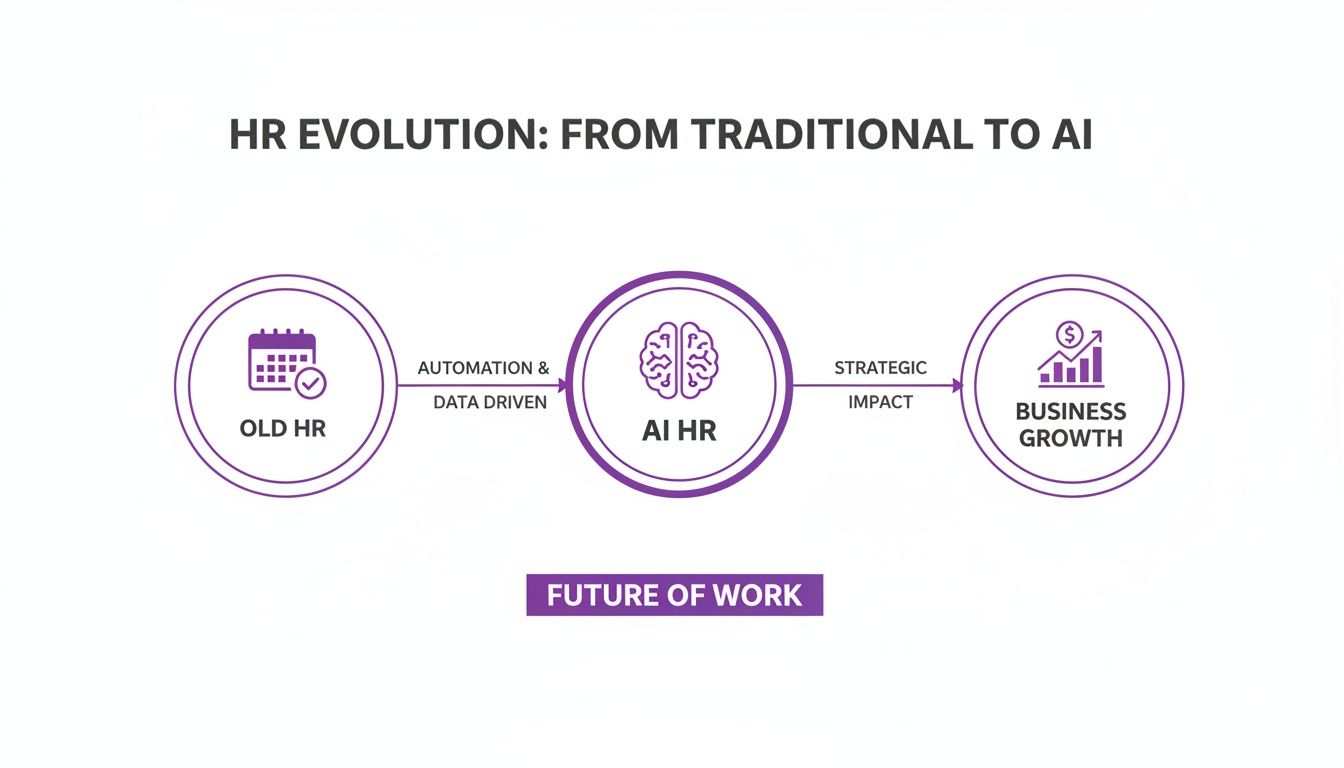
As you can see, AI acts as the critical bridge, transforming standard HR practices into something that creates tangible business results.
AI-Powered Talent Acquisition
Let’s start with recruiting. The old way of doing things often relied on scanning resumes for specific keywords, a clumsy process that could easily miss great candidates who just used different phrasing. Today’s AI HR solutions take a much smarter approach.
Instead of just matching words, the AI analyzes context, experience, and even subtle clues about cultural fit. For example, it can analyze the career paths of your most successful project managers in the U.S. and identify similar patterns in new applicants, even if they use different job titles on their resumes. This dramatically reduces unconscious bias and seriously improves the quality of your hires.
Continuous Sentiment Analysis
This is where a cultural intelligence tool like Wurkn truly excels beyond standard survey platforms. Forget asking for feedback once a quarter. This is about capturing continuous, anonymous sentiment from the communication channels your teams already live in, like Slack and Microsoft Teams.
The AI isn’t just flagging keywords like “burnout.” It’s piecing together complex themes and emotional drivers from these conversations. For instance, it might detect rising frustration tied to a new software rollout in your Toronto office or identify a specific remote team that feels disconnected from the company’s mission.
This continuous listening provides the crucial 'why' behind the numbers. You don't just see a dip in an engagement score; you understand the specific cultural friction causing it. That allows leaders to step in with precision and empathy.
For companies navigating hybrid or remote work—especially in Canada, where teams are often spread out—this real-time cultural view is a game-changer. You can learn more about how different HR systems support these functions by exploring our guide on what an HRIS system is and how it works.
Predictive Performance Insights
By analyzing anonymized communication patterns and other data points, advanced AI can spot the early warning signs of performance shifts. It might identify a link between certain communication styles and a higher risk of burnout, or flag teams where collaboration is starting to fray long before it impacts project deadlines.
This isn't about spying on individuals. It’s about understanding the systemic things that help teams thrive or cause them to struggle. For instance, a business intelligence tool could correlate a sudden drop in positive, forward-looking language with a 15% increase in missed project milestones a month later, giving managers foresight to provide support, adjust workloads, or offer targeted coaching before small issues snowball into big problems.
Proactive Retention Strategies
Employee turnover is one of the biggest hidden costs in any business. An advanced AI HR solution acts as an early warning system. It can identify teams with a high flight risk by detecting subtle shifts in sentiment, like more frequent mentions of workload or a drop-off in positive feedback.
This proactive intelligence lets leaders move from reacting to exit interviews to actually preventing people from leaving in the first place. For example, if the AI flags a high-performing team in your U.S. sales division showing signs of disengagement, leaders can dig into the root cause—maybe it’s a lack of growth opportunities or unclear direction—and fix it.
This table shows just how different the new approach is compared to the old way of gathering feedback.
Traditional HR Tools vs AI-Powered Cultural Intelligence
| Feature | Traditional HR Tools (e.g., Annual Surveys) | AI Cultural Intelligence (e.g., Wurkn) |
|---|---|---|
| Data Frequency | Annual or quarterly | Real-time, continuous |
| Data Source | Direct, solicited feedback | Anonymous, organic communication |
| Insight Type | Lagging indicator (what happened) | Leading indicator (what is likely to happen) |
| Focus | Measuring satisfaction | Predicting behaviour and performance |
| Actionability | Slow, generalized interventions | Fast, precise, targeted actions |
| Scope | Surface-level engagement scores | Deep cultural and operational friction points |
The shift is clear: we’re moving from looking in the rearview mirror to seeing what’s coming down the road. This allows for a truly proactive business strategy.
This strategic approach is gaining serious traction across North America. AI is quickly shifting HR in Canada from a transactional function to a strategic one. As organizations gear up for 2026, 71% expect AI to improve the quality of performance feedback, while 85% of HR professionals value its analytical power. For companies with a lot of remote workers, AI-driven wellness initiatives have been shown to cut stress by 25% and burnout by 30%, boosting retention by creating better career paths, as noted by Employment Hero. Discover more insights about 2026 work trends from Employment Hero.
Implementing AI Without Disrupting Your Business
Bringing artificial intelligence into your organization should feel less like a massive IT overhaul and more like a strategic upgrade. The best AI HR solutions are designed for a smooth rollout, focusing on tangible business outcomes from day one. A successful implementation isn't a technical project; it's a business initiative that slots into existing workflows rather than creating new burdens.
The key is a thoughtful, step-by-step approach that puts people and processes first—not technology for its own sake. When done right, AI becomes an accelerator for your business, not a distraction. This practical roadmap ensures you start delivering value quickly, without hitting the brakes on everything else.
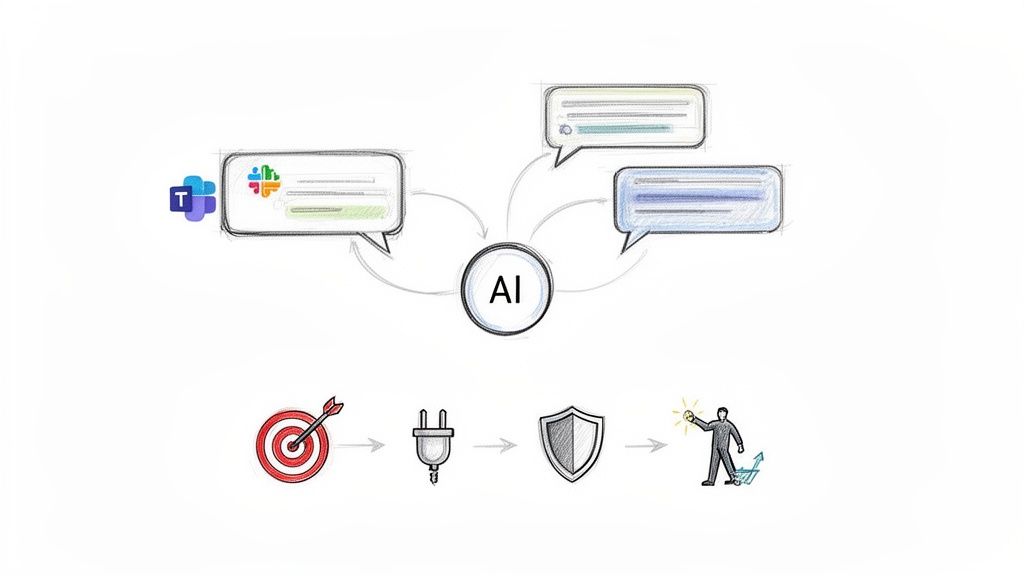
Pinpoint Clear Business Objectives First
Before you even look at a single demo, the most critical first step is defining what you’re trying to fix. A vague goal like “we want to use AI” is a recipe for failure. Instead, anchor your entire project to a specific, measurable business problem you need to solve.
For example, your objective could be reducing turnover in your engineering department in the U.S., which has been consistently 15% higher than the company average. Or maybe you want to boost productivity for your newly remote sales team based in Canada by sniffing out the cultural friction points that are slowing them down.
Focusing on a clear objective does two things:
- It creates a finish line. You’ll know if the AI solution is working because you can measure its impact against a real business metric.
- It keeps your team focused. It prevents the project from becoming a wide-open exploration of tech and grounds it in solving a real-world challenge.
Prioritize Seamless Workflow Integration
One of the biggest killers of new technology is friction. If a new tool forces employees to change their habits, log into yet another system, or learn a complicated interface, they just won't use it. This is why integration is non-negotiable for any modern AI HR solution.
The most effective platforms meet employees where they already work. A cultural business intelligence tool like Wurkn is built on this very principle. It plugs directly into the communication hubs your teams live in every day, like Slack and Microsoft Teams.
By capturing feedback organically from existing workflows, you eliminate the adoption hurdle entirely. There are no new apps to download or websites to visit, which means you get more authentic, real-time data without causing tool fatigue.
This approach transforms data collection from a disruptive event (like a survey) into a continuous, invisible process.
Build Trust Through Anonymity and Privacy
For any feedback system to work, employees must trust that their contributions are genuinely anonymous and their data is secure. This trust is the foundation of honest feedback, which is the fuel for any powerful AI engine. You have to nail this from the very beginning.
Make your commitment to privacy explicit and transparent. Communicate clearly how data is collected, anonymized, and used. Leading platforms like Wurkn are engineered with a privacy-by-design framework, ensuring personally identifiable information is minimized and submissions are fully redacted before any analysis happens.
This isn't just about compliance with U.S. or Canadian privacy laws; it's about culture. When employees feel safe, they are far more likely to share the candid insights you need to spot hidden problems and opportunities. Building this psychological safety is a prerequisite for getting any real value from an AI HR solution.
Empower Leaders to Turn Insights into Action
Ultimately, the goal of any AI platform isn't to produce pretty dashboards; it's to drive meaningful action. Your implementation plan must include a strategy for empowering managers and leaders to use the insights they get. An insight that isn't acted upon is just expensive noise.
This means giving leaders not just data, but also the context and coaching to interpret it correctly. A true business intelligence tool moves beyond simple sentiment scores to reveal the why behind the data, connecting cultural trends to specific performance metrics.
For example, instead of just telling a manager their team’s morale is low, a platform like Wurkn can highlight that the sentiment is linked to unclear project goals or a recent change in leadership. Armed with this specific, actionable intelligence, managers can step in and make a real difference. The implementation isn't truly complete until insights are consistently translated into better business outcomes.
Building Trust with Privacy-First AI
For any HR initiative to work, trust is the absolute price of entry. When you introduce AI HR solutions, your people will rightly ask if their data is safe, if their voice is truly anonymous, and if the whole system is fair. Answering these questions isn't just a compliance task—it's the foundation for getting the honest, unfiltered feedback that makes these platforms so powerful in the first place.
Leaders across Canada and the United States get this. The real goal is to build a "privacy-by-design" framework that protects employees and makes them feel comfortable enough to share openly. When people feel safe, they provide the kind of insights that solve genuine business problems. This is how you turn a potential stumbling block into a real competitive advantage.
Engineering Privacy from the Ground Up
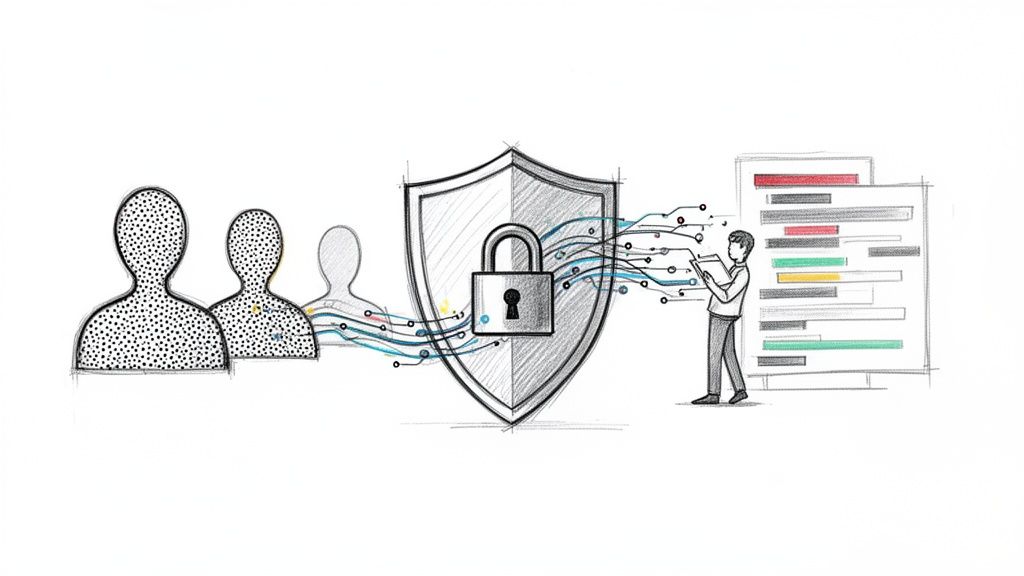
You can't just bolt privacy on at the end; it has to be woven into the core of the platform from day one. A true cultural intelligence tool like Wurkn is engineered around this principle, putting it leagues ahead of traditional HR survey tools. It uses several layers of protection to make sure employee confidentiality is never, ever compromised.
It starts with a strict commitment to data minimization. That means only collecting the information absolutely essential for generating meaningful insights, and nothing more. The system is intentionally designed to avoid gathering personally identifiable information (PII) wherever possible.
From there, two critical processes kick in:
- Full Anonymization: Before any analysis even begins, every identifier is completely stripped from the data. The focus is on what was said, not who said it.
- Submission Redaction: The AI is trained to automatically find and remove names, project titles, or other specific details that could accidentally point back to an individual or a small team.
These technical safeguards create a vault-like environment where employees can be confident their feedback is being used to make the workplace better, not to put anyone under a microscope.
The Human-in-the-Loop Imperative
As powerful as AI is at finding themes in mountains of qualitative data, it isn't perfect. Relying 100% on an algorithm to interpret human emotion and context can lead to strange conclusions or introduce unintended biases. This is where a human-in-the-loop (HITL) system is non-negotiable.
An HITL approach simply means a trained human expert reviews, validates, and refines the insights the AI generates. This person acts as a vital check and balance, making sure the final output is accurate, nuanced, and free from the blind spots an algorithm might have.
A human-in-the-loop system isn't a weakness of the AI; it's a strength of the entire process. It combines the scale and speed of machine learning with the contextual understanding and ethical judgment that only a person can provide, resulting in more reliable and trustworthy business intelligence.
This blend of machine-powered synthesis and human oversight is what builds the confidence needed for people to actually use and trust the system. Take Canada's HR landscape, for example. The 2026 AI Impact Report from Avature found that while 88% of organizations plan to increase their AI investments, a massive 98% of leaders admit they wouldn't fully trust generative AI to make workforce decisions on its own. This gap shows exactly why you need platforms that transparently pair AI's power with human validation to build that crucial trust. Explore the full findings on AI's impact in Canadian HR.
By putting a privacy-first architecture at the forefront and keeping a human in the loop, organizations can responsibly tap into the incredible power of AI HR solutions. This approach ensures you get the deep, actionable insights needed to move the business forward while maintaining the highest standards of data security and ethical integrity.
Measuring the True Business Impact of AI in HR
For any executive in the U.S. or Canada, the question is always the same: “What’s the return?” When you’re talking about AI HR solutions, the answer isn't buried in fluff metrics like survey completion rates. Real business impact is measured by drawing a straight line from cultural insights to the bottom line. It’s about transforming HR from a perceived cost centre into a proven engine for growth.
This means moving past the limitations of old-school employee engagement platforms. An annual survey might tell you morale is down, but a cultural business intelligence platform shows you why it's down, which specific teams are struggling, and the potential cost in turnover and lost productivity if you don't act.
Quantifying the Reduction in Employee Churn
Employee turnover is a quiet profit killer. The real cost of recruiting, hiring, and onboarding a replacement for a skilled employee can be anywhere from 50% to 200% of their annual salary, according to data from Gallup. This is where a proactive AI solution delivers its most immediate and tangible return.
Instead of just reacting to exit interviews after the fact, a cultural intelligence tool like Wurkn identifies flight risks before an employee even thinks about updating their resume. By analyzing anonymized communication patterns, the AI flags early warning signs of disengagement or burnout bubbling up in specific teams.
This gives leaders a chance to intervene with surgical precision. For a U.S.-based tech company, this could mean identifying burnout in a key product team three months before a major launch. Leaders can then address the root causes—like unclear goals or crushing workloads—and stop valuable talent from walking out the door. The ROI is simple math: if the platform helps you keep just a few key people a year, it often pays for itself.
Linking Cultural Trends to Team Productivity
Productivity has always been tough to measure, but its link to culture is undeniable. When teams feel psychologically safe, aligned with company goals, and free from operational friction, they just perform better. The problem is, traditional HR surveys offer no way to connect those feelings to actual output.
A business intelligence tool, on the other hand, makes this connection crystal clear. Wurkn’s living dashboards can correlate shifts in team sentiment directly with your key performance indicators (KPIs). For example, you might see a direct link between a spike in positive sentiment around a new project management tool in your Canadian operations and a 10% decrease in missed deadlines for that team.
This allows you to see which cultural initiatives are actually moving the needle on performance. You can stop guessing what might work and start investing in the cultural drivers that deliver real business results. If you want to dive deeper into connecting people data to performance, check out our guide on the essentials of analytics for HR leaders.
Enhancing Leadership Effectiveness
A manager's impact on their team's health and retention is massive. But without objective data, it’s hard to know which leaders need support and where they need it most. An advanced AI HR solution provides the data-driven coaching insights managers need to level up.
The system might spot a trend where a particular manager’s team consistently shows frustration around feedback or career growth. This isn't about calling out a "bad manager." It’s about providing an objective, anonymized signal that this leader could benefit from coaching on how to run better one-on-ones or map out clearer development paths for their people.
By tracking how sentiment metrics for that team improve over time after the intervention, you can measure leadership growth in a tangible way. Stronger leaders build stronger, more resilient teams, which is a direct contribution to long-term business stability and success.
Choosing the Right AI HR Partner for Your Goals
Picking the right partner for your AI HR solutions is about a lot more than just comparing features on a website. You're not just buying software; you're looking for a strategic partner who can deliver real business intelligence. To get past the marketing fluff, you need to know what to look for—the stuff that actually delivers tangible value.
The best platforms are more than fancy survey tools. They’re business intelligence engines built to drive measurable outcomes. Your evaluation should be grounded in a few core principles that separate a simple tool from a long-term strategic asset.
Look Beyond Keywords to True AI Sophistication
First thing's first: you have to dig into the sophistication of the AI model itself. A lot of basic platforms are just glorified keyword trackers, which can be seriously misleading. For example, a system might flag the word “burnout” every time it appears, but without understanding the context, you're just chasing false positives and wasting everyone's time.
A more advanced business intelligence tool, like Wurkn, uses a sophisticated AI pipeline to pull together complex themes and the real emotional drivers behind them. It doesn’t just see keywords; it understands context, sentiment, and how different topics connect. This is how you get the nuanced insights that point to the root cause of cultural friction, not just the symptoms.
The critical question to ask is: Does this platform give me raw data, or does it provide synthesized, actionable intelligence? One tells you what is being said; the other tells you why it matters to your business.
Prioritize Seamless Integration and Ease of Use
Next up, think about how this solution will actually fit into your team's daily life. The most powerful AI in the world is useless if no one on your team uses it. Forcing people to learn yet another new tool or log into a separate portal is a great way to kill adoption before it even starts.
Look for a partner that puts a premium on seamless integration with the systems your team already lives and breathes in, like Slack and Microsoft Teams. This approach meets employees where they already are, making it possible to capture authentic, real-time feedback without pulling them away from their work. That frictionless experience is absolutely essential for gathering the high-quality data you need for meaningful insights.
Finally, make sure the platform is built on a rock-solid foundation of security and privacy. As you explore how a cultural business intelligence platform can reshape your organization, learn more about our dedicated people ops SaaS solutions designed for forward-thinking leaders. Choosing a partner that values trust as much as technology ensures you can confidently make the smarter, data-driven decisions that will propel your business forward.
Your Questions Answered: AI HR Solutions
When COOs and People Ops leaders in the U.S. and Canada start exploring AI HR tools, a few key questions always come up. Let's get straight to the practical answers you need to understand how these platforms actually create business value.
Will AI Replace Our HR Professionals?
Absolutely not. The real goal of a smart AI HR solution is to make your HR team more powerful, not redundant. Think of it as giving them a data science team in their pocket.
These tools handle the grunt work of gathering and making sense of data. Instead of being buried in spreadsheets for weeks trying to analyze a survey, your team gets continuous, clear insights. This frees them up to do the high-value, human work—like designing a retention strategy for your top engineers in your Boston office or coaching a new manager in Vancouver—that actually moves the needle. It shifts HR from a support function to a strategic driver.
How Do We Ensure Employee Feedback Stays Anonymous?
This is non-negotiable, and frankly, it's where most basic survey tools fall short. True privacy has to be built into the platform’s core architecture, not just promised in a policy document.
A cultural business intelligence platform like Wurkn, for example, is designed from the ground up to be privacy-first. It's engineered to collect minimal personal data and to fully anonymize and redact submissions before any analysis happens. This technical guarantee of confidentiality is what encourages the kind of honest, unfiltered feedback you need to get a true read on your organization's health.
How Do We Avoid Overwhelming Employees with New Tools?
The last thing anyone needs is another app to download or another login to remember. The best AI HR solutions understand this and are designed to meet employees where they already work.
Instead of forcing your team into a separate platform, leading tools integrate directly into the communication channels they use every single day, like Slack or Microsoft Teams. This approach captures feedback organically as part of the normal workflow. It's frictionless for employees, which dramatically boosts participation and ensures the data you get reflects real-time sentiment, not just survey fatigue.
How Quickly Will We See a Return on Investment?
While deep cultural change is a long game, you can see the leading indicators of ROI almost immediately. Unlike a static annual survey that gives you a single snapshot in time, a cultural business intelligence platform provides a live dashboard that connects employee sentiment directly to your core business KPIs.
Within the first few months, you’ll be able to spot flight risks in critical teams, diagnose the root causes of a dip in productivity, and watch sentiment improve as your leaders act on data-driven insights. The financial return becomes very real, very fast, as you start measuring direct reductions in employee turnover and tangible improvements in team performance.
Ready to turn employee sentiment into your next strategic advantage? Wurkn delivers the cultural business intelligence you need to link your people data directly to business results. See how our platform can help you build a healthier, more productive organization by visiting https://wurkn.com.