
The traditional performance review is often a source of anxiety for employees and a logistical headache for managers. It's a high-stakes, backward-looking process that rarely captures the full picture of an employee's contribution or cultural impact. This static approach fails in modern, dynamic work environments, especially in the United States and Canada where agility and employee sentiment are paramount. Instead of driving growth, outdated reviews can disengage top performers and fail to address underlying issues.
The key isn't just to find a better template; it's to connect performance conversations to the living, breathing culture of your organisation. This guide offers a comprehensive look at each example of performance review, but with a critical difference. We'll show you how to move beyond static forms by integrating continuous, anonymous feedback. We will demonstrate how a business intelligence tool like Wurkn transforms reviews from a periodic judgment into an ongoing, data-driven dialogue.
This system links employee sentiment directly to business KPIs like retention and productivity, a capability that goes far beyond traditional HR survey tools. By connecting feedback to measurable outcomes, you can see exactly how cultural health impacts financial performance. Let's explore 8 powerful examples that, when combined with real-time cultural intelligence, can create a fair, insightful, and motivating performance management system. You'll gain practical, replicable strategies to turn every review into a catalyst for growth and engagement.
1. 360-Degree Feedback Performance Review Template
A 360-degree feedback performance review is a powerful method that moves beyond the traditional top-down assessment. Instead of relying solely on a manager's perspective, it gathers confidential, anonymous feedback from a circle of sources surrounding the employee. This includes peers, direct reports, and the employee's own self-assessment, providing a well-rounded, multi-dimensional view of their performance and impact.
This holistic approach is exceptionally valuable for evaluating behavioural competencies and cultural alignment, which are often difficult for a single manager to observe. For instance, a tech company might use 360-degree feedback to assess a team lead’s communication skills, while a healthcare organisation could use it to evaluate a nurse's collaboration with different departments.
Strategic Breakdown
The core strength of the 360-degree method lies in its ability to uncover blind spots and highlight strengths that might otherwise go unnoticed. When integrated with continuous feedback platforms, it becomes more than just a periodic review; it transforms into an ongoing dialogue about growth and development.
Key Insight: Business intelligence tools like Wurkn leverage AI to synthesise anonymous feedback from various sources, identifying recurring themes and behavioural patterns. This turns subjective comments into objective, actionable data, allowing leaders to see how an individual's perceived performance aligns with their actual impact on team morale and productivity. This is a prime example of performance review data being used for predictive business intelligence, a feature that sets it apart from standard HR survey tools.
Actionable Takeaways
To effectively implement a 360-degree feedback process, consider the following tactics:
- Focus the Scope: Limit your feedback questionnaire to 10-15 crucial competencies directly tied to the role and company values. This prevents survey fatigue and ensures higher-quality responses.
- Emphasise Behaviour: Train participants to provide specific, observable examples of behaviour (e.g., "In the project X kickoff, Sarah clearly outlined each team member's role") rather than vague personality judgments (e.g., "Sarah is a good leader").
- Schedule Follow-Ups: The review document is just the start. Managers should schedule dedicated coaching sessions to discuss the synthesised themes, align on development goals, and create an action plan.
- Integrate with Business Intelligence: Use tools like Wurkn to track cultural sentiment shifts and validate the 360-degree review findings against real-time, anonymous feedback aggregated over time. This ensures a more accurate and fair assessment.
2. Competency-Based Performance Review for Technical Roles
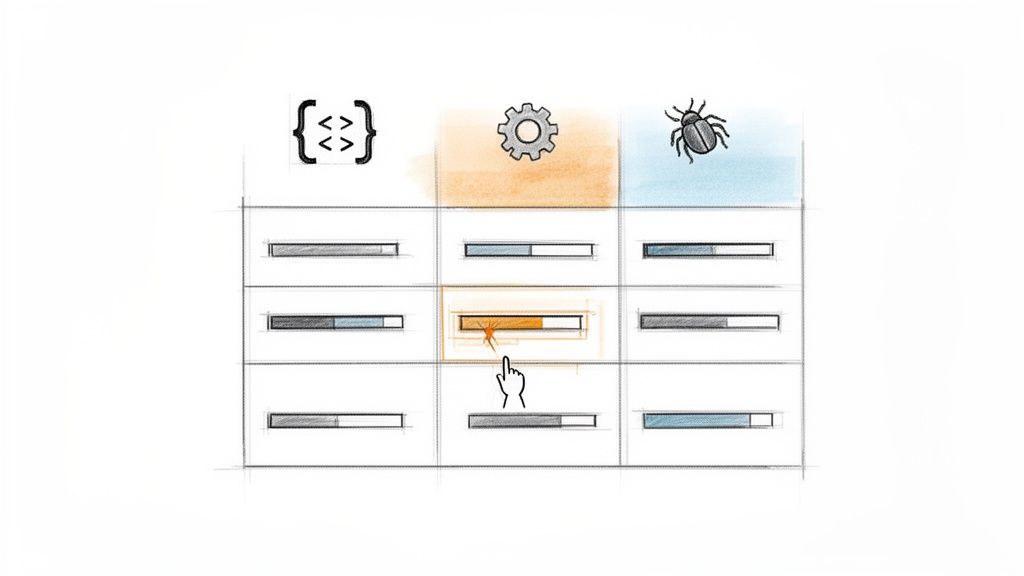
A competency-based performance review for technical roles is a specialised evaluation framework that moves beyond generic performance metrics. It assesses engineers, developers, and other tech professionals against a predefined set of technical skills, project delivery effectiveness, code quality, and capacity for innovation. This model provides a clear, objective ladder for career progression based on demonstrated mastery.
This approach is crucial in fast-paced tech environments where skills can quickly become outdated. For example, a software development team might be assessed on their proficiency in a new programming language, while a DevOps professional is evaluated on their ability to improve system uptime and deployment efficiency. This targeted focus ensures that individual growth aligns directly with the organisation's technological strategy.
Strategic Breakdown
The power of a competency-based review lies in its structured objectivity, which is vital for retaining top technical talent. It shifts the conversation from subjective opinions to a data-backed discussion about specific skills, such as algorithm optimisation, database management, or system architecture. This clarity helps reduce bias and provides a transparent roadmap for career advancement.
Key Insight: When business intelligence tools like Wurkn integrate competency ratings with continuous anonymous feedback, a deeper narrative emerges. Leaders can correlate a developer's high code output with declining team sentiment, potentially identifying burnout risks or communication bottlenecks before they impact project timelines. This is a clear example of performance review data being used not just for evaluation, but for proactive team health management—a level of analysis beyond traditional employee engagement platforms.
Actionable Takeaways
To effectively implement a competency-based review for technical roles, consider these tactics:
- Define Tiered Competencies: Create a clear competency matrix with levels from junior to principal (e.g., "Level 1: Can debug existing code" vs. "Level 4: Can design and implement scalable microservices architecture").
- Use Quantifiable Metrics: Wherever possible, tie competencies to measurable outcomes like code review turnaround times, sprint velocity, bug-to-feature ratio, or pipeline reliability metrics.
- Balance Individual and Team Goals: Assess individual coding contributions alongside their impact on team collaboration. Score metrics like the quality of documentation and mentorship of junior engineers.
- Correlate with Sentiment Data: Use business intelligence tools like Wurkn to monitor sentiment trends within engineering teams. A dip in engagement following a difficult sprint can provide crucial context to performance data, distinguishing a temporary challenge from a systemic issue.
3. SMART Goals-Based Performance Review Template
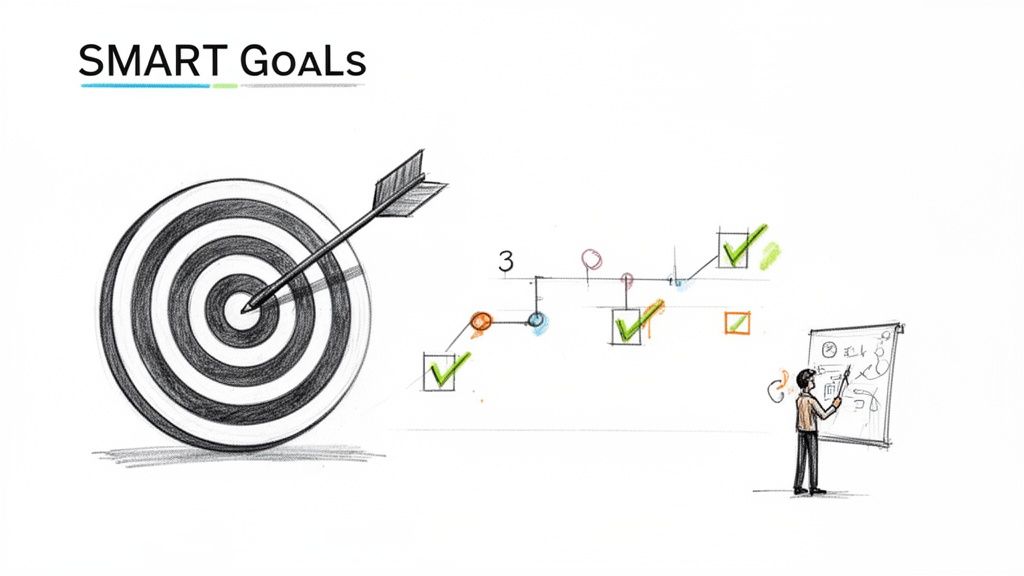
A SMART goals-based performance review shifts the focus from subjective evaluation to objective achievement. This framework measures employee performance against Specific, Measurable, Achievable, Relevant, and Time-bound goals that are collaboratively set between a manager and their direct report. It creates a clear, transparent roadmap for success.
This method is highly effective for roles where performance can be quantified. For example, a sales team can use it to track quarterly revenue targets and customer acquisition metrics, while a product team can measure success based on feature adoption rates and user engagement goals. An HR department could be evaluated on hiring speed and time-to-productivity metrics for new hires.
Strategic Breakdown
The power of the SMART goals framework lies in its clarity and alignment. It removes ambiguity from the review process, ensuring that both the employee and the manager have a shared understanding of what success looks like. This approach, popularised by management thinkers like Peter Drucker in "The Practice of Management" (1954), directly connects individual contributions to broader business outcomes.
Key Insight: A modern implementation of this approach involves more than just setting and forgetting goals. Business intelligence tools like Wurkn can link individual SMART goals directly to departmental KPIs and track progress in real-time. By correlating goal achievement with cultural health metrics like employee confidence and sentiment, organisations can proactively identify if ambitious targets are causing burnout or if goals are not challenging enough. This is a clear example of a performance review model being elevated into a strategic business intelligence function.
Actionable Takeaways
To effectively implement a SMART goals-based review process, consider these tactics:
- Maintain Sharp Focus: Limit each employee to 3-5 key goals per review cycle. This prevents divided attention and ensures that efforts are concentrated on the highest-impact activities.
- Conduct Quarterly Check-ins: Business priorities shift. Use quarterly reviews not just to assess progress but also to re-evaluate and adjust goals, ensuring they remain relevant to the organisation's evolving needs.
- Align Goals Vertically: Ensure individual SMART goals cascade down from departmental and company-wide OKRs. This creates a direct line of sight between daily tasks and the organisation's strategic vision.
- Leverage Sentiment Data: Use tools like Wurkn to gauge employee sentiment surrounding their goals. Low confidence scores can be an early indicator that a goal may be unrealistic or that the employee needs more support or resources to succeed.
- Celebrate Milestones: Acknowledge and celebrate progress toward a goal, not just its final completion. This practice maintains motivation and reinforces positive momentum throughout the year.
4. Behavioral Anchored Rating Scale (BARS) Performance Review
A Behavioral Anchored Rating Scale (BARS) is a sophisticated performance appraisal method that reduces subjectivity by grounding ratings in specific, observable workplace behaviours. Unlike vague scales that use terms like "excellent" or "poor," BARS links numerical ratings (e.g., 1-5) to concrete examples of job performance, creating clear benchmarks for what constitutes different levels of achievement.
This approach offers a clear framework for consistent and fair evaluations. For instance, a customer service team could use BARS to rate interaction quality, with anchors ranging from "Fails to greet the customer and uses a dismissive tone" (a rating of 1) to "Proactively identifies unstated needs and offers additional solutions, creating a memorable, positive experience" (a rating of 5).
Strategic Breakdown
The strategic advantage of BARS lies in its ability to translate abstract competencies into tangible actions, making feedback more direct and defensible. It clarifies expectations for both employees and managers, creating a shared understanding of what success looks like in a specific role. When managers can point to a specific behavioural anchor, conversations shift from subjective opinion to objective observation.
Key Insight: BARS provides the structured, quantitative data that perfectly complements the rich, qualitative insights from business intelligence platforms. For example, Wurkn can aggregate anonymous employee sentiment about a manager's communication style. This qualitative data can then be cross-referenced with the manager's BARS rating on the "Communication" competency, validating whether the perceived sentiment aligns with documented, observable behaviours. This is an excellent example of performance review data being used to build a complete performance picture, far beyond what simple HR survey tools can offer.
Actionable Takeaways
To effectively implement a BARS performance review, consider the following tactics:
- Develop Specific Anchors: For each core competency, create 4-6 behavioural statements that represent performance from unsatisfactory to outstanding. Involve both managers and high-performing employees in this process to ensure the anchors are realistic and relevant.
- Focus on 'How,' Not 'Who': Train managers to document and reference specific incidents and behaviours throughout the review period. The focus should always be on observable actions (e.g., "shared detailed project notes in the shared drive") rather than personality traits ("is organised").
- Train Managers Thoroughly: Ensure all evaluators have a unified understanding of how to interpret and apply the scales. Consistent training is crucial to minimise rater bias and maintain fairness across the organisation.
- Combine with Qualitative Data: Use the quantitative BARS rating as a starting point for a deeper conversation. Integrate insights from business intelligence tools like Wurkn to explore the underlying reasons behind the ratings and understand the cultural impact of an employee's behaviours.
5. Continuous Feedback and Informal Check-In Template
The continuous feedback and informal check-in model shifts performance management from a rigid, annual event to a fluid, ongoing dialogue. This lightweight approach prioritises frequent, high-quality conversations between managers and employees, making feedback a regular part of the workflow rather than a retrospective formality. This method is particularly powerful in dynamic environments where goals and priorities evolve quickly.
For instance, agile tech companies embed this model into sprint retrospectives, allowing teams to adjust their processes in real-time. Similarly, remote-first organisations use asynchronous check-ins via platforms like Slack or dedicated tools to maintain alignment and address challenges proactively. Leading technology and consulting firms have famously moved away from traditional reviews, championing this more immediate and developmental approach.
Strategic Breakdown
The strategic value of continuous feedback lies in its ability to course-correct minor issues before they become major performance problems. It transforms performance management from a judgmental exercise into a coaching and development partnership, fostering psychological safety and a growth mindset. When these frequent conversations are documented, they create a rich, contextual narrative of an employee's journey over the year.
Key Insight: Business intelligence tools like Wurkn act as the analytical layer for this process. Wurkn aggregates anonymous, real-time feedback and cultural sentiment data, providing managers with objective insights to bring into their check-in conversations. This elevates a simple chat into a data-informed coaching session, offering a clear example of performance review evolving from subjective opinion to strategic, evidence-based dialogue.
Actionable Takeaways
To effectively implement a continuous feedback and informal check-in process, consider these tactics:
- Establish a Cadence: Commit to a regular, predictable schedule for check-ins, such as weekly or bi-weekly. Consistency is key to building trust and making feedback a natural habit. You can learn more about structuring these one-on-one meetings to maximise their impact.
- Use Simple Documentation: A lightweight, one-page template can document key discussion points, goals, and action items without creating administrative burden.
- Focus on Coaching Questions: Instead of giving directives, ask open-ended questions like, "What roadblocks are you facing?" or "What support do you need to achieve your goals this week?" to empower employees.
- Make Feedback Two-Way: Actively solicit feedback from the employee about your management style, team processes, and their own well-being to foster psychological safety and mutual respect.
6. Core Values and Cultural Fit Performance Review
A core values and cultural fit performance review shifts the focus from purely task-based achievements to how an employee’s behaviour aligns with the organisation's foundational principles. This framework evaluates an individual's contribution to the company culture, assessing whether their actions and decisions embody the values that define the workplace. It moves beyond "what" was accomplished to "how" it was accomplished.
This approach is crucial for companies where culture is a strategic asset. For example, an organisation prizing innovation might assess an employee's creative risk-taking and experimentation, while a customer-centric company would evaluate their empathy and responsiveness. It ensures that as the company scales, its core identity remains strong and consistent across all teams.
Strategic Breakdown
The strength of a values-based review lies in its ability to make abstract cultural ideals tangible and measurable. By defining core values with specific behavioural indicators, organisations can create a clear, fair, and consistent standard for what it means to be a successful team member, beyond just meeting technical performance targets.
Key Insight: This type of assessment is where Wurkn's business intelligence capabilities provide a significant competitive advantage. The platform can synthesise anonymous, continuous feedback to identify patterns of behaviour that align with or deviate from core values. This transforms subjective observations into objective data, providing a clear example of performance review metrics that directly reflect an individual's cultural impact and contribution.
Actionable Takeaways
To effectively implement a core values and cultural fit review, consider the following tactics:
- Define Behaviours: For each of your 3-5 core values, clearly define the specific, observable behaviours that represent them. For a value like "Collaboration," this could mean "proactively shares knowledge in team channels" or "actively seeks diverse perspectives before making decisions."
- Balance with Performance: Ensure the values assessment is balanced with role-specific performance metrics. An employee should be evaluated on both their technical contributions and their cultural alignment to get a complete picture. You can learn more about how to build a strong, values-driven culture.
- Celebrate Publicly: Use team meetings and company-wide communications to publicly celebrate team members who exemplify values-aligned behaviours. This reinforces cultural expectations and provides clear examples for others to follow.
- Integrate into Career Pathing: Make cultural performance a key criterion for promotions and career progression. This demonstrates a long-term organisational commitment to upholding its values.
7. Peer-to-Peer Recognition and Performance Review Template
A peer-to-peer recognition and performance review template decentralises the feedback process, moving beyond traditional manager-led assessments. This model empowers employees to actively acknowledge and celebrate their colleagues' contributions, accomplishments, and alignment with company values in real time. It leverages collective intelligence to paint a more accurate picture of team dynamics and individual impact.

This approach is highly effective in agile or collaborative environments where cross-functional work is common. For instance, a software development team might use a dedicated Slack channel for peer recognition to highlight innovative code solutions, while a marketing agency could implement a system where team members nominate peers for a "Collaborator of the Month" award based on specific project contributions.
Strategic Breakdown
The strength of a peer-to-peer model is its ability to create positive feedback loops and surface contributions that managers might not witness directly. It captures the daily interactions and collaborative successes that form the backbone of a high-performing team. When this qualitative data is aggregated, it provides a powerful, ground-level view of performance.
Key Insight: Business intelligence platforms like Wurkn automatically aggregate and synthesise peer recognition data, transforming informal "kudos" and nominations into structured insights. By analysing patterns in who is recognised, for what behaviours, and by whom, Wurkn provides leaders with a real-time sentiment map of team collaboration and cultural health. This is an excellent example of performance review data being used to identify informal leaders and pinpoint cultural strengths.
Actionable Takeaways
To build an effective peer-to-peer recognition program that informs performance reviews, consider these tactics:
- Structure Recognition Categories: Provide clear, value-based categories for recognition, such as "Innovation," "Customer Obsession," or "Teamwork." This guides employees to give more meaningful feedback tied to organisational goals.
- Integrate into Daily Workflows: Use tools that integrate with platforms like Slack or Microsoft Teams to make giving recognition a seamless, low-friction part of the daily routine.
- Offer Anonymity Options: While public praise is powerful, an option for anonymous feedback can encourage more candid and honest input, especially on sensitive topics like team collaboration challenges.
- Discuss Peer Themes in Reviews: Managers should use the aggregated peer feedback as a key talking point during formal reviews. This validates the employee's impact on their colleagues and provides a more holistic performance narrative.
8. Development-Focused Growth Performance Review Template
A development-focused growth performance review shifts the conversation from retrospective judgment to future potential. Instead of concentrating solely on past achievements, this framework prioritises an employee’s skill development, career trajectory, and personal growth. It is a strengths-based evaluation designed to unlock an individual's full capabilities and align their aspirations with organisational needs.
This forward-looking approach is particularly effective in fast-paced industries where adaptability and continuous learning are critical. For instance, a tech company might use this model to identify future engineering leaders and build tailored mentorship paths. Similarly, a creative agency could use it to map out an individual development plan (IDP) that helps a junior designer acquire the skills needed for a senior art director role.
Strategic Breakdown
The core strength of the development-focused model is its direct impact on employee engagement and retention. By investing in an individual's growth, organisations signal that they value the person, not just their output. This fosters a culture of loyalty and psychological safety, where employees feel empowered to take on new challenges.
Key Insight: Business intelligence tools like Wurkn transform this process by correlating development initiatives with real-time employee sentiment. By analysing anonymous feedback, Wurkn can identify capability gaps or frustrations that signal a need for specific training. This data-driven approach turns development into a precise, strategic investment, providing a clear example of performance review insights that directly boost retention, a capability far exceeding simple engagement platforms.
Actionable Takeaways
To effectively implement a development-focused growth review, consider the following tactics:
- Start with Strengths: Use assessments like CliftonStrengths or VIA Character Strengths as a foundation. Build development goals that leverage an employee’s natural talents rather than focusing exclusively on weaknesses.
- Establish Clear IDPs: Co-create an Individual Development Plan with 2-3 key growth areas. Define specific milestones and connect them to the employee’s long-term career aspirations and the company's future needs.
- Separate Growth from Evaluation: Conduct development check-ins quarterly, keeping them distinct from annual performance evaluations. This ensures the conversation remains a safe, collaborative exploration of potential, not a judgment of past work.
- Leverage Sentiment Data: Use Wurkn to monitor sentiment around career growth opportunities. If feedback reveals frustration about a lack of advancement, you can proactively introduce targeted mentorship or stretch assignments before it impacts morale. For more structured support, a clear process helps to define a performance improvement plan that is developmental, not punitive.
8 Performance Review Templates Compared
| Template | Implementation complexity 🔄 | Resource requirements ⚡ | Expected outcomes 📊 | Ideal use cases 💡 | Key advantages ⭐ |
|---|---|---|---|---|---|
| 360-Degree Feedback Performance Review Template | 🔄 High — multi-source coordination, anonymization, synthesis | ⚡ High — time, survey/platform tools, analytics (e.g., Wurkn AI) | 📊 Holistic performance view; cultural alignment; exposes blind spots | 💡 Leadership development; cross-functional teams; culture-first orgs | ⭐ Comprehensive multi-perspective insight; bias reduction |
| Competency-Based Performance Review for Technical Roles | 🔄 Medium — define competency matrix and metrics | ⚡ Medium — KPI tracking, code review processes, data collection | 📊 Clear technical benchmarks; skill-gap identification; career paths | 💡 Engineering teams, DevOps, remote technical orgs | ⭐ Objective technical assessment tied to productivity KPIs |
| SMART Goals-Based Performance Review Template | 🔄 Low–Medium — collaborative goal-setting and check-ins | ⚡ Medium — goal-tracking tools; KPI integration (Wurkn) | 📊 Measurable progress; accountability; alignment with business outcomes | 💡 Sales, product teams, high-growth and goal-oriented orgs | ⭐ Transparent expectations; objective measurement; business alignment |
| Behavioral Anchored Rating Scale (BARS) Performance Review | 🔄 High — develop behavioral anchors, calibration, rater training | ⚡ High — SME time, training, documentation, periodic updates | 📊 Highly objective, consistent ratings; defensible evaluations | 💡 Customer service, leadership roles, compliance-sensitive teams | ⭐ Concrete behavioral examples; reduces subjective bias |
| Continuous Feedback and Informal Check-In Template | 🔄 Low — establish cadence and simple documentation | ⚡ Low–Medium — manager time, 1‑page templates, ongoing commitment | 📊 Faster course correction; stronger relationships; fewer surprises | 💡 Remote/hybrid teams, agile squads, modern tech organizations | ⭐ Timely coaching; strengthens manager-employee rapport; integrates with sentiment data |
| Core Values and Cultural Fit Performance Review | 🔄 Medium — define values + behavioral rubrics; calibration needed | ⚡ Medium — cultural analytics, communication, ongoing measurement | 📊 Improved values alignment; identification of cultural ambassadors | 💡 Values-driven companies, distributed teams, culture-first orgs | ⭐ Reinforces values; aligns behavior with culture strategy |
| Peer-to-Peer Recognition and Performance Review Template | 🔄 Low–Medium — set recognition rules and categories | ⚡ Medium — platform support, moderation, synthesis tooling | 📊 Increased engagement; surfaces informal leaders; real-time sentiment | 💡 Team-oriented, distributed, collaborative cultures | ⭐ Boosts belonging; reduces manager bias; continuous positive reinforcement |
| Development-Focused Growth Performance Review Template | 🔄 Medium — create IDPs, learning paths, mentorship plans | ⚡ Medium–High — coaching capacity, learning resources, mentor programs | 📊 Higher retention; clearer growth trajectories; increased engagement | 💡 High-growth orgs, talent-constrained markets, learning-focused cultures | ⭐ Strengths-based growth; identifies high-potential talent; supports retention |
From Static Reviews to Dynamic Business Intelligence
Throughout this guide, we have journeyed through a comprehensive collection of performance review templates, from 360-degree feedback to development-focused growth plans. We have analysed each example of performance review not merely as a form to be filled out, but as a strategic tool capable of shaping careers, reinforcing core values, and driving organisational success. The core lesson is clear: the most effective performance management systems are not monolithic. They are adaptable, multifaceted, and deeply human.
The true power of these examples lies in their application. A competency-based review for a technical role succeeds when it is tied to specific project outcomes and skill progression. A values-based assessment becomes meaningful only when the behaviours that define those values are clearly articulated and consistently recognised. The transition from a static, annual event to a dynamic, ongoing conversation is the single most important strategic shift a modern organisation can make.
Key Takeaways: From Template to Transformation
Mastering the art of the performance review requires moving beyond the template itself and embracing a more holistic philosophy. The examples provided are your starting point, not your final destination.
- Context is King: The ideal performance review framework is not one-size-fits-all. A SMART goals template might be perfect for a sales team, while a BARS approach may offer more clarity for a customer service department. The critical first step is to select and customise the right tool for the specific role, team, and organisational objective.
- Data-Driven, Not Data-Dictated: Effective feedback is grounded in evidence, linking performance to concrete KPIs and observable behaviours. However, data should illuminate the conversation, not replace it. Use metrics to start a dialogue about the 'why' and 'how' behind the numbers, fostering a coaching-oriented rather than a purely evaluative culture.
- Continuous Feedback Validates Formal Reviews: The annual review should contain no surprises. The insights gathered in a formal review process are only truly valid if they mirror the continuous, real-time feedback that occurs day-to-day. When the formal example of performance review aligns with informal check-ins and peer recognition, it builds trust and perceived fairness in the process.
The Strategic Imperative: Connecting Performance to Business Health
Ultimately, performance is a direct output of culture. A disengaged, psychologically unsafe, or misaligned cultural environment will consistently undermine even the most well-designed performance management system. This is where traditional approaches fall short. They measure the 'what' of performance without providing deep insight into the 'why'.
This is the critical gap that next-generation business intelligence tools like Wurkn are designed to fill. By moving beyond simple surveys or basic engagement platforms, Wurkn provides a continuous, real-time pulse of the organisation's cultural health. It captures anonymous, ambient employee sentiment directly from the digital channels where work happens, such as Slack and Microsoft Teams. It transforms this qualitative data into a quantifiable dashboard, allowing leaders to see direct correlations between cultural indicators like burnout risk or team cohesion and business-critical KPIs like productivity and retention.
This continuous stream of business intelligence acts as a powerful validation layer for your performance reviews. It allows you to diagnose if a dip in an individual's performance is an isolated issue or a symptom of a broader team or organisational challenge. It turns your performance management process from a reactive, administrative task into a proactive, strategic function, enabling you to build a resilient, high-performing culture that drives tangible business results.
Ready to connect your performance reviews to the real-time pulse of your company culture? Discover how Wurkn moves beyond traditional surveys, providing the business intelligence you need to validate performance, diagnose issues, and build a truly high-performing organisation. See the full picture at Wurkn today.