

Differentiating between employee engagement and satisfaction often stumps even experienced PeopleOps leaders. For Canadian and European tech companies aiming to spark real performance gains, knowing that engagement involves emotional, cognitive, and physical involvement while satisfaction reflects simple contentment is more than semantics. This article breaks down the psychological differences and reveals actionable steps for using continuous feedback to nurture an engaged, resilient workforce.
Table of Contents
- Defining Employee Engagement Vs Satisfaction
- Key Drivers And Indicators Of Both Concepts
- Impact On Retention, Productivity, And Culture
- Practical Strategies To Balance Engagement And Satisfaction
- Measuring And Linking Sentiment To Business Kpis
Key Takeaways
| Point | Details |
|---|---|
| Employee Engagement vs Satisfaction | Employee engagement is characterized by active involvement and commitment, whereas job satisfaction reflects passive contentment with current conditions. |
| Influence on Performance | High employee engagement leads to reduced turnover and increased productivity, while job satisfaction primarily maintains basic performance levels. |
| Strategic Measurement | Organizations should implement separate measures for engagement and satisfaction to capture comprehensive insights into employee experience. |
| Leadership’s Role | Transformational leadership is essential for fostering both engagement and satisfaction, creating a culture of psychological safety and open communication. |
Defining Employee Engagement vs Satisfaction
Understanding the nuanced difference between employee engagement and employee satisfaction is crucial for organizations seeking to create high-performance workplace cultures. While these terms are often used interchangeably, they represent distinctly different psychological states and organizational dynamics.
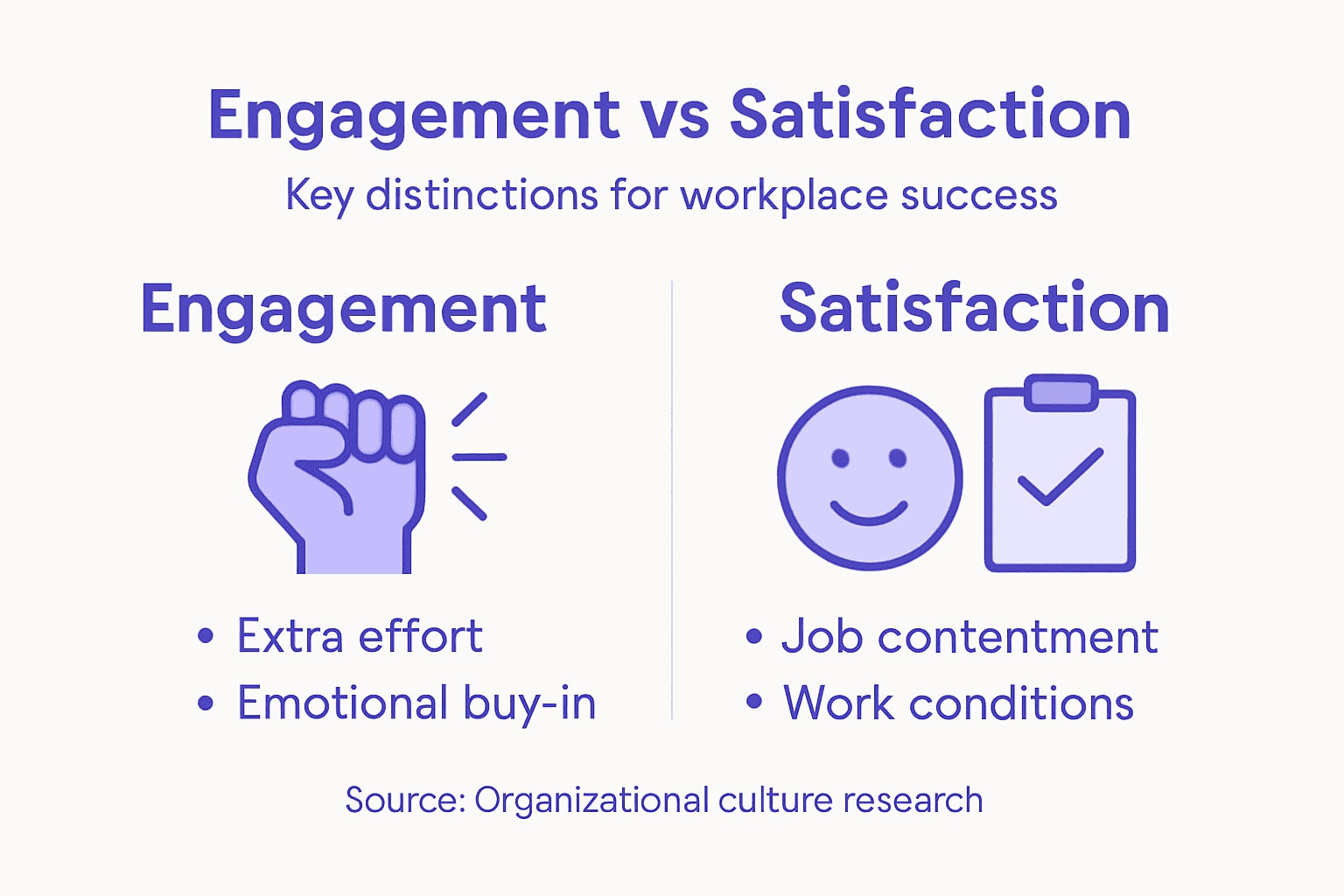
Employee engagement goes beyond mere contentment, representing a deeper, more complex psychological connection. Researchers characterize employee engagement as an emotional, cognitive, and physical involvement with work that transcends basic job satisfaction. It encompasses three key dimensions:
- Vigor: High energy and mental resilience while working
- Dedication: Strong involvement and enthusiasm for one’s work
- Absorption: Complete concentration and immersion in job tasks
In contrast, job satisfaction is fundamentally about an employee’s positive perception of their work environment and conditions. Evidence from organizational psychology research indicates that satisfaction is more passive – representing contentment with current job circumstances without necessarily driving proactive behaviours.
The critical distinction lies in the actionable outcomes. Engagement motivates employees to invest discretionary effort, go beyond basic job requirements, and contribute innovatively. Satisfaction, while important, might simply mean an employee feels reasonably comfortable in their current role without feeling compelled to excel.
Pro tip: Measure both engagement and satisfaction separately to gain comprehensive insights into your organizational culture and employee experience.
Here’s a concise comparison of employee engagement versus satisfaction in workplace psychology:
| Aspect | Employee Engagement | Employee Satisfaction |
|---|---|---|
| Psychological State | Active involvement and commitment | Passive contentment with job conditions |
| Behavioural Impact | Drives innovation and discretionary effort | Maintains current performance levels |
| Measurement Approach | Requires multidimensional assessment | Often based on basic workplace surveys |
| Influence on Culture | Cultivates adaptive and high-performance teams | Supports stable but less dynamic environments |
Key Drivers and Indicators of Both Concepts
Driving employee engagement and satisfaction requires a nuanced understanding of the multifaceted factors that influence workplace psychology. Research reveals complex interconnected drivers that impact both employee engagement and job satisfaction across organizational environments.
The key drivers can be categorized into two primary dimensions:
Intrinsic Drivers:
- Meaningful work
- Personal growth opportunities
- Professional development pathways
- Sense of purpose and autonomy
Extrinsic Drivers:
- Competitive compensation
- Recognition and rewards
- Fair performance evaluation
- Positive workplace environment
Leadership quality emerges as a critical factor in both engagement and satisfaction. Management research indicates that transformational leadership styles significantly enhance employee emotional connection and workplace commitment. Such leaders create environments that nurture psychological safety, encourage open communication, and provide clear pathways for professional advancement.
Indicators of robust engagement and satisfaction extend beyond traditional metrics. They encompass behavioural manifestations like reduced burnout, increased discretionary effort, and active organizational citizenship. Emotional indicators include feeling valued, experiencing workplace belonging, and maintaining positive psychological well-being.
Pro tip: Implement regular pulse surveys that separately measure engagement and satisfaction to identify precise intervention strategies.
Impact on Retention, Productivity, and Culture
Research demonstrates significant connections between employee engagement and organizational performance, revealing that engagement is not just a theoretical concept but a critical business driver. Engaged employees transform workplace dynamics, creating ripple effects across retention, productivity, and cultural health.

The impact manifests through multiple interconnected dimensions:
Retention Dynamics:
- Reduced voluntary turnover
- Lower recruitment costs
- Enhanced talent stability
- Sustained institutional knowledge
Productivity Outcomes:
- Increased discretionary effort
- Higher quality work outputs
- More innovative problem-solving
- Improved team collaboration
Organizational research confirms that employee engagement acts as a powerful mediator between job satisfaction and organizational commitment. Engaged employees don’t just perform tasks; they invest emotionally in organizational success, driving performance beyond traditional metrics.
Cultural transformation emerges as a profound consequence of genuine engagement. Organizations with high engagement levels experience more resilient, adaptive, and collaborative workplace environments. These cultures attract top talent, foster continuous learning, and create sustainable competitive advantages.
Pro tip: Develop holistic engagement strategies that align individual employee aspirations with organizational goals to maximise retention and performance.
Summary of how engagement and satisfaction link to key business outcomes:
| Business Outcome | Effect of Engagement | Effect of Satisfaction |
|---|---|---|
| Retention | Reduces turnover rates | Improves comfort, less impact on exit |
| Productivity | Boosts quality and innovation | Maintains basic output |
| Organisational Culture | Builds resilience and collaboration | Supports harmony, less transformation |
Practical Strategies to Balance Engagement and Satisfaction
Organizational research reveals strategic approaches for simultaneously addressing employee engagement and satisfaction, recognizing these are complementary yet distinct workplace dynamics that require nuanced management techniques.
Key Strategic Approaches Include:
Leadership and Communication Strategies:
- Implement transparent communication channels
- Develop transformational leadership programs
- Create regular feedback mechanisms
- Establish clear performance expectations
Personalization and Recognition Tactics:
- Design customized engagement initiatives
- Develop meaningful recognition programs
- Align organizational goals with individual aspirations
- Provide targeted professional development opportunities
Practical organizational research confirms that successful strategies integrate both emotional and structural elements. This means moving beyond traditional incentive structures to create holistic workplace experiences that simultaneously address psychological and practical employee needs.
Workforce customization emerges as a critical strategy. Different employee segments require tailored approaches that respect individual motivations, career stages, and personal values. Organizations must develop flexible frameworks that can adapt to diverse workforce expectations while maintaining consistent core engagement principles.
Pro tip: Conduct periodic employee sentiment assessments to continuously refine and personalize your engagement and satisfaction strategies.
Measuring and Linking Sentiment to Business KPIs
Comprehensive engagement measurement frameworks transform employee sentiment from abstract perceptions into actionable business intelligence. By systematically tracking psychological and behavioural indicators, organizations can directly correlate workforce sentiment with critical performance metrics.
Key Measurement Dimensions:
Emotional Indicators:
- Employee commitment levels
- Psychological safety scores
- Discretionary effort metrics
- Workplace motivation indices
Performance Correlation Points:
- Retention rates
- Productivity measures
- Customer satisfaction scores
- Innovation output
Evidence-based measurement practices demonstrate that robust analytics go beyond traditional survey approaches. Modern frameworks integrate sophisticated data collection methodologies that capture nuanced sentiment signals across multiple organizational touchpoints.
Successful sentiment measurement requires a holistic approach that bridges psychological assessment with tangible business outcomes. This means developing dynamic measurement tools that can capture real-time emotional states while simultaneously tracking their impact on operational performance.
Pro tip: Implement continuous feedback mechanisms that allow granular, privacy-preserving sentiment tracking across different organizational levels and employee segments.
Transform Employee Engagement and Satisfaction Into Powerful Business Results
The article highlights the crucial difference between employee engagement and satisfaction and the vital need for continuous, nuanced measurement to fuel cultural transformation and operational success. If you are struggling to capture the true emotional and behavioural drivers behind your workforce sentiment or want to connect these insights directly to key business outcomes such as retention and productivity, Wurkn offers exactly the solution you need.
Wurkn’s cultural business intelligence platform goes beyond static surveys by collecting always-on anonymous feedback within the tools your teams already use like Slack, Microsoft Teams, and HRIS systems. This means you can effortlessly measure engagement and satisfaction separately but simultaneously with rich emotional context and behavioural signals—allowing you to identify hidden issues early and unlock the discretionary effort that drives innovation and high performance.
Discover how Wurkn turns continuous employee sentiment into actionable cultural intelligence tied directly to your organisational KPIs. Visit Wurkn now to gain a real-time, trustworthy dashboard that empowers CXOs and PeopleOps teams to reduce churn, enhance team health, and build resilient workplace cultures aligned with your business goals. Don’t wait for disengagement to cost you—take control of your cultural health today with Wurkn.
Frequently Asked Questions
What is the difference between employee engagement and employee satisfaction?
Employee engagement refers to an employee’s emotional, cognitive, and physical involvement with their work, encompassing aspects like vigor, dedication, and absorption. In contrast, employee satisfaction is about an employee’s contentment with their work environment without necessarily involving proactive behaviors.
Why is employee engagement important for organizational culture?
Employee engagement fosters an adaptive, high-performance culture, encouraging innovation and discretionary effort. Engaged employees contribute significantly to positive organizational dynamics, enhancing retention, productivity, and overall workplace collaboration.
How can organizations improve both employee engagement and satisfaction?
Organizations can improve both by implementing transparent communication strategies, personalized recognition programs, and targeted professional development opportunities. Balancing emotional and structural factors is essential for meeting diverse employee needs.
What role does leadership play in employee engagement and satisfaction?
Leadership quality is critical in driving employee engagement and satisfaction. Transformational leaders create environments that promote psychological safety, open communication, and clarity in professional advancement pathways, significantly enhancing employees’ emotional connections to their work.
Recommended
- Boost Your Team with an Employee Satisfaction Index – Wurkn
- Creating a Positive Workplace Culture: Leadership’s Role – Wurkn
- People and Culture: A Guide to Driving Business Performance
- Positive Workplace Culture: Boosting Employee Engagement, Morale, and Revenue – Wurkn
- Talent Retention Strategies: Boost Engagement With Personality
- Employee Retention Solutions | Reduce Turnover | OpenElevator