
Corporate culture isn't just a buzzword; it's the invisible force that shapes how work gets done, how decisions are made, and how your people feel. Get it right, and you unlock innovation, loyalty, and high performance. Get it wrong, and you face high turnover, disengagement, and stagnant growth. Many leaders in the United States and Canada rely on annual surveys and anecdotal evidence, which provide a static, often outdated, picture of their organisation.
But what if you could see your culture as it happens? Business intelligence tools like Wurkn go beyond traditional employee engagement platforms and HR survey tools by capturing continuous, anonymous employee sentiment from communication channels like Slack and Microsoft Teams. This provides a real-time, living dashboard of your cultural health, turning qualitative feedback into actionable intelligence tied to business KPIs like retention and productivity. To cultivate a truly valuable corporate culture, understanding the importance of employee engagement training is paramount, as it equips leaders with the skills to foster a positive environment.
This article explores 10 distinct corporate culture examples, breaking down their core behaviours, key metrics, and common pitfalls. For each example, we'll analyse how a cultural business intelligence platform like Wurkn can help you not just identify your current culture, but intentionally shape it for measurable success. You will learn not just what these cultures look like, but how to build, measure, and sustain them using real-time data instead of guesswork. We will provide a strategic breakdown of specific tactics and replicable methods you can apply to your own organisation.
1. Purpose-Driven Culture
A purpose-driven culture is one where the organisation’s core mission extends beyond profit margins to address a meaningful societal or environmental goal. This approach frames daily tasks within a larger, inspiring narrative, which can significantly boost employee engagement, motivation, and retention. Unlike traditional corporate models, a purpose-driven culture aligns individual employee values with the company's overarching mission, creating a powerful sense of shared identity and commitment.
This is one of the most compelling corporate culture examples because it provides a "why" that fuels the "what" and "how" of business operations. For example, outdoor apparel company Patagonia places environmental activism at its centre, while eyewear brand Warby Parker is dedicated to vision accessibility. Their purpose isn't a marketing slogan; it's a core operational filter for decision-making, from supply chain choices to product development. This resonates strongly with talent in North America seeking meaningful work.
Strategic Breakdown & Implementation
Real Behaviours & Practices: Employees at all levels can articulate how their specific role contributes to the company's mission. Meetings often start by reconnecting the agenda to the core purpose. Hiring and performance reviews explicitly weigh a candidate's or employee's alignment with the company’s values and mission. For a deeper dive into establishing your company's core identity, explore these concrete 10 Actionable Company Values Examples to see how to define and implement a purpose-driven culture.
Measurable KPIs:
- Purpose Connection Score: Measured via pulse surveys, asking employees how strongly they feel their work contributes to the mission.
- Values-Aligned Hires: Percentage of new hires who cite company purpose as a primary reason for joining.
- Mission-Driven Innovation: Number of new projects or features directly linked to advancing the core purpose.
Common Pitfalls: A major risk is "purpose-washing," where the stated mission is disconnected from actual business practices. This creates cynicism and disengagement. Another pitfall is a failure to translate a high-level purpose into concrete, role-specific actions, leaving employees unsure of their impact.
How Wurkn Helps: A purpose-driven culture thrives on authentic alignment. Wurkn’s continuous, anonymized feedback can detect gaps between the stated mission and employees' lived experiences. By analyzing sentiment and keyword trends related to "purpose," "mission," and "impact," leadership can identify teams or departments where the connection to the company’s purpose is weak and intervene before it damages morale and productivity. This is the business intelligence that static surveys miss.
2. Transparency, Trust, and Psychological Safety Culture
A culture of transparency, trust, and psychological safety is built on open communication, accessible information, and the freedom for employees to speak up without fear of reprisal. This environment dismantles information silos, accelerates decision-making, and encourages candid feedback. Instead of operating with caution, teams can take calculated risks, admit mistakes, and challenge the status quo, which are essential ingredients for innovation and resilience.
This is one of the most foundational corporate culture examples because trust is the currency of high-performing teams. A well-known study from Google, "Project Aristotle," identified psychological safety as the top predictor of team success (Edmondson, A. C., & Lei, Z. 2014, Annual Review of Organizational Psychology and Organizational Behavior). The core principle is that safety and honesty are not soft perks; they are hard requirements for sustainable performance and agility, especially in remote and hybrid settings common across the US and Canada.
Strategic Breakdown & Implementation
Real Behaviours & Practices: Leaders openly share both successes and failures, modelling vulnerability. Meetings include dedicated time for dissenting opinions, and feedback is given and received constructively, often using frameworks like Radical Candor. Information, from financial metrics to strategic shifts, is proactively shared rather than guarded. Managers are trained to respond non-defensively to criticism and actively solicit team input.
Measurable KPIs:
- Psychological Safety Index: Measured via anonymous pulse surveys with questions based on Amy Edmondson’s research, like "Can you bring up problems and tough issues?".
- Feedback Velocity: The number of feedback instances (upward, downward, peer-to-peer) logged per employee per quarter.
- Idea Contribution Rate: Percentage of employees who have submitted a new idea or critical feedback through official channels.
Common Pitfalls: A primary failure is demanding transparency from employees without demonstrating it from leadership first. Another is creating feedback channels but failing to act on the information received, which erodes trust faster than having no channel at all. Finally, confusing radical transparency with a lack of kindness can create a harsh, overly critical environment that damages psychological safety.
How Wurkn Helps: Trust is fragile and difficult to measure with traditional annual surveys. Wurkn’s continuous, anonymous feedback provides a real-time barometer of psychological safety. By using sentiment analysis to detect keywords related to "fear," "retaliation," or "unsafe," leaders can pinpoint specific teams or managers where trust is breaking down. This transforms Wurkn from a simple survey tool into a business intelligence platform that proactively identifies and helps mitigate the cultural risks that undermine performance.
3. Inclusive and Diverse Culture
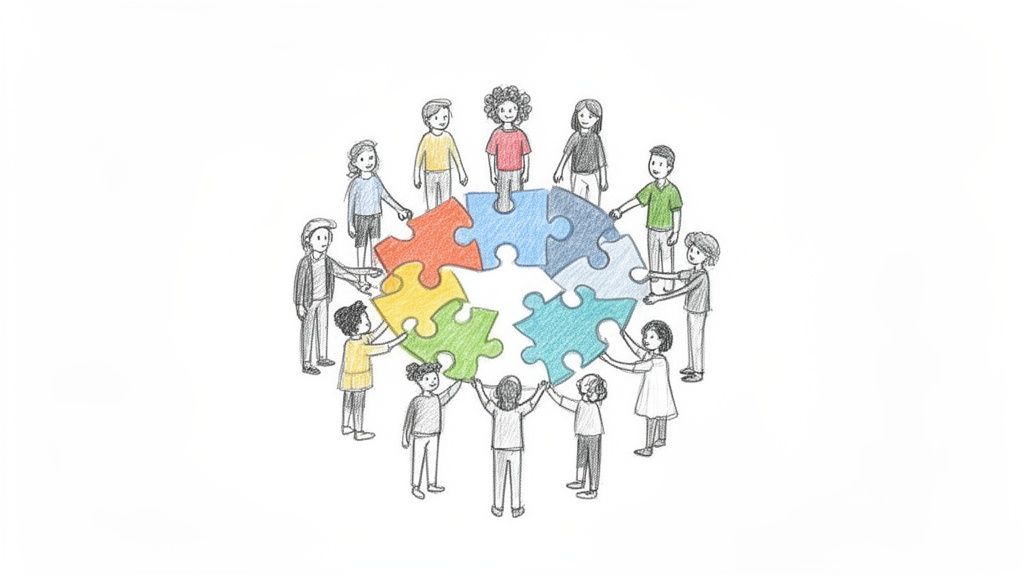
An inclusive and diverse culture is one that intentionally fosters representation, equity, and a deep sense of belonging for every employee, regardless of their background, identity, or perspective. It moves beyond simple demographic quotas to build an environment where diverse voices are actively sought, heard, and valued. This approach unlocks innovation, strengthens decision-making, and significantly broadens the available talent pool in competitive markets like the United States and Canada.
This is one of the most critical corporate culture examples for modern organisations because it directly impacts both ethical standing and business performance. Research consistently shows that diverse teams are more innovative (McKinsey & Company, 2020, Diversity wins: How inclusion matters). Companies that lead in this area weave inclusion into core business practices, such as product design that considers accessibility from the start, rather than treating it as an isolated HR initiative.
Strategic Breakdown & Implementation
Real Behaviours & Practices: Leadership actively sponsors and funds Employee Resource Groups (ERGs). Meetings have established protocols to ensure all participants have a chance to speak. Job descriptions are reviewed for biased language, and interview panels are intentionally diverse. For a deeper understanding of building these foundational elements, explore these key strategies for improving diversity in the workplace and fostering a culture of belonging.
Measurable KPIs:
- Inclusion Index Score: Measured via pulse surveys with questions targeting belonging, psychological safety, and equity across different demographic groups.
- Promotion Rate Parity: Tracking promotion rates to ensure they are equitable across gender, race, and other identity markers.
- Representation at All Levels: Percentage of underrepresented groups in leadership positions, not just entry-level roles.
Common Pitfalls: A frequent failure is "tokenism," where diversity is pursued for appearances without genuine inclusion, leading to isolation and high turnover among underrepresented staff. Another pitfall is focusing solely on hiring metrics while ignoring the internal systems and microaggressions that prevent diverse talent from thriving and advancing.
How Wurkn Helps: An inclusive culture depends on understanding the nuanced experiences of different employee populations. Wurkn provides the business intelligence to move beyond simple engagement scores. By analyzing anonymized feedback and sentiment across demographic segments, leaders can pinpoint exactly which groups feel excluded or unheard, identify hidden biases in processes, and measure the real impact of DEI initiatives before they show up in turnover statistics.
4. Continuous Learning and Development Culture
A continuous learning and development culture is an organisational environment where skill acquisition, knowledge sharing, and a growth mindset are actively prioritised and integrated into daily operations. This culture treats learning not as a sporadic event but as an ongoing strategic imperative, fuelling adaptability and innovation. Organisations that successfully foster this environment adapt faster to market changes, improve retention of top talent, and build robust internal career pathways.
This is one of the most powerful corporate culture examples because it directly links individual growth to organisational success. Microsoft, under Satya Nadella's push for a "learn-it-all" versus a "know-it-all" mindset, demonstrates how embedding learning into the workflow creates a more resilient and forward-thinking workforce. This culture shifts the focus from static job descriptions to dynamic skill sets, preparing the organisation for future challenges in fast-moving North American markets.
Strategic Breakdown & Implementation
Real Behaviours & Practices: Managers regularly discuss development goals in one-on-ones, not just during annual reviews. The company provides and promotes access to diverse learning resources, from online courses to peer-led workshops. "Failing forward" is celebrated as a learning opportunity, and employees are encouraged to share knowledge through internal wikis, lunch-and-learns, and mentorship programmes.
Measurable KPIs:
- Learning Engagement Rate: Percentage of employees actively participating in learning programmes or utilising provided resources per quarter.
- Internal Mobility Rate: Percentage of open positions filled by internal candidates, indicating successful skill development.
- Skill Gap Reduction: Measured through pre- and post-training assessments or employee self-reported confidence scores on key competencies.
Common Pitfalls: A primary pitfall is offering learning resources without creating the time and psychological safety for employees to use them. Another risk is a disconnect between available training and actual career progression, making development feel pointless. Finally, a one-size-fits-all approach that ignores different learning styles can lead to low engagement and wasted investment.
How Wurkn Helps: A learning culture requires understanding where skill gaps exist and whether employees feel supported. Wurkn moves beyond simple engagement surveys to provide business intelligence on your learning ecosystem. By analysing anonymized feedback for themes like "career growth," "training," and "manager support," leaders can pinpoint which teams feel stagnant or which learning initiatives are failing to resonate. This allows for targeted interventions, ensuring that your L&D investments directly address employee needs and drive tangible business outcomes.
5. Remote and Hybrid-First Culture
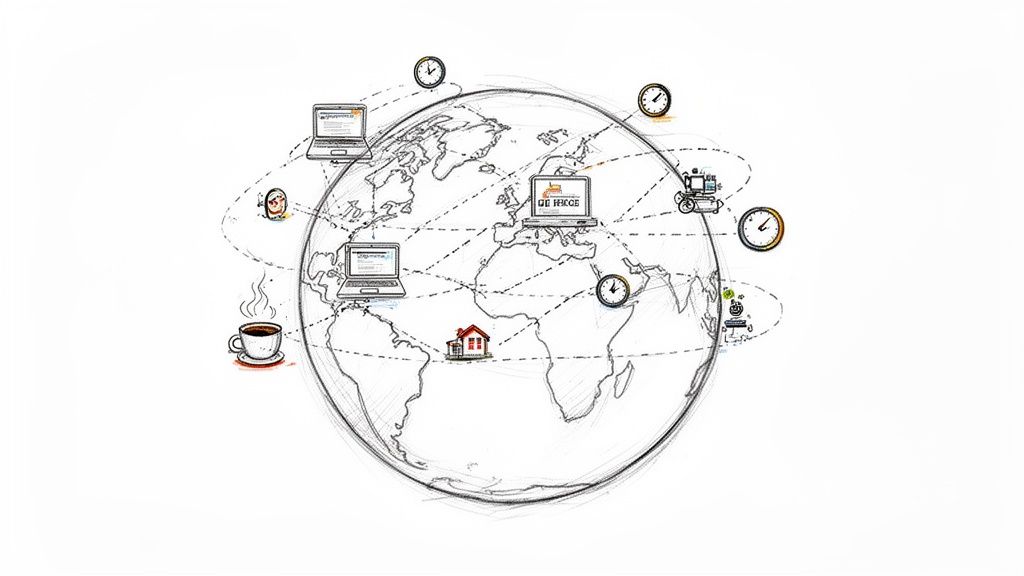
A remote or hybrid-first culture is intentionally designed for distributed teams, prioritising asynchronous communication, documentation, and trust over physical presence. It fundamentally rethinks how work gets done, moving away from office-centric norms to create an inclusive and effective environment for employees, regardless of their location. This model requires a deliberate shift in practices to maintain cohesion and productivity without the traditional oversight of an in-person office.
This is one of the most relevant corporate culture examples today because it directly addresses the modern workforce's demand for flexibility in the United States and Canada. Companies like GitLab and Automattic are pioneers, proving that exceptional work and a strong culture can thrive without a central headquarters. Their success lies in treating remote work not as a temporary perk, but as the core operating system for the entire organisation.
Strategic Breakdown & Implementation
Real Behaviours & Practices: Communication defaults to asynchronous channels like shared documents and project management tools, with synchronous meetings used intentionally for collaboration, not status updates. The organisation maintains a detailed and accessible handbook or internal wiki as the single source of truth. Performance is measured by output and results, not hours spent online, fostering a culture of autonomy and trust.
Measurable KPIs:
- Employee Connection Score: Survey data tracking feelings of belonging and connection to colleagues, segmented by location (remote vs. in-office).
- Documentation Quality: Percentage of key processes and decisions documented and accessible in the central knowledge base.
- Time Zone Inclusivity: Measure participation rates in important meetings and feedback sessions across different time zones to ensure equity.
Common Pitfalls: A primary pitfall is creating a two-tiered system where in-office employees have greater visibility and access to opportunities than remote colleagues. Another risk is employee isolation and burnout from a lack of clear boundaries between work and home life. Failing to shift from synchronous to asynchronous communication can lead to meeting fatigue and exclusion of those in different time zones.
How Wurkn Helps: In a distributed environment, understanding the employee experience is critical. Wurkn provides the business intelligence needed to monitor the pulse of a remote or hybrid culture. By analysing anonymized feedback, leadership can proactively identify pockets of isolation, communication breakdowns, or perceived inequities between in-office and remote teams. This allows for targeted interventions, ensuring the culture remains connected and inclusive, regardless of physical distance.
6. Customer-Centric Culture
A customer-centric culture is one where every decision, process, and employee action is oriented around delivering an exceptional customer experience. This model places the customer at the absolute centre of the business ecosystem, believing that long-term profitability and growth are direct results of customer loyalty and satisfaction. It goes beyond mere customer service by embedding a deep, organisation-wide empathy for the customer journey.
This is one of the most impactful corporate culture examples because it creates a clear, unifying purpose that is easily understood and measured. Companies renowned for this approach, like Amazon with its "customer obsession" leadership principle and Zappos with its legendary service-as-a-brand model, prove that a relentless focus on the customer builds an unshakeable competitive advantage. In these organisations, customer needs aren't just a consideration; they are the primary driver of strategy and innovation.
Strategic Breakdown & Implementation
Real Behaviours & Practices: All-hands meetings regularly feature customer success stories or direct feedback. Non-customer-facing roles, like developers or accountants, are given opportunities to interact with customers to build empathy. Frontline employees are empowered with the autonomy and resources to resolve customer issues on the spot, without needing multiple levels of approval.
Measurable KPIs:
- Net Promoter Score (NPS) / Customer Satisfaction (CSAT): Tracked consistently and tied to team or company goals.
- Customer Lifetime Value (CLV): Measures the total revenue a business can expect from a single customer account.
- Employee-Customer Focus Alignment: Measured in pulse surveys with questions like, "I have the tools and authority to meet customer needs effectively."
Common Pitfalls: A major risk is creating a culture where employees feel devalued in the name of "the customer is always right," leading to burnout. Another pitfall is collecting customer feedback but failing to act on it, which creates cynicism both internally and externally. It's also crucial to avoid focusing solely on vocal customers, which can skew product development away from the needs of the silent majority.
How Wurkn Helps: A true customer-centric culture requires that employees feel equipped and motivated to serve customers well. Wurkn’s business intelligence platform can cross-reference employee sentiment data with customer satisfaction metrics like NPS. By analyzing feedback trends, Wurkn can pinpoint operational bottlenecks or internal policy issues that are preventing employees from delivering excellent service, revealing the root causes of customer dissatisfaction before they impact revenue.
7. Agile and Adaptive Culture
An agile and adaptive culture is organised around rapid iteration, continuous learning, and the ability to pivot quickly in response to market changes or internal feedback. This model prioritises flexibility and speed over rigid, hierarchical processes. It empowers small, cross-functional teams to make decisions and experiment, fostering an environment where change is not just managed but embraced as an opportunity for growth.
This is one of the most dynamic corporate culture examples because it institutionalises responsiveness. Instead of long-term, fixed plans, work is broken into short sprints with built-in feedback loops. Companies like Spotify, with its famous squad-based model, and Amazon, with its "two-pizza teams" and "Day 1" philosophy, exemplify this culture. Their success stems from a structure that treats business operations as a series of experiments designed for continuous improvement.
Strategic Breakdown & Implementation
Real Behaviours & Practices: Teams regularly conduct retrospectives to openly discuss what worked, what didn't, and what to improve. Decision-making frameworks are clear, allowing for rapid, decentralised choices. Leadership celebrates the learnings from failed experiments, removing the fear associated with taking calculated risks. This approach treats feedback not as a formal event but as a constant, integrated part of every process.
Measurable KPIs:
- Iteration Velocity: The speed at which teams can move a project from idea to launch or revision.
- Change Adoption Rate: How quickly new processes or technologies are adopted across the organisation, measured via usage data and employee surveys.
- Employee Agility Score: Survey questions asking employees to rate the organisation's ability to respond to change and their team's autonomy.
Common Pitfalls: A primary risk is "change fatigue," where the constant pace of iteration leads to employee burnout. Another pitfall is a lack of documentation or process coherence, creating chaos rather than organised agility. Without clear decision-making authority, "empowered" teams can become paralysed or create organisational friction.
How Wurkn Helps: An agile culture lives or dies by the quality of its feedback loops. Wurkn acts as a continuous organisational sensor, moving beyond traditional survey tools to provide real-time business intelligence. By tracking sentiment related to "pace," "burnout," and "bottlenecks," leaders can proactively identify teams struggling with change fatigue. Wurkn’s analysis can pinpoint friction points in cross-functional collaboration, helping leadership refine processes to maintain momentum without overwhelming employees.
8. Wellness and Work-Life Balance Culture
A wellness and work-life balance culture explicitly prioritises employee physical health, mental wellbeing, and personal time as core organisational values. This approach moves beyond occasional perks to systemically embed support for employee health into daily operations, policies, and leadership behaviours. It's built on the understanding that rested, healthy, and fulfilled employees are more engaged, innovative, and productive.
This model is one of the most vital corporate culture examples today because it directly combats the rising tide of burnout seen across Canada and the US. Companies that champion this culture, with its emphasis on mental health support and flexible, family-friendly policies, demonstrate that investing in employee wellbeing is a strategic advantage. This culture is not just about offering gym memberships; it's about creating an environment where employees feel empowered to set boundaries and care for themselves without career penalty.
Strategic Breakdown & Implementation
Real Behaviours & Practices: Leaders model healthy work-life boundaries by logging off at reasonable hours and taking their full vacation time. Meetings have clear agendas and end on time to respect schedules. The organisation actively promotes mental health resources, and flexible work arrangements are the norm, not a rare exception. Managers are trained to spot signs of burnout and are equipped to discuss workload, not just output. To build a robust framework, consider exploring the various worksite wellness programs that can form the foundation of your strategy.
Measurable KPIs:
- Burnout Sentiment Score: Tracked through pulse surveys with keywords like "overwhelmed," "stressed," and "exhausted."
- Wellness Program Utilisation: Percentage of employees actively using company-provided wellness benefits (e.g., EAP, mental health apps).
- Vacation Usage Rate: Percentage of paid time off actually taken by employees, aiming for high utilisation across the board.
Common Pitfalls: A significant pitfall is offering wellness "solutions" (like yoga classes) without addressing the systemic causes of stress, such as excessive workloads or toxic management. This can feel disingenuous. Another risk is a one-size-fits-all approach that ignores the diverse wellness needs of the employee population.
How Wurkn Helps: A wellness culture dies when stated values don't match reality. Wurkn’s continuous, anonymized feedback acts as an early warning system for burnout. By analysing sentiment trends related to "workload," "balance," and "stress," Wurkn provides business intelligence that connects these human metrics to operational patterns. This allows leaders to see precisely which teams are overworked and address the root cause, rather than just treating the symptoms.
9. Accountability and Ownership Culture
An accountability and ownership culture is one where employees are empowered with clear responsibility for their outcomes and feel a deep sense of personal investment in their work. This model shifts the focus from simply completing tasks to achieving results, giving individuals the authority to make decisions and the expectation to answer for their performance. It fosters a proactive, solution-oriented mindset across the entire organisation.
This is one of the most powerful corporate culture examples for driving high performance, as it directly links individual effort to organisational success. Netflix champions this with their "freedom and responsibility" philosophy, where high accountability is the trade-off for significant autonomy (McCord, P., 2014, Harvard Business Review). Similarly, Amazon's leadership principle of "Ownership" encourages employees to act like long-term owners, never saying "that's not my job."
Strategic Breakdown & Implementation
Real Behaviours & Practices: Teams conduct transparent "after-action reviews" to analyse outcomes without blame, focusing on learnings. Job descriptions clearly define success metrics and decision-making authority. Employees at all levels are encouraged to take initiative and are celebrated for it, even if the attempt doesn't succeed. Goal-setting frameworks like OKRs (Objectives and Key Results) are used to create clear, measurable targets that cascade throughout the organisation.
Measurable KPIs:
- Goal Attainment Rate: Percentage of key results and project goals successfully met per quarter.
- Clarity of Responsibility Score: Survey metric asking employees to rate their clarity on who is accountable for key team deliverables.
- Employee Initiative Index: Number of employee-initiated projects or process improvements implemented.
Common Pitfalls: A primary risk is creating a blame culture if accountability is not paired with psychological safety. Without clear expectations and the proper resources, employees can feel set up for failure. Another pitfall is "accountability theatre," where people are held responsible for outcomes they have no real control over, leading to frustration and burnout.
How Wurkn Helps: An effective accountability culture requires a balance of high expectations and genuine support. Wurkn provides the business intelligence to monitor this balance. By analysing anonymized feedback, leadership can identify if accountability is perceived as fair and empowering or as punitive. It can pinpoint specific teams where role clarity is low or where a lack of resources is preventing employees from taking true ownership, allowing for targeted interventions before performance suffers.
10. Collaborative and Team-Focused Culture
A collaborative and team-focused culture prioritises collective success, shared problem-solving, and strong interpersonal bonds over individual achievement. This model is built on the principle that diverse teams working together can produce more innovative and effective outcomes than individuals working in isolation. It fosters an environment of trust, open communication, and mutual respect, where every member feels valued and empowered to contribute.
This is one of the most powerful corporate culture examples because it directly addresses the complex, cross-functional challenges modern businesses face. Companies like Pixar, with its famous "Braintrust" feedback sessions, and Southwest Airlines, renowned for its team-oriented customer service, exemplify this culture. In these organisations, success is a shared victory, and failures are collective learning opportunities, not a reason for individual blame. This approach organises work around group synergy rather than a hierarchy of individual contributors.
Strategic Breakdown & Implementation
Real Behaviours & Practices: Cross-functional teams are the default structure for major projects. Meetings are designed to facilitate open dialogue and constructive debate, not just top-down reporting. Peer-to-peer recognition programs are prominent, celebrating team wins and helpful contributions. Leaders actively model collaborative behaviour by seeking input from their teams before making key decisions and openly sharing credit for successes.
Measurable KPIs:
- Cross-Functional Project Success Rate: Percentage of projects involving multiple departments that meet or exceed their goals.
- Team Cohesion Score: Measured through surveys asking employees about trust, communication, and their sense of belonging within their immediate team.
- Network Analysis Metrics: Data showing the frequency and quality of interactions between different teams and departments, identifying potential silos.
Common Pitfalls: A key risk is "groupthink," where the desire for harmony suppresses dissent and critical analysis, leading to poor decisions. Another pitfall is uneven participation, where a few dominant voices overshadow others, or remote employees feel excluded from collaborative processes. Without clear roles and accountability, teamwork can also devolve into disorganisation and social loafing.
How Wurkn Helps: A truly collaborative culture depends on psychological safety and effective team dynamics. Wurkn’s business intelligence provides a continuous, real-time view of these dynamics. By analysing anonymized feedback for themes related to "teamwork," "support," and "silos," leaders can pinpoint specific teams struggling with trust or communication. This allows for targeted interventions, such as team-building workshops or process adjustments, to resolve friction and enhance collaborative effectiveness before it impacts performance.
10 Corporate Culture Types Compared
| Culture Type | 🔄 Implementation Complexity | ⚡ Resources & Time | 📊 Expected Outcomes | 💡 Ideal Use Cases | ⭐ Key Advantages |
|---|---|---|---|---|---|
| Purpose-Driven Culture | 🔄 Medium–High — sustained leadership alignment | ⚡ Medium — comms, measurement, time to embed | 📊 Strong engagement & retention (≈20–30% uplift); stronger employer brand | 💡 Organizations seeking mission differentiation or values-driven recruitment | ⭐ Deeper motivation, consistent decision-making, attracts mission-aligned talent |
| Transparency, Trust & Psychological Safety | 🔄 High — behavioral change, manager training, accountability | ⚡ Medium–High — feedback systems, open-data practices; 6–12+ months to mature | 📊 Faster problem detection, higher candor, increased innovation and safety | 💡 Remote/hybrid teams, knowledge work, risk-sensitive environments | ⭐ Improved trust, faster resolution, better learning from failure |
| Inclusive & Diverse Culture | 🔄 High — systemic policy and process changes | ⚡ High — hiring programs, pay audits, ERGs, long-term investment | 📊 Increased innovation (~19%), better decision quality, broader talent pool | 💡 Organizations seeking market representation, diverse perspectives, fairness | ⭐ Greater innovation, retention, reputation, reduced groupthink |
| Continuous Learning & Development | 🔄 Medium — program design, learning pathways | ⚡ High — budgets, time allocation, mentorship, platform costs | 📊 Improved retention, internal mobility, faster upskilling and adaptability | 💡 Fast-changing industries, tech firms, companies needing internal talent growth | ⭐ Builds resilience, reduces external hiring costs, fosters growth mindset |
| Remote & Hybrid-First Culture | 🔄 Medium — new norms, documentation, async practices | ⚡ Medium — digital tools, stipends, deliberate rituals; tech-reliant | 📊 Access to global talent, increased flexibility and focused productivity | 💡 Distributed workforces, global hiring, roles not tied to location | ⭐ Scalability, inclusivity, lower real-estate overhead |
| Customer-Centric Culture | 🔄 Medium — feedback loops and cross-functional alignment | ⚡ Medium — research, CS empowerment, measurement systems | 📊 Higher NPS, revenue uplift, reduced churn, clearer product priorities | 💡 Product/service businesses prioritizing retention and growth | ⭐ Better customer loyalty, focused innovation, aligned priorities |
| Agile & Adaptive Culture | 🔄 Medium–High — structural changes, continuous rituals | ⚡ Medium — training, tooling, cross-functional teams; risk of fatigue | 📊 Faster market response, higher iteration speed, reduced time-to-value | 💡 Startups, product teams, fast-moving markets requiring pivotability | ⭐ Rapid learning, improved product-market fit, empowered teams |
| Wellness & Work-Life Balance | 🔄 Medium — policy shifts and leadership modeling | ⚡ Medium–High — programs, stipends, time-off policies, monitoring | 📊 Reduced burnout, improved retention, better productivity and morale | 💡 High-stress industries, firms focused on retention and wellbeing | ⭐ Lower absenteeism, higher satisfaction, long-term health gains |
| Accountability & Ownership | 🔄 Medium–High — clarity of roles, consequences, goal systems | ⚡ Medium — goal tracking, performance frameworks, feedback cadence | 📊 Improved execution, faster decisions, higher goal attainment | 💡 Results-driven organizations, scaling companies, high-autonomy teams | ⭐ Clear responsibility, faster execution, fair consequence structures |
| Collaborative & Team-Focused | 🔄 Medium — structures and rituals for cross-team work | ⚡ Medium — collaboration tools, team incentives, coordination effort | 📊 Better innovation, fewer silos, stronger belonging and resilience | 💡 Creative agencies, design orgs, projects needing cross-functional input | ⭐ Enhanced problem-solving, stronger team bonds, collective ownership |
From Examples to Action: Building a Culture That Drives Results
We have journeyed through a diverse landscape of ten distinct corporate culture examples, from purpose-driven ethos to agile and adaptive frameworks that power modern tech giants. Each model, whether it prioritizes psychological safety, customer-centricity, or remote-first operations, offers a unique blueprint for organizational success. The common thread weaving them together is not a specific set of perks or policies, but a deliberate, strategic alignment between a company's values, behaviours, and business objectives.
The critical insight is that culture is not a passive outcome; it is an active, dynamic system. The examples detailed in this article—like fostering a wellness-focused environment or building a culture of radical accountability—demonstrate that exceptional workplaces are meticulously designed and continuously nurtured. They are the result of intentional leadership, clear communication, and consistent reinforcement of desired behaviours at every level of the organization.
The Shift from Theory to Strategic Implementation
Understanding these different cultural archetypes is the essential first step. However, the real transformation begins when you move from appreciation to application. The most significant takeaway for any leader in Canada or the US is that there is no one-size-fits-all solution. The "best" culture is the one that authentically reflects your company's mission and provides the specific environment your team needs to execute its strategic goals.
A collaborative, team-focused culture might be perfect for a creative agency, but a performance-driven, accountability-focused model may be better suited for a competitive sales organization. The key is to diagnose your current state, define your target state, and build a strategic bridge between the two. This involves more than just writing new value statements; it requires re-engineering processes, rethinking reward systems, and empowering managers to become culture champions.
Why Continuous Measurement is Non-Negotiable
The fatal flaw in many cultural initiatives is the reliance on outdated measurement tools. A single, annual engagement survey provides a snapshot in time, a historical photograph of a reality that has already changed. It can't capture the subtle, day-to-day erosion of trust, the creeping signs of burnout in a key department, or the real-time impact of a new inclusive hiring practice. It tells you where you were, not where you are or where you are going.
To truly manage culture as a strategic asset, you need a system that operates at the speed of your business. This is where the concept of cultural business intelligence becomes paramount. By leveraging a platform like Wurkn that provides continuous, anonymized listening, you can access a live dashboard of your organization's health. You can:
- Detect Early Warning Signs: Identify pockets of low psychological safety or declining team collaboration before they escalate into retention crises.
- Measure Initiative ROI: See the tangible impact of a new learning and development program on employee sentiment and skill confidence in real-time.
- Connect Culture to KPIs: Correlate data on employee wellness and work-life balance with productivity and absenteeism metrics, proving the business case for people-first policies.
Ultimately, the powerful corporate culture examples we've explored are not just aspirational stories; they are evidence of what's possible when leaders treat culture with the same rigour and data-driven focus as finance or operations. By moving beyond reactive problem-solving and embracing a proactive, intelligence-led approach, you can stop guessing what your people need and start building a workplace where both your employees and your business can achieve their full potential.
Ready to move from static surveys to real-time cultural intelligence? See how Wurkn transforms anonymous employee feedback into a strategic dashboard, helping you diagnose issues, measure impact, and build a culture that drives measurable business results. Explore the Wurkn platform to see how it provides the business intelligence needed to operationalize the corporate culture examples discussed today.
Leave a Reply