

Many tech leaders focus on annual surveys and perks, but those are only a fraction of what shapes the true Employee Experience. The complete journey from recruitment to exit, every interaction and system, impacts how talent feels and performs. Recognizing Employee Experience as a strategic priority shaped by evolving work dynamics enables C-suite executives to move past outdated HR assumptions and create workplaces where people thrive and business outcomes improve.
Table of Contents
- Defining Employee Experience And Misconceptions
- Stages Of The Employee Life Cycle
- Key Drivers And Sentiment Capture Methods
- Privacy, Anonymity, And Trust In Feedback Systems
- Connecting Cultural Signals To Business Kpis
Key Takeaways
| Point | Details |
|---|---|
| Understanding Employee Experience | Employee Experience (EX) encompasses the entire journey an employee has with an organisation, going beyond mere satisfaction or engagement. It is a strategic priority that influences retention and business success. |
| Continuous Improvement | Treating EX as a one-time initiative is a misconception; it requires ongoing attention to various touchpoints throughout the employee life cycle. |
| Linking Culture to Business Outcomes | Cultural signals directly correlate with business performance, making it crucial to connect employee sentiment data with key performance indicators. |
| Focus on Trust and Anonymity | Establishing trust in feedback systems is essential; employees must feel safe to share honest insights for effective culture management. |
Defining Employee Experience and Misconceptions
Employee Experience (EX) is often confused with employee satisfaction or engagement, but it represents something fundamentally different. Employee Experience encompasses the entire emotional and functional journey an employee has with your organisation, from recruitment through to exit. It’s not a single metric or annual survey result—it’s the continuous accumulation of interactions, systems, and cultural moments that shape how people feel about working at your company.
Many organisations treat EX as an HR department function. That’s the first major misconception. EX sits at the intersection of strategy, operations, and culture. C-suite leaders need to recognise that Employee Experience functions as a strategic priority shaped by evolving work dynamics, not a box to tick in an annual survey cycle.
What Employee Experience Actually Includes
EX extends across multiple touchpoints your employees experience daily:
- Physical and digital workspace design that enables productivity and collaboration
- Technology systems that reduce friction rather than create it
- Manager relationships and the quality of direct communication
- Career development pathways that feel clear and attainable
- Flexibility and autonomy in how work gets completed
- Belonging and psychological safety within team environments
Each of these elements contributes to the overall experience. An employee might have an excellent manager but feel trapped by clunky systems. Another might love their team but see no growth opportunities. Your role is understanding which dimensions matter most to your workforce and addressing them systematically.
Common Misconceptions That Cost You Talent
The biggest misconception is treating EX as a onetime initiative. You plan a redesign, run a one-off survey, celebrate improvements, then move on. Your employees know better. They experience your culture every single day—every meeting, every Slack message, every policy change.
Another costly misunderstanding: confusing EX with benefits packages or perks. Unlimited coffee and a ping-pong table don’t move the needle on experience. What matters is whether your infrastructure supports people to do their best work, whether they feel heard when providing feedback, and whether they see a future worth staying for.
A third trap: measuring only what’s easy to measure. An eNPS score alone doesn’t capture the full picture of company culture—it’s a snapshot, not the complete story. Real insight requires understanding the why behind the numbers: what’s driving engagement changes, where tensions exist, and which cultural signals predict retention or performance issues.
Employee Experience isn’t about making everyone happy—it’s about creating conditions where talented people can thrive, contribute meaningfully, and stay with your organisation.
The most overlooked misconception: assuming EX is separate from business outcomes. Improved Employee Experience directly correlates with business success and revenue growth. When your people experience frictionless systems, feel valued, and have clarity on expectations, productivity increases, turnover decreases, and recruitment becomes easier.
Pro tip: Start mapping your employee journey from hire to exit using real data about pain points rather than assumptions—most organisations discover their biggest EX investments aren’t where they thought they were needed.
Stages of the Employee Life Cycle
The employee life cycle represents the entire journey your talent takes within your organisation. Understanding each stage allows you to optimise the experience at critical moments—moments that directly affect retention, productivity, and your ability to attract top talent. The employee life cycle framework encompasses distinct stages from attraction through separation, each requiring tailored strategies and attention.

Most organisations focus heavily on recruitment and onboarding, then treat the remaining years as a single, undifferentiated period. That’s a missed opportunity. Each stage carries unique challenges, expectations, and friction points that shape whether people stay or leave.
The Seven Critical Stages
Think of the employee life cycle as seven distinct chapters, not a single narrative:
-
Attraction – You’re competing for attention before someone even applies. Your employer brand, job postings, and company reputation matter more than you think.
-
Recruitment – The interview process reveals your culture and values to candidates. Slow processes, poor communication, and bureaucracy send signals you don’t respect their time.
-
Onboarding – Those first 90 days determine whether someone becomes a thriving contributor or a frustrated newcomer. Unclear expectations and missing context derail even talented people.
-
Retention – Beyond the honeymoon period, people stay when they feel valued, see growth, and experience psychological safety with their manager.
-
Development – Career growth isn’t optional for high performers. Lack of development pathways is among the top reasons people leave.
-
Offboarding – How you treat departing employees shapes your reputation and whether they become advocates or critics.
-
Happy Leavers – The best scenario: people who leave on good terms, maintain connections, and potentially return as alumni or referral sources.
Where Most Organisations Stumble
Investment is rarely proportional to impact. You might spend heavily on recruitment but provide minimal support to managers during retention. Or you create fantastic onboarding but ignore career development signals two years in.
The real issue: treating these stages in isolation rather than as a connected ecosystem. A retention problem often signals recruitment mistakes or onboarding failures catching up with you.
Each stage of the employee life cycle offers a chance to strengthen belonging, clarity, and motivation—or to create friction that accumulates and leads to departures.
C-suite leaders need visibility into all seven stages simultaneously. Where are your biggest drop-offs? Which stages predict longer tenure? Where do high performers experience the most frustration?
Pro tip: Map your current employee data across all seven life cycle stages—you’ll likely find your retention crisis actually originates in recruitment quality or onboarding clarity, not in retention efforts themselves.
Key Drivers and Sentiment Capture Methods
Employee sentiment doesn’t emerge randomly. It’s rooted in specific, measurable drivers that influence how people feel about their work, their leaders, and their future with your organisation. Understanding which drivers matter most—and capturing sentiment accurately—separates organisations that retain talent from those bleeding people out the door.
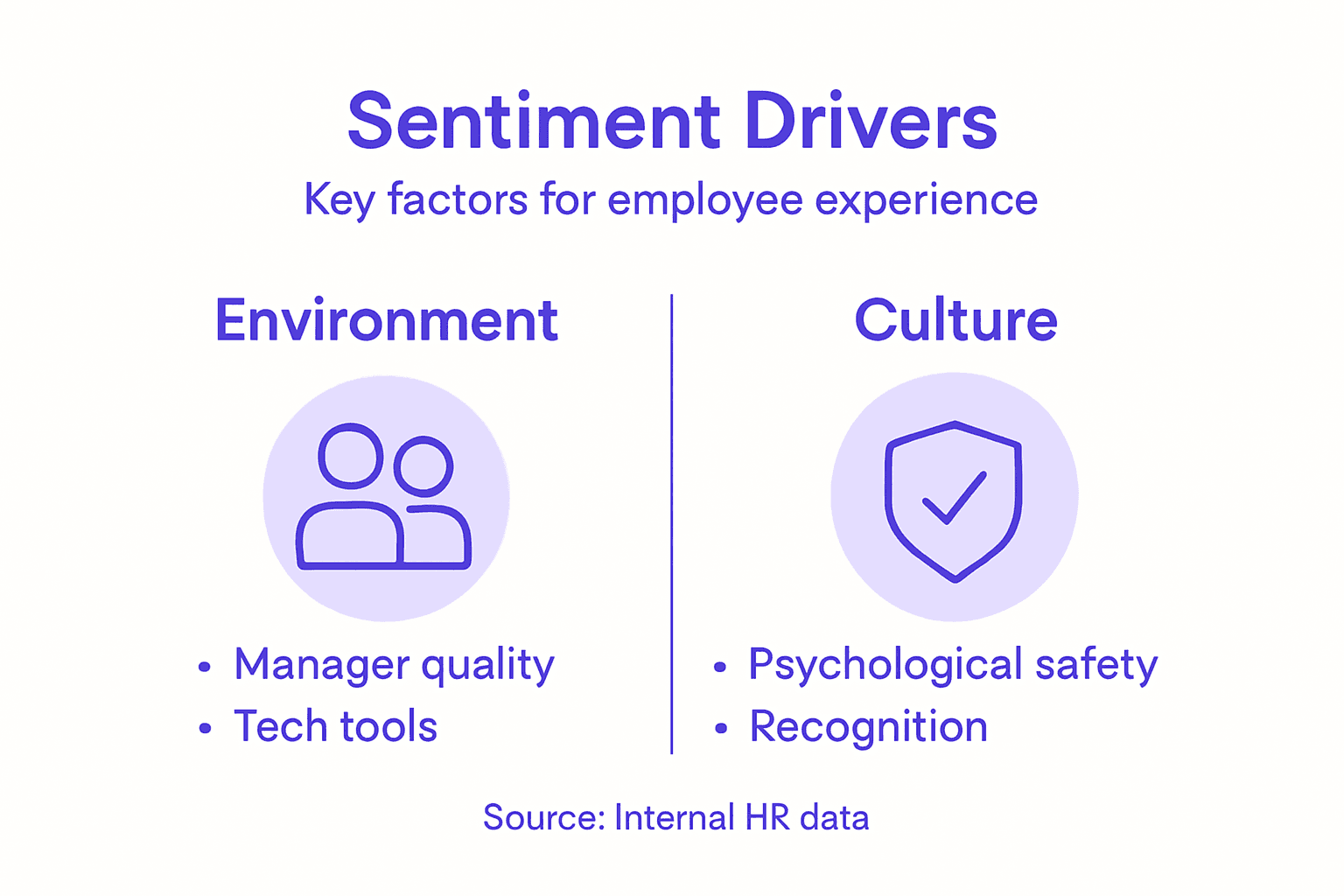
Key sentiment drivers are linked to technology use, leadership quality, and workplace culture, and measurement combines both quantitative and qualitative methods. You need both data types to see the full picture.
The Core Sentiment Drivers
These factors directly influence whether employees feel engaged, valued, and committed:
- Manager effectiveness – Your direct manager shapes daily experience more than any executive decree
- Technology and tools – Outdated systems create friction that compounds across every task
- Career clarity – Do people see a path forward, or feel stuck in their current role?
- Psychological safety – Can your team speak up, take risks, and admit mistakes without fear?
- Work-life integration – Flexibility and respect for personal time matter more post-pandemic
- Compensation and fairness – Pay doesn’t need to be lavish, but it must feel equitable
- Belonging and inclusion – Do people feel they truly fit, or like outsiders?
Most organisations focus on the obvious ones—compensation, flexibility—but underestimate manager quality and psychological safety. Those two drivers often predict retention better than salary alone.
Capturing Sentiment: Beyond Annual Surveys
Traditional annual surveys miss the real story. By the time you analyse results, sentiment has already shifted. Real-time feedback reveals what’s actually happening in your culture right now.
Effective sentiment capture uses multiple methods simultaneously:
- Targeted pulse surveys during critical moments (post-launch, after restructuring, before reviews)
- Real-time feedback tools embedded in daily workflows where employees already work
- Anonymous input channels that encourage honest answers without fear of retaliation
- Qualitative interviews with departing employees to understand true exit reasons
- Manager check-ins calibrated to spot early warning signs of disengagement
- eNPS and advanced analytics to track sentiment trends and identify perception gaps
The key: meeting employees where work already happens rather than asking them to fill out yet another survey outside their workflow.
Here is a concise comparison of employee sentiment capture methods and their unique strengths:
| Method | Data Type | Strength |
|---|---|---|
| Pulse surveys | Quantitative | Fast feedback during key moments |
| Anonymous input | Qualitative | Encourages honesty, reveals hidden insights |
| Real-time tools | Quant & Qual | Integrated into daily workflow, increases usage |
| Exit interviews | Qualitative | Deep context on root causes for departures |
| eNPS & analytics | Quantitative | Tracks broad sentiment trends over time |
Sentiment data without context is noise. You need to connect emotional signals to specific business outcomes—productivity, retention, revenue impact—to understand what actually matters.
Turning Data Into Action
Capturing sentiment is meaningless if leadership doesn’t act on it. The fastest way to destroy trust is to survey employees, disappear for three months, then announce unrelated changes.
C-suite leaders should see sentiment dashboards updated weekly or monthly, with alerts when scores drop in specific teams or departments. This enables early intervention before problems become departures.
Pro tip: Start by identifying your three highest-impact sentiment drivers using employee interviews and focus groups, then measure only those relentlessly rather than tracking twenty metrics half-heartedly.
Privacy, Anonymity, and Trust in Feedback Systems
Employee feedback only works when people feel safe being honest. The moment someone worries their candid comment might reach their manager or affect their career, you lose the truth. Without truth, your culture data becomes meaningless noise dressed up as insight.
This is why privacy and anonymity aren’t nice-to-haves—they’re foundational. Maintaining anonymity and confidentiality in feedback systems protects participant privacy and establishes trust, which directly improves the quality and reliability of the feedback you receive.
Why Employees Hold Back
Consider what your people actually fear when asked for feedback:
- Retaliation or negative performance reviews
- Being labelled a “complainer” or “not a culture fit”
- Their feedback being shared with their direct manager
- Their identity being traced even if supposedly anonymous
- Data breaches exposing sensitive comments publicly
These fears are rational. You’ve likely seen situations where someone spoke up and faced subtle (or not-so-subtle) consequences. Your culture data reflects this reality: bland, safe responses that tell you nothing useful.
The Trust and Technology Connection
Systems designed for confidentiality and anonymity increase user trust and willingness to participate. But this requires more than just checking a box labelled “anonymous.”
Real anonymity means:
- Data minimisation – Collect only what you genuinely need, not every possible data point
- Full redaction – Remove or obfuscate identifying information before analysis
- Separate storage – Keep personally identifiable information physically separated from feedback content
- Limited access – Only authorised people see any connecting data
- Clear communication – Tell employees explicitly how their data is handled and protected
- Third-party verification – Consider independent audits of your anonymisation process
Employees need to see that privacy is engineered into your system, not bolted on afterwards.
When people trust that their honest feedback won’t damage their career, the quality of insight skyrockets—and that insight becomes actionable cultural intelligence.
From Privacy to Participation
The strongest feedback systems balance transparency with anonymity. Employees know who’s collecting their data, how it’s protected, and exactly how you’ll use it. Yet their individual responses remain completely private.
This dual approach builds the psychological safety required for genuine participation. Participation increases, sample sizes improve, and the themes you identify become genuinely representative rather than dominated by the brave few willing to risk retaliation.
Your C-suite team should ask: Can you prove your feedback system minimises PII? Can you demonstrate data separation and access controls? Have you tested whether employees actually believe their feedback is anonymous?
Pro tip: Run an anonymity audit: have a trusted third party attempt to de-anonymise sample feedback using only the metadata your system collects—if they succeed, your employees are right to distrust the system.
Connecting Cultural Signals to Business KPIs
Here’s the hard truth: culture data that doesn’t connect to business outcomes is just expensive vanity. You can measure engagement, track sentiment, and identify themes all day—but unless those cultural signals predict or explain revenue, retention, and productivity, you’re not managing culture, you’re collecting opinions.
The real power emerges when you link what’s happening in your culture to what’s happening in your business. Culture Performance Indicators directly impact business KPIs like retention, productivity, and profitability, creating a measurable chain of causation that justifies investment and guides decision-making.
The Missing Link Most Leaders Overlook
Most organisations measure culture and business outcomes separately. HR tracks engagement scores. Finance tracks revenue per employee. Operations monitors turnover. Nobody connects them.
This creates a dangerous blind spot. Your culture might be deteriorating six months before turnover spikes or productivity drops. By then, damage is done—key people have already mentally checked out.
Building Your Cultural-to-Business Bridge
Effective linkage requires three components working together:
-
Baseline your cultural health metrics – Identify which cultural factors matter most to your business: psychological safety, manager effectiveness, career clarity, or trust in leadership
-
Connect to operational data – Map those cultural signals against concrete outcomes: which teams with high psychological safety show lower turnover? Which departments with clear career pathways have higher productivity?
-
Track correlation over time – Monitor whether changes in cultural sentiment precede changes in business metrics, establishing predictive power
When you discover that a 10-point drop in “trust in leadership” correlates with a 3% increase in turnover three months later, you’ve discovered something valuable: an early warning system.
Making the Business Case for Culture
Linking cultural feedback themes to business performance metrics drives improved employee satisfaction and measurable business outcomes. This alignment transforms culture from an HR responsibility into a strategic lever that executives and boards understand.
Your CFO won’t approve culture initiatives based on sentiment alone. But they will invest when you show that improving psychological safety reduced turnover by 12%, saving three million pounds in replacement costs. Or that addressing career clarity increased internal promotion rates by 34%, reducing external recruitment costs by two million pounds.
When culture metrics connect to business outcomes, you stop debating whether culture matters and start debating which cultural levers drive the greatest return.
C-suite visibility into these connections changes everything. Instead of vague culture improvement initiatives, you get precise interventions targeted at the cultural factors that most influence your business performance.
The following table links key EX drivers to measurable business outcomes for clearer strategic prioritisation:
| EX Driver | Example Impact | Related KPI |
|---|---|---|
| Manager effectiveness | Higher retention rates | Voluntary turnover |
| Career clarity | Increased internal promotions | Internal promotion rate |
| Tech & tools quality | Reduced process delays | Productivity per employee |
| Psychological safety | More innovation, fewer exits | Employee engagement score |
| Fair compensation | Improved satisfaction ratings | Employee satisfaction index |
Pro tip: Start with your highest-impact departures: interview the last ten people who left, map which cultural signals were weak in exit interviews, then trace those signals backward in your sentiment data to find the warning signs you missed.
Unlock the True Potential of Your Employee Experience with Actionable Insights
Understanding the full employee experience is critical to reducing friction, enhancing retention, and driving business results. This article highlights how many organisations struggle with fragmented cultural feedback and disconnected employee sentiment that do not link directly to business outcomes. Common pain points include treating employee experience as a one-time initiative, lacking real-time sentiment capture, and failing to protect employee anonymity—issues that lead to lost trust and missed opportunities to intervene early.
Wurkn offers a practical solution designed specifically for CXOs and PeopleOps teams who want to transform continuous, anonymous employee feedback into clear, actionable cultural intelligence that directly influences KPIs like productivity, retention, and revenue. By capturing always-on sentiment where employees already work—across Slack, Microsoft Teams, and HRIS systems—our platform minimises disruption while safeguarding privacy with robust anonymization. The AI-powered dashboard with humans-in-the-loop uncovers not just what is happening in your culture but why, giving leaders the early warning and clarity needed to fix challenges before they escalate.
[Image:cta_image]
Ready to shift from static surveys and assumptions to real-time, trustworthy insights that empower your leadership and strengthen your organisation? Explore how Wurkn’s cultural business intelligence platform integrates seamlessly into your workflow to deliver measurable impact. Discover more about turning employee sentiment into strategic advantage at Wurkn and start building healthier teams today.
Frequently Asked Questions
What is Employee Experience (EX)?
Employee Experience (EX) refers to the entire emotional and functional journey an employee has with an organization, encompassing all interactions from recruitment to exit. It involves how employees feel about their role, workplace culture, and overall integration into the company.
How does Employee Experience differ from employee engagement?
Employee Experience is a broader concept that includes all aspects of an employee’s journey and interactions within the organization, while employee engagement typically refers to the level of commitment and enthusiasm employees have towards their work and workplace.
What are the key drivers of a positive Employee Experience?
Key drivers include manager effectiveness, technology quality, career clarity, psychological safety, work-life integration, fair compensation, and a sense of belonging and inclusion. These factors collectively contribute to how valued and engaged employees feel.
How can organizations effectively measure Employee Experience?
Organizations can measure Employee Experience through continuous real-time feedback methods such as pulse surveys, anonymous input channels, and manager check-ins. These methods provide timely insights into employee sentiment and help identify areas for improvement.