
Your company’s attrition rate isn’t just an HR number to track; it's the pulse of your organization's health. In simple terms, it measures the rate at which people are leaving your company—for any reason, from finding a new job to retiring.
What Attrition Rate Actually Means for Your Business
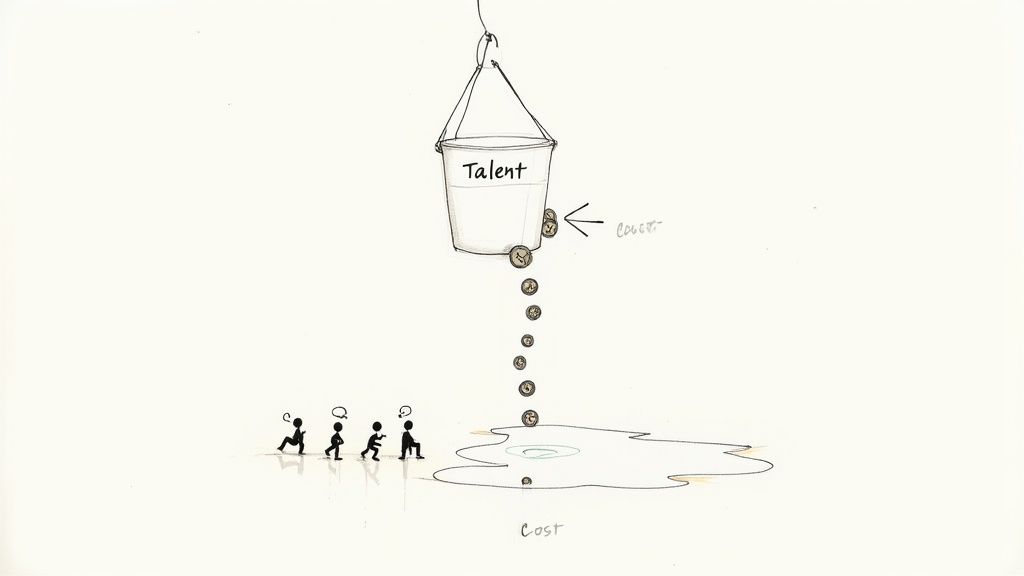
Think of your company as a bucket holding your most valuable resource: your people. Every time someone leaves, it’s a leak. A tiny drip here and there is normal, but a steady stream means you’re losing talent, institutional knowledge, and momentum faster than you can replace them. Measuring your attrition rate is like gauging the size of that leak.
This isn’t just a "people problem"; it’s a direct hit to your bottom line. Every departure comes with obvious costs like recruitment fees and training for a replacement. But the real damage often lies in the hidden costs: the dip in team morale, the lost productivity as new hires get up to speed, and the priceless institutional knowledge that just walked out the door.
Understanding your attrition rate is the first step toward diagnosing deeper organizational issues. A consistently high rate is rarely about a few bad hires; it's a massive red flag signalling problems with your culture, management, or overall employee experience.
This is where the game has changed. Traditional annual surveys might tell you that you had a problem six months ago, but that’s like looking in the rearview mirror. As a business intelligence tool, Wurkn gives you real-time visibility into the why behind the numbers. It transforms employee sentiment from a mystery into actionable intelligence, letting you plug the leaks before they become a flood. This goes beyond what simple HR survey tools offer by linking people analytics directly to business outcomes.
Calculating Your Attrition Rate Step by Step
To get a real handle on attrition, you need to move beyond a vague sense that "people are leaving" and nail down a concrete number. A simple, consistent formula turns this complex issue into a tangible KPI you can actually track and improve over time. It’s the first step to understanding the real flow of talent in your business.
The standard formula is pretty straightforward:
Attrition Rate = (Number of Departures / Average Number of Employees) x 100
Let's walk through a logical example to see how this plays out. Imagine a growing United States-based software firm wants to calculate its annual attrition rate to benchmark its performance.
This isn’t just about a few people leaving; it's a process that directly drains company resources and slows down performance, as this visual shows.
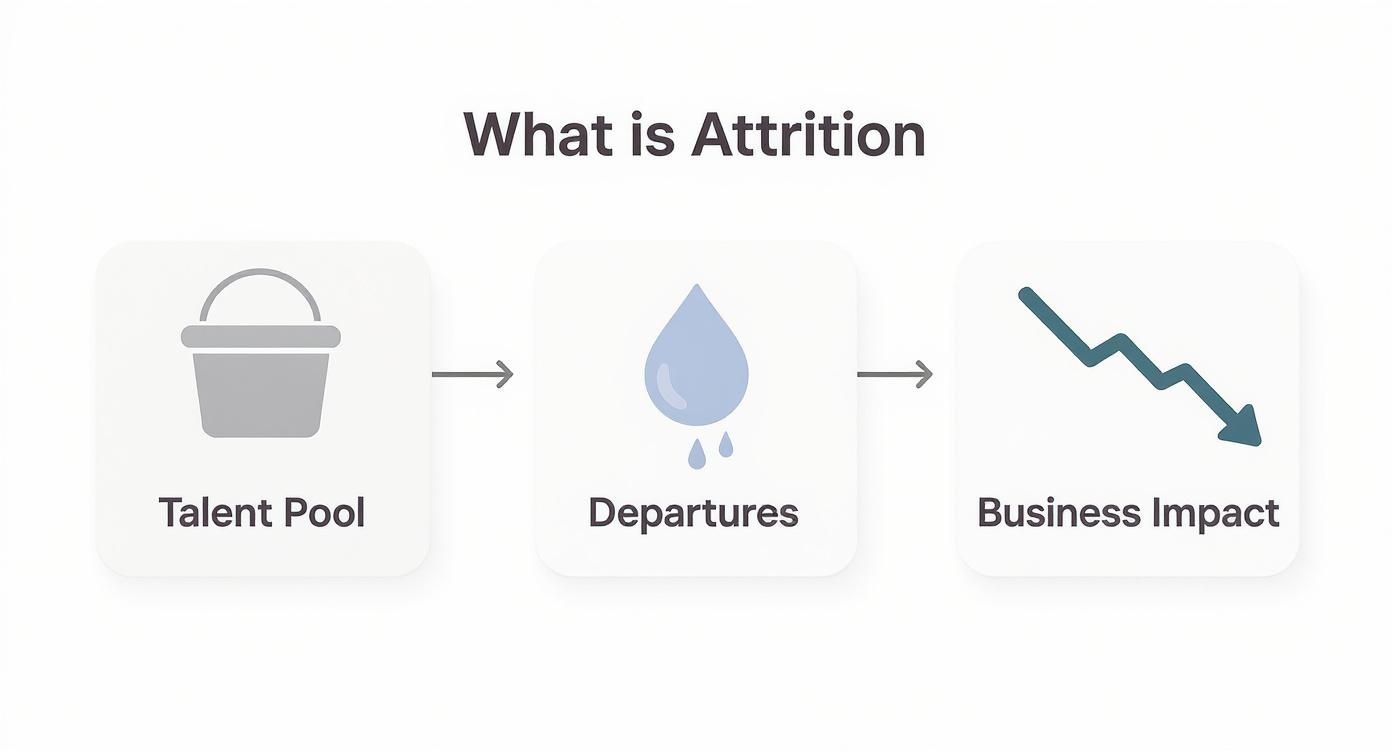
As you can see, every departure creates a ripple effect, impacting everything from team morale to project timelines.
A Practical Example
First, you need to pick a time frame. Let's use one full year. The key here is consistency—whether you measure monthly, quarterly, or annually, stick to the same period so you can spot trends that actually mean something.
Here's how our software firm would do it:
- Get your starting and ending headcounts. The company started the year with 500 employees and finished with 510.
- Figure out the average number of employees. This smooths out any hiring sprees or lulls. Just add the start and end counts, then divide by two: (500 + 510) / 2 = 505 average employees.
- Count the total departures. Over the course of the year, 40 employees left for all reasons combined—resignations, retirements, you name it.
- Plug the numbers into the formula. Now for the easy part: (40 departures / 505 average employees) x 100 = 7.92%.
So, the company’s annual attrition rate is 7.92%.
This number is your baseline. It's the starting point for digging deeper. While you can always do the math by hand, using a dedicated tool saves time and prevents simple mistakes. You can skip the manual work entirely with Wurkn's easy-to-use attrition calculator for a quick, accurate result.
Getting this number tells you what is happening. The real game-changer, though, is figuring out why—and that’s a question most traditional HR survey tools are not equipped to answer with real-time business context.
Why Voluntary and Involuntary Attrition Tell Different Stories
Just calculating one single attrition rate gives you a number, but it doesn’t tell you a story. It’s a bit like lumping all your company’s expenses into one bucket called "spending"—you have a total, but you’ve lost all the critical details needed to make smart decisions. To truly define the attrition rate and what it means for your business, you have to split departures into two very different categories.
After all, not every employee exit is the same. The most important distinction you can make is between voluntary attrition, where a team member chooses to leave, and involuntary attrition, which covers employer-led separations like layoffs or performance-based terminations. Each one points to a completely different set of problems you might be facing, whether you're in Canada or the United States.
The Story Behind Voluntary Departures
When your voluntary attrition rate is high, it’s a massive red flag signalling deep-rooted issues. Your top performers and most valued employees don’t just leave for no reason. Their resignations are a direct symptom of something broken in their experience—maybe it’s a toxic culture, ineffective management, poor compensation, or a dead-end career path.
These are the “regrettable” losses. They drain your company of its institutional knowledge, its momentum, and its future leaders. If you ignore this specific number, you’re missing the most honest feedback your employees will ever give you: the feedback they deliver with their feet.
A rising voluntary attrition rate is the ultimate lagging indicator of a poor employee experience. By the time it shows up on your dashboard, the damage is already done. Your best people are already gone.
This is exactly where old-school HR tools like annual surveys completely miss the mark. Finding out that morale was low six months ago is interesting, but it's far too little, too late.
In stark contrast, a business intelligence tool like Wurkn gives you continuous, anonymous feedback channels that act as an early warning system. It captures the real-time sentiment that builds up long before someone decides to leave. By understanding the ‘why’ behind dissatisfaction as it’s happening, you can actually step in and fix the problems before they turn into resignations. Wurkn moves beyond simple engagement metrics, turning raw cultural data into actionable intelligence that empowers you to solve issues before they ever show up in your attrition numbers.
A Medical School Crisis Teaches Us Everything About Attrition
To really get your head around what the attrition rate means for your business, sometimes it helps to look outside the corporate world. Think about the crisis hitting some medical schools right now, where a shocking number of students who start the program never actually become doctors. This isn't just a number on a spreadsheet; it's a massive loss of talent, money, and human potential.
This whole situation is a powerful cautionary tale for any business leader. High attrition, whether it's in a med school or your company, is just a symptom of a much deeper problem. For instance, some medical schools outside of North America are seeing attrition rates skyrocket to between 40% and 70% (El-Masri, M. et al., 2023, Frontiers in Education). Compare that to the stable 3% in U.S. programs, and you see a massive red flag. This kind of gap almost always points to systemic issues, like crushing pressure and a total lack of support. You can dig into the factors behind these numbers in this detailed educational study.
When a huge chunk of your talent pool just vanishes, it's a sign that the environment is failing—not the people in it. That's a lesson every leader in Canada and the United States needs to take to heart.
If you ignore the real reasons people are leaving—be it burnout, bad management, or a lack of resources—you're basically guaranteeing failure.
The Real Cost Is Lost Potential
In our medical school analogy, every student who drops out is a future doctor who won't be there to save a life. It's the same in your business. Every employee who leaves takes a piece of your company's future with them—lost ideas, weaker client relationships, and broken team chemistry. The cost isn't just about finding a replacement; it's about the unrealized potential that just walked out the door.
This is exactly why those once-a-year, surface-level survey tools just don't cut it. They might tell you someone was unhappy, but they don't give you the real-time, nuanced intelligence you need to stop the next person from leaving. This is where a tool like Wurkn changes the game. It’s not just another feedback form; it’s a business intelligence platform that turns continuous, anonymous employee sentiment into a clear, actionable picture of your company's health. It helps leaders see the systemic pressures building up, giving them a chance to step in before their best people become another statistic.
The Hidden and Not-So-Hidden Costs of High Attrition
Employee attrition is so much more than an HR metric on a dashboard; it’s a financial leak that quietly drains your bottom line. The most obvious costs are easy to spot and add up alarmingly fast, especially for businesses in competitive Canadian and U.S. markets. These are the direct hits you’ll see on your balance sheet.
These tangible expenses often include:
- Recruitment Fees: Agency costs can be brutal, often taking a significant percentage of a new hire’s first-year salary.
- Advertising Costs: The bills for posting on job boards and professional networks accumulate with every open role.
- Interviewing Hours: Think about the time your managers and senior team members spend in interviews instead of on their actual jobs. That’s a direct hit to productivity.
The More Insidious Indirect Costs
Beyond the clear-cut expenses, the indirect costs of attrition are where the real damage happens. These consequences are harder to stick on a spreadsheet but can cripple team performance and slam the brakes on long-term growth. They represent the true, and often underestimated, financial hole a high attrition rate creates.
A high attrition rate isn’t just a people problem—it’s a profit problem. It quietly erodes your company’s foundation through lost productivity, knowledge, and morale.
For example, when an experienced team member walks out the door, you lose priceless institutional knowledge that might take a new hire years to build up. At the same time, the remaining team members are often left picking up the slack, leading to burnout and a noticeable drop in morale and engagement across the whole department.
Eventually, this constant churn tarnishes your employer brand, making it much harder and more expensive to attract top talent down the road. Truly understanding the high cost of employee turnover is essential for any COO or PeopleOps leader aiming to build a resilient and profitable organization.
This is exactly why passive, annual surveys just don’t cut it. A business intelligence platform like Wurkn delivers the continuous, anonymous feedback needed to see these issues bubbling up in real-time. It moves beyond just measuring engagement to provide the deep insights that link your culture directly to business performance, letting you fix the root causes of attrition before they turn into costly exits.
Actionable Strategies to Reduce Employee Attrition
Knowing what attrition is and why it happens is one thing. Actually stopping it is a completely different ball game. To really get a handle on your attrition rate, you have to switch from a reactive mindset—diagnosing problems after your best people have already walked out the door—to a proactive one. It’s about building an environment where they genuinely want to stay and grow.
This is where traditional annual engagement surveys completely miss the mark. They’re like a yearly physical exam; by the time you get the results, a minor issue could have already become a chronic condition. That rearview-mirror approach just doesn't cut it for keeping talent in today’s competitive United States and Canadian job markets.
Move from Surveys to Business Intelligence
The real key to cutting down attrition is understanding the root causes as they happen, in real-time. This is where a business intelligence platform like Wurkn offers a massive advantage over standard HR survey tools. It’s not about bombarding people with more questions; it’s about having a continuous, always-on conversation that captures honest, anonymous sentiment the moment it develops.
By transforming employee feedback from a once-a-year event into a live pulse, leaders gain the ability to spot trends like burnout, poor management, or compensation dissatisfaction long before they lead to resignations.
This constant stream of insight lets you finally connect the dots between the health of your culture and your business performance. Instead of guessing why a certain department has a revolving door, you can see the specific drivers as they emerge.
Implement Targeted, Data-Driven Solutions
Once you have this real-time cultural intelligence, you can roll out precise, effective retention strategies instead of just guessing with generic "best practices." For example, Wurkn might reveal through anonymized, aggregated data that your engineering team in the U.S. is feeling stuck with no growth opportunities, while your sales team in Canada is drowning due to poor work-life balance.
Armed with that kind of specific data, you can take targeted actions that actually work:
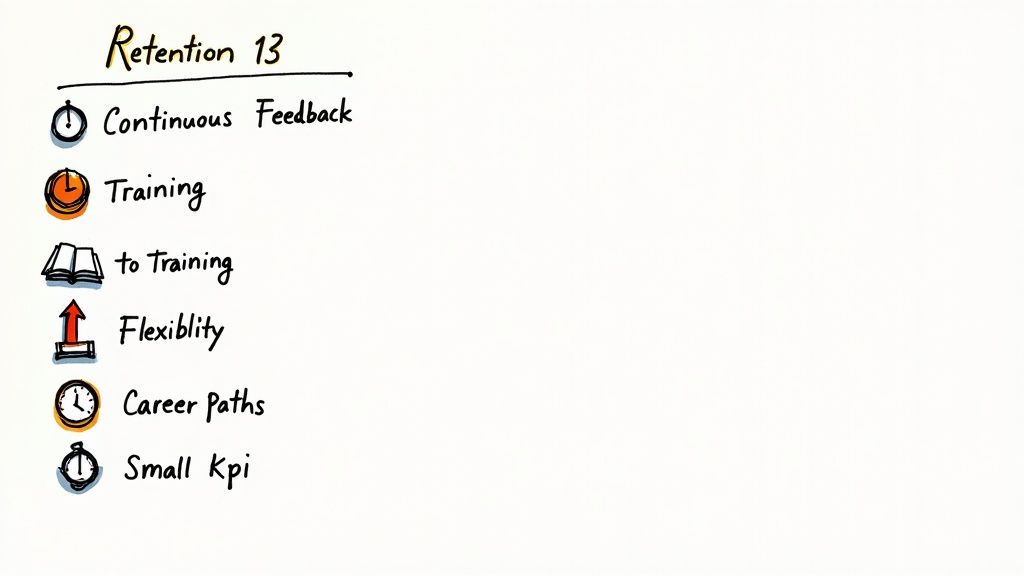
- Enhance professional development: Build out clear career paths and offer skill-building workshops for the specific teams that need them.
- Improve work-life balance: Introduce more flexible schedules or take a hard look at workload distribution in the departments that are struggling.
- Refine compensation and benefits: Use direct feedback to make sure your packages aren't just competitive, but are actually valued by your employees.
This approach turns retention into a dynamic, data-driven strategy. By launching focused initiatives and using Wurkn to measure their immediate impact, you can build a truly proactive culture. You stop guessing what people want and start giving them concrete reasons to stay, turning your organization into a place where talent thrives, not just survives.
Common Questions About Attrition Rate
Once you start digging into your attrition numbers, a few key questions always come up. Getting these definitions straight is the difference between simply tracking a metric and actually using it to make smarter decisions for your business.
What’s a “Good” Attrition Rate, Anyway?
While every industry is a bit different, a solid rule of thumb is to aim for an annual attrition rate of 10% or less. If your number is creeping much higher than that, it’s often a sign that something is broken—be it your culture, management, or compensation. People are voting with their feet.
But hold on, a super-low rate isn't always a sign of a healthy organization. Sometimes, it can mean you’re not bringing in enough fresh perspectives or new talent. The goal isn't zero; it's healthy.
The real key is to watch your own trend line and stack it up against your industry’s benchmarks. This context tells you whether your attrition is just the normal cost of doing business or a flashing red light demanding your immediate attention in markets like the United States or Canada.
A sudden jump in voluntary attrition is one of the clearest signs you have a brewing cultural crisis. It’s a lagging indicator, meaning the problems that caused it have been festering for a while, and now your best people are finally heading for the door.
How Is Attrition Different From Turnover?
People throw these terms around interchangeably, but they mean very different things. The distinction is critical.
Attrition is when an employee leaves and you don't fill their position. Think retirements, role eliminations, or a strategic move to downsize a specific team. It’s often a planned reduction in your workforce.
Turnover, on the other hand, is the classic revolving door. Someone leaves, and you immediately post a job opening to replace them. High turnover points directly to a retention problem that’s costing you time and money.
While both metrics track people leaving, attrition can be part of a deliberate business strategy. High turnover is almost always a signal of deeper issues.
This is where platforms like Wurkn become invaluable. They provide the business intelligence to show you why people are leaving, adding crucial context to your numbers. Instead of just seeing that people left, you understand the root causes, which is the first step to building a proactive strategy to keep your best talent.
Stop reacting to departures and start building a culture people won't want to leave. Wurkn provides the continuous cultural intelligence you need to reduce churn and drive business results. Discover how Wurkn can transform your organization.