
To truly move the needle on employee engagement, leaders have to stop treating it like an annual HR chore. We need to shift from reactive, once-a-year surveys to a proactive strategy that zeroes in on what actually matters: recognition, manager effectiveness, and genuine career paths. It's about diagnosing the real issues with data and then rolling out targeted fixes, not just surface-level perks that don't solve anything.
Beyond Surveys: The Real Cost of Disengagement

Let's be real—the traditional annual survey often feels more like an autopsy report on last year's morale than a useful tool. It gives you a single, static snapshot, but completely misses the day-to-day cultural dynamics that actually drive performance. This reactive approach leaves PeopleOps and operations leaders guessing, often leading them to treat symptoms instead of the root cause.
The true cost of this disengagement is staggering, and it hits far more than just morale. You see it in slumping productivity, innovation bottlenecks, and a direct punch to your bottom line. When employees are disconnected, the financial fallout is inevitable. This is where truly understanding the high cost of employee turnover becomes a critical piece of the puzzle for any organization.
The Manager and Motivation Disconnect
The connection between managers and engagement is impossible to ignore. A manager is often responsible for a significant portion of their team's engagement (Gallup, "The Manager's Role in Employee Engagement"). The problem? Managers' own engagement levels can plummet, creating a ripple effect that directly tanks team performance and retention.
Disengaged teams aren't just less productive; they're a huge flight risk. These teams can suffer from significantly higher turnover rates, a ridiculously expensive problem that old-school HR survey tools are completely unequipped to predict or prevent. This is exactly why a more sophisticated, business-intelligence-driven approach is non-negotiable.
A business intelligence tool like Wurkn moves beyond static surveys. It delivers real-time, actionable insights by connecting employee sentiment to concrete business metrics, showing you exactly how culture is influencing performance.
Instead of clinging to outdated survey methods, modern leaders in Canada and the United States need tools that can diagnose issues as they unfold. By correlating qualitative feedback with hard, quantitative business data, you can finally uncover the why behind the numbers. This data-driven framework is the only real way to build a resilient, motivated workforce that drives sustainable growth.
Diagnosing Engagement Gaps With Real Data
If you want to fix employee engagement, you first have to understand what’s actually broken. And a simple eNPS score just won't cut it. To get to the root cause of why people are checking out, you have to move beyond surface-level surveys and dig into the operational data that tells the real story of your workforce.
This means looking at two kinds of information together: quantitative data (the "what") and qualitative signals (the "why"). Relying on just one is like trying to navigate with half a map. You might spot a worrying trend, but you’ll have no clue what’s actually driving it.
Moving Beyond Simple Surveys
Traditional engagement surveys give you a snapshot in time, but they don't provide the depth you need to make smart decisions. A low engagement score is a symptom, not a cause. The real work starts when you connect that symptom to concrete business metrics.
This is where a business intelligence tool like Wurkn completely changes the game. It’s not just another survey platform; it’s a diagnostic engine built to connect different data streams and show you what’s really going on.
For a logical example, imagine you see a sudden productivity dip in your engineering department in your Vancouver office. Instead of guessing, Wurkn lets you cross-reference that performance data with other signals happening at the same time.
-
Quantitative Metrics to Track:
- Absenteeism and Presenteeism Rates: Are certain teams calling in sick more often? That's a classic leading indicator of burnout or low morale.
- Project Cycle Times: Are projects suddenly taking longer? This could point to collaboration issues, resource shortages, or confusion about who owns what.
- Voluntary Turnover Metrics: When you analyze turnover by department, manager, or tenure, you can uncover toxic pockets that a company-wide survey would completely miss.
-
Qualitative Signals to Capture:
- One-on-One Notes: The themes popping up in manager check-ins offer rich, unstructured context about what’s on your team’s mind.
- Exit Interview Feedback: This is your last, best chance to find out why good people are leaving. Are you hearing the same reasons over and over?
- Unstructured Feedback: Capturing sentiment from communication channels gives you a real-time pulse on how people are feeling, day in and day out.
When you layer these data points, a much clearer picture emerges. That productivity dip in engineering might have nothing to do with compensation, which was your first guess. But when you correlate it with manager feedback from one-on-ones and recent org changes, you might discover the real culprit is role ambiguity after a team restructure.
This kind of holistic diagnosis gives you the accurate baseline you need for any successful engagement strategy.
Combining Data Sources for a Complete Engagement Picture
To truly understand what's happening, leaders need to weave together different types of data. Relying solely on survey scores gives you an incomplete, and often misleading, view. A more holistic approach combines hard numbers with human context.
| Data Type | Examples | What It Reveals |
|---|---|---|
| Performance Data | Project cycle times, sales quotas met, customer satisfaction scores | Direct links between engagement and business outcomes. Are engaged teams actually performing better? |
| HRIS Data | Absenteeism rates, voluntary turnover by department, promotion velocity | Patterns of burnout, management issues, or blocked career paths that surveys might not capture. |
| Survey Data (Pulse/Annual) | eNPS, satisfaction with benefits, manager effectiveness scores | High-level sentiment and specific pain points around key employee experience drivers. |
| Qualitative Feedback | 1-on-1 notes, exit interview themes, anonymous feedback channels | The "why" behind the numbers. Uncovers context, nuance, and issues employees won't say in a formal survey. |
By integrating these sources with a business intelligence tool, you move from guessing at correlations to seeing clear cause-and-effect relationships. This is the foundation of an evidence-based people strategy.
Building an Evidence-Based Baseline
Gathering this kind of comprehensive data is a critical first step for any organization that's serious about its people. The California Government Operations Agency, for example, recently launched a statewide survey to establish the first-ever baseline for state employee engagement. It's part of a bigger push to use evidence to improve the workplace, especially when national trends show low engagement rates across the workforce (Gallup, "State of the Global Workplace").
This data-first approach transforms engagement from a vague HR concept into a measurable business function. When you can draw a direct line from a specific problem (like role ambiguity) to a specific outcome (like decreased productivity), you can design targeted, effective interventions.
This isn't just about collecting numbers; it's about asking the right questions from the start. For a deeper look at how to structure your data collection, check out our guide on building an effective employee opinion survey example that captures both the numbers and the nuance.
Answering "how to improve employee engagement" doesn't start with a solution. It starts with a precise, data-backed diagnosis of the problem.
Designing Targeted Engagement Strategies
Once you’ve figured out the ‘why’ behind your engagement gaps, it’s time to design the ‘what’—the specific, tangible interventions that actually solve the problem. Let's be honest, a one-size-fits-all approach here is a recipe for failure. Free snacks won't fix a toxic management culture, and a new mentorship program won't solve burnout caused by a complete lack of role clarity.
The key is to treat your diagnostic data like a treasure map. If your analysis points to a specific issue, your strategy has to be laser-focused on that root cause. This is how you move beyond guesswork and start building a playbook of solutions that hit your most common engagement detractors right where it hurts.
The process is straightforward: move from raw data to actionable insights. This is the critical first step before you even think about designing an intervention.
This ensures your strategies are built on a foundation of evidence, not assumptions, which is the only way to get real, impactful results.
Addressing Ineffective Management
More often than not, the data points straight to one thing: managers. Research is pretty blunt about it, finding that a single manager can account for up to 70% of their team's engagement variance (Gallup, "State of the American Manager"). If your 360-degree feedback, exit interviews, and performance data are all flagging leadership gaps, a generic, one-off training day just won't cut it.
You need a continuous coaching and feedback program.
- The Goal: Turn managers into coaches, not just bosses.
- Key Actions: Roll out structured training on giving constructive feedback, navigating difficult conversations, and recognizing good work effectively. Use a business intelligence tool like Wurkn to track how manager behaviour correlates with team sentiment and productivity after the training.
- Success Looks Like: A noticeable jump in positive scores for "manager support" in your pulse surveys and a measurable improvement in team retention rates within six months.
Tackling a Lack of Recognition
One of the quickest ways to kill morale is to make people feel invisible. When employees feel undervalued, their motivation tanks. If your qualitative data is littered with comments about a lack of appreciation, it's time to build a culture of recognition from the ground up.
A peer-to-peer recognition system tied directly to your company's core values is an incredibly powerful tool.
Instead of relying only on top-down praise, you empower employees to recognize each other. This creates a more authentic and frequent feedback loop, reinforcing the behaviours you want to see and building much stronger team connections.
For a logical example, you could create a dedicated Slack channel where anyone can give a "shout-out" to a colleague for embodying a value like "Customer Obsession" or "Default to Transparency." This makes recognition visible, timely, and meaningful. Platforms like Wurkn, which offer business intelligence beyond simple surveys, can even help you track these patterns, giving you insights into which teams are building the most positive and connected cultures.
Clarifying Career Progression Pathways
Ambiguity is a motivation killer. If your employees in your Canadian or American offices can't see a future for themselves at your company, they’ll start looking for one somewhere else. Data from exit interviews consistently flags "lack of growth opportunities" as a top reason for leaving.
To fight this, you have to build and communicate clear career progression frameworks.
- The Goal: Show every single employee a viable path for growth inside the organization.
- Key Actions: Develop competency matrices for each role that outline the specific skills and behaviours needed to get to the next level. Make these frameworks dead simple to find and weave them into every performance review conversation.
- Success Looks Like: An increase in your internal promotion rate and a drop in voluntary turnover attributed to career growth, tracked over a 12-month period.
Developing Flexible Work Policies
In today’s work environment, especially across North America, autonomy and flexibility are non-negotiable for a huge chunk of the workforce. If your data is showing signs of burnout or dissatisfaction with work-life balance, rigid, old-school attendance policies might be the culprit. A successful hybrid work policy has to be designed with intention, striking a balance between employee autonomy and the need for genuine collaboration.
Don't just mandate "in-office" days and call it a day. Use your business intelligence data to understand what work is actually best done together versus what's best done alone.
- Define the 'Why': Be crystal clear about the purpose of in-office time. Is it for strategic planning, team-building, or complex problem-solving?
- Empower Teams: Give individual teams the freedom to set their own collaborative rhythms that make sense for their projects and workflows.
- Provide the Right Tools: Make sure your tech stack can support seamless communication and collaboration for a team that isn't always in the same room.
When you design interventions that directly solve the problems your data has uncovered, you stop doing performative engagement activities and start executing a strategic plan that delivers real, measurable business results.
Weaving in Continuous Feedback and Smart Tech
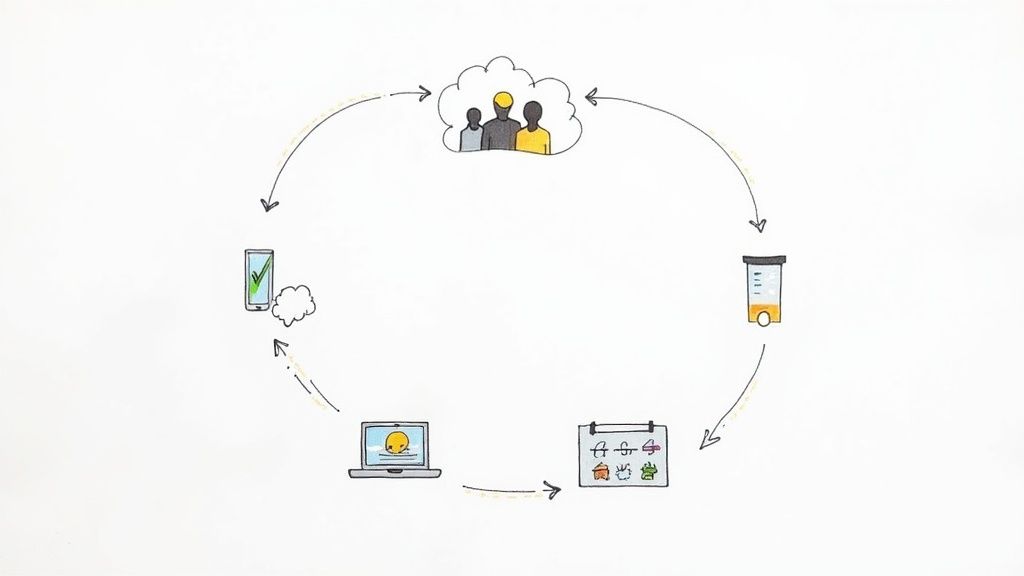
Here’s where most engagement strategies fall apart. Even the best-laid plans will crumble if they’re treated like a one-off project. You know the drill: a big launch with lots of fanfare, followed by a slow fade into the background. This "launch and forget" approach is a surefire way to waste resources and, worse, break employee trust.
To make any real, lasting change, you have to shift from periodic check-ins to a system of continuous improvement. This means weaving engagement into the very fabric of your daily operations. It's about building a live feedback loop that constantly gathers signals, turns them into insights, and lets you make real-time adjustments. When you get this right, engagement stops being an isolated HR function and becomes an ongoing, strategic conversation that actually drives the business forward.
Make Engagement Part of the Daily Workflow
The goal is to make giving and receiving feedback feel like a natural part of the workday, not just another task on someone’s to-do list. This is where smart technology is non-negotiable. Forget relying solely on those cumbersome quarterly surveys that pull people away from their real work. Modern tools meet your employees exactly where they are.
A true business intelligence tool like Wurkn goes leagues beyond what a traditional HR survey tool can do. It plugs into the tools your teams already use every single day—your HRIS, project management software, and communication channels—to capture a live, multi-dimensional view of what people are feeling and experiencing.
For a logical example, your engineering team in Toronto just shipped a huge product release. A basic survey might ask, "How do you feel?" and a few weeks later you get a vague, out-of-context score.
In contrast, an integrated business intelligence platform can connect the dots automatically. It can track sentiment from team chats, cross-reference it with the project’s success metrics from your project tool, and even flag potential burnout by analyzing PTO data from your HRIS. This gives you a rich, contextual understanding of what’s happening, as it happens.
Go From Static Reports to Actionable Intelligence
This integrated approach means you can stop looking at static reports and start working with dynamic, actionable intelligence. You’re no longer performing an autopsy on last quarter’s problems; you’re getting a live diagnostic of your organization's health.
This continuous data stream lets leaders spot issues before they blow up. It’s the difference between finding out a key team is disengaged after three of your top performers have already quit, and seeing the warning signs early enough to actually do something about it.
This isn't just a theoretical idea; it's being put into practice at a massive scale. For example, the state of California launched its Engaged California platform to drive innovation among its state employees. They're using technology to enable huge, meaningful conversations, tapping into the collective brainpower of their workforce to improve public services. It’s a powerful testament to using a data-informed approach to boost engagement. You can discover more about California's innovative engagement strategy and how they are applying these principles.
This proactive stance is exactly what operational leaders need to understand how their teams are truly functioning day-to-day. For COOs and PeopleOps leaders, this business intelligence approach delivers a clear, real-time view of how your culture is impacting the business. If you want to dig deeper, you can learn more about how COOs get actionable business insights from continuous employee feedback.
Putting Continuous Feedback into Practice
So, how do you make this happen? Implementing a continuous feedback loop requires a few key operational shifts.
- Equip Your Managers with Data: Give your managers real-time dashboards showing sentiment and performance data for their teams. This allows them to have much more informed, targeted conversations during their one-on-ones instead of just guessing.
- Automate How You Collect Signals: Use tech to passively and anonymously gather data from the systems you already have. This cuts down on survey fatigue and gives you a much more authentic picture of team health.
- Set Up Clear Action Triggers: Decide ahead of time what you'll do when certain data points are hit. For a logical example, if a team's sentiment score drops by 15% over two weeks, that could automatically trigger a check-in or a review by an HR business partner.
By embedding feedback into your daily workflows and using smart tech to connect the dots, you stop asking "how do we improve engagement?" once a year. Instead, you start building a culture that adapts, responds, and gets better every single day.
Measuring the Business Impact of Engagement
Getting the C-suite to really back your engagement initiatives boils down to one thing: data. To secure a real budget and get strategic buy-in, you have to move beyond "soft" metrics and connect your work to the hard numbers that leaders actually care about.
This is where you stop talking about cultural health as a concept and start proving its impact on tangible business outcomes.
It's time to think bigger than the standard Employee Net Promoter Score (eNPS). While it’s a decent starting point, eNPS only gives you a tiny piece of the puzzle. The real proof—the kind that gets you a seat at the table—comes from tracking key performance indicators (KPIs) that directly mirror operational success and financial stability.
Connecting Engagement to Core Business KPIs
A truly data-driven approach isn't just about running surveys; it's about measuring the ripple effect of your interventions on the company's bottom line. When your people are more engaged, performance gets better across the board. The whole point is to draw a clear, undeniable line from an action you took to a positive business result.
Start focusing on the metrics that tell this story:
- Voluntary Turnover Rates: This is the big one. Highly engaged employees just don't leave as often. Tracking turnover, especially when you can slice the data by department or manager, shows the direct financial savings of keeping your best people.
- Productivity Per Employee: Whether you’re looking at sales revenue, features shipped, or project cycle times, measuring output is a direct line to engagement’s impact. More engaged teams simply get more done.
- Customer Satisfaction Scores (CSAT): Happy, engaged employees create happy customers. It's not a myth. You'll almost always find a powerful correlation between high employee engagement scores and high customer satisfaction or Net Promoter Scores (NPS).
- Internal Promotion Rates: A healthy rate of internal mobility isn't just an HR metric; it's a sign of a strong, engaging culture that gives people a reason to stay. It proves you're developing and retaining top talent.
This is exactly where traditional HR survey tools miss the mark. They can tell you if people feel engaged, but they can't show you how that engagement is moving the needle for the business. A business intelligence tool like Wurkn is designed to bridge that exact gap, demonstrating value far beyond a simple survey tool.
Visualizing the ROI with Actionable Dashboards
Wurkn isn't just another platform to collect feedback. It’s a business intelligence tool that helps you craft a powerful, visual story with your data.
For a logical example, imagine you've just rolled out a new manager coaching program across your Canadian and US offices to tackle feedback gaps. Instead of waiting a year for the next big survey, you can build a real-time dashboard.
This dashboard can show the direct link between that program and its business impact. You could overlay data points to show how, right after the training, manager feedback scores start to climb. Then, you can show that three months later, the voluntary turnover rate in those specific managers' teams drops by 15%.
Now that's a compelling, data-backed story that proves the program's value in a language everyone understands.
Measurement isn't just about proving you were successful. It's about learning, iterating, and cementing your strategic importance. When you can show leadership a dashboard that clearly connects a cultural initiative to a real reduction in turnover costs, engagement stops being a "nice-to-have" and becomes a core business driver.
Key Performance Indicators for Measuring Engagement ROI
To really nail your presentation to leadership, organizing your metrics in a clear cause-and-effect format is incredibly helpful. This structure allows executives to quickly grasp the connection between your people-focused initiatives and the tangible business outcomes they're responsible for.
Here’s a look at how to frame these connections.
| KPI | How to Measure | Business Outcome |
|---|---|---|
| Voluntary Turnover Rate | Track monthly and quarterly exits using your HRIS data, segmented by department and manager. | Reduced Recruitment Costs: Lower turnover directly decreases spending on hiring, onboarding, and training new staff. |
| Productivity Metrics | Use system data (e.g., sales from CRM, project completion from JIRA) to calculate output per employee. | Increased Revenue & Efficiency: More productive teams deliver better results faster, directly impacting the bottom line. |
| Customer Satisfaction (CSAT) | Analyze customer survey results and correlate them with team engagement scores from the same period. | Improved Customer Loyalty: Engaged employees provide better service, leading to higher customer retention and brand advocacy. |
| Absenteeism Rate | Monitor unscheduled absences through your HRIS, identifying trends in specific teams or locations. | Enhanced Operational Stability: Lower absenteeism means more consistent staffing, fewer disruptions, and smoother workflows. |
By consistently tracking these KPIs, you build a powerful narrative that proves improving employee engagement isn't just an HR function—it's a critical strategy for organizational success. It’s about learning to speak the language of the business and demonstrating your indispensable value.
Common Questions About Employee Engagement
PeopleOps leaders and executives across Canada and the United States often run into the same walls when trying to crack the employee engagement puzzle. Below are some direct answers to the most pressing questions I hear, framed around a data-driven approach that leaves old, ineffective methods behind.
How Often Should We Measure Employee Engagement?
Relying on a single annual survey is like trying to drive a car by only looking in the rearview mirror. It shows you where you’ve been, but gives you zero insight into the road ahead. You end up reacting to problems that are months old, long after the damage is done.
A modern, effective strategy doesn't throw out the annual deep-dive, but it pairs it with a continuous listening approach. This means capturing real-time signals from the places where work actually happens every single day.
The goal is to shift from a reactive post-mortem to a proactive, real-time diagnostic of your organization's health. You need to spot issues as they arise, not months later when a report confirms what you already suspected.
A business intelligence platform like Wurkn moves beyond traditional survey tools by pulling in daily signals from the systems your teams already use—like project management tools and communication channels. This creates a live, ongoing view of team health, letting you address friction or burnout before it spirals into a retention nightmare. Measurement becomes an active, strategic tool, not just a passive, historical record.
What Is the Single Most Important Factor for Engagement?
The data is overwhelmingly clear on this one: a person's direct manager can account for up to 70% of the variance in their team's engagement (Gallup, "State of the American Manager").
But hold on. Simply blaming managers for low scores completely misses the point. The single most critical action an organization can take is to empower those managers with the right data and insights to lead effectively.
A manager forced to rely on gut feelings and spotty anecdotes is flying blind. They're far less effective than one who has clear visibility into their team’s workload, sentiment trends, and development needs. The issue isn't "the manager" as an individual; it's about giving that manager the business intelligence tools to be a better, more informed coach.
So, the most important factor is an enabled manager. When you provide them with business intelligence, not just stale survey results, you give them what they need to have meaningful conversations, spot risks early, and offer support that's actually relevant to their team.
What Can We Do When We Can't Afford Big Salary Increases?
It’s a common—and costly—myth that compensation is the main driver of employee engagement. While fair pay is absolutely foundational (think of it as a "hygiene factor"), it rarely solves deep-seated engagement problems on its own. If your engagement scores are in the basement, throwing money at the problem is an expensive guess that probably won’t work.
More often than not, low engagement is tied to things that have little to do with a paycheque.
- Lack of Recognition: Employees feel like their hard work is invisible.
- Unclear Career Paths: They can’t see a future for themselves at the company.
- Poor Work-Life Balance: They feel consistently overworked and unsupported.
Before you make any moves, use data to find the actual root cause. A business intelligence tool can correlate sentiment data with operational metrics to show you what’s really going on. For a logical example, you might discover that a specific department’s low morale isn’t about pay at all, but is directly linked to a lack of recognition from their leadership.
High-impact, low-cost solutions almost always deliver a bigger return. Think about:
- A structured peer recognition program tied to company values.
- Flexible work schedules that give people more control over their lives.
- Targeted development opportunities like mentorship or skill-building workshops.
These strategies speak to the core human needs for appreciation, growth, and balance. They deliver a much more sustainable boost to engagement than a marginal salary bump ever could.
How Can We Improve Engagement with a Remote or Hybrid Workforce?
Engaging a distributed workforce across North America requires a far more intentional and structured approach. You can no longer rely on the spontaneous, informal connections that happen in a physical office. The key is to be deliberate in how you build connection, clarity, and trust.
Focus your efforts on three core pillars:
- Radical Clarity in Communication: When people aren’t in the same room, ambiguity is your worst enemy. Goals, priorities, and expectations have to be over-communicated to ensure everyone is aligned.
- Technology That Enables Connection: Your tech stack should make collaboration feel seamless. This is about more than just video calls; it includes tools that support asynchronous work and create virtual spaces for both focused work and casual interaction.
- Managers Trained for Remote Leadership: Leading a remote team is its own unique skill set. You need to equip your managers to focus on outcomes, not hours logged. They need to become experts at building trust, fostering psychological safety, and checking in on their team's well-being without slipping into micromanagement.
This is where a business intelligence tool like Wurkn becomes especially valuable, demonstrating its superiority over simple HR survey tools. It gives you crucial visibility into how your distributed teams are really collaborating and feeling. By analyzing communication patterns and sentiment, it can help you spot the early warning signs of isolation or burnout, allowing you to intervene with targeted support before they become critical retention issues.
Ready to move beyond guesswork and start making data-driven decisions about your culture? See how Wurkn transforms employee sentiment into actionable business intelligence that leadership can use to drive real results. Learn more about Wurkn.