
Fixing your company culture isn’t about adding another perk or a new foosball table. It's about digging in, getting your hands dirty, and diagnosing the real, often hidden, issues holding your teams back. The only way to do that is to get an honest, evidence-based look at your organization's health, blending human insights with hard data. This is how you stop treating symptoms and start solving the right problems.
Diagnosing the Real Health of Your Company Culture
To get this right, you have to start with brutal honesty about where you stand today. Too many organizations lean on annual engagement surveys as a crutch. While they offer a snapshot, it's a static one, often months out of date by the time you see the results. They might tell you what employees are feeling, but they almost never explain why.
A real diagnosis means pushing past the obvious symptoms to find the root causes of cultural friction.
High turnover? That’s just a symptom. The real disease could be anything from inconsistent leadership and a lack of psychological safety to operational chaos causing massive burnout. Simply rolling out a new wellness app won’t fix a fundamentally broken process that’s draining your team’s will to work.
Moving Beyond Simple Surveys
Traditional HR survey tools have their place, but they're limited. They capture sentiment at a single point in time, completely missing the daily interactions and frustrations that truly define your culture. This is where modern business intelligence tools come in.
A platform like Wurkn, for example, goes way beyond basic sentiment tracking. It analyzes anonymized collaboration patterns and operational data, giving leaders in the United States and Canada a complete, real-time picture. It helps you see not just how people feel, but how work actually gets done.
Imagine being able to connect a dip in team morale directly to a spike in after-hours messages about a specific project. That’s a burnout risk you can spot and address long before it shows up in your turnover stats. This is the kind of insight that shifts your strategy from reactive to proactive.
Diagnosing Culture Symptoms vs Root Causes
It’s crucial to distinguish between what you see on the surface and what’s really going on underneath. This table helps break down common symptoms and connect them to potential underlying issues you can investigate with real data.
| Common Symptom | Potential Root Cause | Data to Investigate with Wurkn |
|---|---|---|
| High voluntary turnover | Poor management, lack of growth, burnout | Manager effectiveness scores, feedback on career paths, workload balance metrics |
| Missed project deadlines | Unclear priorities, resource bottlenecks, poor cross-functional communication | Collaboration patterns between teams, sentiment data tied to specific projects |
| Low engagement scores | Lack of recognition, feeling unheard, toxic micro-cultures | Frequency of praise/recognition, analysis of anonymous feedback themes |
| Increased absenteeism | Widespread burnout, low psychological safety, poor work-life balance | After-hours work patterns, sentiment around psychological safety |
By using data to connect the dots, you can stop guessing and start targeting your interventions where they'll have the biggest impact.
The Critical Role of Leadership and Safety
At the end of the day, a healthy culture rests on two pillars: effective leadership and psychological safety. When your people feel they can speak up, share ideas, and even fail without fear of blame, that’s when innovation and true collaboration happen.
Unfortunately, this is where many companies are backsliding. According to Gallup research, a lack of psychological safety can lead to disengagement, which costs the global economy trillions annually (Gallup, "State of the Global Workplace: 2023 Report"). This erosion of trust makes strong, data-informed leadership more critical than ever.
A healthy culture is built on a foundation of psychological safety. It's the shared belief held by members of a team that the team is safe for interpersonal risk-taking. It’s a sense of confidence that the team will not embarrass, reject, or punish someone for speaking up.
This is exactly why a deep, data-driven diagnosis is non-negotiable. It allows you to pinpoint where communication is breaking down or where leadership is falling short. You can then invest your resources in initiatives that make a tangible difference, strengthening both your teams and your bottom line. This targeted approach is a core part of figuring out how to improve employee engagement.
Building Feedback Systems That Drive Real Action
Diagnosing your culture is a crucial starting point, but it's only half the battle. To actually improve things, you have to move beyond those static, once-a-year assessments. A great culture thrives on continuous dialogue, not a single snapshot in time. This means building systems that capture feedback as it happens, creating a live pulse of your organization.
Traditional annual engagement surveys just don't cut it anymore. By the time you've analyzed the results and shared them, the feedback is already stale—reflecting problems from months ago. The modern workplace moves way too fast for that. Leaders need to sense and respond to cultural shifts in real-time, not react to old news.
From Annual Surveys to Always-On Intelligence
The goal is to shift from periodic, top-down surveys to dynamic, multi-directional communication channels. This isn't just about sending out more polls; it’s about embedding feedback loops right into your team's daily workflows.
This is where a business intelligence platform like Wurkn offers something far beyond traditional HR tools. Instead of asking people to stop what they're doing to fill out a survey, Wurkn captures always-on, anonymous sentiment directly from the communication tools they already live in, like Slack or Microsoft Teams. This meets employees where they are, encouraging more candid and timely input without breaking their focus.
This process transforms scattered conversations into structured, actionable insights.
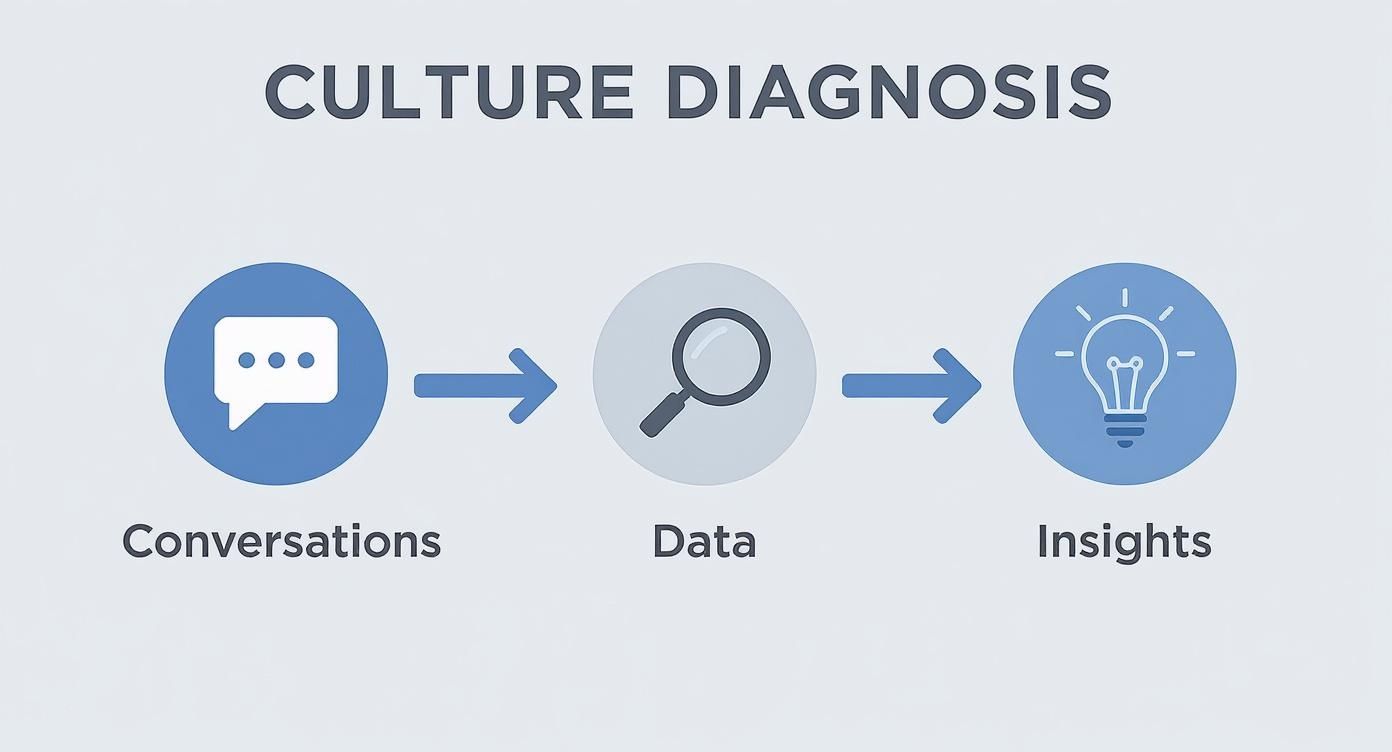
This simple flow—from collecting raw conversations to generating concrete insights—is what allows leaders to make smart decisions, fast.
Fostering Trust Through Anonymity and Action
Let's be clear: for any feedback system to work, your employees have to trust it. Completely. They need absolute confidence that their feedback is anonymous and they can speak freely without fear of reprisal. This is a non-negotiable foundation for honest dialogue in both Canadian and American workplaces.
Wurkn is built with privacy at its core. The platform is designed to minimize personally identifiable information (PII) and fully anonymizes all submissions. This commitment to security is what encourages the kind of raw, unfiltered feedback that reveals the true state of your culture.
But anonymity alone isn't enough. The other side of the trust equation is action. When employees see their feedback leading to tangible changes, it creates a powerful positive loop. They feel heard and valued, which makes them want to keep sharing.
A feedback system without a clear action plan is just a complaint box. To build trust, leaders must close the loop by communicating what they've heard, what they plan to do, and why some suggestions may not be implemented.
Real-World Application in Action
Imagine this scenario at a growing Canadian tech company. Leaders notice project velocity is slowly dropping, but they can't figure out why. The annual survey is six months away.
Using a business intelligence tool, they start analyzing real-time, anonymous conversations about project workflows. The system quickly surfaces a recurring theme: frustration with a new project management tool. Employees feel it’s adding bureaucratic overhead and slowing them down. This crucial insight was buried in day-to-day chatter, totally invisible to traditional surveys.
Armed with this specific data, leadership can act immediately:
- Host targeted training sessions to address usability issues.
- Create a dedicated channel for feedback on the new tool.
- Adjust workflows to remove the biggest points of friction.
This is a proactive approach that solves a problem before it blows up into widespread burnout or starts hitting your retention numbers. It transforms a leader’s role from problem-reactor to culture-shaper. You can dive deeper into how to frame these questions by exploring different types of employee satisfaction survey questions.
By building these continuous, trustworthy feedback systems, you create an agile and responsive organization. You can spot emerging issues, celebrate hidden successes, and make the small, constant adjustments that collectively build a healthier, more productive, and resilient company culture.
Turning Employee Feedback Into Strategic Initiatives
You've built the system, the feedback is flowing in. Now comes the hard part—and the part that actually matters. It's one thing to collect employee sentiment; it's another thing entirely to translate that raw data into cultural initiatives that actually move the needle on business results.
Too many companies fall into the trap of surface-level fixes. The feedback comes in, and out goes a new coffee machine or a team pizza party. While these things aren't bad, they rarely address the deep-seated issues that are actually holding your company back.
To truly improve culture, you need a framework for action. This means moving past the perks and focusing on changes that directly impact retention, productivity, and operational efficiency. It's about connecting the dots between how your people feel and how the business performs, building an unshakeable business case for every cultural investment.
Prioritizing What Truly Matters
Let's be honest: not all feedback is created equal. A classic mistake is trying to act on every single suggestion. This just scatters your efforts, burns out your People Ops team, and delivers minimal impact.
Instead, top-performing COOs and People Ops leaders need a dead-simple way to prioritize. This is where modern business intelligence tools completely change the game.
Unlike old-school survey platforms that just dump raw comments in your lap, a tool like Wurkn can automatically analyze and categorize feedback themes. It might tell you that 30% of negative sentiment last quarter was tied to a clunky internal software, while only 5% was about office amenities. Suddenly, you know exactly where the real pain is.
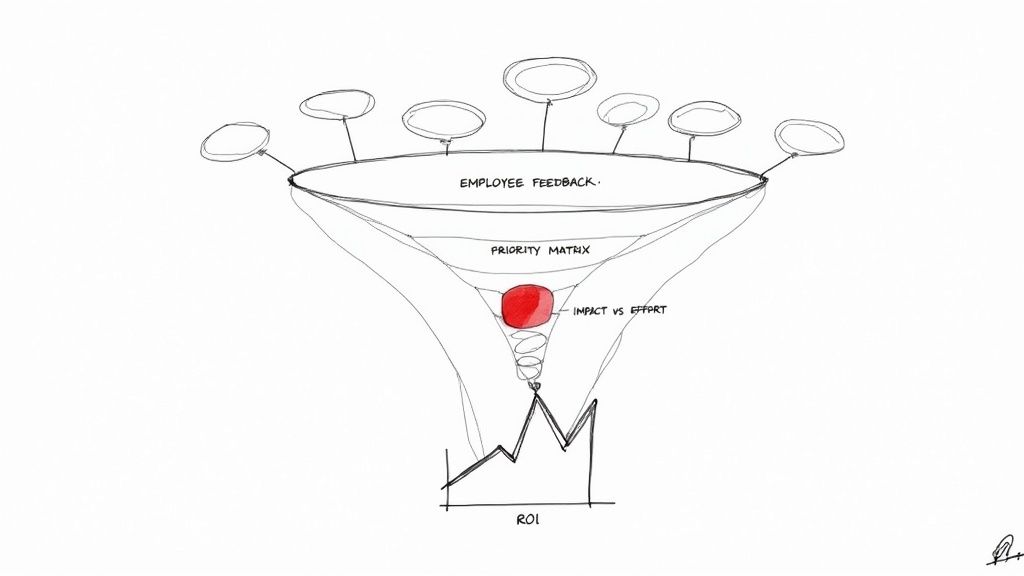
Once you have that clarity, you can apply a simple prioritization matrix:
- High-Impact, Low-Effort: These are your quick wins. Think clarifying a confusing approval process that frustrates dozens of people every single day.
- High-Impact, High-Effort: These are your big, strategic projects. Maybe it’s redesigning a core workflow that’s causing widespread burnout. These need a rock-solid business case.
- Low-Impact, Low-Effort: Minor tweaks. Handle them if you have the bandwidth, but don’t let them distract you from the bigger fish.
- Low-Impact, High-Effort: These ideas get parked. Almost always, they aren’t worth the resources.
This framework immediately shifts the conversation from "keeping people happy" to "strategically solving problems that are holding back the business."
Building an Unshakeable Business Case
If you want to get executive buy-in for cultural initiatives, you have to speak the language of business outcomes. Anecdotes and employee complaints are not enough. You must connect your proposed changes to cold, hard financial results. A proper business intelligence platform gives you the ammunition to do just that.
Let’s go back to that burnout example. Instead of just saying, "Our engineers seem tired," a platform like Wurkn helps you build a data-backed narrative.
- Pinpoint the Problem: Sentiment analysis reveals a consistent spike in frustration directly linked to the "Project Phoenix" workflow.
- Quantify the Impact: You then correlate this sentiment data with your operational metrics. You discover that teams working on Project Phoenix have 15% higher turnover and 20% lower project velocity than other teams.
- Propose the Solution: You recommend a cross-functional initiative to redesign the entire workflow, complete with estimates for time and resources.
- Forecast the ROI: You project that fixing this one workflow will slash team turnover by 5% in the next year (saving thousands in recruitment costs) and boost project delivery speed by 10%.
By linking cultural data directly to operational KPIs, you transform a conversation about "feelings" into a strategic discussion about performance, efficiency, and revenue.
This approach makes it impossible for leadership to dismiss culture as a "soft" issue. It becomes a core driver of business success. States that prioritize this connection often see stronger work environments. For instance, California ranks 8th in the U.S. for workplace culture, thanks to its focus on factors like wage protections, wellness programs, and lower employee turnover. This data-driven approach helps California businesses maintain a competitive edge in retaining talent. You can learn more about what makes a great workplace culture in this detailed state-by-state analysis. By adopting a similar mindset, your organization can turn employee feedback into a powerful engine for growth and improvement.
Measuring the True ROI of Your Culture Investments
Improving your company culture isn't just a 'nice-to-have'—it's a hard-nosed strategic investment with a measurable return. The problem is, People Ops leaders often get stuck trying to prove the value of their work because they can't connect it to the metrics the C-suite actually cares about.
Let's fix that. This isn't about feelings; it's about shifting the conversation from culture as an expense to culture as a core business driver. To make that happen, you have to tie your culture initiatives to cold, hard numbers: employee retention, productivity, and absenteeism. This is precisely where traditional HR platforms and basic survey tools fall completely flat. They might give you a sentiment score, but they can't show you how that sentiment is hitting the bottom line.
Moving Beyond Sentiment Scores
The real breakthrough happens when you can directly correlate how people feel with how they perform. This is where a business intelligence tool like Wurkn blows a standard employee engagement platform out of the water. You stop guessing at causation and start drawing a direct, undeniable line between sentiment and operational results.
Imagine you launch a leadership development program to improve psychological safety. A traditional survey might tell you if employees feel safer a few months later, which is a decent start. But "feeling safer" doesn't build a business case that gets you more budget next year.
This is where you go deeper. With a tool like Wurkn, you track that sentiment data alongside your operational KPIs. Now, you can see if that same team also saw:
- A 10% drop in voluntary turnover over the next two quarters.
- A 15% increase in on-time project completion rates.
- A measurable decrease in absenteeism on high-stress project days.
Suddenly, you have irrefutable proof of ROI. That leadership program is no longer a soft "culture initiative." It's a performance-driving investment that directly improved team stability and output. This data-first approach is the key to knowing how to improve company culture in a way your executives will actually listen to.
Quantifying the Financial Impact of Culture
Let's ground this in a real-world scenario common in the Canadian and American tech scenes. A product team is consistently missing deadlines, and you can practically feel the low morale in their Slack channel. A basic survey tells you they're "unhappy." Thanks, but that's not actionable.
Using a business intelligence tool, you dig into the anonymized, real-time feedback and find the root cause: everyone's frustrated with a clunky, outdated internal software tool. The data shows that negative sentiment spikes every single time an engineer has to use this system. It’s wasting hours of their day and crushing their motivation.
Connecting culture to financial outcomes isn't about putting a price on happiness. It’s about demonstrating how a toxic or inefficient environment creates friction that directly costs the company money in lost productivity, turnover, and missed opportunities.
Now you can build a rock-solid business case. You can show that this one software issue is correlated with a 5% higher turnover rate on that team compared to the company average. Pull up a calculator and show them the real cost of employee turnover—those numbers add up alarmingly fast.
Armed with this data, your proposal to invest in a new tool isn't just about making people happier. It’s a strategic move to plug a financial leak, retain your best engineers, and boost productivity. This is how you prove, without a shadow of a doubt, that investing in the employee experience is one of the smartest financial decisions a company can make.
Sustaining a Healthy Culture in Daily Operations
Launching a new culture initiative is easy. There's excitement, there's buy-in, and there's a clear starting line. The real challenge, though, is making it stick. Too often, great intentions fade away because they aren't woven into the very fabric of how the company operates.
Sustaining a healthy culture isn't about posters or one-off programs. It's about engineering sustained behavioural change where the "right way" to act becomes the path of least resistance. It means moving your values off the wall and into your workflows, your promotion criteria, and your daily stand-ups. This is how abstract concepts become the concrete way work gets done.
Empower Middle Managers as Culture Champions
Your middle managers are the single most critical lever you have for cultural change. They live at the intersection of leadership's vision and an employee's daily reality. If they don’t model and reinforce the behaviours you want to see, even the most brilliant strategy will fall flat.
Yet, we often tell them what to do without ever showing them how. Setting them up for success is non-negotiable.
- Provide Practical Coaching: Don't just talk about values. Give managers specific language and role-play scenarios for navigating tough conversations, like addressing behaviour that undermines psychological safety.
- Give Them Actionable Data: Tools like Wurkn are more than HR survey tools; they are business intelligence platforms that can feed managers anonymized, real-time sentiment data for their specific teams. This lets them spot friction points and get ahead of issues, rather than waiting for an annual review to hear about a problem that's been festering for months.
- Recognize and Reward Them for It: Make culture-building a core part of their performance evaluations. Celebrate the managers who are exceptional at fostering positive, high-trust environments.
When managers are properly equipped, they stop being supervisors and become true culture champions, translating high-level goals into tangible, daily actions.
Hardwire Culture Into Your Talent Lifecycle
To make your culture truly self-sustaining, you have to embed it into every stage of the employee journey. This ensures you're not just hiring people who fit your values but also promoting and developing the ones who actively embody them.
It's time for an audit of your core people processes:
- Hiring Criteria: Go beyond just skills. Develop interview questions that probe for behaviours that reflect your core values. If "collaboration" is a key value, ask a candidate to walk you through a time they had to win over a difficult colleague to get a project across the finish line.
- Performance Reviews: Your review system is one of the most powerful tools you have for reinforcing culture. Evaluate how work was accomplished, not just what was accomplished. A top performer who leaves a trail of burnt-out colleagues is a net negative, and your process needs to reflect that.
- Promotion Discussions: When deciding who gets promoted, make cultural leadership a non-negotiable factor. Promoting someone who exemplifies your desired culture sends a louder message than any all-hands meeting ever could.
A culture is only as strong as the behaviours it rewards. If promotions are based solely on individual output, you're implicitly telling your team that how they treat others doesn't matter.
Invest in Inclusive Wellness That Supports the Whole Person
Finally, a genuinely healthy culture acknowledges that employees are whole people, not just resources. Modern wellness support goes far beyond a subsidized gym membership; it offers holistic support for mental, financial, and emotional well-being.
This isn't just a nice-to-have; it's a powerful signal of your commitment. For instance, many companies are finding that comprehensive wellness programs are a key driver for improving company culture. One Silicon Valley firm saw an incredible 93% employee participation in programs that included everything from digital wellness challenges to financial literacy workshops. Another California employer measured a 4.4% reduction in medical plan spending after expanding its programs to include financial wellness and community involvement.
You can dig deeper into how these California companies are boosting well-being and see the tangible results. These initiatives prove that investing in your people's health directly improves morale and strengthens your culture. By weaving these practices into your daily operations, a healthy culture stops being an initiative and becomes the unshakable foundation of your business.
Your Top Culture Questions, Answered
Even with a solid game plan, a few nagging questions always pop up. Let's tackle the most common ones head-on so you can move forward with confidence.
How Do We Actually Measure the ROI of This Stuff?
The only way to measure the return on your culture efforts is to connect them directly to your operational metrics. It’s time to move beyond tracking a simple “engagement score” and start correlating that sentiment data with cold, hard business results.
Here’s a real-world example: say you roll out a new manager training program focused on delivering better feedback. Don’t just ask if people feel more supported. Use a business intelligence tool to see if those specific teams show a measurable drop in turnover or a bump in project velocity over the next six months. A platform like Wurkn is built for this, drawing a straight line from a cultural improvement to its impact on retention and productivity. That’s how a “soft” initiative becomes a provable business driver.
We’re a Small Business—What's the Very First Thing We Should Do?
If you’re a smaller company, forget the massive annual survey. The single most impactful thing you can do is build a continuous, trusted feedback loop. That's it.
Start by creating a simple, anonymous way for employees to tell you what’s working and what isn’t, as it happens. You don't need complex software on day one. You just need to build the habit of listening and, more importantly, acting on what you hear. As you scale, you can layer in more advanced tools, but that foundational practice is the cultural cornerstone you can’t afford to skip.
How Do I Get Buy-In from Skeptical Leaders?
Skeptical leaders don’t respond to feelings; they respond to data that solves a problem they already care about—like high turnover, missed deadlines, or customer churn. Your job is to frame culture as the solution.
Use a tool like Wurkn to find a data-backed pain point they can’t ignore. For example, show them that teams with the lowest sentiment scores also have a 20% higher rate of missed project milestones. Don’t pitch a “culture project.” Instead, propose a targeted intervention to improve project delivery.
Key Takeaway: Frame your culture initiative as a direct solution to a business problem. When you speak the language of risk mitigation and operational efficiency, culture suddenly becomes a strategic priority.
Ready to stop guessing and start knowing? See how Wurkn transforms employee sentiment into the cultural intelligence you need to build a healthier, more productive organization. It’s time to connect your culture to real business results. Learn more about what Wurkn can do for you.