
Imagine your company has a personality—a distinct way of thinking, behaving, and making decisions. That's organizational culture in a nutshell. It’s the invisible force guiding your team, the shared values and unspoken rules that determine 'how things get done around here.'
What Is Organizational Culture Really?
Think of organizational culture as your company's operating system. It runs quietly in the background, influencing every action, from how a team member in Vancouver handles a customer call to how a product team in New York navigates a project setback.
It’s not just a mission statement on a wall or a few feel-good phrases in a handbook. It's the sum of the collective habits, beliefs, and behaviours that define your workplace day in and day out. This "OS" dictates how information flows, how conflicts are resolved, and whether innovation is encouraged or stifled. A healthy culture empowers people and accelerates growth, while a dysfunctional one creates friction, drains morale, and stalls progress.
Beyond Buzzwords: A Living System
True culture shows up in the small moments: how leaders react to mistakes, how teams collaborate under pressure, and whether employees feel safe enough to voice their honest opinions. It's the lived experience of your people, not just the official policies.
For example, if a core value is "transparency" but leaders hoard information, the real culture is one of secrecy. The actions always speak louder than the words on the wall.
A recent study by Waterstone Human Capital analyzing companies across Canada drives this point home. The study, which rated organizations for their exceptional cultural practices, found a direct link between how employees perceive their culture and their likelihood of recommending their employer (Waterstone Human Capital, 2023). The data confirms that culture is a top competitive differentiator, with companies that invest in it seeing real improvements in employee satisfaction and retention.
Some top firms even report internal survey results showing a 95% pride rate among their Canadian employees, a powerful illustration of how culture contributes directly to reputation and business success. You can dig into the specifics in Canada's most admired corporate cultures full report.
From Vague Feeling to Tangible Asset
Okay, so we agree culture matters. But the first step to improving it is understanding it—and that's where most companies get stuck. The problem is that traditional methods like annual employee engagement surveys only capture a static snapshot. They might tell you that a problem exists, but they almost never tell you why.
Organizational culture is what people do when no one is watching. It’s the pattern of behaviour that’s reinforced by people and systems over time.
To truly understand and shape culture, leaders need continuous, real-time insight. This is where a business intelligence tool like Wurkn moves far beyond simple HR survey tools. Instead of a once-a-year report, Wurkn provides a living dashboard of your cultural health by analyzing always-on, anonymous feedback. It translates those fuzzy, qualitative signals into actionable business intelligence, allowing you to diagnose issues early and build a workplace where people don't just work—they thrive.
Exploring the Four Types of Company Culture
Trying to define your company’s culture can feel like trying to grab smoke—it’s everywhere, but it’s hard to get a handle on. The good news is that just like personalities, company cultures have distinct archetypes that shape how they operate, innovate, and compete. Scholars Kim Cameron and Robert Quinn developed a framework that’s become a go-to for leaders, breaking down the seemingly abstract idea of culture into four main types.
This isn't about slapping a "good" or "bad" label on your organization. Think of it more as a diagnostic tool. It gives leaders in Canada and the United States a shared language to understand their current environment, pinpoint its natural strengths, and see the blind spots that might be holding them back.
To make this tangible, culture can be broken down into its core DNA: the values, behaviours, and unwritten rules that dictate "how things are done around here."
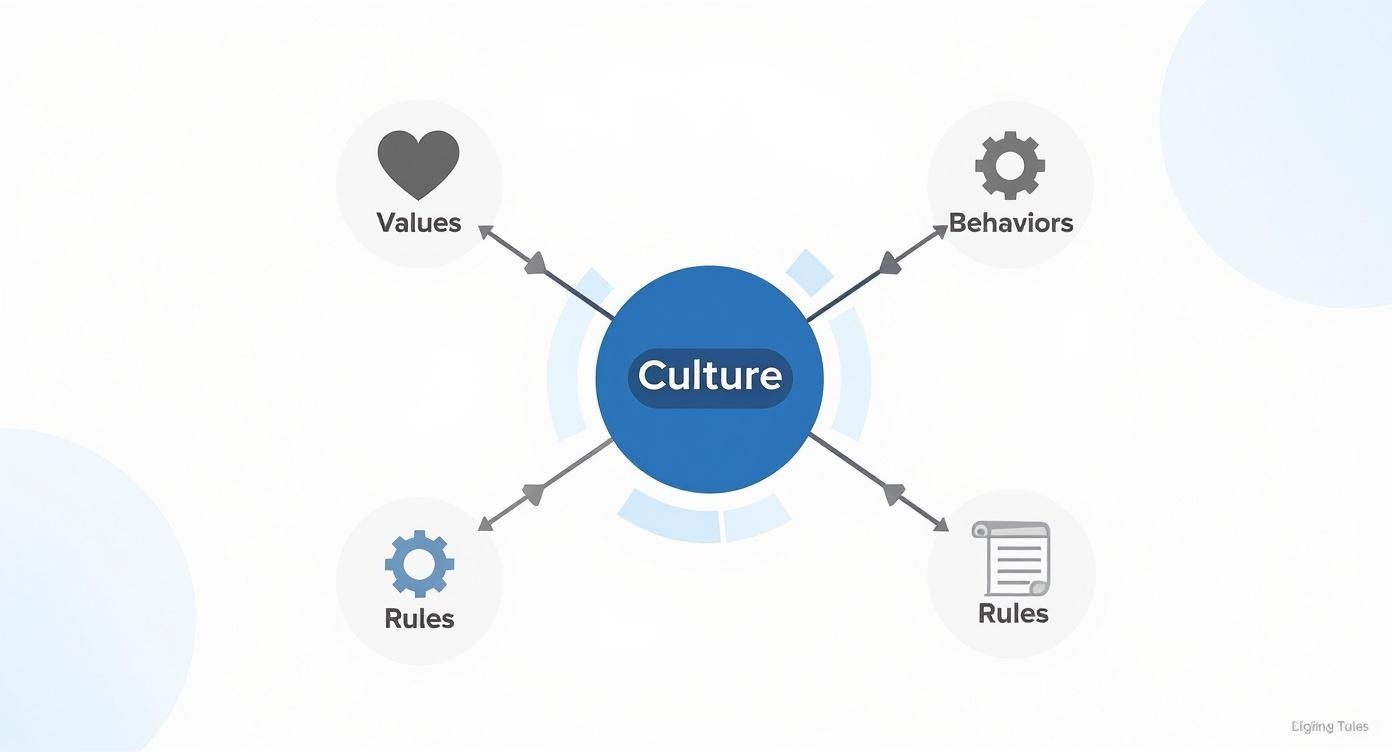
This visual gets to the heart of it. A central cultural identity is built on these three pillars, showing that culture is a living system, not just a mission statement on a wall. Now, let’s see how these pieces come together in four very different ways.
The Clan Culture: A Close-Knit Family
First up, picture a workplace that feels more like a tight-knit family than a corporation. That's the essence of a Clan Culture. It’s built on a bedrock of collaboration, mentorship, and a powerful sense of "we're all in this together."
In this environment, leaders often act more like coaches than traditional bosses. Success isn't just about hitting numbers; it’s defined by teamwork and employee development. For instance, a small software startup in Austin might prioritize team lunches and peer-to-peer learning to maintain its collaborative spirit during rapid growth. This fosters a deeply supportive and loyal atmosphere where people feel a real sense of belonging, with the primary focus being on internal cohesion and morale.
But there’s a catch. This family-like vibe can sometimes lead to a lack of diverse thinking or an aversion to making the tough calls needed for high performance.
The Adhocracy Culture: An Innovation Lab
Now, switch gears and imagine a place that operates like a fast-paced innovation lab. An Adhocracy Culture thrives on creativity, experimentation, and taking calculated risks. The core belief here is that if you're not adapting, you're falling behind.
Leaders in this setting are visionaries and entrepreneurs, pushing their teams to think outside the box and take initiative. The workplace is agile, often a bit chaotic, and prioritizes groundbreaking ideas over rigid processes. A biotech firm in California, for example, might encourage its scientists to pursue unconventional research paths, knowing that a few breakthrough discoveries will outweigh many failed experiments. It’s a magnet for pioneers and problem-solvers.
The potential downside? This constant sprint for the "next big thing" can lead to burnout and a lack of focus on refining the great products you already have.
A company's culture and its leadership are inextricably linked. The way leaders respond to challenges, celebrate successes, and handle failures sets the tone for the entire organization. Their actions, not just their words, define the true cultural reality.
The Market Culture: A Competitive Sports Team
A Market Culture has the intensity of a championship sports team. It is relentlessly results-driven, with a laser focus on winning market share, crushing the competition, and hitting ambitious targets. Failure is not an option.
Here, leaders are demanding coaches who expect peak performance and handsomely reward their top producers. The entire environment is fuelled by metrics, profitability, and market dominance. A high-stakes investment bank in New York is a classic example, where bonuses and promotions are tied directly to quarterly performance metrics. This culture excels at execution and thrives under pressure, making it a force to be reckoned with in competitive industries.
While incredibly effective, this relentless drive can sometimes come at the cost of internal collaboration and employee well-being. The win is everything.
The Hierarchy Culture: A Well-Oiled Machine
Finally, we have the Hierarchy Culture, which operates like a well-oiled machine. This culture values stability, predictability, and efficiency above all else. Everything is defined by clear processes, formal rules, and a strict chain of command.
Leaders act as coordinators and organizers, ensuring procedures are followed to the letter and operations run like clockwork. The main goal is to produce reliable, consistent results through meticulous control and risk management. A large government agency in Ottawa or Washington, D.C. relies on this structure to ensure public services are delivered consistently and fairly, with minimal deviation from established protocols. This structure provides clarity and predictability, which is critical in sectors like finance or government.
The obvious risk? This rigidity can easily stifle creativity and cripple the organization's ability to adapt when markets shift.
Understanding these archetypes is the first step. But figuring out where your company truly stands—and where the hidden friction points are—requires more than a simple quiz. This is where modern business intelligence tools like Wurkn come in, moving beyond surface-level surveys to deliver the deep, continuous business intelligence you need to understand the real, lived experiences that define your culture.
How Culture Becomes Your Competitive Advantage
Let’s be honest. Most companies treat culture like a “soft” perk—it’s nice to have, but it takes a backseat to hard numbers like revenue and market share. This is a huge, fundamental mistake. A strong, positive culture isn't a perk; it's a hard asset that directly fuels your business results and creates a competitive advantage that’s incredibly difficult to copy.
It draws a straight line from how your people feel every day to how your company performs. When the culture is right, key metrics like retention, productivity, and innovation don't just inch up—they accelerate.
From Workplace Vibe to Business Driver
Think about innovation for a second. Countless companies say they want it, but their culture actively stomps it out. True progress only happens in a workplace that champions psychological safety, where people feel secure enough to float a new idea, question how things are done, and even fail without fearing punishment.
This sense of safety is a direct pipeline to better products and services. When a junior developer in the U.S. feels empowered to suggest a radical new feature, or a customer service agent in Canada is encouraged to share a better way to solve a client’s problem, the whole business gets smarter. You can learn more about this in our guide on building a culture of innovation.
This isn't just theory; it's backed by solid data. A 2023 report on Canadian workplaces shows that prioritizing diversity, inclusion, and psychological safety directly correlates with higher productivity and profitability (Culture Amp, 2023). These are the exact conditions that cut down on turnover and build real commitment. As the market shifts, people now value fairness and safety more than ever, making culture the linchpin of retention.
The Financial Power of a Healthy Culture
The financial payoff for investing in your culture is crystal clear. High turnover is brutally expensive when you add up recruitment, hiring, onboarding, and lost productivity. A strong culture is one of the most powerful retention tools you have, and it can slash these costs.
Here are the tangible returns you can expect:
- Reduced Turnover Costs: People who feel valued and connected to a purpose don't look for the exit. That saves your company thousands of dollars for every single employee who stays.
- Increased Productivity: A positive culture gets rid of the friction and "emotional tax" that comes with a toxic environment. This frees up your team’s mental energy to focus on high-value work, leading to better, faster results.
- Attraction of Elite Talent: In competitive markets across North America, top performers have options. They are increasingly choosing organizations with a reputation for a stellar culture, giving you a serious edge in the war for talent.
A strong culture transforms your workforce from a group of individuals into a cohesive, motivated unit. It aligns everyone toward a common goal, making the whole organization more resilient, adaptable, and ultimately, more successful.
Beyond Surveys: A True Business Intelligence Approach
To really understand and nurture this advantage, you need to go way beyond the annual engagement survey. Traditional HR survey tools give you a static, often outdated snapshot of how people feel. They might tell you that you have a problem, but they rarely explain why or offer real-time guidance on how to fix it.
This is where a tool like Wurkn delivers a completely different level of value. It’s not just another employee engagement platform; it’s a business intelligence tool that gives you a continuous, live pulse of your organization’s health. By capturing and analyzing always-on, anonymous feedback, Wurkn translates those fuzzy cultural signals into a dashboard of actionable business intelligence.
This allows leaders to spot issues early, get to the root cause of friction, and make data-driven decisions that strengthen the culture before small problems become expensive ones. Investing in your culture isn't a cost—it’s a strategy that delivers a powerful and sustainable return.
Moving Beyond Annual Surveys to Understand Culture
For decades, the annual employee engagement survey was the standard tool for checking the pulse of an organization's culture. It’s a familiar ritual for leaders, a once-a-year snapshot. But in today’s work environment, relying on this method is like trying to drive down the highway using a map that’s a year old. You’re looking at where you’ve been, not where you are right now.
Annual surveys give you a static, often obsolete, picture. By the time the data is collected, analysed, and finally presented, the cultural reality on the ground has already moved on. This lag forces leaders into a constant state of reaction, always addressing old problems instead of proactively shaping a better future.
The Limits of a Once-a-Year Snapshot
Traditional HR survey tools are great at telling you that a problem exists. They completely fall short in explaining why. They capture sentiment at one specific moment, missing the thousands of subtle, daily interactions that truly define what it’s like to work at your company.
A low score in "collaboration" signals an issue, sure, but it doesn't give you the root cause. Is it friction between two specific teams? Unclear project ownership? Or are communication tools failing in a new hybrid model? The annual survey leaves you guessing.
Recent data on Canadian workplaces makes this complexity crystal clear. While overall employee engagement sits at a respectable 71% (placing organizations in the top 46% globally), there are obvious friction points hiding beneath the surface (Culture Amp, 2023). Employees report lower satisfaction with growth opportunities and remote work, even while rating decision-making highly. These are the nuanced insights critical for retention, and they get lost in broad, infrequent surveys. You can explore the full findings on Canadian workplace culture to see the detailed picture.
The real story of your organizational culture isn’t written in a single survey report. It’s written every single day in team meetings, project updates, and one-on-one conversations. To capture it, you need a continuous, real-time approach.
The Shift to Continuous Business Intelligence
To get a real handle on organizational culture, leaders have to move from periodic measurement to continuous listening. This is where the concept of business intelligence completely changes how we see and manage culture. Forget the yearly check-up; imagine having a live dashboard of your organization’s health.
This approach means analysing real-time, anonymised signals from the daily flow of work—communication patterns, meeting dynamics, and collaboration friction—to get an honest pulse of your company. It’s about understanding the "why" behind the "what," as it happens.
For instance, a business intelligence tool can spot rising frustration around a new software rollout weeks before it shows up as a productivity dip or a complaint in an HR survey. This lets leaders step in with support and training proactively, not reactively.
Why Business Intelligence Outperforms HR Survey Tools
This is where a platform like Wurkn delivers value far beyond traditional survey tools or basic employee engagement platforms. Wurkn isn't just another survey platform; it’s a cultural business intelligence engine built to translate continuous, anonymous employee sentiment into actionable insights.
It meets employees right where they work—in Slack, Microsoft Teams, and other collaboration hubs—without adding another task to their plate. Its privacy-preserving, always-on technology captures the nuance of daily work life, giving leaders a rich, contextual understanding of their culture. This shift is critical because, as we've said before, simple metrics like eNPS aren't enough to accurately measure company culture.
The difference between outdated surveys and modern business intelligence is stark. One gives you a history lesson, while the other gives you a real-time guide.
Annual Surveys vs Continuous Business Intelligence
| Feature | Annual Surveys | Wurkn (Business Intelligence) |
|---|---|---|
| Data Frequency | Once a year (static snapshot) | Always-on, real-time (live pulse) |
| Insight Type | Identifies that a problem exists | Explains why a problem exists |
| Approach | Reactive (addressing past issues) | Proactive (spotting trends as they emerge) |
| Focus | Measures sentiment at one point in time | Analyses daily behaviours and interactions |
| Value | Basic engagement metrics | Actionable intelligence tied to business KPIs |
This move from static reports to a live dashboard is a fundamental change in how we lead. It equips leaders to spot risks before they become crises, celebrate successes as they happen, and make data-driven decisions that build a resilient, high-performing organization. It’s the difference between looking in the rearview mirror and having a clear view of the road ahead.
A Practical Guide to Building a Winning Culture
Knowing what culture is and actually building a great one are two very different things. The real work starts when you move from theory to practice, and that requires a focused, deliberate blueprint. This isn't about grand, one-off gestures; it's about the steady, everyday actions that define how people truly experience their work.
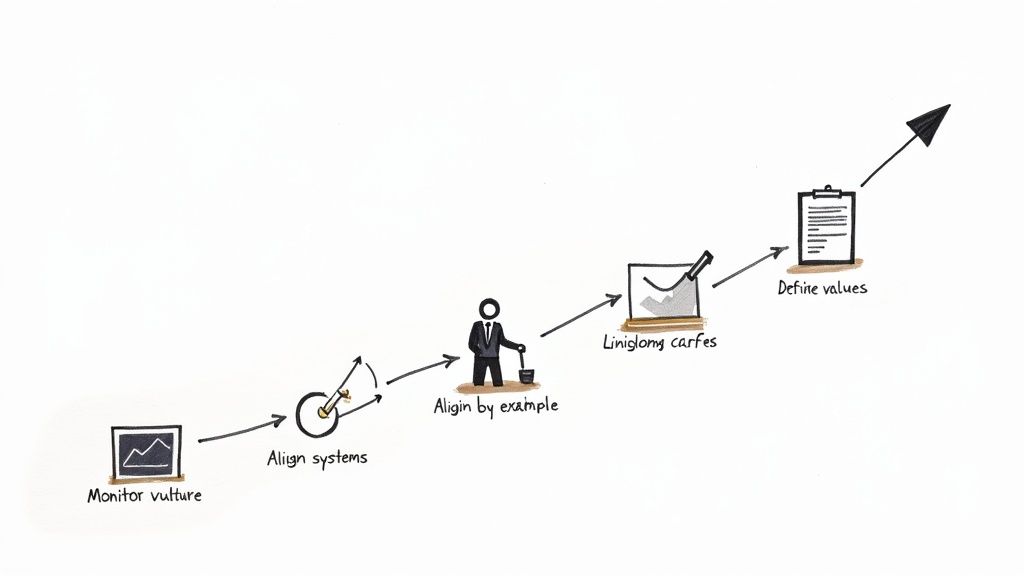
The journey begins with a clear vision and, when done right, ends with a resilient, high-performing organization. Here are five concrete steps any leader can take to build a culture that doesn't just feel good but drives tangible business results.
Define and Communicate Your Core Values
Your values are the bedrock of your culture. They can't be generic buzzwords chosen in a boardroom meeting; they must be an honest reflection of what your organization actually stands for. The best way to make sure they stick is to involve your people in the process from the start.
Ask your teams what they value most about the company and what behaviours they see leading to success. Once you've defined these values, you have to communicate them relentlessly. Weave them into every single part of the employee journey, from the first interview to the way you conduct performance reviews.
Lead by Example Every Single Day
Culture always flows from the top. Your employees are constantly looking to leaders for cues on how to act, so what you do will always be more powerful than what you say. If "collaboration" is a core value, leaders need to be the first ones breaking down silos and actively seeking input.
If you preach "transparency," you have to communicate openly and honestly, especially when the news is tough. Any inconsistency from leadership will quickly destroy trust and make the entire cultural initiative feel like a hollow exercise.
Align Systems to Reinforce Your Culture
Think of your company's internal systems and processes as the silent enforcers of your culture. To build a winning culture, every single system—from how you hire and promote to how you recognize great work—must be aligned with your core values.
- Hiring and Onboarding: Don't just recruit for skills; hire for cultural alignment. Your onboarding shouldn't just be about paperwork; it needs to be a deep dive into "how we do things around here," reinforcing your values from day one.
- Performance Management: Link performance reviews and promotions directly to your values. This sends an unmistakable signal that how the work gets done is just as critical as what gets done.
- Recognition Programs: Make a point to actively and publicly celebrate the people who are living your culture. When you recognize desired behaviours, you reinforce them for the entire organization.
A great culture isn't built on what you say; it's built on what you reward, what you promote, and what you tolerate. Aligning your systems ensures your values are more than just words on a poster.
Cultivate Communication and Psychological Safety
A healthy culture can only thrive on open communication and psychological safety—that feeling people have when they can speak up, share a crazy idea, or even admit a mistake without fearing punishment. This requires leaders to actively ask for feedback and, even more importantly, to act on it.
When people see that their input actually leads to change, they become far more invested in the company's success. It creates a powerful, virtuous cycle of trust and continuous improvement. For more on this, check out our practical advice on how to improve company culture.
Use Business Intelligence to Monitor and Adapt
You can't fix what you can't see. Building a great culture is an ongoing process, not a one-and-done project. While annual surveys give you a limited, outdated snapshot, a continuous approach gives you a live pulse of your organization's cultural health.
This is where a cultural business intelligence tool like Wurkn provides a massive advantage over traditional employee engagement platforms and HR survey tools. By capturing always-on, anonymous feedback, Wurkn translates daily employee sentiment into actionable insights. It lets leaders spot trends as they emerge, diagnose the root cause of friction, and make data-informed adjustments in real-time.
This approach transforms culture management from a reactive guessing game into a proactive, strategic discipline, giving you the power to build a resilient culture that genuinely drives your business forward.
Your Top Culture Questions, Answered
For leaders serious about culture, a few key questions always come up. Here are some straightforward, practical answers to the most common queries we hear.
Can You Really Change an Existing Culture?
Yes, but it’s a marathon, not a sprint. Real change requires unwavering, long-term commitment from the top. It starts when leaders don't just talk about the desired future state but actively model those new behaviours, day in and day out.
From there, you have to hardwire the new culture into the very fabric of the organization. That means aligning everything—from who you hire and how you promote, to how you manage performance and reward success—with your new core values.
This is where a business intelligence tool like Wurkn becomes your secret weapon. It gives you a real-time view of how the change is landing, showing you where you're gaining traction and where you're hitting resistance. This continuous feedback loop lets you make small, data-backed adjustments along the way, ensuring the new culture actually sticks.
How Does Remote Work Impact Company Culture?
Going remote or hybrid means you can no longer rely on physical osmosis to build your culture. You have to be far more deliberate about it. Without the casual interactions and visual cues of an office, you must proactively build connection and reinforce your values through digital channels.
This isn't just about virtual happy hours. It’s about creating dedicated digital spaces for both focused collaboration and informal social connection. It’s about guaranteeing everyone has the same access to information, regardless of their location. Most importantly, it’s about fostering a deep-seated culture of trust and autonomy. In a distributed world, your culture is defined less by a shared space and more by shared principles and digital-first habits.
What’s the Difference Between Culture and Engagement?
It's simple: think of culture as the cause and engagement as the effect.
Your organizational culture is the underlying operating system of your company—the shared values, unspoken assumptions, and common behaviours that define how work gets done. It's the environment itself.
Employee engagement, on the other hand, is the outcome. It's the emotional commitment and passion an employee feels for their work and for the company. It’s a direct result of the culture they experience every day.
A strong, positive culture is the most reliable driver of high engagement. You might see pockets of engaged employees in a toxic culture, but it's never sustainable. To achieve lasting engagement and the incredible business results that follow, you have to do the foundational work of building a healthy culture first.
Ready to stop guessing and get a real-time pulse on your company’s cultural health? Wurkn turns continuous employee sentiment into actionable intelligence you can tie directly to your business results. Discover how Wurkn can help you build a winning culture.