
If you’ve ever wondered “what is an HRIS?”, the answer is simpler than you might think. It’s a Human Resource Information System—a single piece of software that acts as the command centre for all your people operations. Think of it as the digital backbone of your HR department, connecting everything from payroll and benefits to performance reviews in one secure, central hub.
What is an HRIS and Why Does It Matter?
Picture this: your company’s people data is scattered across a dozen spreadsheets, stacks of paper files, and a handful of disconnected apps. Vacation days are tracked in one place, benefits enrolment lives in another, and payroll is its own separate beast. This kind of disjointed system isn’t just a headache; it’s a breeding ground for costly errors and serious security risks for businesses in the United States and Canada.
A Human Resource Information System (HRIS) is the solution. It creates a single source of truth for all employee information, collecting, storing, and managing crucial data across the entire employee lifecycle—from the moment a candidate applies to their very last day.
From Manual Tasks to Automated Workflows
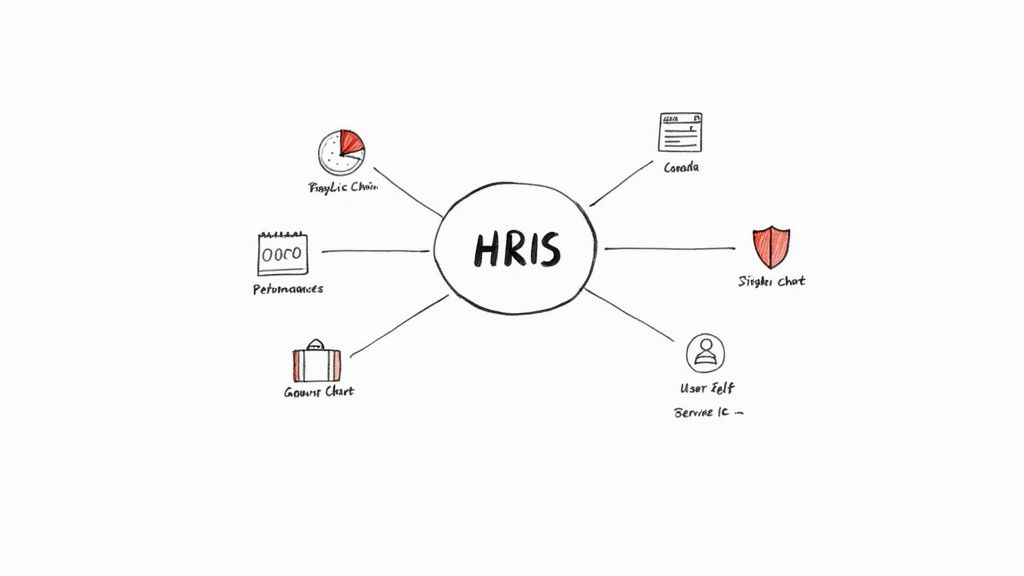
At its heart, an HRIS is about trading manual, repetitive HR chores for smart, automated workflows. Instead of manually punching in new hire information across five different systems, the HRIS does it for you. Instead of calculating paid time off by hand, the system tracks it automatically. This shift is a game-changer for any modern business.
A Human Resource Information System (HRIS) is a centralized software platform that’s become essential for both Canadian and American businesses looking to consolidate employee data and automate core HR functions. For businesses in Canada, these platforms are often designed to keep employee data within the country, ensuring compliance with national privacy laws and minimizing data breach risks. The software handles everything from personal details and payroll to benefits and performance reviews, dramatically improving efficiency by automating onboarding, time tracking, and even offboarding. You can discover more about Canadian HRIS benefits to see how it applies locally.
To give you a clearer picture, let’s break down the core functions you can expect from a typical HRIS.
Core HRIS Functions at a Glance
This table breaks down the essential capabilities of a typical HRIS, offering a quick reference to understand its primary roles within an organization.
| Function Area | Description | Example Task Automated |
|---|---|---|
| Database Management | Acts as a central, secure repository for all employee information. | Storing personal details, contact info, and employment history. |
| Payroll Processing | Manages employee compensation, tax withholdings, and deductions. | Automatically calculating salaries, overtime, and tax contributions. |
| Benefits Administration | Handles enrolment, changes, and management of employee benefits plans. | Allowing employees to self-enrol in health or retirement plans. |
| Time & Attendance | Tracks employee work hours, paid time off (PTO), and sick leave. | Employees clocking in/out and requesting vacation through a portal. |
| Recruiting & Onboarding | Manages the applicant tracking and new hire onboarding processes. | Automating the flow of new hire paperwork and initial training. |
| Performance Management | Facilitates performance reviews, goal setting, and feedback cycles. | Scheduling reviews and tracking progress against set objectives. |
These functions work together to create a cohesive system that touches nearly every aspect of the employee journey.
Empowering Employees and Leaders
But a modern HRIS isn’t just a tool for HR administrators. It empowers the entire organization. Features like employee self-service allow team members to update their own personal information, request time off, or access their pay stubs without filing a single ticket. That simple autonomy frees up your HR team to focus on more strategic work that actually moves the needle.
For leaders, an HRIS provides the data needed for informed decision-making. It offers a clear view of workforce analytics, helping to identify trends in turnover, compensation, and team performance.
Ultimately, an HRIS does more than just organize data; it builds the foundation for a smarter, more strategic approach to human resources. But it’s only the beginning. While an HRIS answers what is happening with your people, integrating it with a business intelligence tool like Wurkn helps you understand why. That’s where you turn raw data into actionable insights about your company culture and its direct impact on performance.
What Are the Core Modules of an HRIS?
Think of an HRIS less like a single, rigid piece of software and more like a set of high-tech building blocks. Each block, or module, is designed to handle a specific HR function. This lets you build a system that perfectly fits your company’s operational needs, rather than forcing your processes into a one-size-fits-all box.
The real goal here is to bring some much-needed order to the chaos of HR administration, turning tedious manual tasks into smooth, automated workflows. This is especially critical for businesses trying to keep up with the different, and often complex, regulatory landscapes in Canada and the United States.
Payroll Management
If there’s one module that’s absolutely non-negotiable, it’s Payroll Management. This is the engine room of the HRIS, automating the entire cycle of paying your people. It crunches the numbers for gross pay, handles all the tricky deductions, and processes direct deposits, all without manual intervention.
Its biggest superpower is managing complex tax withholdings across different jurisdictions. Instead of a payroll manager manually calculating provincial taxes for an employee in Ontario versus state and federal taxes for someone in Texas, the system gets it right every time. This single feature can save a business from crippling fines and compliance headaches.
Benefits Administration
Next up is Benefits Administration. This module tackles one of the most complex and paper-heavy parts of HR, managing everything from health insurance and retirement plans to company wellness programs. It gives employees a central, easy-to-use portal to see their options and sign up during open enrolment.
Better yet, when life happens—an employee gets married or welcomes a new child—they can update their own information and change their benefits right in the system. This self-service function gets rid of the paperwork pile-up on HR’s desk and frees them up to offer real, strategic support to employees.
A well-implemented HRIS turns benefits from a confusing, form-filled nightmare into a clear, user-friendly experience that actually helps you attract and keep the best people.
Time and Attendance Tracking
The Time and Attendance module is where manual timesheets and old-school punch cards go to die. Employees can clock in and out digitally, whether they’re at the office, on a job site, or working from their kitchen table. All that data flows seamlessly into the payroll module, ensuring hourly workers and overtime are calculated with pinpoint accuracy.
This module also puts paid time off (PTO), sick days, and vacation leave on autopilot. Managers can approve time-off requests with a single click, and employees can always see their available balances. It’s a simple change that massively boosts transparency and makes planning easier for everyone.
Onboarding and Recruitment
Finally, the Onboarding module is all about creating a killer first impression for new hires. It automates the entire pre-start process, sending out employment contracts, tax forms, and policy documents so everything is signed, sealed, and delivered before their first day. A structured start like this helps new team members feel confident and ready to contribute from the moment they walk in the door.
This move toward digital HR isn’t a niche trend. As reported by HRD Canada, over 6,000 Canadian small and medium enterprises (SMEs) have already adopted HRIS technology, showing a major shift in how businesses operate. These companies are automating everything from database management to compliance, finding huge operational efficiencies while navigating Canada’s unique regulatory rules. You can dig deeper into how Canadian businesses are using HRIS software to fuel their growth.
By combining these modules, any organization can build a powerful, customized system that truly works for them.
HRIS vs. HRMS vs. HCM: Decoding the Acronyms
The world of HR technology is a minefield of acronyms that all sound frustratingly similar. But figuring out the difference between an HRIS, HRMS, and HCM is crucial for choosing the right system for your business. The easiest way to think about it is as an evolution, with each system building on the capabilities of the one before it.
An HRIS, or Human Resource Information System, is the ground floor. It’s the foundational system for your people operations, focused squarely on collecting and managing core employee data. Its main job is to handle the administrative heavy lifting—things like employee records, payroll, and benefits administration.
This is the system of record, the single source of truth for who works for you and the essential details about them.
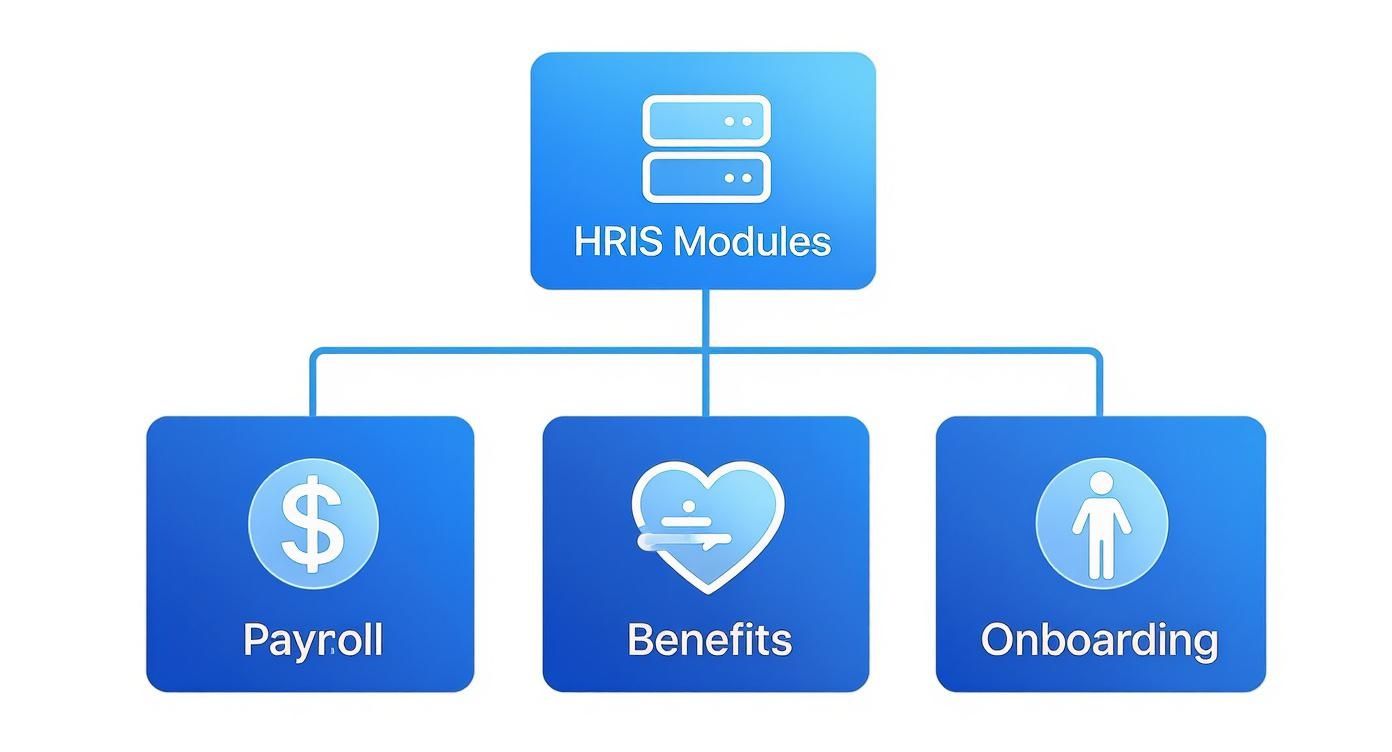
As you can see, the HRIS acts as the central hub for these core functions, making sure data is organised and accessible. You can’t build anything more complex without this solid foundation in place.
HRMS: The Next Level of Functionality
A Human Resource Management System (HRMS) is the next step up. If an HRIS is the blueprint for your house, an HRMS is the fully built structure. It includes all the core administrative functions of an HRIS but layers on more sophisticated features related to talent management.
This expansion typically adds tools for:
- Time and Labour Management: Going beyond basic clock-ins to more advanced tracking of employee hours and productivity.
- Recruiting and Onboarding: Managing the entire applicant lifecycle, from posting a job to getting that new hire fully integrated.
An HRMS starts to connect the dots between pure administration and actively managing the employee experience.
HCM: A Fully Strategic Approach
Finally, we have the Human Capital Management (HCM) suite, which represents the most comprehensive and strategic solution available. To finish our analogy, if the HRMS is the house, the HCM is the fully integrated smart home. It does everything an HRIS and HRMS can do, but adds a powerful strategic layer focused on maximizing the value of your workforce.
An HCM system is designed not just to manage employees, but to develop them into valuable assets. It aligns your people strategy with broader business objectives, focusing on long-term growth and organizational performance.
Key HCM features often include advanced talent management, succession planning, compensation management, and deep performance analytics. These systems give you a ton of data, but they often stop at reporting what is happening.
This is where the real insight gap lies. To truly understand the why behind the numbers—like employee sentiment, team friction, or overall cultural health—you need to go a step further. Integrating your HCM with a business intelligence tool like Wurkn is the key. Wurkn translates that raw HCM data into actionable intelligence, giving leaders the insights they need to make decisions that improve both performance and their people’s experience at work.
Comparing HRIS, HRMS, and HCM Systems
To make the distinctions even clearer, let’s break down how these systems stack up against each other. Each level adds more complexity and strategic value, moving from basic administration to comprehensive talent optimization.
| System Type | Primary Focus | Core Features Included |
|---|---|---|
| HRIS | Core Administration & Data Management | Employee Records, Payroll Processing, Benefits Administration, Compliance Reporting |
| HRMS | Administration & Talent Management | All HRIS features, plus: Time & Labour Tracking, Recruiting & Onboarding (ATS), Performance Management |
| HCM | Strategic Talent & Workforce Optimization | All HRIS & HRMS features, plus: Compensation Management, Succession Planning, Advanced Analytics, Learning & Development (LMS) |
Ultimately, choosing the right system depends on your company’s size, complexity, and strategic goals. A small business might only need a solid HRIS, while a large enterprise aiming to optimize its entire talent lifecycle will find the most value in a comprehensive HCM suite.
The Real Business Impact of an HRIS
Let’s get one thing straight: an HRIS isn’t just about swapping out filing cabinets for digital folders. It’s about driving real, measurable business outcomes that ripple through every department. When you move past a simple feature list, you see the true value: this is the system that turns your HR team from a cost centre into a strategic powerhouse.
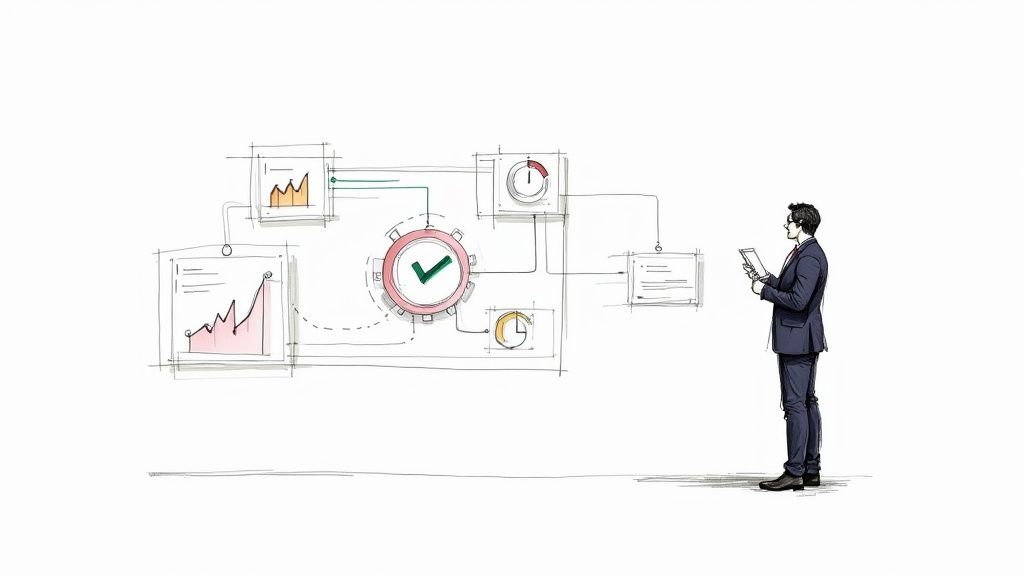
The first thing you’ll notice is a massive efficiency boost. Think of all the routine, administrative busywork—processing payroll, tracking time off, managing benefits. An HRIS automates that, freeing up countless hours for your HR professionals. Suddenly, they’re not stuck on tedious data entry; they’re focused on high-impact work like talent development and strategic workforce planning.
Better yet, that automation drastically cuts down on costly human errors. A manual mistake in payroll or a slip-up in benefits enrolment can destroy employee trust and create a compliance nightmare. An HRIS ensures accuracy, protecting your business from financial penalties while making sure your team gets paid correctly and on time, every single time.
Unlocking Strategic Workforce Insights
But the most powerful impact? An HRIS has the ability to transform raw people data into strategic intelligence. With every piece of employee information centralized, your leadership team finally gets a clear, unified view of the entire workforce. They can stop making decisions based on gut feelings and start using hard data.
For example, instead of just knowing your company-wide turnover rate, you can drill down and see it by department, by manager, or even by demographic. This is where you find the real story and pinpoint problem areas that would otherwise fly under the radar. It allows for big-picture analysis, too. In Canada, for instance, you can take your internal trends and compare them against national benchmarks from Statistics Canada’s labour market data. It gives you a powerful context for your people strategy.
An HRIS transforms people data from a simple record-keeping exercise into a predictive tool for business growth. It provides the foundation for proactive decision-making that directly aligns your people strategy with core business objectives.
Data-Driven Decisions for Leadership
With an HRIS, your leadership team can finally answer critical business questions with confidence:
- Are our compensation packages competitive? You can analyze salary data across roles and regions to make sure you’re actually attracting and keeping top talent.
- Where are our future leaders hiding? Spot your high-performers and track their development to build a solid succession pipeline from within.
- What’s really driving employee turnover? Cross-reference exit interview data with performance reviews and compensation history to uncover the root causes of attrition.
This level of insight is invaluable, but an HRIS typically only shows you what is happening, not why. The data might flag high turnover in a specific team, but it won’t explain the cultural issues or leadership problems causing it.
That’s where true business intelligence comes in. By integrating your HRIS with a business intelligence tool like Wurkn, you can layer that quantitative data with qualitative feedback. This combination uncovers the sentiment and cultural drivers behind the numbers, giving you the complete picture. To see how this works in practice, you can learn how COOs get actionable business insights from continuous employee feedback.
From HR Data to Business Intelligence with Wurkn
A standard HRIS is brilliant at telling you what is happening inside your business. It can flag a 20% turnover rate in your engineering department or show that absenteeism spikes on Fridays. This data is critical, but on its own, it’s just a symptom.
To drive meaningful change, you need the story behind the numbers—you need to know why.
This is where a traditional HRIS hits its limit. It’s also where integrating it with a business intelligence tool like Wurkn creates a serious competitive advantage. An HRIS gives you the dots; Wurkn connects them to reveal the full picture of your organizational health.
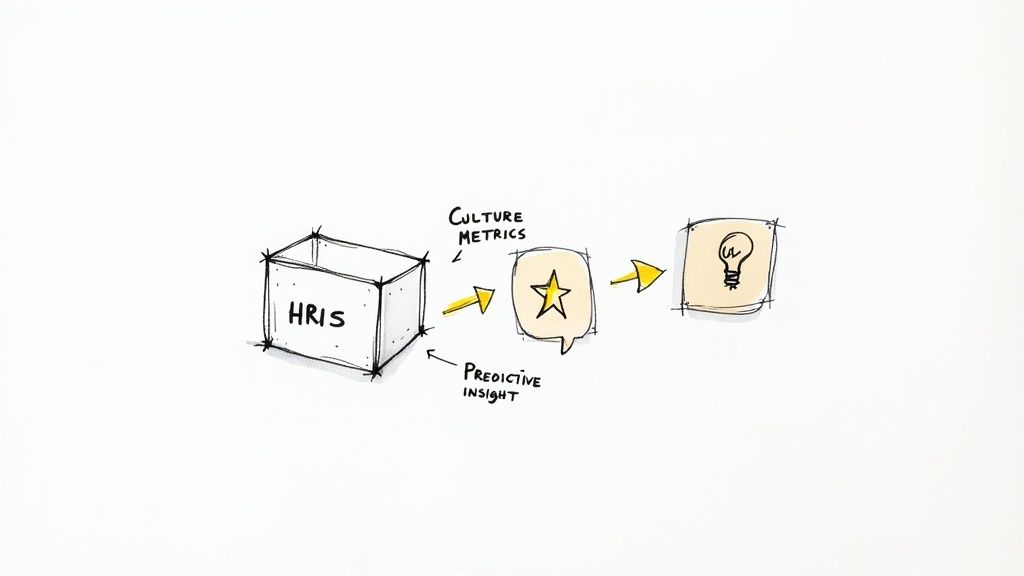
Beyond Reports to Root Causes
Imagine your HRIS report flags that high turnover in engineering. The old way of thinking might lead you to guess at the cause. Is it compensation? Is it the workload? You might launch a generic, disruptive employee engagement survey that delivers lagging data weeks later, long after the problem has already gotten worse.
Now, picture a smarter approach. By integrating your HRIS with Wurkn, you can layer that turnover data with real-time cultural metrics. Wurkn analyzes anonymized communications, continuous feedback, and other cultural signals to find correlations you would otherwise miss.
You might discover the root cause isn’t pay at all. Instead, the data could point to a specific team manager whose communication style is creating friction, or a lack of recognition that’s leaving top performers feeling undervalued. This is the difference between reacting to problems and proactively solving them.
Turning Qualitative Feedback into Quantitative Insights
Standard HR survey tools and employee engagement platforms collect feedback, but they often fail to connect it directly to business outcomes. Wurkn is different. It’s a business intelligence platform that translates qualitative employee sentiment into measurable, actionable insights for leadership.
- From Data Point to Diagnosis: An HRIS shows you an employee has resigned. Wurkn can analyze anonymized feedback trends leading up to that resignation, helping you understand the cultural drivers behind their departure.
- From Guesswork to Strategy: Instead of guessing why a project is behind schedule, Wurkn can identify communication bottlenecks or drops in team morale that are hurting productivity.
- From Reactive Fixes to Predictive Action: By monitoring cultural health in real-time, you can spot early warning signs of burnout or disengagement and step in before they affect your bottom line.
Wurkn elevates your HRIS data from simple, historical reports into a forward-looking, strategic tool. It provides a living dashboard of your organization’s cultural health, linking employee sentiment directly to key performance indicators like retention, productivity, and even revenue.
To get a deeper understanding of this approach, explore how HR software should be data-driven and genuinely helpful. By uncovering the why behind the what, you empower your leaders to build a healthier, more resilient, and higher-performing organization.
How to Choose the Right HRIS for Your Business
Picking an HRIS is a huge decision. It’s not just another piece of software; it’s a foundational investment that will dictate your operational rhythm for years. Getting it right demands a clear, strategic game plan that starts by looking inward at your company’s real-world needs and biggest administrative headaches.
Before you even glance at a vendor’s website, your first job is a thorough needs assessment. Get your key people from HR, IT, and finance in a room and start mapping out your current processes. Where do things grind to a halt? Are you losing hours to manual payroll corrections? Is your onboarding a disjointed, clunky mess? Nailing down these specific pain points gives you a non-negotiable checklist of problems the HRIS must solve.
Defining Your Core Requirements
Once you’ve identified your pain points, you can translate them into a concrete list of essential features. Be brutally honest about what you need right now versus what would be a nice-to-have down the road.
Your requirements list should hit a few key areas:
- Scalability: Will this system grow with you? A platform that’s perfect for 50 employees might completely buckle under the pressure of 250. Think about where your business will be in three to five years.
- Integrations: How well does it play with the software you already use? Think about your accounting platform or project management tools. Seamless integration is what prevents the dreaded data silos that kill efficiency.
- User Experience: Is the interface actually intuitive for both HR admins and everyday employees? A confusing system will tank adoption rates and just lead to widespread frustration.
Vetting Vendors and Ensuring Compliance
With a shortlist of vendors in hand, the real due diligence begins. This is the time to ask the tough questions about vendor support, implementation timelines, and, most critically, data security. For any business operating in North America, this is non-negotiable.
Make sure any potential vendor can show you exactly how they comply with privacy laws like Canada’s Personal Information Protection and Electronic Documents Act (PIPEDA) or the California Consumer Privacy Act (CCPA). Ask them directly where your employee data will be stored and what their exact protocols are for a data breach.
Finally, think beyond the basic HR functions. An HRIS should be the foundation for much deeper business intelligence. While it’s great at managing the core data, you still need a way to understand the cultural stories behind the numbers. This is where integrating your HRIS with specialized People Ops SaaS solutions like Wurkn comes in. It allows you to connect those hard HR metrics to the real-time cultural health of your teams, turning raw data into actionable insights that actually drive performance.
HRIS Questions We Hear All the Time
Got questions? You’re not alone. Let’s cut through the jargon and get straight to the answers you actually need.
What’s the Real Difference Between an HRIS and Basic Payroll Software?
Think of it this way: payroll software is a calculator. It does one job really, really well—calculating paycheques, taxes, and deductions. It’s essential, but it’s a single-function tool.
An HRIS, on the other hand, is the entire operational command centre for your people. It almost always includes a payroll module, but it also handles everything else: benefits administration, time off, performance reviews, onboarding documents, you name it. It connects all the dots of the employee journey into one cohesive picture.
Is an HRIS Overkill for a Small Business in Canada?
Absolutely not. In fact, it’s arguably more critical for a small business. Modern, cloud-based HRIS platforms are built to be affordable and scale as you grow, so you’re not buying a system you’ll outgrow in a year.
More importantly, an HRIS helps a small Canadian business stay compliant with our notoriously complex web of provincial and federal labour laws, from PIPEDA to the ESA. It helps you move from scrambling with spreadsheets to making proactive, data-informed decisions, setting you up for sustainable growth from day one.
How Does an HRIS Actually Talk to Other Business Tools?
Modern systems don’t operate in a silo. They use something called an API (Application Programming Interface), which is basically a secure bridge that lets different software platforms talk to each other automatically. This creates a seamless flow of information between your HRIS and other critical tools like your accounting software, recruiting platforms, or business intelligence dashboards.
For instance, when you connect your HRIS to a business intelligence tool like Wurkn, you eliminate the headache of manual data entry. More powerfully, you create a single source of truth. You can then overlay your core HR data—like turnover and absenteeism rates—with real-time cultural insights, revealing not just what is happening with your people, but the crucial why behind it.
This is how you turn raw data into strategic intelligence. It’s the key to making smarter, faster decisions that actually move the needle.
Connecting your HRIS data with Wurkn gives you a powerful, real-time view of your company’s cultural health. See how our business intelligence platform can help you spot issues early, slash turnover, and boost team performance. Get the insights your business needs today.