
When we talk about "people and culture," we're not just rebranding HR. We're talking about the strategic management of a company's shared values, attitudes, and day-to-day practices. Think of it as your company's core operating system—the invisible force that drives business performance.
It's the shift from a reactive, administrative function to proactively shaping how work gets done. This directly influences everything from productivity to employee retention and, ultimately, your bottom line.
Understanding People and Culture as a Business Strategy
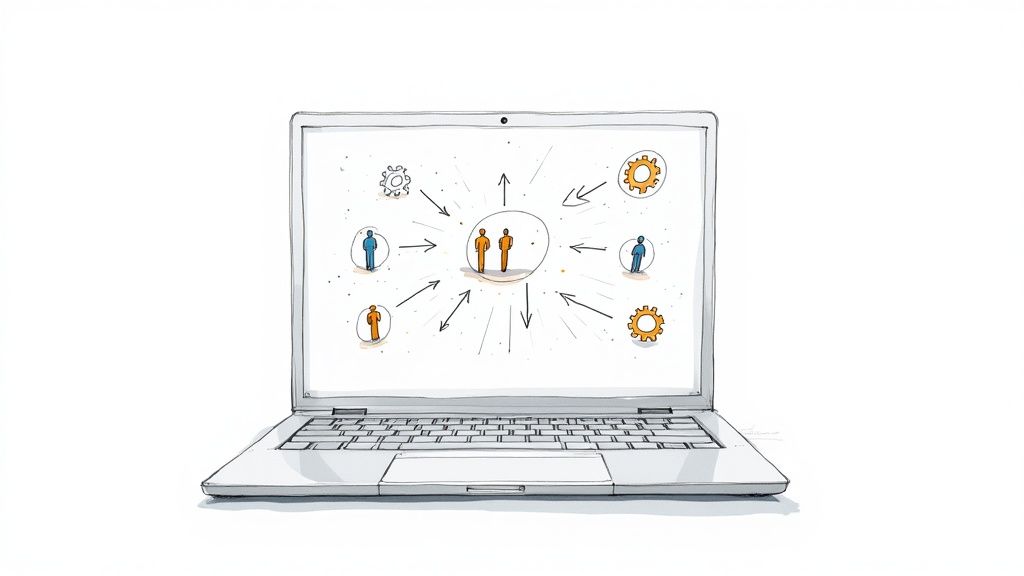
For far too long, anything related to employees got stuck in an administrative box: compliance, payroll, and enforcing the handbook. The modern approach to people and culture flips this script entirely. It isn't a department tucked away in a corner; it's the very OS your business runs on.
Here’s a logical example: your business strategy is the software application you want to run, but your culture is the operating system. If that OS is buggy, slow, or incompatible, even the most brilliant software will crash and burn. This foundational system dictates how teams collaborate, how leaders make decisions, and how the entire organization responds to challenges and opportunities.
The Shift from Engagement to Culture
Many leaders, particularly in Canada and the United States, fixate on "employee engagement" as their go-to metric. While engagement is important, it's an effect—a symptom of the underlying system. A strong, intentionally designed culture is the cause. You don't just stumble into high engagement; you build it from a healthy cultural foundation.
This distinction is crucial. An engagement survey might tell you that 30% of your team is disengaged (Gallup, 2022, State of the Global Workplace), but it won’t tell you why. Is there a lack of psychological safety? Is communication from leadership unclear? Are people disconnected from the company's values? These are deep-seated cultural issues that traditional HR survey tools simply aren't designed to uncover.
A focus on people and culture means you stop asking, "Are our employees happy?" and start asking, "Have we built an environment where talented people can do their best work?"
This shift in perspective changes everything, moving the focus from treating symptoms to fixing the root cause. It's the difference between managing morale and building a high-performance engine.
The table below breaks down this fundamental shift from an old-school administrative mindset to a modern, strategic one.
Traditional HR vs Modern People and Culture
| Aspect | Traditional HR Focus | Modern People and Culture Focus |
|---|---|---|
| Primary Goal | Compliance and administration | Performance and business impact |
| Function | Reactive and policy-driven | Proactive and strategy-driven |
| Measurement | Annual surveys, turnover rates | Continuous feedback, predictive analytics |
| Role | Cost centre, risk mitigation | Revenue driver, competitive advantage |
| Employee View | Resources to be managed | Assets to be developed and empowered |
Ultimately, this isn't just a change in title. It represents a strategic evolution in how the most successful companies view their most valuable asset: their people.
Turning an Abstract Concept into a Measurable Asset
The biggest hurdle for leaders has always been tying culture's impact to the bottom line. This is where the old model crumbles and a new one, powered by business intelligence, takes over. Instead of relying on static, once-a-year surveys, modern leaders need a real-time pulse on their organization's health.
Platforms like Wurkn are built for this, transforming continuous, anonymous feedback into actionable intelligence. Wurkn goes far beyond a simple survey tool; it's a business intelligence platform that provides a dynamic dashboard connecting cultural signals directly to your business KPIs. By analyzing this constant stream of data, leaders can:
- Diagnose issues proactively: You can spot declining morale in a specific department months before it shows up as a spike in turnover.
- Make data-informed decisions: Understand the real cultural impact of a new policy or organizational change as it happens, not a year later.
- Connect culture to performance: Draw clear, undeniable lines between high psychological safety scores and increased team productivity.
This approach lets you manage your people and culture with the same analytical rigour you apply to finance or operations. It turns an abstract "vibe" into a measurable, manageable asset, giving you the power to build a workplace that not only attracts top talent but also drives predictable business success.
Why Investing in Culture Is a Non-Negotiable for Growth
For too many leaders, culture is seen as a "nice-to-have"—something you get around to after you’ve smashed your quarterly targets. This isn’t just old-school thinking; it’s a direct threat to your long-term growth. Investing in your people and culture isn't a soft, feel-good initiative. It’s a hard-nosed business strategy with a clear, measurable return.
A healthy culture is a powerful economic engine. When your team members feel psychologically safe—meaning they can ask tough questions, challenge ideas, and even fail without getting punished—innovation isn't just a possibility; it becomes inevitable. This kind of environment directly fuels productivity because your teams spend less time navigating office politics and more time solving real business problems.
The result is a sharper, more agile, and more resilient organization. It's no surprise that companies actively building this kind of culture find their teams are far more engaged and productive, leading to better business outcomes across the board.
The Clear Link Between Culture and Retention
Employee turnover is one of the biggest hidden costs draining your company’s resources. The money you burn on recruiting, hiring, and training new people is staggering, with the cost of replacing an individual employee ranging from one-half to two times the employee's annual salary (Gallup, 2019, This Fixable Problem Costs U.S. Businesses $1 Trillion). A toxic or undefined culture is a primary reason people walk out the door, especially your top performers who always have other options.
When people feel a real sense of belonging and can see how their work connects to the company's mission, they stick around. A positive culture builds a kind of loyalty and commitment that a bigger paycheque simply can't buy.
A strong people and culture strategy turns retention from a reactive firefight into a proactive advantage. You don't just reduce costs; you retain valuable institutional knowledge and maintain momentum.
Relying on exit interviews to figure out why people are leaving is like trying to drive by looking only in the rearview mirror. By the time someone resigns, the cultural issues that pushed them out have likely been festering for months. Business intelligence tools like Wurkn give you the forward-looking visibility you need to spot these issues in real-time. For example, Wurkn could flag a consistent theme of burnout in anonymous feedback from a specific team, allowing a manager to address workload issues before they lead to resignations.
From Internal Health to External Success
The impact of your company culture doesn’t just stay within your four walls. It radiates outward, directly shaping your customer experience and, as a result, your revenue. Happy, engaged employees who feel valued are your absolute best brand ambassadors. They provide better service, are more driven to solve customer problems, and are genuinely invested in the company’s success.
Think about it: an employee who feels disrespected or unsupported is never going to go the extra mile for a customer. A positive internal culture translates directly into positive external interactions, creating a powerful cycle:
- Empowered Employees: Feel trusted to make decisions that put the customer first.
- Superior Service: Leads directly to higher customer satisfaction and loyalty.
- Sustainable Growth: Drives repeat business and fortifies your brand reputation.
This proves that focusing on people and culture isn’t just an internal HR metric; it's a critical part of a successful go-to-market strategy.
Without a way to continuously monitor and understand the cultural signals inside your organization, you're operating with a massive blind spot. Traditional annual surveys are lagging indicators that only give you a snapshot of a single moment in time. Wurkn provides a living dashboard, turning a constant stream of anonymous feedback into actionable intelligence. This empowers leaders in Canada and the United States to finally connect the dots between internal sentiment and external performance, turning culture into a predictable driver of business growth instead of leaving it to chance.
How to Measure the Intangibles of Your Organization
Let's bust a myth right now: the idea that culture is too "soft" to measure is dead wrong. If your people can feel it, you can find a way to quantify it. For too long, leaders have managed based on gut feelings and hallway conversations, but that approach simply doesn't cut it anymore. A modern people and culture strategy needs real data to get from subjective impressions to objective, actionable insights.
The trick is to stop looking backward and start focusing on leading indicators—metrics that don't just report on what happened last quarter, but actually help predict what will happen next. By tracking the right cultural signals, you can diagnose the health of your organization and make smart, proactive moves before small frustrations turn into big problems like high turnover or tanking engagement. This is how you transform culture from a vague idea into a measurable driver of business performance.
Moving Beyond the Annual Survey
Relying on a once-a-year survey to understand your culture is like trying to navigate a ship across the ocean by checking your position only once every 365 days. It’s a completely reactive approach. It gives you a single, static snapshot of an incredibly dynamic system, and by the time you've analyzed the results, they’re already out of date.
The modern answer is continuous, anonymous feedback. By creating a channel for insights to flow in real-time, you get a living, breathing picture of your organization’s health. This constant stream of data lets you spot trends as they’re forming, see the immediate impact of your decisions, and respond with the agility your business demands. This isn't about launching more surveys; it's about building a constant, trustworthy listening channel.
The goal isn't just to measure sentiment once a year. It's to build a system of continuous intelligence that turns employee feedback into a strategic asset for your business.
This is precisely where a business intelligence platform like Wurkn shows its true value. It goes way beyond what simple HR survey tools can do by collecting and making sense of this continuous, anonymous feedback. It turns all that qualitative data into a live dashboard, giving leaders an accurate, ongoing view of their cultural health and making it possible to draw a straight line from cultural signals to business performance.
Key Metrics That Predict Performance
To get this right, you have to focus on metrics that are directly tied to outcomes like productivity, innovation, and retention. These aren't just fluffy satisfaction scores; they are powerful indicators of deep-seated organizational health.
Here are a few critical metrics you should start tracking immediately:
-
Employee Net Promoter Score (eNPS): This is built on one powerful question: "On a scale of 0-10, how likely are you to recommend our company as a place to work?" It’s a direct and surprisingly accurate measure of employee loyalty and advocacy. A high eNPS is a massive indicator of a healthy culture where people are genuinely proud to work.
-
Psychological Safety: This measures whether your team members feel safe enough to take interpersonal risks—like speaking up with a new idea, asking a "dumb" question, or admitting a mistake without fearing they'll be punished or humiliated. According to a landmark study by Google, psychological safety is the most important dynamic that sets successful teams apart from other teams (Google re:Work, 2015, Project Aristotle).
-
Alignment with Core Values: Do your employees actually believe the company lives by its stated values? This metric uncovers the gap between your intended culture and the reality your team experiences every day. A big disconnect here is a major red flag for a lack of trust and authenticity, which can crush morale.
Tracking these leading indicators gives you a far richer, more predictive understanding of your organization than traditional metrics ever could. For leaders ready to build a truly robust framework, exploring a full range of work culture KPIs for enhanced business success provides a detailed roadmap.
A business intelligence platform like Wurkn automates the heavy lifting of collecting and analyzing this data. It doesn't just spit out raw numbers; it synthesizes themes and emotional tones from anonymous feedback, giving you the critical "why" behind the scores. This lets you pinpoint specific areas of concern—like a department with falling psychological safety or a growing disconnect from company values—and take targeted action before it ever hits the bottom line.
A Practical Framework for Diagnosing Your Current Culture
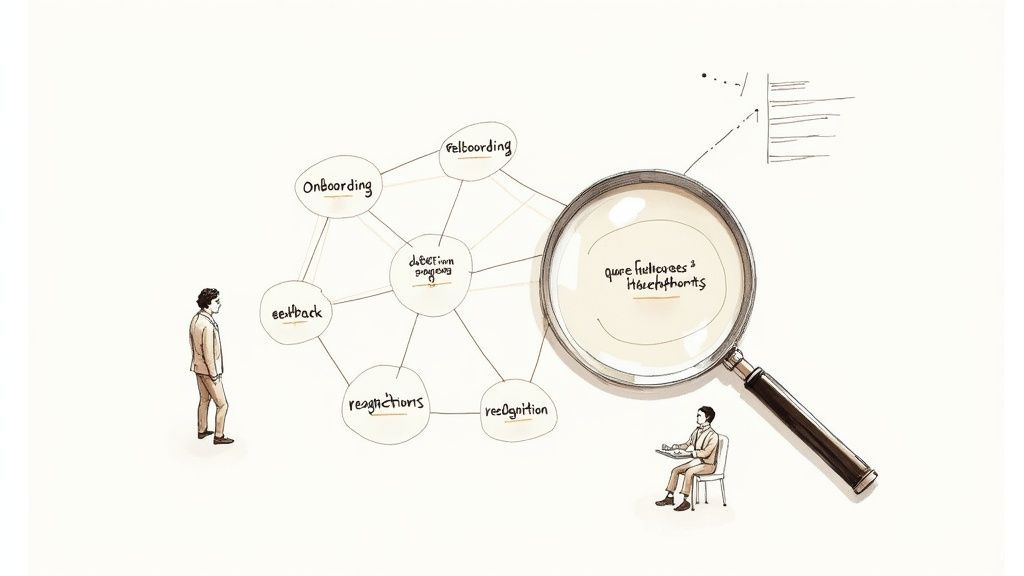
Once you know what to measure, the real work begins: moving from measurement to diagnosis. Getting an accurate read on your company’s culture isn’t about running a single survey and calling it a day. It’s a methodical process that blends cold, hard data with the human stories behind them to build a complete, nuanced picture of your organization’s health.
Think of it like a doctor diagnosing a patient. You wouldn't rely on just one symptom. You’d check multiple vital signs, listen carefully to what the patient says, and run specific tests to confirm what's really going on. A cultural diagnosis works the same way, gathering evidence from multiple sources to understand the underlying system shaping your people and culture.
This process is about moving past gut feelings and office gossip. It turns anecdotal hunches into a clear, data-backed assessment that lets you pinpoint specific pain points, discover hidden strengths, and build targeted strategies that fix root causes, not just the symptoms.
Blending Quantitative and Qualitative Data
A truly effective diagnosis weaves together two different kinds of information. The quantitative data gives you the "what"—the hard numbers and trends. But it's the qualitative data that provides the "why"—the context, stories, and emotions that give the numbers meaning.
For example, a traditional survey might show a 15% drop in engagement within your engineering department. That’s the quantitative signal—the "what." But a business intelligence tool like Wurkn can dig deeper. By synthesizing themes from continuous, anonymous feedback, it might reveal the drop is tied to frustration over outdated development tools and a feeling that leadership isn’t listening to technical concerns. That’s the critical qualitative "why" that basic HR tools completely miss.
This blended approach gives you a three-dimensional view, stopping you from jumping to the wrong conclusions based on an incomplete picture.
Identifying Key Cultural Signals
As you gather information, you need to know what you’re looking for. Cultural signals are the observable behaviours and patterns that show you what your culture is really like, day-to-day. They’re the real-world artifacts of your company's unwritten rules.
Here are a few of the most important signals to watch for in your organization:
-
How Feedback Is Delivered and Received: Is feedback a rare, formal event that only flows downward during performance reviews? Or is it a continuous, multi-directional conversation where peers feel safe offering constructive input and leaders actively ask for it? A culture of candid, constant feedback is a hallmark of high-performing teams.
-
How Failure Is Handled: When a project goes off the rails, is the first instinct to find someone to blame? Or is it to run a blameless post-mortem focused entirely on learning what went wrong? Companies that punish honest mistakes are unintentionally killing innovation and risk-taking.
-
How Recognition Is Distributed: Who gets the spotlight? Is it only the top salespeople hitting their quota, or do you also celebrate the quiet collaborators and problem-solvers who enabled that success? The answer tells you what behaviours your organization truly values, regardless of what the handbook says.
By observing these signals, you move past the "official" version of your culture stated in the handbook and start understanding the unwritten rules that actually govern how people behave.
When you combine these observations with hard data, you get a powerful diagnostic lens.
From Diagnosis to Targeted Strategy
This is where a business intelligence platform like Wurkn becomes essential for leaders in Canada and the United States. It gathers anonymous, honest feedback from the channels your employees already use and organizes it into intuitive dashboards. The platform automatically spots trends and emotional tones, letting you filter insights by department, location, or tenure.
This transforms your diagnosis from a broad, company-wide generalization into a precise, surgical tool. You might find that while psychological safety is high overall, it's dangerously low on one specific team. Or you might see that tenured employees are deeply aligned with company values, but new hires feel disconnected.
Armed with this level of specific intelligence, you can stop launching generic, one-size-fits-all initiatives. Instead, you can provide targeted coaching to a single manager, fix resource gaps in a particular department, or redesign your onboarding process. This data-driven approach ensures your efforts are focused where they will make the biggest impact on your people and culture.
Actionable Strategies for a High-Performance Culture
Once you have an accurate read on your culture, you can shift from analysis to action. Vague advice like "improve communication" is useless without a concrete plan. This is where you roll out targeted strategies designed to fix the specific pain points and seize the opportunities you've uncovered, turning your people and culture into a high-performance engine.
The goal isn’t some massive, disruptive overhaul. Forget that. Instead, focus on creating consistent, structured rituals that weave your desired culture into the fabric of daily work. It’s these small, deliberate actions, practised over and over, that create massive and lasting change.
Establish Structured Feedback Rituals
One of the most powerful ways to shift your culture is to normalize continuous, constructive feedback. High-performing teams are built on open communication, but that almost never happens by accident. You have to build the systems that make it safe, expected, and completely routine.
Stop relying only on annual reviews. They're often high-stakes, backward-looking, and dreaded by everyone involved. Instead, implement structured rituals that foster an ongoing dialogue.
- Manager-Led Check-ins: Train your managers to go beyond simple status updates. A great check-in is about development, roadblocks, and well-being, creating a space where honest conversations can actually happen.
- Peer-to-Peer Feedback: Introduce simple, lightweight frameworks for employees to share constructive input with each other. This builds a powerful sense of shared ownership and collective improvement.
- Anonymous Upward Feedback: You absolutely need a safe, anonymous channel for employees to give feedback to their leaders. This is the only way to uncover critical blind spots and build real trust.
These rituals transform feedback from a feared annual event into a normal part of getting work done. They build psychological safety by showing everyone that honest input isn't just welcome—it's a core part of how the company operates.
Design Inclusive Recognition Programs
Recognition is so much more than just bonuses and awards. It's a powerful tool for reinforcing your company's core values in real-time. When you celebrate specific behaviours, you send a crystal-clear message about what truly matters in your organization.
A great recognition program doesn't just reward top performers; it spotlights the everyday actions that bring your company values to life, creating a culture of appreciation.
For example, if "collaboration" is a core value, publicly recognize an employee who went out of their way to help another team smash a deadline. This makes your values tangible and shows everyone precisely what success looks like. The aim is to create a culture where gratitude flows in all directions—from leaders to employees, from employees to leaders, and between peers.
Empower Managers with Data-Driven Tools
Your managers are the primary carriers of your culture. They are on the front lines, shaping the daily experiences that define your company for their teams. The problem? Most are promoted for their technical skills, not their people management abilities, and are then left to manage by intuition alone.
This is where a business intelligence tool like Wurkn changes the game entirely. It moves beyond traditional engagement platforms by giving managers a real-time, anonymized dashboard of their team's health. Wurkn pulls in and synthesizes continuous feedback to show managers the specific cultural drivers impacting their team—things like clarity, belonging, or workload balance.
This empowers them to lead proactively. Instead of guessing why a project is stalling, a manager can see that their team is feeling a lack of clarity and can intervene immediately. Wurkn operationalizes your people and culture strategy by giving managers the data-driven coaching tools they need to build healthier, more productive teams. This proactive approach is fundamental when you are learning how to improve employee engagement from the ground up.
By putting these focused strategies into play, you create a continuous cycle of measurement, action, and improvement. You can directly track how a new feedback ritual in one department impacts its psychological safety score, or how a recognition initiative boosts alignment with company values. This closes the loop, turning your people and culture strategy from a hopeful initiative into a measurable, predictable driver of business success.
Integrating People and Culture Into Your Business Strategy
Treating people and culture as an HR side project is one of the most common—and costly—mistakes a business can make. The smartest companies in Canada and across North America get it: culture isn't a program you run once a quarter. It's the operating system where your entire business strategy either thrives or dies.
When every business decision is filtered through the lens of its cultural impact, you start building a real competitive advantage. Suddenly, your cultural health becomes as critical as your financial health. This creates a resilient organization that doesn't just attract top talent but keeps them engaged and performing at their peak. It’s a disciplined, continuous cycle: define, measure, and refine.
The Path to a Proactive Culture
Most leaders are stuck in a reactive loop, only dealing with cultural problems after the damage is done—a star employee quits, a key project fails, or morale tanks. Moving from firefighter to architect requires a clear, repeatable process. This isn't about guesswork; it's about building an intelligence system for your culture.
Breaking it down, the journey has five core steps:
- Define Your Target Culture: Get brutally honest about the culture your business strategy needs. What specific behaviours, values, and communication styles will actually accelerate growth?
- Measure Your Current State: Use real tools to get a data-backed baseline of where you are right now. This isn't about feelings; it's about facts. This is your starting line.
- Diagnose the Gaps: Dive into the data. Pinpoint the disconnects between the culture you want and the one you have. Is psychological safety low in one department? Is communication breaking down between teams?
- Take Targeted Action: Armed with data, you can now deploy focused fixes. Instead of generic pizza parties, you might launch targeted manager coaching or new feedback rituals designed to solve a specific problem.
- Continuously Monitor: Track the impact of your actions in real-time. This creates a powerful feedback loop, allowing you to fine-tune your approach and prove a clear return on investment.
This creates a high-performance cycle of continuous improvement: Measure, Act, and Improve.
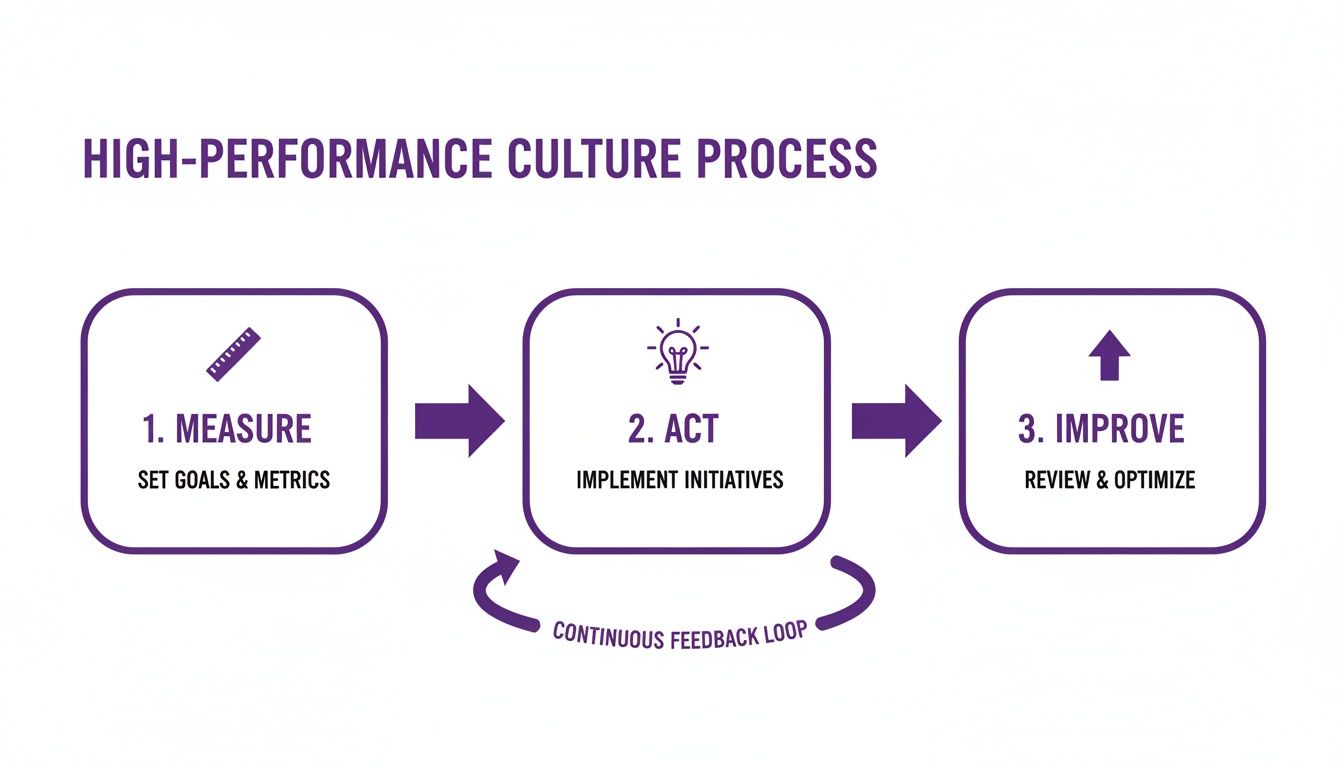
This process shows that building a winning culture isn't a one-off project. It’s an ongoing commitment that gets woven directly into the fabric of your daily operations.
Moving Beyond Engagement to Business Intelligence
Here’s the hard truth: traditional employee engagement surveys are obsolete. They give you a static, rearview-mirror snapshot. They might tell you what is happening, but they offer zero insight into why.
This is where a true business intelligence platform like Wurkn changes the game. It's built for modern leaders who need more than just a score. They need deep, actionable diagnostics.
Wurkn takes the continuous, anonymous feedback flowing through your organization and turns it into a living dashboard of your cultural health. It gives you the power to see trends as they emerge, connect those cultural signals directly to your most important business KPIs, and make decisions based on what's happening today—not six months ago.
This is the critical shift. It’s moving from reactive problem-solving to proactive culture-building, which is the only way to build a high-performing organization that truly wins the war for talent.
Your Questions, Answered
Let's clear up a few of the most common questions leaders have when they start thinking seriously about building a people and culture strategy that actually drives the business forward.
How Is People and Culture Different from Employee Engagement?
It’s a classic chicken-and-egg question, but the answer is simple. Think of employee engagement as the outcome—a snapshot of how emotionally connected your team feels. People and culture is the entire ecosystem that creates that outcome.
Engagement is the score on the board. Culture is the game plan, the coaching staff, and the stadium atmosphere all rolled into one. It’s your values in action, your communication norms, and your leadership behaviours. While an engagement platform might tell you engagement dropped 10%, a true business intelligence tool like Wurkn digs deeper to show you why—connecting that drop to a specific cultural driver, like a breakdown in psychological safety or unclear goals.
Is a Formal People and Culture Strategy Necessary for a Small Business?
Absolutely. In fact, it might be more critical. Every company has a culture, whether you design it on purpose or let it happen by accident. In a small, tight-knit team, a toxic culture can poison the well incredibly fast, killing growth before you even get off the ground.
Putting a simple strategy in place early on—one focused on continuous feedback and recognition—builds a rock-solid foundation for scaling. You're establishing healthy habits from day one. This proactive approach ensures your culture gets stronger as you grow, rather than becoming a massive, expensive problem you have to untangle later.
How Can I Prove the ROI of Investing in People and Culture?
You prove it by connecting the dots between your cultural health and your core business KPIs. This isn't about fuzzy feelings; it's about hard numbers that get the attention of any executive or board member.
Using a business intelligence platform like Wurkn, this becomes straightforward. You can draw a direct line from a measurable jump in "belonging" scores to a quantifiable drop in voluntary turnover. For instance, if you reduce turnover by just five employees, you can calculate the direct savings from reduced hiring and onboarding costs, which could easily be over $100,000 for mid-level roles. That’s your ROI. Similarly, you can show how teams with the highest cultural health scores are also the ones crushing their productivity targets, tying your people strategy directly to financial performance.
Ready to stop guessing and start measuring? See how Wurkn turns culture into your most powerful business intelligence asset, giving you the insights to build a truly high-performing organization.