

Let's cut through the jargon. A Human Resource Information System (HRIS) isn't just another piece of software; it's the central command centre for your entire people operation. Think of it as the digital nervous system for your business, connecting everything from payroll and benefits to hiring and time tracking into a single, unified platform.
Your Business Needs a Central Hub for People Data
Think about the sheer volume of information your company manages for every single employee. You've got personal details, payroll info, benefits selections, performance reviews, and time-off requests. Right now, that data is probably scattered across a dozen spreadsheets, endless email threads, and maybe even a few old-school filing cabinets.
This disjointed approach isn’t just messy; it’s a massive operational risk.
A Human Resource Information System (HRIS) solves this chaos by creating a single source of truth for everything people-related. It’s software purpose-built to maintain, manage, and process detailed employee information and HR policies in one place. Instead of juggling disconnected files, you get one secure, organized, and instantly accessible hub for all your people data. For any growing business in Canada or the United States, this move from manual mess to automated clarity is a non-negotiable step.
Moving Beyond Spreadsheets
For so many small and medium-sized businesses, spreadsheets are the default tool for managing HR. They work fine at first, but they quickly become a major liability as your team grows. Manual data entry is a breeding ground for errors, version control turns into a nightmare, and keeping sensitive data secure is practically impossible.
An HRIS takes these administrative headaches and turns them into smooth, automated processes. The benefits of making the switch are immediate and impactful:
- Improved Data Accuracy: Automating data entry and updates slashes the risk of human error. This means payroll, benefits, and employee records are always correct.
- Enhanced Security: Centralizing sensitive employee information in a secure system with role-based access is worlds better than having it scattered across unsecured files.
- Operational Efficiency: Repetitive tasks like running reports, approving time-off requests, and onboarding new hires get automated, freeing up your team for more strategic work.
An HRIS is more than a digital filing cabinet; it’s a strategic tool that transforms administrative burdens into valuable operational data. This shift allows leaders to make smarter, faster decisions about their most important asset—their people.
This central repository of data becomes the foundation for much deeper insights. While an HRIS is fantastic at telling you what is happening (like tracking turnover rates), it can't always tell you why. That's where a business intelligence tool like Wurkn comes in.
By integrating with your HRIS, Wurkn connects this core HR data to real-time employee sentiment. This reveals the cultural drivers behind the numbers, giving leaders the kind of actionable intelligence that traditional HR survey tools simply can't provide.
Exploring the Core Modules of an HRIS Platform
Think of an HRIS as far more than a digital filing cabinet. It's really a powerful, interconnected suite of tools designed to solve specific business problems. Each module acts like a specialized department within your central HR hub, automating tasks that would otherwise eat up countless hours. This structure turns administrative burdens into efficient, data-driven operations.
This is what we mean when we say an HRIS acts as a central brain, connecting your people, their data, and all the tasks required to manage them effectively.
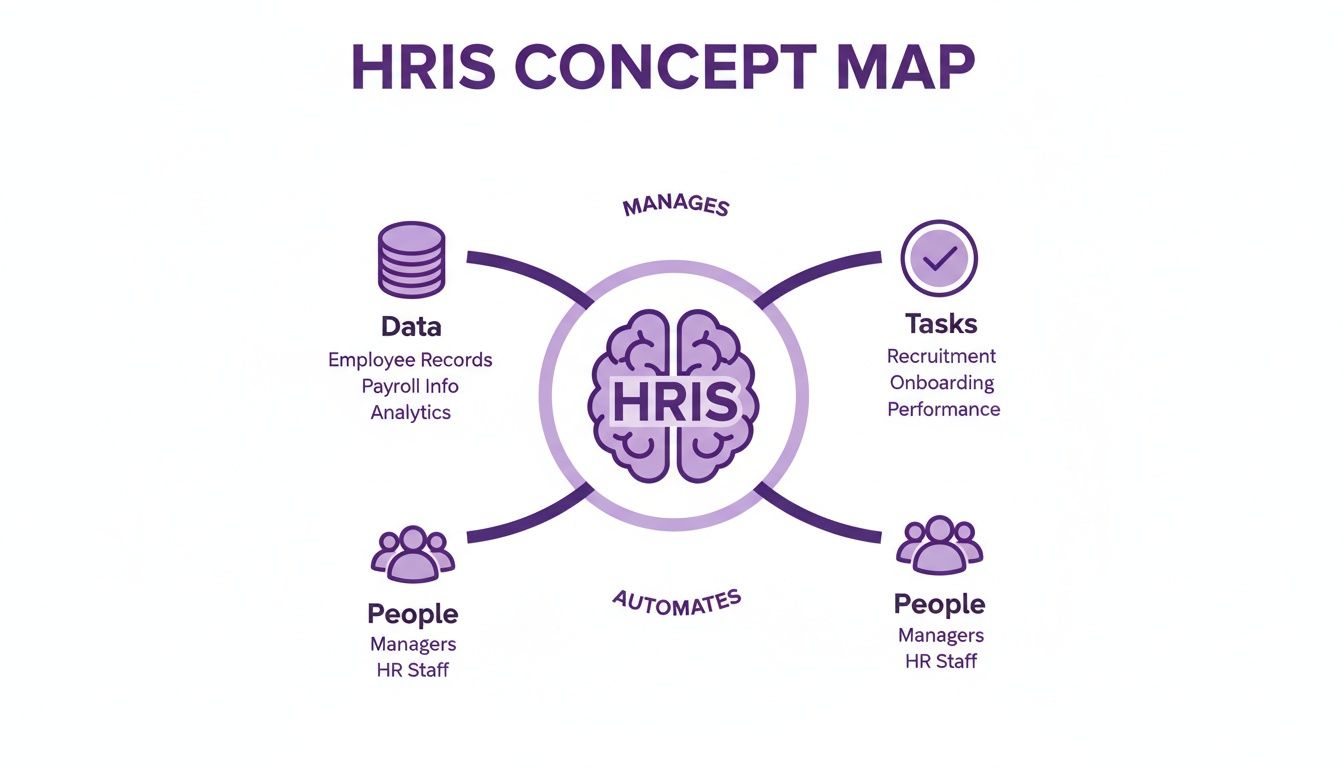
The whole point is to unify all the separate elements of human resources into one cohesive, intelligent system.
Payroll and Benefits Administration
For most Canadian and U.S. businesses, payroll is the single most critical—and complex—HR function. A dedicated payroll module automates all the calculations for wages, deductions, and remittances, ensuring you stay compliant with both federal and provincial/state tax laws from British Columbia to California. It catches the manual errors that are all too common with spreadsheets, which can lead to costly penalties.
Similarly, the benefits administration module simplifies how you manage group insurance plans, retirement savings programs, and other employee perks. It handles enrolment, tracks eligibility, and manages contributions, giving both the company and your employees a clear, accurate overview.
Time and Attendance Management
Tracking hours worked is fundamental, especially for hourly employees. A time and attendance module digitizes this entire process, letting staff clock in and out—whether they're in the office or on a remote job site.
This module automatically applies provincial or state overtime rules, manages statutory holiday pay, and tracks vacation accrual, ensuring full compliance with local labour standards. This automation doesn't just save time; it provides an indisputable record that protects the business from potential disputes.
An effective HRIS transforms compliance from a constant worry into an automated background process. By centralizing rules for payroll, benefits, and time tracking, it frees up leaders to focus on strategic growth instead of administrative minutiae.
Applicant Tracking System (ATS)
In a competitive talent market, a slow and disorganized hiring process means losing out on the best candidates. A Human Resource Information System (HRIS) armed with an Applicant Tracking System (ATS) module streamlines the entire recruitment lifecycle. It lets you post jobs, manage applications, schedule interviews, and extend offers from a single dashboard.
For businesses across Canada and the United States, this kind of efficiency is non-negotiable. The push for HRIS adoption has grown because of persistent labour market challenges, with recruitment remaining a top issue for employers trying to fill vacancies.
An ATS ensures a consistent, professional experience for candidates while giving hiring managers the tools to make faster, better decisions. Of course, these systems are only as good as the data they contain. To dig deeper, check out our guide on why your HR software should be data-driven and helpful. This is where a business intelligence tool like Wurkn adds immense value, turning the raw data from your HRIS into deep insights that link your people operations directly to performance outcomes.
Unlocking the Strategic Benefits of an HRIS
Putting an HRIS in place is about so much more than administrative convenience. It’s a strategic decision, one that’s meant to deliver real, measurable business outcomes. For leadership, the value isn’t in simply ditching spreadsheets; it’s about unlocking new capabilities that strengthen security, drive efficiency, ensure compliance, and sharpen decision-making across the entire company. It’s how HR stops being a cost centre and starts becoming a strategic partner.
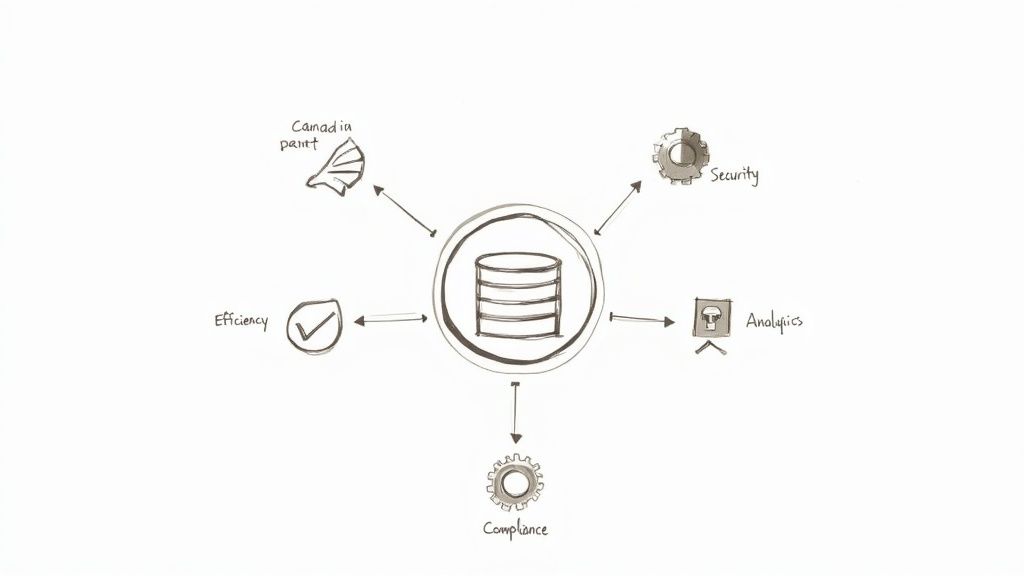
The first, most immediate win is a massive leap forward in data integrity and security. When you centralize all employee information into a single system, you get rid of the scattered, unsecured files that represent a huge risk. With controlled access and a single source of truth, data accuracy skyrockets. This ensures your most sensitive information is both correct and protected.
From Manual Tasks to Operational Efficiency
Automating the repetitive, administrative grunt work is another core advantage of a Human Resource Information System. Think about tasks like managing time-off requests, running payroll, and onboarding new hires. An HRIS handles that heavy lifting, freeing up your people to focus on more strategic initiatives that actually move the needle. This operational efficiency means your team can invest their energy in people and culture, not paperwork.
The shift from manual processes to an integrated system is a game-changer. For example, a mid-sized U.S. logistics company might find that automating time-off approvals through an HRIS saves their managers five hours per week, time that can be reinvested into coaching and team development.
HR Management Spreadsheets vs HRIS
| HR Function | Manual Management (Spreadsheets) | Integrated HRIS Solution |
|---|---|---|
| Data Security | High risk of data breaches, errors, and unauthorized access | Centralized, secure database with role-based access controls |
| Time Tracking | Manual entry, prone to errors and time theft | Automated time and attendance tracking, integrated with payroll |
| Payroll Processing | Time-consuming, high risk of calculation errors | Automated calculations, tax filings, and direct deposit |
| Onboarding | Inconsistent, paper-heavy, and slow | Standardized digital workflows for a seamless new hire experience |
| Reporting | Manual data compilation, limited to basic historical reports | Real-time dashboards and analytics for strategic insights |
Simply put, what used to take days of manual effort can now be done in minutes, with far greater accuracy and security.
Navigating Complex Compliance with Confidence
For any business operating in Canada and the United States, keeping up with the tangled web of labour laws is a constant headache. An HRIS is your best friend here. It helps manage compliance with legislation like Canada's PIPEDA or state-specific laws in the U.S. The system automates the tracking for overtime, vacation accrual, and record-keeping, which dramatically reduces your business risk.
An HRIS provides the framework for proactive, data-informed decision-making. It shifts leadership from reacting to problems to strategically planning for the future based on real-time workforce analytics.
This brings us to the most critical benefit: strategic workforce planning. An HRIS gives you access to powerful analytics that reveal trends in turnover, compensation, and demographics. But here’s the catch: this data tells you what is happening, not why.
This is where a business intelligence tool like Wurkn comes in to complement your HRIS. Wurkn integrates with your system to connect this hard, quantitative data with the qualitative employee sentiment behind it. It moves way beyond basic HR survey tools to deliver actionable intelligence, showing you the cultural drivers behind the metrics. This linkage allows leaders to make decisions that not only solve immediate problems but also build a stronger, more resilient organization for the long haul.
HRIS vs. HCM vs. HRMS: Decoding the Acronyms
Stepping into the world of HR technology can feel like learning a new language, with a whole dictionary of acronyms to master. You’ll hear vendors toss around HRIS, HRMS, and HCM almost interchangeably, but the differences between them are real—and choosing the right one is critical.
Getting this right from the start means you won’t overspend on a system loaded with features you don’t need, but you also won’t underinvest and find yourself stuck with a tool you’ll outgrow in a year. It’s all about matching the technology to where your business is today and where you plan to be tomorrow.
Think of it like building a house. An HRIS (Human Resource Information System) is your foundational toolkit. It’s got all the essentials you need to get the job done day-to-day: managing employee records, running payroll, and tracking time off. It’s the operational backbone, the hammer and nails of HR.
Moving from Core Functions to Broader Strategy
Now, an HRMS (Human Resource Management System) is like upgrading to a full-blown workshop. It includes everything in your basic HRIS toolkit but adds more powerful tools for managing the entire employee journey. This is where you start seeing features like applicant tracking to hire talent and performance management systems to develop them. It’s the bridge between pure administration and people management.
Then you have HCM (Human Capital Management). This isn’t just the toolkit or the workshop; it’s the entire strategic blueprint for building and managing your workforce. It wraps up all the functions of an HRIS and HRMS and then adds a powerful layer of strategic talent management.
This top-tier system includes tools for:
- Succession planning to build your next generation of leaders.
- Compensation management to ensure fair and competitive pay.
- In-depth learning and development modules to upskill your teams.
- Advanced workforce analytics to inform high-level business strategy.
An HRIS helps you manage your people. An HCM is designed to maximize their value as a strategic asset to the business. The right choice really just boils down to your company's current needs and future ambitions.
Linking Technology to Business Intelligence
For many growing businesses in Canada or the U.S., a solid HRIS is the perfect place to start. It provides the clean, core data you need to run the business efficiently. But that data only tells you what is happening. It can show you your turnover rate, but it can’t tell you why your best people are walking out the door.
That’s the gap where a business intelligence platform like Wurkn comes in. By integrating with your HRIS, Wurkn connects that hard operational data to the living, breathing sentiment of your employees. It goes far beyond a simple annual survey, giving you the kind of actionable intelligence that reveals the real story behind the numbers. This allows leaders to make smarter decisions that don’t just improve culture—they directly impact the bottom line.
How to Choose the Right HRIS for Your Business
Picking a Human Resource Information System is one of the most critical tech decisions your business will ever make. Get it right, and you’ve built the central nervous system for your entire people operation—a hub that drives efficiency and feeds you critical data. Get it wrong, and you're stuck with frustrated employees, endless admin bottlenecks, and a terrible return on your investment.
A confident choice doesn’t start with vendor demos. It starts with a brutally honest look at your own unique business needs. A company with a large field team scattered across the United States needs killer mobile access and geolocation for time tracking. A professional services firm in Canada, on the other hand, will care more about sophisticated project-based reporting and performance management.
Your HRIS should be a solution to your specific business challenges, not just a collection of features. Define your problems first, then find the technology that solves them.
Once you have a crystal-clear picture of what you actually need, you can start digging into potential vendors and platforms.
Key Evaluation Criteria
A solid evaluation goes way beyond ticking boxes on a feature list. You need to see how this system will actually live and breathe within your company’s operational ecosystem. You’re looking for a partner, not just a product.
Here are the absolute non-negotiables to scrutinize:
- Scalability: Can this system grow with you? Make sure it can handle more employees, more modules, and more data without slowing to a crawl.
- Integration Capabilities: Your HRIS has to play nice with your existing tech stack. It needs to connect seamlessly with accounting software, project management tools, and communication platforms. A well-integrated system is the difference between data silos and a single source of truth.
- User Experience (UX): This is huge. The platform has to be intuitive and easy to use for everyone, from your HR admins to your front-line staff. A clunky, confusing interface will kill adoption, no matter how powerful the features are.
The Importance of Training and Support
Ultimately, the success of a new HRIS hinges on one thing: people actually using it. And that requires outstanding vendor support and training. This is where many businesses stumble.
In fact, Capterra's 2025 HR Software Trends Survey found that 44% of Canadian HR leaders say upskilling is their number one challenge, while 46% worry about the headaches of software training. As AI adoption doubles year-over-year, with 12.2% of firms now using it, the need for effective training has never been more intense. You can see more in this 2025 HR software trends survey.
While your HRIS is brilliant at organizing your operational data, a business intelligence tool like Wurkn connects that data to its cultural impact. Wurkn integrates with your chosen system, turning raw employee sentiment into actionable intelligence. This synergy allows your People Ops SaaS strategy to evolve from just managing people to truly understanding them, ensuring your tech investments deliver measurable, bottom-line results.
Beyond Data: The Future of Strategic HR Intelligence
A Human Resource Information System is fantastic at capturing the what—things like employee numbers, payroll data, and turnover rates. But to really move the needle on your business, you need to understand the why. This is precisely where a business intelligence tool like Wurkn steps in, offering value that goes far beyond what a traditional HR platform or a simple employee survey tool can provide.
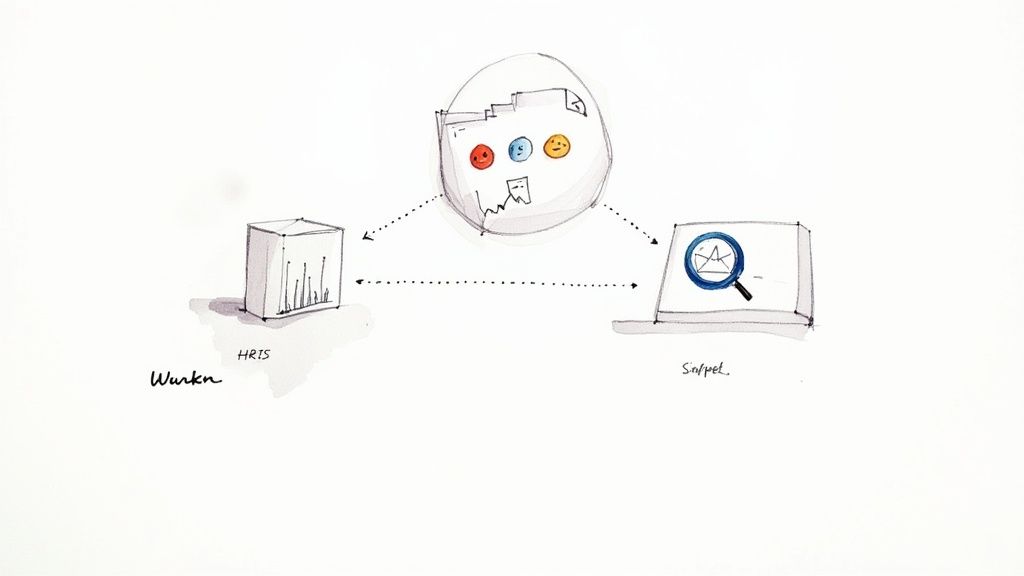
For instance, your HRIS might tell you that your sales department has a 25% turnover rate. On its own, that number is just a symptom, not a diagnosis. Wurkn connects that hard data point to the softer, crucial metrics like employee sentiment, engagement levels, and qualitative feedback to reveal the actual root cause. Maybe the data shows that high-performers are leaving due to a perceived lack of growth opportunities, an insight that allows you to address the problem with targeted career-pathing initiatives.
From Record-Keeping to Strategic Advantage
This integration is what elevates your HRIS data from a simple system of record into a powerhouse of strategic intelligence. It gives leaders the ability to make data-driven decisions that directly improve company culture, drive up retention, and ultimately, strengthen financial performance. This approach is a world away from the limitations of basic employee surveys, which often give you lagging indicators instead of real-time, actionable insights.
For Canadian HR leaders, Capterra's survey shows a major headache is keeping staff amidst a growing AI skills gap, with 51% calling it their number one issue. Interestingly, a Conference Board of Canada study found that HRIS users enabled with AI report 39% better retention, compared to just 26% for those without. As businesses rush to get their teams trained on AI, combining a functional HRIS with a cultural intelligence platform becomes non-negotiable for upskilling and holding onto your best people. You can discover more insights from The Conference Board of Canada on this growing trend.
By linking operational data from your HRIS with the cultural intelligence from Wurkn, you can finally see the direct line between how your people feel and how your business performs.
This connection provides a clear, real-time view of culture's impact on the business, turning what was once fuzzy, qualitative feedback into a living dashboard that executives can actually use to guide decisions. Understanding how technology and people intersect is critical; our guide on AI in the workplace and its evolution from automation to collaboration digs deeper into how these forces are shaping the modern organization.
HRIS Questions We Hear All the Time
Business leaders in Canada and the United States often ask the same sharp questions when they start exploring a Human Resource Information System. Let's get right to them.
What's the Real Cost of an HRIS?
The price tag on an HRIS can swing wildly depending on how many employees you have and which features you actually need. Most North American vendors work on a per-employee, per-month (PEPM) model, which you'll see priced anywhere from $5 to over $25.
But that's just the sticker price. The real total cost of ownership comes from digging into the one-time implementation fees, training costs, and any ongoing support charges. Always get a detailed quote that breaks all of this out before you sign anything.
Can an HRIS Really Keep Us Compliant Across Provinces or States?
Yes, absolutely. This is one of the most powerful reasons to get a modern HRIS. It's built to help you navigate the tangled mess of provincial, state, and federal labour laws. Think automated tracking for stat holidays, complex overtime rules, and vacation accrual that differ across jurisdictions.
Here’s the catch: the system is only as good as its setup. Your company is always the one on the hook for compliance. View the HRIS as an incredibly powerful tool that makes staying compliant easier, not a magic wand that removes your responsibility.
How Long Does an HRIS Implementation Actually Take?
The timeline depends entirely on the size and complexity of your organization. For a small business in the U.S. with straightforward needs, you could be up and running in a few weeks. But for a larger Canadian company migrating years of data and configuring multiple modules, you should plan for a project that spans several months.
A smooth launch always comes down to good planning. You need to dedicate internal people to own the project and maintain clear, constant communication with your vendor. That upfront effort is what guarantees a seamless transition and gets your team to actually use the new system from day one.
While an HRIS nails the "what" of your operations, Wurkn uncovers the "why" behind your business results. We plug into your HRIS, transforming raw employee sentiment into actionable cultural intelligence. This gives you a living dashboard that draws a direct line from your people's experience to your most important KPIs.
It's time to move beyond just collecting data and start making decisions that actually drive performance. Find out how at https://wurkn.com.