
Traditional employee opinion surveys often feel like a once-a-year ritual, producing static reports that quickly become outdated. While these annual snapshots provide a point-in-time measurement, they frequently fail to capture the dynamic, ever-evolving reality of your workplace culture. To drive meaningful change and link employee sentiment directly to business outcomes, leaders in Canada and the United States need more than just data points; they need continuous cultural intelligence. This shift requires moving from a reactive, compliance-focused approach to a proactive, strategic one where feedback informs decision-making in real-time.
This comprehensive guide moves beyond basic templates to provide 8 essential employee opinion survey examples, analyzing each not as a standalone tool, but as a framework for understanding specific facets of your organisation. We will explore how to deploy these different survey types strategically, gather nuanced feedback, and, most importantly, transform that feedback from raw data into a powerful strategic asset. You will find actionable takeaways for each example, helping you diagnose engagement drivers, measure team dynamics, and identify cultural strengths or risks before they impact performance.
We'll also explore how modern platforms are evolving past periodic surveys. For instance, business intelligence tools like Wurkn capture continuous, anonymous feedback where work actually happens. This transforms employee sentiment from an occasional report into a real-time dashboard, directly linking your organisational culture to critical KPIs like retention, innovation, and productivity. Let's dive into the examples that form the foundation of a modern, intelligent feedback strategy.
1. Likert Scale Employee Opinion Survey
The Likert scale is a cornerstone of quantitative feedback and one of the most foundational employee opinion survey examples you can use. Named after its creator, psychologist Rensis Likert, this survey format asks employees to rate their level of agreement with a specific statement on a symmetrical scale, typically with five or seven points. The most common 5-point scale ranges from "Strongly Disagree" to "Strongly Agree," providing clear, numerical data that is easy to analyse. This structure allows HR leaders to quantify sentiment, establish benchmarks, and track changes in employee attitudes over time across different departments or demographics.
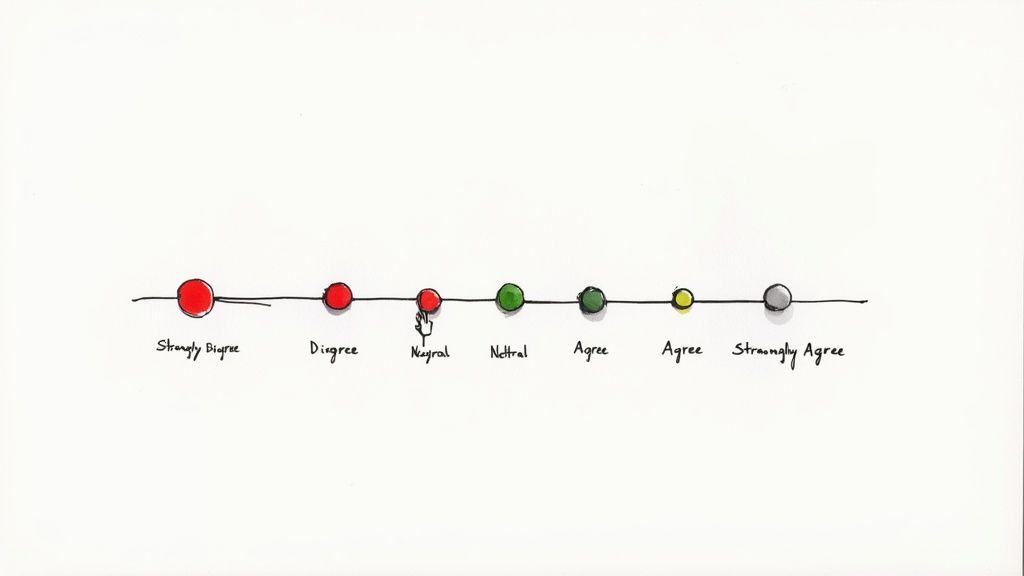
This method is famously employed in well-known engagement surveys that use a frequency scale (a variation of the Likert) to measure core elements of employee engagement. The structured data it produces is invaluable for identifying macro-level trends. However, the limitation of a standard Likert scale survey is its inability to capture the "why" behind the scores. It tells you what employees feel, but not the specific context or reasons for their feelings.
Strategic Application & Actionable Takeaways
To get the most out of a Likert scale survey, you must pair its quantitative data with qualitative insights. While the scores provide a high-level overview, they become truly powerful when connected to business intelligence.
- Integrate with Performance Data: Modern platforms like Wurkn can correlate Likert scale survey results with key performance indicators (KPIs) such as productivity, absenteeism, and staff turnover. This helps you move beyond sentiment analysis to understand how employee opinions directly impact business outcomes.
- Follow Up with Open-Ended Questions: Don't let the numbers stand alone. After a low-scoring statement like "I feel recognised for my contributions," add a conditional, open-ended question asking, "What would make you feel more recognised?" This adds crucial context.
- Balance Your Statements: Avoid "acquiescence bias" (the tendency for people to agree with statements) by including a mix of positively and negatively worded questions. For example, include both "I feel my workload is manageable" and "I often feel overwhelmed by my workload."
By combining the structured, comparable data from Likert scales with deeper analysis, you can effectively diagnose and improve company culture with precision.
2. eNPS (Employee Net Promoter Score) Survey
The Employee Net Promoter Score (eNPS) is a simple yet powerful metric adapted from the customer-focused Net Promoter Score (NPS) to measure employee loyalty and advocacy. This survey format centres on a single, critical question: "On a scale of 0-10, how likely are you to recommend our company as a great place to work?" It’s one of the most efficient employee opinion survey examples for getting a quick pulse on organisational health. Based on their score, employees are categorised as Promoters (9-10), Passives (7-8), or Detractors (0-6). The final eNPS is calculated by subtracting the percentage of Detractors from the percentage of Promoters, resulting in a score ranging from -100 to +100.
This method provides a straightforward, high-level benchmark that is easy for leadership to understand and track over time. Its simplicity encourages higher participation rates compared to longer, more complex surveys. For example, large professional services firms often use eNPS to gauge employee sentiment, integrating it into their regular feedback cycles to monitor engagement trends (Gartner, 2018). The strength of eNPS lies in its ability to deliver a quick, quantifiable snapshot of employee loyalty. However, like the Likert scale, its primary limitation is the lack of context; a single number cannot explain the complex reasons behind an employee's feelings.
Strategic Application & Actionable Takeaways
An eNPS score is a starting point, not a final diagnosis. Its real value is unlocked when you dig into the "why" behind the number and connect it to broader business intelligence.
- Always Ask "Why?": The most critical step is to follow the 0-10 rating question with an open-ended question, such as, "What is the primary reason for your score?" This qualitative feedback is where you will find actionable insights to address issues raised by Detractors or replicate the positive experiences of Promoters.
- Segment for Deeper Insights: A single company-wide score can hide significant variations. Segment your eNPS results by department, location, manager, and tenure. This helps identify specific teams or demographics that are thriving or struggling, allowing for targeted interventions.
- Connect to Business Outcomes: Go beyond sentiment by using a business intelligence tool to correlate eNPS scores with operational data. Platforms like Wurkn can map eNPS trends against KPIs like productivity, customer satisfaction scores (CSAT), and retention rates. This analysis can reveal how employee advocacy directly influences business performance and helps build a strong case for investing in employee experience initiatives.
3. Pulse Survey Template
While comprehensive annual surveys offer a deep dive, the pulse survey is a nimble and responsive format designed to capture a real-time snapshot of the employee experience. This is one of the most agile employee opinion survey examples, consisting of a short set of 5-10 targeted questions administered frequently, such as monthly or quarterly. Its purpose is to monitor the "pulse" of the organisation, enabling HR leaders to track sentiment fluctuations, identify emerging issues, and react quickly before minor problems escalate into major concerns. This approach complements, rather than replaces, the annual survey by providing continuous, timely feedback.
This method has been popularised by major technology and retail companies who use frequent pulse checks to monitor team health and the impact of company initiatives in real-time. A large e-commerce company, for example, might use pulse surveys to gather feedback during periods of significant organisational change, ensuring leadership stays connected to employee sentiment. The brevity of a pulse survey leads to higher participation rates and provides a consistent stream of data, making it invaluable for tracking trends over a shorter period. The key limitation is its narrow focus; by design, it cannot capture the comprehensive detail of a larger, annual engagement survey.
Strategic Application & Actionable Takeaways
The true power of a pulse survey lies in its speed and regularity. To maximise its impact, you must build a system around quick analysis and even quicker action, demonstrating to employees that their frequent feedback is being heard and valued.
- Connect to Business Intelligence: Don't let pulse data exist in a vacuum. A modern business intelligence platform like Wurkn can correlate pulse survey results on topics like manager effectiveness or resource availability with operational KPIs, such as project completion rates or team productivity. This reveals direct links between employee sentiment and business performance.
- Establish a Rhythm and Rotate Topics: Maintain a consistent cadence (e.g., the first Tuesday of every month) to build a habit of participation. While keeping a few core questions consistent for trend analysis, rotate other questions to cover different dimensions of engagement throughout the year, such as wellbeing, career development, or inclusion.
- Close the Loop Quickly: The unwritten rule of pulse surveys is to share high-level results and outline concrete action steps within a week of the survey closing. This rapid response reinforces the value of the feedback loop and encourages continued participation. If you ask frequently, you must act frequently.
4. 360-Degree Feedback Survey
The 360-degree feedback survey is a comprehensive and multi-faceted approach to gathering employee opinions, moving beyond the traditional top-down review. This format collects confidential, anonymous feedback for an employee from a full circle of colleagues: their manager, peers, and direct reports. In some cases, it can even include opinions from external stakeholders like customers or vendors, making it one of the most holistic employee opinion survey examples for individual development. This multi-rater method provides a balanced, well-rounded view of an employee's competencies, behaviours, and impact on others.

This method was popularised by leadership development institutes and is now a staple in management programs at major corporations. For example, a large multinational corporation might use 360-degree feedback to cultivate its leadership pipeline, focusing on behavioural development rather than just performance metrics. The primary strength of this approach is its ability to uncover blind spots. An employee might not realise how their communication style affects their direct reports, and this survey provides that crucial, anonymous insight. The main limitation, however, is the risk of it being misused for performance evaluation, which can create a culture of fear and damage team dynamics (Harvard Business Review, 2018).
Strategic Application & Actionable Takeaways
To be effective, 360-degree feedback must be positioned strictly as a developmental tool, not a punitive one. Its power lies in fostering self-awareness and guiding personal growth, which ultimately benefits the entire organisation.
- Separate from Performance Reviews: Emphasise that 360-degree feedback results are for developmental purposes only and will not be tied to compensation, promotions, or performance ratings. This is critical for encouraging honest, constructive feedback from all participants.
- Provide Professional Coaching: The raw data from a 360 survey can be overwhelming or even demoralising. Always provide access to a manager, HR business partner, or a professional coach to help the employee interpret the results, identify key themes, and create a tangible development plan.
- Focus on Behaviours, Not Traits: Train raters to provide specific, observable feedback on behaviours ("During team meetings, you often interrupt others") rather than making judgments about personality traits ("You are disrespectful"). This makes the feedback actionable and less personal.
- Connect Insights to Organisational Goals: While individual-focused, the aggregated, anonymised themes from 360-degree surveys can reveal wider organisational challenges. A platform like Wurkn can help identify if, for instance, a lack of clear communication is a recurring theme among managers, signalling a need for broader leadership training that aligns with key business objectives.
5. Open-Ended Question Survey
While quantitative surveys provide the "what," open-ended questions deliver the "why," making them one of the most insightful employee opinion survey examples for gathering rich, contextual feedback. This qualitative format moves beyond predefined answers, inviting employees to share their thoughts, experiences, and suggestions in their own words. The narrative responses provide a depth of understanding that multiple-choice or scale-based questions simply cannot capture, revealing nuanced perspectives and surfacing unanticipated issues. This structure allows HR leaders to uncover the root causes behind engagement scores and gather specific, actionable ideas for improvement.
This approach is championed by culture-first organisations that use open-ended feedback to understand employee values and drive meaningful change. The detailed narrative data is invaluable for understanding complex issues like team dynamics, leadership effectiveness, and feelings of inclusion. However, the primary challenge of this survey type is the analysis; sifting through hundreds or thousands of text responses requires a systematic approach to identify recurring themes and patterns.
Strategic Application & Actionable Takeaways
To transform qualitative feedback into a strategic asset, you must structure your analysis process to extract clear, actionable themes from the narrative data. The goal is to move beyond anecdotes and identify organisation-wide trends.
- Combine with Quantitative Data: Use open-ended questions as a follow-up to low-scoring quantitative items. For instance, after a low score on a Likert scale question about career development, ask, "What specific development opportunities would you find most valuable?" This directly links a problem area to potential solutions.
- Utilise Thematic Coding: Manually or with software, group similar responses into categories or "themes." For example, comments like "I need more training on our new software" and "I wish we had a mentorship program" could be coded under the theme "Career Growth & Skill Development." This turns unstructured text into organised, reportable insights.
- Leverage AI for Analysis: For large datasets, manual coding is impractical. Modern business intelligence platforms like Wurkn integrate natural language processing (NLP) to automatically analyse text responses, identifying sentiment (positive, negative, neutral) and key themes at scale. This saves countless hours and removes potential human bias from the analysis.
By systematically organising and analysing qualitative feedback, you can add crucial context to your quantitative data, allowing you to address the specific concerns that truly matter to your employees.
6. Engagement Index Survey
An Engagement Index Survey is a powerful, multi-dimensional tool that goes beyond a single satisfaction score. It is one of the most strategic employee opinion survey examples for understanding the complex drivers of workforce dedication. This survey groups a series of related questions into key "dimensions" or "indices" of engagement, such as purpose, development, wellbeing, belonging, and management effectiveness. By combining responses from multiple questions within each category, it creates a detailed, composite score for each driver, offering a far more nuanced view than a simple one-off question.
This comprehensive approach allows organisations to pinpoint specific areas of strength and weakness with high precision. Renowned models from academic institutions and HR research bodies have popularised this index-based method. The goal is not just to measure overall engagement but to understand its building blocks. However, its depth can be its challenge; if the results are not tied to clear action plans, employees may see it as a data-gathering exercise with no follow-through, leading to survey fatigue.
Strategic Application & Actionable Takeaways
The true value of an Engagement Index Survey is its ability to provide a strategic roadmap for organisational improvement. The detailed index scores guide targeted interventions, ensuring resources are focused where they will have the most significant impact on employee experience and business results.
- Connect Indices to Business KPIs: Don't just analyse engagement in a vacuum. Use a business intelligence platform like Wurkn to correlate specific index scores, like "Management Effectiveness," with tangible outcomes such as team productivity, customer satisfaction scores (CSAT), or retention rates. This demonstrates the direct financial and operational impact of targeted engagement efforts.
- Segment and Benchmark Your Data: Analyse results across different employee groups, such as department, tenure, or location. A low "Development" score in the engineering department requires a different solution than a low score among new hires across the company. Benchmarking your index scores against industry standards also provides critical context.
- Develop Dimension-Specific Action Plans: Move from insight to action by creating focused initiatives for your lowest-scoring dimensions. If "Wellbeing" is a concern, action might involve introducing flexible work policies or mental health resources. If "Belonging" scores are low, initiatives could focus on strengthening Employee Resource Groups (ERGs) or refining DEI programs.
By using this structured, multi-faceted approach, you can systematically diagnose issues and build a more engaged workforce from the ground up.
7. Anonymous Feedback/Suggestion Box Survey
An anonymous feedback or suggestion box survey is a vital tool for capturing unfiltered employee sentiment. This format prioritises confidentiality, allowing employees to provide candid feedback, suggestions, or concerns without fear of identification or reprisal. By creating a psychologically safe channel, organisations can uncover insights on sensitive topics like management issues, safety concerns, or diversity and inclusion challenges that might otherwise remain unspoken. This makes it one of the most powerful employee opinion survey examples for building trust and fostering a transparent culture.

This method is highly effective in environments where direct feedback can be perceived as risky. For instance, healthcare organisations often rely on anonymous reporting to identify potential patient safety issues without penalising staff. Similarly, tech companies frequently use anonymous channels to gather honest opinions on their diversity and inclusion initiatives, ensuring all voices are heard. The core value lies in its ability to surface ground-truth information that is essential for proactive problem-solving and risk mitigation.
Strategic Application & Actionable Takeaways
The success of an anonymous feedback system hinges on trust and systematic follow-through. Merely providing a channel is not enough; leaders must demonstrate that the feedback is valued and acted upon to encourage ongoing participation.
- Guarantee and Communicate Anonymity: Explicitly state how anonymity is protected, whether through a third-party digital platform, a secure physical box, or an encrypted online form. Reinforce this guarantee in all communications to build employee confidence in the process. Never make any attempt to de-anonymise a respondent, as this will destroy all trust.
- Establish a Triage and Action Protocol: Create a clear internal process for reviewing, categorising, and escalating submissions. Serious concerns related to safety or harassment should have a dedicated, fast-tracked response protocol. For general suggestions, a systematic review cadence ensures nothing is overlooked.
- Close the Feedback Loop Publicly: Regularly share aggregated themes from the anonymous feedback with the entire organisation. Communicate the actions being taken in response, such as "Based on several suggestions, we are now reviewing our parental leave policy." This demonstrates that submissions are not going into a black hole and encourages further engagement.
8. Exit Interview/Stay Interview Survey Template
The exit and stay interview templates are powerful, targeted employee opinion survey examples designed to uncover the root causes of both attrition and loyalty. While an exit interview is conducted when an employee is leaving, a stay interview is a proactive conversation with a valued team member to understand what keeps them engaged and committed. Both formats aim to gather candid feedback on management, culture, compensation, and career growth, but from opposite ends of the employee lifecycle. This dual approach provides a comprehensive picture of the employee experience, highlighting both the friction points that drive people away and the positive factors that encourage them to stay.
These surveys move beyond general satisfaction ratings to capture specific, event-driven insights. For instance, innovative tech firms use structured exit and stay interviews to gather data that directly informs their retention strategies. By systematically analysing feedback, they can identify patterns in why top talent leaves a particular team or what cultural elements are most critical for retaining high performers, allowing them to make targeted organisational improvements.
Strategic application & Actionable Takeaways
The true value of these surveys lies in aggregating the individual responses into a collective, actionable intelligence source. They provide the "why" behind your turnover and retention metrics, turning raw data into a strategic roadmap for improvement.
- Combine Proactive and Reactive Insights: Don't just wait for employees to resign. Conduct stay interviews with high-performing, long-tenured employees during performance reviews or career development discussions. Ask forward-looking questions like, "What might tempt you to leave?" and "What aspects of your role are most energising?" This proactive approach can pre-empt potential exits.
- Ensure Neutrality and Anonymity: To get honest feedback, exit interviews should be conducted by a neutral HR representative, not the employee's direct manager. When sharing feedback with leadership, aggregate and anonymise the data to protect individuals and focus on organisational trends rather than personal grievances.
- Correlate with Business Intelligence: The insights gathered are most powerful when linked to other data points. A platform like Wurkn can integrate feedback from exit and stay surveys with performance metrics, absenteeism rates, and departmental turnover data. This allows you to see, for example, if managers with low engagement scores on other surveys also have higher rates of regrettable turnover, providing clear evidence for targeted leadership coaching.
By systematically deploying both survey types, organisations can build a holistic feedback loop to significantly reduce employee turnover and strengthen their retention strategies.
Comparison of 8 Employee Opinion Survey Types
| Survey Type | Complexity & Resources 🔄 | Speed / Efficiency ⚡ | Expected Outcomes ⭐ | Ideal Use Cases 📊 | Key Tips 💡 |
|---|---|---|---|---|---|
| Likert Scale Employee Opinion Survey | Low — standardized templates, minimal tools, low cost | Quick to complete and analyze (minutes) | Quantifiable trends and comparability — ⭐⭐⭐⭐ | Comparing groups, tracking trends, baseline engagement | Keep scales consistent; balance item wording; pre-test |
| eNPS (Employee Net Promoter Score) Survey | Very low — single question, minimal analysis overhead | Extremely fast (≈30 seconds); low fatigue | Simple engagement indicator and trend tracking — ⭐⭐⭐ | Quick pulse checks, benchmarking, executive summaries | Always include open follow-up; segment results; set response-rate targets |
| Pulse Survey Template | Low–Medium — recurring setup, reporting automation helpful | Fast (2–5 minutes); supports frequent cycles | Timely signals and short-term trend detection — ⭐⭐⭐⭐ | Monitoring initiatives, rapid feedback, change management | Rotate topics; share results quickly; ensure anonymity |
| 360-Degree Feedback Survey | High — multi-rater logistics, confidentiality and skilled analysis; higher cost | Slow — time-consuming for participants and interpretation | Deep developmental insights and blind-spot identification — ⭐⭐⭐⭐⭐ | Leadership development, succession planning, coaching | Ensure anonymity; provide coaching; focus on behaviors not traits |
| Open-Ended Question Survey | Medium — easy to design but resource-intensive to analyze qualitatively | Moderate to slow (quick to answer; slow to code) | Rich contextual insights and unexpected findings — ⭐⭐⭐⭐ | Exploratory research, culture understanding, idea generation | Ask clear prompts; use thematic coding or AI-assisted analysis |
| Engagement Index Survey | High — long form, statistical expertise, possible vendor/licensing costs | Slow to complete and analyze; periodic administration | Comprehensive driver analysis and actionable priorities — ⭐⭐⭐⭐⭐ | Strategic HR planning, benchmarking, linking engagement to outcomes | Use validated dimensions; benchmark and connect to action plans |
| Anonymous Feedback / Suggestion Box | Low — simple setup; requires review processes and safeguards | Fast for submission; analysis speed varies | Honest, sensitive inputs but unstructured and hard to follow up — ⭐⭐⭐ | Reporting safety or sensitive concerns, frontline suggestions | Communicate anonymity protections; review regularly; avoid deanonymization |
| Exit Interview / Stay Interview Template | Medium — one-on-one facilitation, moderate admin resources | Moderate — short sessions per employee, timely when scheduled | Actionable causes of turnover/retention — ⭐⭐⭐⭐ | Reducing turnover, identifying retention drivers, onboarding improvements | Use neutral interviewer; aggregate findings; ask what would make them stay |
From Static Surveys to a Living Dashboard of Your Culture
Throughout this guide, we've explored a comprehensive suite of employee opinion survey examples, from the structured precision of Likert scales and Engagement Index surveys to the nuanced insights of 360-degree feedback and open-ended questions. Each model, whether a quick eNPS poll or an in-depth exit interview, serves a distinct purpose. They are indispensable tools for capturing snapshots of your organisation’s health, pinpointing areas of friction, and celebrating pockets of success.
Mastering these survey types gives you a powerful diagnostic toolkit. You can strategically deploy a pulse survey to check the temperature on a new policy, use an anonymous suggestion box to unearth hidden challenges, or leverage an exit survey to understand the root causes of attrition. These are the foundational building blocks for a data-informed people strategy, allowing you to move beyond assumptions and base your decisions on tangible evidence from your most valuable asset: your employees.
However, the very nature of these traditional surveys presents a modern challenge. They are, by design, episodic. They capture moments in time, creating a series of static photographs of your culture rather than a continuous, live video feed. This periodic approach often means you're reacting to issues that have already taken hold, rather than proactively shaping a healthier, more productive environment.
The Shift from Reactive Data to Proactive Intelligence
The future of employee listening isn't about running more surveys; it's about creating a system of continuous cultural intelligence. Imagine having a real-time, living dashboard that visualises the health of your organisation, much like a business intelligence tool tracks financial performance or operational metrics. This is the critical evolution from simply collecting opinions to generating actionable insights that drive business outcomes.
This shift involves moving away from the "ask and wait" cycle and toward an "always-on" listening model. The most powerful feedback is often the unsolicited, candid commentary that happens in the natural flow of work. When you can capture and analyse these signals ethically and anonymously, you gain an unparalleled understanding of your organisational dynamics.
This is where the paradigm shifts from HR metrics to strategic business intelligence. Instead of viewing employee sentiment as a lagging indicator reported quarterly, you can see it as a leading indicator of future performance.
- Spotting Burnout Early: A rise in discussions around workload or stress in a specific department can signal an impending risk to productivity or an increase in turnover.
- Gauging Change Adoption: Real-time sentiment analysis around a new software rollout or process change allows leaders to intervene immediately with more training or support.
- Connecting Culture to KPIs: You can directly correlate dips in team morale with drops in customer satisfaction scores or project completion rates, proving the tangible link between employee experience and business results.
By integrating continuous feedback into your operational rhythm, you transform the employee voice from a periodic report into a strategic asset. You’re no longer just measuring engagement; you're managing organisational health with the same rigour and real-time data you apply to every other critical business function. This is the true power unlocked when you move beyond the static framework of traditional employee opinion survey examples and embrace a more dynamic, intelligent approach.
Ready to evolve beyond periodic surveys and build a real-time, actionable dashboard of your organisational health? Discover how Wurkn transforms anonymous, everyday conversations into strategic business intelligence, giving you the continuous insights needed to build a thriving culture. Visit Wurkn to see how our AI-powered platform can help you make proactive, data-driven decisions that reduce churn and boost performance.