
The real difference between a full-time and part-time employee isn't just about the hours they work—it's about the strategic role they play in your business. At its core, the distinction hinges on weekly hours, which then triggers a cascade of legal, financial, and cultural consequences.
Generally, we think of full-time as 30-40 hours per week, a commitment that usually unlocks a full suite of benefits. Part-time is anything less, often with more limited entitlements. For any business in the United States or Canada, mastering this distinction isn't just about compliance; it's fundamental to building a smart, flexible workforce.
Defining Full-Time vs Part-Time Work in North America

Here’s the thing most people miss: there isn't a single federal law in either the US or Canada that stamps a definitive hour count on "full-time." Instead, the definitions are shaped by a patchwork of employer policies and specific laws, particularly those governing taxes and healthcare.
This ambiguity places the responsibility squarely on your shoulders as an employer. You need to define these classifications with absolute clarity and consistency. Getting it right goes far beyond payroll. It’s about managing legal risk, controlling operational costs, attracting the right talent, and fostering a healthy team culture. One wrong move—misclassifying an employee—can spiral into costly penalties and legal headaches.
Core Differences at a Glance
Deciding whether to hire a full-time or part-time employee involves a series of strategic trade-offs that will ripple across your entire operation. This choice directly influences your budget, benefits administration, team culture, and your ability to adapt to market changes.
To make it clearer, here’s a high-level breakdown of what separates these two employment statuses.
Core Differences Between Full-Time and Part-Time Employees
| Attribute | Full-Time Employee | Part-Time Employee |
|---|---|---|
| Weekly Hours | Typically 30-40 hours, as defined by your company policy or specific laws like the ACA. | Usually under 30 hours per week, though this varies significantly by industry and role. |
| Benefits Eligibility | Often qualifies for comprehensive benefits like health insurance, retirement plans, and paid leave. | Eligibility is typically limited to legally mandated minimums, if any at all. |
| Legal Status (US) | A critical factor for ACA compliance. If you have 50+ full-time equivalents, you must offer health coverage. | Hours are tracked to calculate full-time equivalent (FTE) status for ACA purposes. |
| Legal Status (Canada) | Governed by provincial Employment Standards Acts for overtime, vacation pay, and holiday entitlements. | Entitlements like vacation and holiday pay are usually prorated based on hours worked. |
| Operational Impact | Delivers stability, deep institutional knowledge, and consistent coverage for core business functions. | Provides flexibility to manage fluctuating workloads, seasonal peaks, and extended operating hours. |
Ultimately, the ideal mix of full-time and part-time staff comes down to your operational reality, financial strategy, and long-term vision. But this decision can't be made in a vacuum.
Understanding the real-time sentiment of your existing workforce is critical. How do your part-time staff feel about their inclusion? Are your full-time employees nearing burnout? Answering these questions requires more than an annual survey.
This is precisely where a business intelligence tool like Wurkn gives you an edge. Unlike traditional HR survey tools, Wurkn taps into continuous, anonymous employee sentiment from the tools your team already uses, like Slack and Teams. It translates this raw, qualitative data into actionable business intelligence, showing you exactly how staffing decisions are affecting morale, productivity, and retention. This is the insight you need to build a truly resilient and engaged team.
Navigating Cross-Border Legal and Compliance Rules
When you operate in both Canada and the US, getting employee classification right isn't just good practice—it's a critical defence against fines and legal headaches. The moment your team crosses the border, you're playing by two different rulebooks.
The core challenge? Aligning your definitions of full-time and part-time across jurisdictions that don't see eye-to-eye. What works in Alberta won't fly in Arizona.
Here's the high-level breakdown:
- ACA Definition: In the US, the Affordable Care Act (ACA) is the big one. It defines a full-time employee as anyone working 30 hours or more per week on average.
- Penalty Trigger: The stakes get real once you hit 50+ FTEs. That’s when you’re legally required to offer health coverage or face penalties.
- Canadian Standards: North of the border, there’s no single federal rule. Each province sets its own standards for things like overtime, vacation, and statutory holiday pay.
Misclassifying an employee can get expensive fast. Under the ACA alone, penalties can run into thousands of dollars per employee, per year. Let's dig into how these frameworks actually work on the ground.
US Guidelines for FTE Calculation
The ACA doesn't just look at a single week. It uses a measurement period—often a 12-month look-back window—to average an employee's hours. This is where companies get tripped up.
For example, a US-based retailer has a part-time staffer who usually works 25 hours a week but picks up extra shifts during the holidays, pushing their average to 32 hours over the measurement period. Suddenly, they've crossed the full-time threshold without anyone realizing it, potentially triggering benefits obligations or penalties.
“Accurate FTE calculation isn’t just about ticking a box for compliance. It’s fundamental to avoiding surprise penalties and ensuring benefits are distributed fairly.”
This is where continuous data becomes your safety net. An annual audit only tells you what happened last year. A business intelligence tool like Wurkn can help you analyze hours worked in real-time, flagging employees whose shift patterns are pushing them toward that 30-hour threshold. This proactive insight is the difference between a minor scheduling adjustment and a major compliance fine.
Provincial Employment Standards in Canada
In Canada, you’re dealing with a patchwork of provincial laws. Each one has its own take on overtime and holiday pay, which directly impacts your part-time workforce.
Take British Columbia, for example. Part-time employees there are entitled to statutory holiday pay, but it’s prorated based on the hours they've worked in the 30 days prior. To get it right, you have to meticulously track "hours paid" versus "hours worked."
The rules change province by province.
| Province | Overtime Threshold | Holiday Pay Proration |
|---|---|---|
| Ontario | Over 44 hours per week | Based on average daily earnings in the 4 weeks before the holiday |
| British Columbia | Over 8 hours per day or 40 weekly | Based on average daily earnings in the 30 days before the holiday |
| Alberta | Over 8 hours per day or 44 weekly | Based on average daily wage in the 4 weeks before the holiday |
Staying on top of these differences is the only way to avoid misclassifying staff and facing costly retroactive payments. It’s about being proactive to protect both your budget and your team's morale.
Using Wurkn to Safeguard Across Borders
Compliance isn't just about legal rules; it’s also about the human side of things. How do your employees feel about their status and benefits? Are they confused? Frustrated?
Wurkn goes beyond simple surveys by collecting anonymous sentiment and work pattern data from the tools your team already uses, like Slack and Teams. This continuous business intelligence surfaces issues long before they show up in an HR complaint.
For example, imagine your part-time staff in Quebec are consistently confused about their holiday pay entitlements. Static surveys might miss this, but Wurkn's real-time dashboards can flag the sentiment dip within hours. This cultural intelligence lets you connect the dots between compliance rules and their real-world impact on retention and productivity.
You can create a clear, data-driven protocol:
- Identify Red Flags: See sentiment dipping around payroll dates or benefit announcements.
- Drill Into Data: Correlate hours worked with engagement levels for specific teams or locations.
- Adjust Policies: Use these patterns to refine employee contracts and scheduling policies before a small issue escalates.
This means you’re not just reacting to legal threats; you’re proactively shaping a clearer, fairer work environment. Ultimately, truly understanding the full-time part-time difference requires mastering both the legal and the human element.
Example Scenarios for Clarity
Let's make this tangible. Consider a US startup that starts the year with 48 FTEs. They bring on seasonal help for a summer rush, and by June, they’ve hit 53 FTEs. Without a system flagging this change in real-time, they could blow past the ACA employer mandate threshold and face a significant penalty.
Now, think about a Canadian retailer in Vancouver with 25 part-timers, each working about 20 hours a week. For every statutory holiday, the company must accurately calculate prorated pay based on recent hours. A small miscalculation, multiplied across the team and over several holidays, could easily trigger a demand for significant back pay.
This is where predictive modeling and real-time analytics come in. Business intelligence tools like Wurkn help you connect disparate data sets.
- Project FTE changes to stay ahead of ACA thresholds.
- Forecast prorated holiday pay liabilities for each province.
- Map employee sentiment trends to potential compliance hotspots.
By integrating these operational tools, you move from a reactive to a proactive stance. You bridge the gap between legal requirements and cultural health, ensuring fair treatment and avoiding costly surprises.
Now that we've covered the compliance landscape, let's look at the strategic financial impacts of your staffing mix.
Analyzing The Strategic Financial And Operational Impacts
Beyond legal definitions, the real difference between full-time and part-time roles shows up in both your budget and daily workflow. Every staffing choice forces you to weigh stability against flexibility, and fixed commitments against variable costs. Striking that balance is vital for healthy, sustained growth.
Full-time staff represent a predictable investment. On top of base pay, benefits such as health coverage, retirement contributions and paid leave can add 25-40% to their total compensation. In exchange, you gain deep institutional knowledge, stronger alignment with your core mission, and consistent dedication to long-term projects.
Part-time workers, by contrast, give you breathing room. Especially in sectors like retail and hospitality, you can scale hours to match peaks and lulls. But the headline rate hides less visible expenses that can undermine your margins.
The Hidden Costs Of A Part-Time Workforce
Relying heavily on part-time hires can mask indirect expenses that slowly erode profitability:
- Elevated turnover driving a cycle of recruitment, interviews and training
- Advertising outlays, agency fees and productivity dips each time someone leaves
- Managers spending extra hours onboarding instead of coaching
- Fragmented team culture and fluctuating service quality
Each departure chips away at your bottom line. For a thorough breakdown, see our guide on calculating the cost of employee turnover.
Operational Stability Versus Agility
You need both a solid core and the ability to pivot. Here’s a side-by-side look:
| Criterion | Full-Time | Part-Time |
|---|---|---|
| Cost Structure | Salary + benefits (25-40% overhead) | Hourly wage, minimal benefits |
| Knowledge Retention | Deep institutional expertise | Prone to higher churn |
| Scheduling Flexibility | Fixed schedules | Rapid scaling for demand peaks |
| Cultural Impact | Strong team cohesion | More transient network |
Canadian labour trends reinforce this dynamic. According to a Statistics Canada on recent employment patterns report, part-time employment saw a significant rise, outpacing full-time job growth in the last quarter of 2024. This highlights a national shift toward more flexible work arrangements.
Moving Beyond Guesswork With Business Intelligence
Traditional HR surveys capture sentiment at a single point—they don’t reveal how morale shifts week to week. That means you might miss early warning signs of burnout among your core team or disengagement on the periphery.
Your staffing mix directly influences morale and efficiency. Without real-time insights, you’re making critical decisions with half the picture.
A platform like Wurkn fills that gap. It taps into your existing channels—Slack, Microsoft Teams—and gathers continuous, anonymous sentiment data. The result? A living dashboard that tracks cultural health in real time, transforming qualitative employee feedback into actionable business intelligence.
For example, you might spot a dip in morale among your part-time retail staff every time new schedules drop. Wurkn flags the trend, letting you drill into whether scheduling inconsistencies are driving turnover. Armed with that intelligence, you can adjust before discontent becomes costly, balancing operational needs and team well-being simultaneously.
Comparing Benefits and Total Compensation Packages
The real line between full-time and part-time work isn’t just about the hours logged; it’s drawn in the fine print of the total compensation package. For most organizations, the value proposition for each role is worlds apart. A full-time position is typically a comprehensive offer of stability and support, while a part-time role often sticks to the bare legal minimums.
Full-time employees in both Canada and the United States expect a robust benefits package. It’s not just an add-on; it's a core part of the employment agreement designed to attract and keep top talent for the long haul.
In contrast, part-time employees usually see a much leaner offering. While they’re still entitled to protections like workers' compensation and overtime where it applies, access to things like employer-sponsored health plans and retirement savings is far from guaranteed.
The Standard Full-Time Benefits Package
A full-time offer is a signal. It communicates a deep investment in an employee's well-being and their future with the company. It’s about building a lasting relationship.
The cornerstones of that offer typically include:
- Health and Wellness: Comprehensive medical, dental, and vision insurance is almost a given. In the US, this is a massive differentiator, while in Canada, it supplements provincial healthcare with crucial coverage for prescriptions, dental care, and paramedical services.
- Retirement Savings: Access to a 401(k) in the US or a Registered Retirement Savings Plan (RRSP) in Canada, often sweetened with an employer match, is a standard expectation for long-term financial planning.
- Paid Time Off (PTO): A healthy allocation of vacation days, sick leave, and paid holidays is essential for preventing burnout and promoting a sustainable work-life balance.
This gap in total compensation directly shapes your talent pool. Any candidate looking for stability and comprehensive coverage will almost always gravitate toward a full-time role.
Part-Time Benefits: A Competitive Edge
Sticking to the bare minimum for part-time staff is common practice, but in a tight labour market, it’s not always the smartest play. Some of the most forward-thinking companies are realizing that extending certain benefits to part-timers can be a powerful tool for recruitment and retention.
For instance, offering prorated paid time off or access to a retirement plan can dramatically cut down on turnover. Part-time staff who feel disconnected from the company's culture and long-term vision are much more likely to leave. The initial cost of these benefits can easily be recouped by what you save in recruitment and training.
The decision to offer enhanced part-time benefits shouldn't be based on assumptions. It requires a clear understanding of what your part-time workforce truly values and whether they feel their contributions are recognized equally.
This is where a business intelligence platform like Wurkn gives you an edge over a simple HR survey. Instead of asking direct questions once a year and getting stale data, Wurkn analyzes continuous, anonymous sentiment from everyday work conversations. It can spot if your part-time team is consistently frustrated about benefits gaps, letting you make data-driven decisions before morale tanks and people start quitting.
This approach transforms benefits from a simple cost centre into a strategic investment, guided by real-time intelligence on what your people actually need.
How to Build Your Optimal Workforce Mix
Figuring out the right blend of full-time and part-time staff isn’t just an HR exercise—it's a core strategic decision that directly shapes your company's agility, culture, and bottom line. The perfect mix is never one-size-fits-all. It requires moving beyond old habits and guesswork to data-driven choices that align your workforce directly with your business goals.
For instance, a retailer will almost certainly lean on part-time staff to handle the chaos of seasonal rushes and weekend peaks. It’s a smart way to get maximum coverage without getting locked into high fixed costs. But a B2B tech firm? They'll need a core of full-time experts to guarantee client continuity, maintain deep product knowledge, and drive consistent project management. The goal is the same: align the employment type with the business need.
Moving from Guesswork to Data-Driven Decisions
For too long, leaders have relied on historical trends and gut feelings to build their teams. The problem with that approach is it completely misses the subtle but powerful cultural impacts of every staffing decision. Without a clear window into how your people are really feeling, you have no way of knowing if your choices are building engagement or quietly creating friction.
Recent data shows a clear trend towards more flexible staffing, a shift that demands closer attention. As noted in EHRC’s latest Canadian labour market snapshot, many industries are deliberately choosing more adaptable, lower-commitment roles over traditional full-time hires.
This flowchart breaks down a typical decision path for determining benefits eligibility based on employment status.
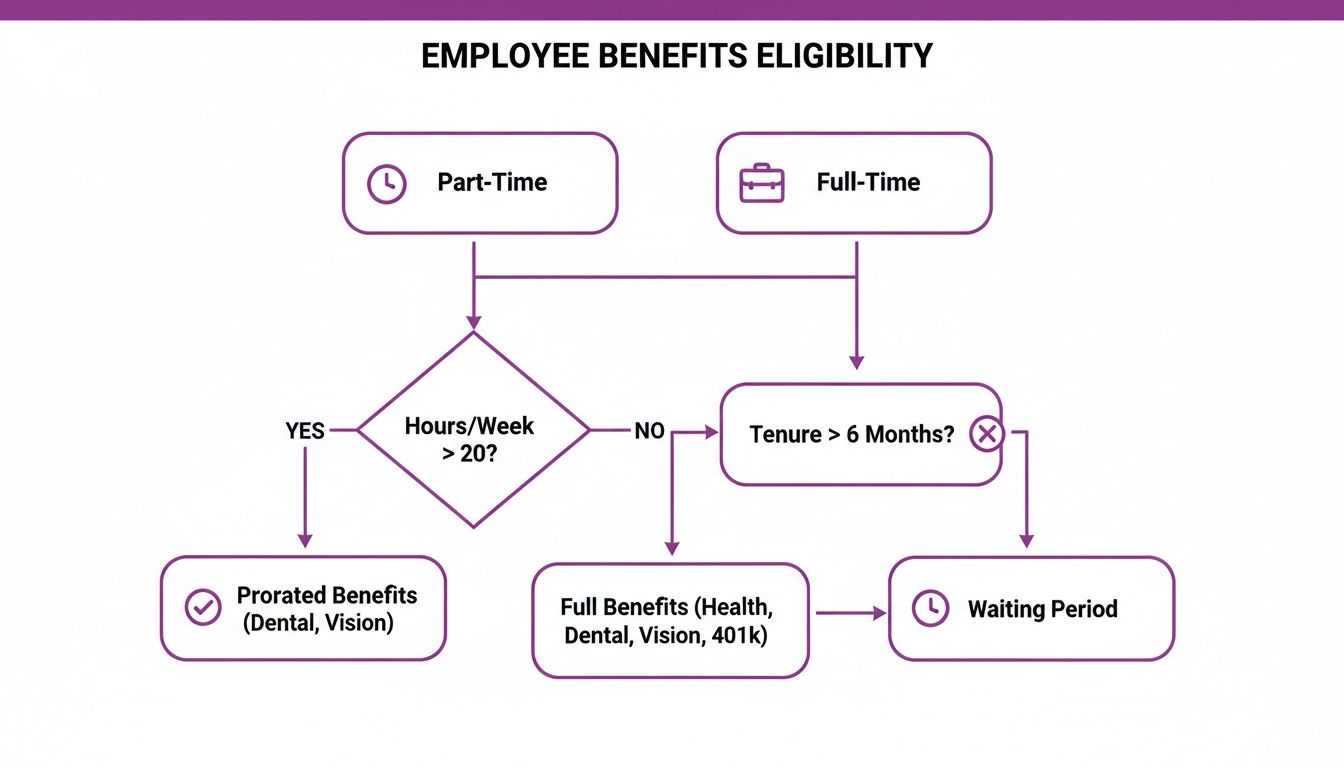
As you can see, benefits eligibility isn't random; it's a direct outcome of your strategic workforce planning. Each classification has downstream effects.
Using Business Intelligence to Refine Your Mix
This is exactly where a business intelligence platform like Wurkn delivers value that traditional HR surveys simply can't match. Forget static, once-a-year feedback. Wurkn gives you a continuous, real-time pulse on your workforce's health by analyzing anonymous sentiment from the communication tools your team is already using every single day.
Your workforce mix is a living system. A decision that works today might create cultural debt tomorrow. Continuous intelligence is the only way to stay ahead.
By tapping into this always-on feedback loop, you can spot hidden pain points long before they mushroom into expensive problems like turnover or burnout. It lets you proactively fine-tune your staffing model to build a more resilient and productive organization.
Here’s how it works in the real world:
- Spot Burnout Risks Early: Your Wurkn dashboard might show that your full-time team’s sentiment consistently nosedives after hours, a classic sign of burnout from covering gaps. This isn't just a hunch; it's a data point prompting you to explore quiet hiring strategies or bring in targeted part-time support.
- Measure True Inclusivity: Are your part-timers feeling like outsiders? Wurkn can detect sentiment patterns that show they feel excluded from key decisions or team events, giving you a chance to strengthen your onboarding and integration before they disengage.
- Find Your Agility Sweet Spot: By correlating sentiment data with your own productivity metrics, you can find the perfect balance. You might discover that a specific ratio of full-time to part-time staff on a team leads to the highest engagement and output—a proven model you can then replicate across the company.
When you can transform qualitative feedback into measurable intelligence, you’re no longer just managing schedules. You're strategically architecting a workforce where every single employee, regardless of their status, is set up to thrive.
Understanding Key Regional Employment Trends
Ontario and California reveal very different stories when it comes to how full-time and part-time roles shape their labour markets. Provincial and state reports uncover shifts you can’t ignore when crafting staffing and compensation strategies.
Take Ontario’s recent labour market snapshot here: the province saw a notable increase in full-time jobs while part-time positions dipped. That swing toward 30+ hour roles bucks the national pattern favouring part-time growth—and it matters, since full-time work usually brings higher weekly earnings.
Across Canada—from Alberta’s steady upticks to Quebec’s service-driven part-time boom—and in US states like Texas and New York, these local nuances determine whether you prioritise full-time stability or part-time flexibility.
Comparing Provincial And State Trends
- Ontario: Full-time professional roles drive most gains
- Quebec: Service-sector part-time jobs outgrow full-time hires
- Texas: Full-time headcount fluctuates with energy cycles
- California: Balanced growth in both full-time and part-time positions
But raw employment data only tells half the story. Wurkn’s continuous sentiment analysis reveals how scheduling changes affect morale across regions, turning numbers into next-step strategies.
“Real-time cultural intelligence across provinces and states turns regional trends into actionable staffing strategies.”
This layer of business intelligence spots when a surge in part-time hires—perhaps driven by seasonality—actually signals potential disengagement. Wurkn flags these moments so leaders can tweak schedules and benefits long before turnover spikes.
Using Sentiment Data To Tailor Hiring
Consider British Columbia’s tourism season. A rush of part-time hires can hide burnout risks until it’s too late. Wurkn surfaces immediate dips in positive sentiment the moment hours jump, giving teams a chance to rebalance shifts or add targeted support for part-time staff.
| Region | Full-Time Trend | Part-Time Trend |
|---|---|---|
| Ontario | Strong Growth | Slight Decline |
| Alberta | Moderate Growth | Strong Growth |
These side-by-side metrics empower HR to align compensation with local market realities and decide when to focus on full-time hires versus flexible part-timers. For more on boosting engagement through work-week design, see our four-day work-week guide here.
By weaving regional labour data together with business intelligence, you build workforce plans that respect legal frameworks and human factors. This multi-layered approach to the full-time vs. part-time question equips leaders in Canada and the US to nurture resilient, engaged teams—no matter the jurisdiction.
- Monitor sentiment before and after compensation changes
- Benchmark engagement metrics across regions
- Adapt scheduling policies based on real-time feedback loops
Common Questions from the Trenches
When you're managing a mixed workforce, the theoretical differences between full-time and part-time quickly become practical, on-the-ground questions. Here are some of the most common scenarios that land on a leader's desk, with answers straight from experience.
Can I Switch an Employee from Full-Time to Part-Time?
Yes, but you have to walk this line very carefully. Simply cutting an employee's hours without their agreement can be seen as constructive dismissal, a serious legal issue, especially in Canada. Why? Because you're fundamentally changing the core of their employment contract.
To do this right, you need a legitimate business reason—and you need to be transparent about it. The best approach is to have an open conversation, provide as much notice as possible, and get the employee's written consent on a new agreement. This document should spell out the new hours, pay, and any changes to benefits. Honestly, this is one of those times where getting legal advice specific to your province or state isn't just a good idea; it's essential.
Are There Big Tax Differences for Employers?
The difference isn't really in the payroll tax rates themselves. In both the US and Canada, you're still remitting things like FICA or CPP/EI based on what an employee earns, regardless of their status.
The real distinction comes down to tax-deductible benefits. The money you spend on health insurance, retirement plan contributions, and other comprehensive benefits—which are usually reserved for full-time staff—are deductible business expenses. This means your total tax deductions are often much higher for your full-time employees, which is a key piece of the puzzle for your overall financial strategy.
How Do Overtime Rules Work for Part-Time Staff?
This is a common point of confusion, but the rule is simple: overtime is about hours worked, not job titles. Regulations in both the US (under the FLSA) and in Canadian provinces kick in after a set number of hours in a workweek, like 40 hours or 44 hours.
So, if your part-time employee who usually works 20 hours a week steps up to cover extra shifts and hits 45 hours, they are absolutely entitled to overtime pay for every hour they worked over that legal threshold. The key is knowing your local labour laws and applying them consistently to every non-exempt employee, period.
Knowing the rules is one thing, but understanding how they land with your team is another. Static policies don't tell you how these decisions affect morale, engagement, or productivity day-to-day. Wurkn closes that gap. It moves you beyond guesswork by delivering continuous business intelligence, translating anonymous employee sentiment into a clear, actionable dashboard. You can finally see the direct line connecting your staffing decisions to real business outcomes. Discover how to build a more resilient and engaged workforce today.