
A team charter form isn't just another document to file away. Think of it as your team's constitution—a living agreement that lays out not just what you're going to do, but how you're going to do it together. It clarifies your shared purpose, goals, communication rhythms, and how you'll make decisions.
Unlike a simple project plan that lists tasks, a charter builds the foundation for how your team collaborates, heading off friction and misunderstandings before they start.
Why Your Team Needs More Than a Mission Statement
In the fast-paced, often-remote work environments common across Canada and the United States, a vague mission statement just doesn't cut it. It won't keep your team aligned when things get tough. This is where a team charter form becomes a game-changer. It’s not more bureaucracy; it’s a practical agreement that defines the 'how' behind your team’s success.
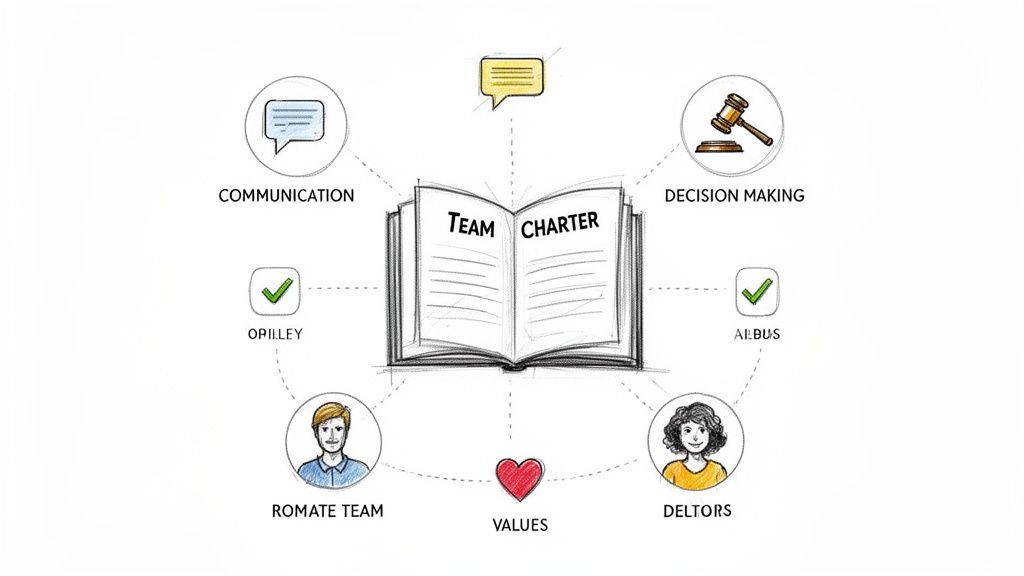
It’s the document that proactively answers the questions that so often derail projects and tank morale.
Moving from Ambiguity to Action
A well-built charter turns abstract goals into concrete ground rules. It forces the team to get clear on the critical, unspoken stuff that usually gets figured out through trial and error.
- Communication Protocols: How do we share updates? Is a chat tool for quick questions and email for official decisions? Nail this down, and you eliminate a huge source of confusion. For example, a software development team in Vancouver might agree that critical bug reports are always submitted via a specific project management tool, never through informal chat messages.
- Decision-Making Processes: Who gets the final say on what? How do we break a tie or handle a strong disagreement? Clarity here prevents bottlenecks. A marketing team in Chicago might decide that any ad spend over a certain threshold requires consensus from three key stakeholders.
- Shared Values and Norms: What behaviours do we expect from each other? How will we deliver tough feedback respectfully? This is how you build real psychological safety.
This isn’t just about feeling good; it’s about turning your workplace culture from an unpredictable variable into a measurable advantage. By setting these ground rules, you create a baseline for what "good" looks like—a baseline that a sophisticated business intelligence tool like Wurkn can then measure against reality.
A team charter isn’t just a document; it’s a shared commitment to how you work together. It serves as a living guide that evolves with your team, helping you navigate change and stay aligned on what matters most.
Wurkn goes beyond traditional HR surveys. As a business intelligence tool, it analyzes real-time, anonymized conversations from platforms like Slack to provide actionable insights into your team’s health. It shows you whether the behaviors defined in your charter are actually sticking.
This lets you see not just what is happening in your culture but why. It connects the agreements you made as a team to your actual performance. For any leader in the United States or Canada serious about building a resilient, high-performing team, this data-driven approach transforms culture from a vague concept into a key business driver.
Laying the Groundwork Before You Draft the Charter
A great team charter isn’t something you just knock out in a meeting. It’s built on a foundation of mutual understanding before anyone even opens a document.
If you rush into a drafting session without doing the prep work, you’ll likely end up with a generic, ineffective team charter form that doesn’t capture what makes your team tick. A little preparation turns what could be a disorganized brainstorming session into a genuinely productive workshop.
One of the most powerful things you can do is have each team member create a quick 'User Guide to Me.' This isn't just another icebreaker; it's a simple exercise that immediately starts building psychological safety.
Understanding Individual Work Styles
Think of the 'User Guide to Me' as a personal instruction manual. It’s not about judging anyone's style—it’s about getting everything out in the open to create clarity. Have each person on the team jot down answers to a few key questions:
- How do you prefer to communicate? Are you a fan of quick chat messages for urgent stuff, or do you need a scheduled call for deeper conversations?
- What’s the best way to give you feedback? Do you prefer it in a private message, during a one-on-one, or are you comfortable with it in a group setting?
- What are your ideal work conditions? What helps you get in the zone? Maybe it's uninterrupted focus time in the morning or collaborative jams in the afternoon.
Sharing these guides before the main chartering session is a game-changer. Team members start to understand each other on a much deeper level, which seriously boosts empathy and cuts down on friction right away.
This isn't just a "feel-good" exercise; the data backs it up. Research from the Canada School of Public Service (CSPS) found that teams using charters experienced significant improvements in efficiency and communication (CSPS, 2021). The process, which often includes exercises similar to 'User Guides,' fosters mutual understanding and can drastically reduce miscommunication. It’s worth looking into how the CSPS develops team charters to get these kinds of results.
This initial information-gathering is a lot like using a business intelligence tool. It gives you a clear, data-backed snapshot of your team’s dynamics before small issues can blow up, turning subjective feelings into objective starting points for discussion.
This kind of qualitative data collection is exactly what business intelligence platforms like Wurkn are built for. Wurkn gathers anonymized employee sentiment to give leaders a real-time view of their team’s health, moving beyond guesswork. It’s a proactive approach that spots patterns and potential friction points, much like how a ‘User Guide to Me’ reveals individual needs.
For any leader, understanding these nuances is just as crucial as tracking performance metrics. Gathering this initial feedback is similar to running an effective employee satisfaction survey; it provides a vital baseline of team sentiment before you introduce any new processes.
Crafting the Essential Components of Your Team Charter
Let's be honest, most team charters are useless. They're generic templates filled out once, filed away, and never looked at again. The key to creating a team charter form that actually works is to treat it less like a document and more like a detailed agreement on how your team will win together. It’s where you translate a fuzzy sense of purpose into the concrete, day-to-day behaviours that drive real results.
Think of the core components as the pillars of that agreement. Each one is designed to head off the most common team failures before they happen—things like murky roles, fuzzy goals, or that awkward silence when conflict arises.
I find it helps to break the creation process down into three simple phases: guide the conversation, discuss the details, and then draft the final agreement.
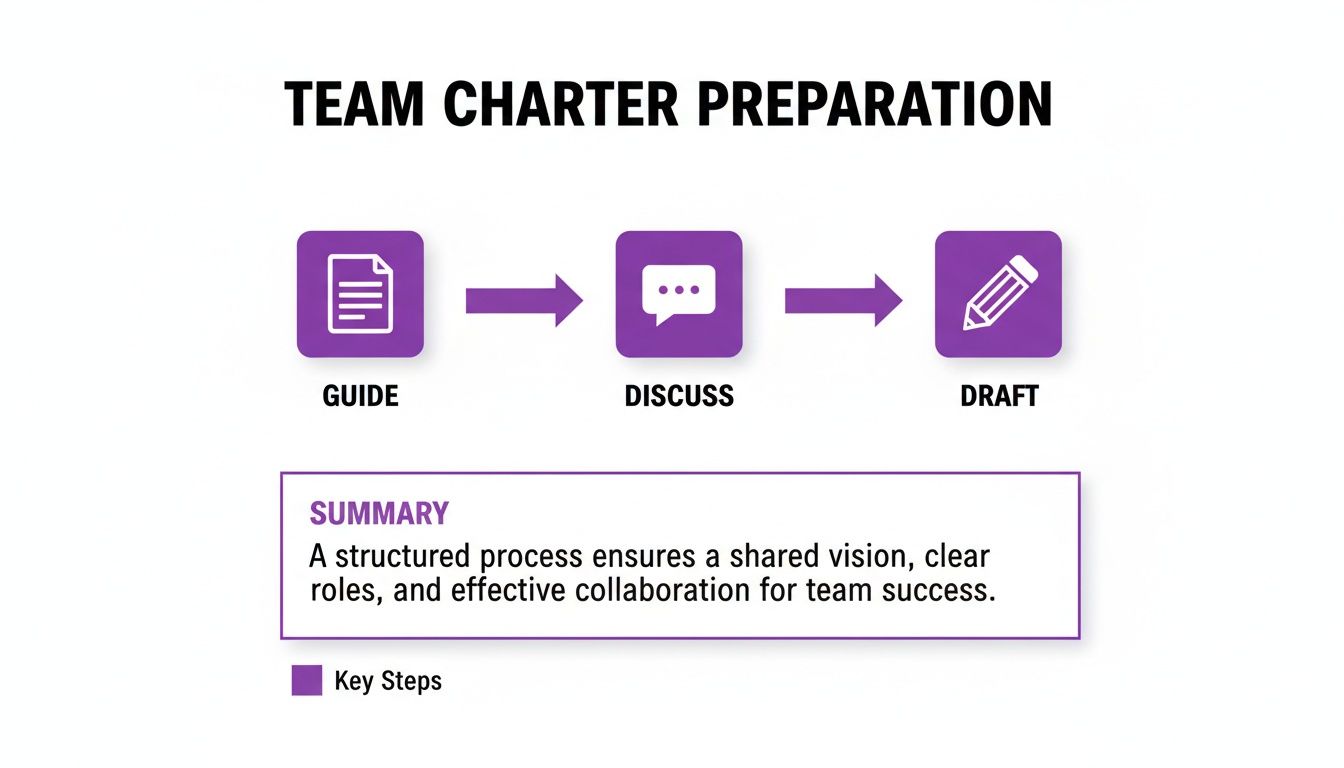
This flow highlights a critical point: the conversations and shared understanding you build along the way are just as valuable as the document you produce.
From Purpose to Practicality
Every single element in your charter needs to be actionable. The best way to do this is to start high-level and then drill down into the nitty-gritty of how your team will operate. This ensures everyone is aligned from the big picture right down to individual tasks.
- A Clear Team Purpose: This isn’t your company’s mission statement. It's your team's unique reason for being. For a marketing team, this might be, "To become the primary driver of qualified leads by creating content that educates and empowers our audience in the North American market."
- Measurable SMART Goals: Now, connect that purpose to something you can actually measure. For that same marketing team, a SMART goal would sound like this: "Increase qualified leads from our Canadian and US content by 20% in Q3 by launching three targeted campaigns."
- Explicit Roles and Responsibilities: Job titles are not enough. You need to define who is the final Decider, who is Responsible for getting the work done, and who just needs to be Consulted or Informed. Getting this right is a game-changer for efficiency.
In fact, this kind of structured role definition has a massive impact. A great Canadian example is the Treasury Board Secretariat's Project Charter Guide, which emphasizes clear organizational charts to define team structures, cutting down on role confusion and ensuring smoother stakeholder alignment (Treasury Board of Canada Secretariat, 2011). You can explore the guide's insights on role clarity to see how they approach it.
Building Cultural Intelligence into Your Charter
The most effective charters go beyond tasks and goals to address the human side of teamwork. This is where you codify the culture you want to build, turning a basic document into a culturally intelligent guide for how you operate.
A culturally intelligent charter anticipates friction and builds mechanisms to handle it constructively. It’s a proactive investment in psychological safety and team resilience.
This is what separates a truly useful charter from a simple checklist. You're not just stating what you'll do, but agreeing on how you'll do it, especially when things get tough.
Comparing a Basic vs a Culturally Intelligent Team Charter
The difference is in the details. A basic charter states the obvious, while a culturally intelligent one provides a clear playbook for interaction.
| Charter Component | Basic Approach (Just the Facts) | Culturally Intelligent Approach (Building How We Work) |
|---|---|---|
| Decision-Making | "The team lead will make final decisions." | "For decisions impacting project timelines, we will use a consensus model. If we can't agree after a 30-minute discussion, the product manager is the final decider." |
| Conflict Resolution | "Team members should resolve conflicts professionally." | "If a disagreement arises, members will first discuss it 1:1. If unresolved, they will bring it to the weekly team sync with a proposed solution for group discussion." |
| Communication Norms | "We will use chat and email for communication." | "Use chat tools for urgent, <1-hour response items. Use email for non-urgent updates requiring a formal record. All major project updates are shared in our Monday sync to respect focus time." |
This level of detail is precisely what makes a charter a living guide instead of a forgotten file.
This is also where a tool like Wurkn comes into play. As a business intelligence platform, it helps you see if the culture you defined in your charter is actually your reality. By analyzing anonymized communication patterns, it connects the behavioural agreements from your charter to hard business KPIs like productivity and retention. This gives leaders a clear, data-backed view of how team culture is directly impacting performance.
How to Run a Charter Session That Actually Works
Building a team charter form isn't just about filling in boxes. The session itself is a critical team-building moment, and how you run it determines whether the final document becomes a living guide or just another file lost in a shared drive. For hybrid and remote teams across Canada and the United States, getting this facilitation right is everything.
A poorly handled session can feel like a top-down order, creating a charter that nobody feels they own. The real goal is to carve out space for healthy debate and genuine consensus, making sure every single person's voice is heard and valued.
Setting the Stage for Real Talk
Your first job is to create psychological safety. The session has to feel like a safe zone where people can float ideas, disagree respectfully, and challenge assumptions without fearing judgment. It’s the same principle behind the anonymous feedback channels found in advanced business intelligence platforms.
Just as Wurkn gives employees a way to share honest, unfiltered feedback, your chartering session must be built on trust. This is what guarantees the output is a real collective agreement, not just a document to check off a list. I always start these meetings by explicitly stating that all ideas are welcome and that the goal is alignment, not forcing unanimous agreement on every little detail.
A Practical Agenda for Your Charter Workshop
A good agenda is your best friend for keeping the conversation on track. Don't rush this; a shallow charter is a useless one. Block out at least two to three hours.
Here’s a flow that I’ve found works incredibly well, especially for distributed teams:
- Welcome & The "Why" (15 mins): Kick things off by grounding everyone in the purpose. Explain exactly how this document is going to make their work lives better, clearer, and more effective.
- Silent Brainstorming (30 mins): This is my secret weapon. Using a virtual whiteboard tool, have everyone silently add digital sticky notes to each section of the charter (e.g., communication norms, how we make decisions). This technique is a game-changer for ensuring quieter folks can contribute equally, without being drowned out by louder personalities.
- Group Discussion & Clustering (60 mins): Now the facilitator steps in. Start grouping similar ideas together and guide a discussion to refine them into crisp, actionable statements. This is where the magic happens.
- Review & Commit (15 mins): Read the drafted charter statements out loud. Go around the virtual room and ask for a verbal "yes" from each person. This final step solidifies the agreement and creates a powerful sense of shared ownership.
The best chartering sessions aren't about speed; they're about depth. A facilitator's number one job is to guide the conversation from a collection of individual ideas to a shared, collective understanding. That's how you get real buy-in.
This structured, collaborative approach is the foundation of team cohesion. If you're looking for more ways to foster that connection in today's work environments, check out our guide on team-building cohesion strategies for hybrid work. By investing the time in a well-run session, you turn a simple form into a powerful tool for building a resilient, high-performing team.
Making Your Team Charter a Living Document
Look, creating a team charter is a fantastic first step. You've had the tough conversations and put it all down on paper. But let's be honest: the real test begins the moment that workshop ends. A team charter form can't just be another file that gets saved and forgotten in a shared drive. Its real value comes from being woven into the fabric of your team’s daily rhythm—a guide you actually use, not just a document you once made.
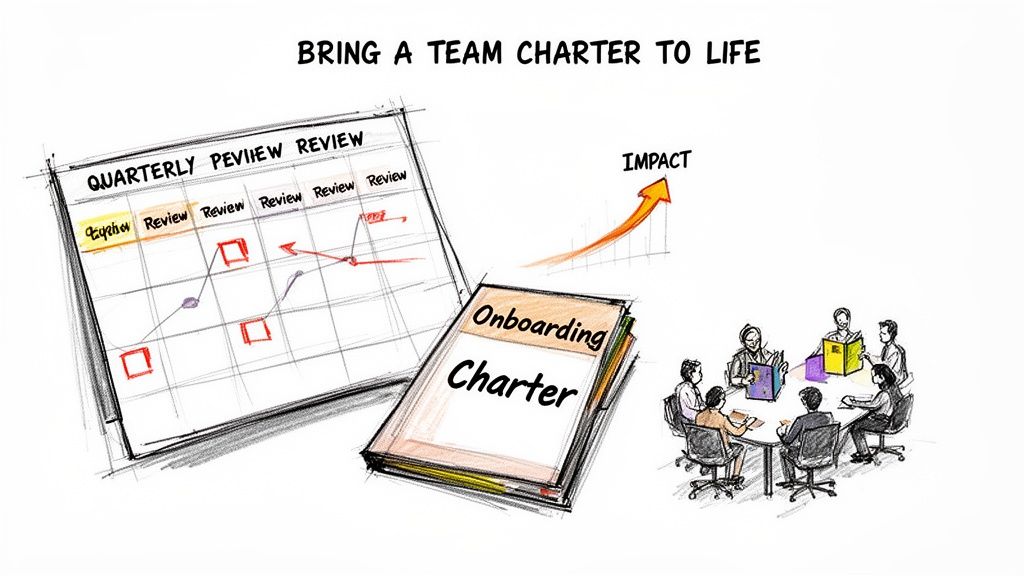
If you don't intentionally integrate it, even the most thoughtfully crafted charter will become irrelevant in a few weeks. The key is to transform it from a static document into an active tool that shapes how your team works, collaborates, and solves problems together.
Weaving the Charter into Your Daily Workflows
For a charter to have any real teeth, you have to embed it into your existing processes. This isn't about adding more meetings; it's about making the charter a natural reference point within your team's operational cadence.
Think of a marketing team in Toronto debating a new campaign direction. Instead of the conversation getting stuck in a loop of personal opinions, they can pull up their charter and use the decision-making framework they all agreed on. It immediately shifts the conversation from subjective debate to a structured, constructive path forward.
Here are a few high-impact ways to keep your charter front and centre:
- During Project Retrospectives: Use the charter to frame the discussion. Ask pointed questions like, "Did we actually follow our communication norms during that last-minute scramble?" or "How well did our conflict resolution process hold up when that unexpected roadblock appeared?"
- When Onboarding New People: Don't just hand them a welcome package. Make the charter a key part of their first week. Walking a new hire through it is the fastest way to get them up to speed on the team's culture, expectations, and unwritten rules.
- In Performance Conversations: For managers, the charter is a powerful tool. It allows them to ground feedback in shared expectations everyone has already agreed to, rather than making it feel like a personal critique. The focus shifts to behaviours the team collectively decided were important.
This kind of consistent reinforcement is what turns the charter from a piece of paper into a dynamic guide for how your team continuously improves.
Setting a Rhythm for Reviews and Measuring What Matters
A team charter isn't a "set it and forget it" document. It has to breathe and evolve along with your team. Goals shift, new members join, and unexpected challenges pop up. A simple quarterly review is usually the right cadence to make sure the charter still reflects your team's current reality.
A charter’s true power lies in its ability to adapt. Scheduling regular check-ins ensures it reflects your team's current reality, not just the goals you set six months ago.
This isn't just about feeling good; this iterative process has a measurable impact. Studies show that teams actively using charters can slash workplace conflicts and that those who commit to quarterly reviews see a significant jump in achieving their shared goals (Mathieu & Rapp, 2009). You can discover more about these findings on team charter effectiveness and see how these regular check-ins drive tangible results.
But how do you really know if the charter is making a difference day-to-day? This is where a business intelligence tool like Wurkn changes the game. Wurkn goes beyond simplistic surveys by analyzing continuous, anonymized feedback from the communication platforms your team already uses, like Slack or Microsoft Teams. It gives you a real-time pulse on whether the behaviours you defined in the charter are actually taking root.
For example, if your charter puts a heavy emphasis on psychological safety and constructive feedback, Wurkn can identify communication trends that show whether people truly feel safe enough to voice a dissenting opinion. It draws a clear line from the cultural signals in daily interactions to hard performance metrics. For leaders in Canada and the United States, this provides the concrete data needed to prove that investing time in culture and your team charter delivers a measurable business outcome.
Common Questions About Team Charter Forms
Even with a great template in hand, questions always pop up when a team builds a charter for the first time. Getting ahead of these common queries builds confidence and makes sure everyone is on the same page before you even start. Let's tackle the ones I hear most often.
How Is a Team Charter Different From a Project Plan?
This is, without a doubt, the most frequent question, and the distinction is critical. Think of it this way: a project plan is all about the what and when. It’s a tactical roadmap filled with tasks, deliverables, and timelines needed to get a specific job done.
A team charter form, on the other hand, defines the how and who. It’s your team’s internal operating system. It lays out how you’ll communicate, make decisions, handle inevitable disagreements, and live up to your shared values. It’s the cultural guide that makes every project plan run smoother.
What Is the Ideal Length for a Team Charter?
Keep it short. Seriously. The best charters I’ve seen are usually just two to four pages long—something you can easily pull up and reference in the middle of a meeting without losing momentum. The goal isn’t to document every hypothetical scenario. It’s to capture the essential agreements that guide how your team works together.
The creation process should feel like an efficient workshop, not another project to manage. For most teams I’ve worked with across Canada and the United States, a single facilitated session of two to three hours is more than enough to get a solid first draft hammered out.
A team charter should be a quick reference guide, not an encyclopedia. If it’s too long, it won’t get used. Focus on clarity and practicality over exhaustive detail to create a tool that actually serves the team every day.
Can We Create a Charter for an Established Team?
Absolutely. In fact, it can be an incredibly powerful reset for a team that's been in the trenches together for a while. It creates a structured, safe space to finally address unspoken frustrations, realign on goals that might have drifted, and formally recognize the positive habits that have already formed organically.
For a team with history, the chartering process makes implicit expectations explicit. It’s a chance to reinforce a shared commitment and turn what’s already a good team into a great one.
How Do We Keep Our Charter From Being Forgotten?
This is where the rubber meets the road. To prevent your charter from becoming just another file lost on a shared drive, you have to bake it into your team’s regular rhythm.
- Make it part of onboarding. It’s the fastest way to get new hires up to speed on your team’s unique culture.
- Reference it in retrospectives. Use it as the benchmark when you discuss what’s working and what isn’t. "Did we follow our communication norms here?"
- Schedule quarterly check-ins. Put 30 minutes on the calendar every three months to review it. Is it still relevant? Does anything need an update based on new challenges?
But the most effective way to measure its real-world impact is to connect its principles to actual team behaviour. This is where a business intelligence tool provides unmatched value over traditional survey tools. It can actively monitor whether the communication styles and conflict resolution agreements you made in the charter are actually showing up in how the team interacts day-to-day.
Wurkn moves beyond static surveys to provide a living dashboard of your team’s cultural health. As a business intelligence tool, it analyzes continuous, anonymized feedback from your existing communication channels to connect the behavioral agreements in your charter to key business results. Discover how to transform your culture into a measurable advantage.