
Let's cut right to the chase. The whole OKRs vs. KPIs debate is simpler than most people make it.
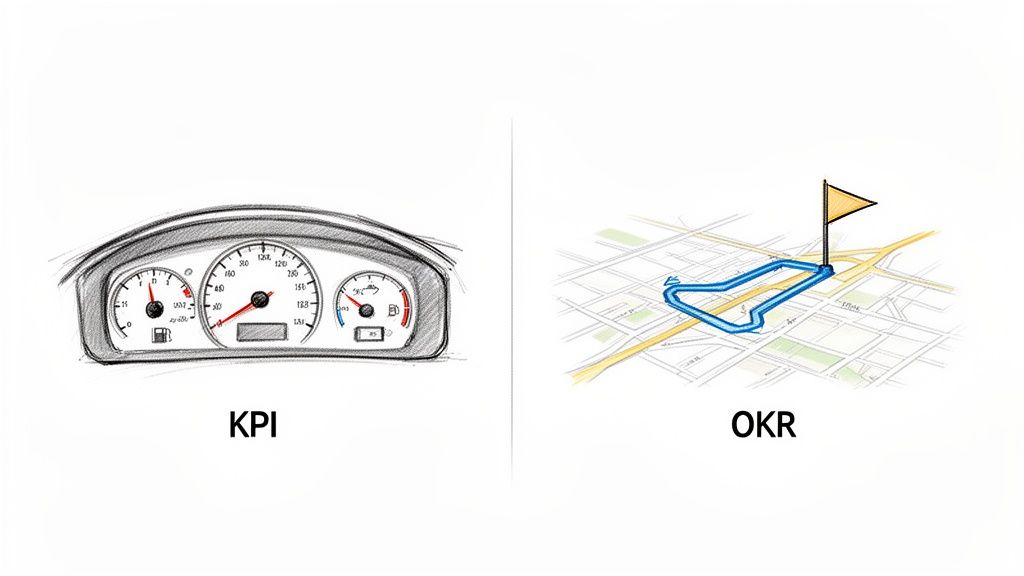
Think of it like this: KPIs (Key Performance Indicators) are the gauges on your car's dashboard. They tell you your speed, your fuel level, and your engine temperature. They're essential for monitoring the day-to-day health of your operations.
OKRs (Objectives and Key Results), on the other hand, are your GPS. You don't turn it on for your daily commute; you use it when you're trying to get somewhere new and ambitious. It sets a destination and maps out the key turns you need to make to get there.
KPIs track your business-as-usual performance, while OKRs drive you toward a specific, game-changing goal.
Understanding The Core Difference Between OKRs and KPIs
When you get down to it, OKRs and KPIs serve entirely different strategic functions. They aren't interchangeable.
KPIs are your company’s vital signs. You monitor them constantly to make sure everything is running smoothly. OKRs are more like a focused, high-intensity campaign designed to push the organization into new territory. They have a start and an end date.
Here's another way to look at it: a hospital continuously tracks a patient's heart rate—that's a KPI. If that heart rate becomes a problem, the medical team doesn't just watch it; they set an Objective to stabilize the patient. Their Key Results might be administering a specific treatment and seeing a measurable improvement within a set timeframe.
The KPI flagged the issue; the OKR is the strategic plan to fix it.
High-Level Comparison: OKRs vs KPIs
Getting this distinction right is fundamental for any leader in Canada or the United States aiming to build a high-performance team. While both frameworks rely on data, their purpose, focus, and timeline couldn't be more different.
This table breaks down the core attributes at a glance.
| Attribute | OKRs (Objectives and Key Results) | KPIs (Key Performance Indicators) |
|---|---|---|
| Primary Purpose | To drive change, achieve ambitious goals, and foster innovation. They answer, "Where do we want to go?" | To monitor and measure the ongoing performance and health of a specific business function. They answer, "How are we doing?" |
| Focus | An aspirational framework focused on achieving significant, measurable outcomes. | A monitoring system focused on tracking outputs and operational efficiency over time. |
| Cadence | Typically set quarterly or annually. They are time-bound with a clear finish line. | Continuously monitored (daily, weekly, monthly) and often ongoing without a defined endpoint. |
| Nature | Aggressive and ambitious; often considered "stretch goals" where 70% achievement is a success. | Attainable and realistic; teams are expected to consistently meet or exceed their KPI targets. |
| Scope | Strategic and directional, often involving cross-functional collaboration to achieve a large objective. | Often operational and specific to a single team, department, or business process. |
As you can see, they aren't enemies; they're two different tools for two different jobs. One measures health, the other inspires growth.
Moving Beyond Simple Metrics
Here’s the problem with relying on KPIs alone. They tell you what is happening (e.g., "voluntary turnover is at 15%"), but they almost never explain why. This is where most performance frameworks and basic HR survey tools fall flat—they give you data points but leave you guessing about the human factors driving those numbers.
An organization's ability to execute its strategy successfully is often hindered by a failure to understand the underlying drivers of performance. Research from The Conference Board shows that while 86% of executives rate culture as important, only 19% believe their culture is where it needs to be—a gap often rooted in a disconnect between metrics and human behavior.
This is exactly the gap a business intelligence tool like Wurkn is designed to fill. It’s more than just another employee engagement platform; Wurkn captures continuous employee sentiment and turns it into the cultural intelligence that connects the dots between a lagging KPI or an ambitious OKR and the real-world experiences of your team. It gives leaders in People Ops and operations the context they need to make smarter, data-informed decisions. By finally understanding the why behind your numbers, you can set far more effective goals and build a healthier, more productive organization from the ground up.
A Detailed Framework Comparison
To really get the difference between OKRs and KPIs, you have to look past the textbook definitions and see how they actually work in a business. Their differences aren't just about wording; they're foundational, shaping everything from how you set goals to the rhythm of your strategic meetings. For leaders in Canada and the United States, knowing which framework to pull out of the toolbox for a given situation is a non-negotiable skill.
The core distinction is simple: KPIs are for maintaining business health, while OKRs are for driving a big, focused leap forward. It’s like the difference between your annual physical and a specialized surgery.
Purpose: Growth vs. Health
Key Performance Indicators (KPIs) are the vital signs of your business. Think of them as the gauges on your dashboard—ongoing, measurable stats that track how critical parts of your operation are performing. The whole point of a KPI is to monitor and maintain the health of "business as usual." For instance, an Operations lead might track ‘Server Uptime’ as a KPI. The goal isn't to reinvent server uptime every quarter; it's to make sure it stays above a critical threshold, like 99.9%, day in and day out.
Objectives and Key Results (OKRs), on the other hand, are built to shove you out of your comfort zone. They’re a framework designed for change, for innovation, for that strategic push you need to make. An OKR doesn’t just track a process; it sets a bold, time-crunched destination. Its purpose is to spark growth, not just keep the lights on.
Measurement: Outcomes vs. Outputs
This one is subtle, but it's where most people get tripped up. KPIs often measure outputs—the direct, tangible results of what your team did. For a People Operations team, a classic KPI is ‘Average Time to Hire.’ It’s a direct output of your recruiting process. It’s important, sure, but it only tells you how efficiently you’re running a process, not whether that process is achieving a bigger strategic win.
OKRs are laser-focused on outcomes. An outcome is the meaningful change or impact you actually create.
An output is what you did; an outcome is what you achieved. KPIs often track activity and efficiency, whereas OKRs measure progress toward a significant, aspirational change.
Let's stick with that recruiting example. Instead of just tracking the output of time-to-hire, a team using OKRs might set something much more ambitious:
- Objective: Become the go-to employer for senior engineering talent in our city.
- Key Result 1: Boost the accepted offer rate for senior roles from 65% to 85% this quarter.
- Key Result 2: Source 40% of senior engineering candidates from direct referrals, up from 15%.
See the shift? The focus moves from process speed (an output) to the strategic outcome of actually winning the war for top-tier talent.
Cadence: Continuous Monitoring vs. Quarterly Sprints
The rhythm of how you use these tools is also completely different. KPIs are typically watched continuously—daily, weekly, or monthly. They live on dashboards that are always on, providing a constant pulse check in ongoing operational meetings. This always-on nature lets leaders spot when something’s drifting off course and make a quick correction.
OKRs run on a much more structured, cyclical beat, usually in quarterly sprints. This built-in deadline creates urgency and sharpens focus. At the start of the quarter, teams set their moonshot objectives. Throughout the quarter, they have regular check-ins to see how they're tracking against their Key Results. At the end, they score their progress, talk about what they learned, and gear up for the next cycle. It’s less about maintenance and more about short bursts of high-intensity execution. The practices you use during this time, from one-on-ones to team meetings, can be enhanced by clear and effective communication structures found in well-designed performance review templates.
The Wurkn Difference: Connecting Goals to People
Look, traditional HR platforms and survey tools can help you track these metrics, but they leave a massive gap. A dipping KPI or a failing OKR is a symptom, not the root cause. If you don't understand the human dynamics driving the numbers, you’re just managing a spreadsheet.
This is where Wurkn completely changes the game. As a business intelligence tool, Wurkn gives you the cultural intelligence to connect your goals to the real-time sentiment of your team. For example, imagine a People Ops team sets an OKR to "Improve new hire onboarding effectiveness" with a Key Result to "Increase 90-day retention of new hires by 20%."
A standard survey tool might tell you if you hit the number, but it won't tell you why. Wurkn, by capturing continuous, anonymous feedback, can surface themes showing that new hires feel disconnected from their teams or that their onboarding process lacks clarity. This insight lets leaders set more meaningful Key Results that address the actual human barriers to achieving their objective. Wurkn turns a simple goal into a data-informed strategy rooted in your team's real, lived experience, demonstrating value far beyond a traditional employee engagement platform.
OKRs, KPIs, or Both? Making the Right Call
Deciding between OKRs and KPIs isn't some academic debate; it's a practical choice about what you’re trying to accomplish right now. The sharpest leaders in Canada and the United States know these frameworks solve different business problems. It all boils down to a simple question: are you trying to keep the lights on or are you trying to rewire the building?
Think of it like this. KPIs are your dashboard gauges—they monitor the ongoing health of your business operations. OKRs are the specific, high-intensity projects you launch to upgrade the engine. You wouldn't use your car's oil pressure gauge (a KPI) to plan a cross-country road trip (an OKR). You use the gauge to make sure everything's running smoothly, and the trip plan to get somewhere new and exciting.
This flowchart cuts right to the heart of it, showing when to reach for an OKR to drive growth versus when a KPI is best for monitoring business-as-usual health.
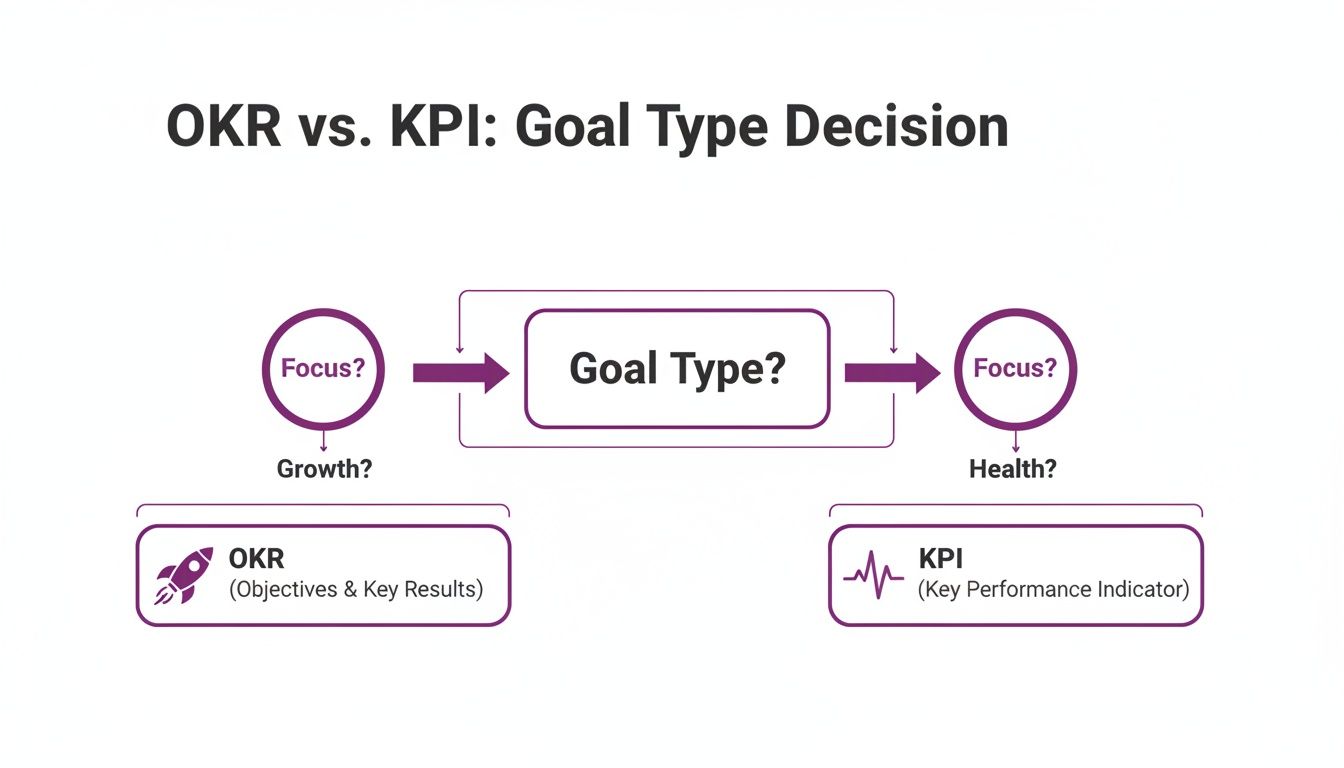
The visual drives home a core principle: if your goal is to maintain and measure a process that already exists, a KPI is your tool. But when you need to create significant, forward-moving change, an OKR provides the ambitious structure you need to get it done.
Scenarios for People Operations
For People Ops professionals, this distinction is everything. KPIs keep track of the health and efficiency of your core HR functions, while OKRs are the strategic plays you run to fundamentally improve the employee experience.
- Use a KPI to monitor Time-to-Hire: This is a vital sign for your recruitment engine. The goal is to keep it within a healthy range, say, under 45 days. It’s a continuous measurement, not a project with a finish line.
- Use an OKR to fix a hiring problem: If your top candidates keep turning down offers, a KPI just tells you you're failing. An OKR gives you a framework to fix it.
- Objective: Overhaul our candidate experience to become the undisputed first choice for top talent.
- Key Result: Cut the senior-level offer decline rate by 25% before the end of Q3.
See the difference? The OKR is an all-out assault on a strategic problem, aiming for a very specific, high-impact outcome on a deadline.
Scenarios for COOs and Operations
For a Chief Operating Officer, KPIs are the lifeblood of the business, ensuring every part of the operational machine is running flawlessly. OKRs are the focused initiatives designed to build a better, faster, or more efficient machine.
- Use a KPI to track Operational Uptime: This metric is non-negotiable. A COO needs this number locked in at something like 99.95% or higher. It’s about maintaining a standard, day in and day out.
- Use an OKR to innovate a process: When you spot a recurring problem that’s bleeding time or money, you set a bold goal to eliminate it for good.
- Objective: Radically improve order fulfillment accuracy and speed.
- Key Result: Implement automation to slash manual order processing errors by 60% this quarter.
The KPI is your constant pulse check on performance. The OKR is the surgical intervention you perform to make a fundamental operational upgrade.
Using KPIs as a Trigger for OKRs
The most effective organizations don't see this as a choice—they see it as a cycle. A struggling KPI is often the perfect catalyst for a new, sharply focused OKR.
A steady drop in a crucial KPI isn't just a number to watch—it's a clear signal that the underlying process is broken or outdated. This is the moment to shift from monitoring to action by setting an ambitious OKR to address the root cause.
For instance, if your ‘Voluntary Turnover’ KPI starts creeping up from 8% to 14% over a couple of quarters, that's a five-alarm fire. Instead of just tracking the damage, a great leader uses that data to launch an OKR aimed at improving manager training or building clearer career paths.
This is where Canadian workplaces, for example, are seeing a huge gap in results. A recent study found AI adoption among office employees has hit 50%, with 55% using it weekly. An OKR helps you frame this as a strategic goal—like 'Increase AI-driven productivity by 20%'—while a basic KPI might just track usage, missing the massive strategic opportunity. You can read more about these trends in Canadian workplaces on Business Wire.
This is where a business intelligence tool like Wurkn provides a serious advantage. Wurkn delivers continuous, anonymous sentiment analysis from your team's everyday workplace tools. It can flag rising burnout, process friction, or dips in morale before they crater a KPI like turnover or productivity. This cultural intelligence gives leaders the power to set proactive, informed OKRs that get to the why behind the numbers, turning a brewing crisis into a strategic win.
Connecting Performance Metrics to Cultural Health
Performance metrics like OKRs and KPIs are powerful, but let’s be honest: on their own, they’re just numbers on a dashboard. They tell you what is happening—productivity is down, turnover is up—but they almost never explain why. Real strategic insight comes from connecting these data points to the human dynamics and cultural factors that actually drive them.
Without this context, leaders are just guessing. A stagnant 'Productivity per Employee' KPI might look like a performance issue, but the real culprit could be widespread burnout or hidden process friction. This is the critical blind spot where traditional performance management and HR survey tools fall short; they track the symptoms but completely fail to diagnose the underlying cultural health problems.
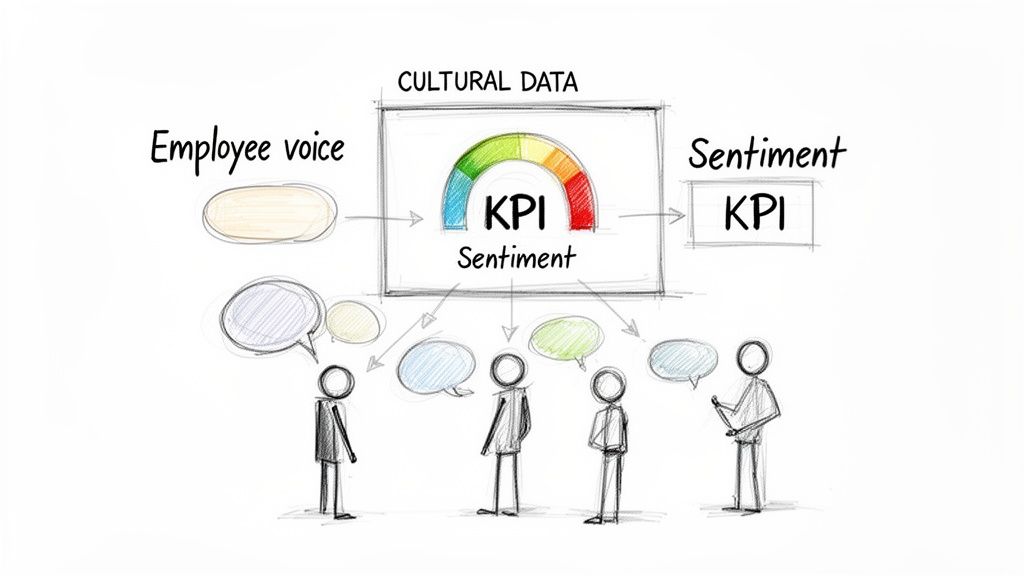
This is precisely where Wurkn operates as an essential business intelligence platform, not just another HR tool. Instead of relying on infrequent, static surveys that are outdated the moment they’re complete, Wurkn gives you a living dashboard of your company’s cultural health by analyzing continuous, anonymous employee sentiment from the tools your teams already use every day.
From Raw Numbers to Actionable Intelligence
Imagine your company sets an ambitious OKR to 'Foster a culture of innovation.' That’s a great objective, but how do you measure it in a way that means something? A common approach is to track a Key Result like 'Launch 3 new product features.' This measures output, sure, but it says nothing about the cultural shift needed for sustained innovation.
A much smarter approach connects the objective directly to cultural health. With Wurkn, you can set a Key Result like, 'Improve sentiment score on psychological safety by 20%.' Wurkn delivers the real-time data to track this, surfacing themes from employee conversations that show whether people actually feel safe enough to share bold ideas or experiment without fear of failure.
When you can measure the cultural enablers of performance, your OKRs and KPIs transform from passive indicators into active levers for strategic change. You stop managing metrics and start leading people.
This allows leaders to see exactly where cultural friction is holding back innovation, turning a vague goal into a data-driven strategy. Understanding your team's real-time experience is everything. You can learn more about defining and measuring these crucial elements by exploring effective work culture KPIs for enhanced business success.
The Canadian Context: OKRs and Cultural Alignment
This link between performance frameworks and cultural intelligence is especially relevant for businesses in Canada. There's a growing preference for OKRs over KPIs in the Canadian business landscape, particularly as organizations grapple with the ROI from new technologies. For instance, while business AI use doubled year-over-year, some sectors are still struggling to see a tangible return.
The aspirational, flexible nature of OKRs allows for the rapid pivots needed in modern work—a critical advantage for remote and hybrid teams where cultural alignment is the primary engine of performance. Wurkn’s mission as a business intelligence tool is to provide this exact connection. It closes the gap between operational outcomes and cultural intelligence, ensuring that as you adopt ambitious frameworks like OKRs, you have the continuous feedback loop needed to keep your team aligned, engaged, and moving in the right direction. The platform gives COOs and People Ops leaders the 'why' behind their OKR and KPI dashboards, empowering them to build healthier, more resilient, and higher-performing organizations.
Putting a Combined OKR and KPI Strategy Into Action
Blending OKRs and KPIs effectively isn’t about running two systems side-by-side. It's about creating a strategic rhythm where one framework feeds and strengthens the other. For COOs and People Ops leaders, this means designing a system where your day-to-day performance metrics (KPIs) naturally tell you where you need a massive strategic push (OKRs).
Think of it this way: KPIs are your business’s vital signs, the steady pulse you monitor to ensure operational health. OKRs are the high-intensity workouts you design to build new muscle.
First, you need to anchor your KPIs to your core business functions. These are your non-negotiables—the metrics that tell you if the lights are on and things are running smoothly. For a COO in Canada, this could be ‘On-Time Delivery Rate’ or ‘Manufacturing Defect Rate.’ For a People Ops leader, it might be ‘Voluntary Employee Turnover’ or ‘Employee Net Promoter Score (eNPS).’ These metrics need to be tracked constantly and displayed on dashboards, forming your baseline for operational stability.
Once that solid KPI foundation is in place, you can unleash OKRs to drive major improvements or tackle big, hairy, audacious goals. The key is making sure your OKRs are genuine stretch goals, not just a glorified to-do list. An OKR shouldn’t be about maintaining business as usual; it should articulate a bold, ambitious future you're reaching for.
Best Practices for a Hybrid Framework
Making a combined OKR and KPI strategy work comes down to discipline and brutal clarity. Without clear guidelines, you’ll just dilute focus and overwhelm your teams with noise.
-
Limit Your OKRs: This is the most common mistake. A company should have no more than 1-3 top-level OKRs per quarter. This forces ruthless prioritization and rallies the entire organization around what truly matters most right now.
-
Align, Don’t Cascade: Forget the old top-down, command-and-control model of cascading goals from the top. Instead, empower teams to set their own OKRs that align with and contribute to the company's big objectives. This creates ownership, unlocks creativity, and gets you better results.
-
Communicate Relentlessly: Your progress, your failures, your learnings—all of it needs to be communicated transparently and often. Regular check-ins (weekly or bi-weekly) are non-negotiable for tracking progress, smashing roadblocks, and making smart adjustments on the fly.
This hybrid approach is proving especially powerful for Canadian businesses navigating the complexities of remote and hybrid work. Statistics Canada has noted steady growth in business AI adoption, a trend that plays to the strengths of an OKR framework. The quarterly cycle of OKRs allows companies to adapt to lightning-fast market and tech shifts, a clear edge over ongoing KPIs which can sometimes feel like you're looking in the rearview mirror. You can learn more about business technology adoption in Canada from Statistics Canada.
Creating an Environment Where Ambitious Goals Can Thrive
The single biggest factor in whether your OKRs succeed or fail is your culture. Full stop.
Ambitious goals can only exist in an environment of psychological safety—that shared belief that it's safe to take risks, to speak up, to fail. If your team is scared of failure, they will never commit to true stretch goals. They'll set safe, incremental targets they know they can hit, and the entire purpose of the OKR framework is dead on arrival.
To achieve ambitious outcomes, you must first build a culture where it is safe to try and fail. OKRs are a test of your organization's commitment to innovation, not just its ability to execute a plan.
This is exactly where traditional HR surveys and employee engagement platforms miss the mark. They give you a static snapshot of sentiment but do nothing to build the deep, foundational trust required for a high-performance culture.
Wurkn is designed to solve this exact problem. As a business intelligence tool, its privacy-first, anonymous feedback system is built to cultivate the psychological safety needed for teams to swing for the fences. By capturing continuous sentiment from the tools your people already use every day, Wurkn gives leaders real-time cultural intelligence. This allows you to see and address the fears, frictions, and communication gaps that silently kill ambitious goals.
For any organization serious about winning, understanding the inextricable link between performance and the underlying health of their people and culture isn’t just a nice-to-have; it's the ultimate competitive advantage.
Frequently Asked Questions About OKRs and KPIs
Let's cut through the theory. When leaders start talking about OKRs and KPIs, a lot of practical questions come up. The whole "OKR vs KPI" debate can get academic fast, but what you really need to know is how to make them work in the real world. This section is all about clear, direct answers to the questions we hear most often from operations and people leaders.
Our goal is to give you the actionable clarity you need to move forward.
Can a Company Use Both OKRs and KPIs Together?
Not only can you, but you absolutely should. The most effective organizations don't see them as competing frameworks; they use them in perfect harmony.
Think of it like this: KPIs are your always-on business health monitors. They're the dashboard gauges for your operational engine—metrics like revenue, customer churn, or system uptime. They tell you if everything is running smoothly day-to-day.
OKRs, on the other hand, are your focused, high-intensity growth projects. You pull the OKR lever when you want to make a significant, targeted leap forward. For instance, if your "Employee Engagement Score" KPI is stable but not where it needs to be, you'd launch a quarterly OKR with specific key results designed to dramatically improve it.
KPIs tell you if the engine is healthy. OKRs are the special projects you run to upgrade that engine for more horsepower. They are partners, not rivals.
How Many OKRs Should a Team Have?
The golden rule here is brutally simple: less is more. The entire point of an OKR is to create intense, laser-like focus on what matters most. Overloading teams with a laundry list of "priorities" is the fastest way to guarantee mediocrity across the board.
At the company level, aim for no more than 1-3 strategic objectives at any given time. Each team should then align its own 1-3 objectives to directly support those top-level goals. Nothing else should get the same level of attention.
For each of those objectives, you'll want 3-5 measurable Key Results. This structure forces discipline and ensures every ounce of effort is channelled toward a handful of game-changing outcomes, not scattered across a dozen well-intentioned but disconnected activities.
Are OKRs Only for Tech Companies?
Not at all. While the framework was famously scaled by tech giants in Silicon Valley, its core principles are universal. We've seen OKRs drive incredible results in manufacturing, healthcare, retail, professional services, and even non-profits across Canada and the United States.
The power of OKRs isn't about tech; it's about creating a transparent, accountable, and outcome-driven culture. That's a massive competitive advantage in any sector. Think of it as a tool for strategic execution and alignment, not just for building software. Any organization trying to get all its teams rowing in the same direction toward ambitious goals can benefit.
How Do OKRs Support Remote and Hybrid Teams?
OKRs feel like they were practically designed for distributed workforces because they shift the entire conversation away from activity and squarely onto outcomes. In a remote or hybrid world, trying to manage performance by tracking "hours logged" or "green dots on Slack" is a recipe for disaster. It kills trust and autonomy.
The OKR framework reframes the performance discussion around a single, powerful question: "What measurable impact did we create?"
You give teams a few clear, ambitious, and measurable goals, then you empower them with the autonomy to figure out the best way to get there. For leaders managing distributed teams, this is a game-changer. It fosters a culture of ownership and accountability where results, not presence, are what truly count.
This is also where tying in a business intelligence tool like Wurkn becomes so powerful. By giving you continuous, anonymous cultural data from the communication tools your teams already use, Wurkn provides the human context behind the numbers. It helps you see hidden blockers and ensure every employee feels connected to the company's big goals, no matter where they're working from.
Ready to connect your performance metrics to the real-time health of your culture? Wurkn is a business intelligence platform that transforms continuous employee sentiment into actionable insights, giving you the 'why' behind your OKRs and KPIs. Discover how to build a healthier, more productive organization at https://wurkn.com.