
Let's get one thing straight: modern worksite wellness programs aren't about free fruit bowls and discounted gym memberships anymore. They've grown up. Today, they are serious, strategic initiatives designed to build a healthier, more resilient workforce—covering everything from physical and mental health to financial stability. In the tight talent markets across the United States and Canada, a top-tier wellness program is no longer a perk; it's a competitive necessity.
What Exactly Are Worksite Wellness Programs?
Think of a worksite wellness program as the coaching and conditioning staff for your entire company. The objective isn't just to keep people from getting injured (or calling in sick), but to actively help every single employee perform at their peak. It's a structured, company-backed effort that gives people the tools and support they need to improve their overall health.
This goes way beyond just offering a decent benefits package. A truly great program creates an entire ecosystem of resources, activities, and cultural nudges that cater to the real needs of your team. The goal is simple: make the healthy choice the easy choice.
The Modern Definition of Wellness
Not long ago, "workplace wellness" was code for physical health. Think weight-loss challenges, smoking cessation posters, and maybe a yearly health screening. While those things still have a place, the definition of wellness has exploded to become far more holistic and, frankly, far more useful.
Today’s leading programs are built on a few key pillars:
- Physical Wellness: Getting people moving, eating better, and staying on top of preventive care. This could be anything from on-site yoga classes and stocking healthy snacks to subsidizing gym memberships.
- Mental and Emotional Wellness: Giving people the resources to handle stress, dodge burnout, and look after their mental health. This often includes access to counselling services (EAPs), subscriptions to mindfulness apps, or workshops that build emotional resilience.
- Financial Wellness: Offering tools and education to help employees get a handle on debt, plan for the future, and dial down money-related stress. Think retirement planning seminars or access to certified financial advisors.
- Social Wellness: Building a genuine sense of community and connection. This happens through well-planned team events, volunteer days, or vibrant employee resource groups (ERGs).
Moving Beyond Guesswork with Business Intelligence
The biggest leap forward in wellness programs is the shift from a one-size-fits-all, "let's try this" approach to a strategy driven by real data. Old-school annual surveys give you a single, static snapshot that's outdated the moment it's compiled. They completely miss the day-to-day cultural currents that truly shape your team's wellbeing.
This is where a business intelligence tool like Wurkn completely changes the game. Wurkn moves beyond the limitations of traditional employee engagement platforms by delivering continuous, real-time insight from the communication channels your team already uses. It's not another survey; it's a diagnostic engine for your company culture.
By understanding the why behind how your employees are feeling—not just the what—you can spot wellness gaps before they become full-blown crises. For instance, Wurkn might detect a spike in conversations about burnout in your engineering department. That allows you to step in with targeted support long before those engineers start updating their résumés. This transforms wellness from a reactive HR task into a proactive, strategic part of running the business.
The Business Case for Investing in Employee Wellness
Okay, we've defined what a worksite wellness program is. Now for the question every COO or People Ops leader needs to ask: why should we invest in this? Is it just another "nice-to-have" perk, or does it actually move the needle on business performance?
The answer is simple: investing in employee wellbeing is a hard-nosed business strategy. It’s not about fluff; it’s about generating a tangible, data-backed return that strengthens your company's financial health and gives you a serious competitive edge.
From Cost Centre to Profit Driver
For too long, employee benefits have been stuck on the expense side of the ledger. A modern, well-designed wellness strategy flips that script entirely, turning this line item into a direct driver of profitability.
The logic is straightforward. When your people feel supported in their physical, mental, and even financial health, they bring their best selves to work. Healthier, less-stressed employees are more focused, more present, and more committed.
This isn't just a theory. It translates into real dollars through a few key channels:
- Reduced Healthcare Costs: When you offer proactive support like preventive screenings or accessible mental health resources, you naturally lower the number and severity of insurance claims. A 2019 report in the Journal of the American Medical Association (JAMA) found that while some wellness program components had mixed results, disease management programs significantly reduced healthcare costs.
- Lower Absenteeism & Presenteeism: Healthy employees take fewer sick days. More importantly, they’re actually engaged and productive when they are at work, which tackles the huge hidden cost of "presenteeism" (when people are physically present but mentally checked out).
- Decreased Employee Turnover: Losing great people is incredibly expensive. Wellness programs are a powerful retention tool, building loyalty and creating a culture that top performers don't want to leave.
One of the biggest mistakes leaders make is measuring wellness initiatives by vanity metrics like participation rates. Asking "How many people signed up for the yoga class?" is the wrong question. The real question is, "How has our investment in mental health resources correlated with a decrease in voluntary turnover on our engineering team?" That's where the value is.
The Tangible ROI of a Healthy Workforce
The numbers don't lie. For organizations in hyper-competitive markets across Canada and the United States, a strong wellness program isn't a luxury—it's a requirement to win.
According to a study by the U.S. Chamber of Commerce, companies that prioritize employee well-being can see significant financial benefits. While specific figures vary, well-executed programs consistently correlate with lower turnover, reduced healthcare claims, fewer sick days, and higher productivity. These aren't marginal gains; they are significant operational advantages.
But as impressive as these stats are, they only tell you what happened, not why. This is where traditional annual HR surveys completely miss the mark. A once-a-year survey might tell you 40% of your team feels stressed, but it can't tell you which specific cultural issues are driving that stress or how it's tanking a specific team's performance right now.
ROI of Comprehensive Worksite Wellness Programs
Investing in your team's wellbeing isn't an act of charity; it's a strategic move with a clear financial upside. The table below breaks down the direct business impact you can expect from a well-executed program, showing exactly how supporting your people translates into stronger operational performance.
| Business Metric | Average Improvement with Wellness Program | Impact on Business Operations |
|---|---|---|
| Employee Turnover | 25-35% Reduction | Dramatically lowers recruitment, hiring, and training costs. Preserves institutional knowledge and maintains team momentum. |
| Healthcare Costs | 20-30% Lower Claims | Reduces insurance premiums and claim payouts, directly improving the bottom line and freeing up capital for other investments. |
| Absenteeism | 27% Fewer Sick Days | Increases overall workforce productivity and reduces the operational strain caused by unscheduled absences on projects and teams. |
| Productivity | 15-21% Higher Output | Engaged, healthy employees are more focused, innovative, and efficient, leading to better project outcomes and higher revenue per employee. |
| Employee Engagement | 30-40% Increase | Higher engagement correlates directly with better customer service, higher quality work, and a stronger employer brand. |
As the data shows, the returns are substantial. A healthier, more engaged workforce doesn't just feel better—it performs better, creating a powerful cycle of productivity and profitability that gives your business a sustainable competitive advantage.
Unlocking Deeper Insights with Business Intelligence
This is precisely where a cultural business intelligence platform like Wurkn changes the game. Wurkn isn't another survey tool; it's a living dashboard of your company's cultural health that provides insights far beyond what typical HR tools or engagement platforms can offer.
By continuously and anonymously analyzing sentiment from the places where work actually happens—like Slack and Microsoft Teams—it connects the dots between employee wellbeing and concrete business outcomes.
Imagine seeing a real-time chart that shows a spike in anonymous conversations about burnout directly correlating with a dip in that department's productivity metrics. That isn't just "feedback"; it's actionable intelligence. It gives you the power to intervene with targeted support—like a workshop on managing workloads or rolling out a new mental health benefit—and then measure the impact on both sentiment and performance.
This transforms employee wellbeing from a vague HR concept into a measurable strategic asset that directly addresses the staggering costs of employee turnover. With this level of insight, you can finally prove what the best leaders already know: investing in your people is the smartest investment a business can possibly make.
How to Design Your Worksite Wellness Program
Let’s be honest: most worksite wellness programs fail. They’re built on assumptions and generic templates that feel disconnected from what people actually need. A successful strategy isn’t about guessing what your employees want; it’s about creating a system to know what they want, continuously and in real-time.
This is the playbook for designing a program that genuinely connects with your team and delivers clear, measurable value back to the business. It starts by ditching the once-a-year HR survey—a stale, outdated snapshot—and plugging into the live pulse of your workforce.
Step 1: Start with a Continuous Needs Assessment
The foundation of any program that actually works is a deep understanding of your people's needs. The problem with traditional surveys is simple: the moment you get the results, they’re already old news. By the time you’ve analyzed the data, your team’s challenges have already shifted.
A much smarter approach is to capture an always-on, anonymous pulse of how your employees are really doing. This is where a business intelligence tool like Wurkn provides value that goes above and beyond standard HR survey tools. It gathers candid, real-time feedback by meeting employees where they already are—inside platforms like Slack and Microsoft Teams—without adding another task to their plate.
This constant stream of information lets you spot wellness gaps the moment they appear. You might notice a spike in anonymous comments about financial stress or see remote teams consistently mentioning struggles with work-life balance. This isn’t just feedback; it’s a heat map showing you exactly where to focus your resources for the biggest impact.
Step 2: Secure Leadership Buy-In with Data
Once you have a clear picture of your team’s needs, you have to get your leadership on board. Executives are rightfully focused on the bottom line, so your pitch needs to speak their language: business outcomes, not just employee perks.
Use the insights from your continuous feedback to build a rock-solid business case. You need to connect the dots for them, clearly and concisely.
- Present the Problem: "Our data shows a 15% increase in conversations related to burnout in the sales department over the last quarter."
- Quantify the Risk: "This sentiment directly correlates with a 10% dip in their quarterly performance and puts us at risk of higher turnover, which we know is incredibly expensive."
- Propose the Solution: "By investing in a targeted mental health resource and a workshop on managing workload, we can get ahead of this before it gets worse."
- Define Success: "We’ll measure success by tracking a reduction in burnout-related sentiment and a corresponding stabilization in sales productivity over the next six months."
This data-first approach transforms your wellness initiative from a vague "nice-to-have" into a strategic investment with a clear, measurable return.
This process shows how investing in your people's well-being directly fuels engagement, which in turn drives retention and profitability.
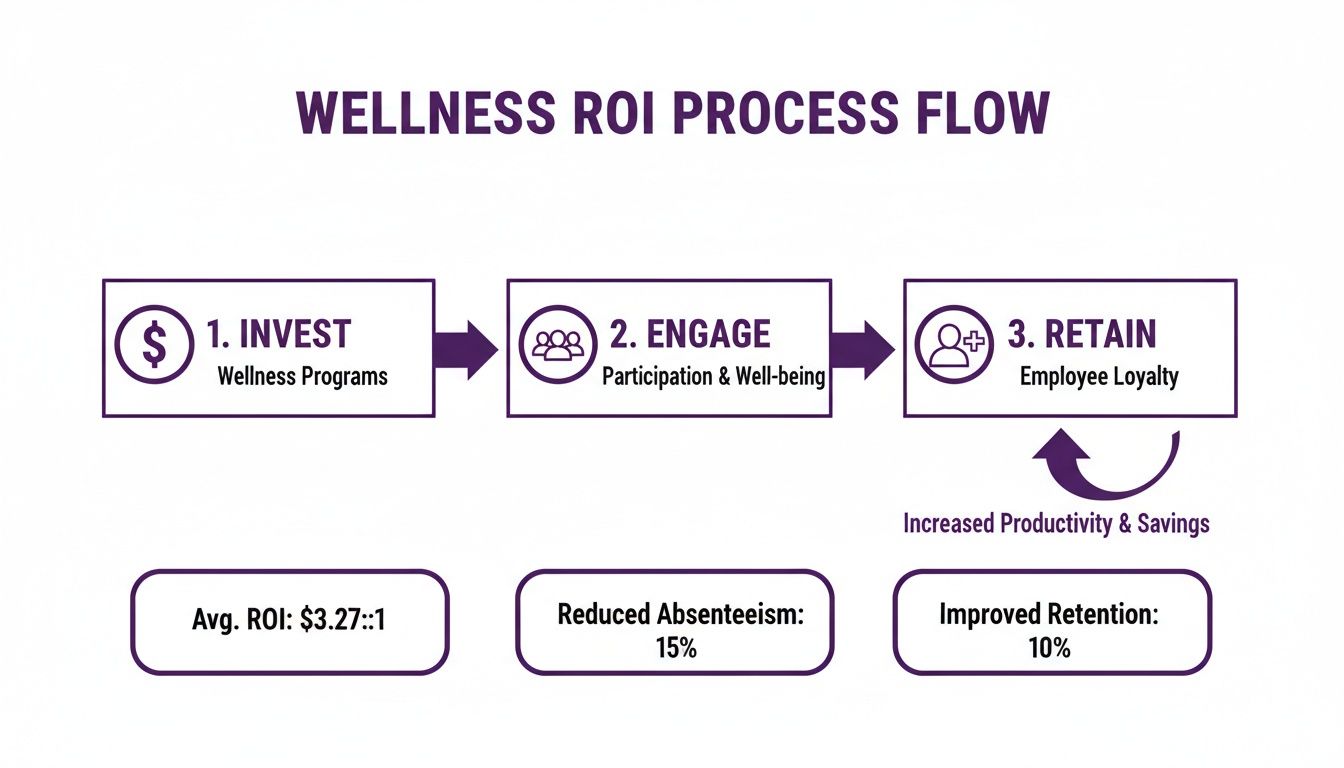
As the flow shows, a thoughtful wellness strategy creates a positive feedback loop: investment leads to engagement, which leads to retention, ultimately strengthening the business.
Step 3: Design a Holistic and Flexible Program
With leadership’s backing, you can start building the program itself. The biggest mistake you can make here is a one-size-fits-all approach. The best wellness programs are holistic—addressing multiple dimensions of well-being—and flexible enough for a diverse workforce.
A common mistake is launching a program that feels mandatory or overly prescriptive. True wellness is about empowerment and choice. Give employees the autonomy to engage with resources that are personally meaningful to them.
Your program should offer a balanced menu of options:
- Physical Wellness: Think beyond gym discounts. Offer virtual yoga or fitness classes that remote staff in different time zones can actually attend. Consider stipends for home workout gear or sponsor a team entry in a local 5k.
- Mental and Emotional Wellness: Make it incredibly easy to access confidential counselling through an Employee Assistance Program (EAP). Offer subscriptions to leading mindfulness apps or host practical workshops on managing stress and building resilience.
- Financial Wellness: Partner with financial advisors for confidential one-on-one sessions. Host webinars on topics that matter, like retirement planning, navigating debt, or saving for a down payment. A flexible wellness spending account is a powerful tool here, letting people use funds for what they truly need, from therapy to financial planning services.
Step 4: Plan a Strategic Launch and Communication Plan
How you roll out your program is just as critical as what’s in it. A great communication plan builds excitement and makes sure everyone understands the why behind the investment.
Start teasing the program a few weeks before launch. Use every channel you have—email, Slack, team meetings—to announce what's coming. Crucially, connect it back to the anonymous feedback you collected. This shows you listened and are taking action.
When you launch, make it dead simple for people to sign up and get involved. Provide clear instructions, maybe host a virtual kick-off event, and identify a few "wellness champions" in different departments who can answer questions and get their peers excited. Communication doesn’t end on day one; plan for ongoing reminders, share success stories, and keep the momentum going.
How to Boost Engagement in Your Wellness Initiatives
You can pour a fortune into the most thoughtfully designed worksite wellness program on the planet, but if nobody uses it, it’s just money down the drain. Low participation is the silent killer of even the best-laid plans. The real key to getting people involved isn't just launching more initiatives; it's about building a culture where wellbeing is personal, celebrated, and constantly tweaked based on what your employees are actually saying they need.
A generic, one-size-fits-all approach is dead on arrival. Your workforce is a mix of unique people at different life stages with completely different needs and interests. Pushing a marathon challenge on someone who’d rather do mindfulness meditation is a recipe for frustration, not engagement. Real buy-in starts with personalisation—giving people the freedom to pick activities that genuinely resonate with them.
This means offering a flexible menu of options. Instead of a single gym membership, think about a wellness stipend that can be used for anything from yoga classes and therapy sessions to financial planning workshops. This gives your team ownership over their health in a way that feels authentic and genuinely supportive.
Foster Friendly Competition with Gamification
Another fantastic way to drive up participation is through gamification. All this means is adding simple game-like elements—points, badges, leaderboards—to your wellness activities. It taps into our natural drive for achievement and a little friendly competition, making the whole thing more fun and socially engaging.
Even simple ideas can make a huge difference:
- Team Step Challenges: Pit departments against each other in a friendly battle to see who can log the most steps in a month.
- Wellness BINGO: Hand out BINGO cards with squares for healthy activities like "drink eight glasses of water," "take a 15-minute walk," or "attend a financial wellness webinar."
- Points for Participation: Award points for using any wellness resource, which can be cashed in for company swag or even an extra day off.
This stuff creates a positive buzz and a sense of shared purpose, turning individual health goals into a fun team effort. It's also worth digging into how to improve employee engagement by understanding the core drivers of motivation and weaving them into your wellness strategy.
Use Business Intelligence to Understand the Why Behind Engagement
While gamification and personalisation are great tactics, the most durable engagement strategy is built on a deep, real-time understanding of your people. This is exactly where traditional HR surveys and engagement platforms fall flat. They might tell you what programs are being used, but they have no way of telling you why some are a hit while others are a miss.
This is the critical gap that a business intelligence platform like Wurkn is designed to fill. It goes way beyond simple participation numbers to analyze the anonymous, continuous feedback coming directly from your team. Wurkn's AI can synthesize comments and conversations to uncover the real sentiment behind your wellness initiatives.
You might see high sign-ups for a new mental health app but also notice a spike in anonymous feedback mentioning that the scheduling is a nightmare. That's a golden insight that a simple survey would miss. It allows you to make a quick, agile adjustment—like creating a simple how-to guide—that removes the friction and dramatically boosts actual usage.
This feedback loop is absolutely essential. For example, a 2021 study by the American Psychological Association found that employees are more likely to participate in wellness offerings when they feel their employer genuinely cares about their well-being. Wurkn gives you the power to uncover specific needs within your own company, demonstrate you're listening, and ensure your worksite wellness programs keep evolving, delivering real value, and keeping engagement high for the long haul.
Measuring Success Beyond Participation Rates
So, how do you know if your wellness programs are really working? For far too long, leadership has been content with vanity metrics. Knowing how many people signed up for a stress-management webinar is one thing, but it tells you absolutely nothing about whether it actually lowered their stress levels or helped them navigate a tough project.
To see the real business impact, you have to move past counting heads. True success isn't about activity; it's about outcomes.
Moving From Lagging Indicators to Real-Time Insights
Think about traditional measurement tools like the annual HR survey. They’re classic lagging indicators. By the time you get the results, the data is months old, reflecting problems that have already festered. It’s like trying to steer a ship by looking at the wake it left behind you.
Modern measurement demands a real-time view of your organization's cultural health. This is precisely where a business intelligence tool like Wurkn completely outshines a standard survey or engagement platform. It gives you a live, continuous pulse of what your people are thinking and feeling, turning qualitative feedback into a measurable strategic asset.
Instead of waiting for a yearly report, imagine seeing an immediate spike in anonymous feedback mentioning 'burnout' on your engineering team. Now, imagine seeing that on the same dashboard where that team's project velocity has just started to dip. This isn't just data; it's a diagnostic tool that lets you intervene before a small issue becomes a full-blown crisis.
Connecting Wellness to Core Business Metrics
Once you have the right tools, you can draw a straight line from your wellness initiatives to the numbers your C-suite actually cares about. This is how you shift the conversation from wellness being a "cost centre" to it being a strategic investment with a clear, demonstrable return.
Here are the KPIs you should be laser-focused on:
- Employee Turnover Rates: Are voluntary departures dropping in departments with high engagement in your new mental health resources? A dip in turnover is a direct, hard-dollar saving.
- Absenteeism Data: Keep a close eye on sick days and unplanned absences. A program that’s working will lead to a healthier, more present workforce, which directly boosts productivity.
- Productivity Metrics: For roles where output is easily measured (think sales quotas or support ticket resolution times), track performance trends as you roll out new wellness initiatives.
- Sentiment Analysis: Use a tool like Wurkn to measure real shifts in how employees feel about topics like stress, workload, and manager support. A positive trend here is a powerful leading indicator that bigger, positive business outcomes are on the way.
From Raw Data to Actionable Intelligence
The real power kicks in when you can see these connections on a single dashboard. A COO using Wurkn can see exactly how launching a new mental health benefit corresponds with a measurable improvement in employee sentiment and a reduction in sick days. This directly links cultural health to tangible business results.
This approach also lets you track leading indicators like your Employee Net Promoter Score, giving you a forward-looking view of employee loyalty before it shows up in your turnover numbers.
A structured approach gets results. For example, a case study by the Centers for Disease Control and Prevention (CDC) on a large U.S. employer showed that their multi-component health promotion program led to significant reductions in health risks and healthcare costs over several years. This is what happens when you create clear metrics and build a culture of continuous improvement—people actually want to be a part of it.
Ultimately, measuring success isn't about proving a program was popular. It's about proving it made your business stronger, your people healthier, and your culture more resilient. That’s the true ROI of a modern worksite wellness program.
Navigating Legal and Privacy Considerations
Jumping into a worksite wellness program without getting the legal and privacy side right is like building a house on a shaky foundation. It’s not just about good intentions; it’s about navigating a maze of regulations designed to protect employees. Getting this wrong doesn’t just break trust—it can land your company in some serious legal hot water.
At the end of the day, any wellness initiative has to be built on a bedrock of confidentiality. Your people won’t give you honest feedback about burnout, stress, or health challenges if they’re worried that personal information could end up in their performance review. This is where the legal frameworks aren’t just red tape; they’re guardrails for building trust.
Key Regulations in the US and Canada
In the United States, a couple of major federal laws set the rules of the game:
- The Americans with Disabilities Act (ADA): This is a big one. It basically says any medical questions or exams in your wellness program have to be 100% voluntary. You can’t penalize employees for not participating or dangle health coverage as a coercive carrot.
- The Genetic Information Nondiscrimination Act (GINA): GINA puts strict limits on asking for genetic information (like family medical history) as part of a wellness program. It’s designed to stop employers from using that information in employment decisions.
In Canada, the Personal Information Protection and Electronic Documents Act (PIPEDA), along with various provincial privacy laws, governs how you collect, use, and store employee data. The bottom line is you need clear consent and rock-solid security.
The common thread weaving through all these laws is simple but powerful: wellness programs must empower employees, not strong-arm them. All health data has to be firewalled from personnel files and treated with absolute confidentiality.
The Role of Privacy-First Technology
This is exactly where the legal complexity makes a business intelligence tool so valuable. A platform like Wurkn isn't just another survey tool with a privacy policy tacked on; it’s built from the ground up with privacy as its core operating principle.
By design, Wurkn minimizes the collection of any personally identifiable information (PII) and completely anonymizes all employee feedback. This structure is what makes it safe for people to be candid. It creates the psychological safety needed to get the honest input you need to actually understand what’s going on across the organization.
For leadership, this built-in compliance provides peace of mind. You know you’re gathering critical cultural intelligence without ever stepping over the legal or ethical line. It lets you stop worrying about compliance checklists and start focusing on what truly matters: building a healthier, more supportive, and more productive place to work.
Worksite Wellness FAQs
When People Ops leaders and COOs start exploring worksite wellness, the same critical questions always come up. Here are the straight answers, focused on what actually works in the real world.
How Much Should We Budget for a Worksite Wellness Program?
The typical benchmark you'll hear is somewhere between $150 to $500 per employee, per year. But honestly, that number is almost irrelevant. The real question isn't how much you spend, but how you spend it.
Throwing money at a generic program without knowing what your people actually need is the fastest way to waste your budget. A data-driven needs assessment is non-negotiable. It ensures every dollar is aimed at a specific, identified problem, turning your wellness budget from a hopeful expense into a strategic investment.
Can Small Businesses Actually Pull This Off?
Absolutely. In fact, small businesses often have an advantage. They can be far more agile and creative than a massive corporation. Forget about expensive, large-scale programs; focus on high-impact, low-cost wins.
Here’s what that can look like:
- Offering genuine flexibility in work hours to ease work-life friction.
- Kicking off a company-wide walking challenge or hosting virtual fitness classes.
- Bringing in experts for workshops on practical topics like mental health first aid or financial literacy.
- Teaming up with local gyms or wellness studios to get group discounts for your staff.
For a small business, success isn't about the size of the budget. It’s about deeply understanding your team and showing up with consistent, relevant support.
What's the Single Biggest Mistake We Can Make?
The most common and costly mistake is launching a generic, one-size-fits-all program without asking your employees what they actually want or need first. A program that doesn't solve a real problem for your team is dead on arrival. Engagement will be dismal, the results will be non-existent, and you'll have nothing to show for your investment.
This is exactly why traditional annual surveys just don't cut it anymore. They give you a static, outdated snapshot of a problem that has likely already changed.
The only way to reliably avoid this mistake is to get a continuous, real-time pulse on what your employees truly value. This is where a business intelligence tool provides value far beyond a simple HR survey, shifting your wellness strategy from a top-down guess into a collaborative system that adapts and evolves right alongside your team.
Ready to stop guessing and start building a wellness program that drives measurable business results? Wurkn is the business intelligence platform that gives you the continuous, anonymous feedback needed to diagnose real issues, measure the impact of your initiatives, and prove the ROI, moving far beyond the capabilities of traditional employee engagement or survey tools. See how it works at https://wurkn.com.