
In today's complex work environment, generic team-building exercises no longer suffice. For leaders in Canada and the United States, fostering genuine connection, collaboration, and psychological safety is a strategic imperative tied directly to performance. The challenge is moving beyond feel-good activities to create experiences that deliver measurable cultural and business impact. This requires a new approach: one that aligns events with specific organisational goals, whether that's breaking down silos, fostering innovation, or reinforcing core values.
Instead of relying on guesswork and post-event surveys that offer a lagging, incomplete picture, modern PeopleOps leaders need real-time cultural intelligence. Imagine being able to measure the direct impact of an event on team cohesion or psychological safety, not weeks later, but as sentiment shifts. Business intelligence platforms like Wurkn provide this level of insight, transforming continuous, anonymous employee feedback from tools like Slack and MS Teams into actionable cultural intelligence. Unlike traditional HR survey tools that provide a static snapshot, Wurkn's continuous analysis allows you to see why an event resonated (or didn't) and connect those outcomes to key business metrics like retention and productivity.
This guide presents 10 strategic corporate team building event ideas designed for in-person, remote, and hybrid teams. Each idea is structured as a practical blueprint, complete with actionable steps, success metrics, and guidance on measuring its true impact on your organisation's culture. You will learn how to move from simply hosting events to architecting strategic experiences that strengthen your teams and drive tangible business results.
1. Virtual Hackathon or Innovation Sprint
A Virtual Hackathon or Innovation Sprint is a dynamic, time-bound competitive event where diverse teams collaborate intensively to solve real business challenges. Participants, whether remote, hybrid, or in-person, work over a focused period, typically 24-48 hours, to develop and pitch innovative solutions to a panel of judges. This is one of the most impactful corporate team building event ideas because it directly links collaborative effort to tangible business outcomes.
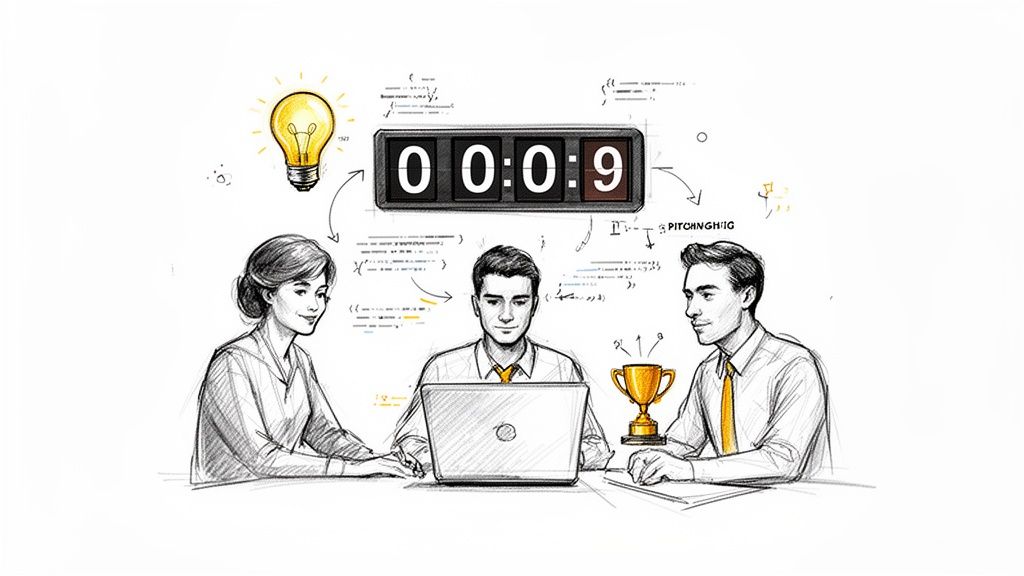
This format excels at breaking down departmental silos and fostering a robust innovation mindset. For instance, a leading Canadian tech firm used an internal hackathon to develop a new mobile feature that improved user engagement by 15% (internal company report). The model is highly adaptable, allowing global participation and providing a structured outlet for creative problem-solving that addresses pressing organisational needs.
How to Implement a Successful Hackathon
- Define Clear Challenges: Frame specific, real-world business problems that need fresh perspectives. Vague goals lead to unfocused efforts.
- Form Cross-Functional Teams: Intentionally mix employees from different departments, like engineering, marketing, and finance, to encourage diverse thinking and holistic solutions.
- Provide Robust Support: Offer access to mentors, subject matter experts, and technical resources throughout the event to empower teams and remove roadblocks.
- Establish Fair Judging Criteria: Ensure your evaluation process values collaboration, creativity, and feasibility, not just the final polished product. Acknowledge and celebrate the effort of all participants.
- Capture and Analyse Sentiment: Before the event, use a business intelligence tool like Wurkn to benchmark baseline sentiment on innovation and collaboration. After the event, Wurkn's continuous monitoring can measure the immediate and sustained impact on employee morale, engagement, and their perception of the company’s commitment to new ideas. This data provides clear ROI on the event’s cultural impact, going far beyond a simple survey.
A well-organised hackathon does more than just build camaraderie; it becomes a powerful engine for progress. By documenting the lessons learned and innovative ideas generated, you can directly fuel your strategic initiatives and cultivate a more agile, forward-thinking organisation. Learn more about how these events can build a thriving culture of innovation.
2. Volunteer and Community Service Days
Volunteer and Community Service Days are organised events where teams dedicate work hours to charitable causes, environmental initiatives, or community support projects. Employees collaborate outside their typical roles to create a tangible, positive impact, fostering a deep sense of shared purpose and connection. This is one of the most meaningful corporate team building event ideas as it aligns professional collaboration with personal values and social responsibility.
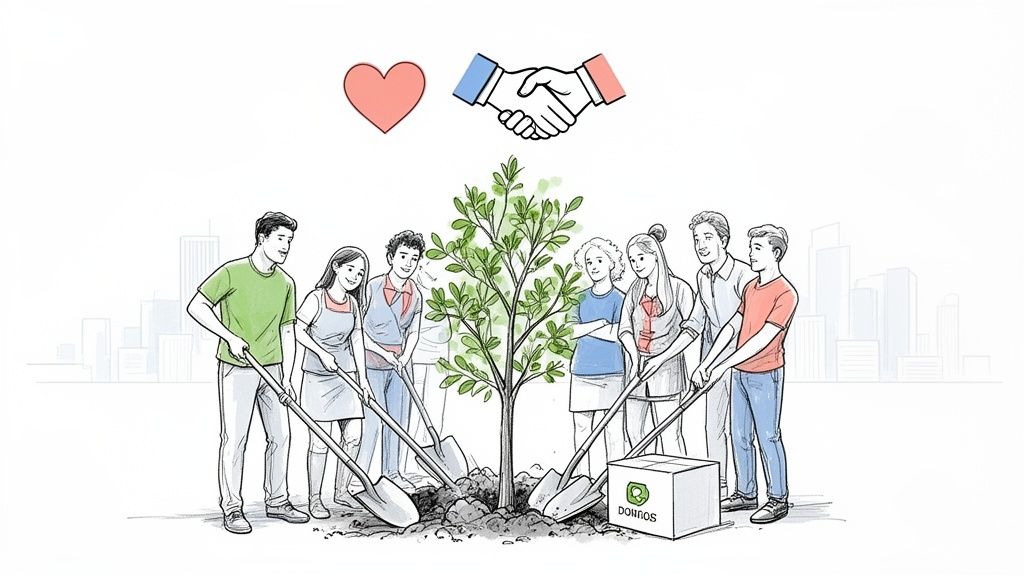
This approach strengthens team bonds through a shared mission that transcends business objectives. For example, a U.S.-based financial services company found that teams participating in quarterly volunteer days had a 10% higher employee engagement score than non-participating teams (Corporate Responsibility Report, 2023). These events resonate strongly with a modern workforce that prioritises purpose-driven work, making them a powerful tool for attracting and retaining top talent.
How to Implement a Successful Volunteer Day
- Align with Employee Interests: Survey your teams to discover the causes they are passionate about. This ensures genuine enthusiasm and higher participation rates.
- Partner with Established Non-Profits: Collaborate with reputable local charities or non-governmental organisations in Canadian and U.S. communities. They can provide structured activities, handle logistics, and ensure your team's efforts are genuinely impactful.
- Schedule During Work Hours: Designating official work time for volunteering removes barriers to entry and signals that the organisation genuinely values community contribution.
- Facilitate Reflection: After the event, hold a debrief session where teams can share their experiences, discuss what they learned, and reflect on the impact they made together.
- Measure the Cultural Shift: Before the event, use a business intelligence tool like Wurkn to establish a baseline of employee sentiment related to purpose and community connection. Afterwards, Wurkn can quantify the uplift in team morale and feelings of belonging, providing clear data on the event's cultural ROI that demonstrates its value far beyond a simple feel-good day.
A well-executed volunteer day does more than just good for the community; it builds a more connected, compassionate, and engaged workforce. By documenting and sharing the impact, you reinforce a company culture where employees feel proud of their collective contributions, both inside and outside the office walls.
3. Skill-Share and Workshop Series
A Skill-Share and Workshop Series is a structured learning program where employees teach each other specialised skills and knowledge. These peer-to-peer sessions leverage internal expertise, empowering team members to become both teachers and learners. This is one of the most effective corporate team building event ideas because it builds a culture of continuous learning and mutual respect while directly addressing organisational skill gaps.
This format excels at recognising and celebrating the hidden talents within your organisation. For example, a Chicago-based marketing agency launched an internal series where data analysts taught SEO fundamentals to the creative team, resulting in a 20% improvement in campaign performance metrics (internal case study). This democratises knowledge, breaks down departmental silos, and creates natural mentorship opportunities that strengthen cross-functional relationships.
How to Implement a Successful Workshop Series
- Identify Subject Matter Experts: Identify passionate employees with valuable skills and invite them to lead a session. Recognise them publicly for their contributions to build a culture of sharing.
- Create a Consistent Schedule: Establish a recurring calendar, such as a monthly "Lunch and Learn," to build anticipation and make it a regular part of the company culture.
- Provide Speaker Support: Offer presentation training, templates, and technical support to ensure facilitators feel confident and can deliver high-quality content.
- Archive for On-Demand Learning: Record all sessions and create a digital library. This allows employees to access the knowledge anytime, which is especially valuable for global and remote teams.
- Tie Content to Strategic Needs: Before launching, use a business intelligence tool like Wurkn to analyze performance data and employee feedback to identify key skill gaps. After a workshop series, Wurkn's continuous monitoring can measure the perceived impact on confidence and capability, demonstrating clear ROI on your learning initiatives beyond what a simple survey could show.
A well-executed skill-share program transforms your workforce into a collaborative learning ecosystem. It not only enhances individual capabilities but also fosters a deep appreciation for the diverse expertise present within the organisation, solidifying a truly interconnected and supportive team.
4. Escape Room Challenges (Virtual and In-Person)
An Escape Room Challenge is a highly engaging, immersive experience where teams work collaboratively to solve a series of puzzles and riddles within a set time limit to "escape" a themed room. Available in both physical and virtual formats, this activity is one of the most popular corporate team building event ideas because it places a premium on communication, critical thinking, and collective problem-solving under pressure. The structured, goal-oriented nature ensures every team member can contribute meaningfully toward a shared objective.
This format is exceptional for revealing team dynamics and highlighting different leadership and problem-solving styles in a low-stakes environment. A Toronto-based software development team used an escape room as an onboarding activity and found that new hires integrated 30% faster into their project workflows in the following month (internal team lead report). The adaptability of virtual escape rooms makes this a viable and exciting option for fully distributed or hybrid teams across Canada and the U.S., ensuring everyone can participate.
How to Implement a Successful Escape Room Challenge
- Choose a Relevant Theme and Difficulty: Select a theme and challenge level that aligns with your team's culture and experience. An overly difficult room can cause frustration, while one that is too easy won't be engaging.
- Form Strategic Teams: Create diverse teams with a mix of skills and personalities. This encourages members to rely on each other's unique strengths, from logical reasoning to creative thinking.
- Facilitate a Post-Event Debrief: The real value comes from reflection. After the event, lead a discussion about what worked, where communication broke down, and how they overcame challenges. Connect these learnings back to daily work scenarios.
- Offer Both Virtual and In-Person Options: To ensure inclusivity for hybrid and remote employees, provide high-quality virtual alternatives that mirror the collaborative spirit of the physical experience.
- Measure the Impact on Collaboration: Before the event, use a business intelligence tool like Wurkn to establish a baseline for how teams perceive collaboration and psychological safety. Afterward, Wurkn can measure any uplift in these areas. Analyzing the continuous sentiment data provides tangible proof of the event's positive effect on team cohesion and morale, offering deeper insights than a one-time survey.
A well-executed escape room is more than just a fun outing; it’s a practical workshop on teamwork. The insights gained from observing how a team navigates pressure can inform future project assignments and leadership development initiatives, making it a valuable investment in your company’s culture.
5. Wellness and Mindfulness Retreats
Wellness and Mindfulness Retreats are dedicated events focused on employee physical, mental, and emotional well-being. These retreats move beyond traditional team building by addressing the root causes of workplace stress and burnout through activities like yoga, meditation, nutrition workshops, and guided mental health sessions. As one of the most resonant corporate team building event ideas today, they demonstrate a profound organisational commitment to employee health.
This approach creates a safe, supportive environment where teams can recharge and build connections on a deeper, more personal level. Research from Deloitte indicates that for every $1 invested in workplace mental health, Canadian companies see a median return of $2.18 (Deloitte Insights Canada, 2019). These events can range from a half-day workshop to a multi-day offsite, offering a powerful antidote to the pressures of modern work.
How to Implement a Successful Wellness Retreat
- Assess Employee Needs First: Before planning, use a tool like Wurkn to gather continuous, anonymous feedback on specific wellness needs and stressors. This data ensures your retreat addresses genuine concerns, whether they are related to mental health, physical activity, or work-life balance.
- Offer Diverse and Inclusive Options: Recognise that wellness is personal. Provide a variety of activities that cater to different physical abilities, comfort levels, and interests. Include both active sessions like hiking and quiet ones like guided meditation.
- Engage Certified Professionals: Bring in credible, certified facilitators for yoga, meditation, nutrition, and mental health workshops to ensure a high-quality, safe, and impactful experience for all participants.
- Make Participation Truly Optional: Emphasise that attendance is voluntary and create an environment free from any subtle pressure to join. True wellness cannot be forced; it must be a personal choice.
- Measure the Impact on Well-being: Use a pre-retreat baseline from Wurkn to understand stress levels, burnout risk, and overall morale. Afterwards, the platform can measure the direct and lasting impact on these metrics, providing clear ROI on your investment in employee health beyond a simple satisfaction survey.
A well-executed wellness retreat sends a powerful message that the organisation values its people as whole individuals, not just employees. By integrating these practices, you can build a more resilient, connected, and supportive company culture. Learn more about conquering health and wellness at work.
6. Mentorship Matching and Speed Mentoring Events
Mentorship Matching and Speed Mentoring are structured events designed to forge meaningful professional connections between employees across different departments, experience levels, and backgrounds. A speed mentoring format uses a series of brief, timed conversations, typically 10-15 minutes each, allowing participants to rotate and meet multiple potential mentors or mentees efficiently. This is one of the most strategic corporate team building event ideas because it builds long-term developmental relationships that strengthen organisational cohesion and support career growth.
These events excel at breaking down hierarchical barriers and fostering a culture of shared knowledge and support. A study by MentorcliQ found that companies with mentorship programs improved their employee retention rates by 50% for both mentors and mentees (MentorcliQ, 2019). The format is highly adaptable for in-person, hybrid, or fully remote settings across the U.S. and Canada, providing a structured pathway for employees to find guidance and build their internal networks.
How to Implement a Successful Mentorship Event
- Define Clear Program Goals: Establish specific objectives from the start, whether it's for leadership development, onboarding new hires, or improving cross-departmental collaboration. Clear goals guide the matching process.
- Use Data-Driven Matching: Go beyond simple seniority. Use skills, career interests, and professional development goals to create more impactful and relevant pairings for both mentors and mentees.
- Provide Conversation Starters: Equip participants with a guide that includes sample questions and topics to facilitate productive conversations and ease any initial awkwardness.
- Incentivise Mentor Participation: Acknowledge the valuable time and effort mentors contribute. Recognise their contributions in company-wide communications or link participation to leadership development criteria.
- Analyse Mentorship Gaps: Before the event, use a business intelligence tool like Wurkn to survey employees about their access to mentorship and career development opportunities. After the program launches, track sentiment and engagement metrics to measure its impact on retention, promotion rates, and feelings of belonging, providing tangible proof of the program’s value that traditional surveys can't capture.
A well-executed mentorship event does more than just connect people; it builds a resilient, supportive organisational fabric. By creating pathways for guidance and growth, you empower employees at every level. Find out more about how to get started with empowering professional growth with mentorship programs.
7. Themed Off-Site Conferences and Summits
A Themed Off-Site Conference or Summit is a multi-day event that unites teams around a core strategic theme, featuring a blend of keynote speakers, interactive workshops, and structured networking. These gatherings are designed to align the entire organization with a common vision, combining professional development with social connection. This is one of the most powerful corporate team building event ideas for large-scale culture reinforcement and strategic alignment, especially for distributed or hybrid workforces in North America.
This format excels at cascading key messages from leadership and fostering a shared sense of purpose. A U.S.-based SaaS company credited its annual internal summit with a 25% increase in cross-departmental project collaborations in the subsequent quarter (Annual Impact Report, 2023). By removing employees from their daily routines, these events create an immersive environment where strategic thinking and cross-departmental collaboration can flourish.
How to Implement a Successful Conference or Summit
- Align the Theme with Strategic Priorities: Centre the entire event around a critical annual business goal, such as "Customer-Centric Innovation" or "The Future of AI in Our Industry." This ensures every session contributes to a unified objective.
- Balance Internal and External Voices: Feature a mix of external keynote speakers for fresh perspectives and internal leaders who can connect those ideas directly to your company's context and direction.
- Engineer Intentional Networking: Go beyond simple coffee breaks. Plan structured activities, themed roundtable discussions, and department-specific meet-ups to ensure meaningful connections are made between colleagues who rarely interact.
- Capture Pre-Event Sentiment: Before the summit, deploy Wurkn's business intelligence capabilities to gauge current employee alignment with the chosen strategic theme and identify key concerns. This data allows you to tailor content to address real-time employee sentiment, something a standard survey can't do.
- Measure Engagement and Follow Through: Use live polls and post-session feedback to measure engagement in real-time. Crucially, schedule follow-up initiatives and project kick-offs based on the summit's outcomes to maintain momentum and translate inspiration into action.
A well-executed off-site conference is more than a retreat; it's a strategic investment in organizational cohesion. It provides an unparalleled opportunity to ensure every employee understands their role in the company's future while strengthening the interpersonal bonds essential for high-performing teams.
8. Sports Tournaments and Fitness Competitions
Sports Tournaments and Fitness Competitions tap into a team’s natural competitive spirit to build camaraderie and promote well-being. This event involves organising athletic contests, from classic sports like soccer or volleyball to modern fitness challenges like obstacle courses or virtual step competitions. As one of the most engaging corporate team building event ideas, it encourages healthy rivalry while strengthening bonds outside of typical work settings.
This format is excellent for boosting energy and morale, offering a physical outlet for stress and celebrating teamwork in a new context. A study published in the American Journal of Health Promotion found that employees who participated in workplace wellness programs, including fitness challenges, reported lower stress levels and higher morale (American Journal of Health Promotion, 2018). The model is also highly flexible, with virtual fitness platforms making it accessible for remote and hybrid teams across Canada and the U.S.
How to Implement a Successful Sports Event
- Offer a Variety of Activities: Cater to diverse interests and fitness levels by including multiple options, such as a competitive basketball tournament, a casual walking challenge, and an e-sports league.
- Form Cross-Functional Teams: Intentionally mix departments to break down organisational silos. This prevents an "us vs. them" mentality and encourages employees to build relationships with colleagues they don't normally interact with.
- Emphasise Participation Over Winning: Create an inclusive atmosphere where the primary goal is having fun and being active. Recognise teams for sportsmanship, spirit, and participation, not just the final score.
- Ensure Accessibility and Safety: Provide options for all physical abilities and ensure proper safety measures are in place. Offer pre-event training sessions or workshops to help participants feel prepared and confident.
- Measure the Impact on Morale: Before the event, use a business intelligence tool like Wurkn to establish a baseline for employee sentiment related to team connection and well-being. After the competition, its continuous analysis can measure the uplift in morale and camaraderie, providing clear data on the event's cultural ROI beyond what a simple survey can provide.
A well-organised sports event fosters resilience, communication, and a shared sense of accomplishment. By tracking the shift in employee sentiment, you can directly connect physical activity and friendly competition to a more energised and cohesive workplace culture.
9. Culture Book and Values Discussion Circles
A Culture Book and Values Discussion Circle is a structured event designed to create authentic dialogue around an organisation's shared values and cultural narrative. In these facilitated sessions, employees explore what the company stands for, how well it lives up to its principles, and where gaps exist. This approach is one of the most profound corporate team building event ideas because it moves beyond superficial activities to strengthen the very foundation of team cohesion: shared purpose and mutual understanding.
This format provides a safe and structured space for honest feedback on cultural strengths and weaknesses, fostering a sense of collective ownership. Organizations that actively manage their culture see significant performance benefits; a Gallup study found that business units in the top quartile of employee engagement are 23% more profitable (Gallup, "State of the Global Workplace," 2022). The model is highly effective for identifying misalignments between stated values and everyday employee experiences.
How to Implement a Successful Discussion Circle
- Establish Psychological Safety: Begin each session by clearly outlining rules of engagement that guarantee confidentiality and respectful dialogue. A skilled, neutral facilitator is crucial to creating this safe container for honest sharing.
- Create Diverse, Small Groups: Mix employees from different departments, tenures, and levels to ensure a rich variety of perspectives. Small groups of 6-8 people encourage more equitable participation from all members.
- Use Open-Ended Prompts: Instead of asking yes/no questions, use prompts like, "Share a time when you saw one of our company values truly come to life," or "What is one obstacle that keeps us from living our value of 'collaboration' every day?"
- Document and Act on Insights: Systematically capture the key themes and feedback that emerge without attributing comments to individuals. Commit to sharing these themes transparently with the broader organisation and developing visible action plans to address them.
- Validate Themes with Data: Before the circles, benchmark key cultural metrics like belonging and trust using a business intelligence tool like Wurkn. Afterwards, use the qualitative insights from the discussions to understand the "why" behind your data. Wurkn's continuous feedback mechanism can then measure if targeted actions have moved the needle on these important cultural KPIs, demonstrating clear ROI.
By turning passive values posters into active conversations, these circles empower employees to co-create the company culture. This process builds deep alignment and trust, ensuring that your organisation's culture is not just an ideal, but a tangible, shared experience.
10. Cross-Functional Project Pods and Collaborative Initiatives
Cross-Functional Project Pods are small, focused teams intentionally formed with members from different departments to tackle specific business challenges or strategic initiatives. More than just a project management structure, this approach embeds team building directly into daily work, creating sustained collaboration by uniting employees under a shared purpose. This is one of the most practical corporate team building event ideas because it builds lasting relationships and breaks down organisational silos through meaningful, goal-oriented work.
This model moves team building from a one-off event to an ongoing process, fostering deep mutual respect and understanding across functions. A U.S.-based technology company found that projects led by cross-functional pods were 40% more likely to meet their deadlines and budget targets (internal project management office data). The sustained interaction allows team members to appreciate different perspectives and work styles, leading to more innovative and holistic solutions.
How to Implement Successful Project Pods
- Select Strategic Projects: Choose initiatives that genuinely require diverse input, such as developing a new product feature or improving the customer onboarding experience. The project's success should depend on collaboration.
- Form Intentionally Diverse Teams: Go beyond just mixing departments. Consider a blend of seniority levels, backgrounds, and skill sets to create a rich environment for creative problem-solving and mentorship.
- Establish a Clear Charter: Kick off the project by defining the pod's mission, scope, goals, and success criteria. Establish clear communication protocols and psychological safety norms from day one.
- Allocate Dedicated Time: Treat the pod's work as a core responsibility, not an afterthought. Protect a percentage of each member’s time to ensure they can fully engage without being pulled in too many directions.
- Measure Collaborative Health: Before launching the pods, use a business intelligence tool like Wurkn to capture baseline metrics on inter-departmental collaboration and trust. During the project, Wurkn’s continuous monitoring provides real-time insights to address friction and proves the pod’s positive impact on your organisational culture, which is far more valuable than a simple project-end survey.
By embedding team building into strategic work, project pods deliver a dual return: they solve critical business problems while forging stronger, more resilient cross-functional relationships. Publicly celebrating the pod's achievements and documenting the collaborative lessons learned reinforces a culture where teamwork is the primary driver of success.
Top 10 Corporate Team-Building Events Comparison
| Activity | 🔄 Implementation complexity | ⚡ Resource requirements | 📊 Expected outcomes | Ideal use cases | ⭐ Key advantages & 💡 Tips |
|---|---|---|---|---|---|
| Virtual Hackathon or Innovation Sprint | High — extensive planning, judging, mentorship | Moderate‑high — platforms, mentors, prizes, dedicated time | Prototypes, innovation pipeline, measurable ideas | Distributed teams solving real business problems | High impact on innovation; define clear challenges and mentor support |
| Volunteer and Community Service Days | Low‑Medium — coordinate external partners and logistics | Low‑Medium — nonprofit partners, materials, transport | Purpose alignment, employee pride, community impact | CSR initiatives; building shared values and purpose | Strengthens values and retention; survey interests and partner with NGOs |
| Skill‑Share and Workshop Series | Low — recurring scheduling and content curation | Low — internal presenters, basic AV/recording tools | Knowledge diffusion, skill gap closure, mentorship growth | Continuous learning; breaking silos; L&D programs | Low cost, scalable; train presenters and archive sessions |
| Escape Room Challenges (Virtual & In‑Person) | Low — book provider or set up virtual puzzles | Low — vendor fees or virtual platform; facilitator | Faster trust, communication gains, quick bonding | Short team‑building sessions or onboarding icebreakers | Fun, measurable teamwork; debrief to surface collaboration lessons |
| Wellness and Mindfulness Retreats | Medium‑High — venue, accessibility, program design | High — facilitators, accommodations, nutrition, travel | Reduced burnout, improved wellbeing, retention gains | Wellbeing initiatives, high‑stress teams, reset periods | Demonstrates commitment to health; follow up for sustained benefit |
| Mentorship Matching & Speed Mentoring Events | Medium — matching design and coordination | Low‑Medium — coordinator time, matching tools | New mentor relationships, development, cross‑level insight | Talent development, onboarding, leadership pipelines | Builds psychological safety; use data‑driven matching and follow‑up |
| Themed Off‑Site Conferences & Summits | High — multi‑day logistics, speakers, content planning | High — venues, travel, speakers, production | Strategic alignment, networking, leadership visibility | Annual strategy alignment, large cultural resets | Aligns organization around priorities; record sessions and plan follow‑ups |
| Sports Tournaments & Fitness Competitions | Medium — scheduling, safety, inclusion planning | Low‑Medium — venues, equipment, trainers, insurance | Increased camaraderie, wellness engagement, team identity | Wellness programs, morale boosts, competitive teams | Promotes health and spirit; offer inclusive tiers and safety measures |
| Culture Book & Values Discussion Circles | Low‑Medium — skilled facilitation, small groups | Low — facilitators, materials, time | Surface culture gaps, psychological safety, rich qualitative data | Culture diagnostics, value alignment, trust building | Yields deep insights; ensure confidentiality and visible action plans |
| Cross‑Functional Project Pods & Initiatives | Medium‑High — chartering, scheduling, facilitation | Moderate — participant time, project resources, facilitation | Business deliverables plus sustained cross‑team relationships | Strategic projects needing diverse expertise | Delivers value while breaking silos; allocate dedicated time and clear goals |
From Event to Insight: Turning Team Building into a Business Intelligence Engine
You now have a comprehensive playbook filled with diverse, impactful, and actionable corporate team building event ideas. We’ve explored everything from the collaborative intensity of a virtual hackathon to the community-focused impact of a volunteer day, and the strategic depth of a themed off-site summit. Each idea offers a unique pathway to stronger teams, improved communication, and a more engaged workforce.
However, the journey doesn’t end when the event concludes. The most significant oversight organisations make is treating these activities as one-off morale boosters rather than strategic cultural investments. The real, lasting value is unlocked when you move beyond simple participation metrics and start measuring the genuine impact on your company culture. This is where a fundamental shift in approach is necessary.
From Anecdotal Wins to Data-Driven Strategy
For too long, the success of team building has been measured by smiles, positive anecdotes, and post-event surveys asking, "Did you have a good time?" While important, this feedback is surface-level. It fails to answer the critical questions that drive business performance:
- Did our Skill-Share Workshop series actually improve cross-departmental collaboration and knowledge transfer, or just highlight existing silos?
- Has our new Mentorship Matching program tangibly increased feelings of psychological safety and career-path clarity among junior employees?
- How did the Wellness Retreat affect our team's sentiment around work-life balance and burnout, and is that effect sustainable?
Answering these questions requires moving beyond traditional survey tools that provide a static snapshot in time. They capture a moment but miss the ongoing narrative of your culture.
The Power of Continuous Cultural Intelligence
This is where the paradigm shifts from simple feedback collection to cultural business intelligence. By leveraging a tool that captures continuous, anonymous sentiment where work actually happens, you gain a dynamic, real-time understanding of your organisation's cultural health. This is the crucial difference between asking about an event after the fact and understanding its ripple effects on daily interactions, project workflows, and employee morale over weeks and months.
Platforms like Wurkn are designed for this purpose. They transform team building from an expense line item into a data-backed strategic initiative. Imagine launching a cross-functional project pod initiative and seeing a measurable, real-time lift in sentiment scores related to innovation and collaboration in your Wurkn dashboard. This business intelligence approach allows PeopleOps leaders and COOs to:
- Diagnose Cultural Issues Early: Identify friction points or declining morale before they escalate into larger problems like employee churn or disengagement.
- Prove ROI on Cultural Spend: Directly connect the investment in specific corporate team building event ideas to positive, measurable shifts in key cultural indicators.
- Refine Future Initiatives: Use data-driven insights to select and design future events that target specific cultural weaknesses or amplify existing strengths.
Key Takeaway: The ultimate goal is not just to host a memorable event, but to create a continuously improving cultural ecosystem. By integrating your team-building strategy with a business intelligence platform like Wurkn, you turn every activity into a valuable data point, fuelling a cycle of insight, action, and measurable improvement that directly impacts your bottom line.
Ready to transform your team building efforts from feel-good events into strategic, data-backed investments? Discover how Wurkn provides the continuous cultural intelligence needed to measure the true impact of your initiatives and build a thriving, high-performance organisation. See how you can connect culture to outcomes by visiting Wurkn today.