
At its core, analytics for HR is about collecting and analyzing people data to make smarter, evidence-backed decisions that actually move the business forward. This isn't just about generating reports; it’s about digging deep to find the real story behind retention, performance, and your company's culture.
Beyond Surveys: The New Era of HR Analytics
Let’s be honest: the traditional annual survey is broken. It’s painfully slow. By the time you’ve collected, crunched, and presented the numbers, the insights are already stale and feel completely disconnected from the day-to-day fires your business is fighting. This old model keeps HR stuck in a reactive, report-pulling role, not the strategic partner it needs to be.
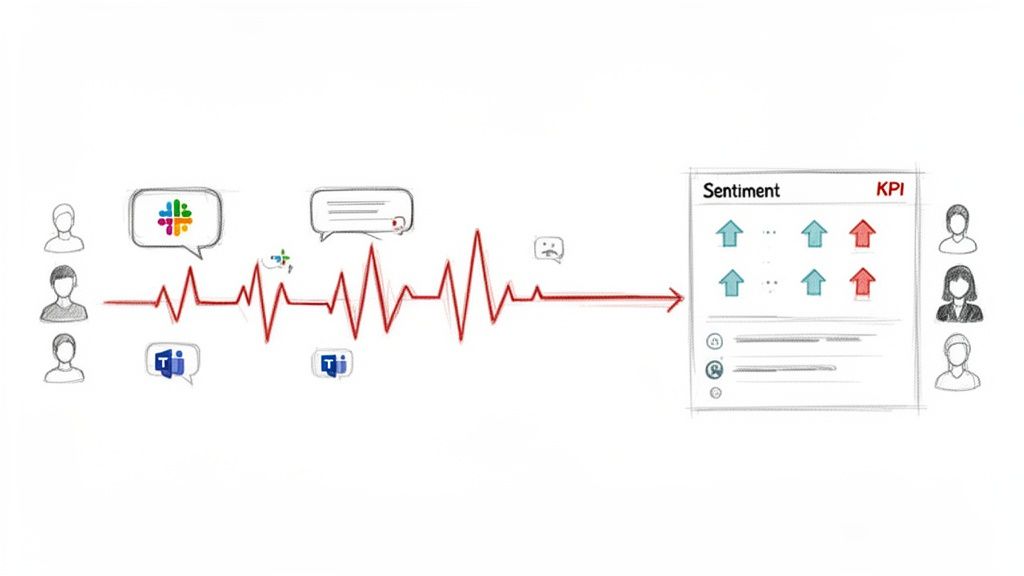
The new era of analytics for HR completely flips that script. It’s about turning the continuous, real-time pulse of employee sentiment into measurable business intelligence. Imagine going beyond a simple engagement score from a basic survey tool to truly diagnose the ‘why’ behind a dip in productivity or a spike in turnover. That’s where the real value is unlocked.
From Lagging Indicators to Leading Signals
Traditional HR has always been obsessed with lagging indicators—data that only tells you what’s already happened. A quarterly turnover report, for instance, confirms you lost good people, but it does nothing to explain why or warn you before it happens again. Modern people analytics, on the other hand, is all about finding the leading indicators.
By capturing real-time cultural signals, organizations can see potential problems forming long before they hit the bottom line. This changes the game from reacting to fires to proactively shaping business outcomes.
This modern approach is all about connecting those cultural signals—captured continuously and anonymously—directly to the Key Performance Indicators (KPIs) that leaders across Canada and the US actually care about. The goal is simple: draw a straight line from how your people feel to how your business performs.
The Power of Cultural Business Intelligence
This is where a cultural business intelligence tool like Wurkn proves its worth, going far beyond what a typical employee engagement platform or HR survey tool can offer. Instead of asking employees to log into yet another system they’ll forget to use, Wurkn plugs directly into the digital spaces they already live in every day, like Slack and Microsoft Teams.
This business intelligence approach gives you a few massive advantages:
- Always-On Feedback: You get a live, continuous pulse of the organization, capturing insights as they happen, not just once a year.
- Privacy-First Approach: By guaranteeing feedback is anonymous, you create the psychological safety needed for employees to be brutally honest.
- Actionable Intelligence: It connects the dots between qualitative feedback (like a rise in chatter about burnout) and hard business metrics (like a drop in that team’s productivity).
For example, a sudden spike in anonymous conversations about unclear project goals is a powerful leading indicator that the team's performance metrics are about to take a nosedive. Armed with that insight from a BI tool, a leader can step in immediately. This is how you transform analytics for HR from a reporting function into a strategic capability that predicts the future instead of just documenting the past.
What HR Analytics Truly Measures: Key Metrics That Matter
To get HR a seat at the strategy table, you have to stop talking about feelings and start talking about numbers. But not just any numbers. Vanity metrics like raw engagement scores from simple survey tools are the business equivalent of counting likes—they feel good, but they don't tell you if you're actually winning.
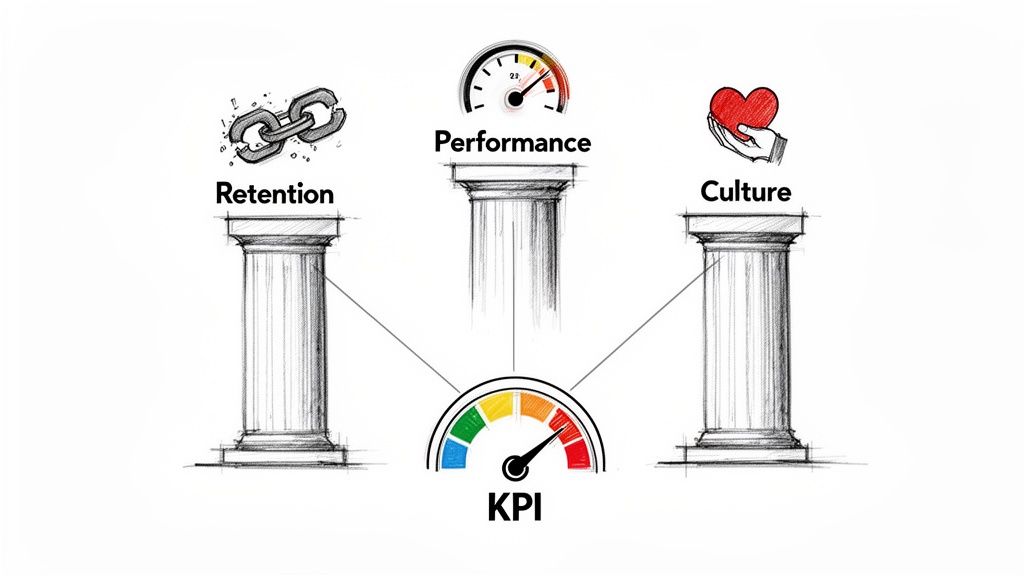
For COOs and People Ops leaders in Canada and the United States, the real power of analytics for HR comes from tracking metrics that directly tie your people strategy to business health across three core pillars.
This isn't just a "nice-to-have" anymore; it's becoming urgent. Labour markets are tightening, and trying to read the room with an annual survey is like navigating a maze with a map from last year. For instance, recent Statistics Canada data showed the national job vacancy rate was 3.9% in the fourth quarter of 2023 (Statistics Canada, 2024), indicating a competitive landscape for talent.
Combine that with sector research from Gallup warning that only about 33% of US employees feel fully engaged (Gallup, 2023), and you've got a perfect storm for disengagement. Misreading your culture in this environment is an expensive mistake. You can find more insights about the Canadian HR landscape and see why data-driven roles are heating up.
Employee Retention and Attrition
Losing employees is expensive. But losing your best employees? That's a business catastrophe. Smart analytics helps you see beyond the simple turnover rate to understand who is leaving, why they're leaving, and what it's really costing you.
- Regrettable Turnover: This isn't just about how many people left; it’s about who left. It isolates the departure of your high-performers and high-potential folks—the people whose absence leaves a real hole in your business goals.
- New Hire Failure Rate: This is your early warning system for a broken hiring or onboarding process. It tracks the percentage of new hires who are gone within their first year, signalling a disconnect between the job you sold them and the one they actually got.
Any basic HR system can give you these numbers. But a true business intelligence tool like Wurkn connects the dots. It can anonymously show you that a spike in regrettable turnover in the engineering department happened right after a surge in conversations about burnout or a lack of recognition. Suddenly, you don't just have a number; you have a problem you can solve.
Performance and Productivity
Understanding how efficiently your teams are working is the bedrock of operational excellence. Analytics for HR finally gives us a way to quantify productivity that isn't just about counting hours logged. It’s about tying people-centric activities directly to business output.
True productivity isn't just about being busy; it's about the speed and quality of value creation. Analytics helps leaders spot the cultural friction—like muddy communication or unclear goals—that’s silently killing your team's momentum.
A few key metrics to watch here:
- Time to Productivity: How long does it take for a new hire to become a fully contributing member of the team? This metric tells you how effective your onboarding and training really are and helps you get a faster ROI on new talent.
- Goal Attainment Rate: This is a simple measure of what percentage of individual or team goals are actually being met. If this number is consistently low, it might not be a people problem. It could be a sign of unrealistic expectations, resource gaps, or confusing leadership—all signals that pop up in sentiment data.
Imagine your sales team's goal attainment starts to drop. The financial report will tell you this three months too late. A powerful BI platform could have shown you a spike in anonymous feedback about a confusing new commission structure weeks earlier, giving you time to fix it before the quarter was lost.
Cultural Health
Culture has always felt like a "soft" and fuzzy concept, but modern business intelligence makes it tangible, measurable, and manageable. In fact, cultural health metrics are the ultimate leading indicators. They predict future retention and performance issues long before they ever hit a spreadsheet.
- Psychological Safety: Do your employees feel safe enough to speak up, challenge the status quo, and admit mistakes without fear? A BI platform like Wurkn can measure this by analyzing the tone and themes in feedback related to idea-sharing and constructive conflict.
- Change Fatigue: Is your team exhausted from one "transformative" initiative after another? You can track this by monitoring sentiment around new projects or reorganizations. High fatigue is a flashing red light for burnout and disengagement.
- Inclusion and Belonging: This goes way beyond diversity headcount. It measures whether all employees truly feel valued, respected, and connected. Analyzing conversational themes around teamwork and leadership can give you a brutally honest look at how inclusive your culture really is.
The table below shows the shift in thinking—from looking in the rearview mirror with old-school HR metrics to looking ahead with true business intelligence.
Traditional HR Metrics vs. Business Intelligence Insights
| Metric Type | Traditional Metric (Lagging Indicator) | Business Intelligence Insight (Leading Indicator) |
|---|---|---|
| Retention | Annual Turnover Rate | Regrettable Turnover Risk: Identifies top performers showing early disengagement signals 3-6 months before they resign. |
| Performance | Quarterly Performance Review Scores | Productivity Friction: Surfaces real-time feedback on process bottlenecks or tool issues that are slowing teams down right now. |
| Engagement | Annual Employee Engagement Score | Psychological Safety Score: Measures team confidence in speaking up, predicting future innovation and problem-solving capacity. |
| Hiring | Time-to-Fill | New Hire Success Predictor: Correlates pre-hire data with post-hire performance to refine the ideal candidate profile. |
| Culture | Employee Net Promoter Score (eNPS) | Change Fatigue Index: Tracks team sentiment during organizational shifts to prevent burnout before it impacts project delivery. |
By moving from lagging to leading indicators, you're not just reporting on what happened; you're actively shaping what will happen next.
By keeping a close watch on these three pillars—retention, performance, and culture—analytics for HR gives you a complete, data-backed picture of your organization's health. It’s time to stop guessing and start making precise, evidence-based decisions that deliver real business results.
Connecting Culture to KPIs with Real-World Use Cases
Knowing which metrics to track is one thing. Seeing them come together to solve a real business problem? That's where the value of people analytics truly comes alive.
Abstract data points on a dashboard are meaningless until you connect them to tangible outcomes. This is where a cultural business intelligence approach stops being simple reporting and starts becoming a powerful diagnostic tool for leaders across Canada and the United States.
Instead of just reacting to problems after they’ve already hit your bottom line, modern analytics lets you see the smoke before the fire. It draws a direct line from the seemingly "soft" data of employee sentiment to the "hard" key performance indicators (KPIs) that actually define business success.
Let's walk through a couple of practical, logical examples that show this in action.
Tackling Regrettable Turnover in a Tech Firm
Picture a fast-growing tech company in the US. Their quarterly reports flash a warning sign: a 15% jump in voluntary turnover over the last six months, and it's heavily concentrated in their highly skilled engineering department. The cost to replace these engineers is eye-watering, and project deadlines are starting to slip.
Old-school HR might launch a broad, expensive employee engagement survey. But the results won't land for weeks, and the insights will likely be too generic to be useful. The leadership team is left guessing. Is it about pay? Is it the managers?
Instead of guessing, they turn to a business intelligence platform like Wurkn. By analyzing the continuous, anonymous feedback already happening in their communication channels, a clear theme emerges. There's been a significant spike in conversations and negative sentiment around the term "career stagnation."
This isn't just a vague feeling; it's a specific, measurable cultural signal. The engineers feel like they have nowhere to grow. Armed with this precise insight, the People Ops team doesn't need to boil the ocean. They can build a targeted, high-impact solution.
The company rolls out a dedicated career pathing program just for the engineering team, complete with mentorship opportunities and a clear framework for advancement. The result? In the next quarter, regrettable turnover in that department drops by 10%, and project velocity stabilizes. That’s a direct line from a cultural insight to a measurable business win. You can explore more about how to define and use these kinds of work culture KPIs for enhanced business success to drive similar outcomes.
Boosting Productivity in a Remote Financial Firm
Now, let's consider a fully remote financial services firm based in Canada. The COO notices a gradual but consistent dip in project completion rates. Deadlines are being missed more often, and big cross-functional projects seem to be losing steam. The first assumption is that remote work is hurting productivity, but there's no real data to back that up.
Rather than making a knee-jerk, top-down decision about returning to the office, the COO uses their cultural intelligence platform to dig into the root cause. The system analyzes anonymized feedback and quickly identifies a rising sentiment around "communication silos" and "information bottlenecks."
This insight reveals the real problem isn't remote work itself; it’s the way information flows (or doesn't) in their digital setup. Teams don't know who to ask for quick answers, and critical details get lost in a mess of different chat channels and email threads.
Based on this data, the leadership team takes a few precise actions:
- They streamline their communication tools, clarifying which tool is for which purpose.
- They put clear "rules of engagement" in place for projects that cross department lines.
- They create dedicated, topic-specific channels to make sure information is easy to find.
Within a few months, the data shows a measurable improvement. Project completion rates climb back to their baseline, and sentiment around communication improves dramatically. The problem was solved with data, not just assumptions.
This data-driven approach is becoming essential, especially in the complex Canadian labour market. National analysis shows that organizations leveraging data analytics can improve talent retention by up to 15% (Boston Consulting Group, 2021). This points to a more fragmented and competitive job landscape where understanding the nuances of your workforce is critical for retention and performance. For organizations that get it right, the payoff is huge; commentary on data-driven hiring in Canada notes that using the right metrics can improve hiring success by around 30%. You can discover more about data-driven recruitment trends in Canada to see how this landscape is shifting.
These examples show how an always-on, privacy-first analytics platform gives you the granular, real-time insights needed to diagnose and solve genuine business challenges—moving HR from a reactive support function to a proactive, strategic driver of organizational health.
Building Your First HR Analytics Roadmap
Okay, let's get down to brass tacks. Moving from the idea of people analytics to actually doing it can feel like the toughest part of the whole journey. But here's the good news: launching an effective analytics for HR strategy doesn't mean you need a team of data scientists or a bottomless budget.
It all starts with a clear, focused roadmap. This isn't about getting bogged down in technical jargon or collecting data just for the sake of it. It’s a practical path for turning those cultural signals you’re already getting into real business intelligence. It starts by asking the kinds of sharp, specific questions that keep COOs and People Ops leaders up at night.
Start With a Burning Business Question
Before you even glance at a spreadsheet or a software demo, you need to define your "why." The most powerful analytics projects are always anchored to a pressing business problem, not a vague goal like "let's improve engagement."
Frame your starting point as a measurable challenge. Think about questions like these:
- Why is our regrettable turnover in the sales department 15% higher than the company average?
- What’s really causing the productivity dip in our fully remote engineering teams?
- Why are our top-performing new hires walking out the door before their first-year anniversary?
Zeroing in on a specific question gives your work a clear purpose. More importantly, it makes it a hell of a lot easier to show a tangible return on your efforts down the line.
This simple flow—moving from a well-defined problem to a data-backed action—is the core engine of great people analytics.
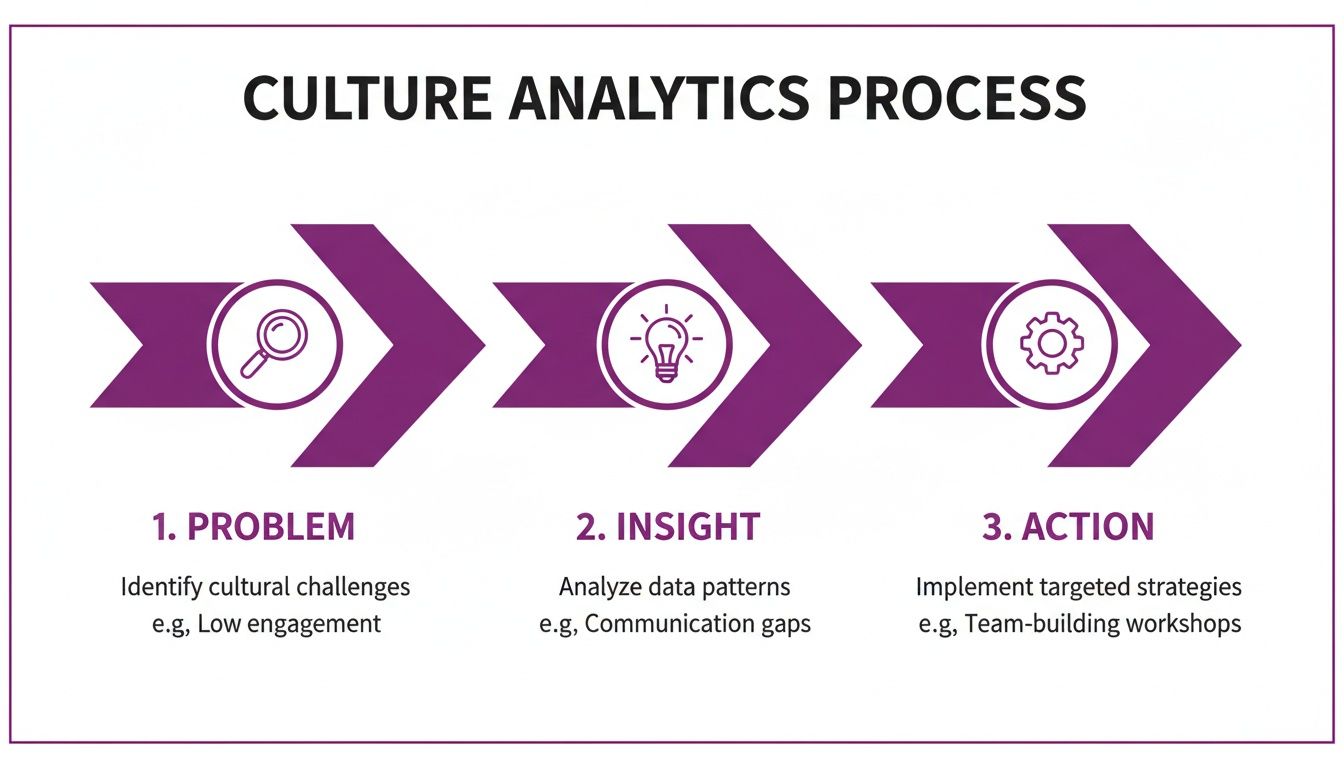
This process isn't complicated. It’s about being disciplined: identify the real problem, generate insight from your data, and then take meaningful action.
Identify Your Key Data Sources
Once your question is locked in, you can start mapping out where the answers might be hiding. Most companies are sitting on a goldmine of people data, it's just scattered across a dozen different systems. Your job is to bring the right pieces together to tell a coherent story.
A classic mistake is waiting for perfect, squeaky-clean data before you start. Don't. Start with what you've got. The goal is to connect different pieces of the puzzle to build a more complete picture of what your employees are experiencing.
Your data will usually be a mix of hard numbers and human context:
- HRIS (Human Resources Information System): This is your foundation. It holds the core data like employee tenure, demographics, department, and promotion history. You can learn more about what an HRIS is and see why it’s the central hub for employee data.
- Performance Management Systems: This gives you the quantitative side of performance—goal attainment numbers, performance ratings, and skills assessments.
- Qualitative Feedback Channels: This is where you find the real "why." This includes data from engagement surveys, exit interviews, and, most powerfully, continuous feedback from platforms where work actually happens, like Slack or Microsoft Teams.
This is where a true business intelligence tool like Wurkn comes in. It’s designed to pull these disparate sources together, connecting the hard numbers from your HRIS with the rich, anonymized sentiment data from the digital workplace. That’s what separates a real analytics platform from a simple survey tool.
Choose the Right Tool for the Job
Picking your technology is a make-or-break step. Too many organizations mistake basic survey tools for a complete analytics solution. While surveys can give you a snapshot in time, they completely miss the continuous, real-time pulse you need to make proactive decisions.
A business intelligence platform like Wurkn is fundamentally different. It doesn't just ask questions once a year; it listens to what employees are already saying, anonymously and continuously. By plugging directly into platforms like Slack and Teams, it captures candid feedback without disrupting anyone's workflow, uncovering insights a formal survey could never hope to find.
Build Trust Through Data Governance
You won't get honest feedback without psychological safety. It's that simple. A non-negotiable part of your roadmap must be a rock-solid commitment to data privacy and governance. Your employees have to trust that the system is there to improve the organization, not to watch them as individuals.
This is where Wurkn's privacy-first architecture is a game-changer. The entire platform is built on a foundation of anonymization, guaranteeing that individual identities are protected. This commitment is what builds the trust you need for people to share the kind of unvarnished feedback that leads to breakthroughs.
Ultimately, this all leads to the final, most important step: fostering a data-informed culture. When your leaders are armed with clear, trustworthy insights, they can finally move from making gut-feel decisions to taking precise, evidence-backed actions that strengthen the business and make work better for everyone.
How to Use People Data While Building Trust

Let's get right to it. This is the single biggest hurdle to clear when you start using analytics for HR. The moment you begin collecting people data, you take on an immense responsibility. If your employees even suspect they're being individually monitored, you've lost their trust. Instantly.
And once that trust is gone, the whole system collapses. You can't get honest feedback without psychological safety. It's just not possible.
The goal must always be to improve the organization, not to scrutinize individuals. It's a critical distinction. When people understand that their feedback is being used to fix broken processes, remove roadblocks, and make their own work lives better, they’ll actually want to contribute.
Being transparent and ethical isn't just about staying compliant with privacy laws in Canada or the US. It's the absolute foundation for getting the kind of accurate, unfiltered cultural intelligence you need to make smart business decisions.
Designing for Privacy from the Ground Up
Trust isn’t something you can just bolt on with a policy. It has to be baked into the very design of the tools you choose. This is where a platform's core philosophy really matters. Too many HR survey tools collect personally identifiable information (PII) by default, making trust an afterthought.
True cultural intelligence relies on candour, and candour is a direct result of guaranteed anonymity. When employees feel completely safe, they share the ground truth—the unfiltered insights that leaders desperately need to hear but rarely do.
This is where a cultural business intelligence platform like Wurkn is fundamentally different. It’s built on a privacy-first architecture. That means minimizing the collection of PII right from the start and using sophisticated redaction and aggregation to ensure individual identities are always protected. This design creates the psychological safety needed for honest feedback to flourish.
For example, Wurkn can easily spot a rising theme of burnout in a specific department without ever revealing who said what. It protects the individual while giving the leader the exact insight needed to address the collective problem.
Best Practices for Ethical Data Handling
Building and maintaining trust isn’t a one-time event; it’s a constant commitment to doing things the right way. This part is non-negotiable.
Here are the core principles every organization should live by:
- Radical Transparency: Be relentlessly open about what data you're collecting, how it's being used, and—most importantly—what it’s not being used for. Make it crystal clear that the objective is organizational improvement, not individual performance management.
- Data Anonymization and Aggregation: Never, ever report on data in a way that could identify an individual. All insights must be aggregated to a group level large enough to guarantee anonymity. A platform like Wurkn automates this, ensuring privacy is built-in, not optional.
- Focus on Themes, Not Individuals: The real power of analytics for HR is in understanding broad trends and systemic issues. The insights should highlight themes like "friction in cross-department communication" or "change fatigue," not what a single person thinks.
Ultimately, this ethical framework makes your entire people analytics program more effective. Standard survey tools often deliver polite, surface-level feedback, which is exactly why eNPS isn't enough to accurately measure company culture. When you build on a foundation of trust, you get the real, unvarnished insights that actually drive meaningful change.
The Future of People Analytics: From Insight to Prediction
So far, our journey into HR analytics has been about understanding what’s happening in your organization right now. But the real power isn’t just in knowing the present; it's in shaping the future. This is where we move from insight to foresight.
We're talking about the leap from descriptive analytics (what happened) and diagnostic analytics (why it happened) into the truly game-changing world of predictive analytics. It’s about using your data to forecast what will likely happen next, giving you a chance to get ahead of problems before they even start.
From Reactive to Proactive
Imagine a system that doesn’t just tell you your team is burnt out. Imagine it tells you which teams are at the highest risk of burnout next quarter. This becomes possible when you feed a continuous stream of real-time cultural data into smart models.
A business intelligence platform like Wurkn is built for this very purpose. It gathers a constant, anonymous flow of sentiment data, providing the rich, nuanced information that AI models need to spot the subtle patterns that come before major business challenges.
Predictive analytics turns your organization's culture into a leading indicator for business outcomes. Instead of reacting to last quarter's turnover numbers, you can start shaping next quarter's retention strategy.
For example, a predictive model could flag that a specific mix of factors—like a rise in negative sentiment around 'leadership communication' combined with a drop in peer recognition—is a strong predictor of team disengagement six months from now. That’s an incredibly powerful insight. It allows leaders to step in with targeted communication and recognition programs long before key talent even thinks about updating their resumes.
Human-in-the-Loop AI
But let’s be clear: raw prediction without context is just automated noise. The most effective systems pair the immense power of AI with essential human intelligence. This is where Wurkn’s ‘human-in-the-loop’ AI approach is so critical.
This method ensures that every insight the system generates is reviewed, contextualized, and validated by experts. This delivers two huge benefits:
- Actionable Insights: It weeds out meaningless correlations, ensuring the alerts leaders get are not only accurate but practical and tied directly to a problem they can actually solve.
- Continuous Improvement: The AI models learn from human feedback. Over time, they become smarter and more finely tuned to the unique cultural dynamics of your organization.
This is what allows your organization to become truly proactive. Instead of just reacting to the past, you can begin to accurately anticipate and shape your future, using data-driven foresight to build a stronger culture and drive better business results across Canada, the United States, and beyond.
Answering Your Questions About HR Analytics
When leaders across Canada and the United States start digging into analytics for HR, the same handful of questions always come up. Let's tackle them head-on.
How Is This Different from Our Annual Survey?
Think of your annual engagement survey as a single, posed photograph taken once a year. By the time you develop the film and see the picture, it’s already out of date. It offers a static snapshot but tells you almost nothing about the day-to-day reality of your culture or how it’s impacting business performance.
In contrast, a business intelligence tool like Wurkn is like having a continuous, live video feed of your organization. By plugging directly into platforms your teams already use, like Slack and Teams, it captures the real, unfiltered pulse of what’s happening. This isn't about getting another engagement score; it's about getting actionable intelligence that links cultural signals directly to your most critical KPIs. You can finally see problems as they're developing, not months after the fact.
How Can We Guarantee Employee Privacy?
This is the most important question, and the answer has to be rooted in both technology and total transparency. You can't get real cultural intelligence without psychological safety, and that's impossible if people don't trust their privacy is protected.
The gold standard involves strict data anonymization, aggregating feedback so no individual can ever be singled out, and being radically honest with your team about how their collective feedback is used to make the organization better.
Trust is the entire foundation. A platform's commitment to privacy isn't just a feature—it's the non-negotiable price of admission for getting the honest, unfiltered feedback you need to make smart business decisions.
Wurkn was built from the ground up with a privacy-first architecture. It minimizes personal data collection and uses advanced redaction and anonymization to keep the focus on systemic themes, not individual comments. This builds the trust you need to get genuine insights.
Is This Too Complex for a Small People Ops Team?
Not anymore. The old days of needing a data scientist on staff are over. Modern business intelligence platforms are designed to be intuitive and accessible, removing the technical hurdles that used to scare people away. The best tools don't require your People Ops team to become coding experts or force your employees to learn yet another new system.
A platform like Wurkn is built for simplicity. It integrates seamlessly into the tools your teams already live in every day, delivering clear, contextualized insights without a heavy implementation lift or a steep learning curve.
What Is the Best First Step to Get Started?
Start with a specific, high-stakes business problem—not a vague desire for "more data." The best way to begin is to pinpoint a clear pain point. Maybe it’s high turnover in your sales department or a sudden drop in productivity on a key engineering team.
Once you have a focused question, you can find a business intelligence tool that gives you the insights needed to diagnose the real root cause. This targeted approach guarantees your first dive into analytics for HR will deliver a measurable and immediate return on your investment.
Ready to stop guessing and start knowing? It's time to move beyond static surveys and turn your cultural signals into measurable business intelligence. Wurkn delivers the actionable insights you need to build a healthier, higher-performing organization. Learn more about how Wurkn can transform your approach to people analytics.