
The old way of managing people is officially broken. Relying on an annual engagement survey to understand your team is like trying to drive down the Gardiner Expressway using a paper map from last year—you're completely blind to the real-time traffic jams, detours, and opportunities happening right now.
Moving Beyond Static Surveys
In today's fast-paced workplaces across Canada and the US, this outdated approach just doesn't cut it anymore, especially with so many teams working remotely or in a hybrid model. These infrequent, disruptive surveys fail to pick up on the subtle, continuous cultural signals that tell you what’s really going on. All they give you is a single, often skewed, snapshot in time.
This static method traps leaders in a reactive cycle. By the time the survey results are finally compiled and analyzed, the problems have likely festered and grown worse, leading to checked-out employees, lost productivity, and people you wanted to keep walking out the door. It’s a system designed for looking in the rearview mirror.
The Shift To Cultural Business Intelligence
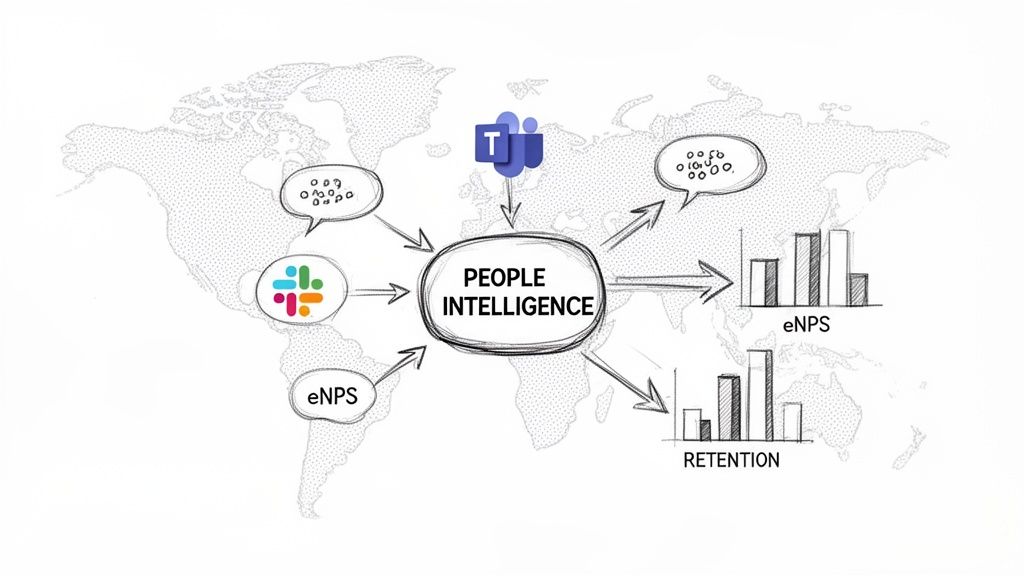
A modern framework reframes people management as a crucial business intelligence function, not just a once-a-year HR chore. The real goal is to build a continuous listening system that translates the authentic, anonymous voice of your employees into measurable business outcomes.
This means you stop asking people to interrupt their work for a survey. Instead, you tap into the communication tools they already live in every day, like Slack and Microsoft Teams. Doing this creates an always-on feedback channel that respects their workflow and captures genuine sentiment as it happens, not weeks later.
The real power in modern people management isn't just about collecting data. It’s about turning that stream of qualitative employee feedback into a quantitative dashboard that leaders can use to make proactive, strategic decisions.
Linking Culture To Business Outcomes
This shift from periodic polling to continuous intelligence is a game-changer, allowing you to diagnose the health of your culture with incredible precision. Imagine spotting the early signs of burnout in a key department weeks before it torpedoes a project deadline. Or understanding the friction points in a new workflow before they start causing customer complaints.
This is where a business intelligence tool like Wurkn delivers value that goes far beyond traditional employee engagement platforms and HR survey tools. Wurkn connects these subtle cultural signals directly to the business KPIs that matter most. By analyzing anonymous, real-time feedback, it gives leaders the power to:
- Diagnose problems proactively: You can spot negative trends in sentiment and tackle them before they blow up into full-fledged crises.
- Measure cultural impact: Finally, you can see the direct line connecting employee morale to metrics like retention, customer satisfaction, and productivity.
- Make data-backed decisions: It’s time to move from guessing how employees feel to knowing exactly where to invest your time and resources for the biggest impact.
Traditional Surveys vs Cultural Intelligence
The gap between the old and new ways of understanding your organization is massive. One provides a blurry, outdated photo, while the other offers a live, high-definition video feed of your company's health.
| Aspect | Traditional Approach (Static Surveys) | Modern Approach (Cultural Intelligence) |
|---|---|---|
| Frequency | Annual or bi-annual | Continuous, real-time |
| Data Type | Static, point-in-time snapshot | Dynamic, ongoing sentiment stream |
| Employee Experience | Disruptive, time-consuming | Seamless, integrated into daily workflow |
| Insight Lag | Weeks or months | Instantaneous |
| Leadership Stance | Reactive (responding to old data) | Proactive (predicting future trends) |
| Business Impact | Correlates poorly with real-time issues | Directly links culture to live business KPIs |
Relying on static surveys is like managing your finances by only looking at last year's bank statement. Cultural intelligence, on the other hand, gives you a live dashboard of your most valuable asset: your people.
Ultimately, this modern approach to the management of people turns your culture from an abstract idea into your most valuable predictive asset. It equips leaders with the insight needed to build a healthier, more resilient, and high-performing organization.
The Pillars of High-Impact Leadership
Let's get one thing straight: truly effective people management has nothing to do with top-down directives or rigid annual reviews. It's about creating an environment where teams can actually perform at their peak.
Think of a manager less like a distant general reviewing battle plans once a year, and more like a coach on the sidelines, offering real-time guidance and support during the game. This modern, coach-like approach stands on three core pillars that create the conditions for success.
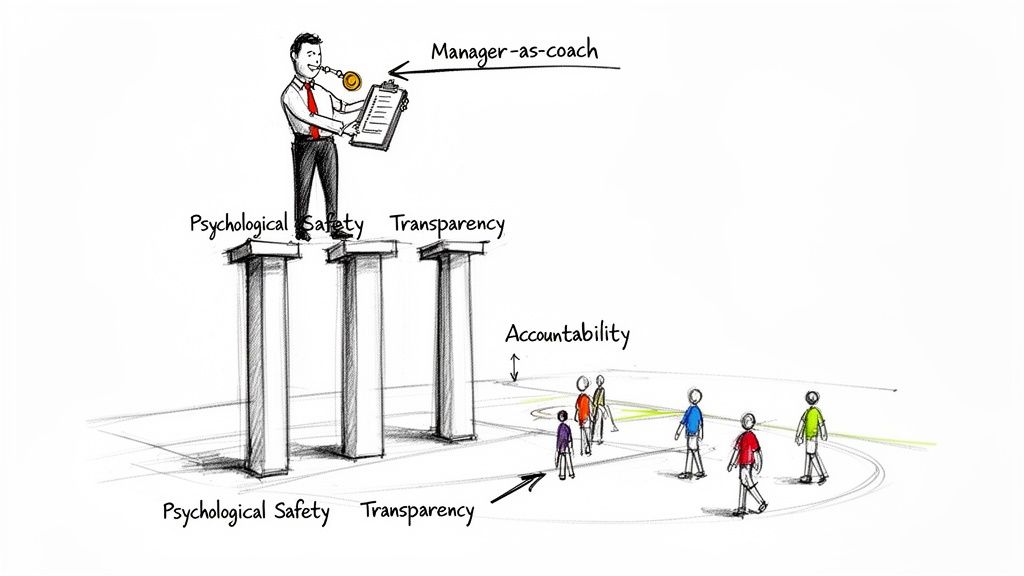
These aren't just fluffy ideals. They are measurable drivers of business performance. When you bake them into your culture, they directly impact everything from innovation and problem-solving to employee retention and raw productivity.
Fostering Psychological Safety
The first and most critical pillar is psychological safety. This is simply the shared belief that your team members can take interpersonal risks without getting punished for it.
In a psychologically safe environment, an engineer in Vancouver feels comfortable flagging a potential flaw in a new product design. A customer service agent in Austin can admit they made a mistake without bracing for impact. It’s the safety net that allows for honesty.
This is absolutely essential for high-performing teams. Research highlighted by McKinsey shows that teams with high psychological safety are far more likely to innovate, learn from failures, and crush their business goals. Without it, people stay silent, potential disasters are missed, and your best ideas never even get spoken. This is exactly where traditional HR surveys fail—they can't capture the subtle, day-to-day interactions that either build or destroy this feeling of safety.
Practicing Radical Transparency
The second pillar is radical transparency. This means being open and honest with information, both the good and the bad. It isn't about oversharing confidential details, but about giving people the context they need to do their jobs well and see how their work connects to the bigger picture.
For instance, a transparent leader might openly discuss the business challenges the company is facing and the strategy for tackling them. This kind of honesty builds incredible trust and empowers employees to think like owners, making smarter decisions because they can see the whole playing field.
When transparency is the default, you kill the rumour mill. You replace workplace anxiety with a shared sense of purpose. People stop wasting energy guessing about the company's direction and start focusing on driving it forward.
This principle is the bedrock of any effective people management strategy, creating a culture where feedback is seen as a gift, not a threat.
Ensuring Clear Accountability
The final pillar, clear accountability, is the glue that holds the others together. It ensures that while people feel safe to experiment and be open, there are still crystal-clear expectations and ownership for results.
Accountability isn't about pointing fingers when things go wrong. It’s about empowering individuals and teams with the autonomy to own their outcomes, good or bad.
This means setting clear goals, defining what success actually looks like, and consistently following through. When accountability is clear, everyone knows their role and how it contributes to the team's mission. Your high performers thrive because their impact is recognized, and those who are struggling can get the targeted coaching they need to improve.
A powerful business intelligence platform like Wurkn is what makes these pillars real and measurable. It moves beyond aspirational posters on a wall by providing objective, real-time data on whether these principles are truly embedded in your organization.
- Psychological Safety: Wurkn’s analysis of anonymous feedback can reveal if employees are voicing concerns freely or if a culture of fear is suppressing vital information.
- Transparency: Sentiment trends can show if leadership communications are actually building trust or just creating confusion and anxiety.
- Accountability: By correlating feedback themes with performance data, you can see if teams feel supported and clear on their goals, or if a lack of clarity is killing progress.
Wurkn transforms these leadership principles from vague concepts into tangible metrics on a COO's dashboard. It gives you the diagnostic power to see if your management of people is fostering a culture of safety, transparency, and accountability—the essential ingredients for any company that wants to win.
Connecting Your Culture to the Bottom Line
How do you actually prove the ROI of a strong, positive culture? For too long, culture has been treated as a fuzzy, feel-good concept—something that's nice to have but completely separate from the hard numbers that run the business. This is one of the biggest misunderstandings in modern management of people.
The truth is, your company culture is a powerful leading indicator of future business performance. Think of it as an engine that directly impacts your bottom line, for better or for worse. The real challenge has always been connecting the dots between the qualitative experience of your employees and the quantitative results that the C-suite obsesses over.
From Sentiment to Financial Impact
We need a new way of thinking—a framework that draws a clear, undeniable line from what employees are feeling to the business KPIs that matter. This isn't about guesswork; it's about data. When you can connect specific cultural signals to financial outcomes, you stop talking about culture as an HR initiative and start treating it as a core business strategy.
Let's imagine a logistics company that operates across the United States and Canada. Anonymous feedback starts trickling in, revealing friction and frustration with a newly rolled-out shipping process. In the past, this might have been brushed off as just complaining.
But with a cultural business intelligence approach, this feedback becomes a critical early warning. It’s a direct signal pointing to a future drop in productivity, a potential spike in operational costs, and even a slip in on-time delivery rates—which hits customer satisfaction right where it hurts. This is the power of connecting the dots.
By translating the anonymous employee voice into measurable trends, you gain a diagnostic tool that can foresee operational problems. This allows you to make data-backed decisions that protect the bottom line before a minor issue becomes a major crisis.
This is exactly where a platform like Wurkn changes the game. It goes way beyond basic sentiment analysis or the once-a-year HR survey. Wurkn is a business intelligence tool built to synthesize themes, emotional tone, and key drivers from the continuous stream of feedback your teams are already providing.
The Business Case for Cultural Intelligence
This advanced analytical capability gives executives in North American companies a predictive edge. Instead of waiting for the quarterly report to show a dip in performance, you can see the cultural warning signs weeks or even months ahead of time. You'll gain a much deeper understanding of how your people and culture directly influence performance.
Here’s how this connection plays out in the real world:
- Burnout and Turnover: A rising tide of burnout-related comments in your product development team is a direct leading indicator of increased voluntary turnover. Spotting this early lets you intervene, fix the root causes, and avoid the staggering costs of recruiting, hiring, and training replacements for key talent—costs that can hit 1.5 to 2 times an employee's annual salary, according to Gallup research.
- Recognition and Customer Satisfaction: A lack of recognition almost always correlates with a drop in employee engagement. And disengaged employees are far less likely to provide the kind of customer service that builds loyalty. Wurkn can flag this trend, allowing you to roll out targeted recognition programs that re-engage your team, leading to better customer satisfaction scores (CSAT) and higher retention.
- Process Friction and Revenue Per Employee: When feedback reveals widespread frustration with internal tools or clunky processes, it’s signalling a direct drag on productivity. By quantifying this friction, you can build a solid business case for investing in better systems that remove roadblocks, streamline workflows, and ultimately boost your revenue per employee.
This strategic approach to the management of people provides a clear, defensible ROI for investing in your culture. It equips leaders to have data-driven conversations about how the employee experience is either fuelling growth or holding it back.
Ultimately, by turning your culture into a measurable asset, you're not just creating a better place to work. You're building a more resilient, efficient, and profitable organization that's ready to win in a competitive market.
Actionable Playbooks for Effective People Management
Gaining insight into your company culture is a great first step, but insight alone doesn’t move the needle. Execution is what turns that data into tangible improvements in your organization’s health and, ultimately, its performance. This section moves beyond theory and provides practical, tactical playbooks for the most critical areas of people management.
Think of these not as rigid, one-size-fits-all manuals, but as adaptable frameworks. They’re designed for leaders across Canada and the US to implement right away and start driving measurable progress across the entire employee lifecycle. We'll focus on three high-impact areas: continuous feedback, employee onboarding, and personalized development.
The Continuous Feedback Playbook
The annual review is dead. High-performing organizations run on a constant flow of communication, not a once-a-year data dump. When you implement a continuous feedback loop, you’re not just collecting comments—you’re building a culture of ongoing dialogue, coaching, and improvement.
Getting this right isn’t just about having the right software; it’s about a fundamental shift in how your teams communicate.
Launching a continuous feedback initiative requires a structured approach to ensure it’s adopted and delivers real value. It’s a transition from a once-a-year event to an everyday habit.
| Phase | Key Actions | Success Metric |
|---|---|---|
| Phase 1: Foundation & Buy-In | Clearly articulate the 'Why' to leadership and teams. Position it as a tool for growth and problem-solving, not micromanagement. | >80% of managers can articulate the program's business goals. |
| Phase 2: Tool & Channel Selection | Choose channels that meet employees where they work (e.g., Slack, Teams). Avoid adding new logins or apps. This is where business intelligence tools like Wurkn shine by integrating directly into existing workflows. | >90% of feedback is submitted through integrated, low-friction channels. |
| Phase 3: Manager Enablement | Train leaders to give and receive constructive, behaviour-based feedback. Role-play scenarios and provide simple frameworks for difficult conversations. | 100% of people managers complete the training program. |
| Phase 4: Launch & Reinforcement | Roll out the program and, critically, act on the feedback received. Publicly acknowledge insights and communicate the changes made as a result. | Visible changes are implemented based on feedback within the first 30 days. |
This process transforms feedback from a dreaded, formal event into a normal, productive part of the workday. It creates an environment where small issues are flagged early, and big wins are celebrated instantly, building a virtuous cycle of trust and engagement.
The goal is to turn this constant flow of feedback into measurable business results.
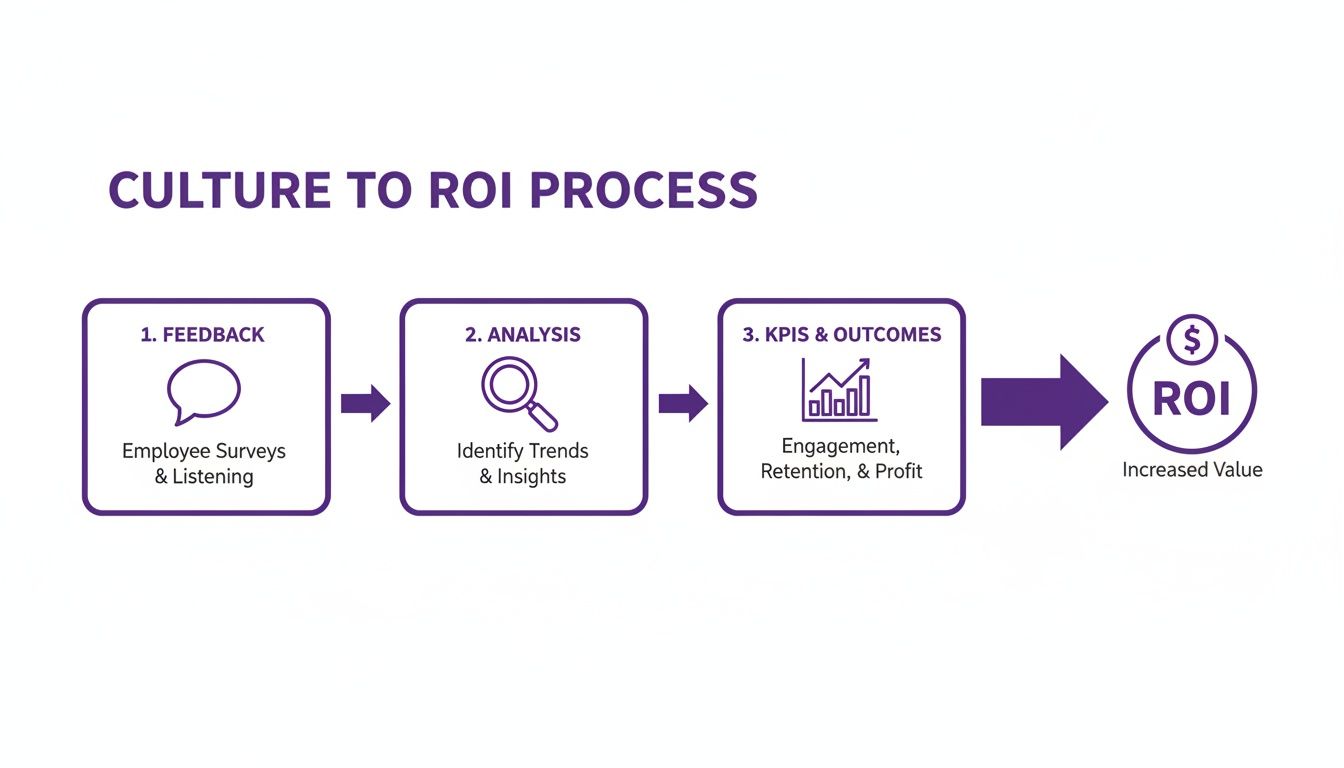
As the diagram shows, collecting raw feedback is just the beginning. The real value comes when you analyze it for trends and connect those insights to core business KPIs to demonstrate a clear return on investment.
The High-Impact Onboarding Playbook
Employee onboarding is your first—and best—chance to prove your culture is real and set new hires up for success. A weak onboarding process is one of the biggest drivers of early turnover. This playbook is designed to redesign that crucial initial experience to maximize engagement right from day one.
A structured plan is absolutely critical. You can learn more about how to set clear expectations by exploring this helpful team charter form that aligns team members from the very start.
The First 90 Days: A Structured Approach
-
Week 1: Focus on Connection. The goal here is cultural immersion, not information overload. Schedule one-on-ones with key team members, assign an onboarding "buddy," and make sure they have every tool and login they need. Your first feedback touchpoint should happen at the end of this week, asking a simple question: "Did you get everything you needed to feel set up for success?"
-
Days 15-45: Focus on Contribution. Start assigning small, manageable projects. This allows the new hire to contribute meaningfully and build confidence quickly. Schedule a 30-day check-in to discuss progress, clarify role expectations, and—most importantly—solicit their feedback on the onboarding experience itself.
-
Days 45-90: Focus on Growth. Now, you shift the conversation toward their long-term development. Discuss career aspirations and start identifying potential growth opportunities within the company. The 90-day review shouldn't feel like a performance evaluation; it should be a forward-looking conversation about their future with you.
By intentionally designing these touchpoints and actively soliciting feedback, you turn onboarding from a passive administrative checklist into an active engagement strategy. This proactive approach significantly increases the likelihood that a new hire will become a long-term, high-performing employee.
The Personalized Development Playbook
Top talent doesn't just want a job; they want a clear career path. Generic, one-size-fits-all training programs rarely hit the mark. A personalized development plan is a powerful retention tool because it proves you’re invested in your employees' futures, not just their current output.
-
Start with the 'Where'. Sit down with each employee to truly understand their career goals. Where do they see themselves in two years? Five years? What skills do they believe they need to get there?
-
Identify the Gaps. Compare their current skill set with their future goals. This creates a clear roadmap of specific areas for development, whether that's technical training, leadership coaching, or project management experience.
-
Build a Custom Path. Create a tailored plan that includes a mix of learning opportunities. This could involve mentorship programs, targeted online courses, high-visibility stretch assignments, or even cross-functional projects that give them new exposure.
-
Track and Adjust. Development is never a "set it and forget it" activity. You need to check in regularly on their progress, offer support when they hit roadblocks, and be flexible enough to adjust the plan as their goals evolve.
By putting these practical playbooks into motion, leaders can move from simply talking about culture to actively building it, fostering a more engaged, productive, and resilient workforce.
How to Diagnose and Address Employee Burnout
Employee burnout is a silent killer of productivity. It’s a quiet but corrosive force that hollows out your best teams, especially in the high-stakes markets across Canada and the United States. We’re not talking about a few tough days at the office; this is a state of chronic emotional, physical, and mental exhaustion born from relentless stress.
When left to fester, burnout tanks engagement, poisons team morale, and ultimately pushes your best people out the door.
The causes are rarely simple. They can be anything from crushing workloads and fuzzy role expectations to a widening gap between an employee’s daily grind and the company’s bigger picture. One of the biggest culprits, though, is something most leaders overlook: the sheer weight of administrative overload.
The Hidden Costs of Administrative Overload
When your most critical teams are drowning in manual, repetitive tasks, their ability to think strategically evaporates. This is a massive problem for People Operations and HR teams, who are supposed to be the guardians of employee well-being but are often the most overwhelmed.
For a logical parallel, a 2018 study on Canadian family physicians found they were spending nearly 20% of their office time on administrative tasks, leading to higher rates of burnout and lower career satisfaction (College of Family Physicians of Canada, 2019). While a different field, this illustrates how administrative burden directly erodes the capacity for high-value, strategic work—a problem mirrored in many HR departments.
What you get is a dangerous feedback loop. An overburdened HR team can’t properly listen to employees or act on their feedback. Concerns go unheard, frustrations build, and you inadvertently create the perfect breeding ground for burnout across the entire company.
Moving from Reactive to Proactive Prevention
For years, the go-to tool for understanding why people leave has been the exit interview. But by then, it’s too late. The damage is done, and the feedback is a post-mortem, not a preventative measure. Real management of people means getting out of firefighting mode and into a proactive, preventative rhythm.
This is exactly where old-school HR survey tools fail. They give you a static, once-a-year snapshot that completely misses the subtle, day-to-day signs of declining morale. To actually get ahead of burnout, you need a system that can pick up on the early warning signs as they happen.
The goal is to spot the embers of burnout before they ignite into a full-blown fire. This means identifying negative trends in real-time anonymous feedback, allowing leaders to intervene with support long before an employee even considers updating their resume.
This is precisely what a business intelligence tool like Wurkn is built for. It gives COOs and People Ops leaders the power to stop relying on lagging indicators like turnover and start tracking the leading indicators of cultural health.
Using Intelligence to Combat Burnout
By tapping into the continuous, anonymous feedback from tools your teams already use, Wurkn gives you a real-time pulse on your organization’s well-being. It’s a diagnostic tool that traditional engagement platforms just can’t compete with. If you're worried about your team's mental state, our guide on navigating employee mental health in a toxic workplace offers more strategies.
Here’s how this approach helps you diagnose and address burnout head-on:
- Identify At-Risk Teams: Wurkn’s analysis can pinpoint specific departments where sentiment is dropping or where burnout-related language is popping up in feedback. This lets you focus your energy and resources exactly where they’re needed most.
- Uncover Root Causes: The platform doesn't just tell you there's a problem; it synthesizes themes from feedback to show you why a team is burning out. Is it the workload? A lack of recognition? Friction with a new manager? Getting to the root cause is the only way to find a real solution.
- Measure the Impact of Interventions: Once you make a change—like reallocating projects or clarifying team roles—you can measure its impact almost instantly. By watching sentiment trends, you can see if your actions are actually making things better, allowing you to make smart, data-driven adjustments.
By turning anonymous feedback into actionable intelligence, you can protect productivity, hold onto your most valuable talent, and sidestep the massive financial and cultural costs that come with high turnover.
Building Your People Management Dashboard
You’ve heard it a million times: “what gets measured gets managed.” It’s an old saying, but it’s the bedrock of any serious business strategy. When it comes to managing people, this means getting way beyond vanity metrics and building a dashboard that ties the health of your culture directly to the performance of your business. If you’re not looking at the right data, you’re just guessing.
A truly strategic dashboard isn’t a static report you glance at once a quarter; it's a living, breathing diagnostic tool that gives you a clear, real-time picture of the signals that actually matter. The entire thing should be built around a core set of key performance indicators (KPIs) that, together, tell the full story of your organization.
Key Metrics for Your Dashboard
While every business has its own unique flavour, a powerful people management dashboard needs to cut through the noise. Ditch the fuzzy numbers and zero in on metrics with a direct line to your operational and financial health.
- Employee Net Promoter Score (eNPS): This is your quick pulse check on employee loyalty. It boils down to one simple question: how likely are your people to recommend your company as a great place to work? It’s a deceptively simple gauge of overall sentiment.
- Regrettable Turnover Rate: Look, not all turnover is a disaster. But losing your top performers? That’s a killer. This metric specifically tracks the exit of high-value employees, giving you a brutally honest measure of how well you're holding onto the talent you absolutely can't afford to lose.
- Sentiment Trend Analysis: This is where modern tools really shine. It’s about tracking the emotional undercurrents and key themes popping up in anonymous employee feedback over time. A steady downward trend in sentiment can be your earliest warning sign of bigger problems like burnout or widespread disengagement.
From Static Reports to Dynamic Intelligence
Just having these numbers isn't enough. The real magic happens when you interpret them in the context of your specific industry and geography, whether you’re operating in the US or Canada. A 5% regrettable turnover rate might be cause for celebration in one sector but a five-alarm fire in another.
This is exactly where traditional HR survey tools fall flat. They give you a snapshot of the past, a static photo of what was. In contrast, a true business intelligence platform like Wurkn presents this data as a dynamic, interactive dashboard.
Wurkn is built for COOs and People Ops leaders who need to understand the "why" behind the numbers. It moves beyond just showing you data to revealing the connections between different metrics, so you can diagnose issues long before they blow up.
For example, a platform like Wurkn can draw a direct line between a dip in eNPS in your engineering department and a spike in regrettable turnover three months down the road. It can connect a wave of negative sentiment around a new software rollout to a measurable drop in that team's productivity.
This is the kind of visibility that separates reactive HR from strategic people management. It gives you the insight to measure the real-time impact of your culture initiatives, letting you make data-backed decisions with confidence. Your dashboard transforms from a simple report card into a predictive tool for building a healthier, more productive, and more resilient organization.
Common Questions About Modern People Management
Isn't This Just a Fancy Employee Survey?
Not at all. Think of a traditional employee survey as a single photograph—a snapshot in time that tells you how things looked on one specific day. By the time you get it developed and framed, everything has already changed.
A business intelligence platform like Wurkn is more like a live video feed. It taps into the tools your teams already live in, like Slack, to capture anonymous, real-time sentiment without pulling them away from their work. This continuous stream of insight turns the everyday "chatter" and honest feedback into a clear, measurable dashboard, showing you exactly how your culture is impacting business performance, moment by moment. It moves you from looking in the rearview mirror to seeing what's right in front of you.
How Do We Get People to Actually Be Honest?
That's the million-dollar question, and the answer comes down to one thing: trust. You can't just ask for honesty; you have to create an environment where it feels safe to give it.
This is where the right system is crucial. Business intelligence tools like Wurkn are built from the ground up with privacy as the absolute priority. We design them to be fully anonymized, stripping out any identifying information to protect your people. But the tech is only half the battle. The other half is leadership. When you clearly communicate these safeguards and—more importantly—visibly act on the feedback you receive without any backlash, you build a powerful loop of trust. That combination of a secure platform and responsive leadership is what makes genuine, candid feedback possible.
Is This Kind of Strategy Overkill for a Small Team?
Actually, it’s the other way around. On a smaller team, a single cultural issue doesn't just create a ripple; it can feel like a tidal wave. Small problems can escalate incredibly fast and have a much bigger impact on everyone's performance and morale.
A modern people management strategy isn't about adding layers of complexity. It's about putting a simple, lightweight system in place for continuous listening so you can catch those small issues before they become big ones. Using an integrated tool from the get-go helps you build a strong, resilient cultural foundation. You're not just solving today's problems—you're preventing the common growing pains that trip up so many companies as they scale.
Ready to move beyond static surveys and connect your culture to the bottom line? See how Wurkn transforms anonymous feedback into actionable business intelligence. Explore the platform.