
An employee satisfaction survey is meant to tell you how happy and fulfilled your people are in their roles. It’s supposed to give you direct insight into everything from leadership and workload to career growth. But let’s be honest: the traditional once-a-year model is broken.
Why Annual Surveys No Longer Work
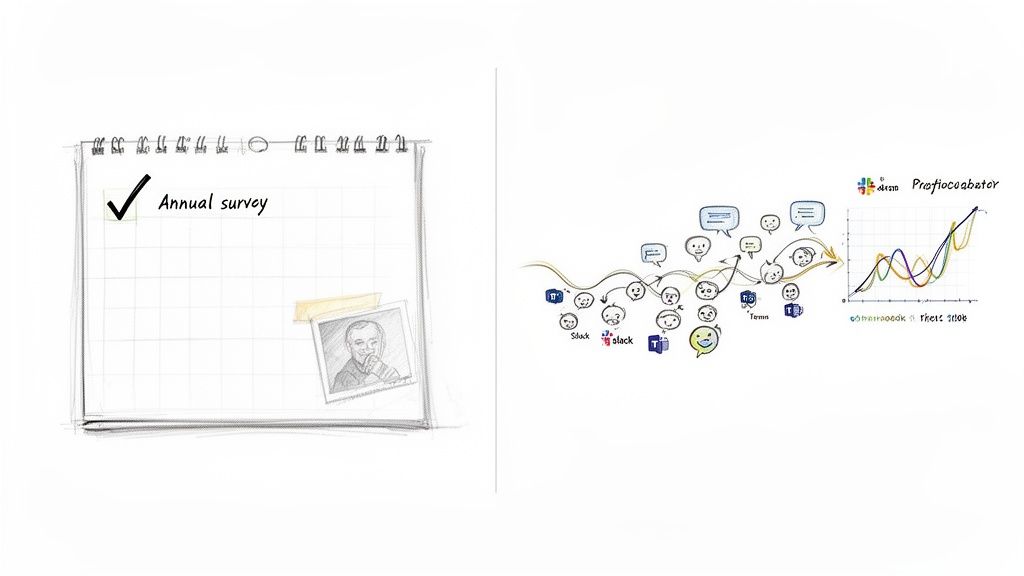
Running a business based on an annual survey is like taking a single photograph of a speeding train—it captures a frozen moment but misses the entire journey. For leaders in Canada and the United States, especially in today’s dynamic hybrid work environments, relying on this outdated model means you're making critical decisions with stale data.
This point-in-time feedback completely fails to capture the continuous shifts in employee sentiment that are really impacting your organization. By the time you analyze the results and put a plan together, the issues have already evolved. Even worse, they may have already led to regrettable turnover. This reactive approach keeps you one step behind, constantly trying to fix problems that have already taken root.
The Problem with a Rearview Mirror Approach
The core issue with annual surveys is that they're fundamentally retrospective. They tell you how your employees felt weeks or even months ago. This is a massive blind spot, especially when sentiment can change on a dime after a tough project launch, a leadership change, or even external market pressures.
For example, a recent study highlighted a troubling decline in job satisfaction, which plummeted from 80% in 2022 to just 59% in 2025. The report from MBS Recruiters noted a significant surge in neutral and dissatisfied ratings, showing a quiet but steady erosion of morale that an annual survey would only catch once it's far too late.
Relying on year-old data to make decisions about today's culture is like trying to navigate a city using a map from last decade. The landmarks have changed, new roads have been built, and the old routes no longer lead where you need to go.
Moving from Static Reports to Cultural Intelligence
To stay ahead, modern COOs and People Ops leaders need a forward-looking perspective. This is where the shift from simple employee feedback to what we call cultural business intelligence becomes so critical. Instead of just collecting data, a true business intelligence tool like Wurkn transforms sentiment into a predictive indicator of your business's health, going far beyond the capabilities of traditional employee engagement platforms.
The table below breaks down the fundamental differences between the old way and the new approach.
Traditional Surveys vs. Continuous Cultural Intelligence
| Feature | Traditional Employee Survey | Wurkn's Cultural Intelligence Platform |
|---|---|---|
| Cadence | Annual or bi-annual | Continuous, real-time |
| Data Freshness | 6-12 months old | Instantly available |
| Nature | Reactive (rearview mirror) | Proactive (predictive dashboard) |
| Focus | Measures past satisfaction | Monitors current and future sentiment |
| Participation | Low, often seen as a chore | High, integrated into daily workflow |
| Insights | Static, high-level reports | Dynamic, actionable signals |
| Impact | Lagging indicator of problems | Leading indicator of business health |
The key is moving to a continuous, always-on model. By tapping into anonymous feedback right from the workflow tools your employees already use, like Slack and Microsoft Teams, you get a real-time pulse of your organization. This approach meets employees where they are, encouraging more frequent and honest input without disrupting their day.
This provides leaders with a living dashboard of cultural signals, allowing them to diagnose issues early and act proactively. For more on this, check out our guide on how COOs get actionable business insights from continuous employee feedback. It's how you transform the "satisfaction survey for employees" from a once-a-year HR task into a powerful, strategic operational tool.
Designing Questions That Reveal Real Insights
A great satisfaction survey for employees does more than just ask, "Are you happy at work?" That kind of question is a dead end. The real goal is to dig into the why behind employee sentiment, giving you the context needed to make changes that actually move the needle.
Let's be blunt: the quality of your questions directly dictates the quality of your insights.
Vague or leading questions will always give you foggy, unusable data. You have to get specific, neutral, and clear. Instead of asking a subjective question like, "Is leadership effective?" break it down into something measurable. A much better approach is, "How confident are you in the strategic direction set by our leadership team?" Now you have a clear signal you can track.
Choosing the Right Question Formats
The way you ask is just as important as what you ask. Different formats are built for different jobs, from measuring overall loyalty to capturing detailed opinions on a new policy. A good survey uses a mix of formats to paint a complete picture.
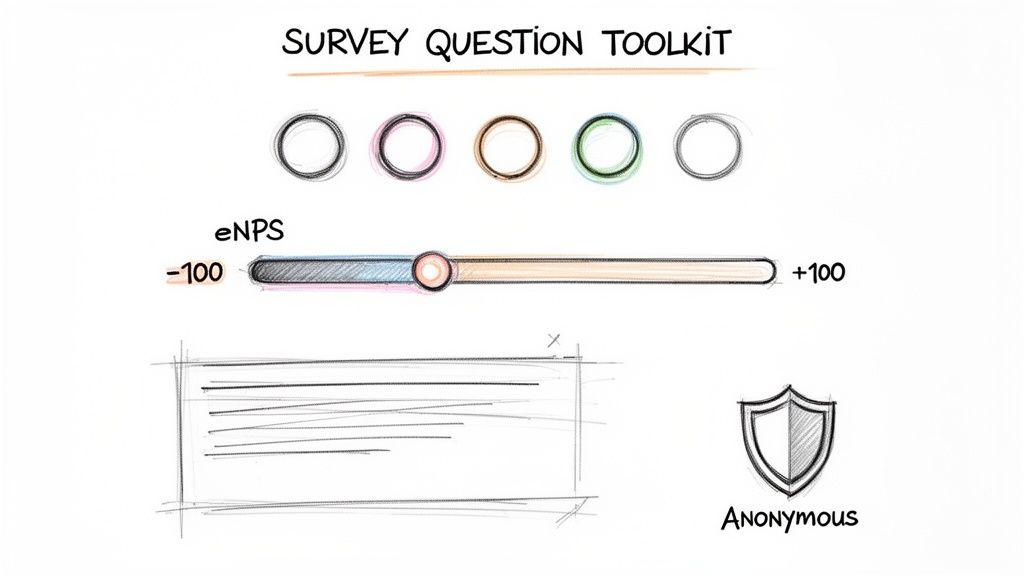
Here are the essentials you should have in your toolkit:
- Likert Scale Questions: These are your workhorses. Using a rating scale (e.g., "Strongly Disagree" to "Strongly Agree"), they quantify feelings about specific drivers like communication, workload, or recognition.
- eNPS (Employee Net Promoter Score): This is your big-picture benchmark. One powerful question—"On a scale of 0-10, how likely are you to recommend our company as a place to work?"—tells you who your Promoters, Passives, and Detractors are.
- Open-Ended Questions: They're tougher to analyze, but this is where you find the gold. A simple follow-up like, "What is one thing we could do to improve your experience?" can uncover mission-critical issues you never even thought to ask about.
Balancing quantitative data with these qualitative stories allows you to see both the what and the why. If you want more inspiration, these employee opinion survey examples are a great place to start.
Focusing on Key Business Drivers
To make your survey a true business intelligence tool, every question needs to tie back to an organizational driver. We're talking about the areas that have a direct impact on productivity, retention, and innovation—not just satisfaction.
Think about framing your questions around these critical themes, especially for today's hybrid teams:
| Driver Category | Example Question for Hybrid Teams |
|---|---|
| Leadership | "Does your direct manager provide the support you need to succeed in a hybrid work environment?" |
| Career Growth | "Do you see a clear path for professional development for yourself at this company?" |
| Inclusion & Belonging | "Do you feel that all team members have an equal opportunity to contribute, regardless of their location?" |
| Work-Life Balance | "Does the company culture respect your time outside of working hours?" |
These questions are grounded in the real challenges of modern North American workforces. They shift the focus from abstract happiness to concrete operational factors that your leaders can actually influence.
The Foundational Role of Anonymity
Here's the bottom line: without trust, you get polite fiction, not honest feedback. Employees, particularly in Canada and the United States, are rightly hesitant to give candid criticism if they fear it could come back to them. The data is clear: a staggering 77% of employees admit they are more likely to give honest feedback through a survey than face-to-face.
Anonymity is not just a feature; it's a prerequisite for truth. Without it, your survey data reflects what employees think you want to hear, not what you need to know.
This is where a dedicated business intelligence tool has a massive advantage over standard HR survey tools. Platforms like Wurkn are built with privacy engineered into their core. By automatically redacting names and other identifying information, the system creates true psychological safety.
This technical safeguard isn't just a nice-to-have; it's what encourages the unvarnished insights you need to understand what’s really happening in your organization and make confident, data-backed decisions.
Turning Raw Feedback Into a Cultural Diagnosis
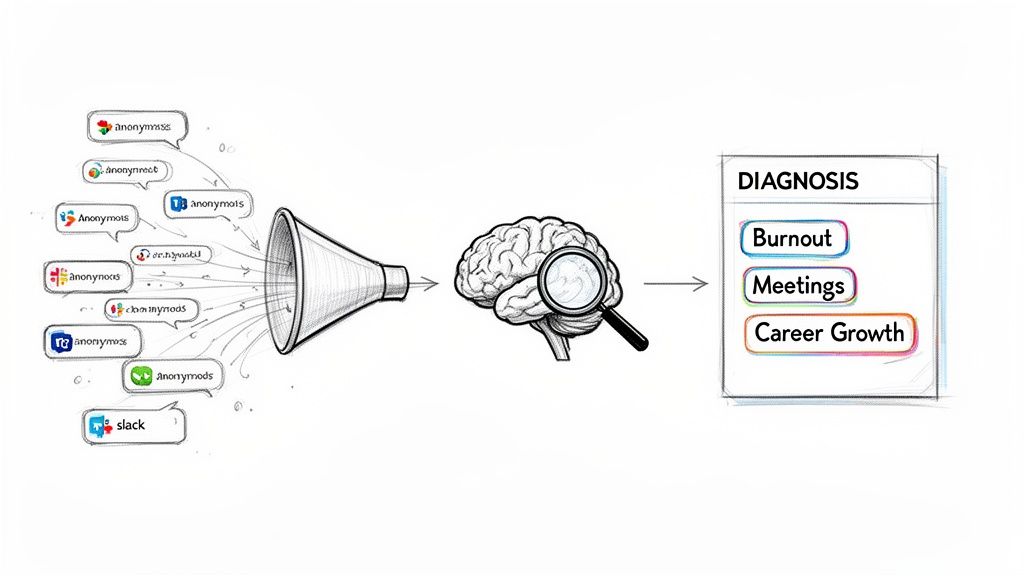
Collecting data from a satisfaction survey for employees is just the opening move. The real strategic value comes when you turn all that raw, unstructured feedback into a clear diagnosis of your company's health. Let's be honest, a spreadsheet overflowing with comments and ratings isn't intelligence—it's noise until you find the signal.
This is where most traditional HR survey tools hit a wall. They're great at tallying scores but struggle to make sense of the rich, nuanced stories buried in open-ended feedback. Without a proper analytical engine, leaders are left trying to manually connect the dots across thousands of individual comments, a process that’s not only a massive time sink but also rife with personal bias.
Moving Beyond Keywords to Thematic Analysis
Effective analysis goes way deeper than just counting keywords. It requires thematic analysis—a method of digging into your qualitative data to identify recurring patterns, topics, and the real ideas bubbling under the surface. This process is about grouping related comments into cohesive themes so you can finally see the bigger picture.
For instance, you might see the word "meetings" pop up a lot. A basic tool tells you meetings are a hot topic. A business intelligence platform, however, reveals the crucial context. It can tell the difference between comments about "too many pointless meetings" and frustration over "a lack of cross-functional meeting alignment."
One is a time-management issue; the other is a collaboration breakdown. Two totally different problems that need different solutions.
This is where a business intelligence platform like Wurkn really changes the game. Wurkn’s AI, which includes human oversight to ensure quality, doesn't just scan for words. It performs sophisticated thematic analysis to uncover the why behind the feedback, pinpointing the specific drivers of sentiment and even the emotional undertones in what people are writing.
A Real-World Scenario: Hybrid Work Feedback
Picture this: your company, with offices across Canada and the United States, just rolled out a new hybrid work policy. You're getting continuous feedback through integrated channels in Slack and Microsoft Teams. At first glance, you see a spike in comments about "scheduling" and "work-life balance."
Without a proper analytical tool, your first instinct might be to assume people are just unhappy with their hours. But Wurkn synthesizes this feedback into a coherent narrative. It identifies a core theme you might have missed: fragmented focus time.
The platform reveals that employees aren't just complaining about meetings. They're explaining that back-to-back virtual calls are leaving them with zero dedicated blocks for deep work. This is hammering their perceived productivity and causing their workdays to bleed into personal time.
Instead of a vague problem like "meeting fatigue," you now have a precise diagnosis: "The hybrid meeting schedule is eroding employee focus time, leading to decreased work-life balance and growing burnout risk." That’s a problem you can actually solve.
Seeing the Nuances in Satisfaction Data
It’s also crucial to understand that employee satisfaction is complex and often contradictory. A recent UC Irvine study found that while 74% of workers reported being satisfied with their jobs, a significant chunk of them still posed a retention risk. The same study revealed that 52% wanted a hybrid schedule, and 41% of current hybrid workers would jump ship for a fully remote opportunity. You can explore the full findings on shifting work preferences from UCI's research.
This drives home a key point: high-level satisfaction scores can easily mask critical underlying issues. An employee can be generally happy but still be a flight risk if one of their key needs, like flexibility, isn't being met.
A true cultural diagnosis tool helps you see these nuances. It lets you segment feedback and understand how sentiment on specific themes—like remote work policy, career development, or manager support—varies across different parts of your business. This is how you transform employee feedback from a simple report card into a detailed diagnostic tool, giving you the intelligence to make precise, impactful changes.
Connecting Employee Sentiment to Business KPIs
It's one thing to know how your employees are feeling. It's another thing entirely to link that sentiment directly to business performance. This is the moment when cultural intelligence stops being a "nice-to-have" HR metric and becomes a core operational asset.
When you can draw a straight line from how your people feel to your most critical business outcomes, your satisfaction survey for employees transforms into a powerful predictive tool. This isn't about soft metrics anymore. It's about hard data that justifies strategic investments, guides leadership focus, and directly drives the bottom line.
A healthy culture isn't just a goal in itself—it's a direct driver of revenue, productivity, and sustainable growth.
From Cultural Signals to Predictive Warnings
Imagine a dip in sentiment around "career growth" starts bubbling up from your engineering team in Toronto. In a traditional survey model, you might not spot this for months. By then, your best talent has already polished their LinkedIn profiles.
With a continuous feedback loop, this isn't just a data point; it’s an early warning signal for regrettable turnover.
A business intelligence tool like Wurkn gives COOs a living dashboard that surfaces these kinds of predictive insights in real-time. By correlating qualitative feedback with operational data, you can see the immediate impact of sentiment on performance.
When your top performers start quietly expressing frustration about their development path, that's not just an HR issue—it’s a direct threat to your product roadmap and future revenue. Acting on this signal proactively isn’t just good management; it's a critical business intervention.
This level of visibility lets you step in long before key employees even think about leaving, turning a potential crisis into a retention win.
The Framework for Linking Sentiment and Performance
To make this connection tangible, you need a clear framework. It's all about mapping specific cultural signals from your feedback channels to measurable business key performance indicators (KPIs). The goal is to demonstrate a clear cause-and-effect relationship between what your employees are saying and what your business is achieving.
The table below shows a few practical examples of how this linkage works, drawing a direct line from employee sentiment to key operational metrics.
Linking Cultural Signals to Business Outcomes
| Cultural Signal (from Employee Feedback) | Potential Business KPI Impact | Proactive Action for Leaders |
|---|---|---|
| Negative sentiment around "internal communication" and "project clarity" from the sales team. | Decreased sales productivity, longer sales cycles, and lower customer satisfaction (CSAT) scores. | Host targeted workshops on communication protocols and clarify project roles using a RACI matrix to streamline workflows. |
| Frequent comments about "workload" and "burnout" within the customer support department. | Increased absenteeism, higher employee turnover, and a noticeable drop in first-call resolution rates. | Re-evaluate staffing models, introduce mental health support resources, and implement stricter policies on after-hours communication. |
| Positive feedback on "manager support" and "team collaboration" in the R&D division. | Shorter innovation cycles, higher product quality, and an increase in successful new feature launches. | Identify what these successful managers are doing differently and scale those leadership behaviours across the organization through training. |
This kind of framework moves the conversation away from just employee happiness and puts it squarely in the language of business results.
Moving Beyond Simple Scores like eNPS
While metrics like the Employee Net Promoter Score are fantastic for getting a pulse on overall loyalty, their real power is unlocked when you pair them with deep qualitative insights. An eNPS score tells you what your employees are feeling, but the thematic analysis of their comments tells you why.
For instance, seeing your company’s eNPS drop from +40 to +25 is definitely concerning. But a platform like Wurkn can instantly show you that the drop is driven primarily by "Detractors" in the marketing team, whose comments are all clustered around a central theme of "lack of creative autonomy."
Suddenly, you have a specific, actionable problem to solve.
Instead of launching a generic company-wide initiative to "boost morale," the COO and marketing leadership can have a targeted conversation about decision-making processes and creative freedom. This level of precision is simply impossible with traditional survey tools that only give you top-line scores. By connecting the dots between scores, themes, and specific business units, you can make surgical interventions that have a real, measurable impact.
How to Build Data-Driven Action Plans
Let's be blunt: insights from your satisfaction survey for employees are completely worthless without action. A cultural diagnosis is a great start, but if it just ends up as a report that sits in a digital folder, you’ve wasted everyone’s time.
This is the final, most critical step: turning that raw intelligence into a measurable action plan that actually drives improvement. This is where People Ops and operational leaders need to be joined at the hip. The goal isn't just to put out fires but to build a system where employee feedback directly shapes business strategy. It’s how you close the loop and prove that speaking up leads to real change.
Prioritizing Issues Based on Business Impact
Once you’ve identified the key themes driving employee sentiment, the inevitable question is, "Okay, where do we start?" Not all feedback is created equal. A problem annoying a small team might be important, but a systemic issue torpedoing a critical business function needs to be tackled yesterday.
To get this right, you have to connect cultural themes directly to your business KPIs.
- High-Impact Issues: These are the problems that pose a direct threat to core business outcomes. For instance, if you uncover widespread burnout in your customer support team, that's a red flag for your CSAT scores and retention rates. You can draw a straight line from one to the other.
- High-Influence Issues: This category includes themes with a broad impact on morale and productivity, even if the KPI connection is less direct. Think concerns about leadership transparency or a lack of recognition—these things erode the foundation of your culture.
Start by mapping your biggest negative sentiment themes against your most important business metrics. This isn't a gut-feel exercise; it's a strategic decision that ensures you're putting resources where they'll make the biggest difference.
This simple flow shows how employee feedback can be turned into measurable business results.
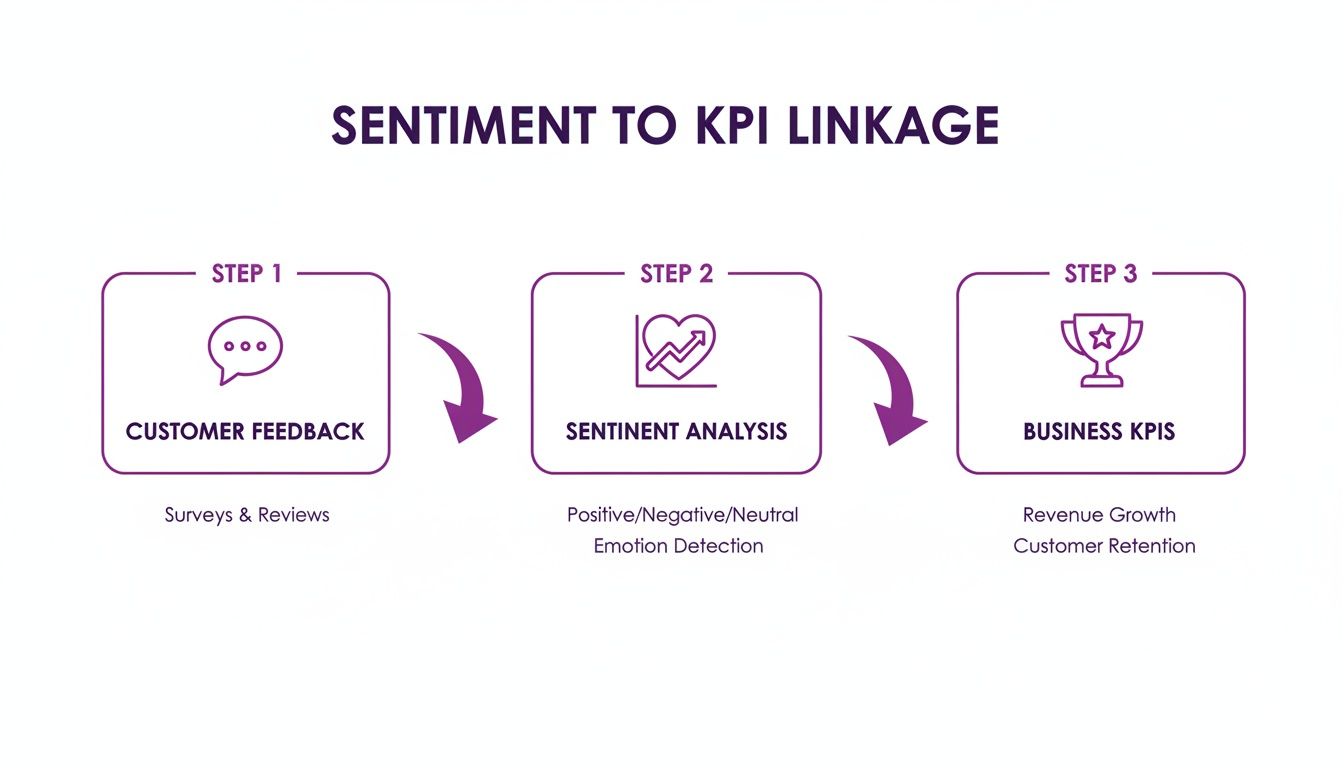
It’s a clear path: anonymous feedback provides the raw data, sentiment analysis turns it into insight, and that insight helps you protect—and improve—your core business KPIs.
Assigning Ownership and Creating Accountability
An action plan without an owner is just a wish list. Every single initiative needs a designated leader who is responsible for seeing it through, complete with a clear timeline and milestones. This is how you build a culture of accountability, where fixing employee concerns is treated with the same rigour as hitting a quarterly sales target.
For example, a recent higher education workforce survey found that while hybrid work was a major satisfaction driver for 64% of employees, some serious challenges were lurking beneath the surface. Key pain points like salary concerns (51%), career stagnation (46%), and burnout (32%) were flagged as major problems. You can discover more about these workforce insights from the HERC survey.
Using that data, a real action plan starts to take shape:
- Issue: Career Stagnation
- Owner: Head of Learning & Development
- Action: Launch a mentorship program and create transparent career pathing guides for all major roles.
- Timeline: Q3 launch.
- Issue: Burnout & Stress
- Owner: COO and Head of People
- Action: Pilot a "no-meeting Fridays" policy and roll out manager training on workload management.
- Timeline: Pilot in Q2, full rollout in Q3.
An action plan is more than a document; it's a public commitment to your employees. When they see specific leaders taking charge of the issues they raised, it builds a foundation of trust that no single survey ever could.
Closing the Loop with Continuous Monitoring
The real magic of a business intelligence tool like Wurkn is its ability to monitor sentiment in real-time as you roll out your changes. This isn't a "set it and forget it" activity. You need a dynamic feedback loop to see if your actions are actually working.
Here’s a practical scenario. A tech company with offices across the United States and Canada is trying to tackle burnout. Using continuous feedback channels in Microsoft Teams, they pinpoint a root cause: a pervasive culture of after-hours messaging. The data shows a sharp nosedive in sentiment related to "work-life balance" every Sunday night as people mentally brace for the week.
In response, leadership rolls out a new "right to disconnect" policy, making it crystal clear that there's no expectation to respond to messages outside of working hours.
Instead of waiting a year for the next big survey, they watch the sentiment data in real-time. Within weeks, they see a measurable positive shift in comments about work-life balance and a decline in burnout-related keywords. That instant feedback validates their policy and reinforces the value of the entire process.
Have Questions? We've Got Answers.
Switching to a modern employee feedback strategy always brings up a few questions, especially for leaders in operations. A well-designed satisfaction survey for employees is more than just a list of questions; it's a powerful tool for taking the pulse of your company's health and boosting business performance.
Here are some straightforward answers to the most common questions we hear from COOs and People Ops leaders across Canada and the United States.
How Can We Guarantee People Feel Safe Giving Anonymous Feedback?
True anonymity is the bedrock of honest feedback. Simply ticking an "anonymous" box on a generic survey tool won't cut it—your team needs to trust the system itself. This requires a platform that's been built for privacy from the ground up.
A business intelligence tool like Wurkn is designed specifically for this. It automatically strips out any personally identifiable information (PII) and synthesizes comments into aggregated themes. Leaders see the patterns and insights without ever knowing who said what. This creates the psychological safety needed for people to be truly candid. The entire focus shifts from who said it to what was said.
What’s a Good Survey Participation Rate to Aim For?
While many companies chase a 70% or higher response rate, that number can be seriously misleading. A high participation rate on a massive annual survey doesn't mean much if your employees are just rushing through to get it done. The real win is consistent, high-quality engagement over time.
Instead of focusing on one big number, a much smarter approach is to weave feedback into the daily flow of work. By meeting your team where they are—like in Slack or Microsoft Teams—you make it effortless to participate. This continuous, low-effort model almost always delivers more authentic and timely insights than a single, high-stakes annual event.
The most valuable feedback isn't found in a once-a-year survey. It's in the steady stream of day-to-day observations from the people who are closest to the work.
How Do We Actually Get Employees to Participate?
Getting people to buy in starts with one simple thing: closing the feedback loop. Employees tune out when they feel like their input just vanishes into a black hole. In fact, one study found that a massive 77% of employees are more willing to give honest feedback in a survey than face-to-face, but only if they believe something will actually come from it.
To build that trust, leaders need to do two things, consistently:
- Explain the "Why": Be crystal clear about how their feedback will be used to make specific business decisions. Connect their input directly to tangible outcomes.
- Show, Don't Just Tell: Publicly share the key themes that came up and the concrete action plans you're putting in place. When people see their suggestions lead to real change, they're far more likely to contribute again.
This simple shift turns the survey from a data-gathering exercise into a genuine conversation about making the business better.
How Do You Measure the ROI of a Feedback Program?
Measuring the return on your investment means connecting the dots between your cultural data and your core business KPIs. This is how you transform employee satisfaction from a "soft" metric into a hard operational indicator.
For instance, a business intelligence platform like Wurkn lets you directly correlate sentiment data with business results.
- Retention: Track themes like "career growth" or "manager support" and see how they impact turnover rates in your most critical departments. A quick intervention based on an early sentiment warning has a clear, calculable ROI in avoided replacement costs.
- Productivity: Link feedback on things like "internal processes" or "collaboration tools" to project completion times or sales cycle lengths. Smoothing out the operational friction your employees point out has a direct and immediate impact on efficiency.
By tying this cultural intelligence to your financial and operational metrics, COOs can prove that investing in employee satisfaction isn't just a culture initiative—it's a smart business strategy.
Stop letting your employee feedback collect dust in static reports. Turn it into a powerful business intelligence engine. With Wurkn, you get a real-time, living dashboard of your organization’s cultural health, letting you connect employee sentiment directly to business results and make proactive, data-driven decisions. See how it works at https://wurkn.com.