
You’ve seen them before. They sneak into surveys and feedback forms, looking innocent enough, but they’re quietly sabotaging your data. We’re talking about the double-barrelled question—a classic survey mistake that asks about two completely different things at once while only allowing for a single answer.
This tiny error creates a massive problem: you get confusing, unreliable data because you have no idea which part of the question someone is actually answering. The feedback becomes completely useless.
Why Better Questions Mean Better Business Performance
Imagine launching a huge new initiative based on your latest employee survey, pouring in time and money, only to find it completely misses the mark. This isn't just a hypothetical; it's a costly mistake that often starts with a single, poorly-worded question that muddies the waters from the get-go. Getting employee feedback right isn't just an HR checkbox—it’s a critical source of business intelligence that fuels performance.
Take this common example: "Are you satisfied with your compensation and benefits?"
It seems straightforward, but it forces an employee to lump two very different topics into one rating. Someone might think their salary is lagging behind the market but feel their health benefits are fantastic. Their neutral "3 out of 5" tells you nothing. Is compensation the real issue, or are the benefits falling short? The data is a mess, paving the way for wasted resources and misguided strategies.
This lack of clarity has serious financial consequences. In the United States and Canada, employee engagement has flatlined at a dismal 33%, with a staggering 51% of employees admitting they're 'not engaged.' According to Gallup, highly engaged teams are 23% more profitable and have an 81% lower rate of absenteeism.
The business cost of not truly understanding what your people are thinking is immense, and it’s a problem made infinitely worse by bad questions. You can discover more about the state of employee engagement from recent studies.
The High Cost of Unclear Feedback
Faulty questions don't just create messy spreadsheets; they send ripples of damage across the entire organisation.
- Wasted Resources: When you invest in the wrong initiatives based on skewed survey data, you're burning through your budget, your time, and your leadership's focus.
- Eroded Trust: Employees share their thoughts, and then they see… nothing. Or worse, action on something that wasn't even the real problem. They quickly lose faith in the process and stop giving honest feedback in the future.
- Stagnant Performance: Without clear insights into what motivates (or frustrates) your workforce, trying to improve productivity and retention becomes a complete guessing game.
"Every piece of employee feedback is a signal. A double-barrelled question adds so much noise that the signal is lost, preventing leaders from hearing what their teams truly need."
Ultimately, asking the right questions is the first step in turning feedback from a simple HR task into a powerful engine for cultural intelligence. This is where a business intelligence tool like Wurkn is changing the game. It moves beyond static, flawed surveys to provide a continuous pulse on employee sentiment, delivering the kind of clear, actionable business intelligence needed to drive real results.
This guide will show you how to spot, fix, and avoid these data-corrupting questions, transforming your feedback process from a liability into a genuine driver for growth.
What Is a Double Barrelled Question Anyway?
Let's break down the double barrelled question with a quick analogy. Imagine asking a restaurant critic to give a single 1-to-5 score for a restaurant's "food and decor." What does a '3' even mean? Did they love the five-star meal but hate the one-star ambiance? Or was everything just… okay? You have no idea which part drove the score, making the feedback totally useless.
This is exactly what happens when we use them in employee surveys. A double barrelled question forces two different ideas into a single answer, creating murky data that can point your entire people strategy in the wrong direction. It’s a small mistake with massive consequences, undermining the whole point of asking for feedback in the first place.
As you can see, a bad question starts a chain reaction that poisons the entire data pipeline, leading to bad decisions and wasted time and money.
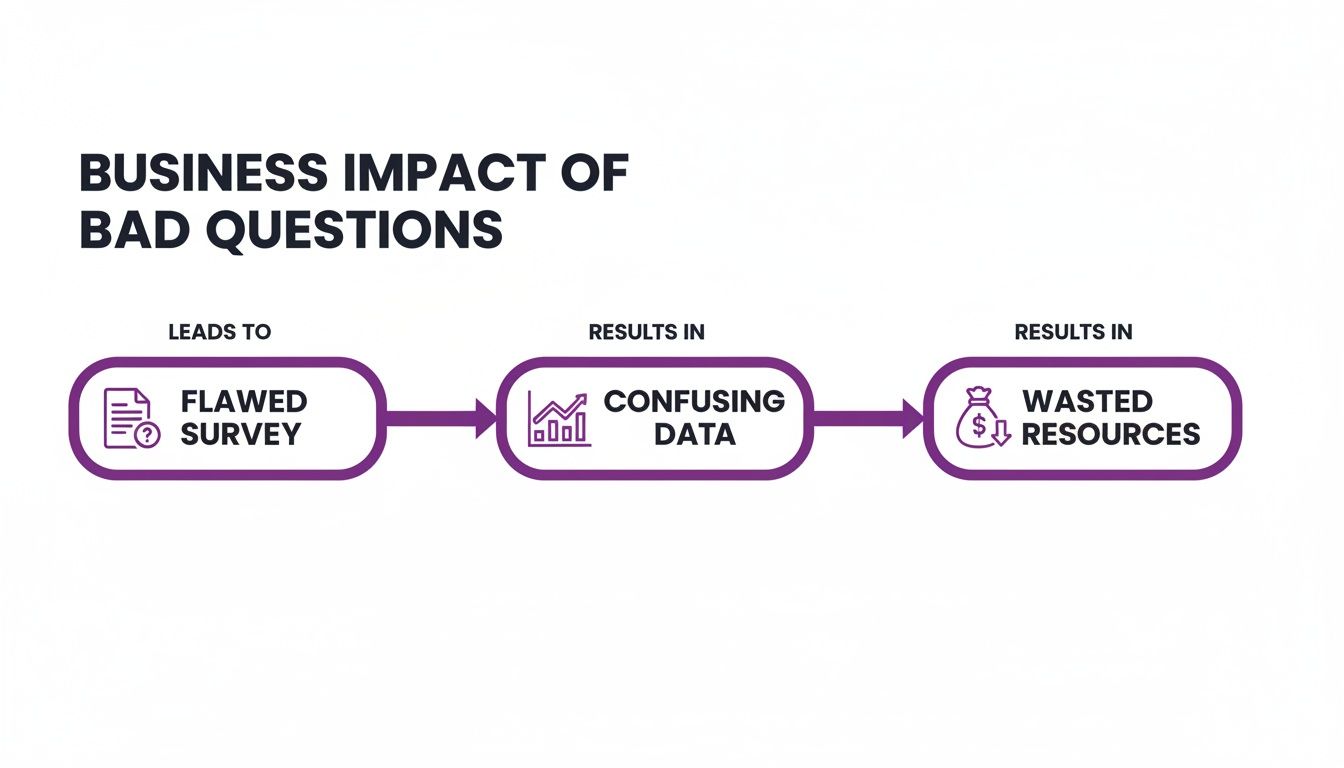
This isn't just a survey design issue; it's an operational risk. Bad questions lead to flawed data, which leads to poor investments in your people.
Spotting Double Barrelled Questions in People Ops
These messy questions are all over HR and People Ops, usually hiding in plain sight. They feel efficient—two questions for the price of one!—but they trade clarity for a false sense of brevity. The word "and" is your first red flag.
Here are a couple of classic examples you've probably seen:
-
Flawed: "Are our health benefits and wellness programs meeting your needs?"
-
The Problem: An employee might think their health insurance is fantastic but see the wellness program as a joke. A single "No" gives you zero clue about which program to fix.
-
Flawed: "Do you feel supported by your manager and connected to your team?"
-
The Problem: Managerial support and team connection are completely different concepts. Someone might have a great, supportive boss but feel totally siloed from their colleagues. That's a critical nuance lost in a single click.
It’s not just about getting bad data; it's also about frustrating your team. When people can't give an honest, accurate answer, they start to check out. The survey feels like a chore designed by someone who doesn't actually care about their real opinion.
A double barrelled question guarantees ambiguous feedback by trying to measure two different things with one tool. It’s like trying to listen to two radio stations at once—all you get is static.
This table shows a few common culprits found in employee surveys and, more importantly, how to fix them by splitting them into clear, actionable questions.
Spotting and Fixing a Double Barrelled Question
| Double Barrelled Question (Flawed) | Issue 1 | Issue 2 | Corrected Questions (Clear & Actionable) |
|---|---|---|---|
| Are our health benefits and wellness programs adequate? | Health Benefits | Wellness Programs | 1. How satisfied are you with our health benefits? 2. How valuable do you find our wellness programs? |
| Do you feel supported by your manager and connected to your team? | Manager Support | Team Connection | 1. Do you feel supported by your direct manager? 2. Do you feel a strong sense of connection with your immediate team members? |
| Is your compensation fair and are you satisfied with your benefits package? | Compensation Fairness | Benefits Satisfaction | 1. Do you believe your compensation is fair for your role and experience? 2. How satisfied are you with your overall benefits package? |
By untangling these concepts, you move from collecting noise to gathering intelligence you can actually use.
The Sneaky Questions That Go Beyond 'And'
While "and" is the most obvious giveaway, these questions can be more subtle. Sometimes they merge an action with a feeling, or combine two closely related ideas into one.
Take this seemingly harmless question:
- "Does the company provide sufficient opportunities for professional development and career growth?"
Looks fine, right? But "development" (learning new skills) and "growth" (climbing the ladder) aren't the same. Your company might offer tons of training courses (great development) but be so flat there’s nowhere to get promoted (zero growth). The employee’s answer becomes a confusing mix of two very different experiences.
This is where most traditional survey tools fall flat. They give you a platform to ask questions but offer no intelligence to check the quality of those questions.
This is why a business intelligence tool like Wurkn is so different. It moves beyond static, flawed survey questions. By analyzing the continuous, unstructured feedback from tools your employees use every day, it can naturally pull apart themes like "health benefits" and "wellness programs" without you ever having to ask a double barrelled question. This gives leaders a clean, unfiltered view of what's really going on.
The Real Costs of Ambiguous Employee Feedback
Let's move past the theory. The real-world business consequences of a double-barrelled question are both severe and sneakily far-reaching. These aren’t just minor survey annoyances; they directly poison the well of your data. Your expensive people analytics dashboards and glossy engagement reports? They become fundamentally unreliable.
It all starts with a single employee’s confusion, but it quickly snowballs into a major operational risk. This confusion creates a ripple effect, starting with skewed survey results where the aggregated scores completely mask the real reasons behind employee sentiment. These misleading metrics then feed into flawed action plans, wasting resources and slowly chipping away at trust.
The Ripple Effect: From Bad Data to Bad Decisions
Picture this common scene playing out in a growing Canadian or American company. A survey goes out asking, "Are you satisfied with the opportunities for training and development?" The final score comes back a lukewarm "3.5 out of 5." Seeing this, leadership figures it's a minor issue and throws a small budget at a new online learning platform. Problem solved, right?
Not even close. The ambiguous question hid the real story. Employees were actually thrilled with the training opportunities but deeply frustrated by the complete lack of a clear path for development and promotion. That shiny new platform? A totally wasted investment because it only addressed the half of the problem people were already happy with.
The real issues—no mentorship, unclear career ladders, and a freeze on internal mobility—went completely untouched. This is exactly how one simple double-barrelled question leads straight to poor capital allocation and unresolved cultural friction. The financial hit is bad enough, but the damage to morale can be far worse.
Connecting Flawed Feedback to Your Bottom Line
The line between ambiguous feedback and your most critical key performance indicators (KPIs) is direct and damaging. When you misread what employees are telling you about crucial areas like management effectiveness or work-life balance, the fallout shows up in the numbers that matter most.
Here’s how the damage unfolds:
- Increased Turnover: When employees feel their core concerns are being ignored, they check out. If you misdiagnose why they're unhappy, you can't build retention strategies that actually work. As you can see in our guide to the real cost of employee turnover, those expenses add up faster than you think.
- Decreased Productivity: A team that feels unheard is not a motivated team. If a survey mashes up feedback on "tools and processes," you might spend a fortune on new software when the real bottleneck is a ridiculously slow approval process. Productivity stays flat because the actual problem never got fixed.
- Wasted HR Budget: Every dollar you spend on an initiative built on bad data is a dollar that could have solved a real problem. This isn't just inefficient; it's a direct drain on your operational budget and profitability.
Bad data is worse than no data at all. No data leaves you guessing. Bad data gives you the false confidence to charge full-speed in the wrong direction, amplifying the cost of every mistake.
This whole cycle exposes the core weakness of traditional, static HR survey tools. They give you a platform to ask questions but offer zero intelligence to check if those questions are any good. The burden of designing a perfect, unbiased survey falls entirely on you.
This is precisely where a business intelligence tool like Wurkn changes the game. Instead of relying on periodic, often flawed surveys, Wurkn gives you a continuous, real-time pulse of your organisation's health. It analyzes unstructured, anonymous feedback from workplace platforms to spot distinct themes—without ever asking a double-barrelled question.
For instance, Wurkn’s AI can easily tell the difference between conversations about "compensation" and those about "benefits." It might find that employees are frustrated with salary bands but absolutely love the company's health plan. That's a critical distinction that traditional surveys almost always miss. This approach moves you from simple feedback collection to true business intelligence, letting leaders make precise, data-driven decisions that solve the right problems and deliver measurable results.
How to Rewrite Your Survey Questions for Clarity
Moving from theory to practice is the fastest way to improve your data quality. Thankfully, rewriting a double-barrelled question isn't complicated. It all boils down to adopting one simple, powerful principle that should guide your entire survey design process.
Get this right, and you'll immediately boost the quality and accuracy of every single piece of feedback you collect.
At its core, the solution is all about discipline and focus.
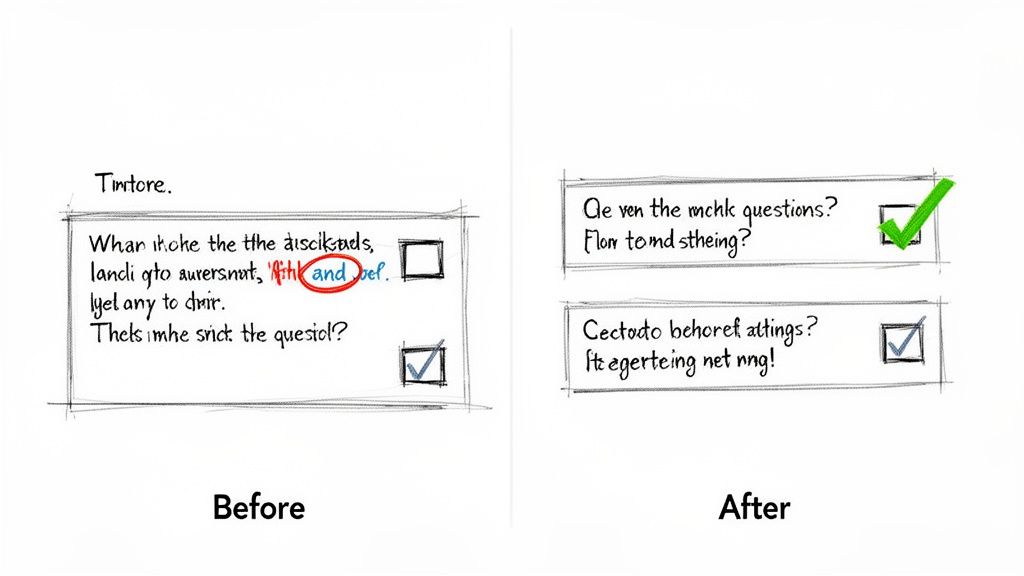
The core principle is this: One Idea, One Question. Every single item in your survey should measure one concept and one concept only. If a question feels like it's trying to do too much, it probably is.
This approach ensures that an employee's response is clear, direct, and—most importantly—unambiguous. You get clean data that tells a specific story, allowing you to pinpoint issues with confidence and build solutions that actually work.
A Practical Checklist for Auditing Your Surveys
Before you send out your next employee survey, run every question through this quick audit. It’s a simple process that can save you from collecting a mountain of useless data. For each item on your list, ask yourself these three critical questions:
- Does this question contain the word ‘and’ or ‘or’? This is your most obvious red flag. Conjunctions are almost always a sign that you’ve packed two distinct ideas into a single question.
- Could an employee agree with one part but disagree with the other? This is the ultimate stress test. If the answer is "yes," your question is flawed and needs to be split. This simple mental exercise helps you see the hidden complexity you might have missed.
- Is this question asking about both a cause and an effect? For example, "Do you feel our flexible work policy has improved your work-life balance?" This combines a policy (the cause) with a personal outcome (the effect), making it impossible to interpret a "no."
Answering these prompts honestly will reveal the weak spots in your survey, letting you fix them before they contaminate your results. For more inspiration, checking out a well-structured employee opinion survey example can give you some great models for clear, single-focus questions.
Before and After: Real-World HR Examples
Let's walk through a few common scenarios in HR, performance, and DEI to see this principle in action. Notice how splitting one ambiguous question into two focused ones transforms them from confusing to crystal clear.
Scenario 1: Diversity, Equity, and Inclusion (DEI)
- Before (Flawed): "Do you believe our company is committed to diversity and provides equal opportunities for advancement?"
- The Problem: A company's stated commitment (a value) and its actual practices (an outcome) are two very different things. An employee could believe leadership is genuinely committed but see a system where promotions are anything but equal.
- After (Clear & Actionable):
- "To what extent do you agree that our company leadership is genuinely committed to diversity and inclusion?"
- "Do you believe all employees have an equal opportunity for career advancement at our company?"
Scenario 2: Performance and Management
- Before (Flawed): "Are you satisfied with the frequency of feedback from your manager and the quality of that feedback?"
- The Problem: Quantity and quality are not the same. A manager could provide daily feedback (high frequency) that is vague and unhelpful (low quality). A single rating mashes these two distinct experiences together.
- After (Clear & Actionable):
- "How satisfied are you with the frequency of performance feedback you receive from your manager?"
- "How would you rate the quality and helpfulness of the feedback you receive?"
This hands-on approach empowers you to immediately upgrade your feedback mechanisms. However, fixing survey questions is just the first step.
A business intelligence tool like Wurkn bypasses this problem entirely. By analyzing continuous, unstructured feedback, Wurkn identifies distinct themes as they emerge naturally. This provides a level of clarity and real-time insight that even the most perfectly designed survey can't match.
Moving Beyond Surveys to True Cultural Intelligence
Even a perfectly designed survey—one that’s completely free from every last double barrelled question—is still just a snapshot in time. It tells you how people felt on a specific Tuesday in May, but it misses the continuous, evolving conversation that actually defines your company’s culture.
To get a real handle on the health of your business, you need to graduate from static feedback forms to real-time cultural intelligence.
This is where a more sophisticated approach comes in. A continuous listening model plugs directly into the platforms where work actually happens, giving you a real-time pulse on your organisation. Instead of asking questions on a schedule, it analyzes the anonymous, ambient conversations already taking place to pull out insights as they naturally bubble up.
How Continuous Intelligence Sidesteps the Survey Trap
This way of gathering feedback completely avoids the double barrelled question trap for one simple reason: it doesn't ask questions at all. The AI-powered analysis listens for topics, themes, and sentiment, neatly separating related—but very distinct—concepts without jamming them into a single, restrictive answer. This delivers a level of nuance and accuracy that traditional surveys just can't match.
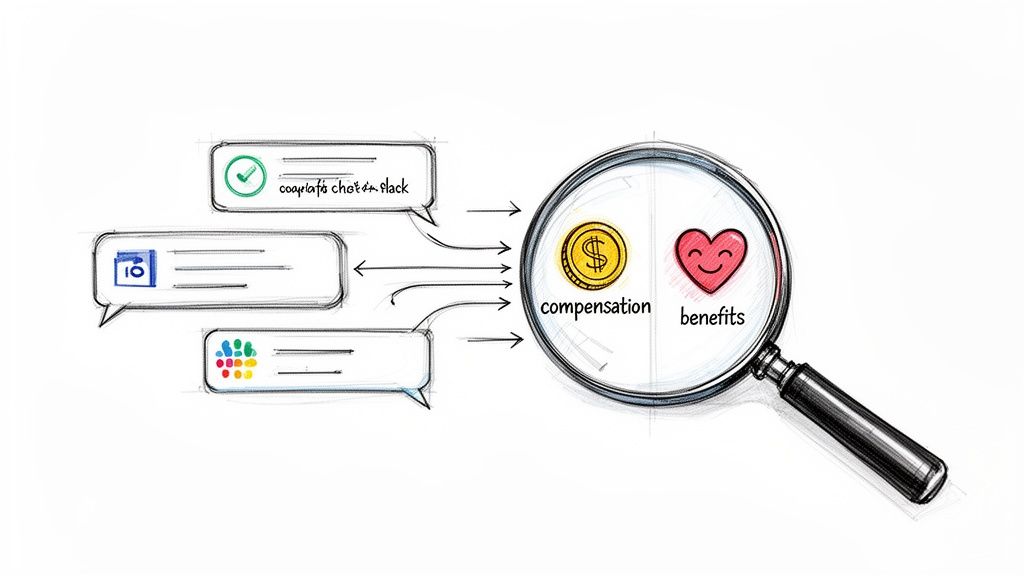
Think back to our flawed "compensation and benefits" question. A static survey forces a combined rating, muddying the waters and leaving leaders to guess what’s really driving satisfaction or frustration. A business intelligence tool like Wurkn works differently.
By analyzing anonymized conversations, its AI can clearly tell the difference between discussions about salary and discussions about the benefits package. It might reveal that sentiment around compensation is a huge point of friction, with many employees feeling underpaid. At the same time, it could show that the company's health benefits are seen as overwhelmingly positive.
This critical distinction—missed by a single survey score—is the difference between a targeted, effective retention strategy and a costly, misinformed one. It elevates your approach from simple feedback gathering to generating strategic business intelligence.
From Employee Feedback to Business Performance
The real power here is the ability to connect these cultural signals directly to business outcomes. By identifying nuanced issues in real time, leaders can act decisively before small frustrations blow up into major problems that hit productivity and retention. This shifts the entire conversation from "What did the survey say?" to "What is our cultural data telling us about business performance?"
This method gives you several key advantages over old-school feedback tools:
- Real-Time Insights: Instead of waiting for quarterly or annual survey results, you get a continuous stream of data. This allows you to manage proactively, not reactively.
- Unfiltered Honesty: By analyzing anonymous data from platforms where employees communicate, you get far more authentic feedback than a formal survey ever could.
- Reduced Survey Fatigue: It lifts the burden on employees to constantly fill out forms, which in turn improves the quality and consistency of the feedback you receive.
When leadership teams understand the subtle but vital differences between related topics, they gain the clarity needed to make smarter investments in their people. As leaders learn how COOs get actionable business insights from continuous employee feedback, they can build a more resilient and high-performing organisational culture.
Ultimately, a business intelligence tool like Wurkn completely overhauls your employee feedback process. It moves way beyond just flagging problems and gives you the deep, contextual understanding needed to connect cultural health directly to your bottom line—giving you a powerful strategic advantage.
Your Checklist for High-Impact Feedback Systems
Turning your feedback process from a simple HR chore into a powerhouse of strategic business intelligence takes more than just dodging the occasional double-barrelled question. It’s about consciously building a robust, thoughtful system.
Think of this checklist as a practical framework that pulls together all the key lessons on question design, process, and technology. Nailing this is the difference between collecting messy data and generating the kind of clear, actionable insights that actually drive business performance. Each pillar is crucial for creating a culture of continuous listening—something essential for any forward-thinking organization in Canada or the U.S.
Pillar 1: Question Design
The quality of your questions is the absolute foundation of any feedback system worth its salt. If your questions aren’t clear and focused, the whole process just crumbles. Your main job here is to stamp out ambiguity wherever you find it.
-
Stick to the ‘One Idea, One Question’ Rule: Before you even think about sending out a survey, comb through every single item. If a question uses the word ‘and’ or ‘or,’ that’s a massive red flag. You're almost certainly cramming two different ideas into one.
-
Stress-Test for Nuance: For every question, ask yourself: “Could someone agree with one part of this but disagree with the other?” If the answer is yes, you've got a double-barrelled question. Split it up.
-
Keep Language Simple and Direct: Ditch the corporate jargon and complex phrasing. A clear question gets a clear answer, which gives you clean data you can actually trust.
Pillar 2: Process and Review
Even perfectly written questions can fall flat if the process around them is broken. A solid review process is your quality control, making sure all your effort leads to results that mean something.
-
Pilot Test Every Single Survey: Before the big launch, send your survey to a small, diverse group of employees. This one simple step can help you catch confusing questions or design flaws before they have a chance to poison your entire dataset.
-
Get a Fresh Set of Eyes: It’s incredibly easy to miss your own mistakes. Have a colleague look over your questions to catch any compound phrasing you’ve overlooked. Research from market analysis firms like Kantar shows this simple peer-review is one of the most effective ways to boost survey clarity.
Pillar 3: Technology and Intelligence
Let’s be honest: static surveys are just one part of the puzzle. If you want to get a true read on your organization's cultural health, you need to supplement those periodic snapshots with a continuous, real-time understanding of what’s going on.
"Getting feedback right isn't just about asking better questions; it's about building a system of continuous listening."
This is where you graduate from basic HR tools and partner with a genuine business intelligence platform. It’s time to look at solutions that can give you a live pulse on employee sentiment without even needing to ask a formal question.
A platform like Wurkn was built for exactly this. It analyzes anonymous, ambient feedback from tools your teams already use to generate cultural intelligence that’s always on. This approach sidesteps the double-barrelled question trap entirely, giving leaders in Canada and the U.S. the clear, continuous insights they need to directly link cultural health to business performance.
Common Questions, Clearer Answers
Got a few lingering questions about cleaning up your feedback process and ditching those pesky double-barrelled questions? You're not alone. Let's tackle some of the most common queries we hear from leaders shifting to a smarter, continuous approach.
What are other giveaways of a double-barrelled question, besides 'and'?
While "and" is the classic red flag, its sneaky cousin "or" can be just as damaging, forcing an employee to weigh two separate concepts in a single response.
But the most subtle trap is bundling. Be wary of broad, umbrella terms that hide multiple distinct ideas. For instance, asking for a single rating on "company culture" is a quiet form of a double-barrelled question. Culture isn't one thing—it’s a mix of leadership, communication, values, recognition, and more. You can't get a clear signal on any of them with a single question.
How often should we really be surveying our people?
The old standard was the big, lumbering annual survey. Then came the shift to more frequent "pulse" surveys. Honestly, both are missing the point. The most effective strategy isn't about a schedule at all; it's about creating a continuous listening model.
The goal is to stop thinking about feedback as a periodic event and start treating it as real-time business intelligence. This isn’t just a change in technology; it's a fundamental shift in mindset from collecting opinions to generating a constant stream of operational data.
Can we salvage any value from old surveys that had double-barrelled questions?
The data is definitely messy, but not entirely useless. Your best bet is to dive into any open-ended comments that were attached to those flawed questions. Those free-text answers can sometimes provide the context you need to decode the ambiguous ratings.
The crucial next step, however, is to immediately rewrite those questions for all future use. And when you look back at that historical data, treat it with extreme caution. Recognize its built-in limitations before you even think about using it to make important business decisions.
A continuous listening model sidesteps these problems entirely. Instead of wrestling with flawed survey questions, a business intelligence tool like Wurkn taps into the ambient, day-to-day feedback flowing through your organization. This gives you a real-time, nuanced understanding of what’s really happening, delivering deep business intelligence without ever causing survey fatigue.
See how you can transform your feedback process at https://wurkn.com.