
Here’s a simple way to think about it: your company’s values are the architect’s blueprint—the foundational principles of what you plan to build. Your company culture is the living, breathing building itself—it’s what people experience every day through their interactions, the unspoken rules, and shared moments.
The Blueprint vs. The Building

It’s a common mistake for leaders in Canada and the United States to use “values” and “culture” as if they mean the same thing. But getting this distinction right is absolutely critical for operational excellence.
Values are the aspirational beliefs you hang on the wall. Culture is what really happens in a meeting when the boss isn’t there.
When the lived experience (culture) doesn’t match the intended design (values), the whole structure starts to feel unstable. This isn’t just some minor HR issue; it’s a serious operational risk that shows up as disengagement, plummeting productivity, and eventually, people heading for the door.
Finding the Cracks in Your Foundation
For any Chief Operating Officer or People Ops leader, this gap between the blueprint and the building is a direct threat to business performance. A company might proudly state “collaboration” as a core value, but if its culture consistently rewards individual achievements and keeps information in silos, that value is just empty words on a poster.
These kinds of misalignments create deep, structural cracks in your organization. Think about these all-too-common scenarios:
- Value: “Innovation and Risk-Taking”
Culture: A blame-focused environment where mistakes are punished, killing creativity and making people afraid to speak up. - Value: “Work-Life Balance”
Culture: A constant expectation to be available after hours and a celebration of “hustle,” leading straight to burnout. - Value: “Transparency”
Culture: Big decisions are made behind closed doors, with information shared on a need-to-know basis, completely eroding trust.
This dissonance makes building a high-performing organization impossible. Your values promise one experience, but your daily culture delivers a completely different one. As one expert puts it, culture is defined by “how people behave when no one’s watching,” making it a powerful, and often invisible, force (Achievers, 2021). To dig deeper into establishing these core principles, check out our guide on defining your company’s core values.
Here’s a quick-reference table to keep the two concepts straight.
Values vs Culture At a Glance
| Attribute | Company Values (The Blueprint) | Company Culture (The Lived Experience) |
|---|---|---|
| Nature | Aspirational & Static | Behavioural & Dynamic |
| Origin | Defined by leadership. | Emerges from shared behaviours. |
| Expression | Stated in documents, on walls. | Seen in actions, rituals, decisions. |
| How to Change | A formal, top-down process. | An organic, evolving process. |
| Example | “We value customer obsession.” | “Engineers join sales calls to hear feedback.” |
This table highlights the core difference: values are what you say you believe, while culture is what you actually do every day.
The real problem is that traditional tools, like annual engagement surveys, are like inspecting a building once a year. By the time you find a crack, the structural damage is already severe and costly to repair.
From Static Surveys to Real-Time Intelligence
To truly understand the health of your organization, you need to see the daily stresses and strains as they happen, not months later. This is where a business intelligence tool like Wurkn gives you a massive advantage over standard HR survey tools.
Instead of a once-a-year snapshot, Wurkn provides a continuous, real-time view of your culture. It gathers anonymous, in-the-moment feedback directly from employee workflows, turning qualitative sentiment into hard, actionable business intelligence.
This allows you to spot the gaps between your stated values and the lived culture before they become foundational cracks. You get to shift from reactive damage control to proactive, data-driven leadership—making sure the building you have is the one you actually designed.
Why Culture Now Outweighs Compensation in the Talent War
Across Canada and the United States, the ground has shifted in the war for talent. For years, compensation was king, but that’s no longer the undisputed truth. Today, a strong, vibrant workplace culture has become the ultimate tie-breaker, often being the single factor that convinces a top candidate to accept one offer over another.
For COOs and People Ops leaders, this isn’t just a trend—it’s a fundamental change in the rules of the game. Treating values and culture as a “soft” metric is a direct threat to your operational stability and growth. A toxic or even just a misaligned culture isn’t just unpleasant; it’s an active drain on your business.
The costs are real and they bleed into everything. You’ll see it in plummeting productivity, a sudden lack of innovation, and most painfully, in your turnover numbers. The cost to replace a key employee is staggering, going far beyond their salary to include recruitment fees, training hours, and the productivity hit a team takes during the transition. When your best people walk, they don’t just leave a vacant role; they take institutional knowledge and team morale with them.
The New Currency in Talent Attraction
The data is clear: the old playbook of throwing more money at a culture problem is a costly myth. Employees are voting with their feet, and they’re walking toward workplaces where they feel valued, psychologically safe, and connected to something bigger than just a paycheque.
This shift is especially obvious with younger generations. They’re not just looking for a job. They’re looking to join an organization whose values align with their own and whose culture actively supports their growth and well-being.
Just look at the numbers. An overwhelming 88% of workers say a healthy culture is vital when choosing an employer. More telling, 69% of Gen Z employees now say they would pick a positive culture over a higher salary. And on the flip side? A shocking 45% of employees who quit their jobs cite a toxic environment as the main reason they left. If you want to dig deeper, the data shows exactly why workplace culture is a top priority for today’s talent.
Diagnosing Your Cultural Health
So, the critical question isn’t if culture matters anymore, but how you’re measuring and improving it. This is precisely where the traditional annual engagement survey fails so spectacularly. It’s a static, rearview-mirror snapshot that’s often obsolete by the time the report lands on your desk. It simply can’t capture the daily realities that define your values and culture.
To compete and win, you need to be more agile. You have to shift from asking people how they felt six months ago to understanding how they feel right now.
A thriving culture is your greatest competitive advantage in retaining top talent. A toxic one is your biggest hidden cost. The difference lies in your ability to see the real story behind the numbers.
This is the exact problem a business intelligence tool like Wurkn was built to solve. Wurkn goes beyond the limits of standard HR survey tools by giving you continuous, real-time insight into your company’s cultural health. It plugs into daily workflows to gather anonymous, honest feedback, essentially giving you a live pulse of what your people are really feeling.
With Wurkn, COOs and People Ops leaders can finally stop guessing why people are disconnected. Instead of vague assumptions, you get clear, actionable business intelligence that pinpoints the friction between the values on your wall and your team’s day-to-day experience. This allows for sharp, targeted interventions that can turn your culture from a retention risk into your most powerful magnet for attracting and keeping the best people.
How to Translate Cultural Health Into Hard Business Metrics
For too long, leaders have treated culture as an intangible, a “nice-to-have” quality that’s important but separate from the hard numbers that drive the business. This is a massive operational mistake. The most effective COOs and People Ops leaders today understand that a healthy culture isn’t just a feel-good initiative; it’s a powerful and measurable operational lever.
The key is to shift the conversation from sentiment to results. You do this by drawing a straight line from your team’s daily experience to the key performance indicators (KPIs) that matter most. When you can connect the dots between how people feel and how the business performs, values and culture transform from an HR topic into a core business strategy.
This requires moving beyond the limits of traditional employee engagement platforms. While useful, they often stop at telling you if people are happy. To truly prove ROI, you need a business intelligence tool that bridges the gap between that qualitative feedback and your company’s quantitative outcomes.
Connecting Cultural Signals to Business KPIs
Think of cultural signals as the leading indicators of your future business performance. A dip in feelings of psychological safety today can predict a drop in product innovation next quarter. An increase in comments about burnout can foreshadow a rise in regrettable turnover within six months.
Let’s walk through a practical example. A software company in the United States prides itself on the value of “speed and agility.” But its culture is low in psychological safety, meaning people are afraid to flag potential problems or admit mistakes for fear of being blamed.
What is the direct business impact?
- Slower Problem-Solving: Small issues aren’t addressed until they become massive crises, causing significant delays.
- Reduced Innovation: Team members hesitate to propose new, potentially risky ideas, leading to stagnant product development.
- Impact on Revenue: Product timelines get pushed, go-to-market strategies are delayed, and the company loses its competitive edge.
In this scenario, a lack of psychological safety isn’t a “soft” problem. It’s a direct drag on revenue and operational efficiency. The ability to spot this cultural weakness early isn’t just good management; it’s a critical operational advantage.
The core message is simple: culture is a measurable operational input. Poor cultural health creates friction, slows down operations, and costs you money. A thriving culture removes that friction, accelerates growth, and boosts profitability.
This hierarchy diagram shows exactly how foundational talent drivers are prioritized in today’s market.
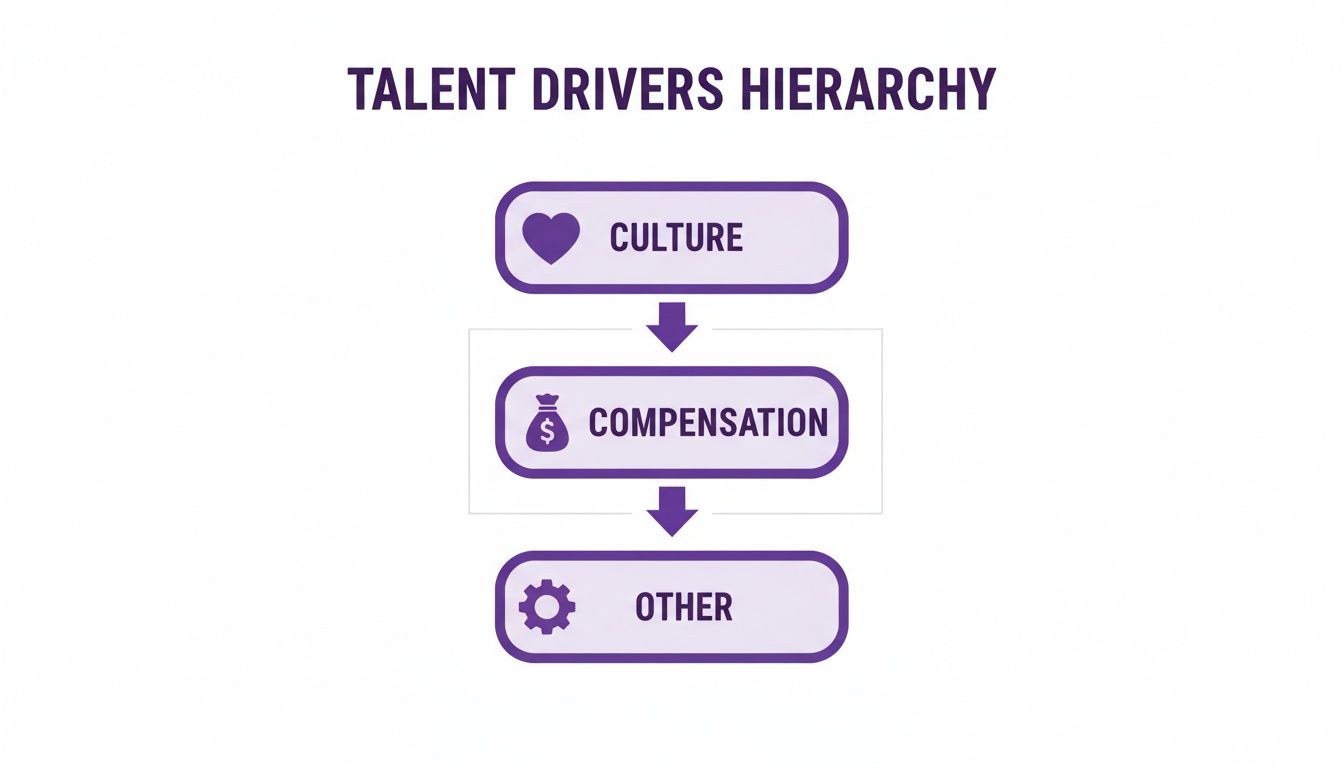
The visualization makes it clear: while compensation is always important, a strong culture has become the primary factor for attracting and keeping top talent.
From Vague Sentiment to Actionable Intelligence
This is where a business intelligence tool like Wurkn provides value far beyond what traditional HR survey tools can offer. Wurkn is designed to be the essential bridge connecting that qualitative employee sentiment to the quantitative metrics executives care about. It doesn’t just tell you if people are happy; it helps you understand how their experience impacts business performance.
Wurkn’s platform transforms continuous, anonymous feedback into a dynamic dashboard of cultural health. This lets leaders see correlations in real time. For instance, you can directly map a decline in team collaboration scores within the engineering department to an increase in project delays or bug reports over the same period. To explore how to harness this data effectively, learn more about the power of analytics for HR and people operations.
This capability allows you to prove the ROI of cultural investments with hard data. You can demonstrate to your board how a targeted initiative to improve manager coaching led to a 15% increase in team engagement and a corresponding 10% reduction in employee turnover in that division, saving the company hundreds of thousands of dollars.
By linking values and culture to concrete business outcomes, you shift the narrative entirely. Culture stops being an expense item on a spreadsheet and becomes what it truly is: a critical driver of sustainable growth and operational excellence.
Moving Beyond Surveys to Continuous Cultural Intelligence
Think of an annual engagement survey like a single photograph from a year-long road trip. It captures one frozen moment, but you miss the entire, unfolding story. For leaders in Canada and the United States trying to keep a finger on the pulse of their organization, relying on these outdated tools creates a massive operational blind spot.
By the time the data is gathered, crunched, and presented, the insights are already stale. The feedback reflects a reality that’s long gone, leaving leaders trying to solve last quarter’s problems with last year’s data. It’s a reactive cycle that keeps you perpetually one step behind.
This static, rearview-mirror approach just doesn’t work. It fails to capture the subtle, day-to-day interactions that truly forge your values and culture. The results are often skewed by recent events, and the whole formal process rarely encourages the honest, candid input you need to find what’s really going on.
Shifting to an Always-On Feedback Model
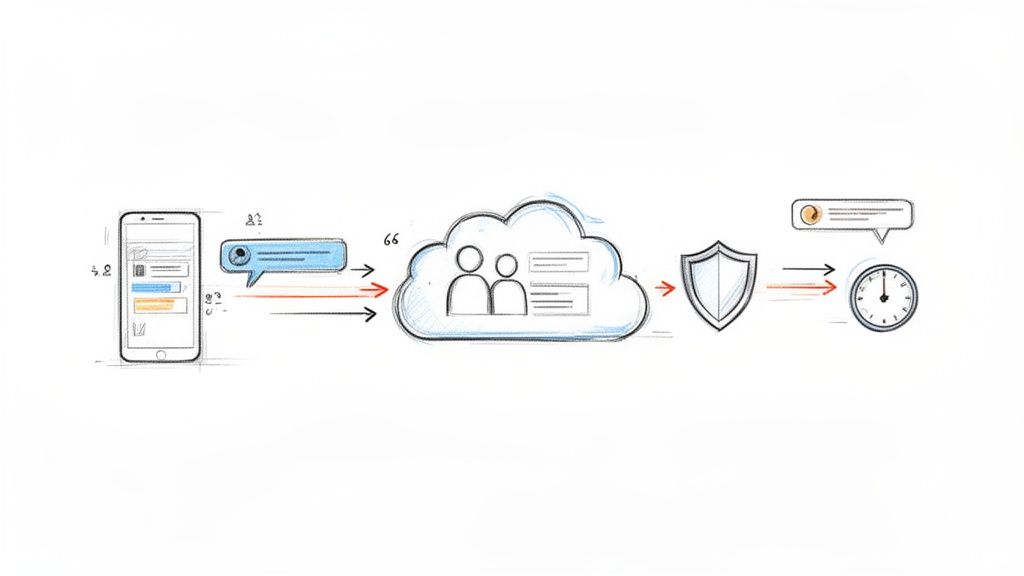
The answer is to ditch the periodic check-in and start a continuous conversation. An ‘always-on’ feedback model gives you a live, unfiltered view of your organization’s cultural health. You can spot trends as they emerge, not months after they’ve already caused damage. This is the heart of cultural business intelligence.
Instead of interrupting workflows with a clunky annual questionnaire, this modern approach meets employees right where they work. This is where a tool like Wurkn shows its value, going far beyond what traditional HR survey tools can do. It integrates seamlessly into daily platforms like Slack and Microsoft Teams, capturing honest, in-the-moment feedback without adding another task to an employee’s to-do list. It becomes a natural part of the workday, not a yearly chore.
This continuous stream of information is gold for leaders who need to make agile, informed decisions. Suddenly, you have the ability to spot cultural friction early, identify team-specific challenges, and understand the real-time impact of any organizational changes you make.
The Power of Psychological Safety in Feedback
Of course, for any of this to work, your people have to feel safe enough to be honest. If there’s even a whiff of fear about retribution, you’ll only ever get filtered, sanitized responses that hide the real issues. This is precisely why Wurkn’s privacy-first, fully anonymized approach is so essential.
By building a system where employees know their identity is completely protected, you create the psychological safety needed for genuine candour. They can share concerns, flag frustrations, or celebrate wins without a second thought. This foundation of trust unlocks a level of insight that traditional surveys could never touch.
When feedback is both continuous and psychologically safe, it transforms from a compliance exercise into a powerful strategic asset. Leaders can finally stop guessing and start knowing what is truly happening within their teams.
Wurkn takes this raw, continuous data and makes it usable. Its smart AI pipeline, backed by human oversight, sifts through the endless stream of comments and sentiments, boiling them down into clear, actionable themes. It doesn’t just show you data; it points to the root causes of cultural problems. For a deeper dive into this, you can learn how COOs get actionable business insights from continuous employee feedback.
This level of business intelligence allows leaders to get out of reactive mode and become proactive. Instead of waiting for a small problem to snowball into a full-blown crisis that tanks your retention numbers, you can see the early warning signs and step in with targeted, data-backed strategies. You can address manager-specific challenges before an entire team disengages or spot burnout before it craters a department’s productivity.
Ultimately, making the switch from static surveys to continuous cultural intelligence changes the game entirely. It gives you the foresight to build a healthier, more resilient organization where your stated values and culture actually match the lived, daily reality of your people.
The Hidden Costs of a Misaligned Workplace Culture
A misaligned workplace culture doesn’t just feel off—it actively bleeds your resources. While most leaders are dialed in on tangible expenses like payroll and overhead, the most destructive costs are the ones that don’t show up on a spreadsheet. These are the silent killers of operational efficiency, quietly eating away at your bottom line through burnout, disengagement, and lost productivity.
When the culture people actually live every day doesn’t match the values you have hanging on the wall, you create a breeding ground for these hidden costs. For instance, a Canadian tech firm might preach “work-life balance” as a core value but implicitly celebrate constant “hustle” and expect unpaid overtime. That’s a culture that manufactures burnout. This isn’t just a morale problem; it’s a direct threat to your operational stability in both Canada and the United States.
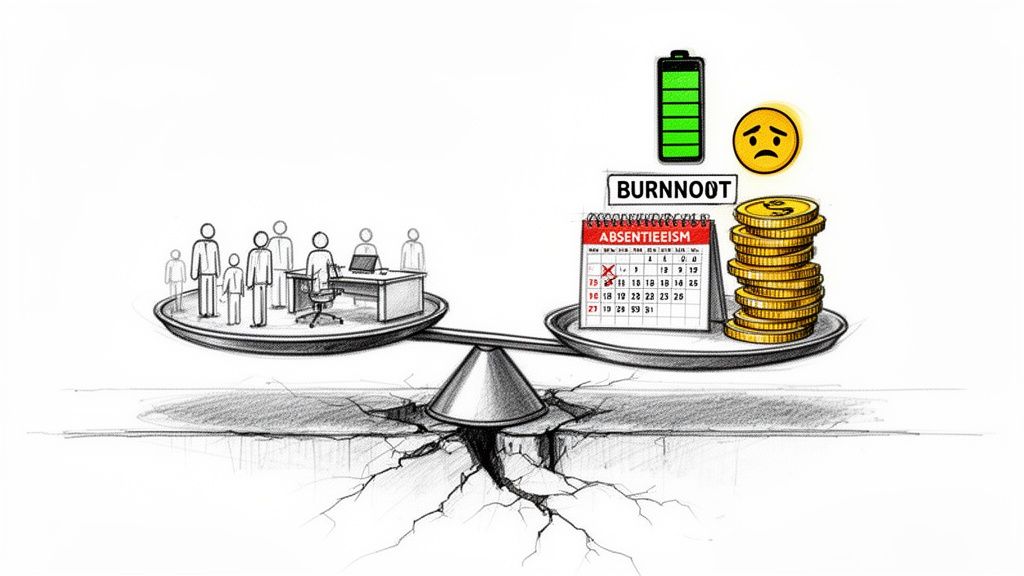
Burnout absolutely shows up on your P&L statement, even if it’s not a specific line item. It takes the form of increased absenteeism, higher healthcare costs, and a major drop in the quality and quantity of work. An exhausted, emotionally drained employee is simply less effective, less innovative, and far more likely to make a costly mistake.
Uncovering the Expense of Burnout and Overwork
The pressure to be “always on” is a cultural norm that comes with a steep price tag. When answering late-night emails and working through weekends becomes the unwritten rule, any short-term bump in output is quickly wiped out by a long-term dive in effectiveness. People can only sprint at 110% for so long before they hit a wall.
This cultural expectation normalizes overwork, creating a dangerous cycle. A worrying number of U.S. employees now report feeling burned out at least once a week. It gets worse: an alarming 84% of desk workers admit to working overtime, but only 36% are actually paid for those extra hours (CNBC, 2022). This isn’t just a few people working late; it’s a systemic culture of unpaid labour. You can explore more findings on how overwork culture impacts the workforce.
When a culture celebrates exhaustion as a badge of honour, it mistakes activity for achievement. The reality is that chronic overwork leads to diminished returns, killing creativity and strategic thinking—the very things you need to stay competitive.
From Reactive Damage Control to Proactive Intelligence
Most organizations don’t recognize the burnout crisis until the damage is done. Traditional HR survey tools are far too slow and infrequent to catch the early warning signs. By the time your annual survey flags a burnout problem, your best people might already be polishing their résumés, and team morale could be at rock bottom.
This is where you see the massive difference between a simple engagement platform and a true business intelligence tool. You need to see the subtle shifts in how your people are feeling as they happen, not months after the fact.
This is exactly the advantage platforms like Wurkn provide. Wurkn isn’t just another survey tool; it’s an always-on business intelligence platform built to detect the leading indicators of burnout and cultural drift in real time. By analyzing continuous, anonymous feedback from daily workflows, it surfaces the earliest signals of stress, frustration, and overwork before they snowball into full-blown crises.
For leaders in Canada and the U.S., this kind of insight is a game-changer. It lets you shift from reactive damage control to proactive, data-backed intervention. Instead of guessing why a team’s productivity has tanked, you can see the cultural drivers behind it. This means you can roll out targeted wellness initiatives, adjust workloads, or provide manager support right when it’s needed most—before your most valuable people burn out and walk out the door.
A Thriving Culture Isn’t a Project; It’s Your Operating System
Throughout this guide, we’ve drawn a clear line between your blueprint and your building—your stated values and culture. We’ve established that values are the principles you hang on the wall, while culture is the reality your people live every single day. Getting this right isn’t a one-and-done project. It’s a continuous, strategic function that is absolutely vital to operational success in today’s competitive Canadian and U.S. markets.
Building a high-performance organization is all about closing the gap between what you say you value and what your teams actually experience. The cost of letting that gap widen is steep, showing up as burnout, tanking productivity, and the loss of your best people. The business case for investing in cultural intelligence is no longer up for debate—it’s a necessity.
Moving from Guesswork to Data-Driven Leadership
The era of relying on gut feelings or dusty annual surveys is over. To build a culture that actually drives results, COOs and People Ops leaders have to stop guessing and start using data. This means having a real-time pulse on your organization’s health, not a snapshot that’s already a year old.
You need to be able to answer critical questions with complete confidence:
- Where, exactly, are the friction points between our stated values and daily behaviours?
- Which teams are showing the early warning signs of burnout, and what specific cultural factors are causing it?
- How are our culture initiatives directly impacting retention, productivity, and the bottom line?
Answering these demands more than a simple engagement platform. It requires a true business intelligence tool designed specifically for culture.
The ultimate goal is to build an organization where your people strategy is inextricably linked to your business strategy. Culture becomes a predictable lever for performance, not a mysterious force you hope works in your favour.
This is precisely where Wurkn provides its distinct advantage. It’s an essential platform for any modern organization that’s serious about building a culture that directly fuels business outcomes. By turning continuous, anonymous employee sentiment into actionable business intelligence, Wurkn gives leaders the foresight to act before small issues snowball into systemic crises.
Wurkn moves you beyond basic HR survey tools, offering a living dashboard that ties cultural signals directly to your most important KPIs. It empowers you to build an organization where both the business and its people thrive, turning your values and culture into your most sustainable competitive advantage.
Have Questions About Values and Culture? We’ve Got Answers.
When it comes to something as vital as workplace culture, leaders often have the same pressing questions. Let’s tackle some of the most common ones we hear from leaders across North America.
What’s the First Step to Aligning Our Values and Culture?
It all starts with measuring the gap. You have to get an honest read on the distance between the values you hang on the wall and what your people actually experience every single day.
Instead of just assuming your values are being lived, the real first step is to gather anonymous, real-time data with a continuous business intelligence tool like Wurkn. This gives you a clear, data-driven baseline of your actual culture. For example, if “work-life balance” is a core value but the feedback is screaming burnout, you’ve just uncovered a specific, measurable problem to solve.
How Can We Actually Measure the ROI of Improving Company Culture?
You tie it directly to the metrics your executive team already obsesses over. A business intelligence platform allows you to see exactly how improvements in cultural health scores impact your core KPIs.
Start tracking employee retention, productivity metrics, and even customer satisfaction scores before and after you launch any culture initiatives. For a real-world example, you can draw a straight line from a 15% improvement in psychological safety scores to a 10% drop in regrettable turnover, calculating the direct cost savings and proving the investment was worth every penny.
The most powerful way to prove the value of culture is to tie it directly to the bottom line. When you can show how a healthier culture reduces costs and drives revenue, it becomes an undeniable business priority.
Why Are Anonymous Feedback Platforms So Much Better Than Surveys?
Let’s be honest, traditional annual surveys are broken. They’re plagued by survey fatigue, recent events skewing the answers (recency bias), and a general fear of being candid. The result? Filtered, unreliable data.
Anonymous, “always-on” platforms like Wurkn create a safe, consistent channel for honest feedback. Because it’s integrated into the daily flow of work and guarantees anonymity, people are far more willing to share what’s really on their minds. This gives leaders a live, accurate pulse on cultural health, allowing for proactive adjustments instead of reactive damage control when a crisis finally boils over.
Ready to stop guessing what’s happening in your organization and start knowing? Wurkn transforms anonymous employee sentiment into the actionable business intelligence you need to build a culture that drives business results. See how our business intelligence platform gives you the foresight to build a healthier, high-performing organization. Learn more and request a demo with Wurkn today.