
When we talk about diversity in the workplace, we’re talking about building a team that reflects the real world—a mix of people with different backgrounds, life experiences, and unique points of view. But let's be clear: this isn't about meeting a quota. It's a strategic decision to treat a varied workforce as your single greatest asset for driving performance and innovation.
Moving Beyond Metrics to Meaningful Diversity
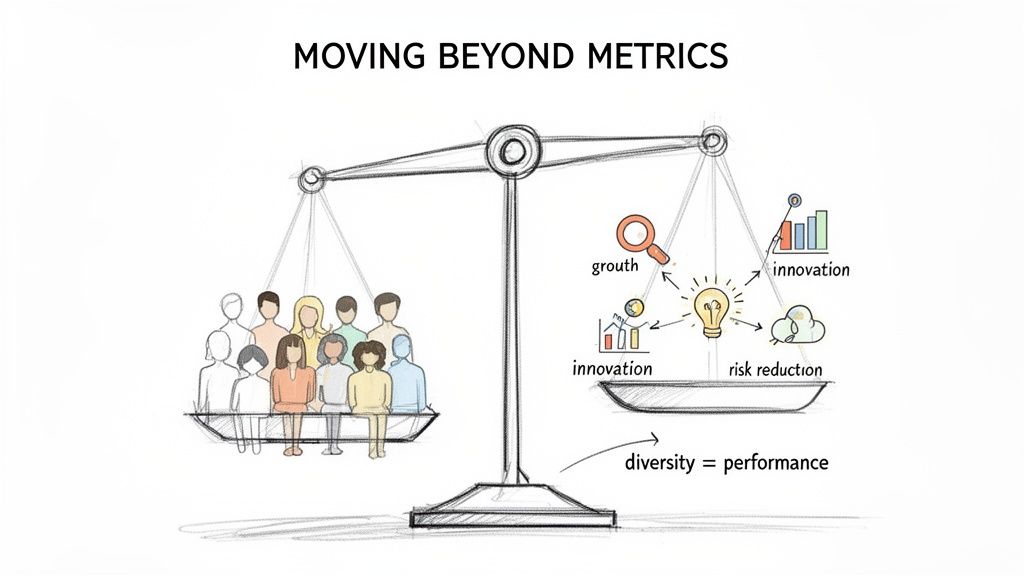
For too many organizations across Canada and the US, diversity initiatives feel like a box-ticking exercise. The entire focus lands on hitting demographic targets instead of creating a place where different perspectives are actually welcomed and used to make the business stronger.
This guide flips that script. We’re framing diversity in the workplace not as an obligation, but as a core driver of business success. Think of it like a smart investment portfolio. You don't just want different stocks; you want assets that work together to lower risk and unlock new growth. A team with varied life experiences is simply better equipped to understand a diverse customer base and out-innovate the competition.
The Limits of Traditional Approaches
The biggest hurdle for most operations and HR leaders is that their tools are stuck in the past. Static annual surveys give you a single snapshot in time, completely missing the living, breathing culture that dictates whether your company succeeds or fails. Let's be honest, those once-a-year check-ins rarely capture what employees are really thinking.
This old-school, reactive approach means that by the time you spot a problem—like a spike in turnover in your engineering team—the damage is already done. You're left guessing at the root cause, unable to draw a straight line from a culture issue to a hit on your bottom line.
Introducing Cultural Business Intelligence
We need a modern approach, one that shifts from static reports to a real-time, continuous understanding of your organization's health. This is where cultural business intelligence comes into play. It works by capturing continuous, anonymous employee sentiment right from the platforms where your teams are already working, like Slack and Microsoft Teams.
Imagine swapping your once-a-year survey for a live dashboard that shows you the health of your company culture in real-time. That's the power of turning subjective feelings into hard, quantitative data that can actually guide your strategy.
This method completely changes how you manage diversity in the workplace. Wurkn provides this intelligence by analyzing anonymized communication patterns to surface the cultural signals that matter. It gives leaders a clear, unbiased view of what’s really happening inside their teams without ever compromising employee privacy.
This isn’t just another HR survey tool. It's a business intelligence platform built to connect your diversity and inclusion efforts directly to the metrics you already care about, like productivity, retention, and innovation. It delivers the real-time insights you need to build a truly inclusive, high-performing organization.
The Real Business Case for an Inclusive Culture
Let’s move past the aspirational posters and talk about what a genuinely inclusive culture actually delivers to your bottom line. This isn’t about buzzwords; it’s about hard numbers and competitive advantage. A workplace where every employee feels valued and heard isn’t just a “nice-to-have”—it’s an operational powerhouse.
Companies that crack this code see tangible gains. The research is clear and consistent: diverse and inclusive organizations are flat-out more innovative and profitable. In fact, companies with greater racial and ethnic diversity are 35% more likely to financially outperform their competitors (McKinsey & Company, "Diversity Wins: How Inclusion Matters," 2020). It's a direct correlation.
When your team reflects the diverse markets you're trying to capture in Canada and the United States, you gain an almost unfair strategic edge. These teams just get it. They understand varied customer needs on a deeper level, which leads to products and marketing that actually land, capturing new market share your competitors can't touch.
The Hidden Costs of a Non-Inclusive Culture
On the flip side, a non-inclusive culture is a silent killer. It's a slow drain on your resources, eroding your business from the inside out through higher turnover, sinking engagement, and reputational damage that’s incredibly hard to undo.
The cost of replacing an employee is staggering—often landing somewhere between half to double their annual salary once you factor in recruitment, onboarding, and lost productivity (Gallup, "The Cost of a Bad Hire Is Staggering," 2019). A toxic or exclusionary environment is a primary driver of voluntary turnover, especially for top performers from underrepresented groups who have plenty of other options.
But it's not just about who leaves; it's about the ones who stay. Disengagement quietly kills productivity. When people feel like they don’t belong, they stop offering their best ideas. They do the bare minimum. This creates a drag on innovation that slowly chips away at your ability to compete.
Think of your culture as an early warning system for business risk. A non-inclusive environment sends out constant alerts—high turnover, low engagement. Ignoring them is like ignoring a fire alarm. The eventual damage is both predictable and expensive.
From Reactive Guesses to Proactive Intelligence
For too long, leaders have only learned about deep-seated cultural issues during an exit interview—long after their top talent has walked out the door. This reactive approach is like trying to diagnose an illness after the patient has already left. You get a few clues, but you’re missing the full picture needed to prevent it from happening again.
This is where a business intelligence approach to culture completely changes the game. Instead of relying on lagging indicators, you get a real-time, anonymized view of your company’s health.
Let's compare the old way to the new way with a logical example:
- The Old Way: A Canadian tech company runs an annual survey. Months later, the report shows a dip in morale among its remote female employees in Western Canada. By the time leadership starts planning how to fix it, several key team members have already quit.
- The New Way: A cultural business intelligence platform like Wurkn continuously and anonymously analyzes sentiment from internal communication channels. Its AI synthesizes this feedback and flags that female remote workers are expressing feelings of exclusion right now.
This shift allows you to move from reactive damage control to proactive, data-driven leadership. You can spot cultural friction points as they emerge and fix them before they escalate into costly turnover and disengagement.
Wurkn isn’t just another employee engagement platform; it’s a business intelligence tool built to connect cultural health to measurable business outcomes. It turns abstract feelings into a dashboard of actionable insights, giving you the power to manage your culture with the same precision you manage your finances. This is how you build a resilient, high-performing organization where diversity truly drives results.
How to Measure What Truly Matters in Your Culture
To build a genuinely diverse and inclusive workplace, you first need an honest diagnosis of where you stand today. For decades, the go-to tool for this was the annual employee survey. But that's like trying to understand a river by scooping out a single cup of water—it gives you a momentary snapshot but completely misses the powerful, invisible currents flowing underneath.
These old-school methods are often flawed from the start. We've all experienced survey fatigue, rushing through questions just to get it done. More importantly, people are often hesitant to give truly honest feedback, worried it could be traced back to them. This fear leads to diluted, "safe" answers that hide the very issues you need to uncover.
Moving From Surveys to Cultural Signals
To get a real feel for your workplace, you need to stop asking questions once a year and start listening to the conversation that’s already happening every single day. This is where the idea of cultural signals comes in. These are the subtle, anonymized patterns found in everyday communications that reveal the true health of your organization.
Think about all the interactions happening on platforms like Slack or Microsoft Teams. These conversations are a goldmine of information about how included, valued, and psychologically safe your people feel. When analyzed properly—and completely anonymously—these signals give you a real-time, unbiased look into your culture that a survey could never hope to capture.
A cultural business intelligence tool like Wurkn is designed to tap into these signals without ever getting in the way. It meets employees right where they work, turning qualitative feelings and conversations into a clear, quantitative dashboard. This is how leaders can finally draw a straight line from cultural health to business performance, moving beyond the limitations of traditional HR survey tools.
Old Methods Versus New Intelligence
The difference between traditional HR tools and a cultural business intelligence platform is night and day. The old way is slow and reactive; the new approach is proactive and immediate.
Take a look at how these two methods stack up.
Comparing Traditional Surveys to Cultural Business Intelligence
| Attribute | Traditional HR Surveys | Cultural Business Intelligence (via Wurkn) |
|---|---|---|
| Frequency | Annual or bi-annual snapshots. | Continuous, always-on analysis. |
| Honesty | Often compromised by fear of reprisal. | Anonymized data encourages candid feedback. |
| Timeliness | Lagging indicator; problems are identified months later. | Real-time alerts on emerging cultural issues. |
| Actionability | Vague data makes it hard to pinpoint root causes. | Specific insights tied to teams and topics. |
| Data Type | Static, self-reported opinions. | Dynamic sentiment from real work conversations. |
It's clear that relying on outdated methods leaves you managing in the dark. Modern intelligence brings critical issues into the light before they become major problems.
This infographic shows exactly why this matters, illustrating the direct path from building a diverse, inclusive team to hitting key business goals like market growth and high retention.
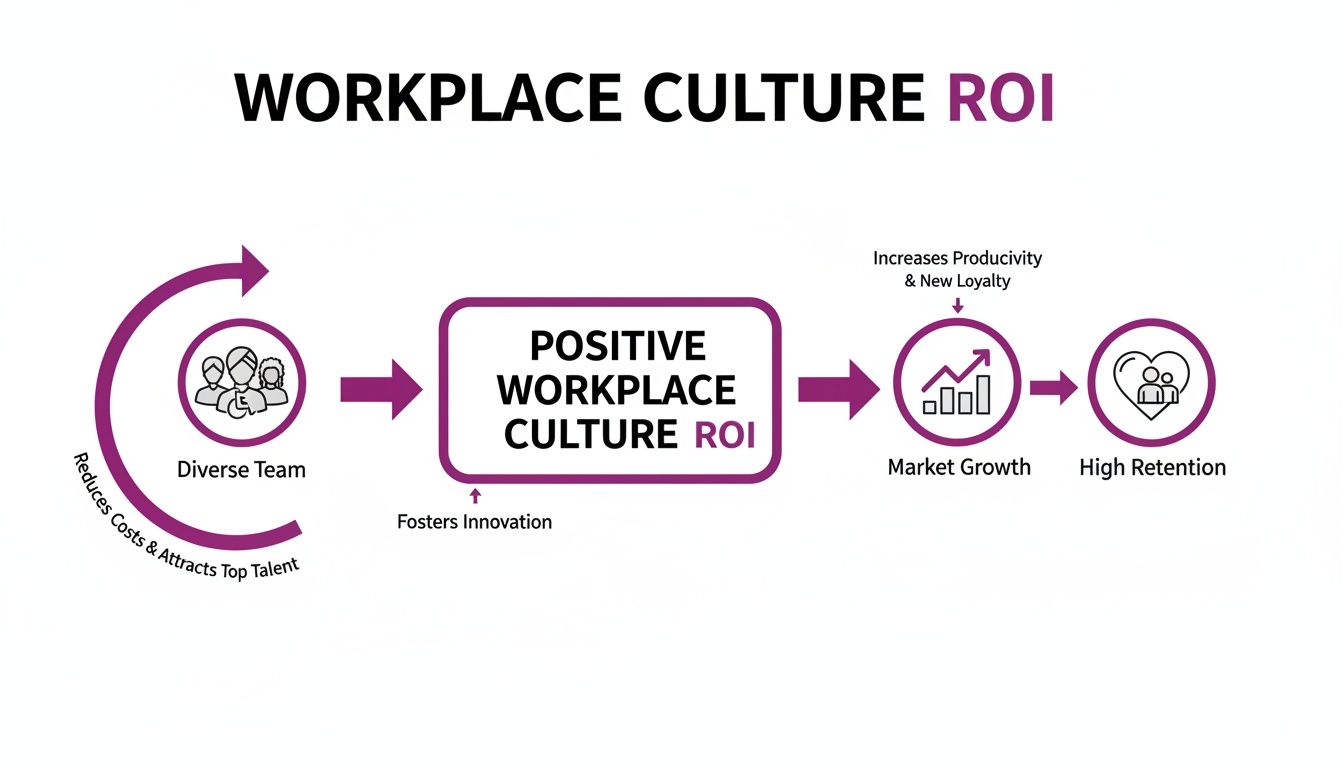
This isn’t about "soft" HR initiatives. The visual makes it plain: investing in an inclusive culture is a direct driver of the metrics that matter most to your business.
Building Trust Through Anonymity
For any of this to work, privacy has to be non-negotiable. Your people must have absolute trust that their feedback is completely anonymous. A true business intelligence tool achieves this by design, stripping all personally identifiable information and aggregating data to show trends, not individuals. This privacy-first foundation is what creates the psychological safety needed for authentic experiences to surface.
This is especially critical for large, geographically distributed organizations. For instance, California's 2023 civil service workforce data shows that nearly 60% of employees are based in just two areas. A simple demographic count tells you what is happening, but it can't explain why. Tools that capture anonymous sentiment can diagnose regional cultural disparities in real-time, linking cultural intelligence to retention KPIs and empowering you to make targeted changes before you start losing talent. You can explore the full breakdown of California's workforce data on their official site.
By turning continuous, unstructured feedback into measurable insights, you gain a clear advantage. You're no longer just asking questions once a year; you're listening to the answers that are already there, every single day. Find out more about how modern analytics for HR can transform your strategy. This is how you stop guessing about your culture and start knowing its impact on your bottom line.
Actionable Strategies for Inclusive Hiring and Retention
Understanding the health of your culture is the first step, but insight without action is just a missed opportunity. Building a truly diverse workforce demands deliberate, evidence-based strategies that span the entire employee lifecycle—from the first job post to long-term career development. Simply attracting diverse candidates isn’t enough; you have to build an environment where they feel valued, supported, and can see a clear path forward.
Effective strategies aren't built on guesswork. They're about making specific changes and then measuring what happens next. If you launch a mentorship program, you can’t afford to wait a year to find out if it worked. You need to know now if it’s making a difference.
This is where a business intelligence tool like Wurkn offers a sharp advantage over traditional employee engagement platforms. It lets you monitor the real-time, anonymous sentiment of participants, giving you an immediate read on a program's effectiveness. This turns your DEI initiatives from hopeful guesses into a data-driven science.
De-Biasing Your Hiring Process
The journey to a more diverse workplace starts with how you attract people in the first place. Unconscious bias can easily creep into job descriptions and interview processes, unintentionally filtering out incredible candidates from underrepresented backgrounds before they even get a chance.
Here are a few practical steps to build a more inclusive hiring funnel:
- Audit Job Descriptions: Use tools to scan your job postings for gendered language or corporate jargon that might turn certain people off. For instance, a US-based software company might find that replacing phrases like "coding ninja" with "skilled software developer" attracts a more diverse applicant pool.
- Standardize Interviews: Implement structured interviews where every single candidate is asked the same set of questions in the same order. This levels the playing field, allowing you to evaluate applicants on consistent, objective criteria and dials down the influence of personal affinity or bias.
- Diversify Interview Panels: Make sure your interview panels include employees from different backgrounds, departments, and levels of seniority. A diverse panel is better equipped to spot a wide range of skills and experiences, and it sends a powerful signal to candidates that your organization is serious about inclusion.
Creating Equitable Pathways for Growth and Retention
Hiring diverse talent is only half the battle. If employees from underrepresented groups don’t see a future for themselves at your company, they will eventually leave. Retention comes down to creating a culture of fairness, recognition, and genuine opportunity.
Pay equity is non-negotiable. Gaps in compensation are a massive driver of turnover, especially among women and communities of colour who are often overrepresented in lower-paying roles. Just look at California's 2023 pay data: while some racial groups make up 49% of the workforce, they fill 65% of low-wage positions. That's a systemic problem. You can dig into the complete findings on California's gender and racial pay disparities in their report.
A lack of inclusion isn't just a cultural issue; it's a direct threat to your bottom line. When pay and promotion processes are seen as unfair, your most valuable talent will walk out the door, taking their skills and institutional knowledge with them.
A business intelligence platform is crucial here. Wurkn can analyze qualitative, anonymous feedback to spot trends, like women of colour in certain roles reporting higher levels of emotional strain or burnout. By connecting this sentiment directly to productivity and retention KPIs, leaders can find and fix the root causes of turnover before it snowballs.
Beyond compensation, focus on creating transparent promotion pathways and offering solid mentorship and sponsorship programs. Employee Resource Groups (ERGs) can be powerful engines for this, providing both community and advocacy. You can discover more about how to strengthen diversity with Employee Resource Groups in our detailed guide.
When people feel supported and see a real future for themselves at your company, they’re far more likely to stay, contribute, and thrive.
Developing Inclusive Leadership at Every Level
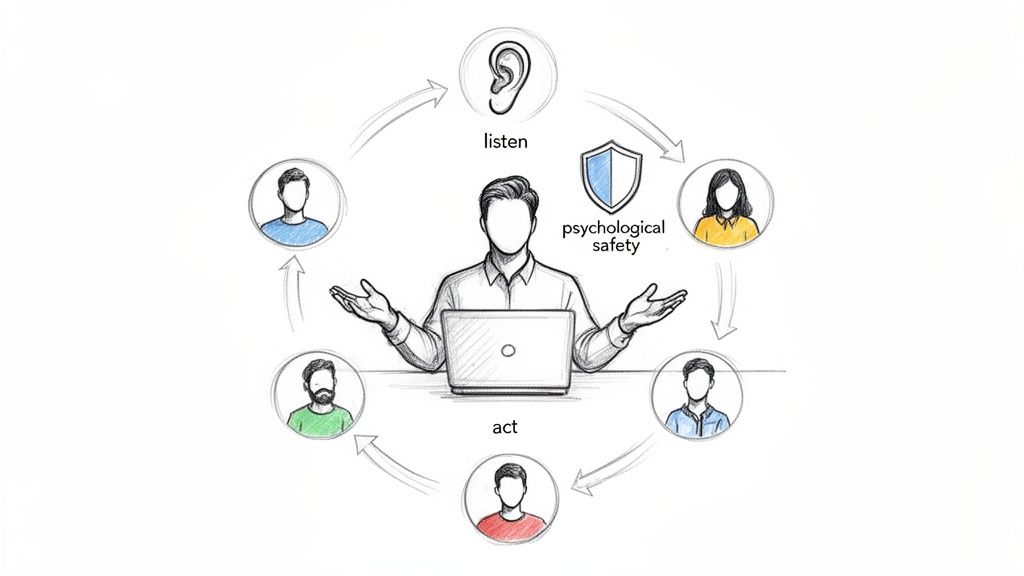
Let's be blunt: a truly inclusive culture isn't born from an HR mandate. It’s built, day by day, in the interactions between managers and their teams. While policies are a necessary foundation, the real work of fostering diversity in the workplace happens when leaders create environments where every single person feels safe to speak up, challenge the norm, and be themselves.
This becomes absolutely critical in the remote and hybrid setups common across Canada and the US. Those casual office chats are gone, so leaders have to be far more deliberate about building psychological safety, actively listening, and giving fair, consistent feedback to everyone, no matter where they log in from.
From Reactive Firefighters to Proactive Culture Builders
For too long, we've asked managers to lead with one hand tied behind their back. We expect them to build an inclusive team culture but only give them outdated tools like annual surveys, which reveal problems months after they've already done their damage. This forces them into a constant cycle of reactive firefighting, trying to fix issues they never saw coming.
A business intelligence approach completely flips this script. Instead of relying on lagging indicators, a platform like Wurkn gives managers a real-time, anonymized, and synthesized view of their team's cultural health. It empowers them by surfacing emerging themes and emotional drivers from everyday communication—all without ever revealing who said what.
This shift transforms a manager's role. They move from guessing at the root causes of disengagement to proactively addressing cultural friction points backed by clear, real-time data.
Imagine a leader at a US-based company seeing a spike in frustration around meeting schedules among their remote staff. This insight allows them to start a conversation and adjust team norms before it spirals into burnout and turnover. They become proactive culture builders, not just reactive problem solvers.
Attracting Talent Is Only the Beginning
Building a diverse pipeline of candidates is a fantastic first step, but it’s only half the battle. If those talented people join a team where they feel invisible, unheard, or unsupported by their direct leader, they won't stick around. Their long-term success is entirely dependent on the inclusive culture they walk into.
The legal profession gives us a stark example. The 2023 State Bar of California Diversity Report Card shows a record 55% of newly admitted attorneys are people of colour. And yet, the profession as a whole still doesn't reflect the state's diverse labour force, pointing to a massive retention and promotion gap. You can dig into the specifics in the State Bar of California's full 2023 Diversity Report Card.
This is exactly where continuous feedback tools provide the crucial intelligence you need. By analyzing anonymized sentiment around inclusion, mentorship, and opportunity, an organization can finally understand why diverse new hires either thrive or leave. That data directly shapes the health of your future leadership pipeline and, ultimately, your company's performance.
When you get right down to it, empowering your managers with the right intelligence is the key to making your diversity strategy a reality at every level. For a deeper dive, check out our guide on leadership-driven diversity and inclusion in the workplace.
Your Implementation Roadmap for a Diverse Workplace
Building a genuinely inclusive workplace isn't a one-and-done project. It's an ongoing commitment, a continuous cycle of listening, learning, and improving. This roadmap is a practical guide for people and operations leaders in the US and Canada ready to move beyond good intentions to get measurable, impactful results.
The journey starts with a comprehensive audit of how you operate today. Take a hard look at everything—from your hiring funnels and promotion criteria to the way you run meetings. The goal is to uncover the hidden biases and systemic barriers that might be holding your organization back without anyone even realising it.
Establish Clear DEI Goals
With a baseline in hand, you need to set clear, measurable goals. Crucially, these goals must tie directly to your most important business KPIs. Vague statements won't cut it. You have to connect your efforts to concrete business outcomes.
For instance, a powerful goal isn't just "improve diversity." It's:
- To reduce voluntary turnover among women in technical roles by 15% within the next fiscal year by improving psychological safety scores.
- To increase the representation of visible minorities in senior leadership positions in our Canadian offices by 10% over two years.
Tying DEI goals to metrics like retention, productivity, and innovation is how you prove the ROI of your work. It's how you get the executive team on board and secure the resources you need for the long haul.
Integrate Continuous Intelligence
Traditional annual surveys are far too slow for today's pace of business. Making smart decisions requires real-time data. This is where a business intelligence tool designed for cultural analysis becomes the central nervous system of your entire strategy.
Platforms like Wurkn provide continuous, anonymous feedback from the digital channels your teams already use, like Slack and Teams. It takes qualitative employee sentiment and transforms it into a live dashboard of actionable insights, revealing not just what is happening in your culture, but why. This gives you the power to spot issues early and step in before they become expensive problems.
A business intelligence approach turns your DEI strategy from a reactive, compliance-driven exercise into a proactive, data-informed business function. It gives you the evidence you need to make smarter decisions and prove the value of your work.
Train and Empower Your Leaders
Your managers are on the front lines, and they're the ones who will make or break your inclusive culture. You need to equip them with the right skills and—just as important—the right data to lead effectively. Training should focus on practical behaviours, like mitigating unconscious bias in performance reviews, facilitating psychologically safe discussions, and giving equitable feedback.
When you give them access to anonymized, team-level data from a platform like Wurkn, you empower them to understand their team’s unique cultural dynamics. They can stop guessing and start addressing challenges proactively.
Finally, commit to a cycle of continuous measurement and improvement. Culture is dynamic, and your strategy needs to be, too. Regularly review your progress, analyze the real-time feedback from your intelligence platform, and adjust your approach. This ongoing loop is what ensures your efforts stay relevant, effective, and deeply embedded in your organization's operational rhythm.
Frequently Asked Questions
As you start turning diversity goals into on-the-ground reality, some tough questions always come up. Here are a few of the most common ones we hear from operations and HR leaders across the United States and Canada, along with some straight answers.
How Should We Handle Sensitive Feedback?
This is where trust is either built or broken. Traditional survey tools often miss the mark because people just don’t believe their candid, critical feedback will stay anonymous. Let's be honest, they’re often right to be skeptical. The only way forward is a system where feedback is truly anonymous by design, not just by promise.
This is exactly what a cultural business intelligence tool like Wurkn is built for. By pulling continuous, anonymized sentiment from everyday platforms like Slack or Teams, it can spot themes and emotional undercurrents without ever pointing a finger at an individual. The whole conversation shifts from a stressful "who said this?" to a productive "what is this pattern telling us?" It allows you to address the root causes of issues like exclusion or bias without making anyone feel like they've put a target on their back.
How Can We Demonstrate ROI to Leadership?
To get real buy-in, you have to speak the language of business outcomes. Forget vanity metrics like how many DEI workshops you've run. The conversation needs to be about connecting your culture initiatives directly to the numbers that leadership obsesses over.
The fastest way to get an executive team on board is to show them a clear, data-backed line between a healthier culture and a healthier bottom line. This reframes DEI from a cost centre into what it truly is: a critical performance driver.
A business intelligence platform is your best friend here. It lets you draw direct correlations between cultural signals and core KPIs. Imagine being able to walk into a meeting and show that a 10% jump in inclusion sentiment in the engineering department directly corresponded with a 5% drop in voluntary turnover on that same team. Suddenly, culture isn't a "soft" concept anymore—it's a concrete business case that’s impossible to ignore.
Do Modern Data Tools Compromise Employee Privacy?
This is a non-negotiable, and you’re right to be concerned. Many standard employee engagement or HR survey tools simply weren't built with modern privacy standards in mind, which is why employees are often hesitant to share what they really think.
A true cultural business intelligence platform, however, is built from the ground up on a privacy-first foundation. Wurkn, for example, is engineered to be an insights tool, not a surveillance tool. It aggregates data, automatically redacts anything that could personally identify someone, and analyzes trends at a macro level. Leaders see the "what," not the "who." This distinction is everything. It’s how you build the trust required to get the authentic, ongoing feedback you need to actually make a difference.
Stop guessing what your employees are thinking. Wurkn turns anonymous employee sentiment into the cultural intelligence you need to connect diversity in the workplace directly to your business results. Discover how to build a higher-performing, more inclusive organization.