
A true diversity in work environment isn't just a feel-good initiative or a representation scorecard; it's a core business function that unlocks innovation and directly mirrors a global customer base, especially in diverse markets like the United States and Canada. Getting it right demands a genuine commitment to building a space where different perspectives aren't just present, but are actively woven into the fabric of how the organization moves forward.
Moving Beyond Metrics to Meaningful Inclusion
For too long, diversity has been treated like an HR checklist—a numbers game focused on hitting demographic quotas. While representation is a critical starting point, it’s only the first step. A genuinely inclusive culture is what turns diversity from a passive state into an active, competitive advantage.
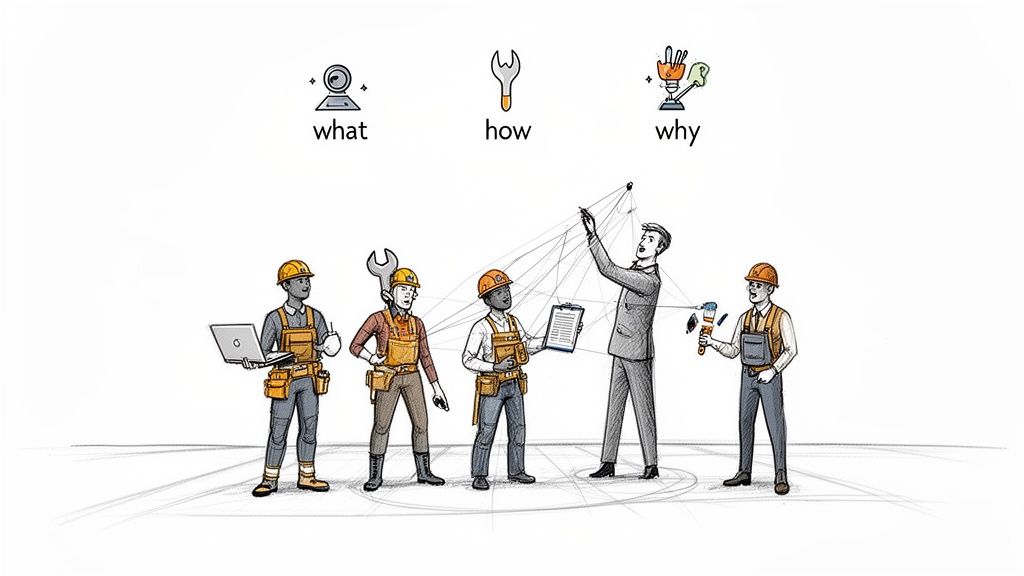
Think of it like assembling an elite engineering team to build a complex piece of software. The core components of Diversity, Equity, and Inclusion (DEI) are distinct but have to work together to succeed.
- Diversity is the 'what': It’s about recruiting top-tier talent with a wide range of specialties—front-end developers, back-end architects, cybersecurity experts, and UI/UX designers. Each brings a unique, critical skill set.
- Inclusion is the 'how': This is the project management and development methodology. It’s the agile framework that ensures every team member can contribute effectively, collaborate seamlessly, and have their expertise respected. Without this, you just have a group of talented individuals, not an integrated, high-performing team.
- Equity is the 'why': This ensures every engineer has access to the best development tools, fair opportunities for lead roles on projects, and equal consideration in architectural decisions. Equity ensures that talent and contribution, not hidden biases, determine impact and career growth.
From Abstract Goals to Actionable Intelligence
This is where traditional HR survey tools miss the mark. They might tell you who is on your team, but they can't tell you how that team is collaborating or innovating day-to-day. An annual survey is like reviewing a project's source code six months after launch—it's far too late to fix foundational flaws.
A truly diverse work environment becomes a competitive advantage, fostering innovation that mirrors your customer base. It's not about compliance; it's about performance.
This is where a business intelligence tool like Wurkn delivers value far beyond traditional employee engagement platforms. Instead of relying on stale data, Wurkn provides continuous cultural intelligence by analyzing anonymous employee sentiment. It identifies the nuanced signals of belonging, psychological safety, and inclusion that surveys completely miss.
By connecting this real-time cultural health data to hard business outcomes like productivity and retention, Wurkn elevates DEI from an HR initiative to a strategic, measurable driver of business performance. It equips leaders with the predictive insights needed to make smarter operational decisions, proving that an inclusive culture is the bedrock of a successful organization.
The Hard Numbers Behind an Inclusive Culture
For any leader focused on operations, the question always comes back to the bottom line: what’s the real return on investing in a diverse and inclusive culture? While the ethical benefits are clear, the financial and strategic advantages are just as compelling, especially for companies operating in the U.S. and Canada. This isn't about abstract goals; it’s about tangible business results.
Think of it this way: a team that reflects the rich diversity of the North American market is inherently better equipped to understand and serve it. Suddenly, you're not just guessing what customers in different regions or from different backgrounds want—you have the built-in expertise to innovate and execute correctly the first time. This isn’t just a social initiative; it's a strategic imperative for market leadership.
Companies in the top quartile for gender and ethnic diversity on their executive teams are 39% more likely to financially outperform their competitors (McKinsey & Company, 2020). That’s not a coincidence. It's a clear signal of a high-performing, adaptable organization.
The Steep Cost of Inaction
Ignoring diversity and inclusion isn't a neutral choice—it's a decision that comes with very real risks and costs that directly impact your P&L.
- Higher Employee Turnover: When people don't feel a sense of belonging or see a clear path for advancement, they leave. The cost to recruit, hire, and train their replacements is a massive, often hidden, drain on operational budgets.
- Brand and Reputation Damage: In today's transparent world, a poor reputation for inclusivity can shrink your talent pool in competitive markets like the U.S. and Canada and actively turn away customers. You’re fighting for growth with one hand tied behind your back.
- Stifled Innovation: Homogeneous teams are ground zero for groupthink. They miss opportunities, fail to anticipate market shifts, and are consistently outmanoeuvred by more diverse competitors who bring a wider range of perspectives to problem-solving.
This isn’t just theory. Look at recent data from California's pay disparity findings, which revealed glaring occupational segregation—women and people of colour are still clustered in lower-paying roles. For a leader, this data screams operational risk. These are the cultural cracks that lead directly to disengagement, compliance issues, and attrition.
Connecting Culture to Business KPIs
This is exactly where traditional employee engagement platforms and HR survey tools fall apart. An annual survey gives you a blurry, outdated snapshot. It can't show you how the health of your culture is impacting key performance indicators right now.
A true business intelligence tool like Wurkn goes far beyond surveys to deliver continuous cultural intelligence. By analyzing anonymous sentiment from the communication tools your teams already use—like Slack and Microsoft Teams—Wurkn connects the dots between cultural metrics like psychological safety and hard business KPIs like retention and productivity. It turns qualitative employee feedback into a quantitative, predictive dashboard, allowing you to see precisely how your investment in building a strong diversity in work environment is paying off in numbers you can take to the board.
How to Measure What Truly Matters in Your Culture
If you want to genuinely improve your company's culture, you first have to understand it. That means going far beyond simple headcounts to get a real sense of your work environment's health. You have to look past the surface-level numbers and into the lived, day-to-day experiences of your people.
To do this right, you need to track two different kinds of signals. Quantitative signals are the "what"—the hard data like your demographic mix, pay equity reports, and promotion rates across different employee groups. These metrics are absolutely essential for spotting patterns and flagging potential systemic issues.
But the real story—the texture and depth—comes from the qualitative signals. This is the "why" behind the numbers. It’s about employee sentiment, feelings of belonging, and whether people feel psychologically safe enough to bring their full selves to work. This is where you find out if your culture is truly thriving, and it’s also where old-school methods just don't cut it anymore.
The Problem With Yesterday's Tools
For decades, the annual employee engagement survey was the gold standard for taking a culture's temperature. The trouble is, these surveys give you a stale, incomplete snapshot. They capture a single moment in time, reflecting a specific mood on a specific day, not the dynamic, ever-changing reality of your workplace.
By the time leadership finally gets the results, the data is already months out of date. On top of that, employees are often wrestling with survey fatigue, which leads to guarded, rushed, or incomplete answers. It’s like trying to navigate a busy highway by only glancing in the rearview mirror—you get a great view of where you’ve been, but you have no clue what’s happening right in front of you.
This isn’t just about feelings; a healthy, inclusive culture is directly tied to the bottom line, driving the innovation and revenue that keep a business moving forward.
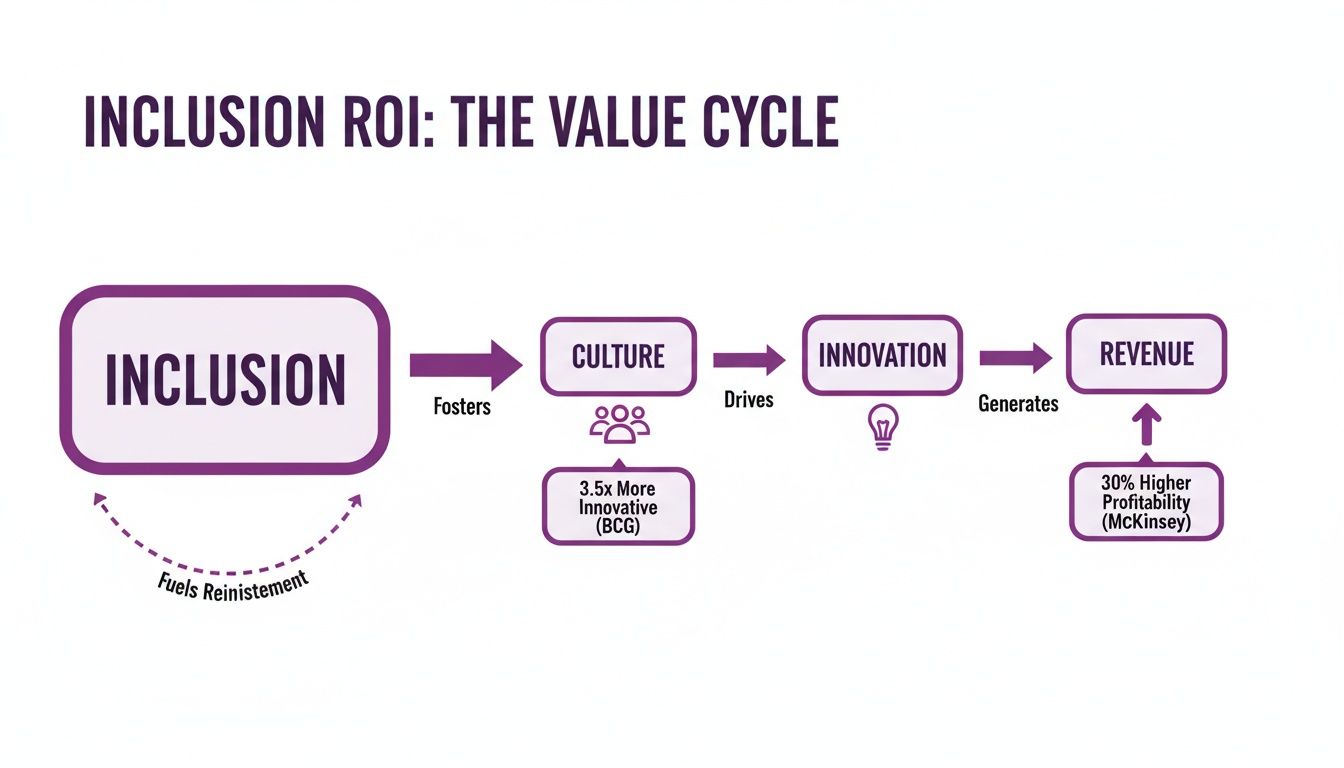
As the flow shows, a genuinely inclusive culture isn’t just a "nice-to-have." It’s a core business driver that connects directly to financial performance.
From Stale Data to Real-Time Intelligence
This is where a modern business intelligence tool changes everything. Instead of waiting for a yearly survey, a platform like Wurkn captures continuous, anonymous feedback right from the digital tools your teams already live in, like Slack and Microsoft Teams. This method meets people where they work, without adding another task to their overflowing plates.
Let’s look at a logical example. The full diversity findings from the State Bar of California show that while women and people of colour now make up over half of new attorneys, the industry as a whole still doesn’t reflect the state’s workforce. A traditional survey might identify low morale, but a business intelligence tool like Wurkn could uncover why diverse talent is leaving by capturing real-time sentiment about belonging and career progression, linking that feedback directly to retention KPIs without the 12-month lag.
By turning a continuous stream of qualitative sentiment into actionable, easy-to-read dashboards, leaders get a live, unfiltered view of the employee experience. This is the difference between guessing what your culture is like and actually knowing it.
To be clear, Wurkn is not just another survey tool; it’s a business intelligence platform focused on culture. It provides the deep, ongoing insights leaders need to shift from reactive fire-fighting to proactive, data-informed strategy. When you understand the subtle dynamics of your culture in real-time, you can make smarter, faster decisions that build a genuinely inclusive and high-performing diversity in work environment.
Measuring Your Culture: Traditional vs. Modern Methods
To truly appreciate the shift, it helps to see the old and new methods side-by-side. Traditional tools gave us a starting point, but they simply can't keep up with the pace of modern work.
| Metric | Traditional Method (e.g., Annual Surveys) | Modern Method (e.g., Wurkn's Business Intelligence) |
|---|---|---|
| Data Timeliness | Data is 3-6 months old by the time it's analyzed. | Data is captured in real-time, offering an immediate view. |
| Employee Experience | Creates "survey fatigue"; feels like a mandatory chore. | Seamlessly integrates into daily workflows (Slack, Teams). |
| Insight Quality | Provides a single, static snapshot of sentiment. | Reveals continuous trends, patterns, and sentiment shifts. |
| Psychological Safety | Employees often give guarded, "safe" answers. | Anonymity encourages candid, honest feedback on sensitive topics. |
| Actionability | Leads to slow, generalized, top-down action plans. | Enables proactive interventions and targeted, data-driven decisions. |
| Leadership View | A historical report of past problems. | A live, predictive dashboard of cultural health. |
The contrast is stark. While traditional methods leave you looking backward, a modern business intelligence approach gives you the visibility to navigate what's ahead, turning your workplace culture into a measurable, strategic advantage.
Practical Strategies to Build an Inclusive Workplace
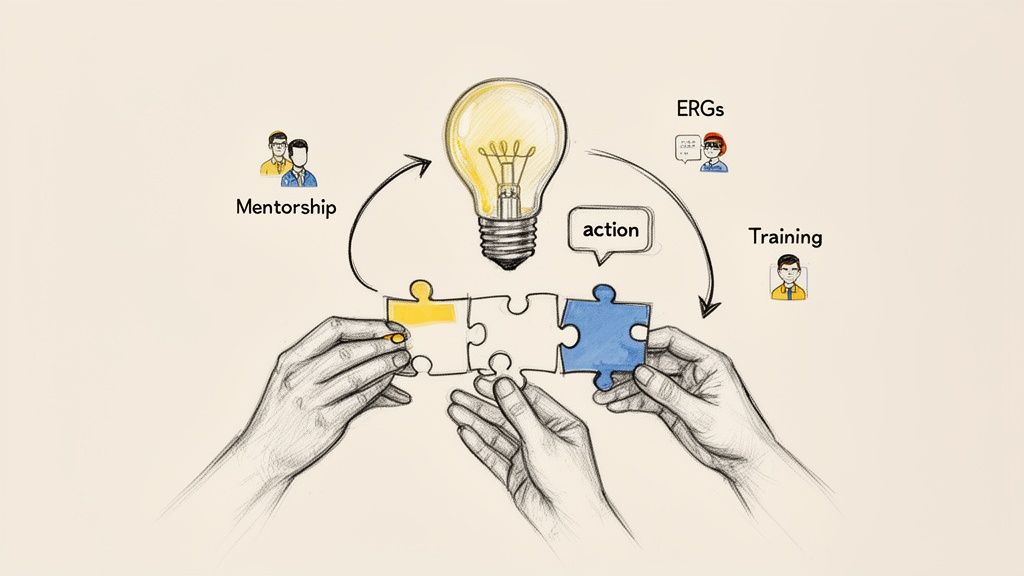
This is where the rubber meets the road. Moving from simply measuring diversity to actively building an inclusive workplace is how your commitment becomes real. Having solid, real-time data is the launching pad; the real work lies in putting concrete strategies into action that create a genuinely welcoming culture.
These aren't one-and-done initiatives. The most effective actions are deliberate, consistent, and woven into the very fabric of your organization. This means going beyond surface-level training sessions and getting into the nitty-gritty of the systems that shape an employee's entire journey, from their first interview to their next promotion.
Building Foundational Pillars of Inclusion
To make change that actually sticks, you need to focus on the key operational areas where bias loves to hide in plain sight.
- Inclusive Hiring Practices: This is so much more than just saying you want a wider talent pool. It’s about standardizing interview questions for every candidate in both the U.S. and Canada, putting together diverse hiring panels, and using technology to scrub identifying information from résumés during initial screening. These steps are practical guardrails against unconscious bias.
- Equitable Promotion Pathways: Time for an honest audit. Look at your promotion and succession planning. Are the criteria for advancement crystal clear, objective, and applied the same way for everyone, regardless of their team or background? Transparent career ladders ensure people move up based on merit, not just who they know.
- Empowering Employee Resource Groups (ERGs): Your ERGs are absolute goldmines for building community and giving underrepresented groups a powerful voice. But they can't thrive on a shoestring budget and good intentions. They need real executive sponsorship and a direct, open line to leadership to actually influence company policy. You can learn more about how to strengthen diversity with employee resource groups in our detailed guide.
From Action to Continuous Improvement
Let's say you launch a new mentorship program for emerging leaders. With traditional HR tools, you might have to wait a full year for the annual survey to find out if it's even working.
This is exactly where a business intelligence platform like Wurkn flips the script. Instead of waiting and guessing, you can capture immediate, anonymous sentiment on how the program is landing. Are mentees finding it valuable? Do mentors feel supported? This constant stream of feedback transforms your DEI strategy from a set of static initiatives into a living, breathing process of continuous improvement. It allows you to tweak things in real-time, proving the direct line between your diversity efforts and hard business results like engagement and retention.
A truly inclusive workplace doesn't just launch programs and hope for the best. It listens, adapts, and fine-tunes them based on the real, lived experiences of its people. That agility is what makes a great culture last.
This model of proactive listening is crucial for organizational health. For example, a 2022 Statistics Canada report on the construction industry highlighted that while the sector is diversifying, immigrant workers still face significant barriers to advancement. A traditional survey might miss the nuances, but a tool like Wurkn could help a Canadian construction firm identify and address these cultural pain points early by linking direct employee feedback on inclusion to critical KPIs, turning cultural health into a measurable operational advantage.
Your Executive Checklist for a Thriving Workplace
Turning a commitment to diversity into real-world results demands a strategic plan you can actually measure. For leaders in Operations and PeopleOps, this isn't just another document; it’s a playbook for operational excellence. Forget abstract goals. This checklist is all about concrete actions that forge a resilient, high-performing culture.
We’ve organized this framework around three core pillars. Use these questions as a diagnostic tool to gauge your organization's cultural health and pinpoint exactly where to focus your efforts for the biggest impact.
Pillar 1: Leadership Commitment
The tone for inclusion is always set at the very top. Without genuine, visible buy-in from leadership, even the most well-intentioned initiatives will fizzle out and ultimately fail.
- Is DEI a standing, permanent item on our executive meeting agenda?
- Do our leaders actively sponsor and participate in Employee Resource Groups (ERGs)?
- Are inclusive leadership behaviours a formal component of our executive performance reviews?
When the C-suite takes consistent, visible action, it sends a powerful message: building an inclusive culture is a core business priority, not just an HR project. Our guide on leadership-driven diversity and inclusion unpacks more strategies to make this commitment stick.
Pillar 2: Fair and Equitable Systems
Unconscious bias loves to hide in plain sight, embedded within the systems we use every day. A truly thriving workplace doesn't just hope for fairness; it actively audits its processes to ensure they are transparent and offer equal opportunities for everyone.
- Have we audited our hiring, promotion, and compensation processes for hidden bias within the last 12 months?
- Are career progression pathways clearly defined, transparent, and accessible to every single employee?
- Do we provide equitable access to high-profile projects, mentorship, and development opportunities?
Answering "no" or "we're not sure" to any of these questions flags a serious operational risk. These are the systemic cracks where disengagement begins and your best talent gets lost.
Pillar 3: Continuous Measurement and Intelligence
You can't fix what you can't see. Shifting from outdated annual surveys to real-time cultural intelligence is the final, critical pillar for building a sustainable, diverse work environment.
- Do we have a real-time system to monitor inclusion sentiment across different employee demographics?
- Can we directly connect our cultural health metrics to business KPIs like employee retention and productivity?
This is where a business intelligence platform like Wurkn provides an undeniable advantage over basic survey tools. By capturing continuous, anonymous sentiment, Wurkn transforms this checklist from a static exercise into a dynamic, data-driven action plan. It provides the live intelligence needed to answer these questions with confidence, turning cultural insights into measurable business outcomes.
The Future of Work Is Continuous Intelligence
Building a truly diverse workplace isn't a project you complete and check off a list; it's a core strategic function that never really ends. Thriving in the competitive landscapes of Canada and the United States means moving past outdated annual surveys and embracing a new level of what we call cultural business intelligence.
Old-school HR surveys are like looking in the rearview mirror. They show you problems long after they’ve taken root, giving you a lagging indicator of your cultural health. A business intelligence platform like Wurkn changes the game. By capturing continuous, anonymous employee sentiment, it transforms that fuzzy, qualitative feedback into a real-time dashboard of cultural KPIs.
The companies that win will be those that listen to their people continuously, understand their experiences, and directly connect cultural health to business performance. This is the future of operational leadership.
Wurkn isn’t just a listening tool or another survey platform; it's a business intelligence engine. It creates a clear, undeniable line between cultural signals—like feelings of inclusion or psychological safety—and hard business outcomes like productivity and retention. This makes it an indispensable partner for leaders in North America who are serious about building a high-performing, resilient, and genuinely inclusive organization. It gives you the foresight to proactively shape your culture, not just react to it after the damage is done.
Answering Your Toughest Questions
Even the best-laid strategy runs into real-world roadblocks. Let's tackle some of the most common and practical questions that leaders in Canada and the United States ask when putting a diversity and inclusion strategy into action.
How Can We Measure the ROI of Our DEI Initiatives?
You need to connect your culture work directly to hard business numbers. Measuring the return on your DEI investment goes way beyond just counting heads; it’s about tracking the impact on core operational KPIs like employee retention, team productivity, and innovation rates.
When you reduce regrettable turnover among your top-performing diverse talent, you’re not just keeping great people; you're saving a significant amount on recruitment and training. This is where a business intelligence platform like Wurkn provides value that traditional HR survey tools cannot. Wurkn is built to correlate real-time sentiment data from your teams with the numbers on your operational dashboards, making the financial link impossible to ignore. It shows you exactly how improvements in psychological safety and belonging are driving tangible business results.
Our Employees Have Survey Fatigue. How Do We Get Honest Feedback?
Survey fatigue is a massive hurdle. When you’re constantly asking people to stop what they’re doing and fill out yet another long, formal survey, the responses you get back are rushed, guarded, or non-existent.
The solution is to stop interrupting their work and start meeting them where they already are. An 'always-on' listening model gathers feedback seamlessly through the tools your teams use every day, like Slack or Microsoft Teams. Wurkn’s platform is built on this principle. By offering a continuous, anonymous channel for people to share what’s on their minds, you build the psychological safety needed for them to be open and honest. This gives you a live stream of unfiltered insights, not a stale report that’s already six months out of date.
When giving feedback is easy and safe, you stop measuring performance and start improving it. The goal is a continuous conversation, not a yearly interrogation.
Isn't Focusing on Diversity in the Work Environment Divisive?
This is a common misconception that frames the issue incorrectly. The conversation about building a diverse work environment isn't about creating division; it's about driving high performance and managing risk. In reality, ignoring diversity is what creates the most expensive and damaging problems.
Teams that all look and think the same are incredibly vulnerable to groupthink, which leads to massive blind spots and missed market opportunities in diverse regions like the U.S. and Canada. A workplace that lacks true inclusion becomes a breeding ground for disengagement and high turnover—both of which hammer your bottom line. The goal isn’t to divide people, but to build a stronger, more resilient organization where every single employee can contribute their best work. A business intelligence platform like Wurkn helps you proactively spot and resolve points of cultural friction, turning potential conflicts into opportunities for growth long before they escalate.
Ready to move beyond outdated surveys and finally connect your culture to real business outcomes? Wurkn provides the continuous cultural intelligence that COOs and PeopleOps leaders need to build a high-performing, inclusive workplace. Learn how Wurkn can transform your approach to diversity and inclusion.