
Ever tried to get a straight answer to two different questions at once? It’s impossible. Imagine a doctor trying to diagnose a headache and a sore throat with a single test—the results would be a confusing mess. That’s exactly what a double barreled question does to your employee feedback, creating garbage data that makes it impossible for leaders in Canada and the United States to figure out what their teams really need.
The Hidden Flaw in Your Employee Surveys
In today's hybrid work world, you can't afford to guess. Accurate sentiment data isn't just nice to have; it's the bedrock of smart decisions on culture, resources, and strategy. But so many organizations shoot themselves in the foot with flawed survey questions. The most common culprit? The double barreled question, which crams two different issues into one, demanding a single answer.
This forces your people into a no-win situation. Let's say you ask, "Are you satisfied with your current projects and your opportunities for professional development?" An employee might love their projects but feel completely stuck in their career. Their answer, positive or negative, tells you nothing. Which part are they happy with? Which part is the problem? The ambiguity turns your data into noise, leading to bad strategies and wasted money.
When you can't trust your data, you can't make effective decisions. Double barreled questions introduce statistical noise that obscures the real challenges and opportunities within your organization, leaving leadership to guess what’s really going on.
This guide will show you exactly how these innocent-looking questions poison your data. More importantly, it explains why a completely new approach is non-negotiable for modern workplaces. For PeopleOps leaders and COOs, the fallout from bad questions is very real:
- Inaccurate Insights: You might sink budget into new project management tools when the real fire is a total lack of growth opportunities.
- Wasted Budgets: You end up throwing resources at the wrong problems, seeing little to no return on your investment.
- Eroded Trust: Employees see you misinterpret their feedback, which breeds survey fatigue and makes them check out entirely.
Ultimately, the goal is to get away from these static, flawed surveys. Business intelligence platforms like Wurkn are designed to bypass these issues completely by capturing authentic, real-time feedback from the tools your teams already use every day. Instead of relying on a broken snapshot from a traditional HR survey tool, Wurkn delivers the clear, actionable business intelligence needed to drive actual performance.
What Is a Double Barreled Question?
Ever seen a survey question that feels like it's trying to do too much at once? That’s a double barreled question. It’s a common survey mistake where you ask about two different things in a single sentence but only allow for one answer.
This structure forces employees to cram two potentially different opinions into one response, making their feedback ambiguous at best and completely misleading at worst.
Think of it like a restaurant asking you to rate its "service and atmosphere" with a single star rating. You might have had a fantastic waiter, but the music was painfully loud. A single "3 out of 5 stars" tells the manager absolutely nothing useful about what to fix. Your employee feedback works the same way.
This flawed approach creates muddy, confusing data, making it impossible for leaders in Canada or the United States to understand what their teams truly need. When you’re left guessing, you’re building your people strategy on a foundation of sand.
Why This Question Type Fails
The core problem is that a double barreled question smashes two distinct ideas together. These questions almost always use connector words like “and” or “or,” which should be an immediate red flag for anyone building a survey.
For instance, take this classic example: “Are you satisfied with your compensation and your opportunities for career growth?”
- An employee might feel well-paid but see zero path for advancement. How do they answer?
- Another could be thrilled about future roles but feel undercompensated right now. What do they pick?
In both cases, a simple ‘yes’ or ‘no’ gives you zero actionable insight. You can’t tell which part of the question is driving the satisfaction or dissatisfaction. This is the direct path from a flawed question to flawed data and, ultimately, to misguided company initiatives.
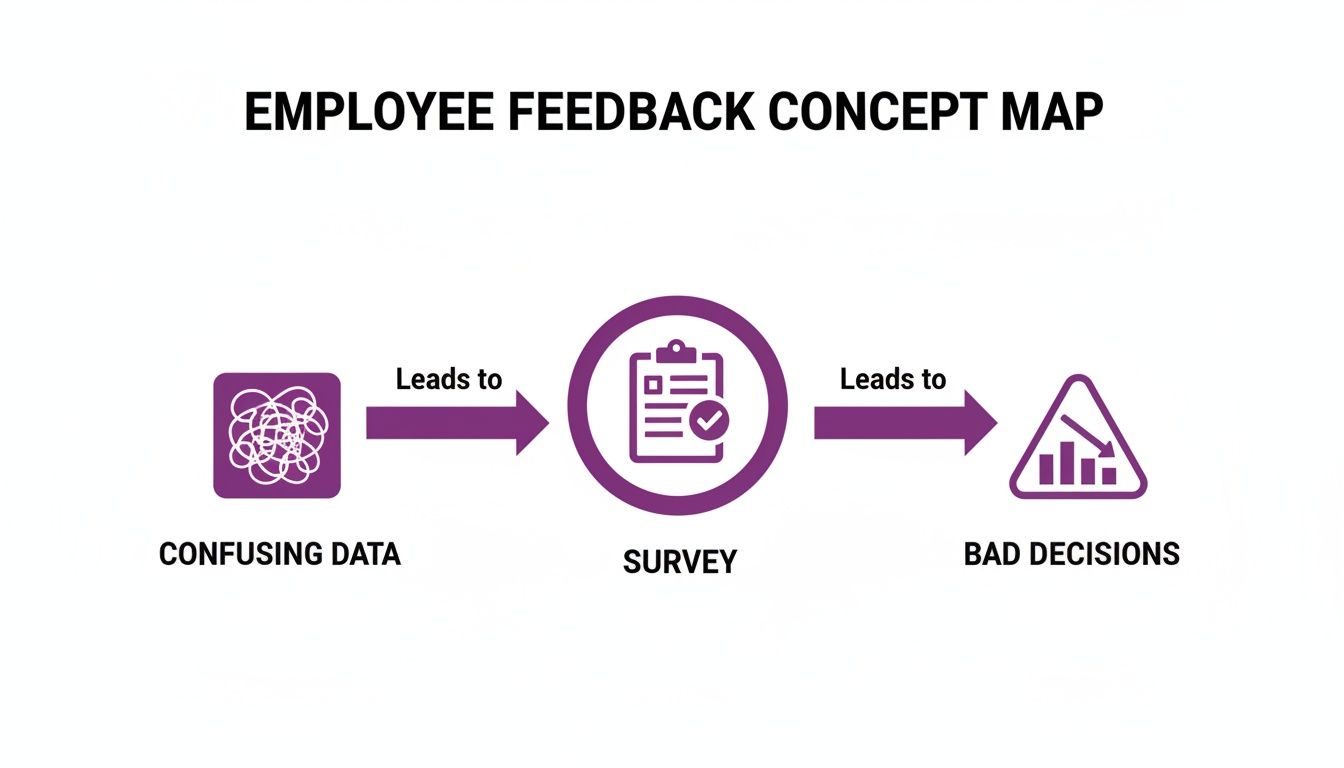
As you can see, the journey from a poorly designed survey to bad business decisions is short and direct. Confusing data is the broken link in the chain.
How to Fix a Double Barreled Question
Fixing these questions is refreshingly simple: split them into two separate, focused questions. That’s it. This small change is the key to collecting precise, clean data you can actually act on.
Each new question should target a single idea, giving employees the freedom to respond accurately to each part.
To make this crystal clear, here are a few real-world examples of how to spot and fix these questions.
Spotting and Fixing a Double Barreled Question
| Double Barreled Question (Avoid) | Corrected Single Questions (Use) |
|---|---|
| "Do you feel our onboarding process was comprehensive and engaging?" | 1. "How comprehensive did you find our onboarding process?" 2. "How engaging did you find our onboarding process?" |
| "Are you satisfied with your current workload and work-life balance?" | 1. "How satisfied are you with your in-office workload?" 2. "How satisfied are you with your remote work-life balance?" |
| "Does your manager provide clear feedback and support your professional development?" | 1. "How clearly does your manager provide feedback?" 2. "How well does your manager support your professional development?" |
| "Is the new project management software easy to use and effective for team collaboration?" | 1. "How easy to use is the new project management software?" 2. "How effective is the new software for team collaboration?" |
By asking one thing at a time, you get a much sharper picture of what's really going on.
By asking one clear question at a time, you empower employees to give honest, specific feedback. This clarity transforms your data from a source of confusion into a powerful tool for building a better workplace.
Instead of wrestling with traditional HR survey tools that can be easily misused, a business intelligence tool like Wurkn offers a much smarter solution. Wurkn analyzes continuous, unstructured feedback from platforms your teams already use—like Slack or Teams—capturing nuanced sentiment without the risk of flawed questions. This gives you a clear, real-time pulse on your culture that static surveys simply can't match.
How Flawed Questions Poison Your Business Intelligence
Asking a double barreled question isn't just a minor survey mistake—it's a direct threat to the quality of your business intelligence. These kinds of flawed questions create a nasty ripple effect, turning your genuine feedback efforts into a source of garbled data and wasted resources.
When you get muddled data back, you can't possibly pinpoint what’s really driving critical issues like disengagement, low morale, or turnover. This leads straight to misallocated budgets. You might pour money into a new wellness program when the real problem is a total lack of career development—a distinction a flawed question would completely erase.
Over time, this erodes trust. Employees who see their feedback constantly misunderstood or ignored will eventually just stop offering it. For leaders in competitive markets across Canada and the United States, this isn't just an HR problem. It’s a serious performance issue that hits the bottom line.
The Straight Line Between Unclear Questions and Business Outcomes
The damage from unclear feedback isn't theoretical; you can actually measure it. There's a strong link between unclear expectations—often born from poorly worded survey questions—and lower employee engagement. When teams are confused, their motivation and productivity nose-dive.
And this is a widespread problem. A classic double barreled question often lurks in employee surveys, undermining the very feedback HR leaders and COOs desperately need. For example, a question like, 'I know what is expected of me at work,' can mash up role clarity with understanding specific tasks.
This confusion reflects a larger trend. In the United States, research has shown that clarity on expectations can significantly drop during periods of workplace change (Gallup, 2022). This problem is only magnified in hybrid work environments common in North America.
When your questions are ambiguous, your data is compromised. You can’t build a high-performance culture on a foundation of guesswork. Clear insights are the only way to take targeted, effective action.
This is where most traditional HR survey tools completely miss the mark. They put the entire burden of perfect question design on you, leaving the door wide open for the exact kind of errors that corrupt your data from the start. Even the best annual survey is just a static snapshot, failing to capture the dynamic, day-to-day reality of your company culture.
Moving Beyond Flawed Surveys
The solution isn't just about writing better questions. It's about adopting a fundamentally better system for gathering intelligence.
This is where a business intelligence tool like Wurkn comes in. Wurkn bypasses this entire problem by analyzing the continuous, unstructured feedback already happening in your organization. Instead of relying on flawed surveys, it taps into the real conversations on platforms like Slack and Microsoft Teams, delivering clear, contextual insights tied directly to critical business KPIs like productivity and retention.
Instead of wrestling with ambiguous survey results, leaders get a real-time, living dashboard of their organizational health. This allows you to stop reacting to old data and start proactively shaping your culture based on clear, current intelligence. By understanding the true sentiment and drivers within your teams, you can make smarter decisions that improve performance and build a workplace where people actually feel heard.
To learn more about this approach, check out our guide on the new era of analytics for HR.
Spotting Flawed Questions in Slack and Teams Polls
The double barreled question isn't just a problem for those big, formal annual surveys. It shows up all the time in the quick, informal polls managers love to run on platforms like Slack and Microsoft Teams. The "get it done now" nature of these tools makes it incredibly easy to accidentally mash two different ideas together just to get a poll out the door.
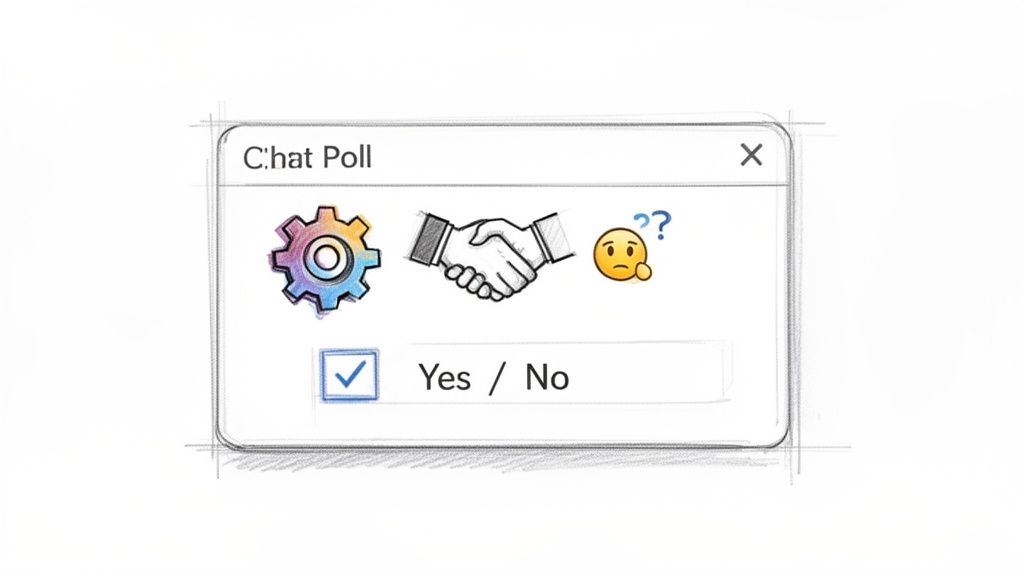
For instance, a manager might quickly post, "Is our new project management tool easy to use and helpful for collaboration?" This forces a single "Yes" or "No" for two totally separate concepts: usability and collaborative impact.
One person on the team might find the tool a breeze to navigate but terrible for teamwork. Someone else might think it’s clunky but an absolute game-changer for getting everyone on the same page. In both cases, their vote is useless because it fails to capture that critical nuance. You’re left with murky data that can’t possibly lead to a smart decision.
Rewriting Common Slack and Teams Polls
To get feedback you can actually act on, you have to break these flawed questions apart. It only takes a few extra seconds, but it makes a night-and-day difference in the quality of your insights.
Here are a few copy-and-paste templates for fixing the kind of double barreled questions that pop up constantly in chat.
Flawed Poll:
- "Are our weekly team meetings productive and engaging?" (Options: Yes / No)
Corrected Polls:
- Poll 1: "How productive do you find our weekly team meetings?" (Options: Very Productive / Somewhat Productive / Not Productive)
- Poll 2: "How engaging do you find our weekly team meetings?" (Options: Very Engaging / Somewhat Engaging / Not Engaging)
By splitting productivity and engagement into two separate questions, you can see exactly where the problem lies. Maybe the meetings are productive but boring, or engaging but a total waste of time. Now you know what to fix.
Informal polls are great for getting a quick pulse on sentiment, but their speed is also their biggest weakness. A single ambiguous poll creates more confusion than clarity, often sending teams down the wrong path to solve a problem that doesn't exist.
This is where both old-school HR surveys and quick-and-dirty polls miss the mark. They put the entire burden of perfect question design on busy managers who have a million other things to do. A much smarter approach is using a business intelligence tool like Wurkn. Instead of relying on flawed, one-off polls, Wurkn plugs directly into platforms like Slack and Teams to analyze ongoing, organic conversations.
This captures nuanced, honest sentiment without interrupting anyone's workflow. The result is clear, continuous business intelligence that static polls and traditional employee engagement tools simply can't compete with.
Best Practices for Writing Clear Survey Questions
Getting your survey questions right is a skill, and it’s one that directly feeds the quality of your people analytics. If you want clear, actionable data, you have to sidestep the pitfalls of ambiguity—starting with the notorious double barreled question. This is a practical playbook for PeopleOps leaders and managers who need to write questions that actually deliver clarity.
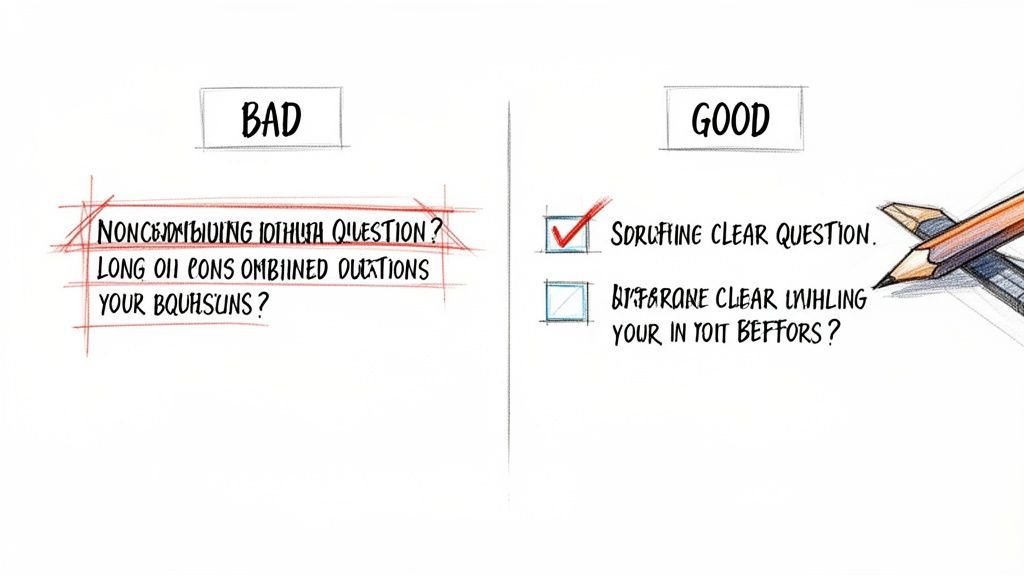
The foundational rule couldn’t be simpler: one idea per question. Every single time. Your goal is to measure one specific thing, not two or three. Sticking to this principle is the ultimate antidote to the double barreled question, ensuring every employee response is precise and easy to make sense of.
Keep Your Language Simple and Direct
Clarity begins with simplicity. It’s absolutely critical to use language that every single employee can understand instantly, no matter their role or how long they’ve been with the company.
- Avoid Internal Jargon: Ditch the acronyms, department-specific lingo, and corporate buzzwords that might leave some employees scratching their heads. A good question is universally understood.
- Use Concrete Words: Abstract ideas are open to interpretation. Instead of asking if a project was "successful," get specific. Ask, "Did the project meet its stated goals?" or "Was the project completed on schedule?"
This directness leaves no room for guesswork. It ensures everyone is answering the same question you think you’re asking. For more ideas on what to ask, you can explore our detailed guide on satisfaction survey questions for employees.
Structure Questions for Neutrality
How you frame a question can quietly nudge people toward a certain answer. To get honest, unfiltered feedback, you have to build your questions on a neutral foundation, free from bias.
A biased question doesn't just skew your data; it signals to employees that you're looking for a specific answer. This can erode trust and discourage candid feedback, defeating the entire purpose of the survey.
For instance, a leading question like, "Don't you agree that our new wellness program is a great improvement?" basically pressures employees to say yes. A much better, more neutral way to phrase it is, "How would you rate the impact of the new wellness program?" This opens the door for a genuine, unbiased response.
Pilot Your Survey Before Launch
Finally, one of the most vital steps is to test-drive your survey with a small, diverse group of employees before you send it out to everyone. This pilot phase is your quality assurance check. It’s where you’ll catch confusing phrasing or sneaky double barreled questions you might have missed.
Asking a few people to "think aloud" as they take the survey is an incredibly powerful way to find problems. Their real-time feedback will shine a spotlight on any points of confusion, letting you refine your questions for maximum clarity. This step is non-negotiable for maintaining the integrity of your continuous feedback loop, especially in remote and hybrid teams where clear communication is everything.
This kind of precision is what helps you understand what truly drives productivity and what causes turnover. Double barreled questions just create statistical noise that gets in the way. It’s a challenge seen across North America, where employee engagement has slumped to a 10-year low (Gallup, 2023), often because companies misinterpret the feedback they receive from flawed surveys.
While these practices will definitely improve traditional surveys, a business intelligence tool like Wurkn bypasses these risks entirely. By analyzing the organic, ongoing conversations already happening, Wurkn delivers clear cultural signals without you ever having to design a question, giving you a real-time, unbiased view of what's really going on.
Moving from Static Surveys to Dynamic Intelligence
Let's be honest: writing a perfect survey question is a great first step, but it doesn't solve the fundamental problem. The real issue is the survey itself. Even a brilliantly designed annual survey is just a snapshot, a single moment frozen in time. It completely misses the day-to-day context and cultural currents that define your organization, delivering a picture that’s already out of date the second it lands on your desk.
This is why a continuous listening strategy has shifted from a nice-to-have to an operational necessity for modern companies in both Canada and the United States. The goal isn’t just to collect static data points anymore; it’s to cultivate a living, breathing view of employee sentiment in real time.
Beyond the Annual Snapshot
This is where a business intelligence tool like Wurkn provides a clear advantage over traditional HR survey tools. By tapping into the natural flow of conversation on Slack, Teams, and your HRIS, Wurkn captures authentic sentiment as it happens—without adding another task to anyone's to-do list.
Instead of a distorted picture from a once-a-year questionnaire, you get a nuanced, constantly updating understanding of your culture. This approach sidesteps the pitfalls of the double barreled question entirely because it analyzes organic feedback rather than forcing people into predefined (and often flawed) boxes. You can explore a deeper dive into this topic in our article on the modern personnel satisfaction survey.
Broad engagement scores often hide the very problems they are meant to reveal. A high overall score can easily mask critical issues festering within specific teams or departments, leading to a false sense of security while top talent quietly disengages.
A double barreled question can seriously mislead COOs and People Ops leaders. For example, research shows that while overall engagement metrics may look stable, there is often a massive gap between leadership perception and employee reality (McKinsey, 2023). This problem only gets worse when you factor in remote work challenges, which can contribute to significantly higher turnover in disengaged teams (Gallup, 2023).
Wurkn’s AI-driven synthesis cuts through this complexity. It delivers clear, actionable insights tied directly to revenue and retention, turning employee feedback from a simple HR metric into a genuine strategic advantage for your business.
Frequently Asked Questions
Here are a few common questions that come up when PeopleOps leaders and COOs are working to eliminate double barreled questions and get more signal from their feedback strategy.
What Is the Biggest Risk of Using a Double-Barreled Question?
The single biggest risk? Making expensive, poorly-informed strategic decisions based on data that’s flat-out wrong. When you smash two different ideas into a single query, you have absolutely no way of knowing which part of the question employees are actually answering.
This kind of ambiguity forces you to guess. You might pour resources into the wrong culture programs, miss the real underlying issues burning out your top talent, and erode trust when your actions don't line up with what people actually need. It’s a dangerous foundation for any people strategy.
How Can We Test Survey Questions Before a Full Rollout?
One of the simplest and most effective ways is a technique called cognitive interviewing. Grab a small, diverse group of five to seven employees from different departments, show them the draft survey, and just ask them to think out loud as they answer each question.
Listening to someone talk through their thought process is incredibly revealing. You’ll instantly spot confusing phrasing, unclear terms, and any hidden double barreled questions. It’s a low-effort way to catch and fix major flaws before they pollute your company-wide data.
Are Double-Barreled Questions a Problem in Informal Slack Polls?
Yes, absolutely. In fact, they might be even worse in that context. The goal of an informal poll is a quick, clear signal. A double barreled question does the exact opposite—it creates immediate confusion and gives you muddy data that isn’t actionable.
For quick feedback, clarity is king. Instead of building easily misinterpreted polls, a better approach is to use a business intelligence tool like Wurkn. It can analyze the ongoing, organic conversations happening every day to surface nuanced insights without ever disrupting your team’s workflow, providing a level of understanding that traditional employee engagement platforms can't match.
Stop relying on flawed feedback. Wurkn delivers the real-time, actionable business intelligence you need to drive results. See how it works at https://wurkn.com.