
A one-on-one meeting isn't just another calendar entry—it's a dedicated, recurring conversation between a manager and their direct report that should go way beyond simple project updates. Think of it as a critical space for mapping out goals, smashing through challenges, and building a real professional relationship.
Rethinking Your One-on-One Meeting Beyond Status Updates

Let's be honest, most one-on-one meetings are a missed opportunity. They almost always decay into a routine status report, completely wasting their potential to become the powerhouse conversations that actually drive engagement and keep your best people from walking out the door. This guide is about redefining the one-on-one, positioning it as a core piece of your company's cultural strategy.
We’re going to explore how to shift these meetings from tactical check-ins to strategic dialogues that build trust and, just as importantly, uncover priceless organizational insights. The key is to stop seeing these conversations as a chore and start viewing them as a source of real-time business intelligence.
The Strategic Value of a Well-Run Meeting
When you get them right, the benefits of a strong one-on-one meeting ripple far beyond just one person's performance. These discussions are the absolute foundation of a healthy, productive, and resilient work environment.
Here are the real advantages:
- Building Trust and Psychological Safety: Consistent, confidential conversations create a space where employees feel safe enough to share real concerns and bold ideas without fearing any backlash.
- Driving Individual Development: This is the dedicated forum to talk about career goals, identify skill gaps, and actually align personal ambitions with where the company is headed.
- Improving Team Agility: By tackling roadblocks in real time, managers can help their teams pivot quickly when priorities change and keep the momentum going.
- Increasing Employee Retention: It’s simple. People who feel heard, supported, and invested in by their manager are overwhelmingly more likely to stick around for the long haul.
A one-on-one meeting should be a grounding point in the week. It keeps people aligned, supported, and moving forward, acting as a key driver of sustainable performance.
From Conversation to Cultural Intelligence
The real magic happens when you start to aggregate the insights from all your one-on-ones. This is where a business intelligence tool like Wurkn delivers value that goes miles beyond what traditional HR surveys can offer. Wurkn helps PeopleOps leaders and COOs capture the anonymous sentiment bubbling up in these crucial conversations.
It turns the qualitative, often-missed feedback from various communication channels into a dashboard showing the real-time health of your organization. This approach elevates the one-on-one from a simple management task to the very foundation of a data-informed cultural and operational strategy. You can see a similar dynamic at play in our guide to skip-level meetings.
Designing a Framework for Meaningful Conversations
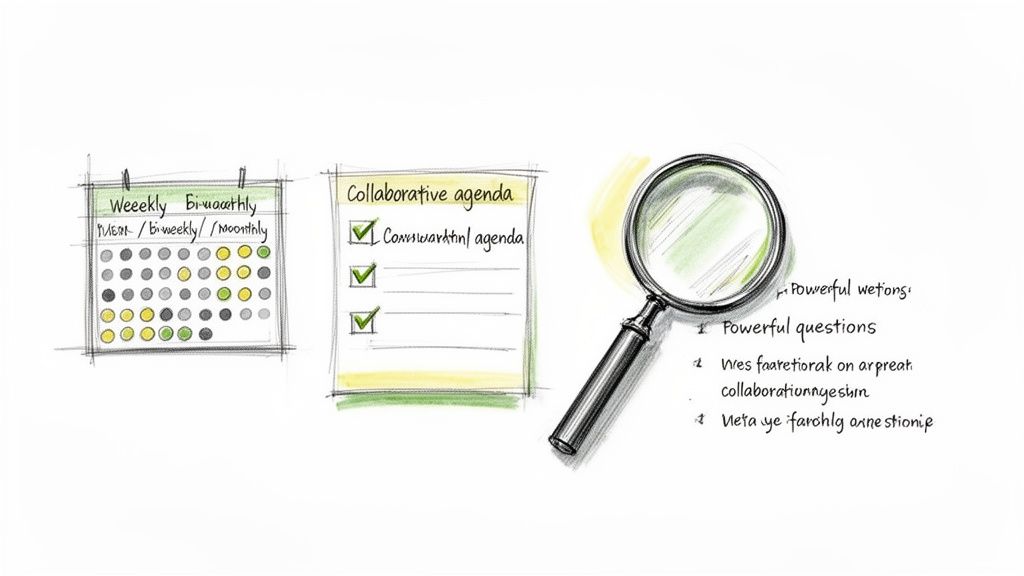
A great one and one meeting doesn't just happen by accident. It's the result of intentional design. Building a solid framework is your first real step in turning these talks from routine check-ins into sessions that actually move the needle on performance and personal growth. This isn't about creating a rigid script, but about establishing consistency and mutual accountability.
The cornerstone of any effective framework is cadence. How often you meet sends a powerful signal about how much you value your team's development. There's no magic number here; the right frequency adapts to the individual's role, their experience, and what's on their plate—whether they're in the office in Toronto or working remotely from Texas.
Choosing the Right Cadence
Finding the sweet spot for meeting frequency is a balancing act. New hires or team members wrestling with complex projects need more frequent touchpoints. On the other hand, seasoned, autonomous employees often do better with less frequent but deeper conversations.
For most managers, the cadence will change depending on who you're talking to and what they're working on. Here’s a simple guide to get you started.
Recommended Cadence for Your One and One Meeting
| Employee Profile | Recommended Cadence | Primary Focus |
|---|---|---|
| New Hires (First 90 Days) | Weekly (30 min) | Onboarding, role clarity, building rapport, early feedback. |
| Junior or Developing Staff | Weekly or Bi-weekly (30-45 min) | Skill development, coaching, task-level feedback, removing blockers. |
| Established Team Members | Bi-weekly (30-45 min) | Project momentum, career growth, feedback exchange, alignment. |
| Senior Staff / High Performers | Monthly (45-60 min) | Long-term strategy, career trajectory, mentorship, high-level challenges. |
| Remote or Hybrid Employees | Bi-weekly (minimum) | Connection, well-being, alignment with team goals, visibility. |
| Employees on a PIP | Weekly (30 min) | Specific performance goals, progress tracking, intensive support. |
This table isn't set in stone, but it provides a reliable starting point. Feel free to adjust based on real-world needs. The goal is to provide the right level of support without creating meeting fatigue.
The most important rule for cadence is consistency. Research from Gallup consistently shows that frequently cancelled meetings make employees feel undervalued (Gallup, 2023). Honouring your scheduled one and one meeting demonstrates respect and reinforces its importance.
Building a Collaborative Agenda
An agenda owned solely by the manager is a recipe for a one-sided conversation. The most productive one and ones are built on a collaborative agenda where both you and your direct report add topics ahead of time. This shared ownership ensures the discussion covers what truly matters to the employee, not just what's on your checklist.
A simple shared document, a note in your calendar invite, or a dedicated tool can house the agenda. This lets both of you add points as they come up during the week. This single practice can shift the entire dynamic from an interrogation to a genuine partnership.
Using Intelligence to Ask Better Questions
This is where technology can seriously elevate your one and one framework. Instead of guessing or relying on stale HR survey data, you can use real-time insights from a business intelligence tool like Wurkn. It analyzes anonymous sentiment from communication channels to spot the themes bubbling up under the surface.
Let’s say Wurkn’s AI flags a rising trend of workload concerns across your team. With that insight, you can proactively tailor your questions. You can move beyond a generic "How's your workload?" to something far more specific and empathetic:
- "Looking at our current sprint, which tasks feel energizing and which ones feel like a grind?"
- "What's one thing we could change about our process to make your work feel more manageable right now?"
This data-informed approach allows you to turn a routine one and one meeting into a targeted, effective intervention that addresses real issues before they become toxic. It’s a perfect example of how Wurkn delivers actionable business intelligence, not just another set of employee engagement metrics.
Navigating Sensitive Topics to Build Psychological Safety
Let's be honest: if your one-on-ones never get uncomfortable, they probably aren't working. The most valuable conversations happen when an employee feels safe enough to bring up the tough stuff—compensation, burnout, or conflict with a colleague. Without that foundation of psychological safety, the meeting is just performance art. It's not a real partnership.
Building that safety isn't a passive process; it's something you actively create as a manager. It means switching off the "problem-solver" brain and turning on genuine curiosity. When an employee raises a difficult issue, your first job isn't to fix it. It's to understand it.
Fostering a Safe Conversational Space
Imagine an employee tells you they feel sidelined in a project. Your gut reaction might be to jump in with solutions or tell them they're a valued team member. But a far more powerful approach is to simply create the space for them to share their experience without judgment.
This comes down to a few practical techniques that show you're actually listening:
- Active Listening: This isn't just waiting for your turn to talk. It's about fully absorbing what they're saying. Try paraphrasing it back to them: "So, if I'm hearing you right, you felt like your ideas weren't being heard in that meeting. Is that accurate?" This confirms you understand and validates their perspective.
- Responding with Empathy: Before you offer a single solution, acknowledge their feelings. A simple, "That sounds incredibly frustrating," or "Thank you for trusting me enough to bring this to me," can completely change the dynamic of the conversation.
- Asking Open-Ended Questions: Avoid yes/no questions that shut down conversation. Instead, use prompts that invite a story. "Can you walk me through what happened?" or "How did that impact your work for the rest of the day?" These questions open the door to real insight.
These aren't just soft skills; they're the tools you use to build the trust required for real vulnerability. You can dig deeper into this in our article on building psychological safety in the workplace.
Connecting Individual Concerns to Systemic Health
A single tough conversation can be a canary in the coal mine for bigger, systemic issues. This is where a business intelligence tool like Wurkn goes far beyond what a simple HR survey can do. It helps leaders connect the dots between what's said in a private one-on-one and the cultural patterns emerging across the entire organization.
Take California, for example, where Hispanics make up over 39% of residents but occupational segregation is still a significant issue (Public Policy Institute of California, 2023). We know from research that companies fostering diversity and inclusion in every interaction, including a one and one meeting, see 23% higher employee engagement (McKinsey & Company, 2020). For a leader using a platform like Wurkn, anonymous feedback can shine a light on cultural blind spots, helping diagnose why retention is dipping in one department but not another. You can find more insights on California's diverse workforce here.
If Wurkn’s AI spots a trend of inclusion-related concerns coming from multiple anonymous sources—like comments in internal communication tools—it flags this as a high-level insight on a COO's dashboard. Crucially, the platform's commitment to privacy means individual identities are always protected.
This process transforms a single, sensitive conversation into a catalyst for organizational change. It allows leaders to address systemic cultural issues with data, not guesswork, without ever violating the trust built in that private one-on-one.
This elevates the one and one meeting from a simple check-in to a vital source of business intelligence. It gives leadership the power to get ahead of cultural challenges, turning qualitative feedback from an employee into a clear, quantitative signal for strategic action.
Turning Conversation Into Actionable Cultural Intelligence
The real value of a one-on-one evaporates the moment the meeting ends if those insights just vanish into thin air. A simple summary and a few action items are a start, but the game changes when you connect individual feedback to the bigger picture.
This is where you need to move beyond just tracking mood. A tool like Wurkn acts more like a business intelligence engine, linking anonymized themes from employee conversations to concrete KPIs like team productivity and, crucially, retention rates.
From Anecdote to Analysis
Picture a COO noticing a dip in performance metrics for one of their key engineering teams. Instead of just guessing what's wrong, they can check their Wurkn dashboard. The platform’s AI might flag a sudden spike in negative sentiment around ‘work-life balance’ and ‘unrealistic deadlines,’ all pulled from anonymized discussions.
Suddenly, a manager's one-on-one transforms from a routine task into a vital source of operational intelligence. The COO now sees a direct line connecting a cultural issue to a business outcome, letting them step in with precision instead of guesswork.
This creates a clear path from an individual concern to an actionable insight, which is exactly what builds the psychological safety you need for honest feedback.
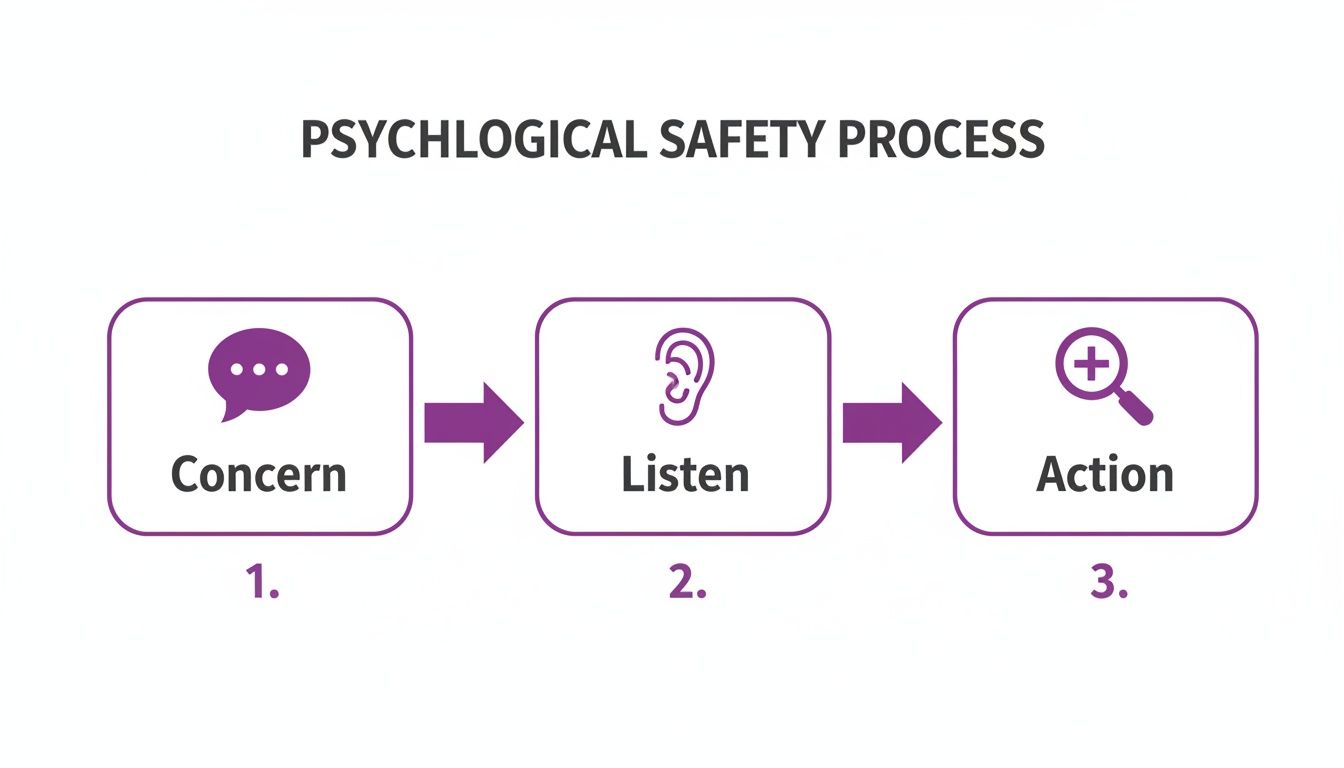
As the process shows, it’s a simple but powerful loop: an employee shares a concern, the organization has a system for listening, and leaders can then take informed action based on real, aggregated data.
Connecting Insights to Business Impact
This data-driven approach is especially critical when you're tackling sensitive topics like compensation equity. Take the new pay data reporting mandates in California, for example. One-on-ones are becoming ground zero for surfacing wage disparity concerns.
For COOs and PeopleOps leaders, having an always-on feedback loop—fed by these meetings and integrated with your HRIS—can anonymize personal data to reveal the real themes driving pay inequity across the board.
Wurkn’s AI can synthesize why engagement often lags in firms that are blind to diversity issues, helping turn qualitative chats into quantitative wins. For example, a Boston Consulting Group study found that companies with above-average diversity scores reported 19% higher innovation revenue (BCG, 2018). You can explore the details of California's reporting guidance to get a better sense of this shifting landscape.
By linking anonymized sentiment to business metrics, a one-on-one becomes more than a conversation. It becomes a vital data point in your organization's cultural and operational health monitoring system.
This elevates the role of both the manager and the employee in building a healthier, more productive workplace. It ensures every voice, when gathered and analyzed responsibly, helps build a smarter, more responsive organization. That's the core function of a true business intelligence tool—turning everyday interactions into a strategic advantage.
Leading Effective One-on-Ones in a Diverse Workforce
Running a great one-on-one meeting is tough enough. But when you’re leading today's distributed and diverse teams across Canada and the United States, the challenge gets a whole lot more complex. Your team is a mix of unique backgrounds, communication styles, and lived experiences. Making sure every conversation is equitable and inclusive isn’t just a nice-to-have—it’s a business necessity.
The tricky part is that unconscious bias can easily creep into these conversations, influencing the questions we ask and the feedback we deliver. As a manager, your goal is to create a space where every single employee feels seen, heard, and valued for who they are. That takes a conscious effort to stay objective, fair, and incredibly self-aware.
Strategies for Inclusive Conversations
To make your one-on-ones truly equitable, you have to be intentional. It means actively working to check your biases at the door and creating a space where different perspectives are not just tolerated, but genuinely welcomed.
Here are a few practical strategies that actually work:
- Standardize Your Core Questions: Yes, conversations need to feel natural and flow freely. But starting with a consistent set of core questions for every team member ensures you're giving everyone an equal shot to discuss their growth, challenges, and aspirations.
- Practice Real Active Listening: This is more than just nodding along. Pay close attention to what is said and how it's said. Before you jump in with a solution or your own take, make a point to acknowledge and validate their perspective first.
- Ask for Feedback on Your Style: This can feel vulnerable, but it's crucial. Directly ask your team for feedback on how you're running these meetings. Simple questions like, "Is this format working for you?" or "What's one thing we could change about our one-on-ones?" can uncover powerful insights.
In a diverse team, a one-size-fits-all approach to communication is destined to fail. The most effective managers adapt their style to meet the needs of each individual, fostering an environment of true psychological safety.
Using Intelligence to Drive Equity
In this complex environment, just relying on your gut isn't going to cut it if you want to build a genuinely inclusive culture. This is where technology becomes essential for getting an unvarnished, objective look at what’s really going on.
A business intelligence tool like Wurkn is built for this exact challenge. It gives you insights that old-school HR surveys could never dream of providing.
By analyzing anonymized sentiment from channels like internal communication tools, Wurkn can pinpoint potential gaps in the employee experience across different demographics—all without ever exposing anyone's personal information. This allows leaders to see where their DEI initiatives are hitting the mark and, more importantly, where they’re falling short. For a deeper dive, check out our guide on fostering diversity in the workplace.
This data-driven approach isn't just theory; it has a massive impact. A McKinsey & Company report found that companies with greater gender and ethnic diversity are significantly more likely to outperform their peers financially (McKinsey & Company, 2020). For PeopleOps leaders, this is the key. Linking this anonymous feedback to core KPIs transforms routine check-ins into powerful drivers of business results. Wurkn helps you move past performative gestures and start building impactful, evidence-based strategies that create real inclusivity.
Common Questions About One-on-One Meetings
Even the most well-intentioned managers and PeopleOps leaders run into a few common roadblocks when rolling out a one-on-one program. Let's tackle some of the most frequent questions with practical, no-nonsense answers.
How Do I Get Busy Managers to Actually Prioritize These Meetings?
Stop pitching them as an administrative task and start framing them as a core leadership tool. Most managers are drowning in reactive work; this is their chance to get ahead.
Show them the numbers. Data consistently links effective one-on-ones to lower turnover, higher engagement, and better team performance. When people feel their manager actually gets them, they perform better. It's that simple.
But more importantly, show them how a platform like Wurkn makes these conversations shorter and far more impactful. When they can walk into a meeting armed with real-time, anonymized data on team sentiment, they can skip the guesswork and address brewing problems before they explode. It’s their best tool for proactive leadership, not just another meeting on the calendar.
What if an Employee Is Quiet or Disengaged During Our Meetings?
First, take a hard look in the mirror. Have you truly created a safe space for dialogue, or are you just talking at them? If the manager dominates the conversation, the employee has zero incentive to open up. A great first step is asking for their feedback on the meeting format itself. Invite them to co-create the agenda.
But that disengagement could also be the tip of an iceberg. Anonymized, aggregated data from a platform like Wurkn provides crucial context here. It helps you see if this is an isolated issue with one person or a wider trend across the team. This lets you address the root cause—maybe a process bottleneck or unclear goals—instead of just the symptom of a quiet employee.
An employee's silence is data. Your job is to create an environment where they feel safe enough to share the story behind it.
How Can We Actually Measure the ROI of Improving Our One-on-Ones?
You have to connect it to the metrics the business already cares about. After you implement a better structure for your one-on-ones, start tracking the direct impact on core business numbers.
Look for tangible changes in employee retention rates, quarterly pulse survey scores, and team productivity. Did the completion rate for action items discussed in these meetings go up? Are you seeing fewer "surprises" during performance reviews?
This is precisely where a cultural intelligence platform like Wurkn proves its worth. Unlike old-school survey tools, it allows you to draw a straight line from qualitative feedback themes (like a jump in "manager support" sentiment) to hard, quantitative business outcomes. You can walk into a leadership meeting and clearly demonstrate that investing in quality conversations delivers a tangible return.
Ready to turn your one-on-one meetings from routine check-ins into a source of strategic business intelligence? See how Wurkn helps you connect cultural insights to real-world performance. Learn more at wurkn.com.