
Onboarding isn't just about paperwork and a first-day lunch. It’s the entire strategic journey of bringing a new person into your company's orbit, from the moment they accept the offer to the point they're a fully contributing, confident member of the team—usually around the 90-day mark.
This is the critical window where you embed your culture, clarify expectations, and make someone feel like they truly belong. Get it right, and you've laid the groundwork for a long, productive relationship.
The Strategic Importance of Onboarding

Too many companies treat onboarding like an administrative chore: a mad dash of forms, IT tickets, and maybe a quick office tour (or a virtual equivalent). This checklist mentality completely misses the bigger picture.
A thoughtful onboarding process is one of the most powerful business functions you have. It directly shapes retention, productivity, and culture—especially in remote and hybrid teams across Canada and the United States, where you have to be far more deliberate about building human connection.
The first 90 days are everything. This is when new hires are deciding if they made the right move, and you're deciding if they're the right fit. A clumsy, impersonal, or chaotic experience breeds instant regret and can lead to disengagement, slow ramp-up times, and expensive, early turnover.
More Than a Welcome Packet
Onboarding is the first real, tangible experience a new employee has with your company culture. It’s your chance to prove that the values on your careers page are more than just words. This is where you set the tone for how people communicate, collaborate, and support each other.
Think of it as the foundation for the entire employee lifecycle. A strong start pays massive dividends down the line.
- Faster time-to-productivity: People who clearly understand their role, who to ask for help, and what success looks like start delivering value much faster.
- Stronger cultural alignment: When new hires feel genuinely connected to their team and the company's mission, they develop a powerful sense of belonging.
- Higher employee retention: A positive, supportive start makes people want to stay, which is far cheaper than constantly recruiting to fill a leaky bucket.
The data is crystal clear on this. Organizations with a strong onboarding process can boost new hire retention by 82% and see productivity climb by over 70%. And it gets better: when people feel supported from day one, they are 2.6 times more likely to be extremely satisfied with their job, a key predictor of long-term commitment. For a closer look at the numbers, you can review the key findings on employee integration here.
To give you a clearer picture, here's how a modern onboarding framework breaks down across these crucial early stages.
| Onboarding Phase | Primary Goal | Key Activities |
|---|---|---|
| Pre-boarding | Build excitement and reduce first-day anxiety. | Welcome emails, team introductions, equipment setup, paperwork. |
| Day 1 & First Week | Create a welcoming and structured introduction. | Orientation, meet-and-greets, goal-setting, initial training. |
| First 30 Days | Foster connection and clarify role expectations. | Regular check-ins, onboarding buddy system, first project. |
| First 60-90 Days | Drive performance and long-term integration. | Performance feedback, career path discussions, cross-functional projects. |
Each of these phases plays a distinct role in turning a promising candidate into a fully integrated and high-performing team member.
Shifting from Surveys to Intelligence
Perfecting this critical journey requires more than just a 90-day check-in survey. Traditional HR tools and employee engagement platforms give you a snapshot in time, but they miss the continuous, subtle signals that reveal where your process is creating friction or confusion. One-off surveys tell you that a problem exists, but rarely why.
This is where a business intelligence tool like Wurkn offers a massive advantage.
By capturing continuous, anonymous feedback, Wurkn moves beyond static engagement scores. It gives PeopleOps and operations leaders real-time cultural intelligence, turning raw employee sentiment into actionable insights you can tie directly to business outcomes like retention and productivity. You can see not just if a new hire is engaged, but also why they might be struggling—allowing you to fine-tune your onboarding process before small issues become reasons to quit.
Building Momentum Before Day One
The time between a candidate signing their offer and their actual start date is a minefield. Too many companies go completely silent during this period, leaving their newest hire to wonder if they've made a huge mistake.
This "preboarding" phase is your first real chance to fight off that buyer's remorse and replace it with genuine excitement. For remote and hybrid teams across Canada and the United States, this isn't just a nice-to-have; it's a critical first step in building a connection.
A thoughtful strategy here shifts the focus from cold, administrative box-ticking to a warm, human welcome. It's the difference between someone showing up on day one feeling like an anxious outsider and someone logging in already feeling like they belong.
From Paperwork to Personal Connection
Look, getting the compliance documents and tax forms sorted out early is non-negotiable. But if that’s your only touchpoint, you're sending the wrong message. The goal is to balance the practical stuff with gestures that show off your company’s personality and prove you’re an organised, people-first workplace.
A clunky, impersonal preboarding experience can plant seeds of doubt before they've even started. By getting the logistical headaches out of the way upfront, you free up their entire first week for what really matters: learning, connecting with the team, and soaking up the culture. To get a better handle on the systems that power this, you might want to check out our guide on what an HRIS is and how it fits into modern HR.
Here are a few things you can do to create a powerful preboarding experience:
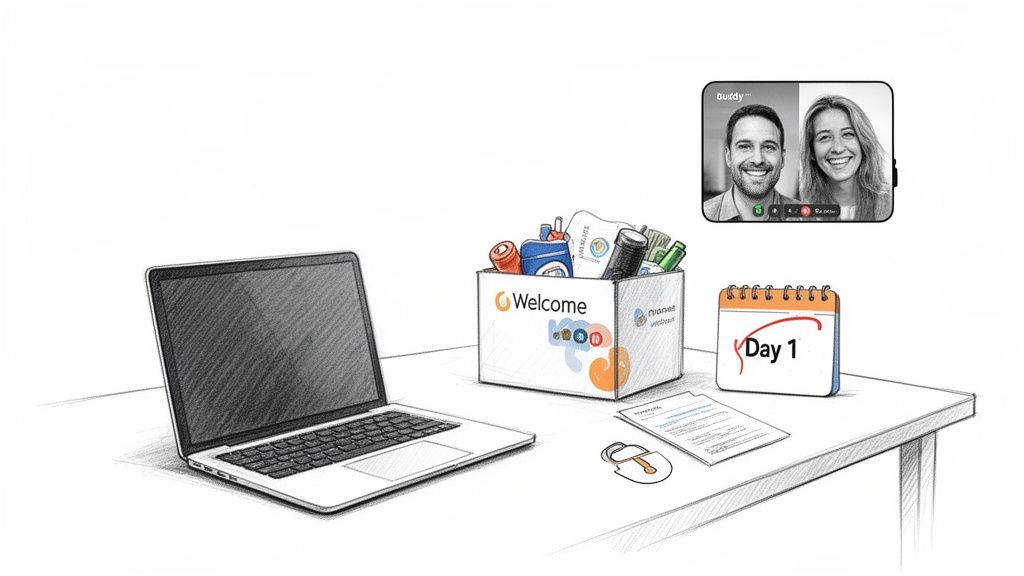
- Send a Killer Welcome Kit: This needs to be more than just a laptop in a box. Think company swag that people actually want—a high-quality hoodie, a branded water bottle, a good notebook. A handwritten welcome note from their direct manager or even the CEO is the kind of personal touch that makes a massive impact.
- Share the Day-One Agenda: Nothing kills first-day jitters like knowing what to expect. Send over a simple schedule for their first day, outlining who they’ll meet and what they’ll be doing. It shows you respect their time and helps them feel prepared.
- Grant Early Portal Access: Give them access to a secure portal to fill out HR forms on their own time. This takes the pressure off and prevents their first few hours from being bogged down in administrative drudgery.
- Set Up a Casual "Buddy" Intro: A few days before they start, schedule a quick, informal video call with their manager and their assigned onboarding buddy. This isn't a business meeting; it's just a friendly "hello" to put faces to names and break the ice.
Key Insight: The main goal of preboarding isn't just to get tasks done. It's to validate the new hire's decision to join your company. Every email, every package, and every call should reinforce that they made the right choice.
Turning Sentiment into Strategy
Here’s the common blind spot in the process of onboarding: how do you know if any of this is actually working? Did the welcome kit feel thoughtful or cheap? Was the buddy intro helpful, or just awkward? Standard HR surveys can't capture these subtle, in-the-moment feelings.
This is where a business intelligence tool like Wurkn gives you a serious edge. By gathering continuous, anonymous feedback, Wurkn lets you understand the emotional journey of the preboarding phase. It turns those qualitative feelings into hard data you can act on.
For example, Wurkn might surface anonymized feedback showing that new hires are consistently confused about the IT setup process before day one. That’s a crystal-clear signal to improve your communication and step-by-step guides. You're no longer guessing; you're refining your process based on what truly makes new hires feel supported and ready to hit the ground running.
Designing a First Week for Connection and Clarity
The first week is where it all comes together. While preboarding builds the initial buzz, these first few days truly set the tone for a new hire’s entire journey with your company. A great first week goes way beyond just getting the IT setup sorted and benefits paperwork filled out; it's about intentionally creating human connection and providing absolute clarity on the role from the get-go.
For remote and hybrid teams across Canada and the United States, this isn't a nice-to-have, it's a must-do. You can't rely on those casual "water cooler" moments or hallway chats to make someone feel part of the team. You have to be deliberate about creating opportunities for new hires to feel seen, heard, and plugged into the company's bigger mission.
This is your chance to blend the practical with the personal. An effective first week isn’t a boring checklist of training modules. It’s a carefully crafted experience designed to make someone feel both confident and genuinely welcome.
Balancing Practical Needs with Human Connection
One of the biggest mistakes I see is front-loading the first couple of days with an overwhelming firehose of information and admin tasks. Yes, that stuff is essential, but it needs to be spaced out to avoid instant burnout and, more importantly, to leave room for actual human interaction.
A killer first week should nail three core goals:
- Equip: Make sure the new hire has every tool, login, and piece of foundational knowledge they need to actually do their job.
- Connect: Introduce them to the key people they'll be working with across the company, helping them build that internal network from day one.
- Inspire: Tie their individual role back to the company's mission. Show them how the work they'll be doing contributes to the bigger picture.
For instance, a logistics company in the United States might schedule a handful of short, 15-minute intro chats with different department heads throughout the week. This helps a new supply chain analyst understand not just their own team's bubble, but how their work directly supports warehousing, sales, and customer success. It provides a level of context a static org chart never could.
A Blueprint for a Memorable First Week
Instead of a random jumble of meetings, structuring the first week around daily themes can make the whole experience feel more logical and a lot less overwhelming. You create a natural flow that builds momentum as the week progresses.
Day 1: The Welcome Mat
The first day should be all about making the new hire feel welcome and oriented. This means a warm, personal welcome from their manager, an introduction to their onboarding buddy, and a clear, simple overview of what to expect for the rest of the week. Save the deep-dive training and technical jargon for later.
Days 2-3: The People and the Purpose
Dedicate the middle of the week to building relationships. Schedule virtual coffee chats with immediate team members, one-on-ones with key collaborators, and maybe a small group session with other recent hires. This is also the perfect time to have a senior leader host a quick session on the company's mission, vision, and values, directly connecting the day-to-day grind to a higher purpose. For a more structured approach, you can learn more about creating a team charter form to clarify how everyone will work together.
Days 4-5: The Role and the Roadmap
As you head towards the end of the week, you can shift the focus more towards the specifics of the role. This is the time for initial training on core tools, a deep dive into the 30-60-90 day plan with their manager, and assigning a small, low-risk first task. Getting a quick win under their belt is a massive confidence booster.
Pro Tip: End the week with something social, even if it's virtual. A simple online game or a relaxed "get-to-know-you" happy hour can solidify the connections made throughout the week and make the new hire feel like they truly belong.
Capturing First Impressions When They Matter Most
So, how do you know if your carefully planned first week actually hit the mark? Traditional HR surveys that ping employees 90 days in are missing the most critical data—those immediate, unfiltered first impressions.
This is where a tool like Wurkn really shows its value as a business intelligence tool. It goes beyond the typical employee engagement platform by capturing continuous, anonymous feedback as it’s happening. By integrating right into Slack or Microsoft Teams, Wurkn can gather sentiment from day one without feeling like another corporate survey.
This real-time intelligence gives People Ops teams the ability to spot friction points in the early process of onboarding that would otherwise fly completely under the radar. For example, if three new hires in a row anonymously mention being confused about the same internal process, you have an immediate, actionable insight to go fix your documentation. Wurkn turns subjective feelings into a clear data signal, letting you refine your onboarding not on assumptions, but on the real-time cultural intelligence of your newest people.
Your 90-Day Roadmap to Full Integration
The first week is about making someone feel welcome, but the next three months are where a new hire truly becomes a high-performing, integrated member of your team. This is where a structured 30-60-90 day plan becomes your most valuable asset. It’s not just a checklist; it’s a clear roadmap that takes an employee from learning the ropes to confidently driving their own projects.
This phased approach is absolutely critical for avoiding the classic "drinking from a firehose" problem. You know the one—where you throw everything at a new person and hope something sticks. Instead, a 30-60-90 day plan builds momentum gradually, setting clear expectations and creating measurable milestones that ensure they feel successful every step of the way. For remote and hybrid teams across Canada and the US, this clarity is even more crucial for building confidence from a distance.
The first week really sets the stage for this entire journey, focusing on three core pillars: setup, connection, and clarity.
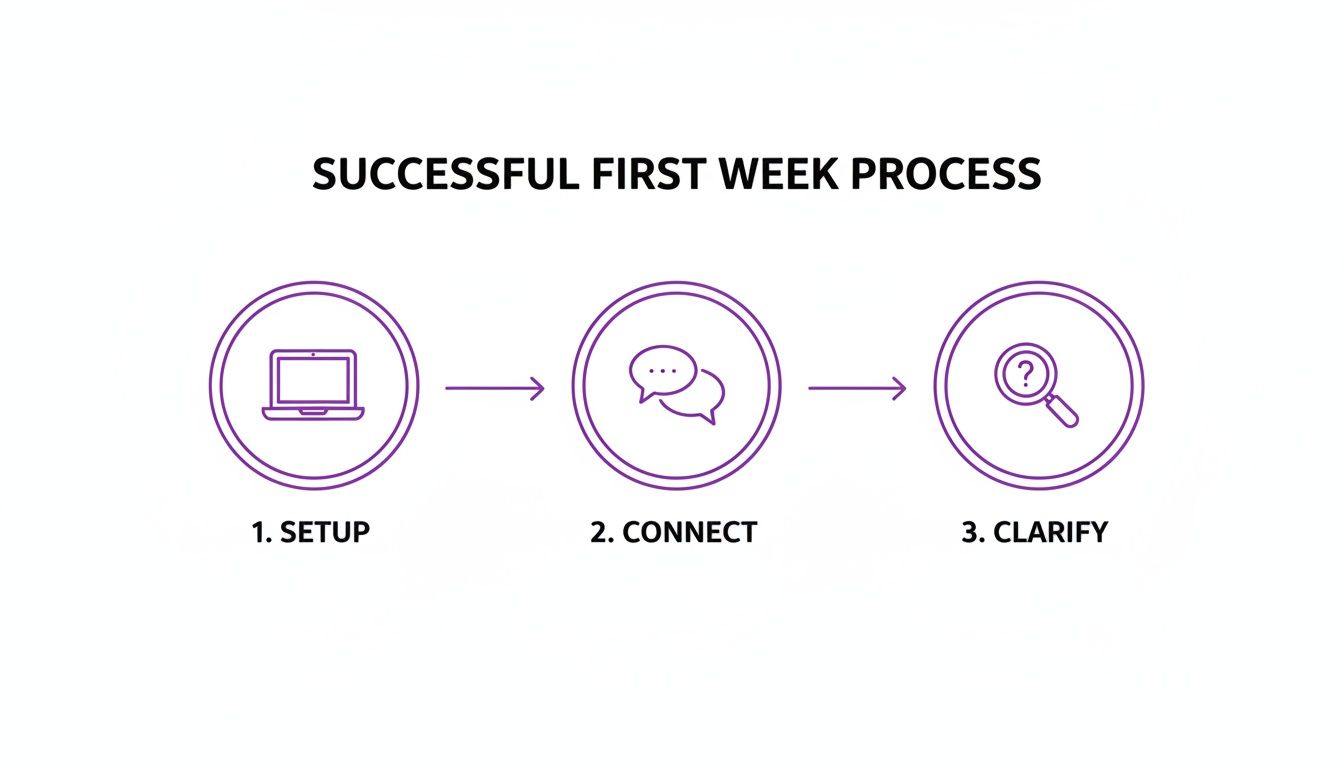
Think of that first week as the launchpad. Get the setup, human connection, and role clarity right, and you've built the perfect foundation for the deeper integration that happens over the next three months.
The First 30 Days: Learning and Absorbing
Month one is purely about orientation and soaking up information. The goal here isn't big wins; it's about giving them the space to understand the company culture, get to know their colleagues, and really get a handle on the tools and processes they'll be using.
This is a period of absorption, not execution. Their key objectives should look something like this:
- Complete Core Training: All the essential product knowledge, compliance modules, and software training needs to be checked off.
- Build Internal Relationships: They should have connected with their immediate team and key people in other departments they'll be working with.
- Understand "How We Work": This is the unwritten stuff—learning the team's communication rhythms, meeting cadences, and how decisions actually get made.
For instance, a new sales rep at a Canadian tech company isn't expected to hit a quota in their first 30 days. Their primary goal is to finish all product training and shadow five discovery calls with a senior team member. It’s about building foundational knowledge, period.
The Next 30 Days: Contributing and Applying
From day 31 to day 60, the script flips from learning to doing. Now that they have that foundation, the new hire should start applying what they've learned by taking on smaller, well-defined tasks. This is all about building confidence and letting them demonstrate their growing competence.
Managers need to guide this carefully, assigning tasks with crystal-clear instructions and achievable outcomes. The aim is to create opportunities for early wins that build momentum and allow them to start adding real, tangible value.
For our sales rep, a great 60-day goal would be to start handling inbound leads under a manager's guidance, with a target of qualifying ten leads and running their first solo discovery call by the end of the month.
Key Takeaway: The 60-day mark is a critical checkpoint. You want to see the new hire shifting from asking, "What should I do?" to suggesting, "Here's what I think we should do." This signals a massive step towards proactive problem-solving.
The Final 30 Days: Owning and Innovating
The home stretch, from day 61 to day 90, is all about fostering autonomy. By now, the employee should be operating more independently, managing their core tasks with minimal hand-holding, and even starting to drive their own small initiatives. They should understand the why behind their work and begin to spot areas for improvement themselves.
By the end of this period, they should feel like a fully integrated part of the team, contributing confidently and proactively. The goals become more strategic. Our sales rep, for example, might have a 90-day goal to independently manage a pipeline of five qualified, self-sourced leads.
Despite how effective this structure is, most companies are falling short. According to one study, only 12% of employees think their organization does a good job with onboarding, and just 29% feel truly prepared for their roles afterward (Teamout, 2023). This gets even worse for remote workers, with nearly 20% reporting feelings of loneliness. You can discover more insights about these onboarding statistics to see just how big the challenge is.
Seeing Beyond the Checklist with Business Intelligence
A 30-60-90 day plan is a fantastic framework, but it falls apart without a real feedback loop. How do you know if a new hire is feeling totally swamped on day 20 or disconnected by day 50? Traditional surveys are too slow and infrequent to catch these things in real-time.
This is where a cultural business intelligence platform like Wurkn offers a massive advantage over standard HR survey tools. By capturing continuous, anonymous feedback, Wurkn gives you a living, breathing dashboard of your onboarding experience. You can spot friction points as they happen, allowing you to step in before a small issue snowballs into a reason for that new hire to quit. It transforms your onboarding from a static plan into a dynamic, data-driven system that actually supports employee integration and keeps them around for the long haul.
Measuring What Matters in Your Onboarding Process
How can you be sure your carefully designed onboarding program is actually doing its job? If you’re just tracking whether someone completed a checklist, you’re missing the whole story.
A truly great process of onboarding isn't measured by tasks finished, but by the business outcomes it creates. This means you have to shift your focus from simple completion rates to meaningful Key Performance Indicators (KPIs) that actually show how well a new hire is integrating into your company.
It’s about answering the bigger, more important questions. Are your new people getting up to speed quickly? Are they engaged enough to stick around? Do they feel psychologically safe and truly part of the team?
Moving Beyond Completion Rates
Most traditional onboarding metrics barely scratch the surface. Sure, it’s good to know that your new hires finished their compliance training, but that single data point tells you absolutely nothing about their confidence, sense of belonging, or if they're even ready to tackle their role.
To get a much clearer picture, you need to zero in on these business-centric KPIs:
- Time to Productivity: How long does it actually take for a new team member to start contributing at the level you expect for their role? This is a direct measure of your onboarding's real-world efficiency.
- New Hire Engagement Scores: What’s the vibe from your newest people during their first 90 days? High engagement is one of the strongest predictors of future performance and retention.
- 90-Day Retention Rate: This is the ultimate pass-or-fail metric. If new hires are walking out the door within three months, it’s a massive red flag that something in your process is fundamentally broken.
This is where the difference between a simple HR survey tool and a genuine business intelligence platform becomes crystal clear. Standard surveys only give you a static, one-time snapshot of the past—often too late to do anything about it.
The Big Picture: Measuring your onboarding isn't just an HR function; it's a strategic necessity. The data you gather should directly inform how you improve your culture, cut down on churn, and speed up business growth across your North American teams.
From Static Surveys to Actionable Intelligence
This is exactly where a cultural business intelligence platform like Wurkn gives you a serious advantage. While traditional employee engagement platforms lean on periodic, high-effort surveys, Wurkn captures continuous, anonymous feedback through the tools your team already lives in, like Slack and MS Teams.
This always-on approach delivers a live pulse of employee sentiment, turning your onboarding program from a rigid checklist into an agile, responsive system. You can finally stop asking "what happened?" and start understanding "why it's happening."
To make that real, imagine a traditional survey shows low engagement for a recent group of new hires. That's it—that's all you know. Wurkn's intelligence layer, however, can dig deeper. It surfaces anonymized feedback that points to the root cause, maybe confusing documentation for a critical software tool or a consistent lack of manager support during the first month.
This kind of detailed insight lets you make precise, data-driven fixes. You're not guessing anymore. You’re using real-time cultural intelligence to solve problems before they snowball into turnover. This is especially powerful for organizations looking to sharpen their use of analytics for HR to drive strategic decisions.
Let's compare the two approaches side-by-side.
Onboarding KPIs: Traditional vs. Business Intelligence Approach
| Metric | Traditional HR Tool (Surveys) | Wurkn (Cultural Business Intelligence) |
|---|---|---|
| Engagement | One-time score from a survey at 90 days. | Continuous, real-time sentiment tracking from day one. |
| Feedback | Generic, high-level feedback collected weeks later. | Specific, anonymized insights surfaced immediately. |
| Problem ID | Identifies that a problem existed. | Pinpoints the root cause of a problem as it's happening. |
| Actionability | Leads to broad, slow changes for the next cohort. | Enables immediate, targeted interventions for the current cohort. |
| Productivity | Relies on manager guesswork to assess time-to-productivity. | Correlates sentiment data with performance metrics for a clearer view. |
| Retention Risk | Flags turnover only after the employee has resigned. | Predicts flight risks based on declining engagement trends. |
The difference is stark. One approach looks in the rearview mirror, while the other gives you a real-time dashboard and a map of the road ahead.
The future of integrating new hires is becoming more and more data-driven. We're already seeing AI-powered platforms personalizing training, and a 2024 report shows 35% of companies are doubling down on their mentoring programs to build stronger connections (SecureCheck360, 2024). This shift toward continuous, data-backed feedback isn't just a fleeting trend—it's essential for staying competitive. You can explore the top employee onboarding trends here to see what’s coming next.
By embracing this approach, you transform your onboarding process from a static chore into a dynamic engine that actively improves your culture and supercharges retention.
Your Top Onboarding Questions, Answered
Even with a rock-solid plan, you’re bound to hit a few bumps or have questions pop up as you refine your onboarding. Let’s tackle some of the most common ones we hear from leaders and People Ops teams building out their programs.
How Long Should Onboarding Really Last?
Let’s be clear: onboarding isn’t a one-day or even a one-week affair. While the first few days are intense, a truly effective onboarding journey lasts a minimum of 90 days. Many of the best companies we see extend it for a full year.
The whole point is to get a new teammate past basic orientation and into a state of full productivity and genuine cultural fit. The 30-60-90 day model is a classic for a reason—it works.
- First 30 Days: This is all about learning. Soaking up the company culture, getting a feel for the role, and just meeting people. No major expectations, just absorption.
- Next 30 Days: Now we shift to guided contribution. New hires start dipping their toes into smaller projects, applying what they’ve learned with a manager’s support right there with them.
- Final 30 Days: This is where autonomy begins to kick in. They start owning their work, maybe even driving a small initiative on their own.
For more complex or senior roles, don't be afraid to stretch this timeline. Rushing a senior leader into the deep end without proper support is a recipe for a very expensive mistake.
What's the Single Biggest Mistake to Avoid?
Easy. Treating onboarding like an administrative to-do list you can knock out on day one.
If your process is just about getting paperwork signed, setting up a laptop, and ticking compliance boxes, you've already failed. You’re essentially leaving new hires to figure out the most important stuff—culture, relationships, unspoken rules—all by themselves.
This "sink or swim" mentality is toxic, especially in a remote or hybrid setting where you have to be deliberate about building connections. It creates a ton of anxiety and kills engagement before it even has a chance to grow. Great onboarding is a strategic program designed to weave someone into the company's social and professional fabric, not just its payroll system.
How Can We Actually Measure the ROI of Our Onboarding?
Measuring the return on your onboarding investment comes down to tracking hard metrics like new hire retention, time-to-productivity, and engagement scores. The problem is, traditional HR surveys give you the what but not the why. You see the numbers dip, but you’re left guessing about the root cause.
This is where business intelligence makes all the difference. When you analyze continuous, anonymous sentiment data, you can draw a direct line between specific onboarding moments and tangible business outcomes. It’s how you walk into an executive meeting and show, with data, that investing in a better onboarding experience directly cuts turnover costs and speeds up revenue-generating work.
A tool like Wurkn is built for this. It’s not another static survey platform. It delivers real-time cultural intelligence, turning all that qualitative employee feedback into a dashboard you can actually act on. You won’t just see that engagement is low; you’ll see exactly why—like pinpointing that a confusing process for new engineers is delaying their first code commit, which directly impacts your product roadmap.
Who's Ultimately on the Hook for Onboarding?
While the People Ops or HR team usually owns the overall strategy, onboarding is absolutely a team sport. Success lives or dies on clear ownership and everyone playing their part.
The hiring manager is the MVP here. No question. They’re responsible for setting expectations, giving constant feedback, and pulling that new person into the team's rhythm. But they can’t do it alone.
Other key players include:
- An Onboarding Buddy: This isn't just a "nice-to-have." This is the peer who answers the "stupid" questions, helps with social integration, and makes someone feel like they belong.
- The IT Department: A smooth, frustration-free tech setup on day one is non-negotiable. Nothing kills momentum faster than login issues.
- Senior Leadership: Even a short welcome video or a 15-minute chat in a group orientation goes a long way. It connects the new hire to the bigger picture and shows they’re valued.
A world-class program happens when every single one of these people knows exactly what their role is in setting a new teammate up for success.
Stop treating onboarding like a checklist and start treating it like a data-driven engine for retention and growth. Wurkn gives you the cultural business intelligence to finally see what’s really happening with your new hires and turn those insights into action. Discover how Wurkn can help you perfect your onboarding process.