
Corporate values are the bedrock of your business. They’re the fundamental beliefs and guiding principles that tell everyone in the company how to behave, how to make decisions, and how to chase the mission. These aren't just motivational words for a poster in the breakroom; they are the operating system of your entire business, shaping every single action and interaction.
What Do Corporate Values Actually Mean?
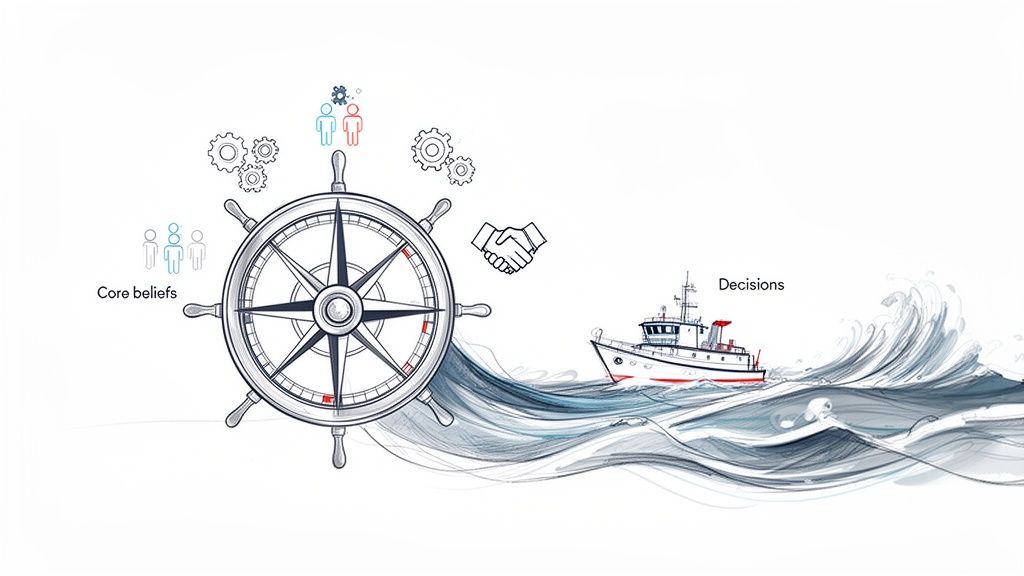
Let’s cut through the corporate jargon. Think of your values as the rudder on a ship.
They are the core beliefs that steer your company through both calm seas and rough storms, making sure everyone is pulling in the same direction. Without a clear set of values, a company is just drifting—vulnerable to shifting priorities, inconsistent decisions, and a culture that feels fractured and confusing.
When you get them right and truly embed them, your values become the invisible force that aligns every person on your team, from the C-suite right down to the front lines.
These principles are the foundation of your company’s identity and a huge part of your wider organizational culture. While the terms are sometimes used interchangeably, it's crucial to understand how they connect. To dive deeper, you can explore our detailed guide on what organizational culture really is.
The Different Types of Values in Your Business
Here’s a hard truth: not all values are created equal. Leaders often struggle with the massive gap between the values they say they have and the ones their teams actually live by every day. A stark study by Gallup found that only 2 in 10 employees feel a strong connection to their company's culture, usually because the official values just don't match reality.
Understanding the different kinds of values playing out in your business is the first step toward building a culture that’s authentic, powerful, and real.
Decoding Your Company's True Values
This distinction is everything. Just stating a value means nothing; it has to show up in daily behaviours and processes. Traditional HR surveys might tell you what people think about your official values, but they almost always miss the subtle, unspoken rules that reveal what’s truly driving your culture.
A business intelligence tool like Wurkn moves beyond static surveys, providing a real-time view of how values are actually perceived and lived. It helps leaders identify the disconnect between aspirational goals and on-the-ground reality, turning cultural insights into actionable intelligence that drives strategy—a leap beyond what typical HR survey tools can offer.
To help you diagnose what's really steering your organization, let’s break down the three types of values you'll find in any business.
| Value Type | Definition | Example | Business Impact |
|---|---|---|---|
| Aspirational Values | The values a company wants to have but doesn't yet fully embody. | A slow-moving company states "Agility" is a value but still has a rigid, multi-layered approval process. | Can create cynicism and employee disengagement if there's no clear plan or action to bridge the gap. |
| Accidental Values | Unintended norms that arise from common behaviours, often conflicting with official values. | A company promotes "Work-Life Balance" but managers consistently reward those who work late and on weekends. | Leads to confusion and burnout. It reveals the true, unspoken rules of what it takes to succeed in the company. |
| Core Values | The deeply ingrained principles that genuinely guide actions and define the company's identity. | A business with a core value of "Customer Obsession" empowers all employees to issue refunds without manager approval. | Drives consistent behaviour, attracts and retains aligned talent, and builds a strong, predictable brand identity. |
Getting honest about which of these values are actually running your company is the only way to close the gap between the culture you have and the one you want.
Why Your Values Are a Strategic Business Asset
Let's be honest. For too long, "corporate values" have been relegated to the HR department—a fluffy topic for onboarding slides and the occasional town hall. That mindset isn't just outdated; it's costing you money. For any C-suite or operations leader, understanding your values isn't a 'soft' skill. It's about wielding a hard-edged business tool that directly drives performance, profitability, and your position in the market.
When values are truly baked into your operations, they become a powerful lever for getting things done. Think about a value like ‘Radical Accountability’. That’s not just a nice phrase for a poster. It’s a mechanism that slashes project delays and kills budget overruns before they start. Teams that live this value take ownership, flag roadblocks early, and hunt for solutions. Efficiency becomes the default setting.
Or take ‘Customer Obsession’. This isn't about being friendly; it translates directly into financial wins. It empowers your team to solve problems on the spot, leading to higher Net Promoter Scores (NPS) and a measurable increase in customer lifetime value. Your values are the very architecture for the behaviours that produce your most critical business outcomes.
Driving Performance Through Principled Action
At every level of your company, values act as a simple, powerful filter for making decisions. When an employee or a leader hits a complex crossroads, they can ask one question: which path best reflects who we are? This alignment doesn't just feel good; it accelerates decisions and ensures consistency across the board, from product development to customer service.
This isn’t just a private-sector game. Look at Statistics Canada. Their departmental plan for 2025-26 explicitly links values like integrity and delivering results to razor-sharp performance metrics. As stated in their Statistics Canada Departmental Plan, the agency is gunning for zero post-release corrections on critical data and 90% conformance with global standards. It's proof that values-driven goals can be measured with absolute precision.
For leaders, this is the critical takeaway: a strong value system simplifies complexity. It provides a shared framework that empowers teams to act autonomously yet cohesively, reducing the need for constant top-down management.
This framework is the key to managing your company’s most important asset—its people and culture.
The ROI of a Value-Driven Culture
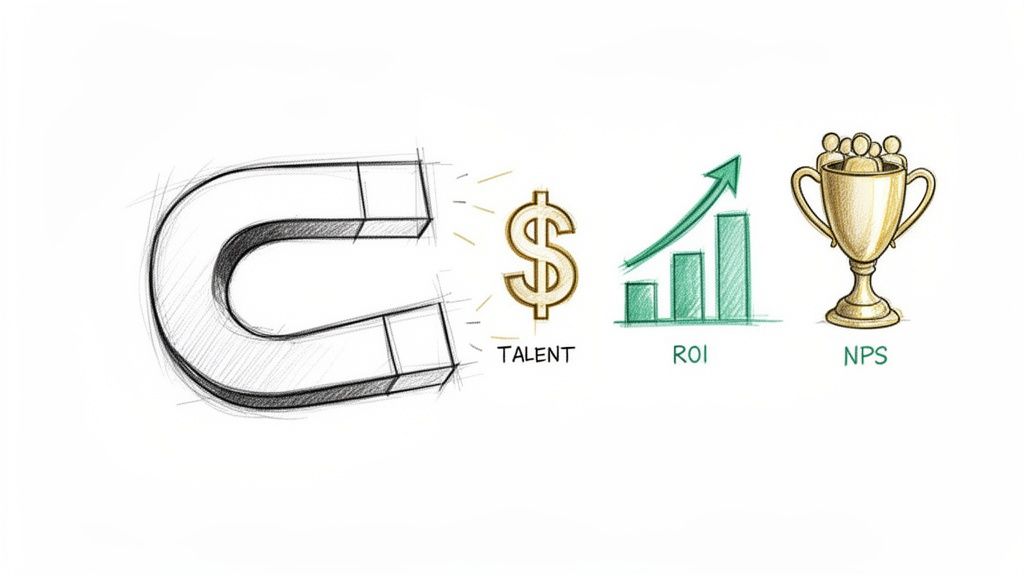
In the hyper-competitive talent markets across Canada and the US, authentic values are a magnet for top performers. The best people aren't just hunting for a paycheque. They’re looking for purpose and a workplace that mirrors their own principles. A set of values that you clearly define and consistently live by becomes a massive competitive advantage in recruitment.
This attraction has a direct, measurable impact on your bottom line:
- Reduced Recruitment Costs: A strong, positive culture naturally attracts more inbound applicants, cutting your dependency on expensive headhunters.
- Improved Employee Retention: When people feel connected to the company's values, they're more engaged and far less likely to leave. This slashes the painfully high cost of turnover.
- Enhanced Brand Reputation: Your values are your brand. A company known for integrity, innovation, or community focus builds deep trust with customers and partners.
But here’s the catch: this asset is fragile. Traditional annual surveys are useless for monitoring the real-time health of your culture. They leave you blind to the growing disconnects between the values on the wall and what your employees are actually experiencing.
This is where a business intelligence tool like Wurkn provides a strategic advantage. It gives you a continuous, live view of your culture by tapping into the ambient signals from the digital tools your teams already use every day. Instead of a stale, once-a-year snapshot from an HR survey tool, you get actionable cultural intelligence. Wurkn transforms qualitative feedback into a strategic dashboard, showing you exactly how your values are being lived—or ignored—and connecting cultural strength directly to your business KPIs. If you want to protect and grow your cultural asset, you have to move beyond outdated measurement.
Separating Powerful Values From Performative Gestures
Is your company truly living its values, or is it just performing 'values theatre'? It’s a tough but essential question for every leader because that gap between what you say and what you do is precisely where culture breaks down.
The real meaning of your corporate values isn't found on a poster in the lobby. It's found in the thousands of tiny decisions and actions that happen every single day.
Performative values are those empty slogans that sound incredible in a town hall but completely evaporate when the pressure is on. A company might have ‘Innovation’ plastered on its walls, but its managers quietly penalize employees for experiments that don't pan out. This kind of disconnect doesn't just feel fake; it actively teaches your team that playing it safe is the only way to survive.
On the other hand, a business that truly embeds a value like ‘Transparency’ proves it by doing the hard stuff—like practicing open-book management or sharing difficult news with brutal honesty. Real authenticity is all about alignment. It's about making sure your systems, your processes, and your leaders' behaviours all reinforce the principles you claim to believe in.
The Litmus Test for Authentic Values
So, how can you tell if your culture is healthy? The difference between powerful values and performative ones becomes crystal clear when you look at how decisions get made, how leaders actually behave, and what employees experience day-to-day.
A classic mistake is confusing flashy perks with deep-seated values. Offering "unlimited vacation" to signal a commitment to 'Work-Life Balance' is pure theatre if the underlying culture shames people for actually taking time off. True cultural health isn't about the benefits package; it's about the consistent, often subtle, behaviours that show what your company really prioritizes when push comes to shove.
To help you see the difference in your own organization, let’s break down how a value like ‘Transparency’ shows up when it’s real versus when it's just for show.
Authentic Values vs. Values Theatre
The table below offers a direct comparison of how a core value manifests in the real world. One side builds trust and high performance; the other breeds cynicism and disengagement.
| Cultural Aspect | Authentic Values (e.g., Transparency) | Performative Values (e.g., 'Transparency') |
|---|---|---|
| Leadership Behaviour | Leaders openly discuss challenges and share the 'why' behind tough decisions, even when the news is bad. | Leaders share only positive news, spin failures, and keep critical business information siloed within the C-suite. |
| Decision-Making | Information and data are widely accessible, empowering teams at all levels to make informed choices aligned with company goals. | Decisions are made behind closed doors with little context, leaving employees feeling confused and disconnected from the strategy. |
| Employee Perception | Employees feel safe to ask difficult questions and raise concerns without fear of reprisal, fostering high psychological safety. | Employees learn that asking challenging questions is career-limiting, leading to a culture of silence and passive agreement. |
| Systems & Processes | Financials, performance metrics, and project statuses are shared broadly to create a sense of shared ownership and accountability. | The company hosts 'Ask Me Anything' sessions where tough questions are filtered or given vague, non-committal answers. |
As you can see, the performative version isn't just a weaker imitation—it actively undermines the very value it claims to support.
Moving Beyond Superficial Metrics
Here’s the challenge for leaders: traditional tools like annual surveys are terrible at spotting this kind of cultural hypocrisy. An employee might check a box saying they "understand the company's values" while simultaneously feeling the sting of performative nonsense every single day. These surveys only capture surface-level opinions and miss the deeper cultural currents entirely.
This disconnect is precisely why genuine cultural intelligence is so critical. It’s about understanding the subtle, ambient signals that reveal the true employee experience, not just what people are willing to say in a formal survey.
This is where a business intelligence tool like Wurkn gives you an incredible advantage over standard employee engagement platforms. By analyzing anonymized, continuous feedback from the digital spaces where work actually happens—like Slack or Teams—Wurkn provides a live, unfiltered view into your culture. It goes far beyond what an HR survey tool can do by helping leaders see past the official corporate-speak and diagnose the real gaps between stated values and lived reality. This is how you move beyond values theatre and start building a culture with real integrity and trust.
A Practical Guide to Defining Your Corporate Values
Let's get one thing straight: defining your corporate values isn't some fluffy executive retreat activity that ends with a nicely framed poster on the wall. It's a hardcore operational necessity. This is especially true for remote and hybrid teams across Canada and the United States, where culture isn't built by accident in the breakroom—it has to be built on purpose.
The whole point is to forge a playbook that turns abstract ideas into the actual DNA of your company. That means creating values that aren’t just words you say, but principles you live out, measure, and reinforce in every single part of the business.
Start With Inclusive Discovery
The best, most powerful values are always discovered, not dictated from on high. When leaders disappear into a boardroom and emerge with a list of values, they’re just setting the stage for "values theatre"—a performance that everyone sees through and that breeds instant cynicism.
To get it right, the process has to be inclusive from the very beginning.
Run workshops that bring together a true cross-section of your organization, from the newest hire to the most senior leader. Your goal is to unearth the unspoken rules that already drive success in your best teams. Dig deep with questions that get to the heart of what makes you, you:
- When were we at our absolute best as a company? What specific behaviours got us there?
- Picture a colleague you really admire. What do they do that makes them so effective and respected?
- If we had to pick one non-negotiable principle to guide every single decision, what would it be?
These conversations are where the gold is. They reveal the authentic, grassroots beliefs that already exist, ensuring the final values feel real and are instantly recognizable to everyone. That’s how you get genuine buy-in and shared ownership.
Weave Values Into Every Employee Touchpoint
Once you've boiled down your core principles, the real work starts. To avoid the classic "set it and forget it" trap, you have to systematically stitch your values into the fabric of the employee lifecycle. It's the only way they become a living, breathing part of your culture.
Think of it as a simple feedback loop: what you say your values are, what you actually do to reinforce them, and how you measure their impact.
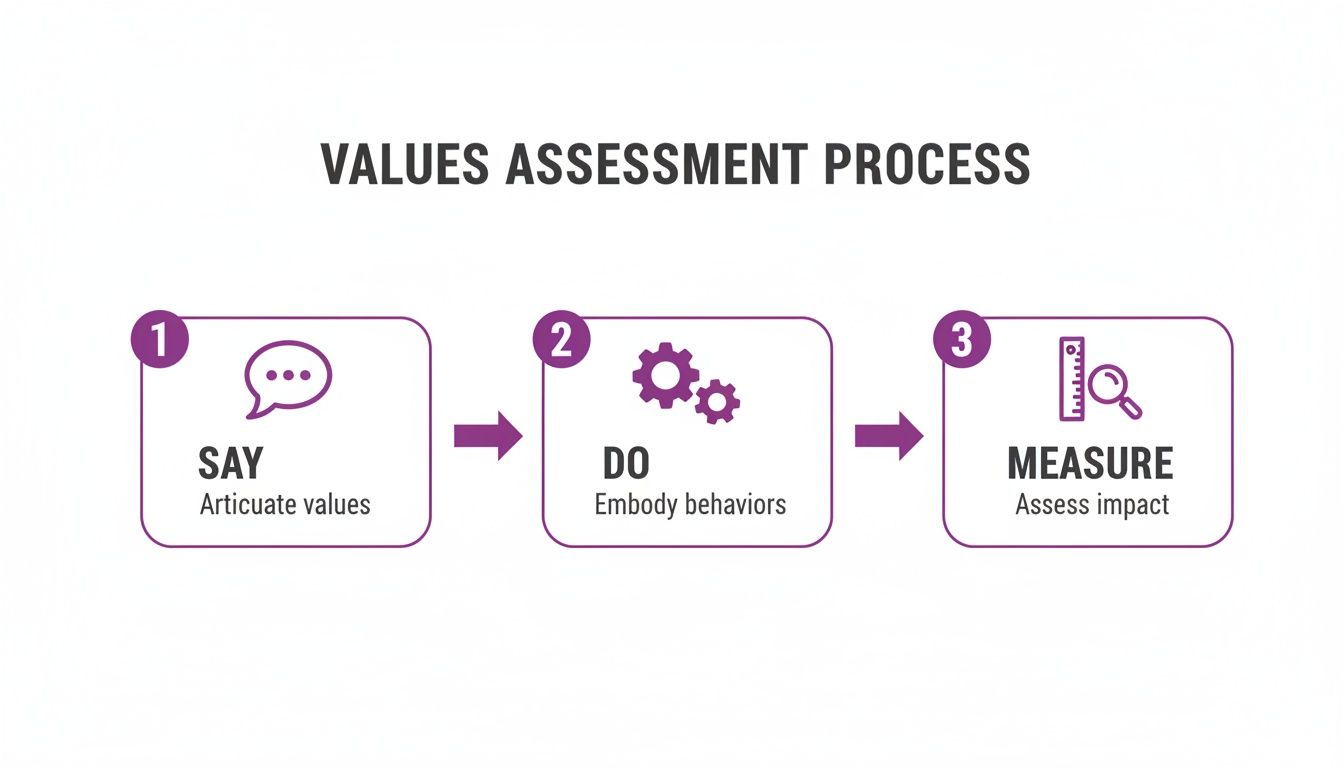
When these three things are in sync, you have the foundation of an authentic culture. It’s how you guarantee your stated values are constantly backed up by your actions and proven by your data.
Here's a no-nonsense framework for making your values operational:
-
Hiring and Onboarding: Go way beyond just checking for skills. Craft behavioural interview questions designed specifically to screen for alignment with your values. If "Radical Accountability" is a value, ask a candidate to walk you through a time a project they owned went completely off the rails and what, exactly, they did about it.
-
Performance Management: Your values need to be a formal part of your performance review criteria. Period. This sends the unmistakable message that how the work gets done is just as critical as what gets done. People who are living examples of the values should be explicitly recognized and rewarded for it.
-
Recognition and Rewards: Build your recognition programs around your values. A public shout-out in a company-wide channel celebrating someone who embodied "Customer Obsession" will do more to reinforce that value than a dozen memos ever could.
-
Daily Rituals: Weave your values into the rhythm of daily work. Kick off team huddles by sharing a quick win that connects to a core value. When announcing big decisions in all-hands meetings, frame the "why" through the lens of your principles.
This constant, multi-channel reinforcement is what it takes. It’s the process that transforms words on a page into the driving force behind every decision your team makes. It’s a continuous cycle of saying it, doing it, and measuring it to ensure your culture becomes—and remains—your greatest strategic asset.
How to Measure Your Culture Beyond Annual Surveys
Let's be honest: annual surveys are like a single, posed photograph of a fast-moving train. They capture one frozen moment in time but completely miss the dynamic, living reality of your company culture. For years, these surveys have been the go-to tool for leaders trying to get a pulse on their organization. But they are fundamentally broken.
These old-school methods are riddled with flaws that make their data questionable at best. Your people are dealing with survey fatigue, which means you get rushed, disengaged responses. Recency bias skews the results, as feedback is often coloured by last week's frustrating meeting rather than the entire year. Most importantly, they fail to capture the subtle, real-time interactions that truly define your culture and give your corporate values meaning.
From Static Snapshots to Live Intelligence
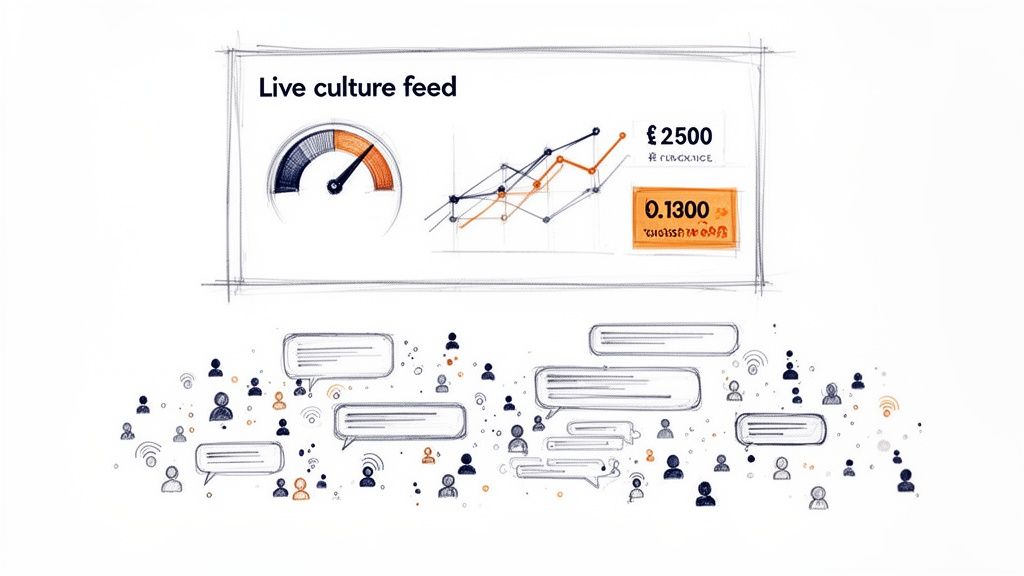
If you genuinely want to know if your values are being lived out, you have to move beyond outdated feedback models. It's time to embrace a modern, business intelligence approach for your culture. This isn’t about collecting more data once a year; it’s about plugging into a continuous, live feed of your organization's health.
This shift isn't happening in a vacuum—it mirrors a much broader trend in data strategy. Look at how Statistics Canada's Data Strategy is tackling data governance to build accountability within Canada's public service. By formalizing data stewardship and collecting anonymized insights, they create a reliable feedback loop to inform policy. For any leader, especially those with distributed teams across the United States and Canada, this highlights the need for always-on, trustworthy analytics on what drives your culture.
This is where a purpose-built tool like Wurkn comes in. It’s designed to do something traditional employee engagement platforms can't: transform the qualitative, often invisible, data of culture into a strategic, quantitative dashboard.
Instead of asking people how they feel once a quarter, cultural intelligence tools listen to how work is actually happening, every single day. They analyze the ambient signals from the digital channels where your culture is truly forged—like Slack and Microsoft Teams.
Turning Ambient Signals into Actionable Insights
Wurkn's AI-driven analysis—which includes human oversight to ensure context and accuracy—gives you a real-time understanding of how your values are being perceived and lived. It taps into anonymized, ambient data from everyday work to reveal the hidden drivers of your culture.
Suddenly, you have visibility into the critical questions that annual surveys could never hope to answer:
- Value Alignment: Is our value of "Radical Candour" actually fostering healthy debate, or is it just creating a climate of fear?
- Behavioural Trends: Are managers consistently recognizing people for behaviours that align with our values, or is there a major disconnect?
- Emotional Tone: What’s the real sentiment in conversations around our new strategy? Are people excited, or are they anxious?
By turning these ambient signals into a strategic dashboard, Wurkn provides leaders with actionable intelligence that goes beyond simple engagement metrics. It connects the dots between cultural strength and tangible business outcomes like productivity, innovation, and retention. You're no longer guessing about the health of your culture—you're measuring it.
This shift moves you from reacting to cultural problems to proactively shaping the environment where your values—and your business—can truly thrive. If you're ready to go deeper, it’s worth taking the time to understand why eNPS isn’t enough to accurately measure company culture.
The Leader’s Role in Bringing Values to Life
Corporate values are nothing more than words on a wall until a leader’s actions give them meaning. Culture is a top-down phenomenon. Your team is always watching, taking behavioural cues from managers and executives to figure out what really matters around here. If a leader's actions don't line up with the plaques in the lobby, the values become a joke.
Becoming a true champion for your company’s values isn’t about grand, sweeping speeches. It’s about the thousand small, consistent decisions you make every single day. It’s in how you frame a tough choice, the way you deliver feedback, and whether you hold yourself to the same high standards you expect from everyone else.
From Abstract Principles to Tangible Norms
Leaders are the critical bridge between an abstract concept on a poster and the real-world, tangible norms of a team. When a manager consistently brings up a core value like “Own the Outcome” while dissecting a project setback, they’re not just reciting a slogan. They’re teaching their team that accountability is a non-negotiable part of how they operate.
This kind of consistent modelling is what turns a corporate buzzword into a shared behaviour. A leader who champions a value like "Honesty," for instance, has to be the first one to admit they made a mistake or to deliver difficult news with transparency. That’s what builds the psychological safety for everyone else to do the same.
The real definition of your corporate values is found in the behaviour leaders reward and tolerate. When there's a gap between what leaders say and what they do, employees will always, always follow what they do.
Leading by Example in Practice
Making values a core part of leadership demands deliberate, everyday action. A fantastic example of this comes from the Canadian federal public service. As outlined in a self-assessment report, leaders at Statistics Canada actively worked to embed values like integrity and respect into their culture, kicking things off with an Executive Townhall focused on practical ways to live those values. Directors then personally led over 90% of divisional sessions, and more than 92% of executives confirmed the discussions effectively tackled real-world concerns. You can learn more about how Canadian public service leaders are driving values on the ground.
Here are a few practical techniques for managers at any level:
- Frame Decisions Through Values: When you have to make a tough call, walk your team through the "why" by explicitly connecting the decision to a specific company value. This shows how strategy and culture are intertwined.
- Give Value-Based Feedback: Ditch the generic praise. Instead, tie positive feedback directly to a value. Say something like, "The way you brought the other team into the loop on that issue perfectly embodied our 'One Team' value."
- Hold Everyone Accountable: This is the toughest part, but it's also the most important. Leaders have to address behaviours that fly in the face of the company’s values, even when it’s a top performer doing it. This sends the clearest possible signal about what truly matters.
While these actions are essential, leaders—especially in remote or hybrid setups—often struggle with visibility into the day-to-day cultural dynamics. Traditional HR tools and annual surveys are far too slow and clunky to capture the subtle cues that show whether values are actually taking hold.
This is exactly where a business intelligence tool like Wurkn gives you an edge. It provides a continuous, real-time picture of how your values are being discussed and perceived in daily work. With Wurkn, leaders can stop guessing about their cultural health, spot misalignments the moment they start, and make data-informed moves to reinforce the exact culture they’re trying to build.
Common Questions (and Straight Answers) About Corporate Values
When you start getting serious about corporate values, a few tough questions always pop up. Leaders often wonder about the practical side of things—how many is too many? Can they change? And what's the one mistake that can derail the entire effort? Let's get into it.
How Many Corporate Values Should We Actually Have?
Keep it simple. Aim for three to five core values. This is the sweet spot. It's a small enough number for everyone in the company to actually remember and use in their daily work, but it's also broad enough to provide real guidance when things get complicated.
If you have a laundry list of ten or more values, they just become noise and nobody remembers them. On the flip side, having only one or two might not give your teams enough of a compass to navigate all the different situations they face. The goal is to lock in on the handful of principles that are absolutely non-negotiable for who you are and where you're going.
Can Our Company's Values Change Over Time?
Yes, but it needs to be a deliberate, strategic evolution—not a knee-jerk reaction. Think of your core values as the long-term foundation of your company. They should be stable. That said, a "values refresh" every few years is not only healthy, it's often necessary. This is especially true as you scale, expand into new markets like Canada or the United States, or when your entire industry goes through a major shift.
The key is to avoid constant tinkering, which just creates confusion and signals instability. Any refresh should be a thoughtful process that actively involves your employees. If the people living the values every day don't feel connected to them, they won't stick.
What Is the Biggest Mistake to Avoid With Values?
The single biggest failure is falling into the "set it and forget it" trap. It happens all the time. A company spends a ton of energy creating these amazing, inspiring value statements, prints them on posters, and then… nothing. They become meaningless wall art. This is incredibly damaging because it creates a culture of cynicism. Employees see a massive gap between what leaders say is important and what the company actually does.
When your stated values aren't baked into how you hire, who you promote, and what you celebrate, they're just empty words. This disconnect is the fastest way to destroy trust and engagement.
The only way to avoid this is through constant reinforcement and measurement. You have to make sure your values are a living, breathing part of how your company operates, not just a forgotten project from HR. This is where cultural business intelligence comes in. A tool like Wurkn gives you visibility into whether your values are truly being lived, moving you from guesswork to action. By monitoring the real-time health of your culture, you ensure your principles remain a powerful strategic asset.
Ready to move beyond static surveys and get a live, continuous view of your culture? See how Wurkn transforms ambient feedback into actionable business intelligence that connects your values directly to performance. Get the clarity you need to build a stronger, more aligned organization at https://wurkn.com.