
To truly get a handle on employee morale, we need to stop reacting to problems and start predicting them. The old way—waiting for the results of an annual HR survey—is fundamentally broken. It’s like trying to navigate a ship by looking at the wake it left behind.
Instead, a modern approach requires diagnosing issues as they bubble up, making quick, targeted fixes, and then building those wins into sustainable cultural habits that actually drive business results.
Moving Beyond Surveys to Understand What Drives Morale
For a lot of leaders in Canada and the United States, employee morale can feel like a foggy, abstract concept. It’s something you know is important, but it's incredibly difficult to pin down, let alone measure effectively. Historically, we've leaned on those big, once-a-year HR surveys to get a read on the room.
The problem? By the time you get the data, analyze it, and present it, the context is gone and the damage is often done. You're looking at a snapshot of a problem that has already taken root, leaving you powerless to get ahead of it.
This playbook is about ditching that limited view. We're shifting the focus from a once-a-year data dump to building a system of continuous cultural intelligence. The aim isn't just to find out what your people are feeling, but to understand why they're feeling it and how that connects directly to critical metrics like productivity and retention.
Before we dive into the specific tactics, here's a quick overview of the core strategies we'll be covering. Think of this as your high-level game plan.
Core Strategies for Improving Employee Morale
| Strategy Area | Key Focus | Expected Business Outcome |
|---|---|---|
| Diagnose | Moving from annual surveys to real-time, anonymous feedback to spot issues early. | Reduced unexpected turnover and early identification of productivity bottlenecks. |
| Fix (Quick Wins) | Implementing immediate, visible changes based on feedback to build trust. | Increased employee engagement and a tangible boost in team sentiment. |
| Sustain | Embedding positive changes into leadership habits, processes, and recognition programs. | Higher long-term retention, improved team performance, and a stronger employer brand. |
This table lays out the fundamental shift from a reactive HR function to a proactive operational strategy, where culture is treated as a key business driver.
From Lagging Indicators to Real-Time Insights
To genuinely improve morale, you have to treat it like any other critical business metric. That means abandoning tools that only give you lagging indicators. An annual engagement score from a traditional survey is like using last quarter's sales figures to plan next week's inventory—it's simply too little, too late.
This is where a more modern, continuous approach comes in.
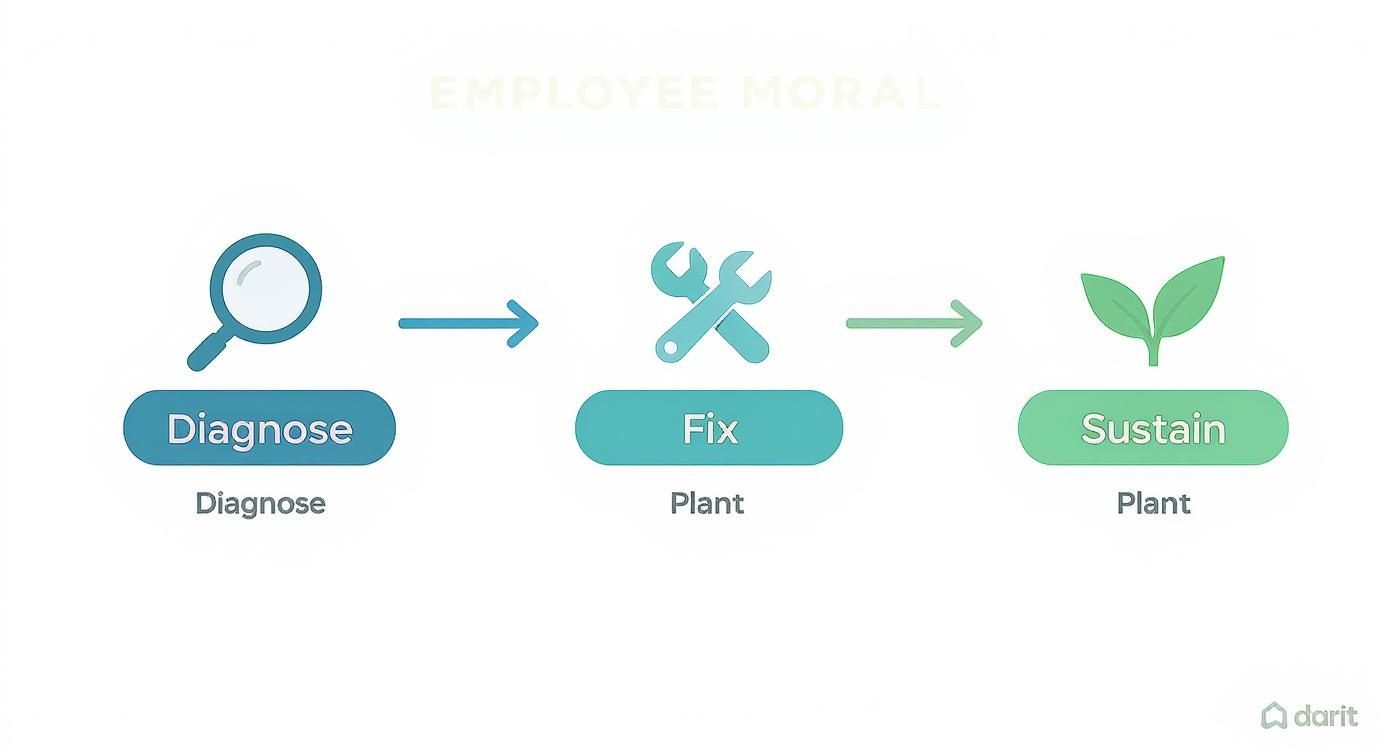
This diagram shows a cycle of diagnosing issues, implementing fixes, and building sustainable habits—a process far more effective than a simple annual check-in. This is where a business intelligence tool like Wurkn provides a different kind of value than traditional HR platforms. It's not about just spitting out survey data. It captures always-on, anonymous feedback and translates that sentiment into actionable intelligence that helps you get in front of problems before they escalate.
You can learn more about why standard metrics just aren't cutting it anymore in our guide on accurately measuring company culture.
The Business Case for Proactive Morale Management
Making morale a priority isn't just a "nice-to-have" for the HR department; it's a strategic imperative with a clear impact on your bottom line. The link between employee well-being and retention is impossible to ignore.
Consider that 47% of employees say work-related stress negatively impacts their mental health (Eagle Hill Consulting, 2023). Even more telling, a staggering 83% would consider leaving a job if their employer failed to prioritize well-being (Aflac, 2023). The cost of ignoring these signals is very real.
Today's leaders in Canada and the United States can't afford to operate on gut feelings about their teams. A business intelligence approach to culture connects the 'soft' signals of morale to the 'hard' metrics of performance. It empowers you to make smarter, data-driven decisions that create a thriving, productive, and resilient workforce.
Diagnosing the Root Causes of Low Morale
When you feel that dip in your team's energy—missed deadlines, quieter meetings, a few more sick days than usual—it's tempting to jump straight into solutions. But hold on. Those are just the symptoms.
The real problem is almost always buried deeper, and you can't fix what you can't find. Treating low morale without knowing its source is like trying to fix a complex engine with a single wrench. You might tighten a loose bolt, but you’ll completely miss the systemic issue that's causing the breakdown.
Let's be honest, the days of relying on an annual engagement survey or a dusty suggestion box are long gone. Those tools give you a static, often outdated, snapshot of your organization's health. To actually move the needle on morale, you need to shift from asking broad questions once a year to digging into specific, real-time cultural data.
Beyond the Obvious Answers
A traditional survey might tell you that 30% of employees are unhappy with their pay. Okay, that's a data point, but it's not an insight. It lacks the context you need to do anything meaningful.
It doesn't tell you who is dissatisfied or, more importantly, why. Is it your new hires in Vancouver struggling with the high cost of living? Or is it your senior sales team in Chicago who feel their commission structure is stuck in the past?
This is where a business intelligence tool like Wurkn goes way beyond a simple survey. It connects the dots between anonymous sentiment and what's actually happening on the ground.
Instead of just seeing a generic "low satisfaction with compensation," you might discover that this feeling is concentrated within your top-performing engineering team in Toronto. Even better, you might see that this sentiment directly correlates with a recent spike in anonymous chatter about burnout and unrealistic project timelines—not just salary.
Suddenly, the diagnosis shifts. It’s not a simple pay problem; it's a complex issue of potential burnout among your most critical talent.
An accurate diagnosis happens at the intersection of what employees say, how they feel, and what the business is doing. Without connecting these dots, you’re just guessing.
A Practical Diagnostic Checklist
To start peeling back the layers, you need a structured way to look at the real drivers of morale. Before you even think about launching another survey, start by assessing your organization's health across these critical areas. This approach helps you zero in on the specific friction points that are dragging your team down.
Here are four core areas I always investigate first:
-
Communication and Transparency
- Do people actually know the company's direction and the "why" behind big decisions?
- Is communication a two-way street, or is it just broadcast from the top down?
- How fast does critical information get shared, especially during times of change? A long delay here kills trust.
-
Workload and Well-being
- Is there an "always-on" culture, or is downtime actually respected? Check for patterns of after-hours emails and messages.
- Do your teams have the resources they need to get their work done without being chronically stressed?
- Are workloads spread out fairly, or are a few key people constantly overloaded?
-
Recognition and Appreciation
- How often are people recognized for their work, both big and small? If it only happens at the annual review, it's too little, too late.
- Is the recognition specific and meaningful, or is it just generic praise that doesn't land?
- Do you have a way for peers to recognize each other? This builds a much stronger sense of team.
-
Growth and Opportunity
- Can your people see a clear path forward for their careers inside the company? Research shows 63% of workers who quit cite a lack of career growth (Gartner, 2021).
- Are there real opportunities for them to learn and develop new skills?
- Are managers having regular, meaningful chats with their people about their career goals?
Using this checklist helps you get from a vague feeling that "morale is low" to a specific, actionable diagnosis. You might find that while pay is fine, a total lack of recognition is making your team feel invisible. Or maybe your communication is great, but the dead-end career paths are causing your best people to quietly update their résumés.
By digging deeper with this kind of intelligence-led approach, you set the stage for targeted changes that actually work. To sharpen your questions even further, you can explore some best practices for designing an effective employee satisfaction survey that captures this kind of nuanced feedback.
Quick Wins to Rebuild Trust and Momentum
Okay, you’ve done the hard work of diagnosing what’s really going on with your team's morale. Now comes the most critical part: acting on it. And you have to act fast. This is your moment to prove you were actually listening and are serious about making a change. Forget the long-term strategic plans for now. This is all about quick, visible wins that start rebuilding trust and get some positive momentum going.
Let’s be clear: this isn’t about ordering pizza or handing out company swag. While the intention might be good, those kinds of perks can feel completely tone-deaf when people are dealing with real burnout or a total lack of transparency. The goal here is to roll out high-impact, low-cost changes that directly hit the pain points you just uncovered.
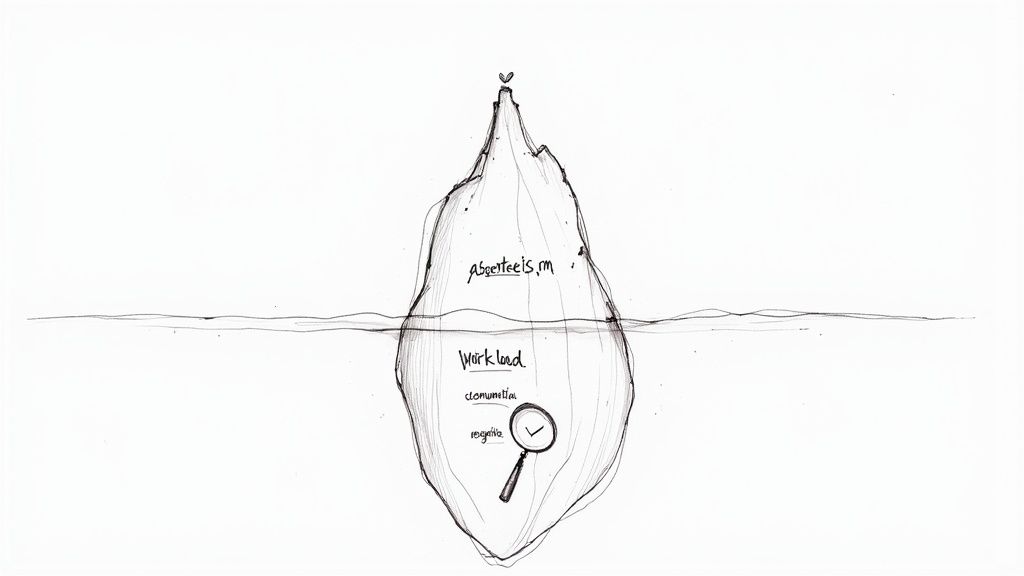
Real improvement happens when you stop focusing on the tip of the iceberg and start tackling what's underneath. Meaningful changes show your team that leadership gets it and is committed to fixing things at a fundamental level.
Make Leadership Visible and Accessible
One of the fastest ways to start mending broken trust is to pull back the curtain on leadership. When employees feel disconnected from the people making decisions, they tend to assume the worst. You can short-circuit that cycle with proactive, open communication.
A powerful first move is to have senior leaders host a truly transparent 'Ask Me Anything' (AMA) session. I’m not talking about a polished, pre-screened town hall. This needs to be a raw, candid forum where no question is off the table. Leaders have to be ready to tackle the tough stuff head-on—whether it's about the company's direction, recent changes, or specific team concerns.
By opening the floor for unscripted dialogue, leaders demonstrate vulnerability and a genuine willingness to listen. This single act can do more to restore psychological safety than months of internal memos.
Another great tactic is for executives to set up regular, informal "office hours." It creates a consistent, low-pressure way for anyone in the company to connect with leadership, share an idea, or raise a concern without having to navigate the formal hierarchy.
Give Back Time and Reduce Friction
If your diagnosis pointed to burnout and overwhelming workloads, giving people back their time is one of the most valuable things you can do. The constant firehose of meetings and notifications is a huge source of stress and kills productivity in organizations all over Canada and the U.S.
Try implementing one of these changes immediately:
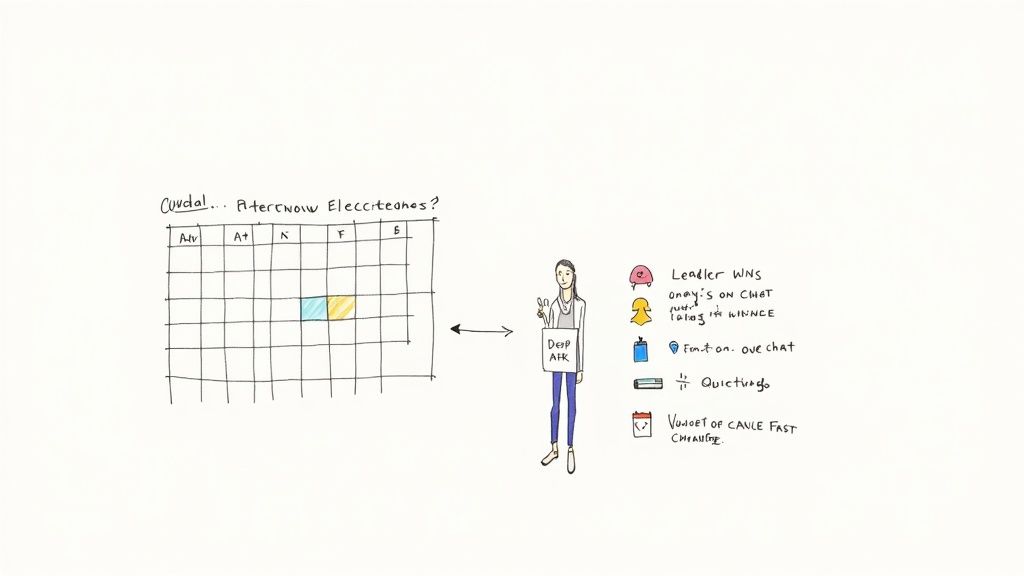
- Introduce "Deep Work" Time: Block out a recurring slot on the company-wide calendar—say, every Wednesday from 1 p.m. to 5 p.m.—as a "no meetings" zone. This gives everyone official permission to disconnect from calls and actually focus. It’s a practice that top tech firms from Vancouver to Austin are embracing for a reason.
- Declare a "Meeting-Free Friday": Take it a step further and get rid of all internal meetings on Fridays. This encourages teams to wrap up their weekly tasks and gives everyone a chance to catch up, entering the weekend with less on their plate.
- Audit Recurring Meetings: Empower your teams to take a hard look at every single recurring meeting on their calendar. Ask the simple question: "If this meeting disappeared tomorrow, would we miss it?" If the answer is no, kill it.
These changes cost absolutely nothing but send a powerful message: you respect your employees' time and focus. It’s a direct counterattack on the "always-on" culture that chips away at morale.
Strengthen Communication and Resolve Conflicts
Bad communication and simmering conflicts are like poison for team morale. Sometimes the biggest wins come from simply fixing how information flows and how disagreements get handled. Addressing these friction points can stop small frustrations from blowing up into major problems. For a deeper look at this, check out our guide on resolving unresolved conflict in workplace culture.
The key is to create clear, reliable channels for both sharing information and escalating issues. When everyone feels heard and knows that problems will be addressed fairly, you’re building the foundation of a healthy work environment.
Measure the Impact of Your Actions
So, how do you know if these quick wins are actually landing? This is where a business intelligence tool like Wurkn provides value that goes way beyond a traditional HR survey. Instead of waiting a year for the next big survey, Wurkn lets you see the immediate impact of your changes on employee sentiment in real-time.
For example, after you roll out "Meeting-Free Fridays," you can monitor anonymous feedback to see if there's a positive shift in conversations around work-life balance or productivity. This gives you instant feedback on what’s working. You can then double down on the strategies that resonate and tweak the ones that don’t. This continuous feedback loop turns improving morale from a guessing game into a smart, data-informed strategy.
Building a Sustainable High-Morale Culture
Quick fixes are great for stopping the bleed and showing your team you’re listening. But if you want to improve employee morale for the long haul, you have to move beyond short-term tactics. The real goal is building a sustainable culture where people feel valued, connected, and can actually see a future for themselves with your company.
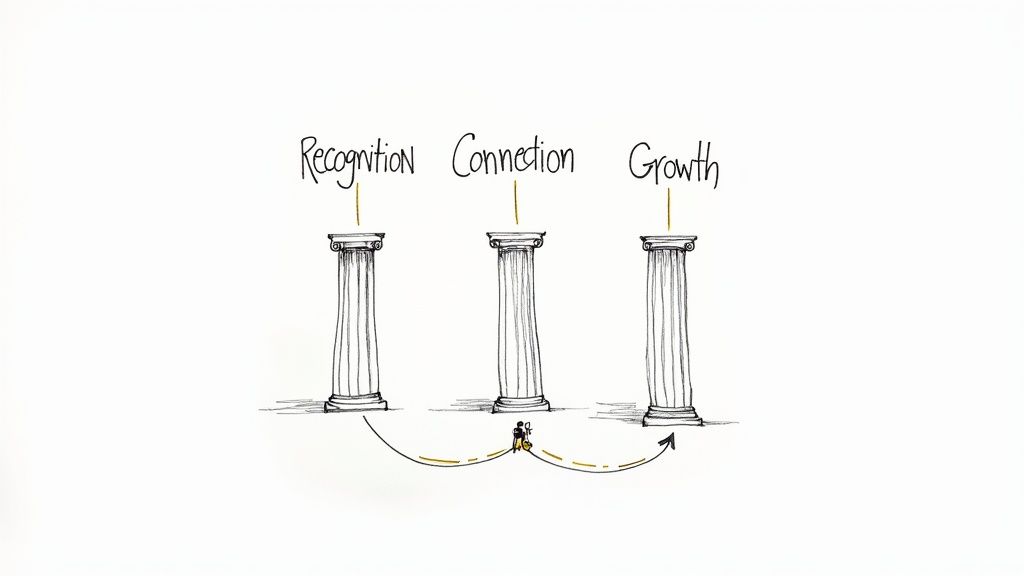
This means embedding positive practices so deeply into your company’s DNA that they become the default way of operating. Lasting change isn’t built on a single initiative; it’s the result of consistently reinforcing the right behaviours and systems. We'll zero in on three core pillars that underpin any high-morale culture: meaningful recognition, authentic connection, and clear pathways for growth.
When you get these elements right, high morale stops being a fleeting feeling and becomes a predictable outcome of a healthy environment.
Foster Meaningful and Consistent Recognition
Recognition is one of the most powerful tools in your arsenal, but only if you do it right. A generic "good job" in a meeting or an annual bonus just doesn't cut it anymore. Meaningful recognition is specific, timely, and frequent. It’s about celebrating both the major wins and the small, consistent efforts that really drive the business forward every single day.
Think about the software developer who stays late to fix a critical bug or the customer service agent who turns a frustrating client experience into a glowing review. Those moments are where your culture is truly built. To make recognition stick, you need systems that encourage it from every direction—not just top-down.
Here are a few practical ways to weave recognition into your cultural fabric:
- Implement a Peer-to-Peer System: Let employees celebrate each other. A dedicated Slack or Teams channel where anyone can give a public shout-out creates an incredible feedback loop of positive reinforcement. It’s simple, visible, and powerful.
- Link Recognition to Company Values: When you give praise, tie the action back to a specific company value. For example, "Thanks, Sarah, for jumping in to help with the Q3 report. Your willingness to collaborate is a perfect example of our 'One Team' value in action." This reinforces what matters.
- Make It a Leadership Habit: Train your managers to make recognition a core part of their weekly one-on-ones. A simple, specific compliment about an employee's contribution that week can be far more motivating than you’d think.
Cultivate Authentic Connection and Transparency
People are desperate to feel connected to their colleagues and leaders, especially in the remote and hybrid work models common across Canada and the United States. But authentic connection doesn’t just happen; you have to intentionally create it. It requires a real effort to break down silos and create space for genuine interaction.
This means everything from fostering cross-departmental projects to ensuring leadership communicates with transparency and a bit of vulnerability. When leaders openly share the "why" behind their decisions, and even admit when things are challenging, they build trust. It makes employees feel less like cogs in a machine and more like valued partners in the business.
A culture of high morale is built on a foundation of psychological safety—where people feel safe enough to be themselves, share wild ideas, and even admit mistakes without fearing blame. This always starts with leaders modelling that behaviour first.
Provide Clear Pathways for Growth
Feeling stuck is one of the biggest morale killers out there. When employees can’t see a path forward for themselves at your company, they disengage. And eventually, they leave. It’s no surprise that one study found 63% of workers who quit their jobs cited a lack of career growth opportunities as a primary reason (Gartner, 2021).
Creating clear growth pathways isn't just about promotions. It's about consistently investing in your people's development in ways that benefit both them and the company. This means having visible career ladders, offering real skill-building opportunities, and making professional goals a regular topic of conversation.
This is an area where technology is making a huge difference. As detailed in the latest HR tech trends on TimeForge, modern HR platforms are moving beyond basic functions. They now often include real-time employee feedback, personalized learning paths, and systems that promote peer recognition, all designed to help employers understand and respond to employee needs far more effectively.
From Simple Surveys to Strategic Intelligence
Sustaining a high-morale culture requires a much more sophisticated approach than a simple annual survey can ever provide. This is where you see the stark difference between a basic HR survey tool and a true business intelligence platform like Wurkn.
The old way of measuring morale with a once-a-year survey is like trying to navigate a ship with a map from last year. It gives you a snapshot of a moment in time, often too late to act on. A business intelligence approach, on the other hand, provides continuous, real-time data.
Traditional Surveys vs Business Intelligence
| Capability | Traditional HR Survey Tools | Business Intelligence Platforms (like Wurkn) |
|---|---|---|
| Data Frequency | Annual or quarterly | Always-on, real-time |
| Insight Type | Lagging indicator (what already happened) | Leading indicator (predicts future outcomes) |
| Focus | Measures satisfaction at a point in time | Links sentiment directly to business KPIs |
| Anonymity | Often perceived as risky by employees | Guarantees true anonymity, fostering honesty |
| Actionability | Vague, high-level feedback | Specific, department-level insights for action |
| Impact | Creates "survey fatigue" with slow follow-up | Enables immediate intervention and optimization |
Wurkn moves beyond just collecting feedback. It delivers continuous, anonymous cultural intelligence that helps you connect the dots. You can finally see how your initiatives—like that new recognition program or mentorship launch—directly impact hard business outcomes.
Imagine seeing how an improvement in sentiment around "career growth" directly correlates with a drop in turnover in your engineering department. Or how a spike in positive feedback on "leadership transparency" lines up with higher customer satisfaction scores. This is how you transform morale from a soft, fuzzy metric into a strategic driver of business performance.
Measuring the ROI of Improved Employee Morale
Every executive from New York to San Francisco wants to see the bottom-line impact of cultural initiatives. For too long, employee morale has been treated as a “soft” metric—important, but disconnected from the hard numbers that drive business decisions.
That perspective is fundamentally outdated. High morale isn't just a feeling; it's a powerful leading indicator of financial performance.
The key is to move beyond simple satisfaction scores and start connecting anonymous sentiment data directly to your most critical operational key performance indicators (KPIs). This is where the difference between a traditional survey tool and a true business intelligence platform becomes crystal clear. You need to be able to draw a straight line from a cultural improvement to a tangible business result.
Connecting Sentiment to Business Outcomes
Imagine being able to show your leadership team that a 15% improvement in morale within your customer support team led directly to a 10% decrease in average ticket resolution times last quarter. That’s the goal.
A business intelligence tool like Wurkn makes this possible by correlating anonymous sentiment trends with your operational data. You can finally prove the ROI of your efforts with concrete evidence.
This approach completely transforms the conversation. Instead of just saying, "Our people seem happier," you can confidently state, "The recognition program we launched in Q2 correlates with a 5% lift in customer satisfaction scores." This is the language that resonates with the C-suite and secures ongoing investment in your culture.
A Framework for Tracking Morale ROI
To demystify the ROI of morale, you need a clear framework. Morale isn't an isolated number; it’s an input that directly influences key outputs across the entire organization. Start by focusing on these four critical areas:
- Employee Retention and Turnover Costs: This is the most direct financial link. Calculate the true cost to replace an employee (recruitment, onboarding, lost productivity) and then track how a lift in morale chips away at voluntary turnover. A small reduction in churn can save hundreds of thousands of dollars.
- Productivity and Output: Look at tangible outputs relevant to each team. For an engineering team, it could be features shipped per developer. For a sales team, it could be the sales cycle length or lead conversion rates. Connect these hard metrics to sentiment data to show how a more engaged team simply produces more.
- Absenteeism and Presenteeism: Track unscheduled absences—a classic sign of low morale and burnout. But also, look for the more subtle "presenteeism," where employees are physically at work but mentally checked out. Reduced absenteeism directly translates to more productive hours worked.
- Innovation and Agility: A high-morale culture encourages psychological safety, which leads to more experimentation and better ideas. You can track this by measuring things like the number of new ideas submitted and implemented, or how quickly teams adapt to new strategic pivots.
Morale isn't an HR metric; it's a business performance metric. When you can show how a cultural initiative lowered turnover by 8% or accelerated product development, you're not just improving the workplace—you're driving the business forward.
The Financial Impact of a Valued Workforce
Compensation plays a foundational role in how employees feel valued, which in turn affects retention and engagement. While it's just one piece of the puzzle, its impact is undeniable.
Research shows that higher wages can correlate with improved employee engagement and decreased turnover, as workers feel more financially secure. Legislative changes affecting wages often prompt employers to also review health insurance and mental health support programs. These are holistic well-being efforts that directly impact morale. You can find more details on how legislative shifts influence workplace benefits by exploring these insights on new California laws.
By using a business intelligence tool, you can move beyond guesswork. You can analyze how different factors—from compensation sentiment to leadership transparency—impact your bottom line. This allows you to make smarter, data-backed decisions that prove the immense value of a high-morale workplace.
Your Top Questions About Employee Morale, Answered
Figuring out team sentiment can feel like navigating a minefield. As leaders across Canada and the United States get serious about building more resilient and productive teams, the same questions tend to pop up.
Let’s tackle some of the most common ones head-on. The answers all point to one clear truth: it's time to ditch the old, clunky survey model and adopt a smarter, intelligence-driven strategy if you want to see real change.
How Often Should We Be Measuring Employee Morale?
The annual or even quarterly survey is a relic. Let's be honest, morale isn’t a static metric you check once a year like a performance review. It ebbs and flows with every project, every leadership decision, every team interaction. Measuring it annually is like checking the weather forecast for a trip you took six months ago—the data is stale and useless.
For a real pulse on what's happening, you need a continuous, always-on approach. This doesn't mean spamming your team with daily surveys. It's about using a business intelligence tool like Wurkn that captures anonymous feedback from the digital channels where work already happens. This gives you a live look at sentiment, letting you spot trends and snuff out issues before they become full-blown crises.
Are Anonymous Surveys Really Anonymous?
This is a huge one, and for good reason. Your team is smart, and they're skeptical. If they suspect their feedback can be traced back to them, you’ll never get the raw, unvarnished truth you need to actually fix things.
Many basic HR survey tools offer a thin veil of anonymity that’s easily pierced, especially in smaller teams where demographic filters can quickly pinpoint individuals. A true business intelligence platform, on the other hand, is built from the ground up with privacy at its core.
Wurkn, for example, is engineered to guarantee anonymity. We do this by minimizing personally identifiable information, redacting submissions, and aggregating data so individuals are protected. This creates the psychological safety people need to be candid, giving you a far more accurate picture of your organization’s health.
What's the Difference Between Morale and Engagement?
People often use these terms interchangeably, but they’re not the same. It helps to think of it like this:
- Morale is the emotional climate of your workplace. It's the collective attitude, feeling, and satisfaction level of your team. High morale means people feel good about their work, confident in leadership, and secure in the company's direction.
- Engagement is the behavioural result of that climate. It's the passion, commitment, and discretionary effort someone puts into their job.
High morale is a powerful catalyst for high engagement. You can have an "engaged" employee who is working hard out of fear, but their morale is in the basement and they’re a major flight risk. If you focus on improving morale, you build the foundation for authentic, sustainable engagement that sticks around.
Can We Actually Improve Morale Without Just Throwing Money at People?
Absolutely. While fair pay is table stakes, it's rarely the main driver of day-to-day morale. Once you’ve covered the basics, more money doesn't magically fix a toxic culture, a lack of recognition, or a career path that leads nowhere.
Time and again, we see that the most powerful morale boosters have nothing to do with salary. They are things like:
- Meaningful Recognition: Simply feeling seen and valued for your work is a massive motivator.
- Leadership Transparency: When people understand the "why" behind decisions, it builds trust and quiets anxiety.
- Career Growth Opportunities: Seeing a real future for yourself at the company is a powerful reason to stay and contribute.
- Genuine Work-Life Balance: Giving people the flexibility to manage their lives reduces burnout and builds loyalty.
Focusing on these areas delivers a much bigger return than salary bumps alone. A tool like Wurkn can help you zero in on which of these non-monetary factors will have the biggest impact on your specific team.
Ready to stop guessing what drives your team? Wurkn transforms anonymous employee feedback into actionable business intelligence, connecting your actions directly to bottom-line results. See how our platform gives you the insights to build a healthier, more productive, and more resilient organization.