
When you get down to it, the real difference between OKRs vs KPIs is all about purpose. Think of it this way: KPIs are the gauges on your dashboard telling you how the business is running day-to-day, while OKRs are the GPS navigation system you plug a bold new destination into. One measures health; the other drives strategic change.
Understanding The Core Difference Between OKRs And KPIs
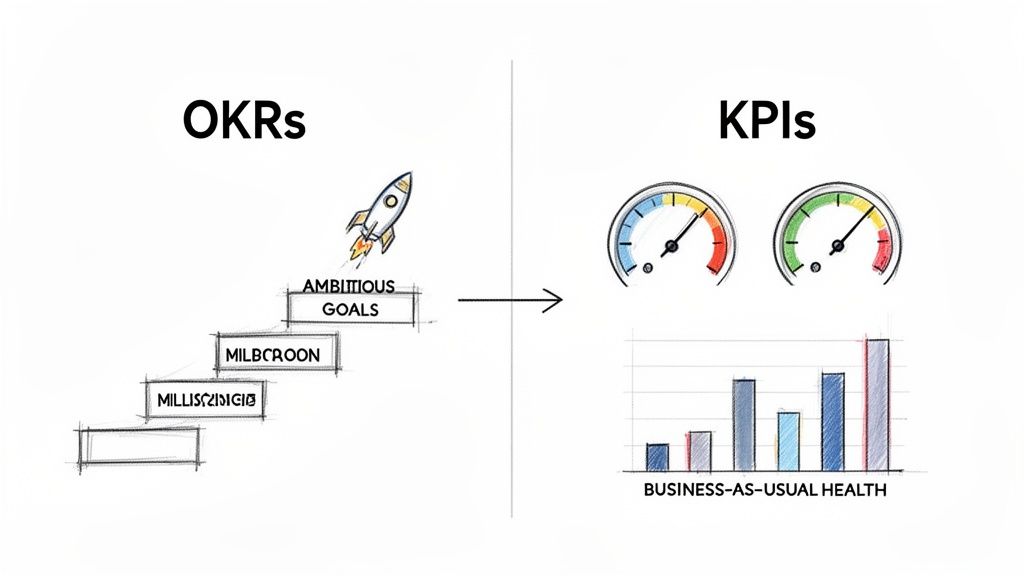
It’s easy to get tangled up in the alphabet soup of performance management, but getting Objectives and Key Results (OKRs) and Key Performance Indicators (KPIs) straight is crucial. While they both lean on metrics, they play fundamentally different roles in your strategy. Confusing them leads to unfocused effort and, frankly, stalled growth.
KPIs are the vital signs of your business. They are the hard numbers that tell you if your core, business-as-usual activities are healthy. For any COO or PeopleOps leader, these are the metrics you're glancing at constantly to make sure the operational engine is running smoothly.
A great way to think about KPIs is as health metrics. A doctor monitors your heart rate and blood pressure—those are your business's KPIs. If a number is off, it’s a red flag that something needs attention, but the number itself isn't a treatment plan.
In stark contrast, OKRs are built to push your organization into new territory. They’re a goal-setting framework designed to rally your team around ambitious objectives and track the results needed to get there. OKRs answer the big question: "Where are we trying to go, and how will we know when we've arrived?"
OKRs Push for Change, KPIs Maintain Stability
The main job of a KPI is to measure the output or health of a process you've already built. They're what you use to maintain standards or track steady, incremental improvements. For remote and hybrid teams in Canada or the US, some classic PeopleOps KPIs might be:
- Employee Net Promoter Score (eNPS) to keep a pulse on employee loyalty.
- Voluntary Turnover Rate to monitor retention and team stability.
- Time to Fill to measure how efficiently you're bringing in new talent.
OKRs, on the other hand, are all about making a significant leap forward. The Objective is a big, qualitative goal that feels aspirational, while its Key Results are the measurable milestones that prove you actually did it. For example, if your eNPS KPI has been flat for three quarters, you might create an OKR specifically to shake things up and drive that score upward.
An Objective is what you want to achieve. Key Results are how you'll measure your progress. If you achieve your Key Results, you've successfully reached your Objective. This structure forces clarity and focuses effort on outcomes, not just activities.
To make the distinction even clearer, here's a quick side-by-side look at how they differ in practice.
Quick Comparison OKRs vs KPIs
| Attribute | OKRs (Objectives and Key Results) | KPIs (Key Performance Indicators) |
|---|---|---|
| Primary Purpose | To set and achieve ambitious, strategic goals that drive change. | To monitor and measure the ongoing health of existing processes. |
| Nature | Often aspirational and directional, pushing for significant progress. | Typically evaluative and diagnostic, tracking performance over time. |
| Cadence | Set quarterly or annually to maintain focus on strategic sprints. | Monitored continuously (daily, weekly, monthly) as health metrics. |
| Scope | Meant to be transformative, moving the organization forward. | Meant to be informational, ensuring stability and performance. |
Ultimately, this table shows that you're not choosing one over the other. You’re choosing the right tool for the right job—using KPIs to monitor what's important and OKRs to change what's possible.
Choosing The Right Framework For Your Business Goals
Picking between OKRs and KPIs isn't some academic debate; it's a practical choice that comes down to the business problem you're trying to solve. The right tool depends entirely on whether your goal is to innovate and grow or to stabilize and optimize. Getting this right is the difference between spinning your wheels and gaining real traction.
Think of your business as having two distinct operational modes. Mode one is all about execution and maintenance—keeping the lights on and running your existing systems with precision. Mode two is focused on transformation and growth, where you’re pushing into new territory and chasing ambitious milestones. Each mode needs its own playbook.
When To Use OKRs For Strategic Growth
OKRs are your go-to framework for making strategic leaps. They’re built for those moments when the path forward isn’t clearly marked, the goal is audacious, and you need to rally everyone around a bold new vision. They thrive in times of change, not business-as-usual.
Here are a few common growth scenarios where OKRs are the perfect fit:
-
Launching a New Product Line: Let's say a B2B SaaS company is about to introduce a new software module. A KPI like 'Current Customer Satisfaction' is important, but it won’t steer the launch. An OKR, on the other hand, gives you a clear mission:
- Objective: Successfully launch the new analytics module and achieve early market validation.
- Key Result 1: Secure 500 sign-ups for the beta program by the end of Q1.
- Key Result 2: Achieve a 4.0/5.0 average feature satisfaction score from beta users.
- Key Result 3: Convert 20% of beta users to paying customers within 30 days of launch.
-
Expanding into a New Market: A Canadian tech company is looking to break into the U.S. market. Existing KPIs like 'Canadian Market Share' are useless here. An OKR cuts through the noise and provides razor-sharp focus:
- Objective: Establish a strong initial foothold in the United States market.
- Key Result 1: Onboard 10 new U.S.-based enterprise clients by the end of Q2.
- Key Result 2: Generate $250,000 in new recurring revenue from the U.S. market.
- Key Result 3: Hire and train a dedicated U.S. sales team of 5 representatives.
OKRs are for navigating uncharted territory. They’re the compass you use when you don’t have a map, focusing your team on the outcomes that will define a new future—not just measure the performance of the past.
When To Use KPIs For Operational Stability
KPIs, by contrast, are the bedrock of operational excellence. For any COO or PeopleOps leader, they are absolutely essential for monitoring the health and efficiency of the systems and processes you’ve already built. They ensure the core of your business is running strong and predictably.
These are the kinds of scenarios where KPIs are the clear winner for monitoring business health:
-
Monitoring System Performance: An operations team needs to guarantee its platform is reliable. An OKR like "make the system better" is far too vague to be useful. A specific KPI is immediately actionable:
- KPI: System Uptime
- Target: 99.9% monthly uptime. This is a non-negotiable indicator of operational health.
-
Tracking Financial Health: A finance team must keep a constant watch on the company’s stability. You don’t need a complex OKR to track your core revenue engine.
- KPI: Monthly Recurring Revenue (MRR)
- Target: Achieve 5% month-over-month growth. This KPI gives you a continuous pulse on the business.
-
Measuring Employee Satisfaction: A PeopleOps team is tasked with maintaining a great work environment.
- KPI: Employee Net Promoter Score (eNPS)
- Target: Maintain a score of +50 or higher. If this KPI starts to slide, it’s a clear signal of a problem that might then trigger a corrective OKR.
This is where a business intelligence tool like Wurkn really shines, surfacing the "why" behind these critical PeopleOps KPIs. A dashboard might show your eNPS score dipped to +45, but Wurkn’s cultural intelligence digs deeper. By analyzing continuous, anonymous feedback from Slack or Microsoft Teams, it can reveal the drop is tied to burnout concerns around a specific project. This business intelligence moves you past simple measurement and HR survey tools, giving you the context to either fix the root cause directly or set a meaningful OKR to drive improvement.
How OKRs And KPIs Create A Cohesive Strategy
Thinking of OKRs and KPIs as opposing forces is a common mistake, and it's a limiting one. The most effective strategies don’t pick a side; they use both frameworks in a powerful, symbiotic relationship. KPIs are your business’s health monitor, giving you the steady, continuous data you need to run day-to-day operations. OKRs use that data to chart an ambitious course for the future.
This duo works so well because KPIs provide the essential context for setting meaningful OKRs. A healthy but stagnant KPI is often the perfect launchpad for a game-changing objective. The KPI tells you what’s stable, and the OKR asks, “How can we make this dramatically better?”
From Health Metric To Strategic Mission
Imagine your PeopleOps team is tracking a critical KPI: the Employee Engagement Score. For the last four quarters, this score has hovered around a respectable 7.2 out of 10. It’s not a fire you need to put out, but it’s definitely not progress either. This is where the synergy kicks in.
That stable KPI becomes the catalyst for a bold new OKR. The data suggests your culture is good, but you know it could be great. So, you set a new strategic goal.
- Objective: Transform our company into a top-tier employer known for its outstanding culture.
This objective is inspirational and points toward a new future. To make it real, you define measurable Key Results that directly address that stagnant KPI.
- Key Result 1: Increase the quarterly Employee Engagement Score from 7.2 to 8.5.
- Key Result 2: Reduce voluntary employee turnover by 15% in the next six months.
- Key Result 3: Achieve a 90% positive response rate on the "sense of belonging" survey question.
In this scenario, the KPI didn’t just measure health; it inspired a mission. It provided the data-driven foundation for setting an ambitious, outcome-focused OKR.
This decision tree visualizes that fundamental choice: use KPIs to monitor the health of your operations and OKRs to drive strategic growth.
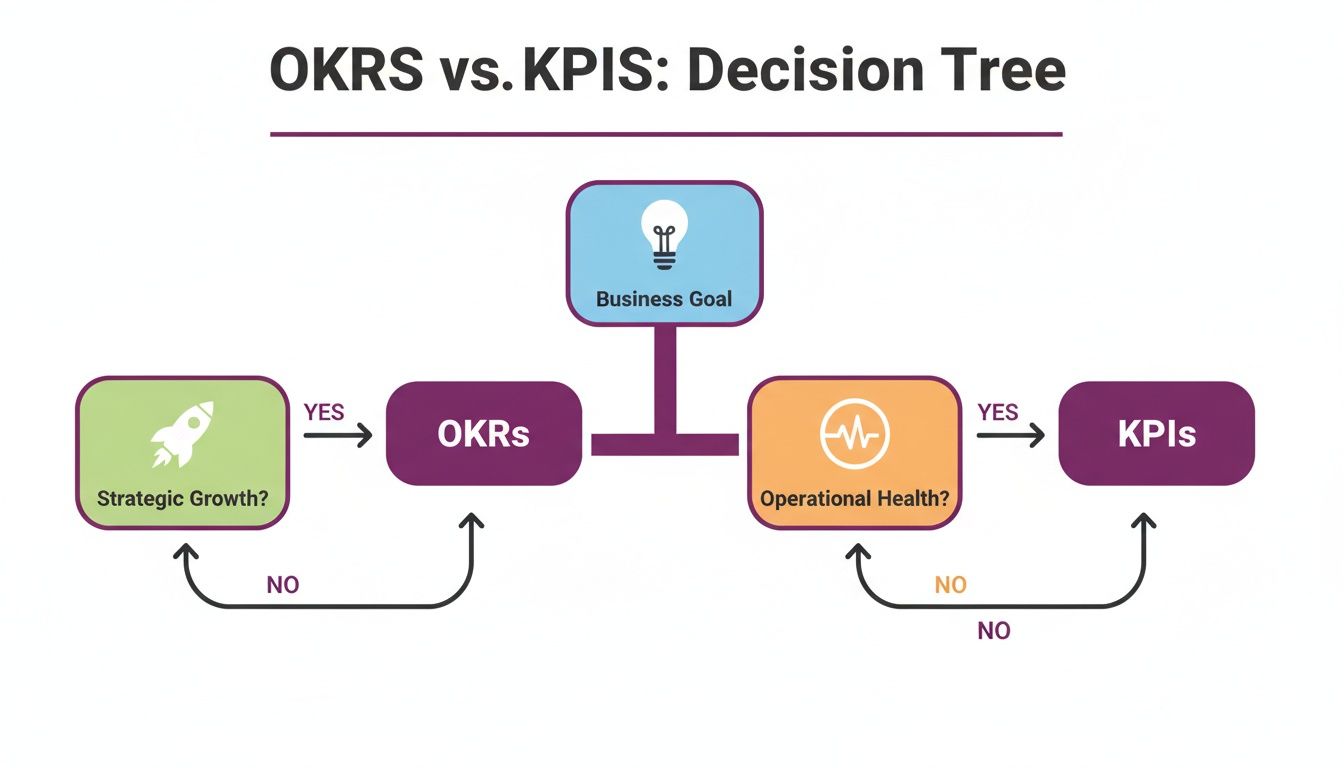
As the visual shows, your journey starts with a business goal, then splits into two distinct paths—one for maintaining performance and another for transforming it.
Connecting Cultural Signals To Business Outcomes
The real magic happens when you can connect real-time cultural signals to both your KPIs and your OKR progress. This is where a business intelligence tool like Wurkn moves far beyond what traditional, static employee engagement platforms and HR surveys can offer. A static survey might confirm your engagement score is 7.2, but it rarely explains why.
Wurkn acts as the connective tissue in your strategy. It captures continuous, anonymous employee sentiment from communication platforms like Slack and Microsoft Teams, turning unstructured conversations into actionable intelligence. This provides the qualitative data—the cultural signals—that give your quantitative metrics meaning.
By analyzing always-on feedback, you’re no longer just tracking a number like an engagement score. You're understanding the human experience behind that number, which is the key to creating strategies that actually work.
Let’s walk through a step-by-step example of how a PeopleOps team would use this integrated approach.
-
Monitor the Health KPI: The team consistently tracks the Employee Engagement Score KPI, which remains stable but unimpressive at 7.2. This is the "what."
-
Diagnose with Cultural Intelligence: Using Wurkn, they analyze anonymized sentiment from Slack channels. The AI-powered analysis reveals a recurring theme: employees feel a lack of clear career growth opportunities. This is the crucial "why" behind the stagnant KPI.
-
Set an Informed OKR: Armed with this insight, the team refines their strategic objective. Instead of a vague goal to "improve culture," they create a highly targeted OKR.
- Objective: Build a transparent and compelling career development framework.
- Key Result 1: Launch a company-wide career pathing program and achieve 80% employee adoption.
- Key Result 2: Increase the "opportunities for growth" sentiment score within Wurkn by 30%.
-
Validate Progress Continuously: As the team rolls out the new program (the initiatives driving the OKR), they don't have to wait for the next quarterly survey. They use Wurkn to monitor real-time employee sentiment. An uptick in positive comments about mentorship and promotions provides an early indicator that their actions are having the desired effect.
This process transforms performance management from a reactive, numbers-based exercise into a proactive, human-centred strategy. The KPI flags an issue, cultural intelligence from Wurkn diagnoses the root cause, and the OKR provides the framework for a targeted solution. This cohesive ecosystem ensures your goals are not only ambitious but also deeply connected to the real needs of your people.
Weaving Cultural Intelligence Into Your Performance Metrics
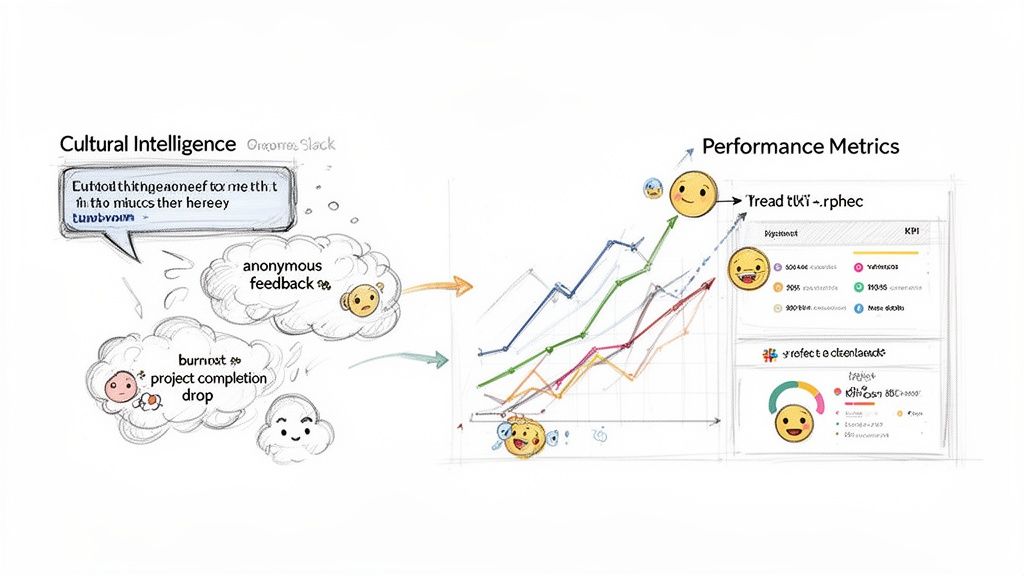
Here’s a persistent challenge every leader faces: connecting the dots between how your people feel and how the business performs. It’s no longer enough to just track performance metrics in a vacuum. A real strategic advantage comes from understanding how the health of your culture directly fuels the health of your business, especially in the scattered reality of remote and hybrid teams across Canada and the United States.
This is where cultural intelligence stops being an abstract concept and becomes a powerful leading indicator. Those feelings and sentiments aren't just noise; they're signals. When you learn to capture and analyze them, these signals start to predict future shifts in your core business KPIs. This moves the OKRs vs KPIs discussion from simple measurement to predictive insight.
Transforming Qualitative Feedback Into Quantitative Insight
The real trick is to systematically map the qualitative cultural data to your quantitative performance metrics. This is a massive leap beyond old-school employee engagement platforms or the annual HR survey that gives you a blurry, outdated snapshot of the past. A business intelligence tool like Wurkn is built for exactly this purpose.
Instead of waiting for a quarterly report to tell you what went wrong last month, Wurkn taps into the continuous, anonymous feedback flowing through the digital channels where work actually happens. This always-on approach catches recurring themes and subtle shifts in sentiment the moment they start, giving you a real-time pulse on your organization's health.
For instance, a rising sentiment around 'burnout' flagged by Wurkn isn't just an HR problem—it's a critical business risk. This cultural signal is a surprisingly accurate predictor of a future drop in the operational KPIs that COOs and operations leaders live and die by.
- Project Completion Rate: Overworked, stressed-out teams start missing deadlines. It's inevitable.
- Customer Satisfaction Scores: An employee running on fumes is far less likely to deliver standout customer service.
- Voluntary Turnover Rate: Burnout is a primary cause of attrition, which hammers your productivity and inflates recruitment costs.
When you treat cultural signals as predictive analytics, you shift from a reactive management style to a proactive one. You’re no longer just tracking KPIs; you're actively managing the cultural drivers that move them. That's where the real strategic value is created.
This proactive stance means you can step in before a cultural issue eats away at a critical business metric. You see the problem forming and can address it at the source, rather than trying to clean up the mess after the damage is done. For a deeper dive, check out our detailed guide on how to set meaningful work culture KPIs for enhanced business success.
From Cultural Signal to Corrective OKR
Once you’ve identified a cultural risk, you can use the OKR framework to launch a focused, strategic response. This is how you turn an abstract cultural health issue into a measurable driver of business success, creating a powerful feedback loop between culture, performance, and strategy.
Let’s walk through a real-world example for a PeopleOps team.
-
Detect the Leading Indicator: Wurkn’s cultural intelligence dashboard flags a 20% spike in conversations and negative sentiment related to "burnout" and "workload" over the past month. The platform immediately tags this as a significant risk to team productivity.
-
Correlate to a Business KPI: The operations team notes their 'Project Completion Rate' KPI is still stable, but they recognize the burnout signal for what it is: a major threat to future performance. They now have a data-backed reason to act before the KPI takes a nosedive.
-
Set a Proactive, Corrective OKR: Armed with this insight, leadership doesn’t just send a memo telling managers to "check in" with their teams. They set a clear, measurable OKR designed to attack the root cause of the burnout.
- Objective: Improve Work-Life Balance and Reduce Employee Burnout.
- Key Result 1: Decrease the average number of hours logged outside of standard business hours by 15% within Q3.
- Key Result 2: Reduce negative sentiment around 'burnout' within Wurkn by 25%.
- Key Result 3: Achieve a 90% participation rate in a newly launched wellness and mental health support program.
This integrated approach perfectly illustrates the sophisticated dance between KPIs, cultural intelligence, and OKRs. Your KPI provides the baseline for operational health. Cultural intelligence acts as your early warning system. And the OKR becomes the strategic vehicle you use to drive meaningful change. This is how high-performing organizations ensure their culture isn't just a talking point, but a core component of their business engine.
Aligning Performance Frameworks in a Hybrid Work Model
Managing performance when your team is scattered across different locations—whether fully remote or hybrid—is a completely different ball game. The old metrics leaders in Canada and the U.S. used to rely on, like who’s at their desk the longest or who looks the busiest, are now totally useless. This isn't a minor adjustment; it’s a fundamental shift from measuring activity to measuring actual outcomes.
This is exactly where outcome-focused OKRs shine, especially for a distributed workforce. Unlike old-school performance reviews that often boiled down to a manager's subjective opinion, OKRs create a crystal-clear, transparent picture of what success looks like. It doesn't matter if you're in the office or in your home office; everyone is aligned around the same goals. This creates a powerful sense of shared purpose that’s tough to maintain without daily face-to-face contact.
Adapting to the Rise of AI in the Workplace
Just as we were getting a handle on remote work, AI threw another curveball. It’s not just changing how we work; it's changing the very definition of performance. Repetitive tasks are being automated, pushing the focus onto things like strategic thinking, creative problem-solving, and innovation. The big question for leaders now is how to measure the real impact of these new AI-driven capabilities.
OKRs give you the agility to keep up. Because they run on a quarterly cycle, you can set ambitious goals around new technologies, learn quickly, and pivot without being locked into a rigid annual plan that’s obsolete by February.
In Canada, for instance, many companies are grappling with how to measure the ROI of AI adoption. One study found that while business AI adoption in Canada doubled year-over-year, many firms still struggle to connect AI usage to tangible business outcomes (KPMG, "Generative AI in Canada," 2024). OKRs provide a framework to create that connection. Instead of just tracking a KPI like "number of employees using AI," a company can set a specific OKR like, "Leverage AI to reduce customer support ticket resolution time by 30%," directly linking the technology to a business result.
Capturing the Pulse of a Distributed Workforce
One of the biggest losses in a hybrid model is the casual, organic feedback loop. You can no longer swing by someone's desk or catch up in the breakroom to see how things are really going. This is where a business intelligence tool like Wurkn becomes non-negotiable, providing a level of insight that a standard HRIS or an annual survey simply can't touch. To understand the baseline, check out our guide on what is an HRIS.
Wurkn is built for this new reality. It taps into the digital channels where work actually happens—like Slack and Microsoft Teams—to capture real-time, anonymous feedback. When you can't be physically present, this gives you a continuous, honest read on employee sentiment and engagement.
For a distributed workforce, continuous digital feedback isn't just a 'nice-to-have'—it's a mission-critical tool for understanding team health, identifying risks, and ensuring that strategic goals are connected to the lived experience of every employee.
This constant flow of information is pure gold. It helps leaders understand how teams are really feeling about their workload, their connection to the company's mission, and their progress towards key objectives. It’s not about tracking happiness for its own sake; it’s about gathering the cultural intelligence needed to make smarter, faster business decisions.
A Practical Example in a Hybrid Setting
Let's put this into practice. Imagine a COO in the U.S. running a distributed engineering team. Their big goal for the quarter is to speed up product development by using new AI coding assistants.
They set a clear OKR:
- Objective: Increase engineering velocity and innovation by integrating AI development tools.
- Key Result 1: Reduce average code deployment time by 20% in Q3.
- Key Result 2: Ship 3 new AI-powered product features by the end of the quarter.
While the team starts working towards these Key Results, the COO is also monitoring cultural signals through Wurkn. The platform quickly flags a rising tide of sentiment around "tool fatigue" and "unclear documentation" coming directly from the team’s Slack channels. This is a critical insight. It reveals that while the engineers are adopting the new tech, the implementation is creating friction that could lead to burnout and kill the project's momentum.
Armed with this real-time intelligence, leadership doesn't have to wait for the quarter to end in failure. They can act now, organizing targeted training sessions and creating better support resources. This is how you bridge the gap in a hybrid model: by connecting your ambitious strategic goals with the on-the-ground cultural feedback needed to actually achieve them.
Common Pitfalls and How to Avoid Them
On paper, rolling out OKRs and KPIs looks simple enough. But in the real world, where strategy collides with daily operations, this is where most organizations stumble. The gap between a successful launch and a failed initiative usually comes down to dodging a few common, but critical, implementation mistakes.
Getting the OKRs vs KPIs dynamic right requires real discipline. Without it, even the best intentions can quickly dissolve into confusion, disengagement, and a feeling that these frameworks are just another flavour of corporate busywork.
The Problem of OKR Soup
One of the most frequent errors we see is what’s known as "OKR soup"—drowning the organization in far too many Objectives and Key Results. When every team and individual is chasing a laundry list of goals, focus completely shatters, and nothing gets the attention it truly needs. Research consistently shows a disconnect between strategy and execution; one report found that only 16% of employees fully understand how their individual work connects to corporate goals (Gartner, "Link Employee Goals to Business Outcomes," 2023). This problem is amplified when priorities are a muddy mess.
The fix is a strict "less is more" mindset. Capping each team or department at 3-5 high-impact objectives per cycle forces everyone to make tough, strategic choices. That kind of clarity is what channels energy toward the goals that will genuinely push the business forward.
An organization with ten priorities has no priorities. True alignment comes from making hard choices about what matters most right now and dedicating disproportionate energy to those few critical goals.
Confusing OKRs With a To-Do List
Another major pitfall is treating OKRs like a glorified to-do list. An Objective should be an inspiring, ambitious outcome, not just another project to get done. A Key Result has to measure the impact of your work, not just the activity itself.
For example, "Launch New Onboarding Program" is a task. A much more powerful Key Result would be: "Achieve a 90% satisfaction score from new hires on the onboarding experience." The first measures output; the second measures the outcome you actually care about. When you frame Key Results around impact, you ensure your team is focused on creating real value, not just checking boxes.
Using KPIs As a Punitive Tool
KPIs are meant to be health metrics, not weapons. When leaders use KPIs to punish teams or individuals for missing targets, they foster a culture of fear. This immediately kills psychological safety and encourages people to start hiding problems or fudging data instead of tackling issues collaboratively.
The right approach is to frame KPIs as diagnostic tools for your systems and processes. A dipping 'Customer Satisfaction' score isn't an individual's failure; it's a signal that a process is likely broken somewhere. This perspective nurtures a constructive, problem-solving mindset.
This is also where continuous cultural intelligence becomes non-negotiable. A business intelligence tool like Wurkn can pick up on a drop in psychological safety by analyzing anonymous feedback for themes of fear or blame. If employees feel KPIs are being used punitively, these signals act as an early warning system. This allows leaders to step in and course-correct before the culture turns toxic and performance craters. If you're looking for constructive ways to frame these conversations, our library of performance review templates can be a solid starting point.
By steering clear of these common traps, you can build performance frameworks that foster a culture of clarity, ambition, and continuous improvement, rather than one of confusion and anxiety.
Frequently Asked Questions About OKRs And KPIs
Can a company use both OKRs and KPIs at the same time?
Of course. Think of it this way: a startup absolutely needs KPIs to monitor its vital signs—things like customer acquisition cost and monthly recurring revenue. You can't fly a plane without looking at the dashboard.
But at the same time, they need a bold OKR to make a strategic leap, something like, "Achieve product-market fit in the North American market." Using both ensures you’re keeping the lights on while also trying to change the world.
How often should you check OKRs versus KPIs?
As for how often you check them, KPIs are your business-as-usual health metrics, so they should be reviewed continuously—daily, weekly, or monthly. OKRs, on the other hand, are typically set quarterly and checked weekly to track your progress toward that bigger goal. This rhythm gives you strategic focus but also lets you make smart adjustments based on what you’re learning in real-time.
What's the main takeaway when choosing between OKRs and KPIs?
The main thing to remember is that it's not a choice of one over the other. The question is, "What are we trying to accomplish?" If you're measuring the ongoing health of an existing process, use a KPI. If you're trying to drive significant, transformative change, set an OKR. They are two different tools for two different jobs. When you have a business intelligence tool like Wurkn providing context, both become even more powerful.
Ready to turn those cultural signals into hard business outcomes? See how Wurkn moves beyond old-school HR survey tools by turning continuous employee feedback into the kind of business intelligence that actually drives your strategy forward. Explore the Wurkn platform.