

What Is a Skip Level Meeting and Why Is It So Important?
A skip-level meeting is a conversation between a senior leader and the people who work two or more levels below them—all done without their direct manager in the room. This isn’t about checking up on anyone; it’s a strategic dialogue designed to give leaders a real, unfiltered look at what’s happening on the ground and to build trust across the company.
Think of your organization’s communication chain like a game of telephone. A message starts at one end, but after being passed through multiple layers of management, it can get diluted, rephrased, or just plain changed. By the time it reaches a senior executive, the original urgency or critical details might be completely lost.
Skip-level meetings slice right through those layers. Let’s be clear: this isn’t a performance review, a surprise audit of the manager, or a formal complaint session. It’s a dedicated space for an honest, two-way conversation that connects leaders directly to the daily experiences of their teams.
For employees, it’s a powerful opportunity to be seen and heard by leadership, which is a massive boost for psychological safety. It shows their perspective truly matters.
The Real Purpose Behind the Practice
At its core, a skip-level meeting is about getting an unvarnished look at the health of your organization. Sure, traditional one-on-ones are vital for managing tasks and developing individuals, but they exist within the unique dynamic between a manager and their direct report. Skip-level meetings serve a completely different, more strategic goal.
These conversations are designed to uncover the kind of insights that just don’t surface otherwise. We’re talking about understanding team morale, finding hidden operational bottlenecks, and hearing brilliant ideas straight from the people closest to the work. When done right, they act as an early warning system, helping leaders catch small issues before they blow up into major problems.
The real power of a skip-level meeting lies in its ability to build trust and shorten the distance between leadership and the front lines. It turns the abstract concept of an ‘open-door policy’ into a tangible, scheduled practice.
This direct line of communication is more critical than ever. Whether your teams are remote, in-office, or hybrid across Canada and the United States, building connections beyond the immediate manager is crucial for keeping people engaged and sticking around. Research consistently shows that employees who feel their voice is heard are far more likely to be committed to the company’s success (Forbes, 2021). A well-run skip-level meeting hits this nail on the head.
Why This Is Not Just Another Meeting
Unlike your typical check-in, the skip-level meeting is fundamentally about discovery. It gives leaders a chance to reality-check their assumptions and validate the information flowing up through official channels.
For instance, a COO in a national logistics company might see reports that a new warehouse software rollout is going perfectly. But a few skip-level chats could reveal that frontline staff in both their Canadian and US distribution centers are wrestling with usability issues that are secretly tanking productivity. This is where standard HR surveys and employee engagement platforms fall short—they give you the “what” (the quantitative data points) but almost never the “why.”
A skip-level meeting delivers the human context behind the numbers. And when you capture these qualitative insights and analyze them with a business intelligence tool like Wurkn, they become exponentially more powerful. As a business intelligence platform, Wurkn helps leaders connect the dots between themes from these conversations and core business metrics, turning anecdotal feedback into measurable cultural intelligence. This creates a complete picture of organizational health that drives smarter, more informed strategic decisions, a capability that goes far beyond traditional HR survey tools.
The Strategic Benefits for Modern Leadership Teams
For leaders in Operations and PeopleOps, a skip-level meeting is far more than an informal chat. Think of it as a strategic intelligence-gathering tool. These conversations cut through the noise, giving you a direct line to the ‘ground truth’ of your organization and revealing insights that polished reports and filtered updates will always miss.
By talking directly with frontline employees, you can diagnose the health of your culture and spot operational friction long before they show up as problems on a dashboard.
The biggest win is unlocking a stream of completely unfiltered feedback. While tools like an employee satisfaction survey give you a valuable snapshot in time, they can’t capture the nuance or the “why” behind the scores. A skip-level meeting delivers the human story behind the data points.
Uncovering Operational Inefficiencies
One of the most immediate payoffs is identifying the hidden roadblocks that are quietly killing productivity. Senior leaders often see a sanitized version of reality where projects are on track and processes look smooth on paper. A skip-level meeting can paint a very different, and much more accurate, picture.
Imagine a manufacturing COO who keeps hearing from different plant teams across the United States about their frustrations with a new inventory management system. The system’s official metrics might look perfectly fine, but these conversations reveal that clunky workflows are causing daily delays and burning people out. That’s the kind of qualitative data that has a direct, tangible impact on the bottom line.
- Spotting Bottlenecks: Pinpoint the specific process steps or tools that cause delays and frustration for the people doing the actual work.
- Improving Resource Allocation: Find out if teams really have the tools, training, or support they need to do their jobs well.
- Streamlining Workflows: Get direct feedback on making daily operations more efficient from the employees who know the processes inside and out.
This direct feedback loop allows leaders to fix small issues before they snowball into systemic problems that tank morale and output.
Driving Employee Retention and Engagement
When a senior leader takes the time to listen, it sends a powerful message: every employee’s voice matters. This simple act builds trust and psychological safety—two of the most critical drivers of employee retention. Employees who feel seen and heard are vastly more likely to be engaged and committed to the company’s success.
A skip-level meeting transforms the vague idea of an ‘open-door policy’ into a real, scheduled commitment. It shows that leadership is genuinely invested in the employee experience, not just their immediate output.
This is especially crucial in today’s work environment. In North American sectors where remote and hybrid work is the norm, skip-level meetings have become an essential tool for bridging communication gaps. A study highlighted by Gallup found that highly engaged business units see a significant drop in turnover—up to 43% in low-turnover organizations (Gallup, 2023). Implementing regular skip-level discussions is a proven tactic for fostering that level of engagement.
Transforming Feedback into Business Intelligence
The real strategic power of a skip-level meeting is unlocked when you connect its qualitative insights to hard business data. This is where a business intelligence platform like Wurkn goes far beyond what traditional HR survey tools can do. Wurkn doesn’t just collect feedback; it functions as a business intelligence tool, helping you connect cultural themes to actual business outcomes.
For example, themes like ‘burnout’ or ‘tool frustration’ that surface in your meetings can be tracked within Wurkn. The platform can then correlate this sentiment data with key performance indicators like project completion rates, absenteeism, or even regional sales performance in key markets like the US or Canada.
By doing this, Wurkn transforms anecdotal feedback into a measurable dashboard. It allows COOs and PeopleOps leaders to make data-driven decisions that improve both the culture and the business results, creating a continuous, intelligent feedback loop that drives a real strategic advantage.
How to Structure Your First Skip Level Meeting
A great skip-level meeting doesn’t just happen by accident. It’s the direct result of thoughtful planning and a clear, intentional structure. Without a solid framework, these conversations can easily feel like a random interrogation or, worse, a total waste of time. The real goal here is to build a repeatable process that turns these meetings into one of the most valuable tools in your leadership kit.
First thing’s first: set a clear objective. What are you actually trying to achieve? Are you digging into team morale, hunting for process bottlenecks, or just getting a feel for how a recent org change landed? Nailing down your primary goal is crucial because it dictates who you invite and what questions you ask.
Once you know your ‘why,’ the next step is communicating your intent—especially to the manager you’re “skipping.” Be proactive. Let them know this isn’t about micromanaging or stepping on their toes; it’s about gaining a wider perspective to better support them and their team. A little transparency here goes a long way in preventing anxiety and turning that manager into an ally.
Setting the Stage for Success
Before you even think about sending a calendar invite, sort out the logistics. For a one-on-one skip-level, a 30- to 45-minute slot is usually plenty of time. If you’re bringing in a small group (keep it to three or four people, max), block out 60 minutes so everyone gets a real chance to speak up.
Next, think about who you’re inviting. You could decide to meet with an entire team over a series of weeks, or you might cherry-pick a cross-section of employees—different roles, different tenures—to get a mosaic of perspectives. Whatever you choose, make sure the selection process feels fair and transparent to everyone involved.
Finally, frame the meeting properly for the employees attending. A quick, friendly note in the calendar invite can work wonders to set the right tone. Something like, “This is just an informal chat for me to better understand your perspective on your work, our team, and the company. Looking forward to hearing what’s on your mind.” This simple framing eases any nerves and gets them ready for a real conversation. You can learn more about building this kind of open environment by exploring how to improve workplace communication in your organization.
A Simple Agenda for Open Dialogue
Resist the urge to create a rigid, minute-by-minute agenda. The best skip-level meetings feel more like a structured conversation than a formal review. Your agenda should be built around broad, open-ended themes that invite genuine discussion.
Here’s a simple three-part structure you can easily adapt:
- The Present (Wins & Roadblocks): Kick things off by focusing on what’s happening right now. Talk about recent team successes and what’s going well before you gently pivot to any challenges or obstacles they’re running into.
- The Future (Aspirations & Ideas): Next, shift the focus to what’s ahead. This is your chance to ask about their career goals, what ideas they have for making things better, and what they’d love to see the team accomplish in the next six months.
- The Support (Leadership & Resources): Wrap up by zeroing in on how leadership can help. This is where you get direct, actionable feedback on what they need from you and the company to be more effective and engaged.
These unfiltered conversations are the very first step in a much larger feedback intelligence process, as this infographic illustrates.
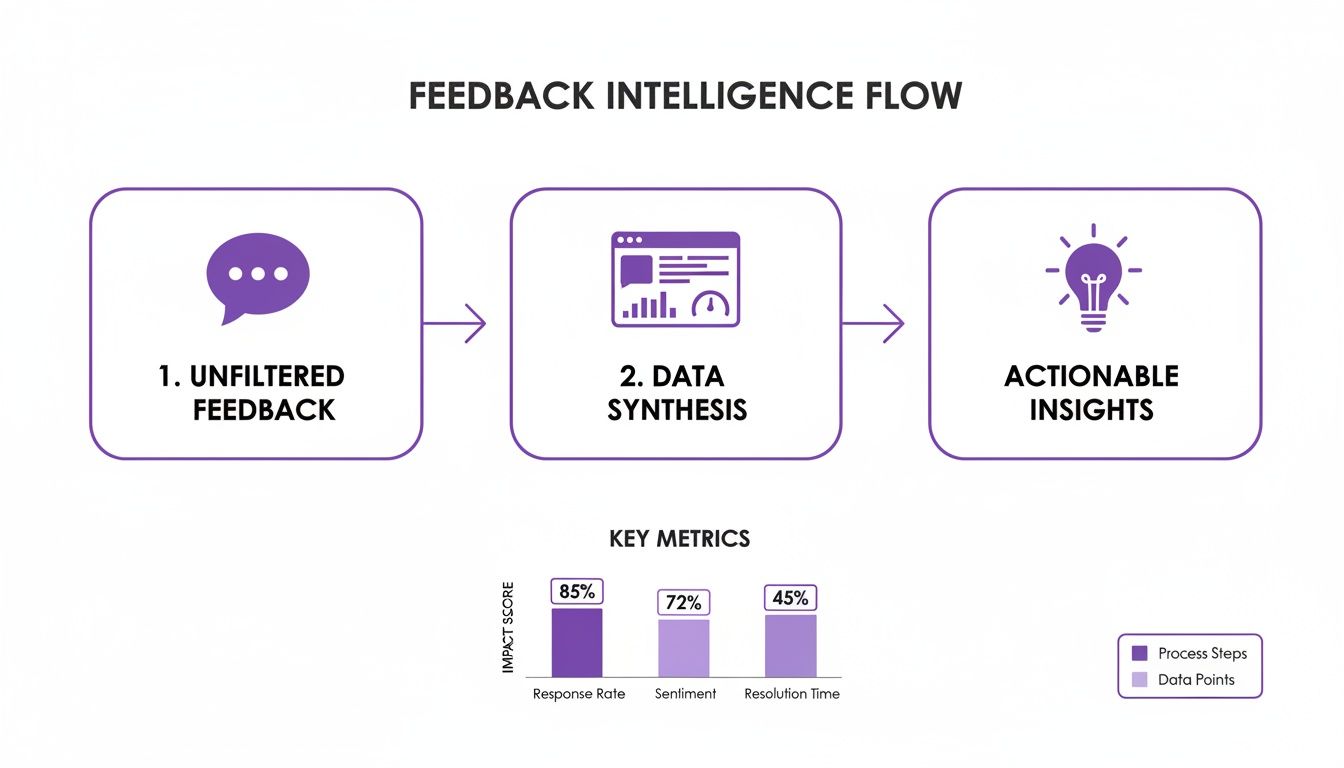
This flow shows how the raw, human feedback from these meetings gets translated into data and, ultimately, into business intelligence you can actually act on.
Powerful Questions to Spark Honest Conversation
The quality of your skip-level meeting hangs entirely on the quality of your questions. Steer clear of simple yes/no questions or leading ones that hint at the answer you want to hear. The goal is to ask powerful, open-ended questions that pull out detailed, thoughtful responses.
The most insightful questions are often the simplest. Asking “If you were in my shoes for a day, what’s the one thing you would change?” can reveal more about your organization’s health than a dozen survey questions.
Here are a few powerful questions to get the ball rolling:
- What’s your favourite part about working on this team? What’s the most challenging part?
- What is something we should start doing as a company? And what should we stop doing?
- What can our leadership team do to make your work more impactful and enjoyable?
- Are you getting enough feedback on your work? Do you feel like you have real opportunities to grow here?
These meetings are far too important to let slide. When managers skip these kinds of check-ins, employee engagement can crater. In the US and Canada, where the average worker spends hours in meetings each week, making them count is critical. Fine-tuning a skip-level to just 30 minutes can produce significantly better outcomes in clearing roadblocks and slash the time it takes to resolve problems.
Knowing the Traps: Common Skip-Level Meeting Pitfalls
While skip-level meetings are a fantastic leadership tool, they’re not without their landmines. A poorly handled meeting can do more harm than good, chipping away at the very trust and transparency you’re trying to build. Getting this right means knowing the common traps before you step into them.
Successfully running these meetings is all about anticipating the ways they can go sideways. From accidentally undermining your direct reports to letting the conversation spiral into a complaint-fest, each misstep erodes psychological safety. Let’s walk through the biggest mistakes and how to sidestep them.
Common Pitfalls and How to Avoid Them
Here’s a quick guide to help you navigate the most frequent mistakes leaders make, along with practical ways to keep your skip-level meetings on track and productive.
| Common Pitfall | Why It Happens | How to Avoid It |
|---|---|---|
| Undermining the Direct Manager | The manager feels bypassed, threatened, or that their authority is being questioned, leading to defensiveness and distrust. | Frame the meeting as a supportive tool for everyone. Reassure the manager beforehand that your goal is to gain perspective to better support them. Afterwards, share high-level, anonymized themes—never specifics that could betray confidence. |
| Becoming a Grievance Session | Without clear structure, the meeting can easily become a venting session where employees only list problems without offering solutions. | Set a constructive tone from the start. Balance questions about challenges with ones about wins, career goals, and ideas. When a complaint comes up, listen, then pivot to problem-solving: “Thanks for sharing. What would an ideal solution look like to you?” |
| Failing to Act on Feedback | Employees share valuable insights, but see no change or follow-up, concluding the meetings are just for show and stop being candid. | This is the fastest way to kill trust. Always close the loop. Synthesize recurring themes, communicate a summary of what you’ve heard (anonymously), and share a clear action plan. Follow up a few months later to show progress. |
| Breaking Confidentiality | A manager hears specific feedback that could only have come from one person, destroying the employee’s trust in the process. | Make an ironclad commitment to confidentiality. Generalize all feedback into themes. If an issue is highly specific to one person, ask for their permission before addressing it with their manager, or find a way to address the root cause more broadly. |
| Creating Unrealistic Expectations | Employees leave the meeting thinking you will solve every single problem they mentioned, leading to disappointment when that doesn’t happen. | Be transparent about your role. Explain that your goal is to understand systemic issues and gather strategic insights, not to intervene in day-to-day management. Manage expectations by clarifying what you can and can’t act on directly. |
Avoiding these pitfalls isn’t just about damage control; it’s about ensuring these meetings actually achieve their purpose: building a healthier, more connected, and higher-performing organization.
The Biggest Mistake of All: Failing to Act
Of all the potential missteps, one stands out as the most damaging: asking for feedback and doing absolutely nothing with it.
When an employee takes the time to share their perspective and sees zero action or communication afterward, they draw a simple conclusion: you weren’t really listening. The meeting was just corporate theatre. You can be sure they won’t be as candid the next time—if there even is a next time.
Creating a system to follow up is non-negotiable.
- Synthesize the Themes: After a few meetings, look for the patterns. What are the recurring issues and standout ideas?
- Communicate Your Plan: Share a high-level summary of what you learned (always protecting anonymity) with the wider team. More importantly, outline the concrete steps you’re taking in response.
- Close the Loop: A few weeks or months down the line, report back on your progress. This single step shows their feedback wasn’t just heard; it was valued and acted upon.
This cycle of listening, acting, and communicating is what builds real trust. But let’s be honest, this is where old-school methods fall flat. Relying on scribbled notes and your own memory is a recipe for letting crucial insights slip through the cracks.
This is where a cultural business intelligence tool like Wurkn provides a massive advantage. Instead of just hoping you remember the key themes, Wurkn helps you log, track, and analyze anonymized feedback from these conversations, connecting it directly to business KPIs. You can build a living dashboard of your organization’s health, ensuring no insight is ever lost and you can actually measure the impact of your actions over time. It turns feedback from a one-off event into a continuous engine for improvement, demonstrating a value far beyond that of standard employee survey platforms.
Turning Feedback into Actionable Intelligence
The real value of a skip-level meeting isn’t unlocked until long after everyone has left the room. The conversation itself is just the starting point. What truly matters is what you do next—turning raw feedback into a clear, meaningful action plan. Without that crucial step, the entire exercise is just another chat that leads nowhere.
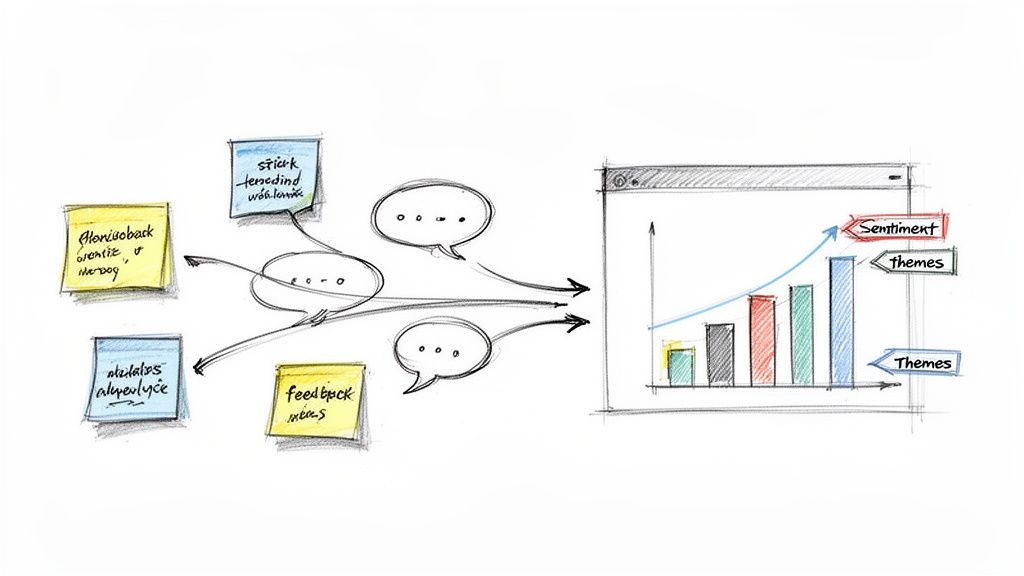
This is exactly where scribbling notes on a legal pad falls apart. A leader might walk away with a page full of comments, but those isolated data points rarely reveal the systemic issues brewing just beneath the surface. It’s nearly impossible to connect the dots across dozens of individual conversations and see the bigger picture.
From Scattered Notes to Systemic Patterns
To create real change, you have to get past individual comments and start identifying recurring themes. Is frustration with a new software tool a one-off complaint, or is it a department-wide productivity killer? Is a call for more flexible hours an isolated wish or a widespread sign of burnout risk?
Answering these questions demands a more structured approach. Start by anonymizing and grouping feedback into broader categories.
- Process & Tools: Comments related to workflows, software, or operational bottlenecks.
- Culture & Communication: Feedback on team dynamics, recognition, and how information flows.
- Leadership & Support: Insights on management effectiveness, mentorship, and resource availability.
- Growth & Development: Discussions about career paths, training opportunities, and building new skills.
By bucketing feedback this way, you can start to see patterns jump out. You might suddenly realize that 70% of the feedback from your operations team centres on process issues, giving you a clear signal on where to focus first.
The Wurkn Advantage Over Traditional Surveys
This is where a business intelligence tool like Wurkn shows its true colours, leaving standard HR surveys in the dust. Instead of relying on memory or messy spreadsheets, leaders can use Wurkn’s platform to log anonymized themes directly from their skip-level conversations. The platform is designed specifically to turn qualitative, human insights into hard, measurable data, showcasing its power as a business intelligence tool.
The goal isn’t just to collect feedback; it’s to understand its business impact. Wurkn connects the dots between what employees are saying and what the business is experiencing.
For instance, if feedback from your US-based sales team consistently points to burnout, you can track sentiment around a theme like ‘Work-Life Balance’ inside Wurkn. The platform then lets you correlate that sentiment data with hard business KPIs, like absenteeism, project delivery timelines, or even employee turnover. Suddenly, a qualitative insight becomes a measurable dashboard for strategic leadership. You’re no longer guessing; you’re seeing the direct financial and operational impact of your company culture.
Creating a Measurable Action Plan
Once you’ve identified the core themes and measured their potential impact, the final step is to build a specific, time-bound action plan. Vague promises like “we’ll improve communication” are destined to fail. A strong action plan is concrete.
Example of an Action Plan:
| Theme Identified | Action Item | Owner | Deadline | Success Metric |
|---|---|---|---|---|
| Tool Frustration | Form a user group to gather specific feedback on the new CRM and present recommendations to IT. | Operations Lead | End of Q2 | 25% reduction in support tickets related to the CRM. |
| Lack of Recognition | Launch a peer-to-peer recognition channel in Slack and train managers on giving effective, timely praise. | PeopleOps | End of Q1 | 15% increase in positive sentiment around ‘Recognition’ in Wurkn. |
This kind of structured follow-through is non-negotiable. Effective skip-level meetings have a direct correlation with lower turnover, with companies that conduct them seeing a tangible impact on retention (Harvard Business Review, 2022). Using a platform like Wurkn to ensure anonymous feedback is actually acted upon becomes a clear strategic imperative for any business operating in Canada or the US. You can find more insights on these meeting statistics on archieapp.co.
Frequently Asked Questions
Putting the theory of skip-level meetings into practice always brings up a few common questions. Here’s a quick rundown of the things leaders ask most, designed to give you that extra bit of confidence before you start these conversations.
How Often Should I Be Doing These?
For most teams in Canada and the United States, a quarterly or bi-annual meeting cadence really hits the mark. It’s frequent enough to build real trust and see progress on the feedback you’ve received, but not so often that it clogs up everyone’s calendar and leads to meeting fatigue.
That said, context is king. If you’re dealing with a brand-new team, navigating a big organizational shake-up, or in the middle of a massive growth spurt, you might want to dial it up to monthly. The most important thing isn’t the exact interval—it’s consistency. A predictable schedule shows you’re committed to this for the long haul, and that speaks volumes.
What Do I Do If an Employee Criticizes Their Manager?
This is the moment of truth for any skip-level meeting. How you handle this single interaction will either build or break the psychological safety you need for these conversations to work. Your first job is simple but crucial: just listen. Listen intently, without judgment, and focus on understanding their perspective.
Fight the urge to jump in and defend the manager or make promises you can’t keep. Instead, ask open-ended questions to get clarity on the specific behaviours and, more importantly, the impact they’re having on the employee. Reassure them that this conversation stays between you.
After the meeting, your role is to coach the manager, not discipline them. You’re working with secondhand information, so treat the feedback as a theme for development. Frame it constructively—something like, “Let’s brainstorm some new strategies for giving clearer direction on projects”—without ever naming the source. Of course, if the feedback points to serious issues like harassment or misconduct, you must immediately follow your company’s official HR reporting process.
A skip-level meeting is a tool for development, not for blame. Use the feedback to build stronger managers, not to undermine them.
Does a Tool Like Wurkn Replace Skip-Level Meetings?
That’s a great question, and the answer is a firm no. Wurkn doesn’t replace skip-level meetings; it supercharges them. As a business intelligence tool, Wurkn elevates the entire feedback process beyond what a traditional employee engagement platform can offer.
Your skip-level meetings give you the rich, nuanced, human story. They deliver the “why” behind the data that you can only get from a real conversation.
Wurkn, on the other hand, gives you the scalable, continuous, and quantitative business intelligence to see the bigger picture. It spots the patterns and trends bubbling up across the entire organization that you’d likely miss in one-on-one chats.
The two work together in a powerful feedback loop. Let’s say you spot a worrying trend in your Wurkn dashboard around ‘workload balance.’ You can use your next round of skip-levels to dig into that specific theme and understand the human experience behind the numbers. Afterward, you can log the anonymized insights from that chat back into Wurkn, enriching the data and creating a more complete picture for everyone.
When you combine the direct human connection of a skip-level meeting with the continuous business intelligence of Wurkn, you get a real-time, 360-degree view of your organization’s health that old-school HR surveys could never hope to match.
Ready to turn your employee feedback into a strategic advantage? Wurkn is a business intelligence platform that helps you connect cultural themes to real business outcomes. Learn more about how Wurkn can transform your leadership strategy.