
Let's be clear: succession management is the ongoing game plan for identifying and developing your internal MVPs to fill critical leadership roles down the road. It’s not a dusty, break-in-case-of-emergency file cabinet. It's a living strategy for building a resilient organization that can handle whatever comes next.
Moving Beyond a Basic Definition

Forget the textbook definition for a moment. At its heart, succession management is about building a deep talent bench. Think of it like a professional sports team—you don't wait for your star quarterback to announce their retirement before you start scouting and training the next one. You cultivate talent continuously.
This is about so much more than just figuring out who takes over as CEO. Real succession management is about future-proofing your entire operation, from the C-suite to the specialist who holds unique institutional knowledge that nobody else has. The goal is to build a "pipeline of ready and capable future leaders," ensuring you have the right people with the right skills for where your company is headed in three, five, or even ten years (Belcourt, M. & McBey, K. Strategic Human Resources Planning. Nelson Education, 2016).
To give you a quick snapshot, here’s a breakdown of the core idea.
Succession Management At A Glance
This table simplifies the shift in thinking from a reactive replacement mindset to a proactive, strategic approach to talent development.
| Core Principle | Strategic Outcome |
|---|---|
| Proactive Talent Cultivation | A deep bench of "ready-now" and "ready-soon" leaders. |
| Data-Driven Identification | Objective, unbiased selection of high-potential individuals. |
| Holistic Development | Leaders equipped with skills for future, not just current, challenges. |
| Cultural Alignment | Ensuring future leaders embody and drive the company's core values. |
| Business Continuity | Seamless transitions that protect productivity and morale. |
Ultimately, it’s about ensuring the lights stay on and the business keeps growing, no matter who leaves or when.
The Modern Approach to Identifying Talent
In the past, spotting "high-potential" employees often came down to an annual performance review and a manager's gut feeling. That’s a risky bet. The modern approach is all about using continuous, objective data to see the full picture of your team's capabilities. This is where a business intelligence tool like Wurkn gives businesses across Canada and the US a serious advantage over traditional employee engagement platforms.
By capturing real-time, anonymous feedback, Wurkn moves beyond static reports to reveal hidden leaders—the ones who influence, solve problems, and boost team morale without a fancy title. These are the people that conventional HR survey tools almost always miss.
This steady stream of business intelligence transforms succession management from a once-a-year HR checklist into a dynamic, data-driven business strategy. You move from guessing to knowing. With this kind of insight, you can:
- Spot Emerging Leaders: Find the employees who naturally guide their peers, even without formal authority.
- Understand Cultural Fit: See who truly lives your company values and has the people skills to lead effectively in your specific environment.
- Make Data-Backed Decisions: Ditch the office politics and gut feelings. Use objective signals to build a leadership pipeline that's robust, diverse, and ready for anything.
This process ensures your next wave of leaders isn't just competent, but deeply connected to the cultural fabric that makes your company successful.
The Critical Difference Between Succession Management and Planning

Many leaders across Canada and the U.S. toss around the terms “succession management” and “succession planning” as if they’re the same thing. They’re not. Understanding this distinction is the first step toward building a truly resilient talent strategy that goes beyond just filling empty boxes on an org chart.
Succession planning is often a reactive, almost frantic exercise. Think of it as an emergency contact list for your C-suite. It’s designed to answer one question: “Who takes over if our VP of Sales quits tomorrow?” It’s a necessary fire drill, but it usually results in a static document, focused on mitigating the immediate risk for a handful of senior roles.
Succession management, on the other hand, is a proactive, continuous, and deeply strategic process. It’s not a side project; it's woven into the very fabric of your company's long-term vision.
The core difference is the mindset. Planning is like having a paper map with a single destination circled in red. Management is like using a live GPS that constantly analyzes real-time traffic, roadblocks, and new shortcuts to find the absolute best route to get you there.
This dynamic approach is where the real business value is unlocked.
Planning vs. Management at a Glance
Making the leap from a static list to a dynamic system requires a much deeper commitment to developing talent across the entire organization, not just at the top.
| Succession Planning (The Map) | Succession Management (The GPS) |
|---|---|
| Reactive: Fills an anticipated vacancy. | Proactive: Cultivates a broad pipeline of talent. |
| Short-Term Focus: Cares about immediate replacements. | Long-Term Vision: Aligns with future business needs and goals. |
| Limited Scope: Targets a few key executive roles. | Holistic: Develops potential leaders at multiple levels. |
| Periodic Event: An annual or bi-annual review. | Ongoing Process: Integrated into daily operations and culture. |
Moving to a Dynamic Management Approach
A plan that’s dusted off once a year quickly becomes irrelevant. Your business evolves, the market shifts, and your people grow in ways you never could have predicted. A true succession management system embraces this change, using a constant stream of data to inform every talent decision.
This is where a business intelligence tool like Wurkn offers a massive advantage over traditional engagement platforms. Instead of relying on infrequent surveys that are outdated the moment you get the results, Wurkn captures always-on cultural data. It reveals who is actually influencing teams, solving tough problems, and showing leadership potential day in and day out.
This stream of business intelligence transforms your succession strategy from a static document into a living, breathing system. It allows you to make talent decisions based on the current reality of your organization, not on last year’s org chart.
Why Proactive Succession Management Is a Business Imperative
Viewing succession management as just another HR initiative is a critical mistake. In reality, it’s a non-negotiable strategy for long-term business health and resilience, essential for organizations across Canada and the United States. Failing to act isn't a neutral choice; it's a significant vulnerability that leaves a company exposed to unnecessary risks.
Imagine a key project leader—the one who holds all the critical client relationships and project history—departs unexpectedly. In an organization without a succession management program, chaos ensues. Projects stall, deadlines are missed, and institutional knowledge walks right out the door. The scramble to find a replacement creates a vacuum where both productivity and morale plummet.
Now, contrast this with an organization that’s proactive. The departure is still a challenge, but it's not a crisis. A successor, already identified and developed, steps in with a deep understanding of the role, the team, and the company culture. The transition is smooth, and business continuity is protected.
Mitigating Knowledge Loss and Boosting Engagement
One of the most immediate benefits is shutting down the risk of catastrophic knowledge loss. As experienced experts and leaders retire, they take decades of invaluable, undocumented knowledge with them. This is a massive issue for large employers.
For example, a study of the University of California system revealed that 17.3% of professional staff and a staggering 24.5% of senior management were in high retirement risk categories, highlighting the urgency of transferring knowledge (Sackett, P. & Laczo, R. Succession Planning and Management: A Best Practices Study. University of California, 2003). It’s a ticking clock.
Beyond risk management, a robust succession program is one of the most powerful tools you have for employee engagement. When employees see clear, tangible career paths and opportunities for growth inside the company, their motivation and loyalty skyrocket. This visibility shows them they have a future, which is fundamental to retention. For more tips on this, check out our guide on top retention strategies to keep your best employees.
Inaction creates a vacuum that your best employees will fill by looking for opportunities elsewhere. A visible succession management process demonstrates a commitment to internal talent, making your organization a place where people want to build a career.
Creating Strategic Agility
Finally, proactive succession management makes your entire organization more agile and responsive to market shifts. The business landscape is unpredictable. Having a deep bench of prepared leaders allows you to pivot quickly, whether it’s launching a new product line, entering a new market, or navigating an economic downturn.
This is where a business intelligence tool like Wurkn provides an edge far beyond traditional employee survey platforms. Wurkn's continuous analytics can help you identify flight risks within your high-potential talent pools long before they decide to leave.
By monitoring cultural signals and engagement levels in real-time, you get the business intelligence needed to intervene proactively, addressing concerns and reinforcing development paths to keep your future leaders invested and on track.
The Core Components of a Winning Program
A great succession management program isn't a single document or a one-off project. It’s a living, breathing system with a few core parts that all have to work together. Think of it less like a static chart and more like a high-performance engine; every component needs to be firing in sync to build real momentum.
Getting this right is what separates a simple replacement list from a true leadership pipeline that can future-proof your organization.
Identify Critical Roles and Competencies
First things first, you have to figure out which roles actually make or break your business. This isn't just about the C-suite. A critical role is any position that, if it went dark tomorrow, would cause a major disruption.
Think about the senior software architect who’s the only one who truly understands your legacy code. Or the top sales director who manages your three biggest accounts. Those are the linchpins.
Once you know which roles matter most, you need to define what it takes to succeed in them—not just today, but three to five years down the road. What skills, knowledge, and behaviours will be non-negotiable?
Pinpoint High-Potential Talent
With a clear picture of what you need, the next step is finding the people who have the potential to grow into these critical roles. This is where most programs fall flat, often relying on a manager's gut feeling or last year’s performance review. That's a recipe for bias and missed opportunities.
A winning program moves beyond asking, "Who is our best performer?" and starts asking, "Who shows the highest potential for future leadership?" This requires looking for qualities like resilience, influence, and a capacity for strategic thinking.
This is exactly where a business intelligence tool like Wurkn changes the game. Instead of relying on subjective opinions, it analyzes continuous, anonymized feedback to surface objective data. You can see who is actually influencing teams and demonstrating leadership, giving you an evidence-based foundation for your high-potential pool.
Deliver Targeted Development
Identifying talent is only half the battle. Now you have to build a bridge between where your high-potentials are today and where they need to be. Generic training seminars and online courses just won’t cut it.
Development has to be hands-on and tailored to the individual.
- Job Rotations: Move them through different departments to build a holistic view of the business.
- Stretch Assignments: Give them a tough, high-stakes project that forces them out of their comfort zone.
- Mentorship and Coaching: Pair them with senior leaders who can offer strategic guidance and open doors.
This isn't just about training; it's about embedding a culture of continuous improvement and upskilling into your company’s DNA.
Measure Program Success
Finally, you have to measure what matters. A successful program proves its own value with data. The key is to shift from tracking activity (like how many people you trained) to tracking outcomes that show a real impact on the business.
A great example is the comprehensive succession effort at Caltrans, a major California state agency. They realized they needed programs like cross-training and leadership development to fill crucial workforce gaps. By measuring the success of these initiatives, they could see exactly what was working and build internal capacity far more effectively. You can read the full research on the Caltrans succession planning study to see how they approached it. This is how you prove your program is delivering a real return on investment.
How to Build Your Succession Management Framework
Alright, let's move from theory to action. Building a succession management framework that actually works isn't a weekend project, but it’s an achievable process that pays dividends for years. By taking a clear, step-by-step approach, leaders across Canada and the United States can build a system that doesn't just identify future leaders, but actively creates them.
First things first: you need executive buy-in. This is non-negotiable. You have to frame this initiative not as an HR cost centre, but as a core business strategy for managing risk and fuelling growth. Put together a compelling business case showing the real-world costs of key vacancies and the ROI of promoting from within.
Once leadership is on board, your next move is to form a cross-functional steering committee. This can't be a project siloed within HR. Getting leaders from operations, finance, and other key business units involved ensures the program is grounded in reality and gets the widespread support it needs to succeed. This isn’t just a corporate best practice; even large-scale government initiatives, like The State of California Succession Management Model, require steering committees to ensure accountability and successful rollout. You can learn more about their structured approach to succession management on CalHR.ca.gov.
From Audits to Action Plans
Next up, it’s time to conduct a ‘critical role’ audit to find your biggest vulnerabilities. And don't just look at the C-suite. You need to pinpoint the linchpin roles at every level—the senior engineer who knows the legacy code, the project manager everyone relies on, or the account director with deep client relationships. The people whose departure would cause serious disruption. This audit defines the scope and urgency of your entire program.
With your critical roles mapped out, you can build a transparent process for spotting potential successors. This is where you have to move beyond a manager’s gut feeling. A business intelligence tool like Wurkn can automate this analysis, surfacing objective insights on who is truly demonstrating leadership behaviours. This gets your team out of spreadsheet hell and lets them focus on the human side of coaching and development.
This simple process flow breaks down the key stages of a successful program.
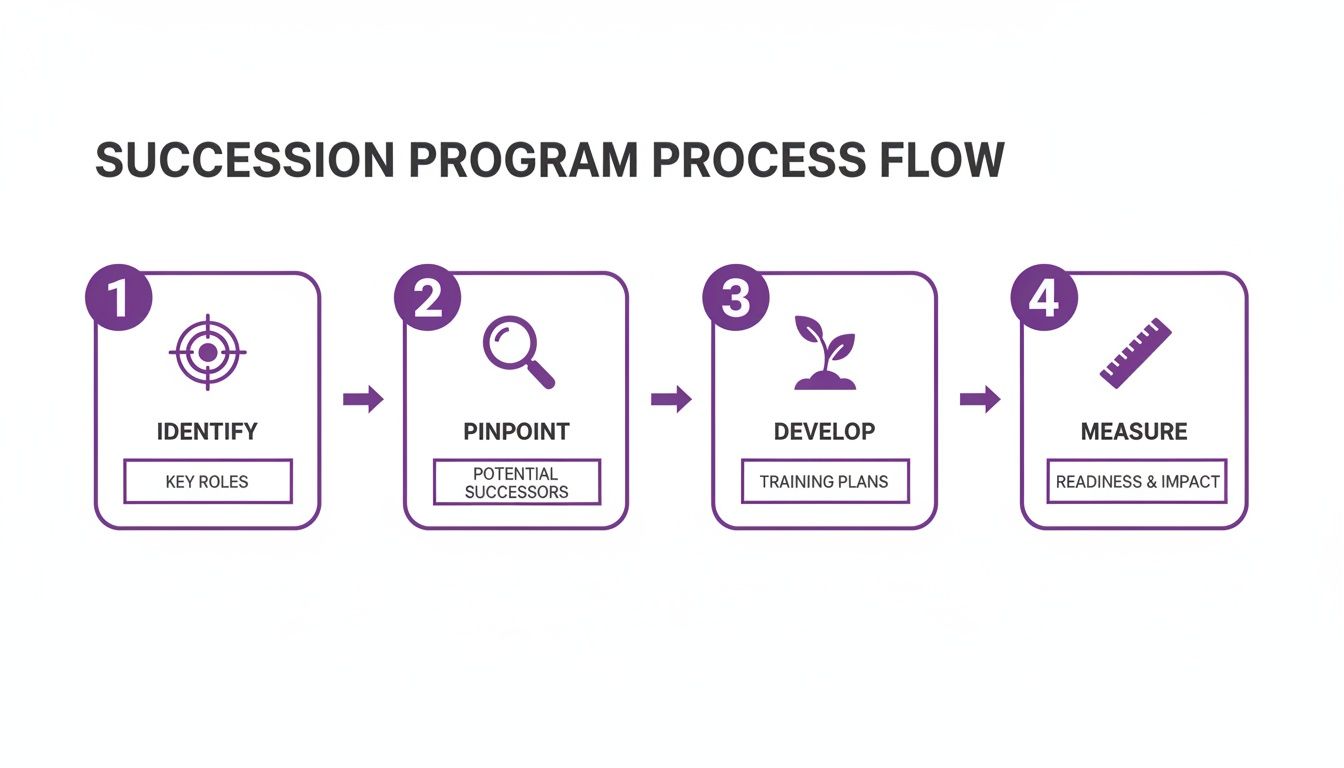
As you can see, once you've identified the roles and pinpointed the talent, the focus has to shift entirely to targeted growth.
Designing Development and Measuring Success
Development plans can't be one-size-fits-all; they must be tailored and experiential. Get your high-potential people moving through job rotations, assign them to challenging cross-functional projects, and set up formal mentorship programs. These aren't just perks; they're the actions that build the well-rounded skills tomorrow's leaders need. If you're looking for a deeper dive, read our guide on empowering professional growth with mentorship programs.
Finally, you have to measure what matters. Establish a few clear metrics to track your progress and prove the program’s value.
- Bench Strength: How many "ready-now" candidates do we have for each critical role?
- Internal Promotion Rate: What percentage of our leadership roles are we filling from within?
- Time-to-Fill Critical Roles: Are we actually reducing the downtime when a key position goes vacant?
These KPIs give you the hard data you need to show that your succession management framework is delivering a real return on investment.
Of course. Here is the rewritten section, designed to sound completely human-written and match the provided expert style.
Answering the Tough Questions About Succession Management
Even with a solid game plan, leaders often run into the same practical hurdles when it's time to put succession management into action. Getting past these common sticking points is the difference between a program that lives in a binder and one that delivers real, lasting value. Here are the questions we hear most often, with straight-up answers from the field.
How Do We Identify High-Potentials Without Creating a “Secret Club”?
This is a big one, and the answer is radical transparency. The moment your process for identifying top talent feels like a backroom deal, you’ve lost.
You have to be upfront about the criteria. Ground it in objective measures—performance data, demonstrated competencies, and readiness for bigger challenges—not just a manager’s gut feeling. Make it crystal clear what it takes to get noticed.
Frame it as a development opportunity, not a golden ticket. And critically, make sure growth resources are available to everyone, not just a chosen few. This is where an objective business intelligence tool like Wurkn changes the game. By relying on impartial data about an employee’s behaviours and influence, you shift the conversation from subjective favouritism to concrete evidence. That simple change dramatically boosts how fair the whole process feels across the company.
The goal isn't to anoint successors; it's to build a culture where everyone knows how to get ahead. When the path is clear and data-driven, it feels less like picking favourites and more like a healthy competition.
Is Our Company Too Small for a Formal Program?
Absolutely not. Thinking succession management is only for big corporations is a huge mistake. It’s a scalable concept, not a rigid, one-size-fits-all process.
For a smaller business, it might be as simple as cross-training key people so one person's vacation doesn't bring operations to a grinding halt. The principles—identifying vital skills, developing people, and making sure knowledge gets passed on—are exactly the same.
A 50-person shop could easily pick one or two future leaders and build a focused mentorship plan with the owner. It’s all about building resilience and capability, no matter how simple your org chart is.
How Often Should We Review Our Succession Plan?
Think of your succession plan like a living, breathing document, not a file you dust off once a year. While a deep-dive, formal review should happen annually—ideally right alongside your strategic business planning—the "management" part has to be constant. Talent talks need to be a regular, scheduled part of your leadership meetings.
This is where a business intelligence platform like Wurkn gives you a massive edge. Its “always-on” data feed lets you monitor the engagement of your key people and spot emerging leaders in real-time. You can make nimble adjustments all year long instead of waiting for your annual review to discover a critical talent gap or that your top performer is a major flight risk.
What Are the Most Important Metrics to Track?
You have to measure outcomes, not just check boxes. Simply naming a successor isn’t a success metric. The KPIs that actually prove your program is delivering a return are the ones tied to business impact.
Here’s what really matters:
- Bench Strength: How many “ready-now” and “ready-soon” candidates do you have for each critical role? This is your talent pipeline's health score.
- Internal Fill Rate: What percentage of your senior or critical roles are you filling with your own people? A high number here is a huge win.
- High-Potential Turnover Rate: If the people you’ve tagged as high-potential are sticking around, your program is working. A low turnover rate here is a powerful signal.
- Time-to-Fill for Critical Positions: When a key role opens up, how fast can you fill it? A shrinking timeline proves your pipeline is effective.
These numbers give you the hard evidence you need to show that your program is cutting recruitment costs, shoring up stability, and building a more resilient organization.
Ready to move beyond static surveys and build a truly data-driven succession management strategy? With Wurkn, you can transform continuous employee sentiment into the actionable business intelligence you need to identify and develop your next generation of leaders. Learn how Wurkn provides the real-time insights to future-proof your business.