
Company values are the heartbeat of your organization. Values in companies are the fundamental beliefs and guiding principles that dictate how an organization and its people behave. More than just words, they are the internal compass that steers every decision, shapes the workplace culture, and defines the company's identity to both employees and customers.
Beyond the Plaque on the Wall

Too often, company values are treated like decorations—nicely framed words like "Integrity" or "Innovation" that hang in a lobby but have little connection to the daily grind. This is a common challenge for businesses across Canada and the United States, and it’s a costly one.
This guide is designed to move your organization beyond that superficial approach. We'll show you how to transform your values from a forgotten plaque into your company's core operating system.
Think of your values as the rudder on a ship. This rudder is the unseen mechanism that guides the entire vessel, keeping it on course through both calm seas and turbulent storms. Without a functional rudder, the ship drifts aimlessly, pushed around by external forces. Similarly, without deeply embedded values, a company loses its direction, reacting to market pressures instead of proactively navigating toward its goals.
The Disconnect Between Stated and Lived Values
The problem many leaders face is a significant gap between their declared values and the reality of their workplace culture. It's a disconnect that breeds cynicism and disengagement.
In fact, Gallup research has shown that a mere 23% of U.S. employees strongly agree that they can apply their organization's values to their work every day (Gallup, 2021). That’s a massive miss.
When a company preaches "collaboration" but rewards individual heroics, or champions "work-life balance" while celebrating late-night emails, employees notice. This hypocrisy erodes trust and makes the value statements meaningless. The challenge is making values a tangible, measurable, and living part of the organization.
"Company culture is what it feels like to work somewhere—the energy, the habits, the way people show up. Company core values are what guide that culture. They’re the beliefs behind the behaviors." – Achievers
To make values more than just words on a poster, leaders need a way to shift them from a static decoration to a dynamic, functional part of the business.
From Wall Plaque to Operating System
| Aspect | Traditional Approach (The Wall Plaque) | Strategic Approach (The Operating System) |
|---|---|---|
| Creation | Top-down decision by leadership in a boardroom. | Collaborative effort involving input from all levels. |
| Purpose | To look good for marketing and recruiting materials. | To guide daily decision-making and behaviour. |
| Measurement | Not measured. Assumed to be "working." | Continuously measured against real-world behaviours. |
| Integration | Isolated in an HR manual or on a wall. | Embedded in hiring, performance reviews, and promotions. |
| Impact | Minimal. Often creates cynicism if not followed. | Drives culture, improves retention, and boosts performance. |
This shift from a "Wall Plaque" to an "Operating System" is the key to unlocking the true business potential of your values. It's about moving from aspiration to activation.
Making Values a Measurable Asset
To close this gap, modern leaders need more than gut feelings or infrequent feedback. This is where a business intelligence tool like Wurkn provides a distinct advantage over traditional HR survey tools. Instead of relying on static, once-a-year employee engagement surveys that only capture a snapshot in time, Wurkn offers continuous, privacy-preserving business intelligence.
By analyzing anonymized communication and work patterns, Wurkn provides a real-time dashboard of your cultural health. It helps you see if your values are truly alive in daily interactions, allowing you to move from simply stating your values to actively steering your culture with data-driven confidence.
The True ROI of a Values-Driven Culture
Let's be clear: investing in company values isn't some fluffy, feel-good initiative. It’s a hard-nosed business decision with a compelling and measurable return on investment.
When your values are actually lived and breathed—not just printed on a poster—they directly influence the KPIs that every leader obsesses over, from revenue growth to operational efficiency. In the tight talent markets of Canada and the United States, a strong, values-driven culture is one of the few sustainable competitive advantages you can build.
Think of your values as the invisible hand guiding how your teams innovate, collaborate, and serve customers. They create consistency and predictability, connecting the strength of your culture directly to your financial results.
From Cultural Concepts to Concrete KPIs
The real magic happens when you can draw a straight line from a cultural principle to a business metric. This is how you demystify the "soft stuff" and start speaking the language of results that COOs and executives understand.
Take a core value like ‘Customer Obsession.’ That’s not just a nice slogan; it’s an operational mandate. It translates into specific, observable behaviours: proactive outreach, deep listening on support calls, and prioritizing features that solve real pain points. The business impact? Higher Net Promoter Score (NPS), increased customer lifetime value, and lower churn rates. You can literally track the connection on a dashboard.
Or consider a value like ‘Radical Candor.’ This encourages open, direct, and respectful feedback. In practice, teams can spot and solve problems in days instead of weeks, cutting through the ambiguity and office politics that kill momentum. The result is a measurable reduction in project timelines and a faster speed-to-market.
When your values are clear, your decisions become easy. They become the filter you use to evaluate opportunities, hire candidates, and manage performance. This alignment creates an organizational momentum that is incredibly difficult for competitors to replicate.
The Financial Impact of High Retention
One of the most immediate financial wins from a strong, values-aligned culture is talent retention. It’s simple: when people feel a genuine connection to the company’s purpose and principles, they stay. They grow. And they do their best work. This is especially true across North America, where skilled professionals have endless options.
Recent Canadian retention trends show that a positive workplace culture—rooted in values like fairness, psychological safety, and well-being—is a more powerful loyalty driver than a bigger paycheque. High-trust organizations see dramatically lower voluntary turnover. The research is undeniable, showing that companies with top-quartile cultures can see significant outperformance in key business metrics. Learn more by reading the full research on greatplacetowork.ca.
This link between values and retention has a massive impact on your bottom line. Every employee you keep is a huge expense you avoid in recruitment, hiring, and training. To see just how much is at stake, you need to calculate the true cost of employee turnover and understand how a values-driven culture directly protects your budget.
Measuring What Matters Most
For years, the impact of culture was hard to quantify. We relied on infrequent annual surveys that gave us a delayed, incomplete snapshot of reality. That’s no longer good enough.
This is where modern business intelligence tools are changing the game.
Platforms like Wurkn move way beyond traditional employee engagement platforms. They provide continuous, privacy-preserving insights into whether your values are truly being lived out day-to-day. By translating anonymous, aggregated feedback into a real-time dashboard, leaders can finally see the direct connection between cultural health and business performance.
When you can see these dynamics as they happen, you can make informed, proactive decisions to strengthen your culture—ensuring your values deliver a tangible and sustained return on investment. This sets the stage for why measurement is absolutely non-negotiable for any modern business.
How to Define and Activate Your Company Values
Let’s be honest: defining your company values isn’t a one-day workshop for the executive team. It’s more like an archaeological dig into the heart of your organization. You’re uncovering what already makes you successful, then building a plan to make those winning behaviours intentional and widespread.
Creating values that actually stick requires a thoughtful, collaborative process that goes way beyond top-down mandates. The most effective values aren't aspirational fantasies; they are authentic reflections of the best parts of your current culture, just codified and amplified. This is your playbook for moving from abstract ideas to tangible, everyday actions. We'll walk through a clear, three-step framework that ensures your values become a lived reality, not just words on a wall.
Step 1: Discover and Uncover Your DNA
Before you can define your values, you have to discover them. Chances are, they’re already there, hiding in plain sight. They live in the unspoken rules and behaviours that your most successful teams and individuals show up with every single day. The whole point of the discovery phase is to pinpoint these authentic cultural traits.
Start by asking the right questions to a real cross-section of your team—not just the leadership.
- Think about a time you felt incredibly proud to work here. What happened?
- Who are the people who consistently succeed, and what behaviours do they share?
- What is the one thing you would never want to change about how we work together?
By gathering these stories and examples, you’ll start to see patterns emerge. Maybe you'll notice a recurring theme of relentless problem-solving, or a deep-seated commitment to helping colleagues get unstuck. These patterns are the raw material for your company values.
Step 2: Define and Craft Actionable Statements
Once you’ve identified these core behaviours, the next step is to translate them into clear, memorable, and actionable value statements. This is where a lot of companies stumble, opting for generic, single-word values like "Excellence" or "Integrity." While the intention is good, these words are just too broad to guide specific actions.
Your value statements should act as a clear filter for decision-making. A great test is whether an employee, faced with a tough choice, could use a value to decide on the right course of action without needing to ask a manager.
To avoid this trap, craft value statements that describe a behaviour. For instance, instead of "Innovation," try "Challenge the Status Quo with Curiosity." Instead of "Teamwork," consider "Succeed and Fail as One Team." These statements aren't just more inspiring; they provide a much clearer benchmark for what’s expected.
This process transforms your culture from an accidental byproduct into an intentional design. For more on this, check out our guide on how to improve company culture with deliberate strategies.
Step 3: Activate and Weave Values into Your Operations
This is the most critical and ongoing step of all. Definition without activation is meaningless. To truly activate your values, you have to systematically embed them into every part of your organization’s operating system—from hiring and onboarding to performance management and promotions. This is how you make sure values in companies become more than just a poster on the wall.
Here’s how to bring your values to life across key business functions:
- Hiring and Interviewing: Build behavioural interview questions based on each value. For a value like "Build with Curiosity," you could ask a candidate, "Tell me about a time you had to learn a new skill quickly to solve a problem. What was your process?"
- Onboarding: Dedicate a real chunk of your onboarding program to explaining the company values through storytelling. Share concrete examples of how current employees have lived these values to solve real business challenges.
- Performance Reviews: Structure your performance conversations around the values. Don’t just assess what an employee achieved, but how they achieved it. Did their actions line up with the company’s guiding principles?
- Recognition and Rewards: Publicly celebrate employees who are a living example of your values. This reinforcement is powerful and shows the entire organization what behaviours are truly prized.
- Promotions and Leadership: Make values alignment a non-negotiable for anyone moving into a leadership role. Your leaders have to be the most visible and consistent champions of your culture.
Activating values isn't a one-time project; it requires continuous effort and measurement. This is where a business intelligence tool like Wurkn provides the feedback loop you need, offering privacy-preserving insights to see if these embedded values are genuinely taking hold. Unlike traditional surveys, Wurkn helps you understand in real-time whether the behaviours you’ve defined are becoming the daily norm, giving you the data to nurture and protect the culture you’ve worked so hard to build.
Measuring the Unseen Forces of Your Culture
For too long, leaders have treated culture like the weather—something you talk about but can't really control. But in business, if you can't measure it, you can't manage it. And you certainly can't prove its ROI. The biggest hurdle for most COOs and PeopleOps leaders is getting past gut feelings and lagging indicators to get a real-time pulse on their company's health.
Think about the annual employee engagement survey. It’s a classic example of a well-intentioned tool that’s just not up to the job anymore. It gives you a snapshot that’s often months out of date by the time you've crunched the numbers. It’s like trying to navigate a ship using a map from last year; you know where you were, but you have no idea where you are right now.
Moving Beyond Lagging Indicators
To really manage your values in companies, you need to stop looking in the rearview mirror and start watching the road ahead. This means shifting to real-time, continuous business intelligence that picks up on the subtle, unseen forces shaping your culture every single day.
This is where a business intelligence platform like Wurkn is fundamentally different from a typical HR survey tool. It's not another survey for your team to fill out. Instead, Wurkn operates as a cultural intelligence engine, delivering continuous, privacy-preserving insights pulled from the natural flow of daily work.
By analyzing anonymized communication patterns, Wurkn’s technology can surface aggregated insights that show whether values like 'collaboration' or 'inclusivity' are actually being lived out. It finally answers the critical question: are the behaviours we say we value showing up in how our teams actually work together?
This process graphic breaks down how you take values from an idea on a wall to a living, breathing part of your operations.
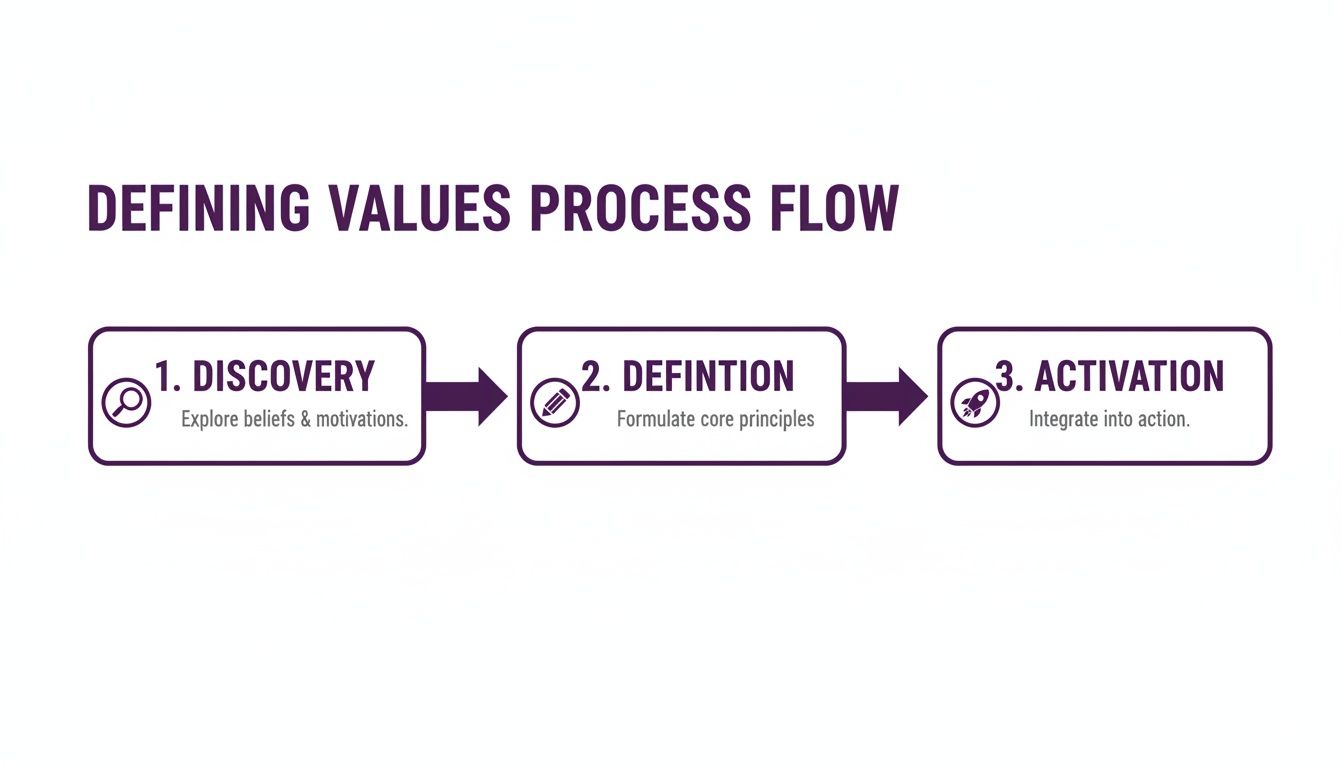
The journey from Discovery to Activation makes it clear: defining your values is just the starting line. The real work is in making them a measurable and active part of your organization's DNA.
Connecting Values to Tangible KPIs
The real power of measuring culture this way is connecting those behavioural insights to hard Key Performance Indicators (KPIs). This is how you translate the "soft" idea of culture into the cold, hard data that drives executive decisions. You're drawing a straight line from a core value to a business outcome.
Here’s what that looks like in the real world:
- Value: Bias for Action
- Behaviours to Measure: How quickly do people respond in project channels? How long does it take to go from identifying a problem to proposing a solution? How often are people making proactive suggestions?
- KPIs Impacted: Reduced decision-making cycle time, faster project completion rates, increased speed-to-market for new features.
Or take a value like Unwavering Integrity. It seems abstract, right? But you can measure it through communication patterns around compliance, how ethical concerns are raised, and the level of transparency in reporting. This can then be tied directly to KPIs like reduced compliance risk or higher client trust scores.
Measuring culture isn't about monitoring individuals. It's about understanding systemic patterns to see if your organizational operating system is running as designed. Privacy-preserving technology is essential to building the trust required for this to work.
Gaining Data-Driven Confidence
Tools like Wurkn give leaders dashboards that visualize these connections, turning anecdotal stories into actionable data. When a COO can see a direct correlation between a dip in collaborative behaviours and a slowdown in a key project's velocity, they can step in with confidence. They're no longer guessing; they're diagnosing a specific issue based on real-time evidence.
This continuous feedback loop is worlds more effective than relying on static survey data, which only ever tells you part of the story. Once you start to accurately measure company culture, you gain the power to make small, proactive adjustments before minor cultural misalignments snowball into major business problems.
This shift from reactive firefighting to proactive culture-shaping is what separates good companies from great ones. By measuring the unseen forces, you finally gain the ability to manage them, ensuring your values consistently translate into superior business performance.
Real-World Examples of Values Driving Success
Theory is one thing, but seeing values drive real-world results is where it all clicks. Let's move from frameworks to the floor and look at a couple of logical examples from organizations across North America. These stories show how specific, deeply embedded values create a powerful competitive edge and tangible business outcomes.
For each one, we'll connect a core value to the behaviours it fuels, the operational systems that lock it in, and the bottom-line results it produces. This should make the whole concept of activating values in companies much more concrete.
The Financial Firm Built on Unwavering Integrity
Picture a financial services firm navigating the tight regulations of Toronto and New York. Their cornerstone value isn't just a nice phrase on a poster; it's their entire operational blueprint: "Unwavering Integrity."
This single value shapes everything. Their compliance process isn’t about just meeting the legal minimums; it's built to proactively shield client interests. It's hardwired into their hiring, where every candidate is screened for their ethical compass. Most critically, it gives every employee the power to raise a red flag without fearing comeback, which builds a culture of genuine psychological safety.
The results are impossible to ignore:
- Industry-Leading Trust: They boast top-tier client retention rates and Net Promoter Scores (NPS) because their clients simply feel safe.
- Reduced Regulatory Risk: Their proactive stance slashes the odds of facing costly compliance breaches and painful investigations.
- Talent Magnet: The best financial minds flock to them, eager to work somewhere that doesn't just talk about ethics but lives them.
The Tech Startup Thriving on Embracing Ambiguity
Now, let's pivot to a fast-scaling tech startup in a brutal market. Their secret weapon is a simple but powerful value: "Embrace Ambiguity." In an industry where the ground shifts every quarter, this isn't just a mindset—it's a survival mechanism that breeds incredible agility.
This value translates into a culture where teams are expected to experiment, fail fast, and pivot without needing perfect information. Project management is fluid, not rigid. Cross-functional collaboration is the default setting. Leaders don't pretend to have all the answers; they model comfort with uncertainty. Instead of getting bogged down in long-term roadmaps, they operate in quick, adaptive sprints.
This is exactly how smaller, nimbler companies consistently outmanoeuvre their bigger, more bureaucratic competitors. They take the very uncertainty that paralyzes others and turn it into their biggest strategic weapon.
Their metrics tell the story. The company launches new features faster than anyone else, grabbing market share by responding to user needs in almost real-time. This is a direct payoff from operationalizing their core value. For businesses in Canada, this isn't a new idea. Take Ipsos Canada, named one of Canada’s Most Admired Corporate Cultures—a testament to how values like integrity and curiosity directly fuel high performance. You can read more about their award-winning culture on ipsos.com.
These examples prove that when values are truly woven into your operational DNA, they create measurable, hard-nosed success. But you can't just assume they're working. You need to verify. This is where business intelligence tools like Wurkn come in. By providing continuous, privacy-preserving insights, leaders can finally see if the behaviours tied to their values are actually happening day-to-day, closing the gap between the culture they've designed and the one they actually have.
Common Traps on the Path to a Thriving Culture
Defining your values is the easy part. The real work—and where most companies stumble—is embedding them into the daily life of your organization without falling into some very common traps.
Even with the best intentions, it's easy to create a set of values that look great on a poster but do nothing to change behaviour. Let’s walk through the mistakes that can turn your culture initiative into a meaningless exercise.
One of the biggest blunders is settling for generic, cliché values. Words like "Excellence," "Integrity," or "Innovation" sound impressive in a boardroom but offer zero real-world guidance. They can mean anything to anyone, which means they end up meaning nothing at all. Great values in companies aren't lofty ideals; they're specific, behavioural, and give every employee a clear filter for making decisions.
The Treacherous "Say-Do Gap"
This is where culture goes to die. The 'say-do gap' is the dangerous chasm between what your company says it values and how it actually operates day-to-day.
When leadership preaches collaboration but only rewards the individual top performers, or champions work-life balance while celebrating 60-hour workweeks, a deep and corrosive cynicism takes root. This isn't just a morale problem; it's a credibility crisis that destroys trust from the inside out.
The data confirms this disconnect is widespread. Research from Gallup shows that only 23% of U.S. employees strongly agree they can apply their organization's values to their work every day (Gallup, 2021). That’s a massive failure of execution, proving that simply posting values on a wall is a recipe for irrelevance.
The smallest inconsistencies between stated values and leadership's actions create the largest cultural divides. Employees have a finely tuned radar for hypocrisy, and once that trust is broken, it's incredibly difficult to earn back.
Inconsistent Reinforcement and Lack of True Buy-In
For values to stick, they have to be woven into the very fabric of your company. Many organizations fail to do this consistently. They might talk about values during onboarding but then conveniently ignore them during performance reviews, promotion decisions, and—most tellingly—when a tough business decision needs to be made. If your values are shelved the moment profits are on the line, they were never truly values to begin with.
Just as damaging is a lack of genuine buy-in from the top. If your executive team isn’t the most visible, consistent champion of the culture, the entire initiative is doomed from the start. Leaders have to model the desired behaviours every single day, proving the values are non-negotiable principles, not just convenient suggestions.
This is precisely where continuous business intelligence becomes your secret weapon. To fight the say-do gap and ensure your values are being reinforced, leaders need real-time data, not just an annual survey. A business intelligence tool like Wurkn provides these kinds of insights, moving far beyond traditional HR tools. By analyzing anonymized communication and work patterns, Wurkn can flag misalignments between your stated values and what’s actually happening on the ground, giving you the intelligence to step in before these gaps poison your culture.
Your Top Questions About Company Values, Answered
When you're in the trenches of running a business, translating the big idea of "company values" into practical action can feel tricky. Leaders and PeopleOps pros across the US and Canada often ask the same smart questions. Here are some straight answers to help you build a culture that actually works.
How Often Should We Revisit Our Company Values?
Think of your values like a strategic plan—they need to be durable but not indestructible. You shouldn't be changing them with every new trend you see on LinkedIn, but they also can't be carved in stone forever.
A good rule of thumb is to give them a serious look every 18-24 months. You'll also want to review them anytime your company goes through a major change, like a merger, a big strategic pivot, or rapid growth that fundamentally changes who you are. This isn't about starting over; it's a gut check to make sure your stated values still ring true for the company you are today and the one you're trying to become.
What Is The Real Role of Leadership in Upholding Values?
It’s simple and non-negotiable: leaders have to be the living, breathing examples of your values. Their job isn’t just to sign off on a list of words; it’s to model those behaviours in every meeting, every email, and especially when the pressure is on.
Leaders are the ultimate guardians of the culture. When their actions align with the stated values, they build trust. When they don't, they create a 'say-do gap' that can erode culture faster than anything else.
Employees are smart; they watch what leaders do, not just what they say. If the executive team lives the values, especially when it’s hard, everyone else gets the message loud and clear about what truly matters.
How Do We Make Values Stick in a Remote or Hybrid Workforce?
Making values feel real for distributed teams is one of the biggest challenges today, but it’s completely solvable if you’re intentional about it. Without a physical office to act as a cultural container, you have to over-communicate and embed your values into your digital operating system.
This means weaving your values into the fabric of daily work:
- Digital Communication: Don't just do your work on Slack or Teams—celebrate wins that exemplify your values in public channels.
- Virtual Meetings: Use your values as the tie-breaker in tough decisions or as a framework for giving feedback on a video call.
- Performance Management: Your performance criteria have to reward how people achieve their goals, not just what they deliver. This is even more critical for remote staff.
For remote and hybrid teams, old tools like the annual survey are useless. Your culture moves too fast and is much harder to see. This is exactly where a business intelligence tool like Wurkn becomes essential. It gives you the continuous, privacy-preserving view you need to understand if your values are actually being lived out across scattered teams. You get the real-time data to nurture and reinforce your culture, no matter where your people are logging in from.
Ready to stop guessing and get a real-time pulse on your company culture? See how Wurkn turns employee sentiment into the actionable intelligence you need to drive real business results. Learn more at Wurkn.com.